BIROn - Birkbeck Institutional Research Online
Berggren, Nick and Eimer, Martin (2016) The guidance of spatial attention
during visual search for colour combinations and colour configurations.
Journal of Experimental Psychology: Human Perception and Performance
42 (9), pp. 1282-1296. ISSN 0096-1523.
Downloaded from:
Usage Guidelines:
Please refer to usage guidelines at or alternatively
1
Running Head: ATTENTIONAL CONTROL IN MULTIPLE-COLOUR SEARCH
The guidance of spatial attention during visual search for colour combinations and colour configurations
Nick Berggren* and Martin Eimer
Department of Psychological Sciences, Birkbeck College, University of London, Malet Street, London WC1E 7HX, UK
* Corresponding author Phone: 0044 20 76316522 Fax: 0044 20 76316312
2 ABSTRACT
Representations of target-defining features (attentional templates) guide the selection of target objects in visual search. We used behavioural and electrophysiological measures to investigate how such search templates control the allocation of attention in search tasks where targets are defined by the combination of two colours or by a specific spatial configuration of these colours. Target displays were preceded by spatially uninformative cue displays that contained items in one or both target-defining colours. Experiments 1 and 2 demonstrated that, during search for colour combinations, attention is initially allocated independently and in parallel to all objects with target-matching colours, but is then rapidly withdrawn from objects that only have one of the two target colours. In Experiment 3, targets were defined by a particular spatial configuration of two colours, and could be accompanied by nontarget objects with a different configuration of the same colours. Attentional guidance processes were unable to distinguish between these two types of objects. Both attracted attention equally when they appeared in a cue display, and both received parallel focal-attentional processing and were encoded into working memory when they were presented in the same target display. Results demonstrate that attention can be guided simultaneously by multiple features from the same dimension, but that these guidance processes have no access to the spatial-configural properties of target objects. They suggest that attentional templates do not represent target objects in an integrated pictorial fashion, but contain separate representations of target-defining features.
3
INTRODUCTION
During visual search, the features of target objects are represented in visual working memory. Such representations have been conceptualised as attentional templates (e.g., Desimone & Duncan, 1995) or top-down task sets (e.g., Folk, Remington, & Johnston, 1992). Search templates are activated prior to the start of a particular search episode, and bias attention towards target-matching visual features (e.g., Olivers, Peters, Houtkamp, & Roelfsema, 2011; Eimer, 2014). In computational models of visual search (e.g., Wolfe, 1994, 2007), attentional templates are implemented as top-down weights. These weights regulate the contribution of signals from different feature channels on the activation profile of a central salience map, which in turn guides the allocation of attention towards particular objects during visual search.
To understand the role of attentional templates in the control of visual search, it is important to determine how information about task-relevant objects is represented in these templates, and how this information then affects the deployment of attention to objects with template-matching features. Numerous studies have investigated how efficiently search templates for one particular target feature (e.g., the colour red) or feature dimension (e.g., colour in general) can guide attention during visual search (see Wolfe & Horowitz, 2004, for a review). However, target objects in real-world search are often defined not just by one specific feature or dimension, but by a particular combination of features from the same or from different dimensions. In such tasks, the allocation of attention has to be controlled by more complex search templates that represent multiple target attributes. In the Guided Search model (Wolfe, 1994, 2007), templates for targets that are defined by a conjunction of features from different dimensions (e.g., red squares) guide attention by biasing template-matching feature channels in different dimensions independently and in parallel. As a result, a target object with all task-relevant features elicits more activation on the salience map than nontarget objects with a single target feature (e.g., green squares or red circles), and is therefore more likely to attract focal attention during visual search. Importantly, Guided Search assumes that search templates represent only a single target attribute within a particular dimension such as colour (Wolfe, 2007). In line with this assumption, template-guided search is inefficient when target objects are defined by a combination of features from the same dimension (e.g., a red and green object; see Wolfe et al., 1990).
4
tasks, visual search displays are preceded by spatially uninformative and task-irrelevant cue displays. In spite of the instruction to ignore them, feature singleton cues with a unique target-matching feature will capture attention, as reflected by faster reaction times (RTs) to subsequent search targets that appear at the same location as the cue relative to target objects at other uncued locations (e.g., Folk et al., 1992; Folk & Remington, 1998). The fact that no such spatial cueing effects are elicited by singleton cues that do not match a currently active attentional template demonstrates that this type of rapid involuntary attentional capture is elicited in a task-set contingent fashion only by objects with target-matching features. Further electrophysiological evidence for this comes from event-related brain potential (ERP) experiments that measured the N2pc component as a marker of attentional selectivity. The N2pc is an enhanced negativity that emerges approximately 200 ms after the onset of a search display over posterior electrodes contralateral to the visual field of objects with features that match the current search template, and is assumed to reflect the allocation of spatial attention to these objects (e.g., Eimer, 1996; Luck & Hillyard, 1994). In line with task-set contingent attentional capture (Folk et al., 1992), template-matching colour singleton cues (e.g., red singleton cues during search for red targets) trigger N2pc components, while nonmatching cues do not (e.g., red singleton cues during search for blue targets or small targets; e.g., Eimer & Kiss, 2008; Leblanc, Prime, & Jolicoeur, 2008; Lien, Ruthruff, Goodin, & Remington, 2008). The presence of an N2pc to template-matching but task-irrelevant objects shows that these objects capture attention at a relatively early stage of visual-perceptual processing. Analogous behavioural and electrophysiological attentional capture effects have also been found when template-matching colour cues appear among other coloured items in heterogeneous cue displays, demonstrating that objects do not need to be perceptually salient singletons in order to attract attention in a task-set contingent fashion (Eimer, Kiss, Press, & Sauter, 2009; Lamy, Leber, & Egeth, 2004).
5
such effects were elicited by non-matching cues, suggesting that other colours were successfully excluded from the currently active search templates. This was the case even when matching and non-matching cues were not linearly separable in colour space. Irons et al. (2012) interpreted these findings as evidence that observers can adopt a simultaneous task set for two different colours (see also Christie, Livingstone, & McDonald, 2015; Grubert & Eimer, in press, for N2pc evidence in support of this conclusion).
The results of Irons et al. (2012) challenge claims that search templates can only represent one feature in a particular dimension at any given time (e.g., Wolfe, 2007). However, it is important to note that individual search targets used in this study were always defined by one particular feature (e.g., they were either red or green objects). If attentional templates can represent multiple target features simultaneously, how do these templates control the allocation of attention in search tasks where target objects are defined by a combination of these features? In a previous study, Kiss, Grubert, and Eimer (2013) employed spatial cueing procedures to address this question. Participants searched for targets defined by a specific colour-size combination (e.g., a small red object). Search displays were preceded by spatially uninformative cue displays that contained a singleton item that matched both, one, or none of the two target-defining features. Behaviourally, spatial cueing effects indicative of attentional capture were found for fully matching cues but not for cues that only matched one of the two target attributes, indicating that partially template-matching objects failed to attract attention. This suggests that attentional templates for conjunctively defined targets can guide attention efficiently and selectively only to objects that match all target features, without any additional allocation of attention to only partially template-matching objects. However, the pattern of N2pc results obtained in response to cue displays in the same study suggested a different interpretation. Reliable N2pc components were triggered not only by fully target-matching cues but also by partially matching cues, demonstrating that task-set contingent attentional capture was not restricted to objects with all target-defining features.
6
displays are processed. In contrast, fully matching cues produce spatial cueing effects because attention remains focused at their location during the time when the search display is processed (see also Eimer & Grubert, 2014, for further electrophysiological support for this two-stage account of attentional object selection).
In this previous experiment (Kiss et al., 2013), search targets were specified by a conjunction of features from two different dimensions (colour and size). The goal of the present study was to investigate the time course of template-guided visual search for a feature combination from the same dimension (colour). Does attentional selectivity also operate in two temporally distinct stages when observers search for targets that are defined by a specific combination of two colours? There are two different ways in which such colour-colour conjunction search targets can be specified. One possibility is to ask observers to search for objects with two target-defining colours that appear together with nontarget objects that can
have one of these two target colours (colour combination search). Another possibility is to
define search targets with respect to a specific spatial configuration of two colours (e.g.,
objects with a red top half and green bottom half). In such colour configuration search tasks,
these targets can appear together with nontarget objects that have both target-defining colours, but in a different spatial configuration (e.g., green above red). Experiments 1 and 2 of the current study investigated the template-guided attentional selection of targets during colour combination search. In Experiment 3, we studied attentional control processes during colour configuration search.
In Experiment 1, participants searched for horizontally or vertically oriented target rectangles that were defined by a combination of two colours (e.g., red and green). In all search displays, a target appeared among three nontarget objects that each contained one of the two target colours (e.g., red/blue, green/brown, red/magenta). Search displays were preceded by irrelevant and spatially uninformative cue displays (Figure 1, top panel). There were three different cue display types. In “Full among No Match” cue displays, one item with both target-matching colours appeared together with three items that each had two different nontarget colours. In “Partial among No Match” displays, one of the four cue items contained one of the two target colours and was presented among three items with two nonmatching colours. In “Full among Partial” cue displays, one item with both target colours was accompanied by three other items that each matched one of the two target colours.
7
also measured spatial cueing effects as behavioural markers of task-set contingent attentional capture, separately for the different cue display types. If attention is initially allocated independently to all objects with target-matching features, but is then rapidly withdrawn from objects that only partially match a conjunctive target template, Experiment 1 should reveal similar dissociations between electrophysiological and behavioural markers of attentional capture that were previously found during search for colour/size targets (Kiss et al., 2013). Behavioural spatial cueing effects should be elicited by cue displays that contain a fully target-matching item (Full among No Match and Full among Partial displays), but not for Partial among No Match cue displays. In contrast, N2pc components should be present not just for cue displays with a fully target-matching item, but also by cue displays with one partially matching and three nontarget-colour items, demonstrating that both fully and partially target-matching colour cues are able to rapidly attract attention.
Full among Partial cue displays (where one fully target-matching item was accompanied by three partially matching items) were included in Experiment 1 to test whether attention is initially allocated independently and in parallel to multiple target-matching colours in the same display. If this was the case, both fully and partially target-matching cue items in these displays should attract attention and thus elicit N2pc components. Because two of the three partially matching items appear on the opposite side to the fully target-matching cue item (and thus trigger N2pc components of opposite polarity), the net N2pc elicited by Full among Partial cues should be smaller than the N2pc to Full among No Match cue displays, which include no competing partially matching items. If attention is then rapidly withdrawn from all partially matching items, the presence of these items in Full among Partial cue displays should not affect responses to subsequent search display targets. As a result, behavioural spatial cueing effects should not differ between Full among No Match and Full among Partial cue displays.
8
EXPERIMENT 1
Method
Participants
Fifteen participants were paid to take part in the study. All had normal or corrected-to-normal vision. One participant was excluded from analysis due to error rates in the task over 3 SDs from group mean. Of the remaining 14 participants, five were male and three were left-handed (mean age = 28 years, SD = 7).
Stimuli and Procedure
The experiment was created and executed using the E-Prime 2.0 software (Psychology Software Tools, Inc.), presented on a 24-inch BenQ monitor (60Hz; 1920 x 1080 screen resolution) at a viewing distance of approximately 90cm, and controlled on a SilverStone computer PC. Participants’ manual responses were registered via keyboard button presses. All stimuli were presented on a black background, with a grey fixation dot (0.2° x 0.2° of visual angle) appearing constantly throughout a block. On each trial, a cue display was followed by a target display (see Figure 1, top panel). Cue displays contained four clusters of four small coloured squares that appeared in the upper left, upper right, lower left, and lower right quadrant at a distance of 1.59° from central fixation. Each cluster measured 0.64° x 0.64°, with each square measuring 0.19° x 0.19°. The four squares within each cluster always appeared in two different colours. The upper and lower square had the same colour, and the left and right squares shared another colour. Possible cue colours were red (CIE colour coordinates: .605/.322), green (.296/.604), blue (.169/.152), magenta (.270/.134), and brown (.451/.364). Target displays included four horizontally (1.8° x 0.8°) or vertically (0.8° x 1.8°) oriented rectangles that appeared at the same locations as the four cue clusters. Each rectangle was composed of two aligned equally sized squares in two different colours. The possible colours used in target displays were the same as the cue display
colours. All colours were equiluminant (14 cd/m2).
9
for a rectangle composed of two pre-defined colours (e.g., red and green) in each target display, and to respond to its orientation. The specific combination of the two target-defining colours was randomised across participants. Target displays always contained one target object with both target-defining colours, and three distractor objects that had one of the two target colours and another randomly selected nontarget colour. Two of the four rectangles in the target displays were oriented vertically and the other two horizontally. For both target and distractor objects, the relative locations of the target-matching colours (above/below; left/right) varied randomly across trials. The location and orientation of the target rectangle was also selected randomly for each trial. Participants were instructed to press the ‘0’ or ‘2’ key on the numeric keypad with their right index and middle finger within a 1500 ms time window in response to horizontal or vertical targets, respectively. The interval between the offset of the target display and the onset of the cue display on the next trial was 1950 ms.
Target displays were preceded by one of three different types of cue displays. In “Full among No Match” cue displays, the two colours of one of the four cue items matched the two target colours (e.g., red and green, as illustrated in Figure 1, top panel), while the other three items appeared in randomly selected combinations of two nontarget colours (e.g., blue and magenta). In “Full among Partial” displays, one cue item had both target-defining colours, and the other three matched one of these colours (e.g., red and blue). In “Partial among No Match” displays, one of the cue items matched one of the two target colours, while the other three had two randomly selected nontarget colours. These three cue display types each appeared in 32 randomly interspersed trials in every block. The fully target-matching cue item or the partially matching item (in Partial among No Match cue displays) was equally likely to appear in the left or right visual field. There were two trials for each of the 16 possible combinations of matching cue location and target location for each cue type. The location of fully or partially target-matching items in these cue displays was therefore not predictive of target location in the subsequent target display. Participants completed an initial practice block of 12 trials before completing 8 experimental blocks of 96 trials.
10
EEG Recording and Data Analysis
EEG was DC-recorded from 27 scalp electrodes, mounted on an elastic cap at sites Fpz, F7, F8, F3, F4, Fz, FC5, FC6, T7, T8, C3, C4, Cz, CP5, CP6, P9, P10, P7, P8, P3, P4, Pz, PO7, PO8, PO9, PO10, and Oz. A 500-Hz sampling rate with a 40 Hz low-pass filter was used. Channels were referenced online to a left-earlobe electrode, and re-referenced offline to an average of both earlobes. No other filters were applied after EEG acquisition. Trials with eye-movement (exceeding ±30 µV in the HEOG channels), eye blink (exceeding ±60 µV at Fpz) and muscle movement artifacts (exceeding ±80 µV at all other channels) were rejected, as were trials with incorrect responses. The remaining trials were segmented into epochs from 100ms before prior to 500ms after cue display onset. Averaged ERP waveforms were computed for each type of cue display, separately for trials where the fully matching cue or partially matching cue (in Partial among No Match cue displays) appeared on the left or right side. N2pc amplitudes were quantified based on ERP mean amplitudes obtained between 220 and 320 ms after cue display onset at posterior electrode sites PO7 and PO8. N2pc onset latencies were determined by assessing grand averaged difference waveforms (contralateral minus ipsilateral ERPs) using a jackknife-based analysis method (Miller, Patterson & Ulrich, 1998). Fourteen subsamples of grand-averaged difference waves were computed, each excluding a different participant from the original sample. Onset latencies were determined as the point in time when each of these subsample waveforms reached an absolute threshold of
-0.5 V. They were compared between cue display types using paired t-tests with t-values corrected according to the formula described by Miller et al (1998).
Results
Behavioural Data
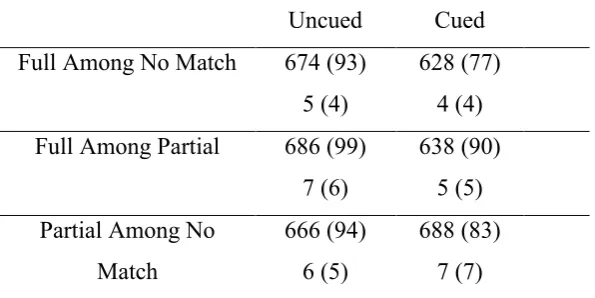
Reaction time (RT) data (shown in Table 1) were entered into a 3x2 repeated-measures ANOVA with the factors Cue Type (Full among No Match, Full among Partial, Partial among No Match) and Cue Validity (target at cued versus uncued location). There was a main effect of Cue Validity (F(1,13) = 21.19.69, p < .001, ηp2 = .62), as RTs were
generally faster in response to targets at cued versus uncued locations (M = 651 vs. 676 ms).
11
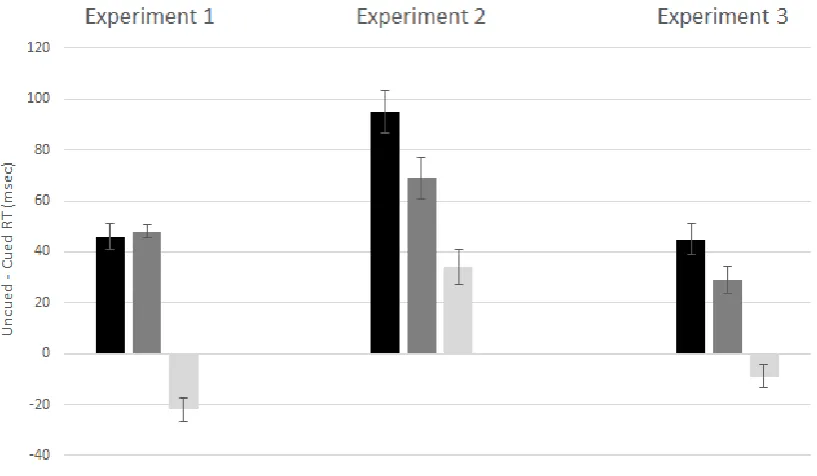
.68) demonstrated that these spatial cueing effects differed across the three types of cue displays. This is illustrated in Figure 2 (left panel), which shows spatial cueing effects (RTs to targets at cued versus uncued locations) separately for each of the three cue display types. The reliability of the spatial cueing effects triggered by each cue type was assessed with planned paired sample t-tests. Significant spatial cueing effects were present for Full among
No Match cues (46 ms; t(13) = 4.84, p < .001) and Full among Partial cues (48 ms; t(13) =
9.07, p < .001). The size of these cueing effects did not differ between the two cue types (t <
1). In contrast, there was a reliable inverse spatial cueing effect for Partial among No Match
cues (-22 ms; t(13) = 2.45, p < .03). There was also a main effect of Cue Type (F(2,26) =
10.49, p < .001, ηp2 = .45), reflecting overall RT differences between trials where targets
were preceded by Full among No Match cues, Full among Partial cues, or Partial among No Match cues (651 ms, 662 ms, and 667 ms, respectively). For error rates (shown in Table 1),
there were no main effects of Cue Type (F(2,26) = 2.15, p > .10), or Cue Validity (F(1,13) =
2.61, p > .10), and no interaction between these factors (F < 1).
--- Insert Table 1 and Figure 2 about here
---
N2pc components to cue displays
Figure 3 (top panel) shows ERPs measured in response to the three different cue display types at electrodes PO7/8 contralateral and ipsilateral to fully target-matching cues or partially matching cues (for Partial among No Match cue displays). N2pc components appeared to be present for all three types of cue displays, but the size of these N2pcs differed between display types. This is illustrated in Figure 3 (bottom panel), which shows N2pc difference waveforms that were computed by subtracting ipsilateral from contralateral ERPs, separately for each cue type.
To assess the size of N2pc components elicited by the three different cue types, mean amplitudes obtained in the 220 to 320 ms post-stimulus time window were entered into a 3x2 repeated-measures ANOVA with the factors Cue Type (Full among No Match, Full among Partial, Partial among No Match) and Laterality (electrode ipsilateral versus contralateral to
the fully or partially target-matching cue item). A main effect of Laterality (F(1,13) = 12.74,
12
μV). There was no main effect of Cue Type (F(2,26) = 2.10, p > .10). Importantly, a two-way interaction between Cue Type and Laterality (F(2,26) = 13.76, p < .001, ηp2 = .51)
demonstrated that N2pc amplitudes differed between the three different types of cue display (see Figure 3). Follow-up analyses conducted separately for each cue type revealed reliable
N2pc components for all three types of cue displays (t’s > 3.34, p’s < .01). The N2pc elicited
by Full among No Match cue displays was significantly larger than the N2pcs to Full among
Partial displays (M diff = -1.17 vs. -.77 μV; t(13) = 3.39, p < .01) and to Partial among No
Match displays (M diff = -1.17 vs. -.39 μV; t(13) = 4.25, p < .01). In addition, the N2pc triggered by Full among Partial displays tended to be larger than the N2pc in response to
Partial among No Match displays (t(13) = 2.76, p < .02).
--- Insert Figure 3 about here ---
To compare the onset latency of N2pc components to Full among No Match cue displays Full among Partial displays, a jackknife-based procedure was employed, using an
absolute onset criterion of -0.5 μV. Even though the N2pc emerged slightly earlier in
response to Full among No Match displays, this onset latency difference was not significant (M = 225 vs. 237 ms; tc(13) = 2.0, p = .067).1
--- Insert Figure 4 about here ---
Discussion of Experiment 1
The results of Experiment 1 provide strong support for a two stage-model of attentional object selection during visual search for conjunctively defined targets. As in an
1 Given the small size and gradual onset of the N2pc to Partial among No Match cue
13
earlier spatial cueing study with colour-size targets (Kiss et al., 2013), we found a clear dissociation between electrophysiological and behavioural markers of attentional capture during search for targets defined by a colour-colour combination. Reliable N2pc components were triggered not only by Full among No Match cue displays but also by Partial among No Match cues, demonstrating that partially target-matching colour cues were able to attract attention. However, positive spatial cueing effects were only observed on trials with fully target-matching cues, whereas a reliable inverse cueing effect (i.e., faster RTs for targets at
uncued locations) was present for trials with Partial among No Match cues.2 The presence of
an N2pc to Partial among No Match cues and the absence of positive behavioural spatial cueing effects in response to the same cues strongly suggest that cue-elicited N2pc components and behavioural markers of task-set contingent attentional capture are linked to different stages of attentional object selection. At an early stage that is reflected by the N2pc, attention was allocated rapidly to all cue items with target-matching colours. At a subsequent stage, attention was rapidly withdrawn from partially matching cues, but remained focused on the location of fully matching cues during the time where the search display was processed. As a result, RT benefits for targets at cued versus uncued locations were only present on trials where cue displays contained a fully target-matching item. Importantly, the size of these positive spatial cueing effects did not differ between Full among No Match and Full among Partial cue displays. In line with the two-stage account, this observation demonstrates that the presence versus absence of partially matching cue items had no impact on the distribution of spatial attention during the time when the target display was processed.
Even though behavioural spatial cueing effects were identical for Full among No Match and Full among Partial cue displays, N2pc components were smaller for the latter cue type. This suggests that all target-matching items in Full among Partial cue displays attracted attention simultaneously and independently. Because two of the three partially matching items in these displays were presented opposite to the fully target-matching item, the parallel allocation of attention to all target-matching colours will produce N2pcs of opposite polarity
2Similar inverse spatial cueing effects have been observed in several previous studies in
14
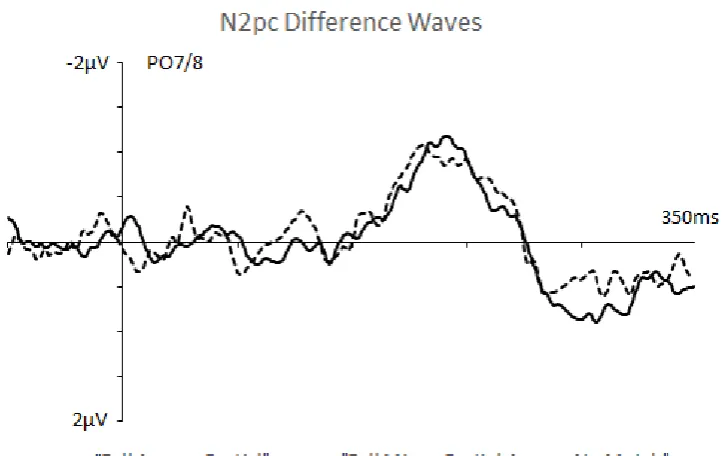
in both hemispheres, resulting in an attenuated net N2pc component. If the contributions of the three partially matching items to the overall N2pc to Full among Partial cue displays were additive, the reduction of N2pc amplitudes for these displays relative to the N2pc to Full among No Match cues should correspond to the N2pc elicited by Partial among No Match cues that included a single partially matching item. To test this prediction, we compared N2pc components elicited by Full among Partial cue displays to the difference between N2pcs to Full among No Match and Partial among No Match displays. Subtracting the N2pc to Partial among No Match displays from the N2pc to Full among No Match displays produced an N2pc waveform that was very similar to the N2pc to Full among Partial displays (as shown in Figure 4). A comparison of N2pc mean amplitudes showed no significant
difference between these two waveforms (-.77 vs. -.78 μV; t < 1). A jackknife-based
procedure using an absolute criterion of 0.5 μV also showed no significant N2pc onset
latency difference (237 vs. 232 ms; tc(13) = 1.1, p > .25). These results show that the impact
of partially target-matching cue items on N2pc components was additive, in line with the hypothesis that during the early stage of attentional object selection, attention is allocated simultaneously, independently, and in parallel to all target-matching features.
If the absence of behavioural spatial cueing effects for Partial among No Cue displays reflects the rapid de-allocation of attention from partially matching cue items, reducing the cue-target interval should make it more likely that attention is still focused at the location of these items when the target search display is processed. This prediction was tested in Experiment 2.
EXPERIMENT 2
15
Method
Participants
Nine participants took part in Experiment 2 (4 male; M age = 25 years, SD = 5, all
right-handed). One participant was excluded from analysis due to error rates over 3 SDs from group mean, leaving a final sample of eight. All had normal or corrected-to-normal vision and were naïve to the experimental hypotheses.
Stimuli and Procedure
The experimental set-up was identical to Experiment 1, except that the cue-target interval was reduced from 150 ms to 50 ms, and no EEG was recorded. Following practice, participants completed 6 experimental blocks of 96 trials each.
Results
RT data are shown in Table 2 and were entered into a 3x2 repeated-measures ANOVA with the factors Cue Type (Full among No Match, Full among Partial, Partial among No Match) and Cue Validity (target at cued versus uncued location). A main effect of
Cue Validity (F(1,7) = 21.37, p < .005, ηp2 = .75) demonstrated that RTs were generally faster
for cued as compared to uncued targets (M = 720 vs. 786 ms). There was also a significant
Cue Type x Cue Validity interaction (F(2,14) = 13.28, p = .001, ηp2 = .66), indicating that the
size of these spatial cueing effects differed between the three cue display types (as illustrated in Figure 2, middle panel). As in Experiment 1, planned comparisons of RTs to targets at cued versus uncued locations were conducted separately for the three cue display types. Significant spatial cueing effects were present on trials with Full among No Match cue
displays (95 ms; t(7) = 5.60 , p < .001) and trials with Full among Partial cues (69 ms; t(7) =
4.28 , p < .005). In contrast to Experiment 1, reliable positive spatial cueing effects were now
also found on trials with Partial among No Match cues (34 ms; t(7) = 2.37 , p < .05), and
16
relative to trials with Full among Partial cues (t(7) = 2.83 , p < .03). The positive spatial cueing effect on trials with Partial among No Match cues was reliably smaller than the cueing
effects for the other two cue display types (t’s > 2.64, p’s < .04). There was also a main effect
of Cue Type (F(2,14) = 4.88, p < .03, ηp2 = .41), reflecting overall RT differences between
trials with Full among No Match cues, Full among Partial cues, and Partial among No Match cues (735 ms, 759 ms, and 765 ms, respectively). For error rates (shown in Table 2), there was no main effect of Cue Type (F < 1), Cue Validity (F(1,7) = 3.40, p > .10), and no
interaction between these factors (F(2,14) = 1.56, p > .20).
--- Insert Table 2 about here ---
Discussion of Experiment 2
Reducing the SOA between cue and target arrays in Experiment 2 resulted in reliable positive spatial cueing effects on trials with Partial among No Match cue displays, indicating that attention was still focused at the location of partially matching cue items when the target display was processed. This observation supports the two-stage account of attentional object selection, as attention now had less time to withdraw from partially matching cue items prior to the perceptual analysis of target displays. The fact that spatial cueing effects were reliably smaller for Full among Partial cue displays as compared to Full among No Match cues in Experiment 2 provides additional support for this interpretation. Prior to its de-allocation from partially matching cue items, attention is not exclusively focused on the location of fully target-matching item in Full among Partial cue displays (as shown by the reduced N2pc amplitudes to these displays in Experiment 1), and this can account for the smaller spatial cueing effects produced by these displays relative to Full among No Match cue displays.
17
sensitive to any relational property that is defined across these features, even when this property is task-relevant. This prediction was tested in Experiment 3.
EXPERIMENT 3
In Experiments 1 and 2, targets were defined by a combination of two colours, but the relative spatial arrangement of these two colours (e.g., red above/below green) varied randomly across trials. Experiment 3 investigated the control of attention by target templates in colour configuration search where this spatial relationship was task-relevant. Participants searched for a particular spatial configuration of two target colours (e.g., red above green). Search displays contained two types of vertically oriented objects (diamonds and capsules) with two different colours in their upper and lower halves (see Figure 1, bottom panel). In half of all trials, the target was accompanied by three nontarget objects that each contained one of the two target colours in their correct position (e.g., red above blue). In the other half, one of these nontarget objects was replaced by a “reverse-colour” nontarget that had both target colours, but in the reverse spatial arrangement (e.g., green above red). Under these circumstances, the recognition of target objects cannot be based exclusively on the presence of both two target-defining colours in the same object, but also requires the detection of the specific target-defining colour configuration. Search displays were preceded by spatially uninformative cue displays that all contained one item with target-matching features among three other items with two nontarget colours. In Full cue displays, one item had both target-defining colours in their correct spatial configuration (e.g., red above green). Partial cue displays included one item with one of the two target-matching colours in its appropriate position (e.g., red above blue). In Reverse cue displays, one item possessed both target colours, but in the opposite spatial arrangement (e.g., green above red).
18
target-defining colour arrangement, but be rapidly withdrawn from cues where this spatial configuration is reversed. Analogous to Experiment 1, this should be reflected by reliable behavioural spatial cueing effects on trials with Full cue displays, and the absence of such effects for Reverse cues. Alternatively, the early stage of attentional object selection might already be sensitive to relational properties between target features when these properties are task-relevant. In this case, the N2pc to Reverse cues should be attenuated and/or delayed relative to the N2pc to Full cues. Partial cues were included in Experiment 3 to confirm the dissociation between electrophysiological and behavioural markers of attentional capture that was found in Experiment 1. In line with the two-stage account of attentional object selection, these cues should elicit reliable N2pc components, but no positive behavioural spatial cueing effects.
If the rapid allocation of spatial attention to candidate target objects during colour configuration search is insensitive to target-defining relational properties such as the spatial configuration of two target colours, the selection of target objects should be particularly difficult when displays also contain an object with both target colours in the opposite spatial arrangement (reverse-colour nontarget). To assess this hypothesis, we also measured N2pc components in response to target displays, separately for displays without a reverse-colour nontarget, displays where the target and a reverse-colour nontarget appeared on the same side, and displays where these two objects were presented on opposite sides. If targets and reverse-colour nontargets do not differ in their ability to attract attention, both should elicit identical N2pc components, and these two N2pcs should cancel each other out when these two objects appear on opposite sides of a target display.
Method
Participants
Fourteen participants took part in Experiment 3 (8 male; M age = 32 years, SD = 6,
one left-handed). All had normal or corrected-to-normal vision.
Stimuli and Procedure
19
contained only two small squares. These two squares were always vertically arranged (one above the other). The vertical spatial extent of these clusters (0.64°) was identical to Experiment 1. The two squares within each cluster always appeared in two different colours. Because the spatial arrangement of the two target-defining colours was now task-relevant, this arrangement had to be kept constant across target objects that were mapped to different responses. For this reason, the target displays now contained vertically oriented diamond-shaped or capsule-diamond-shaped objects (see Figure 1, bottom panel). The overall size and spatial arrangement of these target display objects was identical to Experiment 1. The time course of stimulus events on each trial was identical to Experiment 1, except that the interval between the offset of the target display and the onset of the cue display on the next trial was now jittered (in 100 ms steps) between 1750 and 2150 ms.
The participants’ task was to detect target objects defined by a particular spatial configuration of two colours (e.g., the red above green), and to respond to its shape (diamond versus capsule). The target-defining colour combination was randomised across participants. To encourage participants to employ a search template for the specific spatial configuration of the two target colours, the target displays shown on 50% of all trials contained the target object itself, one partially target-matching nontarget object that matched the upper target colour (e.g., red above blue), another nontarget with the lower target colour, and a reverse-colour nontarget object that contained both target reverse-colours in the reverse spatial configuration (e.g., green above red). The target and the reverse-colour nontarget appeared on opposite sides on two thirds of these trials and on the same side on the remaining third. In the other 50% of all trials, the target appeared together with three partially matching nontargets. Two of these objects matched the upper target colour and one the lower target colour, or vice versa. Participants responded by pressing the ‘1’ key for a capsule-shaped target, or the ‘2’ key for a diamond-shaped target, on the numeric keypad with their right index and middle fingers. Each target display contained two diamond-shaped and two capsule-shaped objects.
20
experimental blocks of 48 trials. Each block contained 16 randomised trials for each of the three cue display type conditions, with one trial per block for each combination of the four cue and target locations.
EEG Recording and Data Analysis
EEG recording and analysis procedures matched Experiment 1. In addition to N2pcs to cue displays, N2pc components were now also independently computed and analysed for target displays. These analyses were based on ERP waveforms averaged within a time window from 100 ms prior to cue display onset to 500 ms after target display onset, relative to a 100 ms pre-cue baseline, and across all three different cue display types. Averages were computed for search displays where a target was accompanied by three partially matching nontarget objects, displays that included the target and the reverse-colour nontarget object on the same sides, and displays where these two objects appeared on opposite sides, separately for displays with targets on the left or right side. N2pc mean amplitudes were computed at electrodes PO7/8 within a 200-300 ms time interval after target display onset. To assess longer-latency lateralised effects, additional analyses were conducted within a 300-500 ms post-stimulus time window.
Results
Behavioural Results
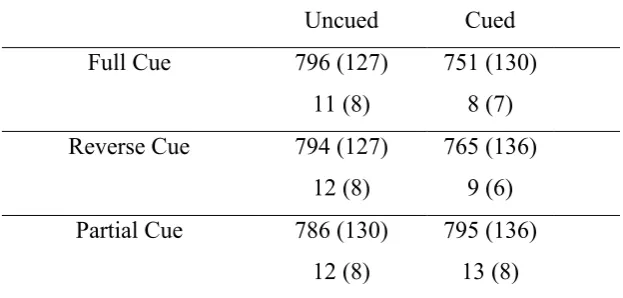
RTs are shown in Table 3 and were analysed in a 3x2 repeated-measures ANOVA with the factors Cue Type (Full, Reverse, Partial) and Cue Validity (target at cued versus
uncued locations). There was a main effect of Cue Validity (F(1,13) = 6.67, p < .03, ηp2 =
.34), demonstrating the presence of significant spatial cueing effects (M = 792 vs. 770 ms).
Importantly, a significant Cue Type x Cue Validity interaction was again present (F(2,26) =
11.41, p < .001, ηp2 = .47), indicating that these cueing effects differed between the three
types of cue displays (as shown in Figure 2, right panel). Planned comparisons conducted separately for each cue display type revealed significant spatial cueing effects for Full (45 ms; t(13) = 3.85, p < .005) and Reverse cue displays (29 ms; t(13) = 2.54, p < .003). The difference in the size of the effect between these two cue display conditions was significant
21
cueing effect (-9 ms) that was however not reliable (t(13) = 1.05, p > .30). The cue validity
effect on these trials differed reliably from the effect observed in trials with Full and Reverse
cue displays (t’s > 2.95, p’s ≤ .01). There was also a main effect of Cue Type (F(2,26) = 4.74,
p < .02, ηp2 = .27), due to overall RT differences between trials with Full, Reverse, and
Partial cue displays (773 ms, 780 ms, and 791 ms, respectively).
To assess whether the presence versus absence of a reverse-colour nontarget (an object with both target-defined colours in the opposite spatial configuration) in a search display affected target RTs, an additional analysis was conducted that also included the factor Reverse Nontarget (present, absent). RTs were substantially and reliably delayed when a
reverse-colour nontarget was present in the same display (820 vs. 743 ms; F(1,13) = 69.22, p
< .001, ηp2 = .84). This effect did not interact with Cue Validity (F(1,13) = 2.01, p > .15) or
Cue Type (F(2,26) = 1.13, p > .30), and there was no three-way interaction (F < 1).
--- Insert Table 3 about here ---
The analysis of error rates (shown in Table 3) revealed a main effect of Cue Type (F(2,26) = 9.14, p = .001, ηp2 = .41), with errors more frequent on trials with Partial cue
displays (12%) than for trials with Full or Reverse cues (9% and 10%; t’s > 2.59, p’s < .03).
The difference in error rate between trials with Full and Reverse cues was not reliable (t(13)
= 2.06, p > .05). There was no main effect of Cue Validity (F(1,13) = 1.47, p > .20) for error
rates. The Cue Type x Cue Validity interaction approached significance (F(2,26) = 3.08, p =
.06).
N2pc components to cue displays
22
and Laterality (electrode contralateral versus ipsilateral to the target-matching cue item).
There was a main effect of Laterality (F(1,13) = 32.68, p < .001, ηp2 = .72), reflecting the
presence of reliable N2pc components. A significant Cue Type x Laterality interaction (F(2,26) = 5.71, p < .01, ηp2 = .31) suggested that the size of the N2pc differed between
different types of cue displays. Analyses conducted separately for each cue display type
confirmed that N2pc components were reliably triggered by all three types of cues (t’s > 4.43,
p’s ≤ .001). The N2pcs in response to Full and Reverse cues did not differ in size (.97 vs.
-.93 μV; t < 1). However, both were larger than the N2pc to Partial cues (-.58 μV; t’s > 2.24,
p’s < .05). There were no N2pc onset latency differences between trials with Full, Reverse,
and Partial cue displays (Fc < 1).
--- Insert Figure 5 about here ---
N2pc components to target displays
23
These observations were confirmed by two 3x2 ANOVA with the factors Target Display (target and reverse-colour nontarget on same side, target and reverse-colour nontarget on opposite sides, reverse-colour nontarget absent) and Laterality, conducted separately for the N2pc and SPCN time windows (200-300 ms and 300-500 ms after target display onset, respectively). For the N2pc, there was a significant interaction between these
two factors (F(2,26) = 24.25, p < .001, ηp2 = .65), demonstrating that N2pc amplitudes
differed across the three target display types. Paired-sample t-tests showed that significant N2pc components were elicited by target displays without an accompanying reverse-colour nontarget (M diff = -1.45 µV; t(13) = 6.13, p < .001) and displays where the target and reverse-colour nontarget appeared on the same side (M diff = -2.44 µV; t(13) = 5.54, p <
.001), but not by displays where these two objects were located on opposite sides (M diff =
-.07 µV; t < 1). The N2pc to displays with targets and reverse-colour nontargets on the same
side was reliably larger than the N2pc to target displays without a reverse-colour nontarget
(t(13) = 3.23, p < .005). An analogous pattern of results was found for the subsequent SPCN
time window. There was a significant Condition x Laterality interaction (F(2,26) = 27.24, p <
.001, ηp2 = .68), as the SPCN was present for target displays without a reverse-colour
nontarget (M diff = -1.38 µV; t(13) = 6.82, p < .001) and displays where the targets and reverse-colour nontarget appeared on the same side (M diff = -2.32 µV; t(13) = 5.73, p <
.001), but not for target displays where the two objects appeared on opposite sides (M diff =
.29 µV; t(13) = 2.02, p > .05). The SPCN amplitude for displays with targets and
reverse-colour nontargets on the same side was reliably larger relative to target displays without a reverse-colour nontarget (t(13) = 2.87, p < .02).
--- Insert Figure 6 about here ---
Discussion of Experiment 3
24
dissociation between electrophysiological and behavioural markers of attentional capture found in Experiment 1, and provide further support for the claim of a two-stage model of attentional selection that attention is initially attracted by all target-defining features and is then rapidly withdrawn from partially target-matching objects. Importantly, the behavioural and electrophysiological results observed on trials with Reverse cue displays provide new insights into the limitations of attentional guidance during colour configuration search when targets are defined by the specific spatial arrangement of two colours. Full and Reverse cue displays elicited identical N2pc components, demonstrating that the early stage of spatially selective attentional processing is entirely insensitive to the spatial arrangement of two target colours, even when this relational property is task-relevant. This insensitivity to relational features is likely to reflect the fact that the initial allocation of attention to target-matching features operates in parallel and independently for different features.
If the subsequent stage of attentional selectivity where attention is de-allocated from objects with partially target-matching attributes can be based on information about feature configurations, the rapid withdrawal of attention from items with both target colours in Reverse cue displays should eliminate behavioural spatial cueing effects, analogous to what was observed for Partial cues. This was clearly not the case. Reliable behavioural spatial cueing effects were elicited on trials with Reverse cues, demonstrating that attention remained focused at the location of reverse-colour cue items during the processing of target displays. The observation that spatial cueing effects were smaller with Reverse cues relative to Full cue displays suggests that some disengagement of spatial attention may have started on some trials, but this process was clearly slower and less efficient than the rapid de-allocation of attention from partially matching cues.
25
two objects in opposite visual hemifields, N2pc components of opposite polarity are elicited in parallel, which cancel each other out. The absence of an N2pc for targets that were accompanied by a reverse-colour nontarget in the opposite visual field is of course entirely consistent with the fact that that identical N2pcs were elicited by Full and Reverse cue displays. Both observations demonstrate that at the stage where N2pc components are generated, attentional control processes cannot distinguish between targets and reverse-colour nontarget objects.
Importantly, this insensitivity to information about colour configuration did not only affect the rapid allocation of attention that is reflected by the N2pc, but also subsequent stages of attentional processing. As shown in Figure 6, the spatial distribution of attention that was evident during the N2pc time window remained present during the entire 500 ms interval after target display onset. In many attentional selection tasks, a sustained posterior contralateral negativity (SPCN) follows the N2pc component (e.g., Jolicoeur, Brisson, & Robitaille, 2008; Mazza, Turatto, Umiltà, & Eimer, 2007). The SPCN has been linked to the spatially selective activation of visual working memory during the identification and categorisation of selected objects (Mazza et al., 2007; see Eimer, 2014, for further discussion). The observation that SPCN components to displays that contained the target and the reverse-colour nontarget object on the same side were larger than the SPCN to target-only displays, and the fact that no SPCN was elicited at all when these two objects appeared on opposite sides, suggest that targets and reverse-colour nontargets were both attentionally maintained in working memory. These findings indicate that for at least 500 ms after search display onset, top-down control attentional processes remained unable to differentiate between target and nontarget objects on the basis of their colour configuration. The fact that target RTs were delayed by 80 ms by the simultaneous presence of a reverse-colour nontarget object is likely to be the direct result of attention being divided between these two objects at the time when targets were identified. In the context of the two-stage model of attentional selectivity, the results of Experiment 3 demonstrate that attention can be rapidly de-allocated from nontarget objects that lack one of the target-defining features, but not from objects that differ from targets only with respect to the spatial configuration of these features.
26
In the present study, we employed spatial cueing procedures to investigate the guidance of attention by search templates for multiple target colours during colour combination and colour configuration search with behavioural and electrophysiological measures. Experiment 1 demonstrated that during search for targets defined by a combination of two colours, attention is initially allocated rapidly and independently to both target-matching colours, but is then withdrawn from objects that only match one of these colours. Experiment 2 provided further support for this two-stage selection process by showing that when target displays are presented before the attentional de-allocation from partially matching cues is complete, these cues affect target processing in a spatially selective fashion. Experiment 3 investigated colour configuration search, and showed that when targets are defined by a particular spatial arrangement of two colours, attentional guidance is unable to distinguish between targets and nontarget objects with the reverse colour configuration. Both objects attracted attention equally, both were selected in parallel when they appeared together in the same target display, and both were selectively maintained in working memory. Overall, these results demonstrate that attention can be readily guided by multiple features from the same dimension, but that this type of attentional guidance becomes highly inefficient in configuration search tasks where targets and nontargets differ only with respect to the spatial relationship between these features.
27
elicited in a spatially global fashion at multiple locations in the visual field (e.g., Martinez-Trujillo & Treue, 2004; Bichot, Rossi, & Desimone, 2005; Serences & Boynton, 2007; see also Eimer, 2014, 2015, for a more detailed discussion of links between preparatory baseline shifts and feature-based attention). The rapid allocation of attention to objects with target-matching colours, as reflected by the N2pc to cue displays in the present study, might directly reflect such spatially global feature-based attention mechanisms during search for colour combinations. In such tasks, the simultaneous representation of different target colours in a search template would be implemented by colour-selective preparatory baseline shifts that are triggered in parallel for multiple colours, and result in subsequent feature-based attentional modulations that operate independently and simultaneously for these colours.
28
However, this template-guided gradual narrowing of focal attentional processing appears to be limited in one important respect. Although target templates can be used to discriminate between objects that do or do not possess the full set of target features, the control of attentional selectivity remains insensitive to differences in the spatial configuration of these features, even when this is a critical target-defining attribute. This was demonstrated in Experiment 3, where focal attention was found to remain divided between targets and reverse-colour nontargets for at least 500 ms after a search display was presented. This is an important observation, because it suggests that while search templates can represent multiple colours simultaneously, these colour representations remain separate, and are not combined into an integrated analog representation of the target object. If the search templates used to control the deployment of attention towards target objects were two-dimensional pictorial representations of these objects (i.e., mental images as described by Kosslyn, 1987 and Kosslyn & Thompson, 2003), they should not only specify all target-defining colours, but also their specific spatial arrangement (e.g., red above green). Because information about the spatial configuration of target features can be directly accessed in pictorial search templates at no extra cost, observers should be able to use this configural information just as readily as information about the presence versus absence of a particular feature to guide attentional allocation processes. The fact that top-down attentional control processes were found to be entirely unable to distinguish between targets and reverse nontarget objects demonstrates that this is clearly not the case. This implies either that search templates are not analog mental images of target objects, or that the configuration of individual features within such pictorial representations of target objects is not accessible to attentional guidance processes. If attention cannot be guided by information about the spatial-configural layout of target object features, even when this information is critical to find these objects, the discrimination between targets and nontargets has to take place at a subsequent post-selective processing stage.
29
the size and orientation of two target line segments (Treisman & Gormican, 1988), and search for the presence versus absence of an intersection between line segments of objects (Wolfe & DiMase, 2003) are all inefficient, suggesting that attention cannot be guided by this type of spatial-configural information (see also Enns & Rensink, 1990, for similar findings during search for targets defined by the spatial arrangement of two-dimensional shapes). When feature-based guidance is insufficient to discriminate between targets and distractors, additional processes are required to find target objects. One possibility is that focal attention is allocated voluntarily and sequentially to all possible target objects until the target is found. Another possibility is that attention remains divided between candidate targets, which are processed in parallel until one of them is identified as the target. In either case, the absence of configuration-based guidance will delay target localization relative to tasks where targets can be detected by parallel feature-based control processes, resulting in inefficient search.
30 REFERENCES
Becker, S.I., Folk, C.L., & Remington, R.W. (2013). Attentional capture does not depend on
feature similarity, but on target-nontarget relations. Psychological Science, 24,
634-647.
Bichot, N. P., Rossi, A. F., & Desimone, R. (2005). Parallel and serial neural mechanisms for visual search in macaque area V4. Science, 308, 529-534.
Carmel, T., & Lamy, D. (2014). The same-location cost is unrelated to attentional settings: An object-updating account. Journal of Experimental Psychology: Human Perception & Performance, 40, 1465-1478.
Carmel, T., & Lamy, D. (in press). Towards a Resolution of the Attentional-Capture Debate.
Journal of Experimental Psychology: Human Perception & Performance.
Chelazzi, L., Duncan, J., Miller, E.K., & Desimone, R. (1998). Responses of neurons in
inferior temporal cortex during memory-guided visual search. Journal of
Neurophysiology, 80, 2918-2940.
Christie, G. J., Livingstone, A. C., & McDonald, J. J. (2015). Searching for inefficiency in visual search. Journal of Cognitive Neuroscience, 27, 46-56.
Desimone, R., & Duncan, J. (1995). Neural mechanisms of selective visual attention. Annual
Review of Neuroscience, 18, 193-222.
Eimer, M. (1996). The N2pc component as an indicator of attentional selectivity.
Electroencephalography and Clinical Neurophysiology, 99, 225-234.
Eimer, M. (2014). The neural basis of attentional control in visual search. Trends in Cognitive
Sciences, 18,526-535.
Eimer, M. (2015). EPS Mid-Career Award 2014: The control of attention in visual search –
Cognitive and neural mechanisms. The Quarterly Journal of Experimental
Psychology, 68,2437-2463.
Eimer, M., & Grubert (2014). The gradual emergence of spatially selective target processing
in visual search: From feature-specific to object-based attentional control. Journal of
Experimental Psychology: Human Perception and Performance, 40, 1819-1831. Eimer, M., & Kiss, M. (2008). Involuntary attentional capture is determined by task set:
Evidence from event-related brain potentials. Journal of Cognitive Neuroscience, 20,
1423-1433.
Eimer, M., & Kiss, M. (2010). Top-down search strategies determine attentional capture in
31
Psychophysics, 72, 951-962.
Eimer, M., Kiss, M., Press, C., & Sauter, D. (2009). The roles of feature-specific task set and
bottom-up salience in attentional capture: An ERP study. Journal of Experimental
Psychology: Human Perception and Performance, 35, 1316-1328.
Enns, J.T., & Rensinck, R.A. (1990). Influence of scene-based properties on visual search.
Science, 247, 721-723.
Folk, C.L., & Anderson, B.A. (2010). Target-uncertainty effects in attentional capture: Color-
singleton set or multiple attentional control settings? Psychonomic Bulletin & Review,
17, 421-426.
Folk, C.L., & Remington, R.W. (1998). Selectivity in distraction by irrelevant featural
singletons: Evidence for two forms of attentional capture. Journal of Experimental
Psychology: Human Perception and Performance, 24, 847-858.
Folk, C.L., Remington, R.W., & Johnston, (1992). Involuntary covert orienting is contingent
on attentional control settings. Journal of Experimental Psychology: Human
Perception and Performance, 24, 847-858.
Grubert, A., & Eimer, M. (in press). All set, indeed! N2pc components reveal
simultaneous attentional control settings for multiple target colours. Journal of
Experimental Psychology: Human Perception and Performance.
Hopf, J-M., Boelmans, K., Schoenfeld, M.A., Luck, S.J., & Heinze, H-J. (2004). Attention to features precedes attention to locations in visual search: Evidence from
electromagnetic brain responses in humans. The Journal of Neuroscience, 24,
1822-1832.
Irons, J.L., Folk, C.L., & Remington, R.W. (2012). All set! Evidence of simultaneous
attentional control settings for multiple target colors. Journal of Experimental
Psychology: Human Perception and Performance, 38, 758-775.
Jolicoeur, P., Brisson, B., & Robitaille, N. (2008). Dissociation of the N2pc and sustained
posterior contralateral negativity in a choice response task. Brain Research, 1215,
160-172.
Kiss, M., Grubert, A., & Eimer, M. (2013). Top-down task sets for combined features: Behavioral and electrophysiological evidence for two stages in attentional object
selection. Attention, Perception, & Psychophysics, 75, 216-228.
Kleffner, D.A., & Ramachandran, V.S. (1992). On the perception of shape from shading.
32
Kosslyn, S. M. (1987). Seeing and imagining in the cerebral hemispheres: a computational
approach. Psychological Review, 94, 148-175.
Kosslyn, S.M., & Thompson, W.L. (2003). When is early visual cortex activated during
visual mental imagery? Psychological Bulletin, 129, 723-746.
Lamy, D., Leber, A., & Egeth, H.E. (2004). Effects of task relevance and stimulus-driven
salience in feature-search mode. Journal of Experimental Psychology: Human
Perception and Performance, 30, 1019-1031.
Leblanc, E., Prime, D.J., & Jolicoeur, P. (2008). Tracking the location of visuospatial
attention in a contingent capture paradigm. Journal of Cognitive Neuroscience, 20,
657-671.
Lien, M-C., Ruthruff, E., Goodin, Z., & Remington, R.W. (2008). Contingent attentional capture by top-down control settings: Converging evidence from event-related
potentials. Journal of Experimental Psychology: Human Perception and
Performance, 34, 509-530.
Luck, S.J., & Hillyard, S.A. (1994). Spatial filtering during visual search: Evidence from
human electrophysiology. Journal of Experimental Psychology: Human Perception
and Performance, 20, 1000-1014.
Martinez-Trujillo, J.C., & Treue, S. (2004). Feature-based attention increases the selectivity
of population responses in primate visual cortex. Current Biology, 14, 744-751.
Mazza, V., Turatto, M., Umiltà, C., & Eimer, M. (2007). Attentional selection and
identification of visual objects are reflected by distinct electrophysiological responses.
Experimental Brain Research, 181, 531-536.
Miller, J., Patterson, T., & Ulrich, R. (1998). Jackknife-based method for measuring LRP
onset latency differences. Psychophysiology, 35, 99-115.
Olivers, C.N.L., Peters, J., Houtkamp, R., & Roelfsema, P.R. (2011). Different states in
visual working memory: When it guides attention and when it does not. Trends in
Cognitive Sciences, 15, 327-334.
Serences, J.T., & Boynton, G.M. (2007). Feature-based attentional modulations in the
absence of direct visual stimulation. Neuron, 55, 301-312.
Stokes, M., Thompson, R., Nobre, A.C., & Duncan, J. (2009). Shape-specific preparatory
activity mediates attention to targets in human visual cortex. Proceedings of the
National Academy of Sciences, 106, 19569-19574.
Theeuwes, J. (1991). Cross-dimensional perceptual selectivity. Perception & Psychophysics,
33
Treisman, A.M., & Gelade, G. (1980). A feature-integration theory of attention. Cognitive
Psychology, 12, 97-136.
Treisman, A.M., & Gormican, S. (1988). Feature analysis in early vision: Evidence from
search asymmetries. Psychological Review, 95, 15-48.
van Moorselaar, D., Theeuwes, J., & Olivers, C.N.L. (2014). In competition for the attentional template: Can multiple items within visual working memory guide
attention? Journal of Experimental Psychology: Human Perception and Performance,
40, 1450-1464.
Wolfe, J.M. (1994). Guided Search 2.0: A revised model of visual search. Psychonomic
Bulletin & Review, 1, 202-238.
Wolfe, J.M. (2007). Guided Search 4.0: Current progress with a model of visual search. In W.
Gray (Ed.), Integrated Models of Cognitive Systems (pp. 99-119). New York: Oxford.
Wolfe, J.M., & DiMase, J.S. (2003). Do intersections serve as basic features in visual search?
Perception, 32, 645-656.
Wolfe, J.M., & Horowitz, T.S. (2004). What attributes guide the deployment of visual
attention and how do they do it? Nature Reviews Neuroscience, 5, 495-501.
Wolfe, J.M., Yu, K.P., Stewart, M.I., Shorter, A.D., Friedman-Hill, S.R., & Cave, K.R. (1990). Limitations on the parallel guidance of visual search: Color x color and
orientation x orientation conjunctions. Journal of Experimental Psychology: Human
34
Table 1: Mean reaction times and percentage error rates in Experiment 1, as a function of Cue
Type and Cue Validity (SD in parentheses)
Uncued Cued
Full Among No Match 674 (93)
5 (4)
628 (77) 4 (4)
Full Among Partial 686 (99)
7 (6)
638 (90) 5 (5) Partial Among No
Match
666 (94) 6 (5)
35
Table 2: Mean reaction times and percentage error rates for Experiment 2, as a function of
Cue Type and Cue Validity (SD in parentheses)
Uncued Cued
Full Among No Match 783 (117)
18 (11)
688 (133) 14 (12)
Full Among Partial 793 (145)
18 (11)
724 (168) 14 (11) Partial Among No
Match
782 (133) 16 (11)
36
Table 3: Mean reaction times and percentage error rates in Experiment 3, as a function of Cue
Type and Cue Validity (SD in parentheses)
Uncued Cued
Full Cue 796 (127)
11 (8)
751 (130) 8 (7)
Reverse Cue 794 (127)
12 (8)
765 (136) 9 (6)
Partial Cue 786 (130)
12 (8)