N A N O E X P R E S S
Open Access
Tailoring the Microstructure of Sol
–
Gel Derived
Hydroxyapatite/Zirconia Nanocrystalline
Composites
HC Vasconcelos
1,2*, MC Barreto
1,3Abstract
In this study, we tailor the microstructure of hydroxyapatite/zirconia nanocrystalline composites by optimizing processing parameters, namely, introducing an atmosphere of water vapor during sintering in order to control the thermal stability of hydroxyapatite, and a modified sol–gel process that yields to an excellent intergranular distribution of zirconia phase dispersed intergranularly within the hydroxyapatite matrix. In terms of mechanical behavior, SEM images of fissure deflection and the presence of monoclinic ZrO2content on cracked surface indicate that both toughening mechanisms, stress-induced tetragonal to monoclinic phase transformation and deflection, are active for toughness enhancement.
Introduction
Hydroxyapatite [HA, Ca10(PO4)6(OH)2] has attracted much interest as a biomaterial for use in prosthetic applications due to the similarity of its crystallography and chemical composition to that of human hard tissues [1,2]. However, the main weakness of this material lies in its poor mechanical strength that makes it unsuitable for load-bearing applications.
An attractive way of producing tougher HA is to use composites of 3 mol% yttria-stabilized tetragonal zirconia (YSZ) and HA, where the biocompatibility and bioactivity come from the apatite phase and the high strength is derived from the zirconia oxide (ZrO2) phase [3-5], on account of its high strength and fracture toughness being significantly increased by stress-induced tetragonal (t) to monoclinic (m) phase transformation toughening, or by deflection toughening mechanism [6-10].
Therefore, such composites must display uniform microstructures with a high degree of dispersion and without decomposition of the HA, during the sintering process. However, it has been reported that the addition of ZrO2 causes an increase in the content of tricalcium phosphate (b-TCP, Ca3(PO4)2) [11], which seriously deteriorates the mechanical properties and chemical
stability of these composites. In addition, calcium can be released from HA and interact with zirconium, resulting in the formation of cubic zirconia or calcium zirconate, which inhibits the toughening transformation mechan-ism [4,12-15].
To minimize these reactions, some efforts have been made toward reducing the sintering temperature and holding time. One alternative is the use of HA and YSZ nanopowders [16]. Another important method is the introduction of external pressure using the following techniques: spark plasma sintering (SPS), hot pressing or hot isostatic pressing (HIP) [5,16-18]. However, the exact mechanism of b-TCP content increase in ZrO2 -added HA is not fully understood, and thus a method to control this decomposition has not been reported so far. Sol–gel technique has been selected as a potential method to synthesize a large variety of materials [19-22], and in particularly ceramic matrix composites carefully doped with additional phases, offering a very good homogeneity and a better control of the morphol-ogy and microstructure. Several synthesis routes have been proposed for the synthesis of HA as well as differ-ent mixing conditions with numerous reactants molar ratios [23-26]. Although various precursors have been tried in the attempt to obtain a well-developed HA, the Ca(NO3)2 and [P(OC2H5)3] (TEP) combination has shown the most promising results, but until now it has still been difficult to obtain phase-pure HA.
* Correspondence: [email protected]
1
Department of Technological Sciences and Development, Campus de Ponta Delgada, Azores University, 9501-801, Ponta Delgada, Açores, Portugal. Full list of author information is available at the end of the article
In this study, a new type of HA/YSZ composite was fabricated with tailored microstructure by optimizing processing parameters in order to control the thermal stability of HA and YSZ grain phase distribution. An important outcome of the present work is an excellent intergranular distribution of YSZ phase, for the first time, in ZrO2-based composites.
Experimental
High-purity chemicals of calcium nitrate tetrahydrate (Ca (NO3)24H2O), triethyl phosphate (P(OC2H5)3) bought from Sigma–Aldrich, ammonium hydroxide (NH4OH, 30% BDH, England), yttria-stabilized (3wt% Y2O3) tetra-gonal zirconia (TZ-3Y, Tosoh Corporation) with particle size as 40 nm and BET as 16 ± 3 m2/g were used as start-ing start-ingredients for HA/YSZ composites.
Gel powders of HA and HA/YSZ composites (contain-ing 10 mol% YSZ, denoted by HAZ10) were processed by a tailored sol–gel processing route, according the scheme illustrate in Figure 1a, involving triethyl phos-phate (TEP) and calcium nitrate (Ca(NO3)2) as precur-sors of HA (route1). In order to obtain HAZ10 (route2), YSZ commercial powder diluted in deionised water was added to the HA sol.
At the end of both routes, the solvents were then dri-ven off at 60°C until a viscous liquid was obtained.
Further drying of the viscous liquid at 60°C resulted in a gel. Oven drying was undertaken for a further 24 h at 120°C, and powders (pure HA and HAZ10, respectively) were obtained. Green pellets were prepared by uniaxial pressing at 100 MPa, and sintering was performed in water vapor atmosphere at the temperature of 950°C for 1 h. Under typical atmospheric conditions, water vapor was continuously generated by the evaporation of boil-ing liquid water and directly introduced inside the fur-nace, using the set-up illustrated in Figure 1b.
The characterization of as-sintered samples was carried out by scanning electron microscopy (SEM/EDX, JEOL JMS-840) and X-ray diffraction (XRD) using CuKa radia-tion (Siemens D-5000 diffractometer). Data were col-lected from 25 to 63° 2θwith step of 0.02° and counting time 12 s. The identification of phases present was done using JCPDS files n° 9-432 to HA phase, 17-923 to ZrO2 tetragonal phase and 13-307 to ZrO2monoclinic phase.
Vickers indentations (using a Shimadzu Micro Hard-ness Tester Type-M) and resulting crack propagation were used to detect toughening mechanisms.
Results and Discussion
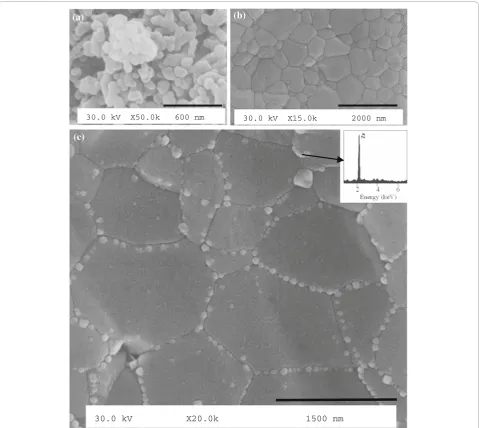
SEM on the HA powder, after drying for 24 h at 120°C, is shown in Figure 2a. The averaged particle size was ~60–100 nm, and the particles were agglomerated.
0,1 mol P(C2H5O)3 + 1mol( H2O + EtOH) (stirring under reflux,
12h at 40ºC)
add 0,167 mol Ca(NO3)2.4H2O
HA gel
ZrO2 (powder) Hydrolysis of TEP
Stirring, 6 h at RT
HA powder
Stirring, 6 h
at RT HA sol
add NH4OH
HA/YSZ Aging 24h
Aging and Drying HA/YSZ gel
Route2 Route1
[image:2.595.58.538.423.688.2](a) (b)
Figure 2b, c illustrates the scanning electron micro-structure of the polished and thermally etched surface of the sintered HA and HAZ10, respectively. Full densi-fication of the optimized powders and respective com-pacts (load = 100 MPa), after routes 1 and 2, was achieved in 1 h at low temperature of 950°C. In Figure 2c, the dark grains are HA and the bright ones are ZrO2, which were dispersed mostly intergranularly within the HA matrix. EDX analysis (inset of Figure 2c) indicates the presence of Zr within whitish grain. Due to process synthesis, zirconia served as nucleation sites during HA precipitation, so HA crystals were formed on
the surfaces of ZrO2 particles. This phenomenon pro-vided a more intimate mixing in binary composites, yielding a higher dispersion, allowing ZrO2 particles to be present mostly at grain boundaries, without agglom-erates. Thus, the prepared samples were fully densified with small isolated voids, as shown in Figure 2c.
It is well established that HA is thermally decomposed into mostly b-TCP [Ca3(PO4)2], CaO and water vapor [27-29], according to the following reactions:
Ca10(PO4 6) (OH)2⇔Ca10(PO4 6) (OH)(2 2− x)Ox+ ↑H O2 (1)
(a) (b)
(c)
30.0 kV X20.0k 1500 nm
30.0 kV X15.0k 2000 nm
[image:3.595.59.539.88.516.2]30.0 kV X50.0k 600 nm
Ca10(PO4 6) O⇔2−Ca PO3( 4 2) +Ca P O4 2 9 (2)
Ca10(PO4 6) (OH)2⇔3−Ca PO3( 4 2) +CaO+↑H O2 (3)
Also, the tetragonal phase of ZrO2 can be decomposed through the reaction [28]:
Ca PO OH) O ZrO
Ca PO CaO(Zr
tetragonal
10 4 6 2 2 2
3 4 2 3
( ) (
( )
(− ) + ( )⇔
+
x x y
O
O2(cubic))y+ ↑H O2 (4)
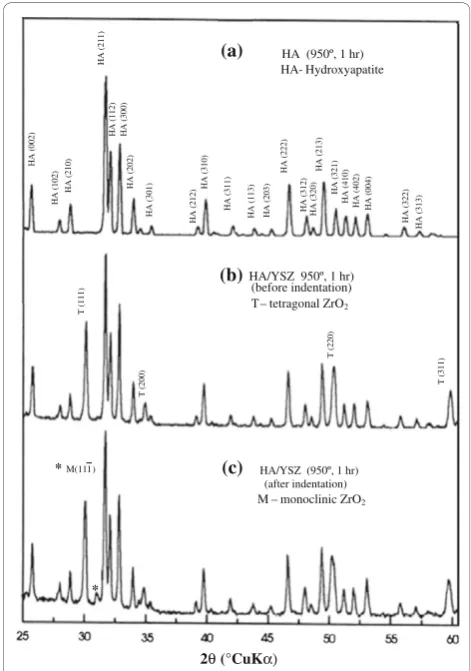
However, the obtained HA and HAZ10 compacts did not contain any phases other than HA and the tetrago-nal modification of zirconia, as revealed by their X-ray powder diffraction patterns in Figure 3a, b. The patterns demonstrate the stable nature of HA; peaks indicating the presence of stoichiometric HA after sinterization at 950°C for 1 h.
Two mechanisms may explain this behavior: first, since a gaseous species (H2O) exists on the products side of the decomposition reactions, sintering
atmosphere would be expected to influence the decom-position kinetics of HA. In the present work, a water vapor atmosphere was used during sintering reaction, causing a compensation of the partial vapor atmosphere of water inside the furnace, avoiding vacancies forma-tion in the HA structure—Ca10(PO4)6(OH)(2–2x)Ox at reaction (1), counteracting the effect of HA decomposi-tion in the reacdecomposi-tions (2), (3) and (4), and secondly the decomposition reactions of HA were avoided, most probably because diffusion of water from the reaction zone to the surfaces is retarded by the zirconia matrix (nano intergranular ZrO2 particles) in boundaries of HA grains, forming a continuous framework.
The mechanical properties of this category of compo-site materials can be optimized by carefully tailoring the microstructure. Thus, the contribution of stress-induced phase transformation was evaluated by XRD, which is assessed in terms of the reflection of ZrO2 monoclinic phase, as shown in Figure 3c. The presence of m-ZrO2 content on cracked surface (after Vickers indentation) indicates that the transformation toughening phenom-enon is an active mechanism for toughness enhance-ment. Additionally, crack deflection toughening by ZrO2 particles also contributes to toughening of the compo-site. SEM observations also sustain the role of crack deflection toughening in these composites. The observa-tion of indentaobserva-tion crack in the HAZ10 composite (Fig-ure 4) shows little crack deflection around the dispersed ZrO2 particles; therefore, this mechanism seems also contribute to the toughening.
Conclusions
In this study, HA was reinforced with 3 mol% of Y2O3 partially stabilized ZrO2, and structure-tailored HAZ10 composites, yielding intergranular distribution of ZrO2 particles, were fabricated by a modified sol–gel process.
HA (950º, 1 hr) HA - Hydroxyapatite
HA/YSZ 950º, 1 hr) (before indentation) T – tetragonal ZrO2
HA/YSZ (950º, 1 hr) (after indentation)
M – monoclinic ZrO2
2θ (°CuKα)
HA (002)
HA (211)
HA (112) HA (300)
HA (102)
HA (210) HA (202) HA (310)
HA (004) HA (402) HA (410) HA (321) HA (213) HA (312) HA (222) HA (311) HA (113) HA (301) HA (212) ) 1 M(11 T (111) T (200) T (220) T (311) * * HA (322)
HA (203) HA (320)
HA (313)
(a)
[image:4.595.55.291.348.684.2](c) (b)
[image:4.595.306.540.535.691.2]Figure 3(a) XRD patterns of HA and YSZ/HA powder, with Ca/ P ratio of 1,67 and YSZ content of 10%, heated at 950°C, 1 h in water vapor atmosphere, before indentation (b) and after indentation (c).
Absence of deleterious reaction products is mostly attributed to the sintering atmosphere of water vapor and tailored microstructure. Stress-induced ZrO2 phase transformation (indicated by XRD) together with SEM images of fissure deflection indicates that both mechan-isms are active for toughness enhancement.
Acknowledgements
This project was in part financially supported by the“Fundação para a Ciência e a Tecnologia”(Portugal) under grant number BII/CEFITEC/DCTD (Uaç)/Linha2-2/2009.
Author details
1Department of Technological Sciences and Development, Campus de Ponta
Delgada, Azores University, 9501-801, Ponta Delgada, Açores, Portugal.
2Physics Department of FCT/UNL, CEFITEC—Centre of Physics and
Technological Research, Quinta da Torre, 2829-516, Caparica, Portugal.
3CIRN—Centre of Research in Natural Resources, 9501-801, Ponta Delgada,
Açores, Portugal.
Received: 16 July 2010 Accepted: 16 August 2010 Published: 31 August 2010
References
1. Jarcho M:Clin Orthop Relat Res1981,157:259.
2. Aoki H:Medical Applications of Hydroxyapatite.Ishiyaku Euro America, Tokyo; 1994.
3. Wu JM, Yeh TS:J Mater Sci1988,23:3771.
4. Ramachandra Rao R, Kannan TS:Mater Sci Eng C2002,20:187. 5. Adolfsson E, Alberius-Henning P, Hermansson L:J Am Ceram Soc2000,
83:2798.
6. Claussen N:J Am Ceram Soc1976,59:49. 7. Wang J, Stevens R:J Mater Sci1989,24:3421.
8. Bleier A, Becher PF, Alexander KB, Westmoreland CG:J Am Ceram Soc1992,
75:2649.
9. Becher PF, Alexander KB, Bleier A, Waters SB, Warwick WH:J Am Ceram Soc
1993,76:657.
10. Evans AG, Cannon RM:Acta Metall1986,34:761. 11. Nagarajan VS, Rao KJ:J Mater Chem1993,3:43. 12. Wu JM, Yeh TS:J Mater Sci1998,23:3771.
13. Evis Z, Ergun C, Doumus RH:J Mater Sci2005,40:1127. 14. Evis Z:Ceram Int2007,33:987.
15. Chiu CY, Hsu HC, Tuan WH:Ceram Int2007,23:715. 16. Ahn ES, Gleason NJ, Ying JY:J Am Ceram Soc2005,88:3374. 17. Miao X, Chen Y, Guo H, Khor KA:Ceram Int2004,30:1793.
18. Rapacz-Kmita A, Slosarczyk A, Paszkiewicz Z:J Eur Ceram Soc2006,26:1481. 19. Arcos D, Vallet-Regí M:Acta Biomater2010,6:2874.
20. Zhong P, Que WX:Nano-Micro Lett2010,2:1. 21. Kundu S, Biswas PK:Opt Mater2008,31:429.
22. Kobayashi Y, Okamoto M, Tomita A:J Mater Sci1996,31:6125. 23. Tkalcec E, Sauer M, Nonninger R, Schmidt H:J Mater Sci2001,36:5253. 24. Bigi A, Boanini E, Rubini K:J Solid State Chem2004,177:3092. 25. Han YC, Li SP, Wang XY, Chen XM:Mater Res Bull2004,39:25. 26. Bogdanoviciene I, Beganskiene A, Tonsuaadu K, Glaser J, Meyer HJ,
Kareiva A:Mater Res Bull2006,41:1754.
27. Ahn ES, Gleason NJ, Nakahira A, Ying JY:Nano Lett2001,1:149. 28. Shen Z, Adolfsson E, Nygren M, Gao L, Kawaoka H, Niihara K:Adv Mater
2001,13:214.
29. Heimann RB, Vu TA:J Mater Sci Lett1997,16:437.
doi:10.1007/s11671-010-9766-z
Cite this article as:Vasconcelos and Barreto:Tailoring the Microstructure of Sol–Gel Derived Hydroxyapatite/Zirconia Nanocrystalline Composites.
Nanoscale Res Lett20116:20.
Submit your manuscript to a
journal and benefi t from:
7Convenient online submission
7Rigorous peer review
7Immediate publication on acceptance
7Open access: articles freely available online
7High visibility within the fi eld
7Retaining the copyright to your article