A New Algorithm for Finding a Minimum Dominating Set
of Graphs
P. Pradhan,
Department of Mathematics and Statistics, Gurukula Kangri University, Haridwar (UK), India
B. S. Rawat,
Department of Mathematics and Statistics, Gurukula Kangri University, Haridwar (UK), India
ABSTRACT
In the present paper the concept of relative domination power of vertices for finite undirected graphs have been introduced. An algorithm has been developed to obtain a minimum dominating set of a graph. Some results related to domination number and other graph theoretic parameters for a tree also obtained.
Keywords
Dominating set, Domination number, Domination power of a vertex, Support of a graph
1.
INTRODUCTION
All graphs considered in this paper are undirected and finite. Most of the graph theoretic notations have been borrowed from the book by Harary [1]. A graph consist a finite set of vertices together with an edge set such that each edge is an unordered pair of vertices. A subset Dof is said to be dominating set of a graph if every vertex which is not in D is adjacent to at least one vertex in D.The domination number
of is the cardinality of smallest dominating set of A dominating set D is said to be connected dominating set if induced subgraph D is connected [5]. D is called independent dominating set if induced subgraph D is null graph. The connected domination number c and the independent dominationnumberi of are the cardinality of smallest connected
dominating set and smallest independent dominating set of respectively.
A vertex which is adjacent to pendent vertex is called support of [2]. All vertices of except pendent vertices are internal vertices. is called neighbourhood of in and the closed neighbourhood of v is denoted by
( )
N v and is defined as N v( ) N v( ){ }v
. A set of vertices is said to be an independent set of vertices if no two vertices in the set are adjacent and the number of vertices in the largest independent set is called the independence number of a graph [3].
The distance between two verticesu and v of a graph is denoted by d u v( , ) and is defined as the length of shortest path between them.
2.
SOME DEFINITIONS
2.1 Definition
A vertex v in G dominates another vertex u in G if 1
d u v( , ) . Obviously d u u( , ) 0 1, so u dominates itself.
2.2 Definition
A vertex dominates itself and all the vertices adjacent to it, that is dominates every vertex in its closed neighborhood [4]. The number of vertices in G which are dominated byvis known as domination power of ,v it is denoted bydp v
so dp v
|N v
|.2.3 Definition
The relative domination power of a vertex with respect to any vertex is denoted bydpu( )v and defined as
the number of vertices which are dominated by
v
but not byu. Similarly the relative domination power of a vertex with respect to in is given by
Number of vertices dominated by
v
but not by .2.4 On the Basis of Above Definition 2.3 We
Have the Following Observation
2.4.1 Observation
If
G
is a tree and is an internal vertex and adjacent to vertex , then is a pendent vertex.2.4.2 Observation
If for a graph G, ( ) 0; , ,
j
v i i j G
dp v v v V then G is a complete graph.
2.4.3 Observation
If for a graph G, v vi jEG such that
( ) 1; ,
j
v i i j G
dp v v v V and |VG|3,then Gis a cycle.
2.4.4 Observation
If for a graph G, v vi jEG, then dpvj( )vi deg( ) 1,vi
, .
i j G
v v V
2.5 EXAMPLE
In the following graph dp v( )1 3, dp v( 2)4, dp v( )3 2,
2 5 1
4 5 1 1 2
( ) 2, ( ) 4, v( ) 1, v( ) 1, v( ) 2,
dp v dp v dp v dp v dp v
3 4 2 1 3
1 3 4
2 2 3 2
2
( ) 2, ( ) 2, ( ) 0, ( ) 1, ( ) 0 etc.
v v v v v
v v v
dp v dp v dp v dp v
dp v
10
Fig 1: Tree with seven vertices
3. AN ALGORITHM FOR FINDING A
MINIMUM DOMINATING SET OF A
GRAPH
BY
USING
RELATIVE
DOMINATION POWER OF VERTICES
Case I –When set of supports exist in
1. Let be a graph of order with tsupports.
2. LetS{ ,v v v1 2, 3,..., }vt be the set of supports such that
1 1 2 1 2 3 1
1 1 2 2 , 3 3 , , ...
( ) , ( ) , ( ) ..., ( )
t
v v v v v v v t t
dp v k dp v k dp v k dp v k
.
3. Ifk1k2k3 ... kt n and
1,2, ...3 t( ) 0;
v v v v i i
dp v v Sthen
DSis a minimum dominating set and domination number
|S| .
4. If k1k2k3....ktn, then we take a set S1such that S1 S { }vi ; where
v
i is an internal vertex exceptsupport and having maximum relative domination power with respect to v v v1, 2, 3,... .vt Let dpv v v1,2, ,...3 vt( )vi kt1 and
1 { ,1 2,
S v v v3,...,v vt, }i .
Again if k1k2k3 ... ktkt1n and
1, , ,... ,2 3 t i v v v v v dp
1
(vj) 0; vj S.Then D S1is a minimum dominating set and domination number|S1|.
5. If k1k2k3 ... kt kt1n, then the process as given in step 4 is continued in similar manner until
1
i i n
k n
.Case II –When set of supports does not
exist in
If a graph does not have any support then in order to find a minimum dominating set for a graph; first we select a vertex
i G
v V of maximum domination power among all the vertices of G.
Now if dp v( )i n, then the set D{ }vi is a minimum
dominating set but if dp v( )i n,then the process as given above in step 3 and 4 is continued in similar manner until to get a dominating set.
[image:2.595.317.549.74.180.2]3.1 Example
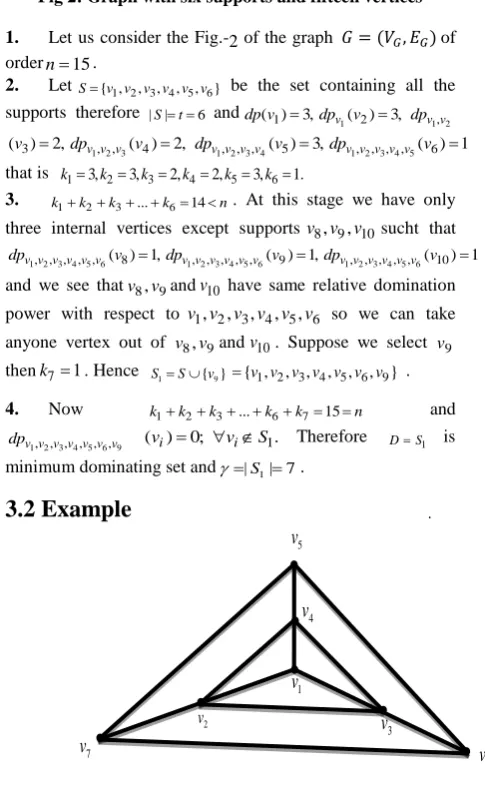
Fig 2: Graph with six supports and fifteen vertices
1. Let us consider the Fig.-2 of the graph of ordern15.
2. LetS{ ,v v v v v v1 2, 3, 4, 5, 6} be the set containing all the supports therefore |S| t 6 and
1 1 2
1 2 ,
( ) 3, v( ) 3, v v
dp v dp v dp
1 2 3 1 2 3 4 1 2 3 4 5
3 , , 4 , , , 5 , , , , 6
(v )2,dpv v v(v )2, dpv v v v (v )3,dpv v v v v (v ) 1
that is k13,k23,k32,k42,k53,k61.
3. k1k2k3 ... k614n. At this stage we have only
three internal vertices except supportsv v v8, 9, 10sucht that
1,2, ,3 4, ,5 6( 8) 1, 1,2, ,3 4, ,5 6( 9) 1, 1,2, ,3 4, ,5 6(10) 1 v v v v v v v v v v v v v v v v v v
dp v dp v dp v
and we see thatv v8, 9andv10 have same relative domination power with respect to v v v v v v1, 2, 3, 4, 5, 6 so we can take anyone vertex out of v v8, 9andv10. Suppose we select v9
thenk71. Hence S1 S { }v9 { ,v v v v v v v1 2, 3, 4, 5, 6, 9} .
4. Now k1k2k3 ... k6k715n and
1,2, ,3 4, ,5 6,9 v v v v v v v
dp ( )vi 0; vi S1. Therefore DS1 is minimum dominating set and|S1| 7 .
3.2 Example
Fig 3: Graph without any support
1. Let be the graph as given Fig. 3 such that
7
n and t0.
2. Since there is no support in G therefore we construct the set Sby taking the vertex having maximum domination power.
Now dp v( )1 4, dp v( 2)5, dp v( 3)5, dp v( 4)5, 5
( ) 4,
dp v dp v( 6)4, dp v(7)4.
Since the vertex v v2, 3and v4 have maximum domination power, therefore we can take any vertex out ofv2,v3 andv4
as an element ofS.
3. Let us take v2 in Sthat is S{ }v2 and dp v( 2)5that isk15.
1
v
2
v
3
v
4
v
6
v
7v
5
v
1 v
2 v
3
v v4
5 v
6 v
7 v
8 v
9 v 10 v
15 v 13
v
12 v
11 v
14 v 1
v
2 v
3 v 4
v 5
v
6 v
[image:2.595.313.556.196.594.2]4. Since k1 5 n so we construct another set S1 by extending setS.
Now
2( 1) 0,
v
dp v
2( 3) 1,
v
dp v
2( 4) 1,
v
dp v
2(5) 2,
v
dp v
2( 6) 2,
v
dp v
2( 7) 2.
v
dp v
Since the vertex v v5, 6and v7 have same maximum relative domination power with respect to v2 therefore we can take anyone out of v v5, 6andv7in setS1.
5. Suppose we take v5 in S1 that is S1{ ,v v2 5} and
2( 5) 2
v
dp v , sok22.
6. Now k1k2 7 n, and
2 5( ) 0; 1.
v v i i
dp v v S
ThereforeDS1{ ,v v2 5}is a minimum dominating set and 1
|S | 2
.
4. MAIN RESULTS
4.1 Theorem
If Sbe the set of all supports of a connected graphG,then domination number |S| .
Proof:
Let Gbe a connected graph of order n and Sbe the set of all supports in Gsuch that |S|k. Then there are at-least kpendent vertices inG. Pendent vertices are dominated by either support or by itself. Therefore either each support or corresponding pendent vertex must be in dominating set.
Dk Thus k |S| .
4.2Theorem
If I be the set of all internal vertices of a tree T then connected domination number c| |.I
Proof:
Let T be a tree of order nand let | |I m that is there are minternal vertices inT.Obviously I is a sub tree of T and |N I( ) | n.HenceIis a connected dominating set of a treeT.Iis the smallest connected dominating set of tree T. If it is not so, letI'be another connected dominating set of treeT
such that I'I. Clearly at least one viI such that '.
i v I
Now two cases arise:
[image:3.595.317.557.75.220.2](i) When viIandviis a support of T such that viI'.In this case |N I( ') |n,so I'is not a dominating set of tree T.
(ii) When viI andvi is not a support of T such that '.
i
v I Clearly in this case I' is not connected.
Thus there exist no proper subset of Iwhich is connected dominating set for T. Hence I is the smallest connected dominating set forT and c | | .I
4.3 Example
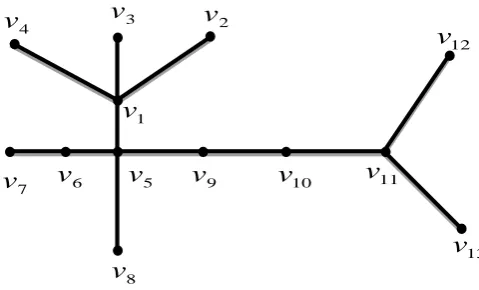
Consider the Fig. 4 of labelled tree with 13 vertices as given below:
Fig 4: Labelled tree with six internal vertices and seven pendent vertices
Here I{ ,v v v v1 6, 5, 9,v10,v11}and c 6 | | .I
In the next lemma a relation between
connected
domination
number
and
domination number for a tree has been
established.
4.4 Lemma
If domination number of a tree T is equal to number of support, then
c k
,
where k is the number of internal vertices which are not support.
Proof:
LetSbe the set of all support of a tree Tsuch that domination number|S|. Let kbe the number of internal vertices of T which are not support thenc
= number of internal vertices
c
= number of support + number of internal vertices which are not support.
c
= |S| + k
c
= + .k ( = |S|)
4.5 Example
In the following tree3, c4,andv2 is only internal vertex which is not support that isk1which verify the above result
c k
. 1
v
4
v
v
3v
25
v
6
v
7
v
8
v
9
v
v
10v
1112
v
13
12
Fig 5: Tree with one internal vertex without support
4.6 Corollary
If every internal vertex of a tree is support, then domination number and connected domination number of the tree are same.
Proof:
Consider a tree T with domination number and connected domination number c. Let k be the internal vertices but not support thenc k.Since every internal vertex of T is support that is there is no internal vertex which is not support therefore k0c.
Note: This corollary is also proved by Arumugam et al [2] as a theorem.
4.7 Example
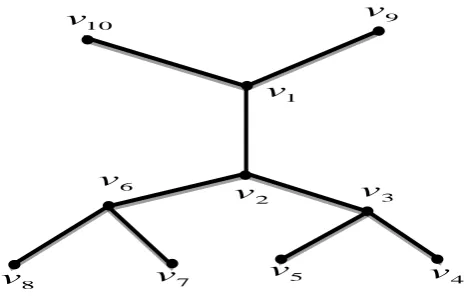
Consider the tree in Fig.-6 as given below:
[image:4.595.57.290.74.223.2]
Fig 6: Tree with all internal vertices are support
Herev v1, 2and v5 are three internal vertices which all are support and
3 c.
4.8 Theorem
If
T
be a tree with mpendent vertices then independence number ofT
isml , wherel is maximum number of internal vertices such that v vi, j I Sand viand vjarenot adjacent.
Proof:
LetEbe the largest set of independent vertices of a treeT
such that p p1, 2,p3,...,pm are m pendent vertices,1, 2, 3,..., t
s s s s aretsupports andi i i1 2, , ...,3 ik are k internal vertices except support of
T
,
then m t.Since each pendent vertex is adjacent only support and m t. Therefore; 1
i
p E i m
and si E; 1 i t.
Now out of k internal vertices which are not support let maximum l internal vertices are independent to each other. Suppose that these vertices are i i i1 2, , ,...,3 il then
; 1 .
j
i E j l
So
1 2 3 1 2 3
{ , , ,..., m; , , ,..., }l
E p p p p i i i i is the largest set of independent vertices for
T
and hence|E| m l.
4.9 Example
In Fig. 4;v v v v v v2, 3, 4, 7, 8, 12,v13are pendent vertices that is 7
m and v9,v10are two internal vertices except support but these two vertices are adjacent sol 1and
8 m l.
4.10 Corollary
If every internal vertex is support in a tree
T
,
then independence number ofT
is equal to number of pendent vertices inT
.Proof
:
LetT
be a tree with m pendent vertices then independence number ofT
is given bym l
,
wherel is maximum number of internal vertices such that ,
i j
v v I S
and viand vjare not adjacent. Since every internal vertex is support therefore l0 that is m
number of pendent vertices.
4.11 Example
Consider the tree in Fig.-6.Here v v1, 2 and v5 are three internal vertices which all are support andv v3, 4,v v6, 7and v8
are5 pendent vertices that ism5and 5 mwhich verify the result.
In the next theorem, a relation among
domination number, connected domination
number and independence number for a
tree has been established
.
4.12 Theorem
If in a tree T, every internal vertex except support are independent to each other then
.
c m
Proof:
LetT
be a tree such that every internal vertex except support are independent to each other than by result of corollary 4.6,,
c k
(1)
where k is the number of internal vertices which are not support. By result of theorem 4.8,
,
m l
(2) 1
v
v
23
v
4
v
5
v
6
v
v
78
v
1v
2
v
v
34
v
5
v
6
v
7
v
8
v
10
wherel is maximum number of internal vertices such that ,
i j
v v I S
and viand vjare not adjacent. Since every internal vertex except support are independent to each other thereforekl, using in equation (2) gives
m k k m
(3)
using equation (3) in equation (1) gives
c m
cm.
5. ACKNOWLEDGEMENT
This research work is supported by Gurukula Kangri University, Haridwar (UK), India. The authors are grateful to Dr. S. R. Verma for his valuable suggestions to improve the manuscript of this paper.
6. REFERENCES
[1] Harary, F., 1997 Graph Theory, Narosa Publishing House.
[2] Arumugam, S., Joseph, J. P. 1999 On graphs with equal domination and connected domination numbers, Discrete Mathematics vol.206, 45-49.
[3] Deo, N. 2005 Graph Theory with Applications to Engineering and Computer Science, Prentice-Hall of India Private Limited.
[4] Saoud, M., Jebran, J. 2009 Finding A Minimum Dominating Set by Transforming Domination of Vertices, Acta Universitatis Apulensis 19.