http://dx.doi.org/10.4236/jamp.2014.27062
The SABR Model: Explicit Formulae of the
Moments of the Forward Prices/Rates
Variable and Series Expansions of the
Transition Probability Density and of the
Option Prices
Lorella Fatone1, Francesca Mariani2, Maria Cristina Recchioni3, Francesco Zirilli4
1Dipartimento di Matematica e Informatica, Universitá di Camerino, Via Madonna delle Carceri 9,
Camerino, Italy
2Dipartimento di Scienze Economiche, Universitá degli Studi di Verona, Vicolo Campofiore 2, Verona, Italy 3Dipartimento di Management, Universit
á Politecnica delle Marche, Piazza Martelli 8, Ancona, Italy 4Dipartimento di Matematica “G. Castelnuovo”, Universitá di Roma “La Sapienza”, Piazzale Aldo Moro 2, Roma, Italy
Email: [email protected], [email protected], [email protected], [email protected]
Received 19 March 2014; revised 19 April 2014; accepted 28 April 2014
Copyright © 2014 by authors and Scientific Research Publishing Inc.
This work is licensed under the Creative Commons Attribution International License (CC BY).
http://creativecommons.org/licenses/by/4.0/
Abstract
ex-pressed using only elementary functions. The option pricing formulae are used to study synthetic and real data. In particular we study a time series (of real data) of futures prices of the EUR/USD currency's exchange rate and of the corresponding option prices. The website:
http://www.econ.univpm.it/recchioni/finance/w18 contains material including animations, an interactive application and an app that helps the understanding of the paper. A more general ref-erence to the work of the authors and of their coauthors in mathematical finance is the website: http://www.econ.univpm.it/recchioni/finance.
Keywords
SABR Stochastic Volatility Models, Option Pricing, Spectral Decomposition, FX Data
1. Introduction
Let us consider the SABR stochastic volatility model. This model has been introduced in mathematical finance in 2002 by Hagan, Kumar, Lesniewski, Woodward [1] to describe the time dynamics of forward prices/rates and is widely used in the financial markets.
Let , + be respectively the sets of real and of positive real numbers and let t be a real variable that de- notes time. The SABR model describes the dynamics of two variables: the forward prices/rates variable xt,
> 0
t , and the stochastic volatility variable vt, t> 0. The variables xt, vt, t> 0, are real stochastic pro- cesses that satisfy the following system of stochastic differential equations:
dxt=x v W ttβ td t, >0, (1) dvt =εv Q ttd t, >0, (2) where β∈
[ ]
0,1 and ε> 0 are real parameters. The parameters β and ε of (1), (2) are called respectively β-volatility and volatility of volatility. The choices β =0 and β =1 define respectively the normal and the lognormal SABR models and are not considered here. The normal and lognormal SABR models have been widely studied in the scientific literature (see, for example, [1]-[9]). In this paper we restrict our attention to the study of the case β∈( )
0,1 . The stochastic processes Wt, Qt, t> 0, are standard Wiener processes such that0 0 0,
W =Q = dWt, dQt, t> 0, are their stochastic differentials and we assume that:
(
d td t)
d , 0,E W Q =ρ t t> (3) where E
( )
⋅ denotes the expected value of ⋅ and ρ ∈ −(
1,1)
is a constant called correlation coefficient. The Equations (1), (2) are equipped with the initial conditions:0 0,
x =x (4)
0 0,
v =v (5) where x0 and v0 are random variables that we assume to be concentrated in a point with probability one. For
simplicity we identify these random variables with the points where they are concentrated. Moreover we assume
0, 0> 0
x v . The assumption v0 > 0 with probability one and Equation (2) imply that vt > 0 with probability one for t> 0. It is known that when β ∈
( )
0,1 the stochastic volatility model (1), (2) with the conditions (3), (4), (5) is underspecified (see [9] [10] [11]). In fact when β ∈( )
0,1 the origin of the forward prices/rates variable xt, t> 0, is “accessible” from x0> 0, and in the origin of the forward prices/rates variable equation(1) has not a unique solution. In order to guarantee the uniqueness of the solution of (1), (2), (3), (4), (5) and the no arbitrage condition we impose an absorbing barrier in zero to the forward prices/rates stochastic process xt,
> 0
the absorbing barrier just for simplicity. The results obtained here for this model can be extended to several mo- dels with other uniqueness conditions. The absorbing barrier in zero imposed to the forward prices/rates process implies that the time evolution defined by the model equations (1), (2) does not conserve probability. Despite this fact we continue to call probability density function the fundamental solution of the backward Kolmokorov equation associated to (1), (2) that satisfies the homogeneous Dirichlet boundary condition when the forward prices/rates variable is zero. This boundary condition imposed to the probability density function corresponds to the absorbing barrier in zero imposed to the forward prices/rates variable. The SABR model studied in this paper is defined by the equations (1), (2), (3), (4), (5), by the conditions x0, v0> 0, β ∈
( )
0,1 , ρ ∈ −(
1,1)
, ε> 0,and by the absorbing barrier in zero imposed to the forward prices/rates variable.
The practice of the financial markets has shown that in many circumstances this SABR model fits satisfac- torily the implied volatility curves associated to the observed option prices and is able to capture the dynamics of the implied volatility smile. Moreover it yields stable hedges of elementary portfolios built with the asset un- derlying the forward prices/rates variable and its derivative products (see, for example, [1] [12]). These facts jus- tify the use of the SABR model by the practitioners and the interest in the SABR model of the research com- munity. Some approximate expressions of the probability density function of the SABR model, of the corres- ponding European option prices and of the implied volatility associated to the option prices are available in the scientific literature. These formulae have been obtained using several mathematical methods, such as singular perturbation theory and heat kernel asymptotics (see [1] [13] [14]). For example an explicit formula (involving a one dimensional integral) for the transition probability density function of the SABR model when β =0 or
1
β = and ρ ∈ −
(
1,1)
has been obtained in [4]. Similar results are contained in [15] when β =1, ρ≤0 and in [7] for a modified SABR model. In [16] an option pricing problem is studied. Let t=0 be the current time,1> 0
T be the maturity time of the options considered and ε2T1 be the total volatility of volatility. The SABR
model for t∈
[
0,T1]
is studied and it is derived a series expansion in powers of the total volatility of volatilityof the transition probability density function of the variables xt, vt, t> 0, of the SABR model (1), (2), (3), (4), (5), β ∈
[ ]
0,1 , ρ ∈ −(
1,1)
, when no condition in zero is imposed to the forward prices/rates variable [16]. The terms of the expansion in powers of ε2T1 are obtained scaling the variables of the model and using a trans-formation of the bivariate normal function. Explicit formulae are given for the first three terms of the expansion in powers of ε2T1 of the probability density function and of the corresponding expansions of the European
option prices. The idea of imposing an absorbing barrier in zero to the forward prices/rates variable of the SABR model is discussed in [3]. In particular in [3] in order to price long dated options in the SABR model it is sug- gested the idea of completing the probability density function determined imposing the absorbing barrier in zero to the forward prices/rates variable adding a term proportional to a Dirac’s delta supported on the absorbing bar- rier. The choice of the Dirac's delta term restores the probability conservation during the time evolution.
In this paper for the previously specified SABR model we deduce a series expansion in powers of the cor- relation coefficient ρ of the transition probability density function. Explicit expressions of the first three terms of this expansion are derived. These terms are integrals of known integrands. In particular the zero-th order term of the expansion is a one dimensional integral whose integrand is expressed using only elementary functions. This is a new formula of the probability density function of the SABR model when ρ=0. Previously this pro- bability density function was known only through a formula consisting in a one dimensional integral of an ex- pression involving non elementary transcendental functions [9]. Related formulae have been derived by several authors. For example in [17] a formula for the marginal distribution of the forward prices/rates variable of the SABR model when ρ=0 is presented. The terms of the expansion of the probability density function present- ed in this paper are integrals of the product of a function depending on the forward prices/rates variable and the integration variable times a function depending on the stochastic volatility variable and the integration variable (see, for example, formula (34)). The integration variable, in general, is a vector valued variable and the corres- ponding integral is a multidimensional integral. Furthermore we show that for n≥1 the n-th order term of the expansion in powers of ρ of the probability density function of the SABR model can be written as the con- volution of the zero-th order term with a “forcing” function.
nalization” procedure makes possible to obtain integral formulae for the expansion terms. In particular the “di- agonalization” procedure shows that the zero-th order term of the expansion is a kind of convolution between two kernels, one depending from the transformed forward prices/rates variable and the other depending from the stochastic volatility variable. This last kernel has already been used in [4] to express the transition probability density function of the SABR model when β =0 or β =1 and ρ ∈ −
(
1,1)
, and in [9] [15] to study respec- tively a modified SABR model when β ∈[ ]
0,1 , ρ=0 and when β =1 and ρ ∈ −(
1,1)
. Previously the same kernel has been used in the study of the transition probability density function of the time integral of a geometric Brownian motion (see [15] [20]).Despite the fact that the SABR model with β∈
( )
0,1 and the absorbing barrier mentioned above does not conserve probability it is common practice to use the “risk neutral approach” to price options in the SABR mo- del framework as “expected values” of the discounted payoff functions. We follow this practice and we extend the method used to derive the expansion in powers of ρ of the transition probability density function to de- duce the corresponding expansions of the European call and put option prices in the SABR model. The terms of these expansions are integrals of known integrands. The integrands are expressed as the product of a function depending from the forward prices/rates variable and the integration variable times a function depending from the stochastic volatility variable and the integration variable. Some of these integrals are done analytically, this guarantees that (order by order in perturbation theory) the option prices can be obtained evaluating numerically integrals of the same dimension than those that must be evaluated to obtain the transition probability density function. Moreover these integrals due to the special structure of their integrands can be computed using ad hoc quadrature rules. The development of these ad hoc quadrature rules is beyond our purposes in this paper. Finally we study the moments of the forward prices/rates variable. For these moments we obtain closed form formulae that do not contain integrals or series expansions. These formulae are polynomials in the correlation coefficient ρ. The coefficients of these polynomials are closed form expressions containing only elementary functions of the remaining quantities defining the model. In [5] and [6] similar moment formulae have been obtained for the normal (i.e. β =0) and for the lognormal (i.e. β =1) SABR models.Some numerical experiments on synthetic and on real data are discussed. In particular using the option pricing formulae mentioned above we study the daily values of the futures price of the EUR/USD currency’s exchange rate having maturity September 16th, 2011 and of the daily prices of the corresponding European call and put options with expiry date September 9th, 2011 and strike prices Ki=1.375 0.005+
(
i−1)
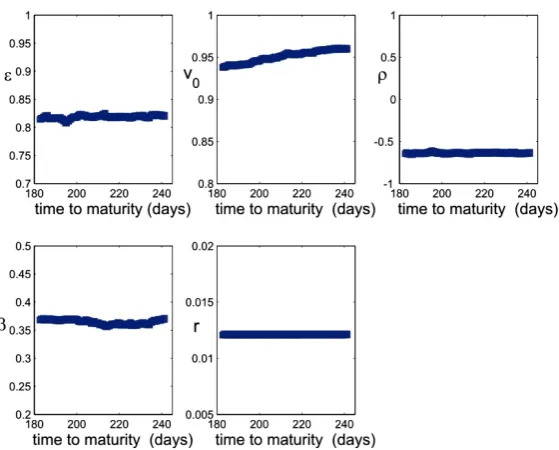
, i=1, 2,,18. The prices Ki, i=1, 2,,18, are expressed in USD. More specifically we study the daily closing prices of these contracts observed at the New York Stock Exchange in the time period going from September 27th, 2010, to July 19th, 2011.considered. Moreover the parameter values resulting from the calibration and the option pricing formulae are used to forecast option prices. The comparison between forecast option prices and option prices actually obser- ved in the market confirms the validity of the model and of the calibration procedure used.
The website: http://www.econ.univpm.it/recchioni/finance/w18 contains some auxiliary material including animations, an interactive application and an app that helps the understanding of this paper. A more general reference to the work of the authors and of their coauthors in mathematical finance is the website:
http://www.econ.univpm.it/recchioni/finance.
The remainder of the paper is organized as follows. In Section 2 we derive the expansion in powers of ρ of the transition probability density function associated to the SABR model (1), (2), (3), (4), (5) with the previously specified absorbing barrier. In Section 3, using “the risk neutral approach”, we derive the corresponding ex- pansions in powers of ρ of the European call and put option prices. In Section 4 we derive closed form for- mulae for the moments of the forward prices/rates variable xt, t>0. Finally in Section 5 we use the series ex- pansions of the option prices derived in Section 3 to study numerically time series of synthetic and real data.
2. The Series Expansion of the Probability Density Function
Let us study the transition probability density function of the stochastic processes xt, vt, t> 0, implicitly de- fined by (1), (2), (3), (4), (5) and by the absorbing barrier in zero imposed to xt, t> 0.
2.1. The Initial Value Problems Satisfied by the Expansion Terms Let us define the stochastic process:
[
)
1
, 0, 0,1 . 1
t t
x t
β
ξ β
β −
= > ∈
− (6)
From Equations (1), (2) and Ito's lemma it follows that ξt, vt, t> 0, satisfy the following system of sto- chastic differential equations:
(
)
1 2d d d , 0,
2 1
t t t t
t
v t v W t
β ξ
β ξ
= − + >
− (7)
dvt=εv Q ttd t, >0. (8) The initial conditions (4), (5) become:
1 0
0 0 ,
1
x β
ξ ξ
β −
= =
−
(9)
0 0.
v =v (10) An absorbing barrier in zero is imposed to the stochastic process ξt, t> 0. The barrier imposed to ξt, > 0
t , follows from the analogous barrier imposed to xt, t> 0.
Let pS
(
t x v t x v, , , , ,′ ′ ′)
, x, x′, v, v′, t, t′> 0, t′ −t> 0, be the transition probability density function of model (1), (2), (3), (4), (5) with the previously specified absorbing barrier imposed to xt, t> 0, that is let(
, , , , ,)
S
p t x v t x v′ ′ ′ , x, x′, v, v′, t, t′> 0, t′ −t> 0, be the probability density function of having xt′=x′, t
v′ =v′ given the fact that we have xt =x, vt =v when t′ −t> 0. Let p t
(
, , , ,ξ v t′ ′ ′ξ ,v)
, ξ, ξ ′, v, v′, t, t′> 0, t′ −t> 0, be the transition probability density function of model (7), (8), (3), (9), (10) with the absorbing barrier previously specified imposed to ξt, t> 0, that is let p t(
, , , ,ξ v t′ ′ ′ξ,v)
, ξ, ξ ′, v, v′, t,> 0
t′ , t′ −t> 0, be the probability density function of having ξt′ =ξ′, vt′ =v′ given the fact that we have t
ξ =ξ, vt=v when t′ −t> 0. We have:
(
, , , , ,)
d d(
, , , , ,)
d d , 1 , 1 ,1 1
, , , , , 0, 0. S
x x
p t x v t x v x v p t v t v v
x x v v t t t t
β β
ξ ξ ξ ξ ξ
β β
− ′−
′ ′ ′ ′ ′= ′ ′ ′ ′ ′ = ′=
− −
′ ′ ′> ′− >
(11)
Let us deduce the series expansion in powers of ρ of p. The function p is the solution of the backward Kolmogorov equation associated to (7), (8), that is:
(
)
2 2 2 2 2 2 2
2
2 2 ,
2 2 2 1
, 0, 0,
p v p v p p v p
v
t v v
v t t
ε ρε β
ξ β ξ ξ
ξ ξ
∂ ∂ ∂ ∂ ∂
− = + + −
∂ ∂ ∂ ∂ ∂ − ∂
′ > > >
(12)
with final condition:
(
, , , , ,)
(
) (
)
, , , , 0,p t′ξ v t′ ′ ′ξ v =δ ξ ξ δ− ′ v v− ′ ξ ξ′v v′> (13) and boundary condition:
(
, 0, , , ,)
0, , , 0, 0,p t v t′ ′ ′ξ v = ξ′v v′> t′> >t (14) where δ is the Dirac's delta. The Dirichlet boundary condition (14) imposes to the function p the condition that corresponds to the absorbing barrier in zero imposed to the stochastic process ξt, t> 0. Note that p does not depend from t and t′ separately, it depends only from s= − >t′ t 0. Let us introduce the function
(
)
(
)
* , , , , , , , , ,
p sξ ξv ′ ′v = p t ξ v t′ ′ ′ξ v , where s= −t′ t, ξ ξ ′, , , , ,v v t t′ ′> 0. From (12), (13), (14) it follows that
*
p is the solution of the partial differential equation:
(
)
* 2 2 * 2 2 2 * 2 * 2 *
2
2 2 , , , 0,
2 2 2 1
p v p v p p v p
v v s
s v v
ε ρε β ξ
ξ β ξ ξ
ξ
∂ ∂ ∂ ∂ ∂
= + + − >
∂ ∂ ∂ ∂ ∂ − ∂ (15)
with initial condition:
(
)
(
) (
)
*
0, , , , , , , , 0,
p ξ ξv ′ ′v =δ ξ ξ δ− ′ v−v′ ξ ξ′v v′> (16) and boundary condition:
(
)
*
, 0, , , 0, , , , 0.
p s vξ′ ′v = ξ′v v s′ > (17) Let us assume that:
(
)
(
)
* *
0
, , , , n , , , , n, , , , , 0,
n
p sξ ξv v p sξ ξv v ρ ξ ξ v v s
+∞ =
′ ′ =
∑
′ ′ ′ ′ > (18)where the functions p*n, n=0,1,, do not depend from ρ. Substituting the series (18) in (15), (16), (17), dif-
ferentiating (18) term by term and equating the coefficients of the terms of the same degree in ρ we obtain the following problems:
(
)
* 2 2 * 2 2 2 * 2 *
0 0 0 0
2 2 , , , 0,
2 2 2 1
p v p v p v p
v s
s v
ε β ξ
β ξ ξ ξ
∂ ∂ ∂ ∂
= + − >
∂ ∂ ∂ − ∂ (19)
(
)
(
) (
)
*
0 0, , , , , , , , 0,
p ξ ξv ′ ′v =δ ξ ξ δ− ′ v−v′ ξ ξ′v v′> (20)
(
)
*
0 , 0, , , 0, , , , 0,
p s vξ′ ′v = ξ′v v s′ > (21) and
(
)
* 2 2 * 2 2 2 * 2 * 2 *
2 1
2 2 , , , 0, 1, 2, ,
2 2 2 1
n n n n n
p v p v p v p p
v v s n
s v v
ε β ε ξ
β ξ ξ ξ
ξ −
∂ ∂ ∂ ∂ ∂
= + − + > =
∂ ∂ ∂ − ∂ ∂ ∂ (22)
(
)
* 0, , , , 0, , , , 0, 1, 2, ,
n
p ξ ξv ′ ′v = ξ ξ′v v′> n= (23)
(
)
* , 0, , , 0, , , , 0, 1, 2, .
n
p s vξ′ ′v = ξ′v v s′ > n= (24) Moreover from (19), (20), (21) and (22), (23), (24) we have:
(
)
(
)
2 *(
)
* * 2 1
0
0 0 0
, , , , d d d , , , , , , , , ,
, , , , 0, 1, 2, . s
n n
p
p s v v v p s v v v v v
v v v s n
ξ ξ ε τ ξ τ ξ ξ τ ξ ξ
ξ ξ ξ
+∞ +∞ ∂ −
′ ′ = − ⋅ ′ ′
∂ ∂ ′ ′ > =
∫ ∫
∫
Formula (25) is one of the formulae announced in the Introduction. In fact for n≥1 formula (25) gives pn*
as the convolution of the zero-th order term of the expansion p*0 with the “forcing” function 2 *
1
n
p− ξ v
∂ ∂ ∂ .
2.2. The Zero-th Order Term of the Expansion
Let be the set of complex numbers, i be the imaginary unit and let ν =1 2 1
(
(
−β)
)
, β ∈[
0,1)
. Note that when β ∈[
0,1)
we have ν ∈[
1 2 ,+∞)
. The formulae that follow, unless diversely specified, hold for1 2
ν ≥ , ε> 0.
Let us study problem (19), (20), (21). The function p0* solution of (19), (20), (21) can be written as follows:
(
)
( ) (
)
* *
0 , , , , 0 d , , , , , , , , , 0,
p sξ ξv v ξν λJν λξ C sλ ξv v ξ ξ v v s
+∞
′ ′ =
∫
′ ′ ′ ′ > (26)where Jν is the first kind Bessel function of index ν (see [21] pag. 358) and *
C is a function to be de- termined. It is easy to see that when the integral contained in (26) and its integrand are “well behaved” the function p*0 given by (26) satisfies the boundary condition (21). In fact when ξ =0 we have J
( )
0ν ν
ξ λξ = , > 0
λ . In order to determine the function *
C of (26) let us impose equation (19) under the integral sign in (26). We have:
( )
* 2 2(
)
* 2(
( )
)
* 2 2( )
2 *2 2
2 1
( ) ,
2 2 2
, , 0, 0.
C v v v C
J J C J C J
s v
v s
ν ν ν ν
ν ν ν ν
ν ε
ξ λξ ξ λξ ξ λξ ξ λξ
ξ ξ
ξ
ξ λ
∂ = ∂ + − − ∂ + ∂
∂ ∂ ∂ ∂
> >
(27)
Using [21] page 362 formula 9.1.52 Equation (27) becomes:
( )
* 2 2( )
* 2 2( )
2 *2 , , , 0, 0,
2 2
C v v C
J J C J v s
s v
ν ν ν
ν ν ε ν
ξ λξ = −∂ λ ξ λξ + ξ λξ ∂ ξ > λ>
∂ ∂ (28)
and from (26) we have:
* 2 2 2 2 *
2 *
2 , , 0, 0.
2 2
C v v C
C v s
s v
ε
λ λ
∂ = − + ∂ > >
∂ ∂ (29)
From [21] page 374 formula 9.6.1 and (29) it follows that *
C can be written as a Laplace transform, that is we have:
(
)
2 2 2(
)
* 8 2 *
0
, , , , e d e , , , ,
, , , 0, 0,
s s
i
C s v v v K v D v
v v s
ε ω ε
ω λ
λ ξ ω ω λ ω ξ
ε
ξ λ
+∞
− −
′ ′ = ⋅ ′ ′
′ ′ > >
∫
(30)where i is the imaginary unit, Kiω is the second kind modified Bessel function of index iω, also known as
Macdonald function (see [21] pag. 374), and D* is a function to be determined. From (26) and (30) we have:
(
)
2( )
2 2(
)
* 8 2 *
0 , , , , e 0 d 0 d e , , , , , , , 0.
ε ν ω ε
ν ω
λ
ξ ξ ξ λ λξ ω ω λ ω ξ ξ ξ
ε
+∞ +∞
− −
′ ′ = ⋅ ′ ′ ′ ′ >
∫
∫
s s
i
p s v v v J K v D v v v s (31)
To determine the function *
(
)
, , ,
D λ ω ξ′ ′v , ξ ′ ′,v > 0, λ ω, > 0, we impose to p0* the initial condition (20).
To do this we recall the following formulae (see [22] Section 11.2):
(
)
( ) ( )
0 d Jν Jν , , 0,
δ ξ ξ
λλ λξ λξ ξ ξ
ξ
+∞ ′ −
′ ′
=
∫
> (32)and (see [4] [23])
(
)
2 0( )
( )
( )
( )
2 1
d sinh π , , 0, , Re 0,
π ω ω
δ v v− ′ =
∫
+∞ ωω ω Ki βv Ki βv′ v v′> β∈ β >v (33)
where Re
( )
⋅ is the real part of the complex number ⋅ and sinh denotes the hyperbolic sine function. From (16), (31), (32), (33) we have:(
)
(
)
(
)
*
0 , , , , 0 d 0, , , 0, , , , , , , , , 0,
where L0,ν and V0,ε are given by:
(
)
( ) ( )
0, , , 1 , , 0, 0,
L J J
ν
ν ν ν ν
ξ
λ ξ ξ λ λξ λξ ξ ξ λ
ξ −
′ = ′ ′> >
′ (35)
(
)
( )
( )2 1
2 2 cosh 2
0, , , , 0 d 0, , 0 d e e e ,
, , 0, 0,
vv y v v
y
y u v v
v
V s v v u s u y
v v v v s
λ ε
ε λ ε
λ
′ ′
− − +
+∞ +∞ − ′
′ = Θ ⋅
′ ′ ′ > >
∫
∫
(36)where cosh denotes the hyperbolic cosine function and Θ0,ε is given by:
( )
( )
( )
( )
2 2
2 2
2
π 2
2 8
0, 2 2
1 e π
, e e sinh sin , , 0.
π π 2
s
u s
s u
s u u u s
s s
ε
ε ε
ε ε
ε −
−
Θ = >
(37)
From [24] page 146 formula 25 we have:
(
)
( )
( )
( )
2 2
1
0, 0 0, 2 2
2 cosh 2
, , , d , ,
2 cosh
, , 0, 0.
K v v vv u
v v
V s v v u s u
v v v vv u
v v s
ε ε
λ
λ ε
λ
ε λ
+∞
+ ′ + ′
′ = Θ ⋅
′ + ′ + ′
′ > >
∫
(38)Computing explicitly the integrals in the λ and y variables contained respectively in formulae (34) and (36) we have:
(
)
( ) (
)
(
(
)
(
)
)
(
)
(
)
(
)
* 0
3
2 2 2 2
0, 0
, , , ,
, , , , , , , ,
2 d , , , , , ,
, , , , , , , ,
, , , , 0,
p s v v
q u v v m u v v v v
u s u m u v v
v q u v v m u v v
v v s
ν ν ν
ε ν
ξ ξ
ξ ξ ν ξ ξ
ε ξ ξ ξ ξ
ξ ξ ξ ξ
ξ ξ
+∞ −
+ +
′ ′
′ ′ + ′ ′
′ ′ ′
= Θ ⋅
′ ′ ′ + ′ ′
′ ′ >
∫
(39)where
(
)
2 2( )
2(
2 2)
, , , , 2 cosh , , , , , 0,
q uξ ξv ′ ′v =v +v′ + vv′ u +ε ξ +ξ′ ξ ξ′v v u′ > (40)
and
(
)
(
)
2 2 2 4, , , , , , , , 4 , , , , , 0.
m uξ ξv ′ ′v = q uξ ξv ′ ′v − ξ ξ ε ξ ξ′ ′v v u′ > (41)
It is easy to see that the function q u
(
, , ,ξ ξv ′ ′,v)
2−4ξ ξ ε2 ′2 4is positive for u≥0, ξ, ξ ′, v, v′> 0. Moreover the function p*0 defined in (??) satisfies the boundary condition (21). In fact when ξ =0 the term
2ν
ξ is zero and the functions q and m are bounded in v, v′ for ,v v′> 0, ξ ′, u≥0 (i.e. the functions
q and m are “well behaved”).
Formula (39) of p*0 expresses the probability density function of the SABR model when ρ=0 using only
elementary functions. This last fact makes the numerical evaluation of (39) easy and efficient. Previously only a formula of p*0 as a one dimensional integral of an integrand involving non elementary transcendental functions
was known [9]. Note that using (11) from formula (39) that gives p*0 expressed in the variables ξt, vt, t≥0, it is easy to deduce the corresponding formula of the probability density function of the SABR model when
0
ρ = expressed in the variables xt, vt, t≥0. That is formula (39) and the analogous formula in the variables xt, vt, t> 0, are the formulae that have been announced in the Introduction for the probability density function when ρ=0.
For later convenience the function V0,ε defined in (38) is rewritten as follows:
(
)
( )
(
)
0, , , , 0 d 0, , 0, , , , , , , 0, 0,
(
)
( )
( )
2 2 1 0, 2 2 2 cosh, , , 2 ,
2 cosh
, 0, , 0.
K v v vv u
v v M u v v
v v v vv u
v v u
ε λ λ ε λ ε λ + ′ + ′ ′ = ⋅ ′ + ′ + ′
′ > >
(43)
Moreover let us define 0, 0, V D v ε ε ∂ =
∂ , , , > 0v v s′ , λ> 0. Using the identities satisfied by the Mcdonald functions (see [21] pag. 376, formula 9.6.28) we have:
(
)
(
)
( )
(
)
( )
(
)
(
)
0, 0, 0 0, 0,
0, 0, 1,
0
, , , , , , d , , , ,
3
d , , , , , , , , , , 0, 0,
2
D s v v V s v v u s u M u v v
v v
u s u M u v v M u v v v v s
v
ε ε ε ε
ε ε ε
λ λ λ
λ λ λ
+∞
+∞
∂ ∂
′ = ′ = Θ ′
∂ ∂
′ ′ ′
= Θ + > >
∫
∫
(44)where
(
)
(
( )
)
( )
( )
2 2
2 2
1, 2 2
2 cosh
, , , 2 cosh ,
2 cosh
, 0, , 0.
K v v vv u
v v
M u v v v v u
v v vv u
v v v u
ε λ λ ε λ ε λ + ′ + ′ ′ = + ′ ⋅ ′ ′ + + ′ ′ > >
(45)
Formulae (44), (45) will be used later.
2.3. The First and Second Order Terms of the Expansion Let us consider the functions *
1 p , *
2
p defined in (18). Proceeding as in Section 2.2 it can be shown that chang- ing the integration order in (25) when n=1 we have:
(
)
(
) (
)
*
1 , , , , 0 d 0 0 d 1 1, 0, 1, , 1, , 0, 1, , ,
, , , , 0,
p s v v L V s v v
v v s
ν ε
ξ ξ ε λ λ λ λ ξ ξ λ λ
ξ ξ
+∞ +∞
′ ′ = ′ ′
′ ′ >
∫
∫
(46)where the functions L1,ν and V1,ε are given by:
(
)
(
)
(
)
1, 0, 1, , 0 d 0, 1, , 0, 0, , , , 0, 0, 1 0,
Lν λ λ ξ ξ ξL ν λ ξ ξ ξ L ν λ ξ ξ ξ ξ λ λ
+∞ ∂
′ = ′ ′> >
∂
∫
(47)and
(
)
2(
)
(
)
1, 0 1 0 0 0, 1 0, 0
0 1
, , , , d d , , , , , , ,
, , 0, , 0. s
V s v v vv V s v v V v v
v v v s
ε λ λ τ ε τ λ ε τ λ
λ λ
+∞ ∂
′ = − ′
∂ ′ > >
∫ ∫
(48)
Similarly changing the integration order in (25) when n=2 we have:
(
)
(
)
(
)
* 2
2 , , , , 0 d 0 0 d 1 0 d 2 2, 0, 1, 2, , 2, , 0, 1, 2, , ,
, , , , 0,
p s v v L V s v v
v v s
ν ε
ξ ξ ε λ λ λ λ λ λ ξ ξ λ λ λ
ξ ξ
+∞ +∞ +∞
′ ′ = ′ ′
′ ′ >
∫
∫
∫
(49)where the functions L2,ν and V2,ε are given by:
(
)
*(
*)
(
*)
2, 0 1 2 0 0, 2 * 1, 0 2
0 1 2
, , , , d , , , , , ,
, 0, , , 0,
Lν λ λ λ ξ ξ ξ L ν λ ξ ξ ξ Lν λ λ ξ ξ ξ ξ λ λ λ
+∞ ∂
′ = ′
∂ ′ > >
∫
(50)and
(
)
( )
2(
)
(
)
* * * *
2, 0 1 2 0 0 0, 2 * 1, 0 1
0 1 2
, , , , , d d , , , , , , , ,
, , 0, , , 0. s
V s v v v v V s v v V v v
v v v s
ε λ λ λ τ ε τ λ ε τ λ λ
λ λ λ
+∞ ∂
′ = ⋅ − ′
∂ ′ > >
Using (35) and the properties of the functions Jν (see [21] p. 361 formula 9.1.27) we have:
(
)
( ) (
) (
)
1, 0, 1, , 1 1 1 0 0, 1 , , > 0, 0, 1> 0,
ν
ν ν ν ν ν
ξ
λ λ ξ ξ λ λ ξ λ ξ λ λ ξ ξ λ λ
ξ −
′ = ′ ′
′
L J J Q (52)
and
(
)
( ) (
) (
) (
)
2, 0 1 2 2 1 2 0 0 1 1 2
0 1 2
, , , , , , ,
, 0, , , 0,
L J J Q Q
ν
ν ν ν ν ν ν
ξ
λ λ λ ξ ξ λ λ ξ λ ξ λ λ λ λ
ξ ξ ξ λ λ λ
−
′ = ′
′ ′ > >
(53)
where
(
)
2( ) ( )
1 0, d , , 0.
Qν λ η λ ξξJν ηξ Jν λξ λ η +∞
−
=
∫
> (54)Using (43), (44) we can rewrite the functions V1,ε, V2,ε, defined in (48), (51), as follows:
(
)
2(
)
(
)
1, 0 1 0 0 0, 1 0, 0
0 1
, , , , d d , , , , , , ,
, , 0, , 0,
s
V s v v vv V s v v D v v
v v s
ε λ λ τ ε τ λ ε τ λ
λ λ
+∞
′ = − ′
′ > >
∫ ∫
(55)
and
(
)
*( )
* 2(
*)
2(
*)
(
)
2, 0 1 2 0 0 0, 2 0 0 0, 1 0, 0
0 1 2
, , , , , d d , , , d d , , , , , , ,
, , 0, , , 0.
s
V s v v v v V s v v vv D v v D v v
v v s
τ
ε λ λ λ τ ε τ λ τ ε τ τ λ ε τ λ
λ λ λ
+∞ +∞
′ = − ⋅ ′ − ′ ′ ′
′ > >
∫ ∫
∫ ∫
(56)
The formulae (46), (49) for * 1 p , *
2
p are new. Similar formulae can be deduced for the higher order terms of the expansion, that is for the functions *
n
p , n≥3. These formulae become more and more involved when n
increases.
Note that given s> 0 to approximate the integrals (55), (56) using a quadrature rule it is sufficient to evaluate the functions V0,ε
(
τ λ, , ,v v′)
and D0,ε(
τ λ, , ,v v′)
on a grid of the set(
) (
)
[ ] [
)
[
)
[
)
{
τ λ, , ,v v′ τ λ, , ,v v′ ∈ 0,s × 0,+∞ × 0,+∞ × 0,+∞}
. This means that exploiting the “structure” of the integrands of (55), (56) ad hoc quadrature rules can be built to evaluate efficiently the integrals (55), (56). We do not consider the problem of building these quadrature rules here.3. The Series Expansion of the Option Prices
To price European call and put options in the SABR model we use the no arbitrage pricing theory. Let us as- sume that the risk free interest rate is constant in time. This hypothesis guarantees that the forward prices/rates variable xt, t> 0, is a martingale under the risk-neutral measure (see [25] Proposition 3.1). That is in this case the risk neutral measure used to compute the option prices coincides with the “physical” measure used to de- scribe the dynamics of xt, vt, t> 0, defined implicitly by (1), (2), (3), (4), (5) with the absorbing barrier in zero imposed to the variable xt, t> 0.
Let CS and PS be respectively the prices at time t=0 of a European call and put option having maturity time T > 0 and strike price E> 0. Under the assumption of constant risk free interest rate the no arbitrage theory implies that:
(
0, 0, ,)
e 0 d(
)
0 d(
0, 0, 0, , ,)
, 0, 0, , 0,+∞ +∞
−
+
=
∫
−∫
> rT
S S
C x v E T x x E vp x v T x v x v E T (57)
(
0, 0, ,)
e 0 d(
)
0 d(
0, 0, 0, , ,)
, 0, 0, , 0,+∞ +∞
−
+
=
∫
−∫
> rT
S S
P x v E T x E x vp x v T x v x v E T (58)
where
( )
⋅ =+ max , 0( )
⋅ and r is the risk free interest rate.(
)
( )
(
)
(
)
2 * *
0 0 2 0 0 0 0
0 0
e
, , , d d , , , , ,
2
, , , 0, rT
S
C x v E T E vp T v v
v E T
ν
ν ξ ξ ξ ξ
ν ξ − +∞ +∞ + = − >
∫
∫
(59)(
)
( )
(
)
(
)
* 2 *
0 0 2 0 0 0 0
0 0
e
, , , d d , , , , ,
2
, , , 0, rT
S
P x v E T E vp T v v
v E T
ν
ν ξ ξ ξ ξ
ν ξ − +∞ +∞ + = − >
∫
∫
(60)where E*=
( )
2ν 2ν E.In analogy with the analysis of Section 2.1, let us deduce the first three terms of the expansion in powers of ρ of CS and PS. We begin considering the expansion in powers of ρ of PS. Substituting (18) into Equation (60) and integrating term by term the resulting series we obtain the following formula:
(
)
( )
(
*)
0 0 2 , 0 0
0
0 0
e
, , , , , , ,
2
, , , 0, rT
n
S n S
n
P x v E T P v E T
x v E T
ν ρ ξ
ν − +∞ = = >
∑
(61) where(
*)
(
* 2)
*(
)
, 0 0 0 0 0 0
* 0 0
, , , d d , , , , ,
, , , 0, 0,1,
n S n
P v E T E vp T v v
v E T n
ν
ξ ξ ξ ξ ξ
ξ +∞ +∞ + = − > =
∫
∫
(62)
Let us recall the following formulae (see [21] pag. 484, formulae 11.3.20, 11.3.21, pag. 486 formula 11.4.17):
( )
( )
( )
1
0d , 0, Re 0,
x
y y Jν′ ν′− y =x Jν′ ν′ x x> ν′ >
∫
(63)( )
(
)
( )
( )
1 0
1
d , 0, Re 0.
2 1
x
y yν Jν y ν xνJν x x ν
ν
′ ′
− −
′+ = ′Γ ′+ − ′ > ′ >
∫
(64)Substituting (34), (35) in (62) and using formulae (63), (64) when n=0 we have:
(
)
( )
(
)
( )
(
(
)
)
( ) (
)
(
)
**
*
0, 0 0 0 0 0
* 2 *
0, 0 0 0 0, 0
1
0 0 0
* 0 0
, , , d
d d , , , d , , , ,
, , , 0, S
E
P v E T J
J
E vV T v v J B E W T v
v E T
ν
ν ν
ν ν
ε ν ν ε
ν
ξ ξ λλ λξ
λξ
ξ ξ λ ξ λ λξ λ λ
ξ ξ +∞ +∞ +∞ − = ⋅ − = >
∫
∫
∫
∫
(65)where E**=
( )
E* 1 2( )ν , and the functions Bν and W0,ε are given by:(
)
*( )
1( )
(
) ( )
(
)
1 1
* * ** ** ** ** *
1 1
1
, , , 0,
2
E
B E E E J E E J E E
ν ν ν
ν ν ν ν
λ
λ λ λ λ
ν
− − +
− +
−
= − + >
Γ (66)
and
(
)
(
)
0, , 0, 0 d 0, , , 0, , , 0 0, 0.
W ε T v λ =
∫
+∞ vV ε T λ v v T v > λ> (67) Substituting (46), (52) in (62) when n=1 we have:(
*)
( )
1,S 0, 0, , 0 0 d 1 1 1 0
P ξ v E T εξν λ λJν λ ξ +∞
=
∫
⋅
(
0 1)
(
*)
(
)
*0 0 1, 0 0 1 0 0
0
0
,
dλ Qν λ λ Bν λ ,E Wε T v, ,λ λ ξ, , ,v E T, , > 0, λ
+∞
where W1,ε is given by:
(
)
(
)
1, , 0, 0, 1 0 d 1, , 0, 1, 0, , , 0 0, 0, 1 0.
Wε T v λ λ vVε T λ λ v v T v λ λ
+∞
=
∫
> > (69)
Finally substituting (46), (53) in (62) when n=2 we have:
(
)
( )
(
)
(
)
(
)
(
)
0 1
* 2 *
2, 0 0 0 0 2 2 2 0 0 1 1 2 0 0 0
0 *
2, 0 0 1 2 0 0
,
, , , d d , d ,
, , , , , , , , > 0, S
Q
P v E T J Q B E
W T v v E T
ν ν
ν ν ν
ε
λ λ
ξ ε ξ λ λ λ ξ λ λ λ λ λ
λ λ λ λ ξ
+∞ +∞ +∞ = ⋅ ⋅
∫
∫
∫
(70)where W2,ε is given by:
(
)
(
)
2, , 0, 0, 1, 2 0 d 2, , 0, 1, 2, 0, , , 0 0, 0, 1, 2 0.
W ε T v λ λ λ vV ε T λ λ λ v v T v λ λ λ
+∞
=
∫
> > (71)
Let us deduce the expansion in powers of ρ of the European call option price CS corresponding to the expansion (61) of the European put option price PS. Substituting (18) in (59) and integrating term by term the resulting series we obtain the following formula:
(
)
( )
(
*)
0 0 2 , 0 0
0
0 0
e
, , , , , , ,
2
, , , 0,
rT n
S n S
n
C x v E T C v E T
v E T
ν ρ ξ
ν ξ − +∞ = = >
∑
(72) where(
)
(
2 *)
*(
)
, 0 0 0 0 0 0
0 0
, , , d d , , , , ,
, , , 0, 0,1, 2,
n S n
C x v E T E vp T v v
v E T n
ν
ξ ξ ξ ξ
ξ +∞ +∞ + = − > =
∫
∫
(73)
It is easy to see that:
(
)
(
)
( )
(
)
(
)
2 * *
0 0 0 0 2 0 0 0 0
0 0
e
, , , , , , d d , , , , ,
2
, , , 0.
rT
S S
C x v E T P x v E T v E p T v v
x v E T
ν
ν ξ ξ ξ ξ
ν − +∞ +∞ − = − >
∫
∫
(74)Relation (74) is the analogous in the SABR model context of the well known put-call parity relation of mathematical finance. Substituting the expansions (18), (61), (72) in (74) and imposing (74) order by order in powers of ρ we obtain the following formulae:
(
)
(
)
(
)
(
)
(
)
(
)
* *
, 0 0 , 0 0
2 * * *
0 0 1, 0 0 0, 0 0
0 0
* 0 0
, , , , , ,
d d , , , , , , , , ,
, , , 0, 0,1, ,
n S n S
n n n
C v E T P v E T
v E p T v v S T v E S T v
v E T n
ν
ξ ξ
ξ ξ ξ ξ ξ ξ
ξ +∞ +∞ − = − = − > =
∫
∫
(75)where the functions S0,n, S1,n, n=0,1,, are given by:
(
)
*(
)
0, 0 0 0 0 0 0
0 0
, , d d , , , , ,
, , 0, 0,1, ,
n n
S T v v p T v v
T v n
ξ ξ ξ ξ
ξ +∞ +∞ = > =
∫
∫
(76)
(
)
2 *(
)
1, 0 0 0 0 0 0
0 0
, , d d , , , , ,
, , 0, 0,1, .
n n
S T v v p T v v
T v n
ν
ξ ξξ ξ ξ
ξ +∞ +∞ = > =
∫
∫
(77)
Formula (75) is simply the “put-call parity” relation (74) written order by order in powers of ρ.
(
)
(
)
(
( )
)
( )
(
)
2 2 2 2
0 0 0
2 2
0,0 0 0 0 0 0 0 0, 0 2 2
0 0
0 0
2 cosh
, , 2 d , d ,
2 cosh
, , 0,
v v vv u
S T v v v u T u v
v v vv u
T v
ν ν ν
ε
ε ξ
ξ ξ ε
ξ
−
+∞ +∞ + + +
= Θ ⋅
+ + >
∫
∫
(78)where Θ0,ε is given by (37).
From formulae (34), (35), (36), [24] formula (18) pag. 197, formula (28) pag. 146, formula 37 pag. 92, and [26] formula (2.32) we have:
(
)
21,0 , 0, 0 0 , , 0, 0 0.
S T ξ v =ξν T ξ v > (79) Substituting formulae (46), (49) in formulae (76) and (77) it follows that the functions S0,n and S1,n,
1, 2,
n= , satisfy the following recursive relation:
(
)
(
)
2(
)
, 1
2 *
, 0 0 0 0 0 0 0 0
0 0
, , d d d , , , , , , ,
, , 0, 0,1, 1, 2, .
T j n
j n
S
S T v vv p T v v v
v
T v j n
ξ ε τ ξ τ ξ ξ τ ξ
ξ ξ
+∞ +∞ ∂ −
= ⋅ −
∂ ∂ > = =
∫ ∫
∫
(80)
Substituting (79) in (80) when j=1 we have:
(
)
1,n , 0, 0 0, , 0, 0 0, 1, 2, .
S T ξ v = T ξ v > n= (81)
Formulae (79), (80) and (81) imply that:
(
)
(
)
2 * 2
0 0 0 0 0
0 dv 0 d p T, ,v, ,v , ,T ,v 0, 1,1 .
ν ν
ξξ ξ ξ ξ ξ ρ
+∞ +∞
= > ∈ −
∫
∫
(82)From (78), (80), (81), (65), (68), (70) and (75) it is possible to obtain formulae for Cn S, , n=0,1, 2, analogous to the formulae (65), (68), (70) obtained for Pn S, , n=0,1, 2. For the terms Pn S, , Cn S, , n≥3, expressions analogous to the ones obtained for the terms with n=0,1, 2, can be deduced. These formulae become more and more involved when n increases and are omitted for simplicity.
4. The the Forward Prices/Rates Moment Formulae
Let us consider the moments of the forward prices/rates variable xt, t> 0. Let m
(
s x v, 0, 0, , ,ε ρ ν)
, s, x0, 0> 0v , ε> 0, ρ∈ −
(
1,1)
, ν∈[
1 2 ,+∞)
be the m-th order moment of the forward prices/rates variable xt, > 0t , m=1, 2,, that is:
(
)
(
)
(
)
[
)
0 0 0 0 0 0
0 0
, , , , , d d 0, , , , , ,
, , 0, 0, 1,1 , 1 2 , , 1, 2, . m
m s x v v xx pS x v t x v
s x v m
ε ρ ν
ε ρ ν
+∞ +∞ =
> > ∈ − ∈ +∞ =
∫
∫
(83)
From (11) and (18) we have:
(
)
( )
(
)
(
)
[
)
0 0 2 , 0 0
0 1
0
0 0 0
1
, , , , , , , ,
2
, , , 0, 0, 1,1 , 1 2 , , 1, 2, ,
1
n
m m m n
n
s x v S s v
x
s x v m
ν β
ε ρ ν ρ ξ
ν
ξ ε ρ ν
β
+∞ = −
=
= > > ∈ − ∈ +∞ =
−
∑
(84) where(
)
( )
2 *(
)
, 0 0 0 0 0 0
1 0
0 0 0
, , d d , , , , ,
, , , 0, 1, 2, , 0,1, .
1
m
m n n
S s v v p s v v
x
s x v m n
ν β
ξ ξ ξ ξ ξ
ξ β
+∞ +∞ −
=
= > = =
−
∫
∫
(85)
Recall that in Section 3 we have already considered the functions S0,n and S1,n, n=0,1,, and that these
functions have been expressed with the formulae (78), (79), (80), (81).
for the functions Sm,0, m=1, 2,, we have:
(
)
2 2
2 2 2 2
,0 ,0 ,0 ,0
2 2
2 1
,
2 2 2
, , 0, 1, 2, ,
m m m m
S v S v S v S
s v
s v m
ν ε
ξ ξ
ξ ξ
∂ ∂ ∂ − ∂
= + −
∂ ∂ ∂ ∂
> =
(86)
(
)
2,0 0, , , , , 0, 1, 2,
m m
S ξ v =ξ ν ξ v> m= (87)
(
)
,0 , 0, 0, 0, , 1, 2, , m
S s v = s> v m= (88) for the functions Sm n, , n=1, 2,, m=1, 2,, we have:
(
)
2 2 2
2 2 2 2
, , , , 2 , 1
2 2
2 1
,
2 2 2
, , 0, 1, 2, , 1, 2, ,
m n m n m n m n m n
S v S v S v S S
v
s v v
s v n m
ν
ε ε
ξ ξ ξ
ξ ξ
−
∂ ∂ ∂ − ∂ ∂
= + − +
∂ ∂ ∂ ∂ ∂ ∂
> = =
(89)
(
)
, 0, , 0, , 0, 1, 2, , 1, 2, ,
m n
S ξ v = ξ v> n= m= (90)
(
)
, , 0, 0, , 0, 1, 2, , 1, 2, . m n
S s v = s v> n= m= (91) It is easy to see that:
(
)
21,0 , , , , , 0,
S sξ v =ξ ν sξ v≥ (92) is the solution of problem (86), (87), (88) when m=1. Substituting (92) in the Equation (89) we obtain:
(
)
1,n , , 0, , , 0, 1, 2, .
S sξ v = sξ v≥ n= (93) Substituting formulae (92), (93) in (84) when m=1 we have:
(
)
(
)
[
)
1 s x v, 0, 0, , ,ε ρ ν =x s x v0, , 0, 0>0,ε>0,ρ∈ −1,1 ,ν∈1 2 ,+∞ .
(94)
Recall that 1
(
) ( )
1 2( )1 2
x β x ν
ξ = − −β = ν
. We seek Sm,0, m=2, 3,, solution of problem (86), (87), (88), in the following form:
(
)
2 *( )
*,0 , ,0
0
, , , , , , 0, 2, 3, ,
n
m j n
m j m
j
S sξ v ξ ν R s v ξ − ξ v s m
=
=
∑
> = … (95)where for m=2, 3,, the index n*=n*
( )
mis an integer such that the function Sm,0 expressed as a function
of x is zero when x=0. It is easy to see that if n*=n*
( )
m, m=2, 3,, satisfies the inequality:
(
*)
2mν−n >0,m=2, 3,, (96) the function Sm,0, m=2, 3,, given by (95) is zero when x=0. The largest integer
( )
*
n m , m=2, 3,, that satisfies (96) is:
( )
(
)
* *
2 1 1, 2, 3, ,
n =n m = m− ν+ m= (97) where
[ ]
⋅ denotes the integer part of ⋅.Moreover from (87) it follows that:
( )
( )
* *
*
, ,0 0, 1, , ,0 0, 0, 0, 1, 2, , , 2, 3, .
n m n j m
R v = R − v = v> j= n m= (98) Substituting (95) into equation (86) and equating the coefficients of the powers of ξ of the same degree we obtain the following initial value problems:
for the functions Rn*−j m, ,0,
*
0,1, ,
j= n , m=2, 3, we have:
* *
2 2 2
, ,0 , ,0
2 , , 0, 2, 3, ,
2
n m n m
R v R
v s m
s v
ε
∂ ∂
= > =
∂ ∂ (99)
( )
*, ,0 0, 1, 0, 2, 3, ,
n m
(
)
* * *
2 2 2
1, ,0 1, ,0 2 , ,0
2 2 , , 0,
2 2, 3, ,
n m n m n m
R v R R
m v v s
s v v
m
ε ερ ν
− −
∂ ∂ ∂
= + >
∂ ∂ ∂
=
(101)
( )
* 1, ,0 0, 0, 0, 2, 3, ,
n m
R − v = v> m= (102) and
(
)(
)
* *
* 2
2 2 2
, ,0 , ,0
2 2, ,0
*
2 2 2 2 2 ,
2 2
, 0, 2, 3, , 2, 3, , ,
n j m n j m
n j m
R v R v
m j m j R
s v
v s m j n
ε ν ν ν
− −
− +
∂ ∂
= + − + − − +
∂ ∂
> = =
(103)
( )
*
* , ,0 0, 0, 0, 2, 3, , 2, 3, , .
n j m
R − v = v> m= j= n (104) The solutions of the problems (99), (100) and (104), (102) are respectively:
( )
*, ,0 , 1, , 0, 2, 3, ,
n m
R s v = v s> m= (105)
( )
* 1, ,0 , 0, , 0, 2, 3, ,
n m
R − s v = v s> m= (106) and the solutions of the problems (103), (104) are:
( )
(
) (
(
)
)
(
)( )
(
)
* *
2
, ,0 0 0 2, ,0
*
1
, 2 2 2 1 2 d d , , , ,
2
, 0, 2, 3, , 2, 3, , ,
s
n j m n j m
R s v m j m j v s v v v R v
v s m j n
ν ν τ +∞ τ τ
− = − + − − + ⋅ ′Ψ − ′ ′ − + ′
> = =
∫ ∫
(107)
where the function:
(
)
( ( ) ( )) 2 2 2 ln ln 8 2 2 e, , e ,
2π
v v
s
s
v s v v
v v s
ε ε ε ′ − − − ′ Ψ =
′ ′ v v s, , > 0,′ (108)
is the solution of the following problem:
2 2 2
2 , , 0,
2
v
v s
s v
ε
∂Ψ ∂ Ψ
= >
∂ ∂ (109)
(
0, ,v v′)
δ(
v v′)
, ,v v′ 0.Ψ = − > (110)
For later convenience note that an elementary computation gives:
(
)( )
2 8 2(2 1)280 d , , e e ,
, 0, 0,1, .
q q s s q
v s v v v v v s q
ε ε
+∞ − −
′Ψ ′ ′ =
> =
∫
(111)
Using equations (105), (106), (107) we obtain the following formulae:
( )
(
) (
(
)
)
(
)( )
(
)
* *
2
, ,0 0 0 2, ,0
*
1
, 2 2 2 1 2 d d , , , ,
2
, 0, 2, 4, , 2 2 , 2, 3, ,
s
n j m n j m
R s v m j m j v s v v v R v
v s j n m
ν ν τ +∞ τ τ
− = − + − − + ⋅ ′Ψ − ′ ′ − + ′
> = =
∫ ∫
(112) and( )
* * , ,0 , 0, , 0, 2, 3, , 1, 3, , 2 2 1.n j m
R − s v = v s> m= j= n + (113) Formula (112) reduces to (92) when m=1. In fact from (112) when m=1 and j=2 we have
( )
* 2,1,0 , 0
n
R − s v = and this last formula implies that Rn*−j,1,0
( )
s v, =0, v, s> 0,*
3, 4, ,