POST CYCLIC BEHAVIOUR OF MALAYSIAN PEAT SOIL
HABIB MUSA BIN MOHAMAD
ii
POST CYCLIC BEHAVIOUR OF MALAYSIAN PEAT SOIL
HABIB MUSA BIN MOHAMAD
A thesis submitted in
fulfillment of the requirement for the award of the
Degree of Master of Civil Engineering
Faculty of Civil and Environmental Engineering
Universiti Tun Hussein Onn Malaysia
Dedicated to my beloved parents, family and friends.
Mohamad Bin Habib Ali @ Bacho
Nor Jamilah Binti Abdul Kadir
Tabanac Château
Larkin Residence
v
ACKNOWLEDGEMENT
In the name of Allah, the Most Gracious and the Most Merciful Alhamdulillah, all
praises to Allah for the strengths and His blessing in completing this thesis. I would
like to take this opportunity to express my heartfelt gratitude to all those who helped
me to make my thesis work a success.
First and foremost, I have to thank my parents for their love and support
throughout my life. I’m forever indebted to my family who, understanding the
importance of this study to me, you will always be in my heart where absence makes
the heart grow fonder. Special appreciation goes to my supervisor, Assoc. Prof. Dr.
Adnan Bin Zainorabidin (Director of Centre of Alumni Advancement and Relations,
Universiti Tun Husein Onn Malaysia) for his support, guidance and cooperation. His
invaluable help of advices and suggestions throughout the experimental and thesis
works have contributed to the success of this research. Like proverbial, you can’t
make bricks without straws. A bouquet of thanks to the RECESS members, Mrs.
Salina Binti Sani, Mr. Amir Zaki Bin Salikin and Mr. Mudzaffar Syah Bin Kamarudin,
dear colleagues and friends for the helps, experiences and cooperation. I express my
heart full thanks to all staffs in the Faculty of Civil and Environmental Engineering for
their helps and who had involved directly or indirectly contributed in this research,
your kindness means a lot to me. Last but not least, deeply from my heart with love
and faith, I would like to thank my sweet siblings and love, in Tabanac Château and
Larkin Residence for their outstanding and highly appreciated patience day and night
throughout the time of my study, May Allah blessed them all for ever. May Allah
ABSTRACT
In Malaysia, there are 2.4 million hectares of land covered by peat soil, with 1.5 million
hectares available in Sarawak alone. The conversion and draining of peatland for construction,
infrastructure, housing and industrial projects has created several maintenance issues that are
increasingly appearing on the peat soil. The conventional method that was used to design the
roads only considers soil shear strength through static load and does not take into account the
vehicular dynamic loading and shear strength thereafter. The purpose of this research is to
investigate the engineering properties of peat soils and evaluate the effects of peat soil
behaviour under static and dynamic loading. This is also to evaluate and establish the
post-cyclic undrained behaviour while comparing it to static monotonic stress-strain behaviour.
This research is focused on the post-cyclic shear strength of peat soil behaviour characteristics
based on cyclic loading and shear strength curves derived from triaxial test under consolidated
undrained conditions. Static and post-cyclic monotonic load tests were carried out on peat
soil samples from Parit Nipah, Johor (PNpt) and Penor, Pahang (PRpt). 175 specimens were
tested, and prepared under effective stresses at 13kPa, 25kPa, 50 kPa, 100 kPa and 200 kPa.
Whereas, dynamic load tests were carried out in different frequencies to simulate the loading
type such as vibration of machineries, wind, traffic load and earthquake in field from 0.5 Hz,
1.0 Hz, 1.5 Hz and 2.0 Hz with 100 numbers of loading cycles. Post-cyclic monotonic shear
strength results as compared to static test showed some significant changes in reduction of
stress-strain behaviour. Post-cyclic shear strength decreases with the increase in the
frequencies. Averagely, the PRpt has dominantly higher in reduction strength in post-cyclic
at 59.24% while PNpt is approximately about 58.72%. Prior to critical yield strain level, the
peat specimen experience a significant deformation. The deformation of peats triggers
changes in soil structures that causes reduction in stress-strain behaviour. Thus, it can be
concluded that the stress-strain behaviour of peat soil decreased after 100 numbers of cyclic
loading in post-cyclic test as compared to the static tests, and it decreased substantially when
vii
ABSTRAK
Terdapat 2.4 juta hektar tanah gambut di Malaysia, dengan 1.5 juta hektar sahaja terdapat di
Sarawak. Penukaran dan penyaliran tanah gambut untuk pembinaan, infrastruktur, perumahan
dan projek-projek perindustrian menyebabkan isu penyelenggaraan selepas pembinaan
semakin ketara pada tanah gambut. Kaedah konvensional telah digunakan dalam mereka
bentuk jalan raya dengan mempertimbangkan kekuatan ricih tanah melalui beban statik dan
tidak mengambil kira beban dinamik daripada kenderaan selepas itu. Tujuan kajian ini adalah
untuk menyiasat sifat-sifat kejuruteraan pada tanah gambut dan menilai kesan kelakuan tanah
gambut di bawah pembebanan statik dan dinamik. Ini juga adalah untuk menilai dan
menerbitkan tingkah laku tak tersalir selepas kitaran berbanding kelakuan tegasan-terikan
semasa ujian statik. Kajian ini memberi tumpuan kepada kekuatan ricih selepas getaran pada
tanah gambut dan ciri tingkah laku berdasarkan beban getaran dan lengkung kekuatan ricih
yang diperolehi daripada ujian tiga paksi di bawah keadaan tak tersalir disatukan. Ujian beban
statik dan selepas getaran dijalankan ke atas sampel tanah gambut dari Parit Nipah, Johor
(PNpt) dan Penor, Pahang (PRpt). 175 sampel telah diuji, dan berada di bawah tekanan
tegasan berkesan pada 13kPa, 25kPa, 50 kPa, 100 kPa dan 200 kPa. Manakala, ujian beban
dinamik yang dijalankan pada frekuensi yang berbeza untuk mensimulasikan jenis bebanan
seperti getaran jentera, angin, beban trafik dan gempa bumi di tapak daripada 0.5 Hz, 1.0 Hz,
1.5 Hz dan 2.0 Hz dengan 100 kali beban getaran. Selepas getaran, keputusan kekuatan ricih
telah dibandingkan dengan ujian statik dan terdapat beberapa perubahan penting dalam
pengurangan kelakuan tegasan-terikan. Kekuatan ricih selepas getaran berkurangan dengan
peningkatan frekuensi. Secara purata, PRpt adalah lebih dominan kearah kekuatan yang lebih
tinggi dan pengurangan slepas getaran adalah pada kadar 59.24% manakala PNpt adalah pada
kadar 58.72%. Sebelum tahap ketegangan kritikal dihasilkan, specimen tanah gambut telah
mengalami perubahan bentuk yang ketara. Perubahan bentuk tanah gambut bermaksud
perubahan dalam struktur tanah yang menyebabkan pengurangan dalam tingkah laku
tegasan-terikan. Oleh itu, dapat disimpulkan bahawa kelakuan tegasan-terikan tanah gambut menurun
selepas 100 kali beban getaran selepas berlku getaran berbanding dengan ujian statik dan
TABLE OF CONTENT
TITLE ii
DECLARATION iii
DEDICATION iv
ACKNOWLEDGEMENTS v
ABSTRACT vi
ABSTRAK vii
TABLE OF CONTENTS viii
LIST OF TABLE xii
LIST OF FIGURE xiv
LIST OF SYMBOL AND ABBREVIATION xviii LIST OF APPENDICES xix CHAPTER 1: INTRODUCTION
1.1Background of study 1
1.2Problem statement 4
1.3Objective of study 4
1.4Scope of study 5
1.5Significant of Study 6
CHAPTER 2: LITERATURE REVIEW
2.1Introduction 7
2.2Peat soil 8
2.3Peat content and formation 9
2.4Peat Area in Malaysia 10
ix
2.6Engineering Properties of Peat 14
2.7Shear Strength of Peat Soil 22
2.7.1 Undrained Shear Strength 23
2.8Static Test 24
2.8.1 Consolidated Undrained Triaxial Test 26
2.8.2 Static Testing Program 30
2.9 Dynamic Loading Test 35
2.10 Post-Cyclic Shear Strength of Peat Soil 41
2.11 Review of Post Cyclic Response on Peat Soil 44
2.12 Post-Cyclic Undrained Monotonic Behaviour 50
2.13 Post-Cyclic Normalized Undrained Shear Strength 51
2.14 Research Drives 52
CHAPTER 3: METHODOLOGY
3.1Introduction 53
3.2Research methodology 54
3.3Site Location 55
3.4Site Conditions during Sampling 57
3.4.1 Parit Nipah, Batu Pahat, Johor 56
3.4.2 Penor, Pekan, Pahang 59
3.5Sampling Method 60
3.5.1 Disturbed Sampling Method 60
3.5.2 Undisturbed Sampling Method 61
3.6Index Properties 64
3.6.1 Particle Size Distribution 66
3.6.2 Degree of Humification 67
3.6.3 Specific Gravity 68
3.6.4 Moisture content 70
3.6.5 Organic Content 71
3.6.6 Liquid Limit 73
3.6.7 Fibre Content 74
3.6.8 pH test 75
3.7Standard Procedure for Triaxial Checking Transducers
3.7.1 Calibration of Cell Pressure 77
3.8Static Test 78
3.8.1 Monotonic Triaxial Test 78 3.8.2 Specimen Preparation 79 3.8.3 Saturation Stage 82 3.8.4 Consolidation Stage 82 3.9Shearing Stage 83 3.10Dynamic Stage 84 3.10.1 Cyclic Triaxial Test 85 3.11Post-Cyclic Shear Test 87 3.12ELDYN Software Test Procedure 87
3.12.1 Saturation Stage 88
3.12.2 Consolidation Stage 90 3.12.3 Shearing Stage 91 3.12.4 Cyclic Stage 92 3.12.5 Post-Cyclic Shear Stage 94
3.13Data Encapsulation and Analysis 96
CHAPTER 4: DATA ANALYSIS AND DISCUSSION 4.1Introduction 94
4.2Index Properties Test 95 4.2.1 Degree of Humification Test 95 4.2.2 Particle Size Distribution Test 96 4.2.3 Specific Gravity Test 98 4.2.4 Liquid Limit Test 98
4.2.5 Moisture Content Test 99 4.2.6 Organic Content Test 100
4.2.7 Fibre Content Test 101
4.2.8 pH Test 101
4.3Summary of Index Properties 102
4.4Monotonic Triaxial Test 104
4.4.1 Repeatability of Test 104
4.4.2 Static monotonic test 106
xi
4.5.1 Cyclic Triaxial Behaviour Analysis 114
4.5.2 Pore Water Pressure Behaviour 115
4.6Post-Cyclic Behaviour of Peat 121
4.7Effect of Cyclic Strain 121
4.7.1 Stress-Strain Behaviour 122
4.7.2 Excess Pore Water Pressure 132
4.8Undrained Post-Cyclic Monotonic Behaviour 139
4.8.1 Shear Stress 139
4.9Variation of Post-Cyclic Normalized 145
4.9.1 Normalized Undrained Shear Strength 145
4.9.2 Normalized Excess Pore Water Pressure 149
4.10 Triaxial Test Mode of Failure 154
4.11 Chapter Summary 155
CHAPTER 5: CONCLUSIONS AND RECOMMENDATION 5.1 Introduction 159
5.2 Conclusion 160
Objective 1 - The Physical Properties of Peat Soil in Parit Nipah, Johor and Penor, Pahang. 161
Objective 2 – Peat Soils Behaviour under Static and Cyclic Loading. 163
Objective 3 - Establishment of Post-Cyclic Behaviour of Peat Soil. 165
Objective 4 - Static and Post-Cyclic Monotonic Stress-Strain Behaviour 167
5.3 Recommendation for Further Investigation 169
REFERENCE 170
LIST OF TABLE
1.0 Status of peat soil areas in Malaysia. 2
2.1 Descriptions of Peat 8
2.2 The estimated extent of peat cover in Malaysia 11
2.3 Characteristic of peat swamps in Malaysia 12
2.4 The Von Post Scale for Assessing Peat
Decomposition 13
2.5 Tabulated of Peat Soil Properties in Malaysia 17
2.6 Summary of Laboratory Tests 19
2.7 Summary of Definition and Significant Index
Properties Tests 20
2.8 Principal characteristics of the examined peat 29
2.9 Amplitude values in monotonic triaxial test 32
2.10 Dynamic Parameter from Past Researcher 40
2.11 Typical test frequency ranges for cyclic triaxial testing 40
2.12 The definition of post-cyclic study from
various researcher 42
2.13 Tabulated of Post-cyclic Past Researcher 49
3.1 Specimen labelled in symbol of peat
based on Location 56
3.2 Summary of Laboratory Tests 74
3.3 Schedule of Calibration Triaxial Apparatus 76
3.4 Calibration of Cell Pressure 77
3.5 Cyclic Properties and Number of Sample 86
3.6 Components Function of ELDYN System 86
3.7 Target Required for Amplitude and Datum Values 94
4.1 Von Post Degree of Humification 95
xiii
4.3 Specific Gravity Test Results 98
4.4 Percentage of Moisture Content 100
4.5 Percentage of Organic Content 100
4.6 Percentage of Fibre Content 101
4.7 pH value of Tested Peat 102
4.8 Tabulated of Peat Soil Properties in Malaysia 103
4.9 Datum and Amplitude Values for Cyclic Loading 108
4.10 Tabulated of Maximum Deviator Stress
from Various Researchers 109
4.11 Shear Strength Properties Changes in
Post-Cyclic for PNpt 131
4.12 Shear Strength Properties Changes in
LIST OF FIGURE
1.1 Malaysia peat soil distribution map. 3
2.1 Peat subsidence at the eastern edge of South East
Pahang Peat Swamp Forest at the transition from
undisturbed forest to degraded peatland. 10
2.2 Profile morphology of drained organic soils 14
2.3 Relationship between Shear Strength,
Moisture Content and Degree of Humification 23
2.4 Results of Undrained Triaxial Shear Strength Test on 28
Undisturbed Peat Sample.
2.5 Triaxial test on peat specimen reinterpreted to determine 32
the shear strength of Penor peat, Pahang.
2.6 Pore pressure vs. axial strain for the undrained test. 34
2.7 Triaxial Test Mode Of Failure 34
2.8 Cyclic loading conditions in the laboratory to simulate 36
level ground and sloping ground conditions
2.9 Stress-versus-strain relationship for Vicksburg
silty clay under sustained and axial pulsating stress 37
2.10 Cyclic triaxial test at 100th number of cycles 38
2.11 Cyclic triaxial test results at 10 seconds 39
2.12 Datum setup for cyclic triaxial test 45
2.13 The influenced of cyclic loading to the shear
strength for PRpt. 45
2.14 Effect of cyclic loading on post-cyclic
behaviour of specimen 47
xv
2.16 Post-Cyclic Normalized Undrained Shear Strength
versus Sand Content 51
3.1 Methodology Flowchart 53
3.2 Field Location of Peat Sampling in Peninsular Malaysia. 56
3.3 Research on Peat Soil Station (REPEATS) Parit Nipah 57
3.4 Parit Nipah Site Location Encircled with Plantations 58
3.5 Road Deterioration in Parit Nipah 58
3.6 Access Road to Penor, Pekan, Pahang, Malaysia 59
3.7 Penor, Sampling Site in Bush Areas 59
3.8 Tube Sampler Planted 61
3.9 Illustration of the tube sampler setup condition 62
3.10 Tube sampler in vertical position and penetrate to the soil 62
3.11 (a) Sample waxed both ends and sealed (b) Sample storage 63
3.12 Sizes of Sieve Apertures 67
3.13 Representative Sample of Peat Squeezed 68
3.14 Specific Gravity Equipment 69
3.15 Kerosene and Peat Specimens Mixed in Pyconometre 69
3.16 Peat Specimens for Moisture Content Test 71
3.17 Loss of Ignition Peat Specimens 72
3.18 Cone Penetrometer Equipment 73
3.19 Cone Penetration Test Supported Equipment 74
3.20 Dispersing Agent and Reagent for Fibre Content Test 74
3.21 Electrometric pH meter set 76
3.22 GDS Enterprise Level Dynamic
Triaxial Testing System (ELDYN) 80
3.23 Monotonic Triaxial Test Tools 81
3.24 Monotonic Triaxial Test Tools 81
3.25 GDS Enterprise Level Dynamic Triaxial
Testing System (ELDYN) 85
3.27 Screen-shot for Saturation Ramp Setup – Stage 2 89
3.28 Screen-shot for B-Check Setup – Stage 3 89
3.29 Screen-shot for Consolidation Setup – Stage 4 90
3.30 Screen-shot for Shearing Consolidated
Undrained Setup – Stage 5 91
3.31 Screen-shot for Shearing – Axial Strain Setup – Stage 5 92
3.32 Screen-shot for Cyclic Loading Setup – Stage 6 92
3.33 Screen-shot for Cyclic Loading Setup – Stage 6 93
3.34 Screen-shot for Post-Cyclic Shear Setup – Stage 7 95
3.35 Screen-shot for Post-Cyclic Shear Axial
Strain Setup – Stage 7 95
4.1 Particle Size Distribution Graph 96
4.2 Penetration Graph for PNpt and PRpt 99
4.3 Repeatability of Static Testing 105
4.4 Stress-Strain Relationships at Different Effective
Stress, ’ for PNpt 107
4.5 Stress-Strain Relationships at Different Effective
Stress, ’ for PRpt 107
4.6 Pore Water Pressure of PNpt 110
4.7 Pore Water Pressure of PRpt 110
4.8 Stress-Strain Results Comparison with Various Researchers 112
4.9 Excess Pore Water Pressure Results
Comparison with Various Researchers 113
4.10 Relationships Pore Pressure Ratio, ru and
Number of Cycles for PNpt At frequencies 116
4.11 Relationships Pore Pressure Ratio, ru and
Number of Cycles for PRpt At frequencies 119
4.12 Relationships Pore Pressure Ratio, ru and
xvii
4.13 Relationships Deviator Stress, q and Axial Strain,
a for PNpt 124
4.14 Relationships Deviator Stress, q and
Axial Strain, a for PRpt 130
4.15 Relationships Excess Pore Pressure, u and
Axial Strain, a for PNpt 135
4.16 Relationships Excess Pore Pressure, u and
Axial Strain, a for PRpt 138
4.17 Relationships Shear Stress, and Shear Strain,
for PNpt with 141
4.18 Relationships Shear Stress, and Shear Strain,
for PRpt with 144
4.19 Normalized Undrained Shear Strength for PNpt
versus Frequencies. 147
4.20 Normalized Undrained Shear Strength for PRpt
versus Frequencies. 148
4.21 Normalized Excess Pore Water Pressure for PNpt
versus Frequencies. 152
4.22 Normalized Excess Pore Water Pressure for PRpt
versus Frequencies. 153
4.23 Failure Condition of Peat Soil 154
4.24 Failure Envelope for Static Test 156
LIST OF SYMBOL AND ABBREVIATION
PRpt - Penor peat
PNpt - Parit Nipah peat
POpt - Pontian peat
∆σ′ - Effective pressure
CTX - Cyclic triaxial
Cu - undrained shear strength
N - Number of cyclic
CIU - consolidated isotropic undrained
CU - Consolidated Undrained
q - Deviator stress
u - Pore pressure
a - Axial strain
Gs - Specific Gravity
LL - Liquid Limit
PL - Plastic Limit
rur - Pore Pressure Ratio
Su - NormalizedUndrained Shear Strength
umax - Maximum excess pore water pressures p’ - Mean effective stress
UTHM - Universiti Tun Hussein Onn Malaysia
RECESS – Research Center for Soft Soil Malaysia
xix
LIST OF APPENDIX
APPENDIX TITLE PAGE
A Influence of Cyclic Loading to the Shear 180
Strength of Peat Soil
B Comparison Study of the Dynamic Characteristics 181
Between Peat and Sand
C Post-Cyclic Behaviour of Soil – A Critical Review 182
D The Characteristics of Pontian Peat under 183
Dynamic Loading
E Pre- and Post-Cyclic Behaviour on Monotonic Shear 184
Strength of Penor Peat
F Post-cyclic Shear Strength Behaviour of Peat Soil 185
G Effect of Cyclic Loading on Post-Cyclic Behaviour of 186
CHAPTER 1
INTRODUCTION
1.1 Background of Study
Malaysia, comprising the regions of Peninsular, Sabah and Sarawak, supports some
of the most extensive tropical peatlands in the world. Tropical peat forest is found
mainly in Southeast Asia (Phillips, 1998) it was estimated at about 20 million
hectares, two-third of the total area of the world’s tropical peat swamps (Kyuma,
1992). In Peninsular Malaysia, they are found in the coastal areas of the east and
west coast, especially in the coastal areas of west Johore, Kuantan and Pekan district,
the Rompin-Endau area, northwest Selangor and the Trans-Perak areas in the Perak
Tengah and Hilir Perak district as shown in Figure 1.1. In Sarawak, peat occurs
mainly between the lower stretches of the main river course (basin peat) and in
poorly drained interior valleys (valley peats). They are found in the administrative
division of Kuching, Samarahan, Sri Aman, Sibu, Sarikei, Bintulu, Miri, and
Limbang. In Sabah, the organic soils are found on the coastal areas of the Klias
peninsula, Krah swamps in Kota Belud, Sugut and Labuk centuries and
Kinabatangan floodplains. The peat swamp forest is well represented in Borneo
(Phillips, 1998). The Klias Peninsular contained the largest pieces of peat swamp
2
Figure 1.1 Malaysia peat soil distribution map. (Wetlands International – Malaysia. March 2010)
However, Peat is in the category of problematic soil because it has low shear
strength and high compressibility, which are not suitable for construction (Said and
Taib, 2009). Peat soil is not suitable for the construction of embankment, highway, building or any other load bearing engineering structures due to the fact that it is
having extreme low shear strength and bearing capacity. In natural state, peat
consists of water and decomposed plant fragment with virtually no measurable
strength (Munro, 2004).
Therefore, it is essential to find an alternative to improve the strength since
nowadays lands are very expensive and very limited. Peat soil is not only soft, it is
compressible to where this characteristic will lead to excessive settlement which is a
very serious problem. Generally, peat soil is considered as a soft soil as it has high
settlement value even under moderate loading condition.
Sabah
Peat swamps cover about 2.7 million hectares in Malaysia. Nearly 63% of this
area or about 1.7 million hectares are in the East Malaysian state of Sarawak
according to Shenbaga and Huong (2009). Construction of road networks and other
infrastructural facilities on the peat land fairly difficult and the maintenance issue
after construction often rise up as major topic. Table 1.1 shows the proportionate
distribution status of peat soil areas in Malaysia. Values in parentheses are the
percentage proportion of total peat soil area and the data for peat swamp forest from
[image:21.595.116.520.319.441.2]the year 2000 (Wong, 2003). The total for moderately and severely disturbed peat land comprise Wong’s classes of medium and low density peat swamp forest.
Table 1.0: Status of peat soil areas in Malaysia. (Wetlands International – Malaysia. March 2010)
Regions Total peat soil area (ha)
Undisturbed/ relatively undisturbed (ha)
Moderately Disturbed (ha)
Peat soils under infrastructure (ha)
Peninsular Malaysia 642, 857 226, 026 (35) 66, 353 15, 512
Sabah 116, 965 21, 000 (18) 27, 757 17, 767
Sarawak 1, 697, 847 223, 277 (13) 488, 357 nd
Total 2, 457, 730 470, 303 (19) 582, 528 33, 633 (1)
*nd - not defined
Construction on peat soil will experience significant short-term and long-term
settlement with regard to stability and long-term settlements. In road design as an
example, conventional method used where the vehicular traffic on the roadway,
treated as static loads and the vehicular dynamic loading and shear strength thereafter
that related to the earthquake, rail transit or vibrating machinery that called
post-cyclic are not considered. Thus, Erken and Ulker (2008) has stated that, in
laboratory investigation, the post-cyclic monotonic shear strengths were evaluated
using various numbers of cycles of dynamic loading. This thesis has examined and
discuss the characterisation of the peat soil that has a significant effect to the
post-cyclic behaviour as well as the shear strength of peat soil. The response of soil
to cyclic loading are induced significant to the shear strength for a more practical
4
1.2 Problem Statement
Peat is known as a one of the most problematic soil in the construction industry.
Construction on peat soils has proven to be a challenging task to civil engineers since
this soil type has a very low bearing capacity and the settlement is high. Conversion
and draining of peatland for construction, infrastructure, housing and industrial
projects are occurring at an alarming technology to solve the maintenance issue after
construction that increase significantly. The peat layers itself in the subsoil lead to
irregular subsidence of roads, railways and foundations. In settlement analysis, it is
often that the long term compressibility parameters of peat is underestimated or
neglected. This situation can lead to problem regarding on the structure stability in
the future. For many years, in road design as an example, conventional method was
applied in designed the road by considering soil shear strength through static load
and do not take into account the vehicular dynamic loading and shear strength
thereafter. Shafiee et al., (2013) in prior study was investigated volume change
characteristics of peats associated with cyclic loading. The researcher has stated that,
the pore pressure generates during cyclic loading relatively low and undergoing
cyclic softening and induced strength lost but not has been formally investigated.
This research carried out to investigate the post-cyclic behaviour of peat soil and
changes in shear strength accordingly.
The characteristics of peat soil are high organic content, high water content,
large void ratio and high compressibility naturally influence the impact of uneven
settlement of subgrade on the surfaces of flexible pavements and often results in a
damage to buildings and engineering structures. In practice, the design engineer
more focus on shear strength based on static load. In this study, researcher stressed
on post-cyclic shear strength. The frequencies used in this research is simulation to
the dynamic loading and pulse frequency from 0.5Hz, 1.0Hz, 1.5Hz and 2.0Hz are
represented from traffic loading and up to the earthquake level to ensure that the
results of simulation are applicable to the real application. The knowledge of the
shear strength for post-cyclic behaviour of peat soil is essential as it enables
designers to understand the response of the soil when loaded and presentable
1.3 Objective of Study
Based on the study to examine the soil properties and identify the effect of
post-cyclic loading exerts a key role in tropical peat soil stability. The following
objectives therefore set out for this research.
a) To investigate the physical properties of peat soil.
b) To evaluate the effect of peat soil behaviour under static and cyclic
loading.
c) To establish the post-cyclic behaviour of peat soil.
d) To analyse static monotonic and post-cyclic monotonic stress-strain
behaviour.
1.4 Scope of Study
The aim of this study is to investigate the behaviour of peat soil under static and
dynamic loading. This research focused on the characteristic of peat soil samples
from Penor, Pahang (PRpt) and Parit Nipah (PNpt) Johor. The testing and evaluation
test for peat soil sample are conducted by using GDS Enterprise Level Dynamic
Triaxial Testing System (ELDYN) apparatus and load applied from top in
compliance to BS 1377-8: 1990. Laboratory tests for the peat soil are conducted in
Research Center for Soft Soil Malaysia (RECESS), Universiti Tun Hussein Onn
Malaysia (UTHM) Batu Pahat, Johor. This experimental research limits its scope on
the shear strength of peat soil that obtained from pre-cyclic test and post-cyclic test
in consolidated undrained condition. The frequencies of test are performed variously
at 0.5Hz, 1.0Hz, 1.5Hz and 2.0Hz. This research discovered the post-cyclic
6
1.5 Significant of Study.
This research is undertaken in academic study with a view to improve the designing
technique and emphasizing parameters in general. By its nature, it is expected that
policies of research will contribute to the development of the national construction
and technology industries for well developing project quality and enhancement of
design system. Design method and parameters consideration in order to produce
better product quality and applicable on site as well, the load design itself should be
derived in proper understanding to ensure the achievable idea in sustainability in
quality of construction method. At the end of this research, researcher expected to
share the factual correlation of undrained shear strength behaviour to improve and
refined so that the designing process and post construction issue can be minimised.
This research certainly gives an impact to the research to overcome the problem that
raised in peat soil. The effectiveness of this research are covered the applications
and implementations of post-cyclic method in the laboratory tested for peat soil
CHAPTER 2
LITERATURE REVIEW
2.1Introduction
It is well-known that Malaysia has very precious varieties of natural earth surface
even before the formation of the federation of Malaysia itself. Malaysia comprises
of the region of Peninsular Malaysia, Sabah and Sarawak. According to United
Nations Development Programme (UNDP, 2006), nearly 60 per cent of Malaysia or
about 19.5 million hectares is covered by forest of one type or another. Malaysia’s
tropical forest constitutes a significant component especially of peat soil that is
naturally available with an estimated 2.7 million hectares and predicted 1.54 million
hectares still remaining with the inclusion for more than 70 per cent of these peatland
forests are located in Sarawak, while less than 20 per cent of it is available in
Peninsular Malaysia and the remainder in Sabah as reported by the UNDP (2006).
At present, due to demands and human civilization necessities, large areas of
peat soil forests have already been cleared and converted for other uses and purposes.
The conversion aims to completely alter the landscapes for future development and
to take advantage of the land use in a more productive manner deemed fit for human
activities, settlements and industrial properties all in the name of economic
development for a greater Malaysia. The utilization of these peatlands in Malaysia is
one out of many options available, however, before compromising these peatlands
for construction, there are many economic factors that needs consideration, such as
budgets and others. Aside from that, the behaviour of the peat soil itself may result
in several major problems in the future after constructions which are highly related to
8
2.2 Peat Soil Definition
In Malaysia, some 3 million hectares of land is covered with peat. When
constructing roads or erecting any structures or human artificial edifices on
peatlands, the designer must understand both the common characteristics and failure
mechanisms that can initiate a peat slide. This is essential to ensure the construction
process does not trigger an unwanted event.
Peat materials can be characterized in various ways depending on the purpose
for which they are being used. Geotechnical engineers define peat soils as soils that
consist of organic content that is more than 75%, while soils that has organic content
below 75% is categorized as organic soils. However, in soil sciences, the soils that
have organic content more than 35% are classified as peat. In addition to that, the
definition of peat according to the ASTM D4427-13 (2013), peat is defined as soil
that is naturally available with high organic substance that is derived primarily from
plant materials. It is formed when organic matters, normally plant matters
accumulate more than it humidifies.
Duraisamy and Huat (2008) determine peat as a material that usually occurs
when organic matter is preserved below high water tables like in swamps or
wetlands. Consequently, with Ramsar’s (2002) statement, peatlands are wetlands
with a thick water-logged organic soil layer (peat) made up of dead and decaying
plant materials. Peatlands include moors, bogs, mires, peat swamp forests and
2.3 Peat Content and Formation
Peats is a type of soft soil composed from high contents of fibrous organic matters
and is produced from partial decomposition and disintegration of mosses, sedges,
trees, and other plants that grow in marshes and other wet places in a condition
where there is a lack of oxygen, according to Kazemian et al., (2011a). Peat is a mixture of fragmented organic materials formed in wetlands under appropriate
climatic and topographic conditions and it is derived from vegetation that has been
chemically changed and fossilized (Dhowian and Edil, 1980). In its natural state,
peats consist of water and decomposed plant fragments with virtually no measurable
strength (Munro, 2005).
Peats also contain high organic content, often more than 75%. The organic
contents present in peats are the remains of partially decomposed and disintegrated
plants. This happens in conditions where the rate of accumulation is more than the
rate of decay. Peats are accumulated if the rate of decay is slower than the rate of
addition (Bell, 2000). It accumulates whenever the conditions are suitable, that is, in
areas where there is an excess of rainfall and the ground is fully undrained,
irrespective of latitude or longitude.
Peat soil differs from mineral soil in several respects. Peat is a biogenic
deposit which was developed in the post-glacial (Holocene) period within the past
10,000 years. The formation of peat soil may vary in some places. Furthermore, the
content of peat may differ from location to location due to factors such as the origin
of fibres, temperature and degrees of humification. Decomposition or humification
involves the loss of organic matter either in gas or in solution, the disappearance of
physical structure and the change in chemical state (Kazemian et al., 2011b). Therefore, the color of peat usually is dark brown or black and with a distinctive
odour (Craig, 1992). Since the main component is made up of organic matter, peat is
very spongy, highly compressible and combustible in characteristics (Bujang, 2004).
According to Jamil et al. (1989), whichever soil with a peat depth of <1.0, 1.0-1.5,
1.5-3.0 and >3.0m can be classified as shallow, moderate, deep and very deep peat.
Figure 2.1 shows peat subsidence measured in degraded peatlands to the east of the
Virgin Jungle Reserve in Pekan Forest Reserve. The degraded land has subsided up
10
[image:28.595.161.479.77.206.2]
Figure 2.1: Peat subsidence at the eastern edge of South East Pahang Peat Swamp forest at the transition from undisturbed forest to degraded peatland.
(Pahang Forestry Department - 2005).
2.4 Peat Location in Malaysia
Peat swamp is located in a few areas in Africa and parts of Central America,
but more than 60 per cent of the world’s tropical peat lands can be found in
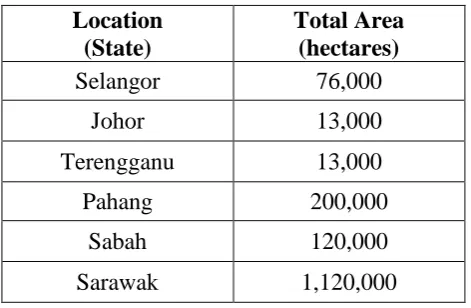
South-East Asia. Estimated peatlands in Malaysia –2.7 mil ha Peninsular Malaysia - 0.98
mil ha Sarawak - 1.66 mil ha Sabah - 0.80 mil ha (Mutalib et al., 1991) Peatlands are usually found on highlands and poorly-drained lowlands. Highland peats are found
on small isolated areas in steep mountainous regions above 1000 mean sea level
(masl). Lowland peats are found in depressions near coastal areas. In Peninsular
Malaysia, peats are found in the Trans-Perak areas in the Perak Tengah and Hilir
Perak district, coastal areas of West Johore, Kuantan and Pekan districts,
Rompin-Endau area and Northwest Selangor. According to Mutalib et al., (1991) the state of Sarawak has the largest peat area in the country with 16,500km²constituting 13% of
the state with 90% of it being more than 1 m deep.
Peats in Sarawak are found mainly between the lower stretches of the main
river courses and in poorly drained interior valleys. They are found in the
administrative divisions of Kuching, Samarahan, Sri Aman, Sibu, Sarikei, Bintulu,
Miri and Limbang. In Sabah, peat soils are found on coastal areas of the Klias
Peninsular, Krah swamp in Kota Belud, Sugut, Labuk estuaries and Kinabatangan
floodplains. Peat soils in Sarawak occur in large basin swamps and in small interior
valleys that have been developed in comparatively recent times (Andriesse, 1988).
Table 2.2 shows the estimated extent of peat coverage in Malaysia that is published
Table 2.2: The estimated extent of peat cover in Malaysia (United Nations Development Programme - UNDP. Malaysia – 2006)
Location (State)
Total Area (hectares)
Selangor 76,000
Johor 13,000
Terengganu 13,000
Pahang 200,000
Sabah 120,000
Sarawak 1,120,000
Peatlands are found just beyond the coastline on both east and west coasts of
Peninsular Malaysia. According to Bujang (2004), there are 3 million hectares or 8%
area in Malaysia covered with peat.
2.5 Classification of Peat Soil
According to Ajlouni (2000), there are many types of classifications avaliable to
classify peat soils. The physical, chemical, and physicochemical properties of peat
soils such as texture, organic content, pH, colour, moisture content, and the degree of
decomposition could serve as a basis for peat classification. Hobbs (1986) stated
that, those physical properties should be included in a full description of the peat soil.
These attributes are influenced by the main components of the formation such as
mineral content, organic content, moisture content and air respectively. Generally,
peat is grouped into two categories; amorphous peat and fibrous peat. Amorphous
peats are peats containing less than 20% of fibre content. It contains mostly particles
of colloidal size (less than 2 microns), and the pore water is absorbed around the
particle surface. Fibrous peats are defined as peats that contains more than 20% of
fibre content. Both, amorphous and fibrous peat has their own specific
12
According to the Canadian and US Taxonomy, this order is further divided into
3 suborders based on the degree of decomposition of the organic matter and is
defined as Fibric, Hemic and Sapric. The Fibric is dominated by fibric peats which
contains undecomposed to weakly decomposed organic material with over 66% of
fibre content. The Hemic and the Sapric suborders are dominated respectively by
hemic peats, which are formed with moderately to well decomposed organic
materials with 33 – 66% of fibre content and by sapric peats which are formed by
strong to completely decomposed organic materials with less than 33% of fibre
content. Under the current soil classification, the Organic Soil Groups are separated
into two Subgroups according to the type of organic materials, thickness of organic
materials, ash content, groundwater table, and nature of mineral substratum. The
convexity of coastal and deltaic peat swamps surfaces are increasingly more
pronounced with its distance from the sea (Mutalib et al., 1992). In its natural state, the water table is always high, often at or near the surface (Tie and Kueh, 1979).
Table 2.3 shows the Malaysian peat characteristics. Generally, the topography of
peat soil within Peninsular Malaysia and Sabah comparatively are flat, unlike the
ones in Sarawak where surface strata where is more dome-shaped. Table 2.4 shows
Table 2.3: Characteristic of peat swamps in Malaysia (Muttalib et al., 1991)
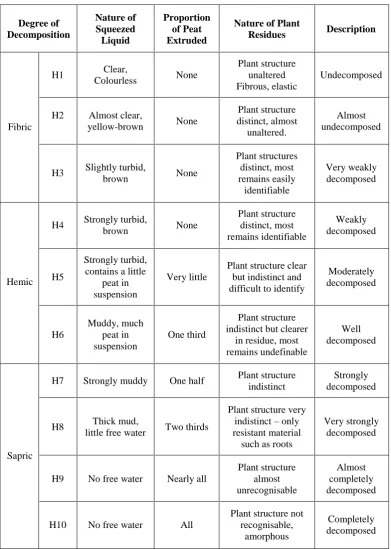
The Von Post scale begins from H1 to H10. H1 is classified as containing little
decomposed fibrous and light-coloured peat. While H10 is classified as containing
well decomposed, colloidal and dark-coloured material. Peat at scale H1-H3
indicates qualifying terms for fibric, H4-H6 is hemic with moderately decomposed
and H7-H10 is sapric or amorphous.
Region Location Topography Total Area Characteristics
Peninsular
West Johore, Kuantan, Pekan,
Selangor, Perak
Peat land is flat
Approximately 80,000km2 with
89% of it having deep
peat (>1m)
Normally found in the coastal areas of the east
and west coasts
Sarawak
Kuching, Samarahan, Sri Aman, Sibu, Sarikei, Bintulu,
Miri and Limbang
The basin peat swamps are dome-shaped
16500 km2 with 89% of it having deep
peat (>1m)
Peat occurs mainly between the lower
stretches of the main river courses
(basin peats) and in poorly drained interior valleys
(valley peats).
Sabah
Kota Belud, Sugut,Labuk, Kinabatangan
Peat land is flat
86 km2. There were no estimates on
the depths
14
Table 2.4: The Von Post Scale for Assessing Peat Decomposition (science.ulst.ac.uk/vft/vonPost, 2014) Degree of Decomposition Nature of Squeezed Liquid Proportion of Peat Extruded
Nature of Plant
Residues Description
Fibric
H1 Clear,
Colourless None
Plant structure unaltered Fibrous, elastic
Undecomposed
H2 Almost clear,
yellow-brown None
Plant structure distinct, almost
unaltered.
Almost undecomposed
H3 Slightly turbid,
brown None
Plant structures distinct, most remains easily identifiable Very weakly decomposed Hemic
H4 Strongly turbid,
brown None
Plant structure distinct, most remains identifiable Weakly decomposed H5 Strongly turbid, contains a little
peat in suspension
Very little
Plant structure clear but indistinct and difficult to identify
Moderately decomposed H6 Muddy, much peat in suspension One third Plant structure indistinct but clearer
in residue, most remains undefinable
Well decomposed
Sapric
H7 Strongly muddy One half Plant structure
indistinct
Strongly decomposed
H8 Thick mud,
little free water Two thirds
Plant structure very indistinct – only resistant material such as roots
Very strongly decomposed
H9 No free water Nearly all
Plant structure almost unrecognisable Almost completely decomposed
H10 No free water All
Plant structure not recognisable,
amorphous
Completely decomposed
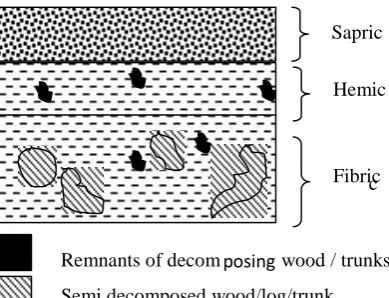
Figure 2.2 shows the profile and stratum of peat soil in line with the
classification of soil in Sarawak (Mutalib et al., 1992). An upper layer (20 –30 cm
thick) consist of well-decomposed organic materials of the sapric type, the middle
layer (30 – 40 cm thick) however, consist of semi-decomposed organic materials of
the hemic type while the lower layer of fibric materials is mainly made up of large
wood fragments and branches as well as tree trunks (Mutalib et al., 1992)
[image:33.595.249.444.223.372.2]
c
Figure 2.2: Profile morphology of drained organic soils (Source: Modified from Mutalib et al., 1992)
2.6 Physical and Engineering Characteristics of Peat
Peats originate from plants and denotes the various stages in the humification process
where the plant structures can be determined (Deboucha et al., 2008). The decaying process of plants under acidic conditions without microbial process will result in the
formation of organic matters in the peats. This condition renders the peats extremely
soft and can be concluded as problematic soil. Thus, this study is conducted to
examine and comprehend the particularities of peat engineering behaviour in respect
to the compressibility and various characteristics to establish suitable correlation
when seeking their indexed properties such as natural water content, organic content,
liquid limit, specific gravity and density. According to Deboucha et al., (2008), peats have certain characteristics that require special consideration and set up from
that of mineral soils.
Remnants of decomposing wood / trunks
Semi decomposed wood/log/trunk Sapric
Hemic
16
Peats occur as extremely soft, wet and unconsolidated surficial deposits.
According to Bujang (2004) peats are geotechnically problematic due to their high
compressibility and low shear strength. In a moderate load increment, it may lead to
large volume changes that showes high compressibility. Deep peats exhibit high
compressibility, medium to low permeability, low strength and volume instability as
described by Wong (2008). Peats are also characterized by high initial void ratio,
organic content and water holding capacity (Deboucha et al., 2008).
For civil engineering purposes, it is essential to describe organic soils or peats.
Therefore some essential indexed properties of these soil conditions are needed
in-order to classify them and find the best ways to counter their negative effects on the
designed imposed loads. The following characteristics are suggested by Hobbs
(1986) and Edil (1977) to describe the properties of peat.
a) Colour, and odour
b) Water content
c) Degree of humification
d) Fibre content
e) Liquid limit and plastic limit
f) Principal plant component, namely coarse fibre, fine fibre,
amorphous granular material and woody material
g) Grain size distribution
h) Density and Specific Gravity
i) Atterberg Limits
Tests should be conducted to determine and identify the major components of
engineering properties and it is essential to conduct various types of tests. These test
can be divided into two categories: physical and mechanical tests. Visual inspection
of the soil such as the soil’s appearance, colour, possible odour and plasticity are
classified as physical tests, which would then be followed by the indexed property
tests and mechanical property tests. However, all these methods must be
supplemented by other procedures leading to quantitative results that may be related
Since the main component is an organic matter, peats are very spongy, highly
compressible and combustible in characteristics (Shafiee et al., 2013). These
characteristics make the peats to pose its own distinctive geotechnical properties as
compared to other inorganic soils like clay and sandy soils which are made up of
only soil particles (Deboucha et al., 2008).
Table 2.5 shows tabulated peat soil properties in Malaysia from previous
studies. In the tabulated data from past researchers, the Atterberg limit parameters
for plastic limit and plasticity index in some conditions are not shown due to the soil
samples used for testing have very low clay content, while the liquid limit and plastic
limit tests may not produce reliable results according to Whitlow (2001). Natural
water content as recorded, ranges from 200 per cent to 2200 per cent for East
Malaysia and the range of 230 per cent to 500 per cent was found in Johor Hemic
peats (Zainorabidin and Bakar, 2003). Acidity of peat soils from past research were
recorded as 3.51 on the pH scale while the highest reading was 6.18 on the pH scale.
Thus, researchers explained that the reason is due to high water content and active
composition systems. In subsequent parameters, fibre contents for peat soils were
recorded in ranges between 30 to 91%. In addition to these parameters, there were
also specific gravity components that mostly recorded between 1.0 and 2.0.
Zainorabidin and Bakar (2011) followed by Aminur and Kolay (2011) recorded
values of plasticity index for Western Johor peats where the presence of clay were
spotted in the peats sampled. It is best to inspect its grain size properties before
proceeding with the Atterberg Limits test if the presence of fines is more than 35%
(NZ Geotechnical Society, 2005) in accordance to the BS5930, where liquid limit
18
No. Researcher Atterberg Limit (%)
Natural water Content (w, %) Specific gravity (Gs)
Bulk density (Mg/m3)
Acidity (pH) Organic content (%) Void ratio, (e) Fiber content (%)
Ip wL
1 Deboucha et al., (2008) 57.95 115.8 700-850 1.343 1.059 4.6 - 10.99 -
- 285 266 1.52 0.922 - 76 7.541 65
- 350 330 1.45 0.834 - 84 9.535 75
- 398 350 1.42 0.811 - 88 10.480 77
2 Duraisamy and Huat (2008) - 250 181 1.55 1.008 - 73 5.522 55
- 275 241 1.53 0.856 - 75 6.536 58
- 240 140 1.56 1.019 - 70 4.125 32
- 310 286 1.51 0.956 - 77 7.895 68
- 330 300 1.49 0.996 - 80 4.824 31
3 Wong et al., (2008) - - 668 1.40 - 3.51 96 - 90
4 Hashim and Islam (2008a) - 208.4 414-674 0.95-1.34 1040.41 3.51 99.06 7.999 90.25
5 Wong et al. (2009) - - 668.30 1.40 1038.00 3.51 96.50 9.30 90.40
6 Islam and Hashim (2008b) - - 555 1.24 - 3.51 96.45 - 90.39
7 Faisal (2008) - - 668.30 1.396 1037.72 3.51 96.45 9.329 90.39
8 Zainorabidin and Bakar (2011)
90-160 190-360 200-700 1.38-1.70 - - 65-97 - -
85-297 210-550 200-2200 1.07-1.63 - - 50-95 - -
- 220-550 230-500 1.48-1.8 - - 80-96 - -
9 Aminur and Kolay (2011)
78 - 620.14 1.45 - 4.05 85.10 - 65.00
79 - 473.70 1.62 - 4.64 78.88 - 63.45
73 - 360.72 1.64 - 5.15 66.60 - 61.40
75 - 787.04 1.48 - 4.25 82.40 - 64.25
[image:36.842.81.781.164.508.2]77 - 623.76 1.56 - 4.33 80.85 - 63.55
Table 2.5: Tabulated of Peat Soil Properties in Malaysia
This research work deals with a study on the post cyclic behaviour of peat soils
analysed using dynamic and static methods. The application of effective stresses and
frequencies are critically reviewed using triaxial tests. A series of triaxial tests were
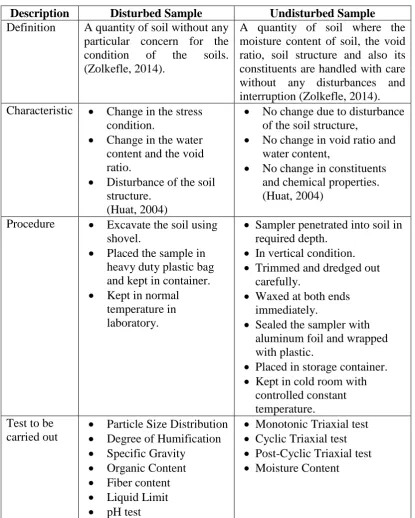
carried out to investigate the influence of dynamic loading on shear strength. Table
2.6 has been summarized to show the differences between disturbed and undisturbed
samples by the means of their definition, procedure and the use of samples
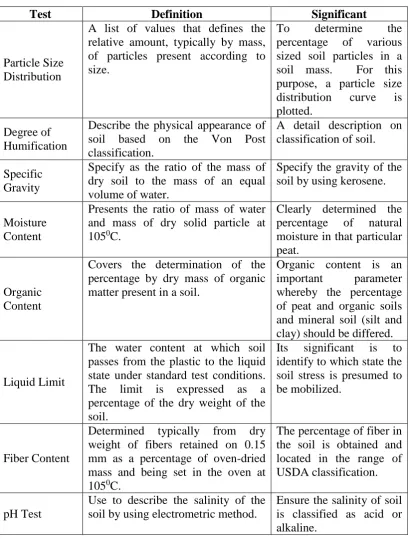
respectively. Table 2.7 summarizes the features of the indexed properties tests with
definitions and significances of the tests used. The denomination of indexed
properties provide valuable information when the results are compared to empirical
data that is relative to the indexed properties determined for peat classification.
PVC used in undisturbed sampler, is recommended by Munro and MacCulloch
(2006) as this is a low cost system for attaining peat soil samplings. They have
concluded that, the achieved results are due to the sampler being driven down into
the peat by the means of a lightweight percussive machine or gent tappings with a
hammer. Sina et al., (2011) recommends using a tube sampler after the wax has been dried, and subsequently sealed using foil and sealer to prevent any losses or
20
Table 2.6: Summary of Disturbed and Undisturbed Samples Differences.
Description Disturbed Sample Undisturbed Sample
Definition A quantity of soil without any particular concern for the condition of the soils. (Zolkefle, 2014).
A quantity of soil where the moisture content of soil, the void ratio, soil structure and also its constituents are handled with care without any disturbances and interruption (Zolkefle, 2014). Characteristic Change in the stress
condition.
Change in the water content and the void ratio.
Disturbance of the soil structure.
(Huat, 2004)
No change due to disturbance of the soil structure,
No change in void ratio and water content,
No change in constituents and chemical properties. (Huat, 2004)
Procedure Excavate the soil using shovel.
Placed the sample in heavy duty plastic bag and kept in container. Kept in normal
temperature in laboratory.
Sampler penetrated into soil in required depth.
In vertical condition. Trimmed and dredged out
carefully.
Waxed at both ends immediately.
Sealed the sampler with aluminum foil and wrapped with plastic.
Placed in storage container. Kept in cold room with
controlled constant temperature. Test to be
carried out
Particle Size Distribution Degree of Humification Specific Gravity
Organic Content Fiber content Liquid Limit pH test
Table 2.7: Summary of Definition and Significant Index Properties Tests.
Test Definition Significant
Particle Size Distribution
A list of values that defines the relative amount, typically by mass, of particles present according to size.
To determine the percentage of various sized soil particles in a soil mass. For this purpose, a particle size distribution curve is plotted.
Degree of Humification
Describe the physical appearance of soil based on the Von Post classification.
A detail description on classification of soil.
Specific Gravity
Specify as the ratio of the mass of dry soil to the mass of an equal volume of water.
Specify the gravity of the soil by using kerosene.
Moisture Content
Presents the ratio of mass of water and mass of dry solid particle at 1050C.
Clearly determined the percentage of natural moisture in that particular peat.
Organic Content
Covers the determination of the percentage by dry mass of organic matter present in a soil.
Organic content is an important parameter whereby the percentage of peat and organic soils and mineral soil (silt and clay) should be differed.
Liquid Limit
The water content at which soil passes from the plastic to the liquid state under standard test conditions. The limit is expressed as a percentage of the dry weight of the soil.
Its significant is to identify to which state the soil stress is presumed to be mobilized.
Fiber Content
Determined typically from dry weight of fibers retained on 0.15 mm as a percentage of oven-dried mass and being set in the oven at 1050C.
The percentage of fiber in the soil is obtained and located in the range of USDA classification.
pH Test
Use to describe the salinity of the soil by using electrometric method.
22
2.7 Shear Strength of Peat Soil
According to Boylan and Long (2012), peats which are formed from the
accumulation of organic materials over thousands of years, are characterised by its
high water content, compressibility and low shear stiffness and shear strength.
As with mineral soils (silt and clay), the settlement parameters of peats such
as the consolidation settlement can be determined from a standard incremental
oedometer test (Edil, 2003). However, the overburden pressure of peats are very low
(Gosling and Keeton, 2006). The researcher discovers at the base of the 2 m thick
layer with water level at ground level, the effective stress is only about 2 kPa. They
compared it with an inorganic soil where the layer is of the same thickness and water
level as well, would impose a 20 kPa stress this is almost 10 times greater than the
peat soil. This shows that, peats have much lower strength.
Nonetheless, the effective shear strength of peat soils are essentially a
frictional material and that it behaves closely in accordance with the principles of
effective stress. Gosling and Keeton (2006) conclusively explained that standard
tests that consolidates undrained triaxial test with the measurement of pore water
pressure does not required over 50% axial strain to fail. However, tests can be carried
out and be interpreted to give similarly high effective stress values where only 20%
of axial strain is applied.
Bujang (2006) stated on his study on peat strength revealed that, some
confusion indicates the potential of peats to be treated as a frictional material like
sand or cohesive like clay. It is almost the same as the assumptions by Dhowian and
Edil (1980) where they explain that surficial peats are commonly encountered as
submerged surficial deposits. This is because of their low unit weight and
submergence, as such deposits develop very low vertical effective stresses for
consolidation and the associated peats exhibit high porosities and hydraulic
conductivities that are comparable to those of fine sand or silty sand. Bujang (2006)
also states that peats with such materials can be expected to behave like “drained"
soils such as sand when subjected to shear loading. On the other hand, soils with
consolidation shows a rapid decrease in porosity and hydraulic conductivity becomes
comparable to that of clay. There is a rapid and immediate transition from a
Gosling and Keeton’s (2006) assessment on the geotechnical properties of
peats are made complex by its high water content and compressibility, as well as its
organic composition. Acknowledging the high compressibility of peats and the need
to break fibres during sampling makes obtaining high quality samples difficult and
disturbed samples may display non-conservative parameters of stability in the
assessments especially when it comes to an increased in strength.
Shear strength is the primary controlling factor in peat failures. This research
adduces an understanding of the shear strength variations through peat soils that
provide an indication of the likely stability of the peats during pre and post
construction that are close to road construction works. Aside from that, it is also
related to the interest of static and dynamic loading study. Due to this study of shear
strength behaviour of peat soils, Gosling and Keeton (2006) describes the causal
factors of peat failures through an examination of the soil behaviour during a peat
failure which could range from the undrained such as sudden loading or a short
duration of extreme rainfall. As for drained characteristics, do expect noticeable
features like drying and cracking of peats during summer or the creep of peats when
there is a significant change in the slope angle. The range of permeability values
reported for peats and its potential to change significantly under modest loading
(Mesri and Ajlouni, 2007) adds further uncertainties, and one of it being the
appropriate drainage conditions that needs consider.
Boyland et al., (2008) explains that the Undrained shear strength (su) refers to the strength of soil in situations where the excess pore water pressures developed
during shearing cannot dissipate and failure takes place. Whereas in mineral soils,
failure occurs as a result of a reduction in effective stress brought about by the
increase in pore water pressure. Not knowing the effective stress principle in its
classical form in peats make the application of undrained shear strength
correspondingly doubtful. Figure 2.3, showes the Relationship between shear
strength, moisture content and degrees of humification. The shear strength of peat
soil is measured no matter it is drained or undrained strength. From Figure 2.3, it can
24
Figure 2.3: Relationship between Shear Strength, Moisture Content and Degree of Humification
(Helenlund 1980:, Boyland et al., 2008)
2.7.1 Undrained Strength
According to Boylan and Long (2012), peats which are formed from the
accumulation of organic materials over thousands of years, are characterised by its
high water content, compressibility and low shear stiffness and shear strength.
As with mineral soils (silt and clay), the settlement parameters of peats such
as the consolidation settlement can be determined from a standard incremental
oedometer test (Edil, 2003). However, the overburden pressure of peats are very low
(Gosling and Keeton, 2006). The researcher discovers at the base of the 2 m thick
layer with water level at ground level, the effective stress is only about 2 kPa. They
compared it with an inorganic soil where the layer is of the same thickness and water
level as well, would impose a 20 kPa stress this is almost 10 times greater than the
peat soil. This shows that, peats have much lower strength.
Nonetheless, the effective shear strength of peat soils are essentially a
frictional material and that it behaves closely in accordance with the principles of
effective stress. Gosling and Keeton (2006) conclusively explained that standard
REFERENCE
Abbas, Soroush, A. and Soltani-Jigheh H. (2009). Pre- and post-cyclic behavior of mixed
clayey soils. Department of Civil and Environmental Engineering, Amirkabir University
of Technology (Tehran Polytechnic), Tehran, Iran. Canadian Geotechnical Journal, 2009, 46(2): 115-128, 10.1139/T08-109.
Ajlouni MA (2000). Geotechnical properties of peat and related engineering problems. PhD
Dissertation, University of Illinois at Urbana-Champaign. 15-189.
Alex G. G. (2014). Shear resistance degradation of lime –cement stabilized soil during cyclic
loading. Division of Soil- and Rock Mechanics Department of Civil, Architectural and
the Built Environment Stockholm 2014. Independent thesis Advanced level (degree of Master.
Aminur M. and Kolay P. (2011). Physical and geotechnical characteristics of stabilized and
unstabilized tropical peat soil. World Journal of Engineering 09/2011; DOI: 10.1260/1708-5284.8.3.223. 8(3) (2011) 223-230.
Andriesse J.P. (1988). Nature and Management of Tropical Peat Soils. 1sted. Rome: FAO Soil
Bulletin 59. Food and Agriculture Organization of The United Nations, Rome.
ASTM D2974 – (2013) Standard Test Methods for Moisture, Ash, and Organic Matter of Peat and Other Organic Soils.
ASTM D1997 – (2013) Standard Test Method for Laboratory Determination of the Fiber Content of Peat Samples by Dry Mass.
ASTM D4427 - (2013) Standard Classification of Peat Samples by Laboratory Testing.
172
Bell F.G. (2000). Engineering Properties of Soils and Rocks. Malden, MA, Blackwell Sci., pp. 202-221.
Boulanger R. W. and Idriss, I. M. (2007). Evaluation of cyclic softening in silts and clays. J. Geotech. & Geoenviron. Eng., 133(6): 641-652.
Boulanger, R.W., R. Arulnathan, L.F. Harder, R.A. Torres, and M.W. Driller, (1998). Dynamic
properties of Sherman Island peat, J. Geotech. Geoenviron. Eng., 124(1): 12-20.
Bujang B. K H. (2004). Behaviour of Soft Clay Foundation beneath an Embankment.
Pertanika J. Sci. & Techno. 2(2): 215-235 (1994) ISSN: 0128-7680. Universiti Pertanian Malaysia Press.
Bujang B. K. H. (2006). Deformation and Shear Strength Characteristics of Some Tropical
Peat and Organic Soils. Pertanika J. Sci. & Techno. 14(1 & 2): 61 - 74 (2006) ISSN: 0128-7680. Universiti Putra Malaysia Press
Boylan N., Jennings P. and Long M. (2008). Peat slope failure in Ireland. Quarterly Journal of Engineering Geology and Hydrogeology 2008; v. 41; p. 93-108 doi:10.1144/1470-9236/06-028.
Boylan N. and Long M. (2012). Evaluation of Peat Strength for Stability Assessments.
Proceedings of the Institution of Civil Engineers, Geotechnical Engineering. University College Dublin, Ireland. 166 : 1-10
BS 1377-1:1990. Methods of test for soils for civil engineering purposes. General requirements and sample preparation
BS 1377-2:1990. Methods of test for soils for civil engineering purposes. Classification tests
BS 1377-3:1990. Methods of test for soils for civil engineering purposes. Chemical and electro-chemical tests
BS 1377-8:1990. Methods of test for soils for civil engineering purposes. Shear strength tests (effective stress)
Cabalar A.F. and Cevik A. (2008). Modelling damping ratio and shear modulus of sand mica mixtures using neural networks’, Engineering Geology, doi: 10.1016/ j.enggeo. 2008.