• No results found

Analysis on the Influence Factors of Wind Power Accommodation

N/A
N/A
Protected

Academic year: 2020

Share "Analysis on the Influence Factors of Wind Power Accommodation"

Copied!
8
0
0

Loading.... (view fulltext now)

Full text

(1)

http://dx.doi.org/10.4236/jpee.2015.34023

Analysis on the Influence Factors of Wind

Power Accommodation

Xiaofei Li

1

, Yuehui Huang

1

, Shuo Ma

1

, Changjun Li

2

, Xiaolei Ma

2

1Renewable Energy Department, China Electric Power Research Institute, Beijing, China 2State Grid Xinjiang Electric Power Corporation, Wulumuqi, China

Email: [email protected]

Received January 2015

Abstract

With the increase of wind power capacity in China, the situation of curtailment of wind power is getting worse. An annual sequence production simulation model is established with maximum wind power consumption as the objective function. The calculation of specific power grid opera-tion in 2013 verifies the precision of this model. The impact of different factors on wind power accommodation as well as the impact of power grid reserve, wind resources and load on wind power curtailment is analyzed. The calculation results quantify the impact of different factors from power system to the accommodation of wind power and provide reference to solving the problem of wind power curtailment.

Keywords

Wind Power Accommodation, Time Sequence Simulation, Spinning Reserve

1. Introduction

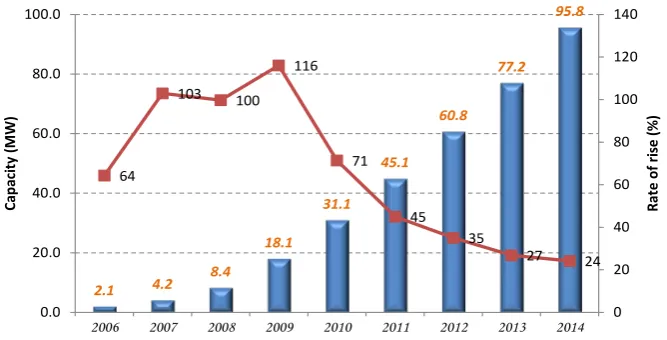
In 2014, the newly installed wind power capacity in China (excluding Taiwan) is 18.6 GW, the total installed wind power capacity is up to 95.8 GW, a year-on-year growth of 24.2%, as shown in Figure 1. Wind power is mainly distributed in the “Three North” areas in China. Wind power capacity in North China, Northeast China and Northwest China accounts for 13%, 20% and 12% respectively of the total installed capacity and wind power accounts for more than 30% in some provinces [1]. According to the wind power development planning in China, the national wind power capacity will reach 104 GW in 2015 and 200 GW in 2020.

(2)
[image:2.595.133.467.84.254.2]

Figure 1. Wind power capacity and increase rate over the years of China.

tistic shows that the curtailment of wind power in 2011, 2012 and 2013 was up to 10 TWh, 20 TWh and 16.2 TWh respectively. Therefore, further research on power grid peak-load regulation capacity of and its impact on wind power accommodation is significantly important to the wind power development of China.

2. Analysis of Influence Factors of Wind Power Accommodation

As can be seen from the current wind power operation experience in wind power curtailment area of China, the influencing factors of wind power accommodation is mainly divided into two kinds: one is the peak-load regula-tion capacity of power grid, the other is grid transmission capacity [3]. The influence factors of peak-load regu-lation capacity includes power load characteristics, power unit boot mode, spinning reserve capacity, power unit peak-load capability and pumped storage capacity, as shown in Figure 2.

Curtailment of wind power due to both peak-load regulation of power grid and transmission capacity restric-tion, when transmission capacity restriction is released, curtailment power caused by it may be transformed into the other type caused by peaking capacity, as shown in Figure 3. In current curtailment statistical mode, trans-mission capacity restriction is indicated as Section 2 and Section 3 [4]; peak-load regulation capacity is indi-cated as Section 1. But the real situation should be transmission capacity restriction in Section 2 and peak-load regulation capacity in Section 1 and Section 3 which indicates the part transformed from transmission capacity restriction. Taking a provincial power grid as an example, in current statistical mode, curtailment from transmis-sion capacity restriction accounts for 60%, but in reality it should account for 40%, the problem of peak-load regulation capacity of power grid is more serious.

Thermal power units’ commitment in China is currently arranged by way of planning, with load forecasting for next day, reserve capacity of system and tie line plan taken into consideration. Thermal power units’ com-mitment is also limited by the minimum unit mode stipulated by electric power supervision department power regulation authorities plan. Minimum unit mode is adopted mainly because of winter heating and power plant building insulation requirements. Limited by the minimum operation mode in thermal power, peak-load regula-tion capacity of power grid is significantly lower in the winter heating period. The following Table 1 shows minimum number of thermal power unit and minimum output in heating period and non-heating period in North China [5].

3. Analysis of Optimization Model

In this paper, a power grid model was established based on the power balance of the whole grid to calculate wind power consumption, with full consideration of spinning reserve, output range of thermal power and other restrictions.

3.1. Object Function

The objective function of the time sequential production simulation is maximum consumption of wind power, 2.1 4.2 8.4

18.1 31.1

45.1 60.8

77.2 95.8

64

103 100 116

71

45 35

27 24

0 20 40 60 80 100 120 140

0.0 20.0 40.0 60.0 80.0 100.0

2006 2007 2008 2009 2010 2011 2012 2013 2014

Ra

te o

f r

ise (

%

)

Cap

ac

ity

(M

W

(3)

Characteristics of load

Unit commitment

Spinning capacity Peaking

capacity of power

grid

Transmission capacity

Pump storage Accommodation

capability of wind power

[image:3.595.165.431.83.214.2]

Peaking capacity of power unit

Figure 2. The influence factors of wind power accommodation.

Region 1

Region 1:

Region 2

Region 3

Curtailment by peak-load capacity

Region 2: Curtailment by transportation difficulties

Region 3: Curtailment which is convertible

Figure 3. The relationship between peak-load regulation capacity of po- wer grid and transmission capacity restriction.

Table 1. The operation situation of thermal power in North China.

Period The minimum number of thermal power The minimum output of thermal power (%)

Non-heating period 32 58

Initial and end of heating period 47 64

Middle of heating period 55 66

namely, total maximum wind power of each region in different periods, as shown in Equation (1).

( )

1 1

max ,

T N

t n P t n

= =

∑∑

(1)

Among them, N is the number of partitions of the power grid; T is the calculation step, for 1 hours; P t n

( )

, is wind power of the n partition in the t period [6].

3.2. Balance of Electric Power and Energy

( )

( )

( )

1

, 1, 2, N

i i

p t TieP t L t t T

=

+ = =

, (2)

In Equation (2), p ti

( )

is the unit i output at time t; N is the number of unit (include wind power); TieP t

( )

is the tie line power at time t (input is positive, output is negative); L t

( )

is the whole electricity load at time t.

3.3. Spinning Reserve Constraints

In Equation (3), SP and SN are respectively positive/negative spinning reserve of power system; t N

[image:3.595.170.384.243.360.2] [image:3.595.85.536.424.486.2]
(4)

conven-tional unit commitment and enhance peak-load regulation capacity of power grid [7]. Spinning reserve takes the higher value of 5% of load or the largest single unit capacity.

max

1

min

1

j

N

t t

j N l P

j N

t t

j N l N

j

P C P S

P C P S

=

=

+ ≥ + 

 

+ 

(3)

3.4. Power Output Limit

( )

i i i

pp tp (4)

In Equation (4), pi is the lower limit and pi is the upper limit of thermal power unit.

3.5. Pumped Storage Model

0

t t

p h

pp = (5)

In Equation (5), ptp is the pumping condition of pumped storage unit; pht is the generating condition. Pumping and generating can’t be conducted simultaneously [8].

4. Calculation Verification

4.1. Calculation for Previous Years

Take a provincial power grid as example and calculate its annual wind power output. The wind power operation of Power Grid A in 2013 is calculated with its wind power output sequence over different years. The calculation result is compared with the actual operation data of Power Grid A in 2013, so as to verify the precision of this model.

4.2. Data for Calculation

1) Load curve

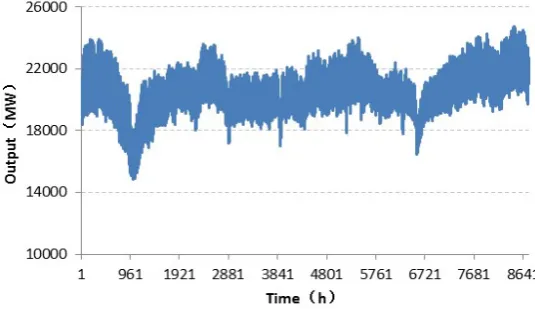
Take the predictive value of load as the annual load curve for calculation. The maximum value is 24.74 GW and the minimum value is 14.85 GW. The maximum daily peak valley difference value is 5.10 GW and the minimum difference is 1.71 GW, as shown in Figure 4.

2) Capacity of wind power

[image:4.595.163.431.551.706.2]

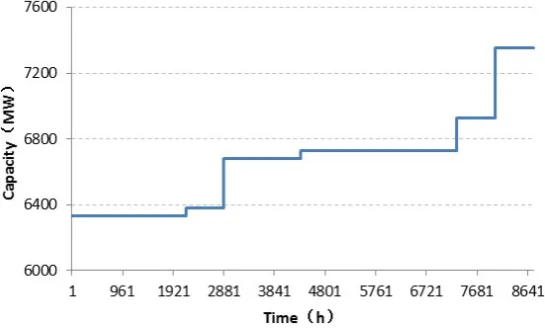
Wind power installed sequence is total wind power installed for wind power production. Wind power in-stalled capacity increases by steps. 1020 MW wind power is expected to be added annually and the cumulative wind power installed capacity will reach 7.35 GW, as shown in Figure 5.

(5)
[image:5.595.163.436.91.255.2]

Figure 5. Installed capacity sequence of wind power.

3) Output of wind power

Wind power output data is normalized with consideration of wind power reduction. The full load hour of wind power is 2050 hours. The highest of wind power normalization is 83% and the minimum is 0, as shown in Figure 6.

4) Peaking capacity of thermal power

Thermal power unit is mainly composed of pumping thermal unit and air condensing thermal unit. Air con-densing thermal unit is not heating units and its minimum output is unchanged; pumping thermal unit generates both heat and electricity and its minimum output is different in heating period and non-heating period, as shown in Table 2.

4.3. Calculation Results

Calculation results are shown in Table 3. The data for 2013 is the actual operation statistics, while those for 2010, 2011, 2012 and 2014 are calculation data. The deviation between calculated output and actual power gen-eration in 2013 is no more than 5%, which indicates the credibility of calculation results.

5. Analysis on Wind Power Accommodation Capacity

This calculation model aims at maximizing wind power consumption and optimizing thermal power unit com-mitment and output. Because variables of the model are huge and it is a typical mixed integer programming problem, this paper adopts GAMS to solve it. The calculation results show that, on the premise of maximum ac-cepted wind power, the whole year is expected to consume 11.6 TWh of wind power with 1.2 TWh of curtail-ment and the full load hours of wind power is 1675 hours.

5.1. Impact of Spinning Reserve on Wind Power Accommodation

Spinning reserve capacity affects the unit's boot capacity, the bigger the spinning reserve, the higher the mini-mum technical power and the more the wind power curtailment. When the power system spinning reserve is re-spectively assumed as 5%, 10%, 15% and 20%, wind power accommodation conditions are detailed in Table 4, the wind power generation quantity decreases while the wind power curtailment and its proportion increase.

5.2. Impact of Wind Resources on Wind Power Curtailment

(6)

(a) (b)

[image:6.595.81.530.81.384.2]

(c) (d)

Figure 6. Normalization output sequence of wind power in different years.

Figure 7. Influence of wind resources on wind power curtailment.

5.3. Impact of Load on Wind Power Curtailment

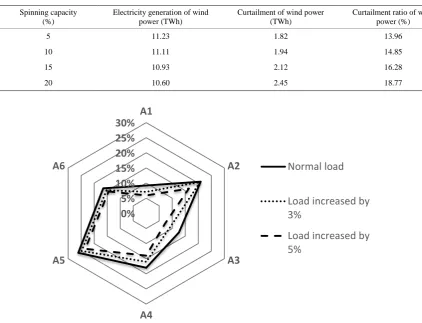
Wind power curtailment varies between power grids with different load capacity, that is, lower load leads to higher curtailment rate while higher load leads to lower curtailment rate. And load influence degree varies be-tween different provinces and regions, as can be seen in Figure 8, where A2 and A3, with curtailment rates standing at 4.5% and 5.5% respectively, are influenced more by load capacity than A5 and A6 whose curtail-ment rates are 2.7% and 2.1% respectively.

0 0.2 0.4 0.6 0.8 1

1

463 925 1387 1849 2311 2773 3235 3697 4159 2146 5083 5545 6007 6964 6931 7393 7855 8317

O

utput

Time (h)

0 0.2 0.4 0.6 0.8 1

1

439 877 1315 1753 2191 2629 3067 3505 3943 4381 1948 5257 5695 6133 7165 7009 7447 7885 8323

O

utput

Time (h)

0 0.2 0.4 0.6 0.8 1

1

463 925 1387 1849 2311 2773 3235 3697 4159 2146 5083 5545 6007 6964 6931 7393 7855 8317

O

utput

Time (h)

0 0.2 0.4 0.6 0.8 1

1

463 925 1387 1849 2311 2773 3235 3697 4159 2146 5083 5545 6007 6964 6931 7393 7855 8317

O

utput

Time (h)

0% 5% 10% 15% 20% 25% 30% A1

A2

A3

A4 A5

A6 Normal wind

resources

Wind resources reduced by 10%

[image:6.595.147.448.407.611.2]
(7)
[image:7.595.88.539.102.219.2]

Table 2. Peak-load regulation capability of thermal power.

Capacity of pumping thermal power

(MW)

Heating period Non-heating period

Minimum number of operating unit

Minimum output of operating unit (%)

Minimum number of operating unit

Minimum output of operating unit (%)

100 4 75 2 70

200 14 64 9 58

300 18 69 10 57

330 13 67 7 52

[image:7.595.87.539.250.359.2]

600 6 50 4 47

Table 3. Calcuation results of 2013. Year of normalization

output sequence of wind power

Generated energy of wind power (TWh)

Curtailment energy of wind power (TWh)

Curtailment ratio of wind power (%)

Full load hour of wind power (h)

2010 11.78 1.73 12.8 1703

2011 11.64 1.79 13.3 1682

2012 11.47 2.00 14.8 1658

2013 11.73 1.80 13.3 1692

[image:7.595.87.510.382.705.2]

2014 11.93 1.59 11.7 1725

Table 4. Impact of thermal power peak-load regulation capacity on wind power accommodation. Spinning capacity

(%)

Electricity generation of wind power (TWh)

Curtailment of wind power (TWh)

Curtailment ratio of wind power (%)

5 11.23 1.82 13.96

10 11.11 1.94 14.85

15 10.93 2.12 16.28

20 10.60 2.45 18.77

Figure 8. Influence of load capacity on wind power curtailment.

0%

5%

10%

15%

20%

25%

30%

A1

A2

A3

A4

A5

A6

Normal load

Load increased by

3%

(8)

6. Conclusion

This paper establishes the time sequence simulation model with targeted maximum wind power consumption. The impact of unit commitment, peaking capacity of thermal power units and spinning reserve on wind power accommodation has been analyzed. Calculation of specific power grid operation statistics in 2013 verifies the precision of the adopted simulation model. Spinning reserve, wind resources and load capacity have significant impact on wind power curtailment, and the impact of each factor on wind power accommodation varies between different power grids. Calculation results in this paper will provide reference to solving the problem of wind power curtailment.

References

[1] Liu, C., Lv, Z.H., Huang, Y.H., et al. (2013) A New Method to Simulate Wind Power Time Series of Large Time Scale. Power System Protection and Control, 41, 7-13.

[2] Kang, C.Q., Zhou, T.R., Chen, Q.X., et al. (2009) Assessment Model on Low-Carbon Effects of Power Grid and Its Application. Power System Technology, 33, 1-7.

[3] Ummels, B.C., Gibescu, M. and Pelgrum, E. (2007) Impacts of Wind Power on Thermal Generation Unit Commitment and Dispatch. IEEE Transactions on Energy Conversion, 22, 44-51. http://dx.doi.org/10.1109/TEC.2006.889616 [4] Zhu, L.Z., Chen, N. and Han, H.L. (2011) Key Problems and Solutions of Wind Power Accommodation. Automation

of Electric Power Systems, 35, 29-34.

[5] Xue, B., Zhang, X. and Zheng, Y.X. (2014) Influence of Thermal Unit Spinning Reserve on Wind Power Accommoda-tion. East China Electric Power, 42, 1550-1553.

[6] Cao, Y., Li, P. and Yuan, Y. (2014) Analysis on Accommodating Capability of Renewable Energy and Assessment on Low-Carbon Benefits Based on Time Sequence Simulation. Automation of Electric Power Systems, 38, 60-66. [7] Liu, D.W. and Huang, Y.H. (2011) Research and Enlightenment of High Percentage of Wind Power in Spain.

Renewa-ble Energy, 33, 25-28.

Figure

Figure 1. Wind power capacity and increase rate over the years of China.
Figure 2. The influence factors of wind power accommodation.
Figure 4. Annual load curve.
Figure 5. Installed capacity sequence of wind power.
+3

References

Related documents

The Critical Shear Crack Theory forms the background to the design approach used in Model Code 2010, so after the theoretical background and the use of the method are described,

Pain in appendicitis is thus caused, initially by the distension of the wall of the appendix, and later when the grossly inflamed appendix rubs on the overlying inner wall of

نانرس هب لاتبم نارامیب طسوت نیزگیاج و رد هدنهد نیکست یاه میژر زا یشخب یناهج تشادهب نامزاس رامآ قبن اما دشاب یمن اهروشک زا یخرب رد یتبقارم زکارم 81 دننک یم هدافتسا

categorial description; and therefore, (2) the difference between phrase, clause and sentence since these three notions may lead us to misunderstandings; (3) the difference

Centre de vaccination et médecine des voyages, PMU

The Court of Appeal also confirmed - in another decision rendered on the same day in the Coeur Défense safeguard proceedings - the judgment made on 19 October 2009 by the Paris

Where records of hazards are kept Safe work procedures. That I will receive the results of personal health monitoring

established by Elliott. It retraces .618 of the market decline from the 1928 and 1930 highs and, within it, the extended fifth wave travels 1.618 times the distance of the