© 2017, IRJET | Impact Factor value: 6.171 | ISO 9001:2008 Certified Journal | Page 1059
Energetic Slot Allotment for Improving Interchange In Wireless Sensor
Network
Mrs. B. Arulmozhi
1, Ms.P.Agalya
2,
Ms.A.Sivasankari
31
Head of the Department (BCA) and Assistant professor, Dept of Computer Science and Application, D.K.M College for
Women (Autonomous),Vellore, Tamilnadu, India.
2
Research Scholar, Dept of Computer Science and Application, D.K.M College for Women (Autonomous), Vellore,
Tamilnadu, India.
3
Head of the Department(CS) and Assistant Professor, Dept of Computer Science and Application, D.K.M College for
Women(Autonomous),Vellore, Tamilnadu, India
---***---
Abstract—
A wireless sensor network (WSN) contains ofnumerous small sized sensor nodes that have computation power. Wireless sensor networks have recently received increased attention for a broad array of applications such as surveillance, environment monitoring, medical diagnostics, and industrial control. In WSNs serious incident data collected by the sensor nodes necessity to be reliably delivered to the sink for successful monitoring of an environment. Because of more energy consumption the lifetime of the wireless sensor network reduces. If the channel utilization is more than throughput of the wireless sensor network reduces. Wireless sensor networks medium access control (MAC) protocols for energy efficiency comes at the cost of extra packet delay and limited throughput, since a sender is allowed to transmit in the short active periods, only. However, typical applications, in addition to low rate periodic traffic, also present burst traffic triggered upon event detections. Thus, there is an emerging need for a MAC protocol that adapts its offered bandwidth to a dynamic traffic load, i.e., maintain low duty-cycle in light traffic condition and schedule more transmission opportunities when traffic increases so that the energy is only used for carrying the application traffic whenever needed. In this paper we provide the survey of dynamic slot allocation in wireless sensor network.
Keywords— CSMA, Dynamic slot allocation, MAC, Queue length, TDMA, Wireless sensor network.
I. INTRODUCTION
A wireless sensor network [1] is which organized itself rendering to the circumstances. It’s a collection of nodes. The nodes are low cost and low battery power sensor devices. WSN can be positioned on the ground, in the air. It can be positioned in vehicles, on bodies of the human or animals. It can be deployed under water, and inside the houses. The main components of wireless sensor networks are sensing unit, and a wireless transceiver. The function
of sensing unit is capture events of attention. The main function of wireless transceiver is transmuting the apprehended actions back to the main base station.
[image:1.612.330.567.372.593.2]The main base station is called sink node. Sensor nodes cooperate with every other to achieve tasks of data identifying, data communication, and data processing. In WSNs serious incident data collected by the sensor nodes used for specialist care of an environment.
Fig 1: Wireless sensor network
© 2017, IRJET | Impact Factor value: 6.171 | ISO 9001:2008 Certified Journal | Page 1060
Moreover it has the probable to send prosperity of dataabout the setting in which they are organized and send their outcomes across the network to the users. A sensor node is a tiny component that is proficient of computation, sensing and communication competences. Sensor node is the main component of WSN.
Sensor data nodes can be helpful to sense moisture and temperature. It is also used to sense temperature and light. Since a single sensor transports only limited information; a system of these maneuvers is cast-off to achieve huge surroundings.
The communication component in sensor nodes is used to transfer information. It has nowadays turn out to be conceivable to install enormous quantities of low cost sensors to monitor big regions over ground underwater, surface, or atmosphere. WSNs have received noteworthy consideration in current years due to their potential applications in wildlife tracking, armed sensing, traffic investigation, fitness care, atmosphere monitoring, building constructions monitoring, etc. Nodes in WSNs are disposed to letdown due to hardware letdown, energy reduction, communication link faults, mischievous attack, and so on.
Because of the challenges of designing of routing protocols of wireless sensor network we have many constraints. WSN have limitations due to resources. WSN have low storage capacity, low bandwidth. The other limitations are low central processing unit and limited battery energy.
The design challenges of WSN are limited hardware resources, limited energy capacity, sensor locations, random and massive node positioning, scalability, network characteristics and unreliable environment, data aggregation [2], diverse sensing application requirements.
How to provide high throughput and short delay, while still keeping low power consumption is still a research challenge in current WSNs MAC protocols. When the load increases, the number of collisions and retransmissions strongly degrade their bandwidth efficiency and generate long delays. Because of more energy consumption the lifetime of the wireless sensor network reduces.
If the channel utilization is more than throughput of the wireless sensor network reduces. The duty cycle and lifetime of the wireless sensor network will improve the system performance.
The throughput of the system and end to end data transmission will improve if the systems have low energy
consumption. If the traffic of the wireless sensor network will reduce and overall system performance will increases.
A. Wireless Sensor Network
A wireless sensor network is which organized itself according to the situation. It is a collection of nodes. The nodes are low cost and low battery power sensor devices. WSN can be positioned on the ground, in the air. It can be positioned in vehicles, on bodies of the human or animals. It can be deployed under water, and inside the houses. The main components of wireless sensor networks are sensing unit, and a wireless transceiver. The function of sensing unit is capture events of attention.
The main function of wireless transceiver is transforming the captured events back to the base station. The base station is called sink node. Sensor nodes cooperate with every other to achieve tasks of data identifying, data communication, and data processing. In WSNs serious incident data collected [3] by the sensor nodes necessity to be reliably delivered to the sink for successful monitoring of an environment. The greatest noteworthy advantage of sensor networks is that they increased the computation ability to physical atmosphere where human beings cannot reach.
They can work for lengthy periods in locales that are antagonistic, challenging or environmentally too sensitive for human examination. Moreover it has the probable to send prosperity of data about the setting in which they are organized and send their outcomes across the network to the users. A sensor node is a tiny component that is proficient of computation, sensing and communication competences. Sensor node is the main component of WSN. Sensor nodes can be used to sense moisture and temperature. It is also used to sense temp. And light. Since a single sensor transports only limited information.
© 2017, IRJET | Impact Factor value: 6.171 | ISO 9001:2008 Certified Journal | Page 1061
The main WSN objectives are low node cost, small nodesize, low power consumption, scalability, self
configurability, better channel utilization, fault tolerance, adaptability support and security.
B. WSN Design Challenges and Routing Issues
Because of the challenges of designing of routing protocols of wireless sensor network we have many constraints. WSN have limitations due to resources. WSN have low storage capacity, low bandwidth. The other limitations are low central processing unit and limited battery energy.
The design challenges of WSN are limited hardware resources, limited energy capacity, sensor locations [5], random and massive node positioning, scalability, network characteristics and unreliable environment, data aggregation, diverse sensing application requirements.
C. Wireless Sensor System Network Development Aims
Nodes in WSNs are disposed to letdown due to hardware letdown, energy reduction, communication link faults, mischievous attack, and so on. The main WSN objectives are low node cost, small node size, low power consumption, scalability, self configurability, better channel utilization, fault tolerance, adaptability, Qos support and security.
Low node cost: The cost of node is necessary factor to design a WSN. Reduced cost node also reduces the entire network cost. The WSN can be implemented in military; forest area which when destroyed cannot be reclaimed so cost may be effective parameter for wireless sensor network design.
Scalability: The network should be scalable i.e. the nodes can be without difficulty added to the wireless sensor network as and when required. In most cases wireless sensor network can be implemented in wild region so small sized network may be easily manageable.
Small node size: The size of node is also important for WSN design. Small node size reduces the price and power intake of network. In most cases wireless sensor network can be implemented in wild region so small sized network may be easily manageable. The faulty link detection and security can be easily implemented in WSN.
Self-configurable: The wireless sensor network should be self-configurable i.e. network should be automatically organizing themselves as needed.
Low power consumption: Sensor node is always powered by battery. For better network performance low power consumption is an important factor. All the nodes in wireless sensor network are powered by battery. So node should consume less power as compared to other adhoc network.
Reliability: The network should be reliable. The data transmission between destination and source should be reliable and secure. In most cases wireless sensor network can be implemented in wild region so the network should be reliable.
Security: Security is also very important for better network. The data transmission should be secure.
So the main network design parameters are small power intake, reliability and security.
D. Wireless Sensor Network Landscape
WSN have the following individual features and limitations.
Self-configurable: Sensor nodes are usually arbitrarily prearranged and particularly assemble themselves into a communication range.
Battery-powered sensor nodes: Sensor nodes are naturally power-driven by battery and are prearranged in a corrective situation where it is very stimulating to change or boost the batteries.
Dense sensor node situation: Sensor nodes are logically professionally situated and can be numerous orders of magnitude higher than that in a MANET.
Untrustworthy sensor nodes: Since sensor nodes are probable to physical damages or letdowns due to its placement in corrective or antagonistic atmosphere.
Severe energy, computation, and storage restrictions: Sensors nodes are taking extremely incomplete energy, computation, and storage abilities.
Data duplication: In utmost sensor network use, sensor nodes are powerfully positioned in an area of attention and work together to accomplish a shared recognizing work. Thus, the data identified by numerous sensor nodes naturally have a certain level of relationship or duplication.
© 2017, IRJET | Impact Factor value: 6.171 | ISO 9001:2008 Certified Journal | Page 1062
destruction, addition, energy decrease, or stationdisappearing.
Application precise: A sensor network is typically intended and positioned for a precise application. The design necessities of a sensor network alteration with its application.
E. Routing Protocols in WSN
Routing in wireless sensor networks differs from conventional routing in fixed networks in various ways. There is no infrastructure, wireless links are unreliable, sensor nodes may fail, and routing protocols have to meet strict energy saving requirements [8]. Many routing algorithms were developed for wireless networks in general.
Routing in wireless network is different from simple adhoc network. Wireless sensor network is infrastructure less. Wireless links are not reliable. All the routing protocols of wireless sensor network require good energy. Wireless sensor node may fail because of infrastructure. The wireless sensor network protocols are location based protocols, hierarchical protocols, data centric protocols, multipath based protocols, QoS based protocols, mobility based protocols, and heterogeneity based protocol.
Location based protocols are GAF, TBF, SMECH, GeRaF, MECN, GEAR, Span, BVGF. Hierarchical Protocols are APTEEN, LEACH, HEED, PEGASIS, and TEEN.
Data-centric Protocols are Rumor Routing, ACQUIRE, Quorum-Based Information Dissemination, SPIN, EAD, Information-Directed Routing, HABID, GBR, EAR, IDR, COUGAR, DD. Heterogeneity-based Protocols are CHR, CADR, IDSQ.
Multipath-based Protocols are Braided Multipath, Sensor-Disjoint Multipath, N-to-1 Multipath Discovery. Mobility-based Protocols are TTDD, SEAD, Dynamic Proxy Tree-Base Data Dissemination, Joint Mobility and Routing, Data MULES.
QoS-based protocols are SPEED, Energy-aware routing, SAR. All major routing protocols proposed for WSNs may be divided into seven categories and as summarized.
II. LITERATURE SURVEY
Wireless sensor networks (WSNs) have been widely used in many application areas such as infrastructure protection, environment monitoring and habitat tracing.
Because of more energy consumption the lifetime of the wireless sensor network reduces.
If the channel utilization is more than throughput of the wireless sensor network reduces. Wireless sensor networks medium access control (MAC) protocols for energy efficiency comes at the cost of extra packet delay and limited throughput, since a sender is allowed to transmit in the short active periods, only. How to provide high throughput and short delay, while still keeping low power consumption is still a research challenge in current WSNs MAC protocols.
However, typical applications, in addition to low rate periodic traffic, also present burst traffic triggered upon event detections. Thus, there is an emerging need for a MAC protocol that adapts its offered bandwidth to a dynamic traffic load, i.e., maintain low duty-cycle in light traffic condition and schedule more transmission opportunities when traffic increases so that the energy is only used for carrying the application traffic whenever needed.
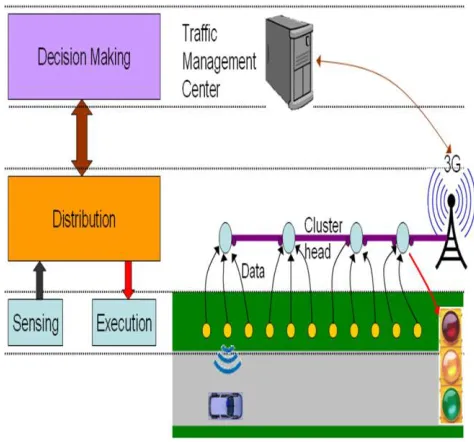
Fig 2: WSN
When the load increases, the number of collisions and retransmissions strongly degrade their bandwidth efficiency and generate long delays.
Low cycle duty cycle is always used to improve the network lifetime in WSN. Its disadvantage is long delay and low throughput if traffic is more.
© 2017, IRJET | Impact Factor value: 6.171 | ISO 9001:2008 Certified Journal | Page 1063
contention-free TDMA mechanism allocating transmissionslots. IQueue-MAC mitigates packet buffering and reduces packet delay, combining the best of TDMA and CSMA. This system can be used in both multi-channel and single channel mode. IQueue-MAC is able to effectively use multiple channels, duplicating its throughput when compared to single channel operation. It proposes a distributed sub-channel selection algorithm to assign unique sub-channels to routers to arrange the slotted transmissions in parallel.
For continuation transmission Wise-MAC [10] a contention-based protocols, uses a “more-bit” information in the data packet header of data packets. RIMAC [11] Receiver-initiated MAC uses beacon as the ACK transmission and next forwarding for continuous transmission. RI-MAC and Wise-MAC have low throughput at heavy load because of collision between receiver and senders.
Z-MAC uses hybrid CSMA/TDMA procedure for static slot allocation and reduces traffic overhead. In this mechanism vacant slot can be used by others. Due to static slot allocation the bandwidth is reduced. Straw man MAC [12] reduces the contention by using extra Collision packets. The sender who has sent the longest Collision packet wins the channel.
But the Collision packets introduce a considerable amount of overheads to the system. RCMAC [13] improves RI-MAC that designates the next sender through ACK piggybacking to reduce collision. However, how to allocate bandwidth among senders is not specified.
CoSenS [13], a collecting then sending burst protocol was proposed to provide traffic adaptation. It dynamically adjusts the duration of its data collecting period according to the estimated traffic load. The traffic estimation algorithm is based on the weighted exponential average (similar to that used for RTT estimation in TCP protocol). ContikiMAC [14] efficiently integrates several unique techniques of other WSNs MACs, such as burst forwarding, phase-lock, and data packet strobe. However, ContikiMAC is mostly designed to handle low rate packets; it has no specific mechanism to handle burst traffic loads.
Wireless Hart [15], ISA100 and the new IEEE802.15.4e standard are currently the most popular wireless solutions for industrial applications. These standards utilize Time Slotted Channel Hopping (TSCH) technique to provide deterministic transmissions and robustness. However, currently, they lack link scheduling algorithms which are crucial for assigning slots/frequency resources in WSNs. Compared to existing solutions, iQueue-MAC mitigates
contention and retransmission by shifting intensive senders into the TDMA slots period. The senders’ queue-length information is piggybacked on data packet, so that the time slots are assigned right upon queuing detection. The crux of iQueue-MAC is an efficient closed loop control mechanism that uses nodes’ queue-length as the measured output and uses adaptive time slots assignment as the control input to mitigate packets queuing. In fact, prior to iQueue-MAC, the similar idea emerged in the FTT (Flexible Time-Triggered) paradigm which is originally proposed for CAN and Ethernet; iQueue-MAC makes it more suitable for WSNs.
III. RESEARCH GAP
The different methods provided for dynamic slot allocation comes at the cost of limited throughput, and additional packet delay. The sender is allowed to transmit in the short active periods, only with less energy efficiency. Thus, under high traffic load, the absence of collisions makes them very efficient supporting high throughput. However, if the offered bandwidth does not match exactly the communication requirements, either bandwidth will be wasted if nodes have nothing to transmit or queues will build up if nodes have more to transmit than what fits in the allocated slots, leading to long delays.
IV. PROBLEM IDENTIFICATION
How to make available short delay, high throughput and less power consumption is main problem and research challenge in existing WSNs protocols. The different low duty-cycle protocol delivers low energy effectiveness under the assumption that the system has long-standing low rate intervallic traffic. Nevertheless, typical applications, in adding to low rate interrupted traffic, also contemporary burst traffic generated upon occurrence detections, e.g., target detection. Consequently, there is an developing need for a protocol that get used to its obtainable bandwidth to a dynamic data traffic load, i.e., conserve little duty-cycle in low traffic condition and provide more transmission prospects when data traffic increases, that the energy is only applied for carrying the network traffic on every occasion needed. The methods may have more traffic overhead and more energy consumption.
V. PROPOSED METHODOLOGY
© 2017, IRJET | Impact Factor value: 6.171 | ISO 9001:2008 Certified Journal | Page 1064
neighbor will be considered as the gateway bycoordinators. All coordinators determine the position of their own and neighbors using gateway.
Step 2. Nodes access stage: After nodes access to the network, they apply for the allocation time according to the step 3.
Step 3. Nodes mobility tracking and prediction: When the position information indicates that the node has already moved to another network, the current associated network will inform the target node to reserve time slots for the coming node.
Step 4. Nodes mobility support: If there are buffered packets in the former associated network when nodes enter into a new network, the former coordinator would forward those packets to the new one.
VI. CONCLUSION
Wireless sensor networks have recently received increased attention for a broad array of applications such as surveillance, environment monitoring, medical diagnostics, and industrial control. The greatest noteworthy advantage of sensor networks is that they increased the computation ability to physical atmosphere where human beings cannot reach. How to provide high throughput and short delay, while still keeping low power consumption is still a research challenge in current WSNs MAC protocols. Low cycle duty cycle is always used to improve the network lifetime in WSN. Its disadvantage is long delay and low throughput if traffic is more. If the channel utilization is more than throughput of the wireless sensor network reduces. In this survey we discussed how to provide dynamic slot allocation in wireless sensor network.
REFERENCES
[1] Q. Cao, T. Abdelzaher, J. Stankovic, K. Whitehouse, and L. Luo, “Declarative tracepoints: A programmable and application independent debugging system for wireless sensor networks,” in Proc. ACM SenSys, Raleigh, NC, USA, pp. 85–98, 2008.
[2] W. Dong, Y. Liu, Y. He, T. Zhu, and C. Chen, “Measurement and analysis on the packet delivery performance in a large-scale sensor network,” IEEE/ACM Trans. Netw., vol. 22, no. 6, pp. 1952–1963, 2014.
[3] L. Girod et al., “EmStar: A software environment for developing and deploying wireless sensor networks,” in
Proc. USENIX Annu. Tech. Conf., Boston, MA, USA, pp. 24, 2004.
[4] N. Leone et al., “The DLV system for knowledge representation and reasoning,” ACM Trans. Comput. Logic, vol. 7, no. 3, pp. 499–562, 2006.
[5] X. Li, Q. Ma, Z. Cao, K. Liu, and Y. Liu, “Enhancing visibility of network performance in large-scale sensor networks,” in Proc. IEEE ICDCS, Madrid, Spain, pp. 409– 418, 2014.
[6] Z. Li, Y. Liu, M. Li, J. Wang, and Z. Cao, “Exploiting ubiquitous data collection for mobile users in wireless sensor networks,” IEEE Trans. Parallel Distrib. Syst., vol. 24, no. 2, pp. 312–326, 2013.
[7] Y. Liu et al. Does wireless sensor network scale? A measurement study on greenorbs,” in Proc. IEEE INFOCOM, Shanghai, China, 2011, pp. 873–881.
[8] Y. Liu, K. Liu, and M. Li, “Passive diagnosis for wireless sensor networks,” IEEE/ACM Trans. Netw., vol. 18, no. 4, pp. 1132–1144, 2010.
[9] Shuguo Zhuo, Zhi Wang, Ye-Qiong Song, Zhibo Wang, and Luis Almeida, “A traffic adaptive multi-channel MAC protocol with dynamic slot allocation for WSNs,” IEEE Transactions On Mobile Computing, vol. 15, no. 7, pp-1600-1613, 2016.
[10] A. El-Hoiydi and J.-D. Decotignie, “Low power downlink MAC protocols for infrastructure wireless sensor networks,” Mobile Netw. Appl., vol. 10, no. 5, pp. 675–690, 2005.
[11] Y. Sun, O. Gurewitz, and D. B. Johnson, “RI-MAC: A receiver-initiated asynchronous duty cycle MAC protocol for dynamic traffic loads in wireless sensor networks,” in Proc. ACM 6th ACM Conf. Embedded Netw. Sens. Syst., pp. 1–14, 2008.
[12] F. € Osterlind, L. Mottola, T. Voigt, N. Tsiftes, and A. Dunkels, “Strawman: Resolving collisions in bursty low-power wireless networks,” in Proc. ACM/IEEE 11th Int. Conf. Inf. Process. Sens. Netw., pp. 161–172, 2012.
[13] B. Nefzi and Y.-Q. Song, “QoS for wireless sensor networks: Enabling service differentiation at the MAC sub-layer using CoSenS,” Adv. Ad Hoc Netw., vol. 10, no. 4, pp. 680–695, 2012.
© 2017, IRJET | Impact Factor value: 6.171 | ISO 9001:2008 Certified Journal | Page 1065
[15] Industrial Communication Networks–WirelessCommunication Network and Communication Profiles-Wireless HART, IEC Standard 62591:2010, 2010.
[16] O. D. Incel, L. van Hoesel, P. Jansen, and P. Havinga, “MC-LMAC: A multi-channel MAC protocol for wireless sensor networks,” AdHoc Netw., vol. 9, no. 1, pp. 73–94, 2011.
[17] L. Tang, Y. Sun, O. Gurewitz, and D. B. Johnson, “EM-MAC: A dynamic multichannel energy-efficient MAC protocol for wireless sensor networks,” in Proc. ACM 12th ACM Int. Symp. Mobile Ad Hoc Netw. Comput., pp. 23:1– 23:11, 2011.
BIOGRAPHY:
Mrs. B. Arulmozhi
Head of the Department(BCA) and Assistant professor, Dept of Computer Science and Application, D.K.M College for
Women (Autonomous), Vellore,
Tamilnadu, India.
Ms.P.Agalya
Research Scholar, Dept of Computer Science and Application, D.K.M College for
Women (Autonomous), Vellore,
Tamilnadu, India
Ms.A.Sivasankari
Head of the Department(CS) and Assistant Professor, Dept of Computer Science and Application, D.K.M College for
Women (Autonomous), Vellore,