Construction of a high-resolution genetic linkage map and
comparative genome analysis for the reef-building coral
Acropora
millepora
Shi Wang, Lingling Zhang, Eli Meyer and Mikhail V Matz
Address: Section of Integrative Biology, School of Biological Sciences, University of Texas at Austin, 1 University Station C0930, Austin, TX 78712, USA.
Correspondence: Shi Wang. Email: [email protected]
© 2009 Wang et al.; licensee BioMed Central Ltd.
This is an open access article distributed under the terms of the Creative Commons Attribution License (http://creativecommons.org/licenses/by/2.0), which permits unrestricted use, distribution, and reproduction in any medium, provided the original work is properly cited.
Coral genetic map
<p>A high-resolution genetic linkage map for the coral Acropora millepora is constructed and compared with other metazoan genomes, revealing syntenic blocks.</p>
Abstract
Background: Worldwide, coral reefs are in decline due to a range of anthropogenic disturbances, and are now also under threat from global climate change. Virtually nothing is currently known about the genetic factors that might determine whether corals adapt to the changing climate or continue to decline. Quantitative genetics studies aiming to identify the adaptively important genomic loci will require a high-resolution genetic linkage map. The phylogenetic position of corals also suggests important applications for a coral genetic map in studies of ancestral metazoan genome architecture.
Results: We constructed a high-resolution genetic linkage map for the reef-building coral Acropora millepora, the first genetic map reported for any coral, or any non-Bilaterian animal. More than 500 single nucleotide polymorphism (SNP) markers were developed, most of which are transferable in populations from Orpheus Island and Great Keppel Island. The map contains 429 markers (393 gene-based SNPs and 36 microsatellites) distributed in 14 linkage groups, and spans 1,493 cM with an average marker interval of 3.4 cM. Sex differences in recombination were observed in a few linkage groups, which may be caused by haploid selection. Comparison of the coral map with other metazoan genomes (human, nematode, fly, anemone and placozoan) revealed synteny regions.
Conclusions: Our study develops a framework that will be essential for future studies of adaptation in coral and it also provides an important resource for future genome sequence assembly and for comparative genomics studies on the evolution of metazoan genome structure.
Background
Although substantial effort is being devoted to understand physiological mechanisms of coral stress tolerance and accli-mation [1-3], virtually nothing is currently known about the mechanisms that might enable their adaptation to the
chang-that the coral Acropora millepora shows considerable genet-ically determined variation in thermal tolerance and respon-siveness of the larvae to the settlement cue, which may be the raw evolutionary material for future local thermal adaptation or modification of the larval dispersal strategy in response to Published: 10 November 2009
Genome Biology 2009, 10:R126 (doi:10.1186/gb-2009-10-11-r126)
Received: 30 July 2009 Revised: 12 October 2009 Accepted: 10 November 2009 The electronic version of this article is the complete one and can be
map would enable identification of the quantitative trait loci (QTLs) associated with these and other adaptation-relevant physiological traits [5,6]. To date, however, no genetic map has been constructed for any coral species, mainly due to lack of genetic resources for most corals.
The coral A. millepora, like the majority of hermatypic (algal symbiont-hosting) corals of the order Scleractinia, is a diploid hermaphrodite with 2n = 28 chromosomes [7]. A. millepora
is common across the Indo-Pacific. As a representative of the most speciose and ecologically important coral genus Acro-pora, A. millepora is becoming the leading coral model in terms of molecular groundwork. Currently, 50 microsatellite markers are available for this species [8,9]. Although these markers are obviously not enough for linkage mapping, they are already the largest marker collection available for any reef-building coral. Single nucleotide polymorphisms (SNPs) are the most abundant type of genetic variation in eukaryotic genomes, and are the preferred genetic markers for a variety of applications such as high-resolution linkage mapping, QTL mapping of complex traits, and for combining these results with population genomics, which is arguably the most power-ful way of detecting and understanding the process of natural adaptation [10]. Previously, our group has released a large body of sequence data for A. millepora obtained by 454 sequencing of the larval transcriptome [11]. More than 33,000 putative SNPs have been identified in these data. Since the detected SNPs reside in or immediately next to the protein-coding sequences ('gene-based SNPs'), they are par-ticularly useful for QTL mapping and population genomics studies because they have the potential for quickly identifying causal genes underlying complex traits [12,13].
A genetic linkage map, especially gene-based, is also an excel-lent platform for comparative genome studies. Recent com-parative genome analyses based on genetic maps have already provided new insights into genome organization, evo-lution, and function across different organisms [14-20]. For example, comparison of the Caenorhabditis briggsae genetic map and the Caenorhabditis elegans genome reveals exten-sive conservation of chromosome organization and synteny despite a very long divergence time (80 to 110 million years), suggesting that natural selection operates at the level of chro-mosomal organization [14]. In another study, a genetic link-age map of the blind Mexican cavefish Astyanax mexicanus
has been successfully applied to predict candidate quantita-tive trait genes relating to rib number and eye size by anchor-ing cavefish QTLs to the zebrafish genome [16]. The phylum Cnidaria is the sister group of the Bilateria. Anthozoan cni-darians such as corals are phylogenetically basal in the phy-lum Cnidaria, and have proven to be particularly informative for understanding the evolution of metazoan genetic and developmental complexity [21,22]. Identification of con-served synteny blocks across coral and other metazoan genomes would help to unravel ancestral metazoan genome architecture.
Here, we report the first high-resolution genetic linkage map for a reef-building coral, Acropora millepora, which was con-structed based on a family of larvae from a cross between two naturally heterozygous coral individuals from Magnetic Island, Australia (an outbred full-sib cross design). An inves-tigation of SNP transferability was carried out in two more populations. Sex differences in recombination were observed in the coral linkage map. Comparison of the coral map with other metazoan genomes (human, nematode, fly, anemone and placozoan) was conducted to identify syntenic regions. This coral genetic map should lay a solid foundation for a variety of future genetic and genomic studies such as QTL mapping of adaptive traits, population genomics, compara-tive genomics, and assembly of the coral genome.
Results
SNP marker development
For SNP marker development, we designed PCR primers for 1,033 candidate SNPs, which were previously identified in the
A. millepora larval transcriptome by 454-FLX sequencing [11]. After PCR amplification, 603 produced single strong bands with expected sizes, of which 427 SNPs were hetero-zygous in at least one parent of the mapping family, 91 were homozygous in both parents but for two different alleles, and 85 showed no genetic variations in two parents. Although we restricted the expected amplicon length to about 100 bp in primer design, 208 primer pairs still produced single strong bands but of larger than expected sizes, indicating potential introns in the vicinity of the SNPs. Longer amplicons greatly diminish the precision of high-resolution melting (HRM) SNP analysis, so most of these intron-containing amplicons were discarded. Only four SNP markers developed based on intron sequences were included in this study. The remaining 222 attempted SNP assays resulted in poor amplification (very little or no product) or bad melting curves, suggesting non-specific amplification.
In order to evaluate the transferability of our markers in other populations of A. millepora, we randomly selected 48 SNP markers to test their applicability on 7 colonies from 2 Aus-tralian Great Barrier Reef locations, Orpheus Island (n = 4) and Great Keppel Island (n = 3), which are 80 km and 570 km away from Magnetic Island, respectively. All the 48 SNP markers could be successfully amplified in the assayed sam-ples. Notably, 36 (75%) and 31 (65%) of them were still poly-morphic in the Orpheus Island and Great Keppel Island populations, respectively, despite the fact that only a few indi-viduals were assayed.
Linkage mapping
expected Mendelian ratios at P ≥ 0.05 level. More than half of the distorted markers depart only slightly from expected Mendelian ratios (0.01 <P < 0.05).
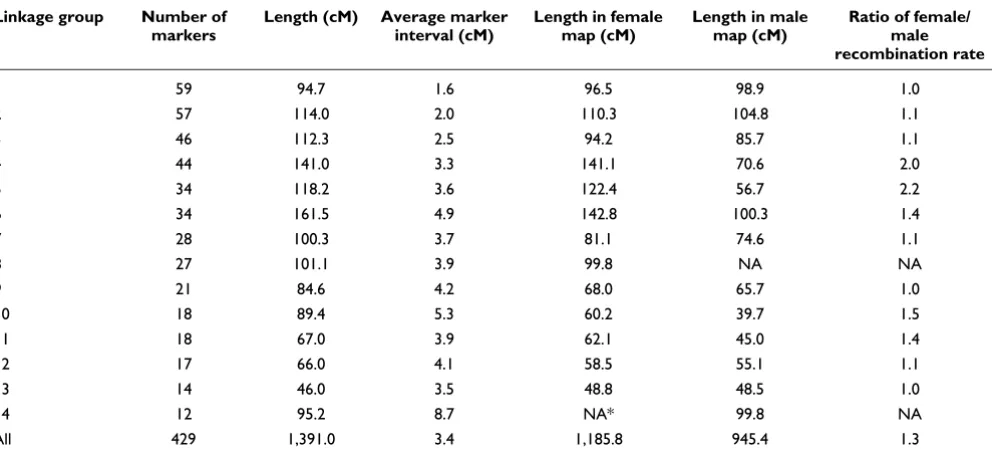
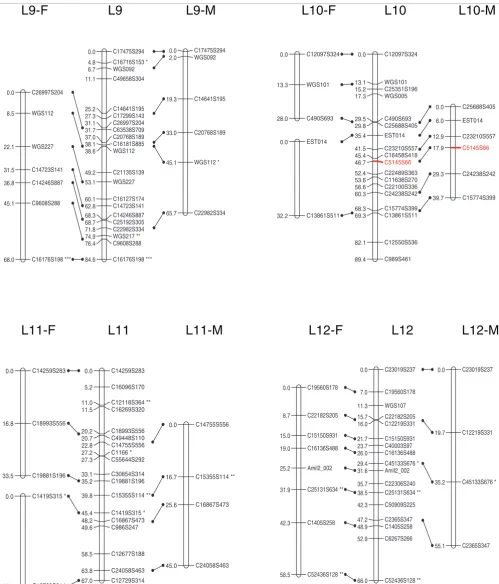
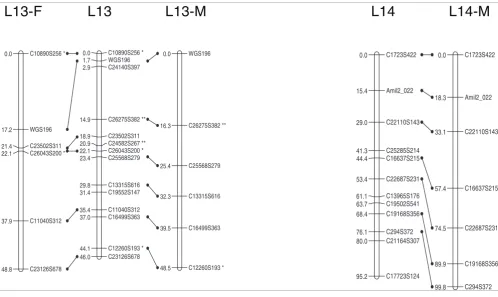
At the initial logarithm of the odds (LOD) threshold of 4.5, 293 markers were grouped into 14 linkage groups, which cor-responds to the known haploid chromosome number for this species. Then 124 markers were added to the established groups at LOD = 3, and 14 additional markers were added at LOD = 2.5. After data partitioning by the Joinmap 4.0 pro-gram, the maternal (1:1 female type) and paternal (1:1 male type) datasets contained 167 and 155 markers, respectively, which were subsequently used for constructing sex-specific maps based on the two-way pseudo-testcross strategy [24]. The female map contains 152 markers and spans 1,185.8 cM, while the male map contains 149 markers and spans 945.4 cM (Figures 1, 2, 3 and 4). The female map is 240.4 cM (30%) longer than the male map, even discounting L8 and L14 where recombination information is missing for one parent. Large differences between recombination rates in the male and female parents were observed for linkage groups L4, L5, L6, L10 and L11 (Table 1). Notably, we found that the poly-morphism level revealed by markers in L8 was significantly lower than the average in the male parent (chi-square test, P
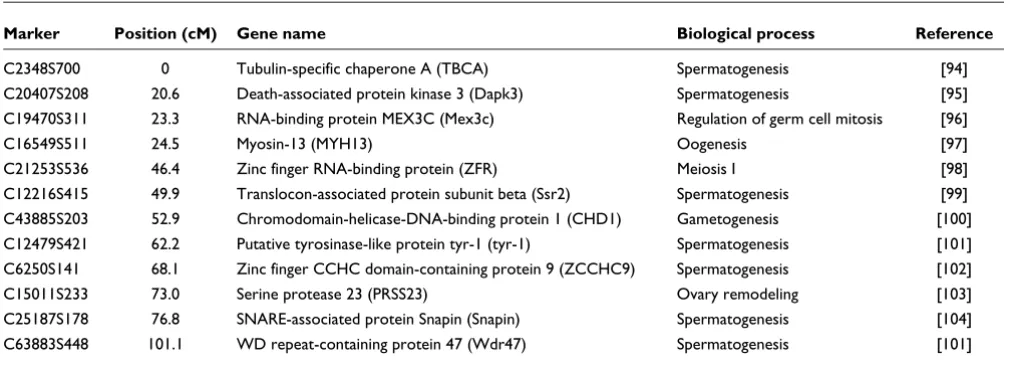
< 0.0001). More interestingly, we found that more than half of the annotated genes in this linkage group were putatively involved in sexual reproduction (Table 2).
The consensus map contains 429 markers (393 SNPs and 36 microsatellites) in 14 linkage groups (Figures 1, 2, 3 and 4), and spans 1,391 cM with an average marker interval of 3.4 cM.
The length of each linkage group ranges from 46 cM to 161.5 cM. Marker density varies dramatically across linkage groups (Table 1). For example, both L1 and L14 are approximately 95 cM in length, but L1 contains 59 markers whereas L14 con-tains only 12 markers. Nine putative stress-related genes were identified in the consensus map (Figures 1, 2 and 3; EM and MVM, unpublished) [25,26]. These genes are involved in cytoskeleton formation, heat shock, oxidative stress, protein degradation, and vesicular transport.
Genome lengths estimated by two different methods [27,28] are similar at 1,484.8 cM (Ge1) and 1,501.9 cM (Ge2), respec-tively. The average of two estimates was taken as the expected genome length - 1493.4 cM. Given an estimated genome size of 200 Mbp for A. millepora [1], the average recombination rate across all linkage groups is approximately 7.5 cM/Mbp. The genome coverage of the current map was estimated as 93.1%.
Comparative genome analysis
[image:3.612.58.554.498.723.2]Comparison of the markers mapped in this study with the previously annotated coral larval transcriptome [11] allowed the assignment of nearly all markers (97%) to longer cDNA sequences, which included all markers derived from 454 tran-scriptome sequences. Of the 416 sequences so identified, 286 (69%) corresponded to known genes based on the previously described transcriptome annotation [11]; 280 genes mapped by this process were each associated with a single marker, with 6 genes containing two markers each. The accession numbers, gene annotation, and synteny information for all mapped markers are shown in Additional data file 1.
Table 1
Summary of the coral genetic linkage map
Linkage group Number of markers
Length (cM) Average marker interval (cM)
Length in female map (cM)
Length in male map (cM)
Ratio of female/ male recombination rate
1 59 94.7 1.6 96.5 98.9 1.0
2 57 114.0 2.0 110.3 104.8 1.1
3 46 112.3 2.5 94.2 85.7 1.1
4 44 141.0 3.3 141.1 70.6 2.0
5 34 118.2 3.6 122.4 56.7 2.2
6 34 161.5 4.9 142.8 100.3 1.4
7 28 100.3 3.7 81.1 74.6 1.1
8 27 101.1 3.9 99.8 NA NA
9 21 84.6 4.2 68.0 65.7 1.0
10 18 89.4 5.3 60.2 39.7 1.5
11 18 67.0 3.9 62.1 45.0 1.4
12 17 66.0 4.1 58.5 55.1 1.1
13 14 46.0 3.5 48.8 48.5 1.0
14 12 95.2 8.7 NA* 99.8 NA
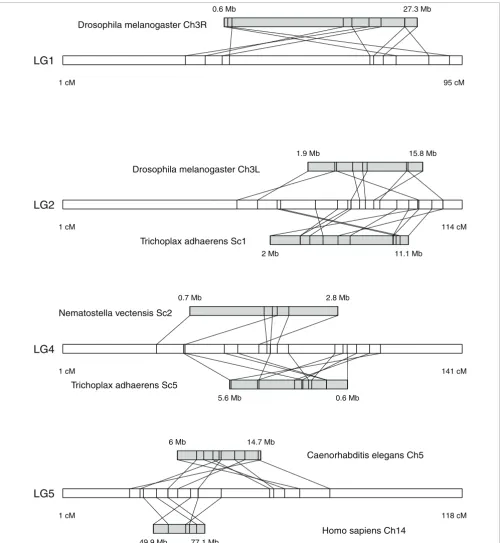
Comparison of the mapped sequences with assembled genomes from other metazoans identified putative homologs for between 48% (nematode) and 80% (sea anemone) of the mapped coral genes, and a similar comparison with the yeast genome identified putative homologs for 29% of mapped coral genes. These pairs of putative homologs allowed for comparison of the coral genetic map with assembled genome sequences of other metazoans, identifying conserved synteny blocks in 11 of the 14 coral linkage groups, each of which tained from 3 to 12 markers. The largest synteny block con-served between coral and another metazoan was found in linkage group 4, with 12 markers spanning 69 cM in the coral linkage group and their best matches spanning 5 Mb in scaf-fold 5 of the Trichoplax adhaerens genome (Figure 5). An overlapping set of markers within this same linkage group also showed conserved synteny with the anemone Nemato-stella vectensis (Figure 5). Synteny blocks were identified in each of the metazoan comparisons; each comparison identi-fied 4 to 13 blocks, with each block containing 3 to 12 markers (Table 3). Most of the conserved synteny blocks identified here involved intra-chromosomal rearrangements, in which linkage was conserved but gene order was not (for example, the synteny block conserved between coral and placozoan in Figure 5). Notably, a parallel comparison between the coral map and the yeast genome found no evidence of conserved synteny, even though the small genome size of yeast (approx-imately 12 Mb) would be expected to relax one of the opera-tional criteria for determining synteny (the requirement that matches occur within ≤10 Mb in the yeast chromosome).
We tested for the significance of synteny blocks using ran-domly shuffled permutations of the original data, which revealed that a non-trivial number of synteny blocks could be expected to emerge in these comparisons by random chance (Table 3). Although numerous synteny blocks were detected in comparisons between coral and Drosophila melanogaster
or C. elegans, the number of blocks detected was not
signifi-cantly higher than expected by chance for either comparison (P = 0.68 and P = 0.39, respectively). In contrast, the other three metazoan genomes we investigated each showed signif-icantly more synteny than expected by chance (anemone, P < 0.001; placozoan, P = 0.002; human, P = 0.002). Obviously the comparison with yeast (Saccharomyces cerevisiae), which found no conserved synteny, was unaffected by these statistical tests. Each of the metazoan genome comparisons identified at least one synteny block that contained more markers (n = 6 to 12) than expected by chance. These signifi-cant blocks of conserved synteny are depicted in Figure 5, and the syntenic markers in each block are described in more detail in Additional data file 1.
Discussion
SNP marker development in coral
Molecular markers are useful tools for assessing important ecological and evolutionary issues such as connectivity, local adaptation, range shifts, biodiversity depletion, speciation, and invasion. Despite widespread concerns about the future of reef-building corals in the changing climate, genetic resources for corals remain scarce. The traditional ways of developing microsatellites or SNP markers are quite costly and time-consuming. Moreover, due to technical problems and low abundance in the genome, it has been shown that development of a large number of microsatellite markers in acroporid corals is particularly difficult based on the tradi-tional microsatellite-enriched genomic library method [29]. Despite the advantages of SNP markers for a variety of tasks [30], their use in non-model organisms such as corals has been hampered primarily due to the costs of high-throughput SNP discovery and genotyping. With the introduction of the next-generation 454 sequencing technology, high-through-put SNP discovery is now feasible for any non-model organ-ism. Our previous study [11], as well as others recently published [31-33], demonstrates a cost-effective way to
pro-Table 2
A list of genes from linkage group 8 that are putatively involved in sexual reproduction
Marker Position (cM) Gene name Biological process Reference
C2348S700 0 Tubulin-specific chaperone A (TBCA) Spermatogenesis [94] C20407S208 20.6 Death-associated protein kinase 3 (Dapk3) Spermatogenesis [95] C19470S311 23.3 RNA-binding protein MEX3C (Mex3c) Regulation of germ cell mitosis [96]
C16549S511 24.5 Myosin-13 (MYH13) Oogenesis [97]
[image:4.612.53.559.115.298.2]A genetic linkage map (L1 to L4) of the reef-building coral A. millepora
Figure 1
A genetic linkage map (L1 to L4) of the reef-building coral . Female (F) and male (M) maps are shown on the left and right, respectively, and the consensus map is shown in the center. Homologous loci are connected with solid lines. Putative stress-related markers are shown in red. Distorted loci are indicated by asterisks (*0.01 <P < 0.05, ** P < 0.01; *** P < 0.001).
C13288S189 0.0 C11422S292 6.1 WGS211 13.0 C19740S286 20.4 C1024S157 21.1 C17912S202 22.4 EST254 ** 28.0 C19263S650 32.1 C19862S335 34.0 C11959S269 * 36.0 C21833S285 40.9 C22405S305 43.6 C14455S306 53.4 C22875S709 * 62.2 EST181 63.9 C10466S190 75.0 C52176S400 * 75.1 C18841S310 78.2 C11099S398 82.7 C15620S247 84.7 C13698S442 90.0 C841S459 95.6 WGS079 96.5 C21349S456 0.0 C1328S290 1.9 C11524S150 * 4.7 C13288S189 5.8 C20570S83 7.3 C11422S292 9.4 WGS211 11.1 C25302S260 15.8 C24856S313 19.7 C19740S286 22.1 C1024S157 23.1 C17622S201 * 23.5 C12140S96 24.6 C17828S268 26.7 C21470S842 29.7 C3633S408 30.8 C17438S197 33.6 C17912S202 34.4 C15044S328 35.4 C45199S349 36.6 EST254 ** 36.7 C19263S650 38.4 C19862S335 39.1 C35020S147 39.8 C18397S183 40.1 C11959S269 * 42.5 C22545S1379 43.0 C22826S366 44.5 C13905S483 * 47.4 C26852S307 48.2 C21833S285 49.2 C21186S526 49.9 C22405S305 51.1 C20625S210 53.0 C14455S306 54.5 C20763S245 56.2 C3729S182 59.2 C22875S709 * 60.3 C12606S270 60.7 EST181 62.1 C23083S345 62.5 C17741S312 65.0 C25628S525 68.5 WGS051 70.1 C10466S190 70.8 C52176S400 * 70.9 C18443S396 * 73.1 C18841S310 73.9 C22993S160 *** 76.2 C11099S398 77.7 C31833S405 * 78.6 C15620S247 79.2 C22973S285 81.8 C11470S398 84.7 C13698S442 86.9 C841S459 91.8 WGS079 ** 92.6 C15873S711 94.5 C14269S102 * 94.7 C11524S150 * 0.0 C20570S83 6.4 WGS211 15.6 C17622S201 * 25.0 C45199S349 37.4 C35020S147 41.5 C26852S307 49.5 C20625S210 51.5 C20763S245 58.1 C23083S345 65.6 C25628S525 72.1 C18443S396 * 79.8 C22993S160 *** 87.5 C31833S405 * 88.9 WGS079 * 97.7 C15873S711 98.9 C36218S165 0.0 C45380S826 15.6 C24159S323 35.2 C20274S537 * 36.7 C12902S674 50.3 C237S473 58.6 C24096S618 ** 60.0 C6659S249 * 71.4 C17077S225 0.0 C16387S343 23.4 C22900S198 ** 38.9 C36218S165 0.0 C18580S230 13.2 C23375S174 * 15.8 C45380S826 16.1 C18366S189 24.1 EST164 26.5 C14319S510 * 35.9 C24159S323 36.4 C14226S523 * 38.1 C20274S537 * 40.6 C21618S209 42.8 C19944S225 44.3 C13648S225 44.5 C19364S520 47.0 C22643S340 *** 47.2 C20821S413 50.4 EST165 *** 54.0 C20399S426 55.4 C12902S674 56.2 C13142S250 EST062 ** 57.5 C237S473 61.7 C22821S388 62.7 C24096S618 ** 64.5 Apam3_166 66.0 C10697S175 66.7 C25444S173 68.4 C14487S191 *** 71.9 C13354S446 ** 72.6 C6659S249 * 73.9 C20442S307 75.4 C26831S450 76.0 C13486S116 ** 76.9 C24129S242 78.9 C14357S360 79.3 C2435S173 81.7 C25234S280 82.6 C25652S324 84.0 C23734S391 84.9 C15351S256 * 85.1 C17077S225 86.7 C16387S343 87.3 C15493S507 89.1 C17287S307 90.7 C12507S635 90.8 C18231S140 91.3 C22109S391 * 93.7 C25536S620 * 95.6 C22900S198 ** 96.0 C15056S244 99.0 C54074S403 *** 101.5 C14474S185 101.8 C26329S310 105.5 C25946S829 105.7 C11020S415 108.6 C25425S128 112.8 C14242S316 114.0 C18580S230 0.0 C23375S174 * 2.0 C18366S189 8.1 EST164 12.9 C14319S510 * 22.6 C14226S523 * 25.5 C13648S225 31.5 C22643S340 *** 34.1 C20821S413 37.5 C20399S426 43.0 C12902S674 46.6 Apam3_166 53.3 C25444S173 54.0 C14487S191 *** 55.0 C13354S446 ** 55.2 C13486S116 ** 58.1 C25234S280 62.0 C23734S391 66.6 C15351S256 * 69.0 C15493S507 75.1 C22109S391 * 77.5 C25536S620 * 82.1 C15056S244 86.4 C14474S185 91.2 C14242S316 104.8 C188S318 * 0.0 C28595S225 19.9 C15111S282 23.4 C34124S511 26.0 C19002S323 38.6 C16956S551 46.7 WGS131 55.9 C1136S272 62.3 C11110S247 * 67.6 C21244S233 72.4 C29060S309 81.7 C15670S505 94.2 C26271S403 0.0 C188S318 * 1.6 C10862S253 9.4 C17498S226 ** 16.0 C28595S225 16.4 C38503S228 18.5 C15111S282 28.0 C22427S223 29.6 C27925S129 32.2 C15176S465 34.2 C34124S511 36.3 C16912S265 37.8 C19002S323 39.5 C19713S134 42.0 C20998S134 44.0 C18165S232 44.2 C12093S318 44.8 C10565S307 ** 46.2 C16956S551 49.2 C13265S200 49.6 C23489S194 53.9 WGS131 55.9 C20581S243 58.4 C24932S258 61.1 C23738S719 62.5 C11110S247 * C1136S272 63.7 C16621S398 64.7 C22425S453 68.0 C24216S175 69.0 EST016 70.4 C166S563 72.5 C21244S233 73.2 C12174S605 75.1 C13535S196 ** 75.4 C11242S364 78.0 C28868S363 * 79.5 C29060S309 C16965S252 84.6 C22138S164 86.5 C15670S505 90.9 WGS035 91.9 C18064S518 98.1 C23209S177 ** 99.6 C60613S230 105.8 C10810S897 112.3 C26271S403 0.0 C10862S253 12.0 C17498S226 ** 24.9 C22427S223 29.2 C15176S465 30.6 C16912S265 37.4 C19713S134 40.4 C12093S318 43.2 C10565S307 ** 44.6 C13265S200 48.0 C23489S194 52.4 WGS131 56.2 C20581S243 57.0 C23738S719 60.6 C16621S398 63.6 C22425S453 66.1 C24216S175 67.8 EST016 69.7 C166S563 71.6 C12174S605 74.0 C11242S364 76.8 C16965S252 83.3 WGS035 85.7 C17479S262 0.0 C15084S136 16.7 C24438S225 24.0 C14364S490 34.2 C3724S507 35.8 C14018S197 42.2 C27153S258 43.6 C29226S281 60.1 C18185S479 62.8 C7889S263 ** C18487S1302 *** 70.7 C22633S340 72.5 C1063S181 78.1 WGS116 *** 86.8 C13992S181 ** 90.4 C26116S342 96.6 C48806 102.8 C17914S739 104.5 C11759S946 113.3 C12464S260 120.1 C11999S90 124.5 C13550S341 141.1 C17479S262 0.0 C15084S136 16.7 C24438S225 24.0 C14364S490 34.2 C3724S507 35.8 EST007 37.3 C14018S197 42.2 C19797S331 43.6 C27153S258 44.1 C18363S421 50.2 C7134S210 56.4 C13990S341 57.9 C29226S281 C17330S121 59.8 C18920S453 60.4 C18185S479 62.6 C5239S208 * 65.2 EST149 68.1 C10773S305 70.0 C7889S263 ** 72.3 C18487S1302 *** 72.4 C11797S545 72.8 C22633S340 73.7 C10625S161 * 74.0 C76S562 76.4 C13301S439 77.1 C1063S181 77.8 C19928S437 80.4 C23327S599 84.1 WGS116 ** 85.8 C20443S297 * 89.4 C13992S181 ** 89.9 C20163S412 92.9 C63602S197 95.1 C26116S342 96.6 C14848S1085 99.4 C11461S560 100.9 C48806 102.7 C17914S739 104.1 C14404S340 *** 108.7 C11759S946 112.5 C12464S260 119.7 C11999S90 124.3 C13550S341 141.0 EST007 0.0 C18363S421 11.8 C7134S210 18.2 C17330S121 22.8 C5239S208 * 26.9 C10773S305 31.5 C11797S545 34.5 C10625S161 * 35.4 C19928S437 41.2 WGS116 45.5 C20443S297 * 51.1 C20163S412 55.2 C63602S197 57.1 C14848S1085 61.9 C14404S340 *** 70.6
L1-F L1 L1-M L2-F L2 L2-M
A genetic linkage map (L5 to L8) of the reef-building coral A. millepora
Figure 2
A genetic linkage map (L5 to L8) of the reef-building coral A. millepora. Female (F) and male (M) maps are shown on the left and right, respectively, and the consensus map is shown in the center. Homologous loci are connected with solid lines. Putative stress-related markers are shown in red. Distorted loci are indicated by asterisks (*0.01 <P < 0.05, ** P < 0.01; *** P < 0.001).
C26311S424 ** 0.0 C25225S451 16.7 C11329S180 * 31.0 WGS189 42.1 C18576S293 66.1 C18603S149 79.3 C29080S200 91.7 C15741S475 *** 105.6 C14154S231 122.4 C22820S193 ** 0.0 C26311S424 ** 6.8 Amil2_010 * 14.4 C15891S454 *** 19.5 C8136S163 * 20.8 C59049S135 23.8 C25225S451 24.8 EST032 27.8 C6723S318 28.7 C12395S564 32.0 C15021S282 * 34.9 C70S236 35.3 C15238S417 38.7 C11329S180 * 40.3 C23525S293 40.9 C11670S169 42.8 WGS152 44.7 C21844S313 ** 47.6 WGS189 51.2 C25713S318 52.6 C16442S295 54.7 C10924S223 59.1 C29432S370 61.8 C24388S705 63.0 C26140S243 66.2 C11439S315 70.5 C15985S312 70.6 C18576S293 72.6 C22761S360 75.4 EST121 76.6 C18603S149 79.5 C29080S200 90.1 C15741S475 *** 102.1 C14154S231 118.2 Amil2_010 * 0.0 C15891S454 *** 2.4 C59049S135 4.4 EST032 C6723S318 11.7 C12395S564 11.9 C70S236 15.2 C15238S417 17.4 C11670S169 21.7 WGS152 24.1 C21844S313 ** 26.3 WGS189 27.9 C25713S318 32.3 C10924S223 39.8 C29432S370 42.1 C26140S243 45.7 EST121 56.7 C23978S544 * 0.0 C31340S160 10.3 C3255S483 19.0 C15113S204 29.7 C915S149 38.9 C10475S502 45.7 C15522S127 * 53.5 C1023S218 63.0 WGS134 72.6 C29463S468 82.1 C11520S633 94.1 C16774S791 99.3 C21914S231 112.9 C13394S333 142.8 C23978S544 * 0.0 C31340S160 11.3 C3255S483 20.2 C15113S204 30.7 C915S149 39.8 C16279S643 43.2 C10475S502 46.5 C19478S130 52.4 C20167S379 54.6 C288S173 56.9 C15522S127 * 58.7 C26478S226 66.1 C1023S218 70.2 C23950S250 74.2 C10005S217 75.3 WGS134 81.8 WGS205 * 84.7 C29463S468 86.4 C27026S472 91.4 C11520S633 92.6 C16774S791 95.3 C23085S183 98.6 C19533S241 100.8 C21914S231 106.8 C11535S517 108.7 C19178S536 116.6 C1114S124 119.7 C13394S333 130.2 C15415S232 133.9 C16634S406 134.2 C4134S257 142.0 C52394S280 144.4 C22526S224 148.7 C1379 161.5 C20167S379 0.0 WGS134 26.0 WGS205 * 31.7 C27026S472 38.7 C19533S241 47.8 C11535S517 55.7 C1114S124 68.2 C15415S232 84.2 C22526S224 100.3 C8085S432 0.0 EST122 12.5 C15286S686 22.1 C11076S81 33.7 C50281S478 * 50.9 C27337 57.5 WGS153 ** 62.7 C12987S419 81.1 C23566S420 0.0 C26794S214 5.5 C45851S374 15.5 C15318S250 18.1 C49697S354 C19092S284 23.7 C8085S432 26.7 C19982S400 34.4 EST122 35.9 C27071S243 40.3 C17050S589 43.3 C15286S686 45.8 C24897S240 48.2 C20102S582 48.8 WGS145 49.3 C20479S292 53.1 C11463S192 55.9 C16449S173 58.0 C11076S81 59.6 C10050S780 67.2 C14161S301 72.7 C50281S478 * 73.2 C24813S193 73.5 C27337 78.7 WGS153 ** 83.0 C14532S618 84.4 C23508S203 92.4 C12987S419 100.3 C26794S214 0.0 C45851S374 10.7 C49697S354 C19092S284 19.1 C19982S400 30.1 EST122 31.8 C27071S243 36.0 C20102S582 45.4 C16449S173 50.3 C10050S780 67.1 WGS153 * 74.6 C2348S700 0.0 C28447S501 1.2 C18084S286 9.8 C18442S324 13.5 C22464S266 * 18.6 C20407S208 21.2 C19470S311 * 23.7 C11715S299 * 27.2 C55647S531 32.8 C25725S230 * 37.2 C25677S330 43.3 C21253S536 *** 46.3 C12216S415 50.0 C17151S285 56.9 C12479S421 63.3 C969S127 67.9 C6250S141 68.2 C15011S233 71.3 C25187S178 75.3 C17471S281 84.7 C19916S128 90.2 C63883S448 99.8 C2348S700 0.0 C28447S501 1.1 C18084S286 9.4 C18442S324 13.0 C22162S248 17.2 C22464S266 * 18.6 C20407S208 20.6 C19470S311 * 23.3 C16549S511 24.5 C11715S299 * 27.5 C55647S531 32.5 C24321S173 35.3 C25725S230 * 37.8 C25677S330 43.6 C21253S536 *** 46.4 C12216S415 49.9 C43885S203 52.9 C17151S285 56.0 C12479S421 62.2 C969S127 67.7 C6250S141 68.1 C15011S233 73.0 C25187S178 76.8 C17471S281 85.2 C19916S128 92.1 C15269S273 92.8 C63883S448 101.1
L5-F L5 L5-M L6-F L6 L6-M
A genetic linkage map (L9 to L12) of the reef-building coral A. millepora
Figure 3
A genetic linkage map (L9 to L12) of the reef-building coral A. millepora. Female (F) and male (M) maps are shown on the left and right, respectively, and the consensus map is shown in the center. Homologous loci are connected with solid lines. Putative stress-related markers are shown in red. Distorted loci are indicated by asterisks (*0.01 <P < 0.05, ** P < 0.01; *** P < 0.001).
C26997S204 0.0
WGS112 8.5
WGS227 22.1
C14723S141 31.5
C14246S887 36.8
C9608S288 45.1
C16176S198 *** 68.0
C17475S294 0.0
C16716S153 * 4.8
WGS092 6.7
C49658S304 11.1
C14641S195 25.2
C17299S143 27.3
C26997S204 31.1
C63538S709 31.7
C20768S189 37.0
C16181S885 38.1
WGS112 38.6
C21135S139 49.2
WGS227 53.1
C16127S174 60.1
C14723S141 62.8
C14246S887 68.3
C25192S305 68.7
C22982S334 71.8
WGS217 ** 74.9
C9608S288 76.4
C16176S198 *** 84.6
C17475S294 0.0
WGS092 2.0
C14641S195 19.3
C20768S189 33.0
WGS112 * 45.1
C22982S334 65.7
C12097S324 0.0
WGS101 13.3
C490S693 28.0
EST014 0.0
C13861S511 32.2
C12097S324 0.0
WGS101 13.1
C25351S196 15.2
WGS005 17.3
C490S693 29.5
C25688S405 29.8
EST014 35.4
C23210S557 41.5
C16458S418 45.4
C5145S66
46.7
C22489S363 52.4
C11638S270 53.6
C22100S336 56.6
C24238S242 60.3
C15774S399 68.3
C13861S511 69.3
C12550S536 82.1
C989S461 89.4
C25688S405 0.0
EST014 6.0
C23210S557 12.9
C5145S66
17.9
C24238S242 29.3
C15774S399 39.7
C14259S283 0.0
C18993S556 16.8
C19881S196 33.5
C1419S315 * 0.0
C12729S314 28.6
C14259S283 0.0
C16096S170 5.2
C12118S364 ** 11.0
C16269S320 11.5
C18993S556 20.2
C49448S110 20.7
C14755S556 22.8
C1166 * 27.2
C55644S292 27.3
C30854S314 33.1
C19881S196 35.2
C15355S114 ** 39.8
C1419S315 * 45.4
C16867S473 48.2
C986S247 49.6
C12677S188 58.5
C24058S463 63.8
C12729S314 67.0
C14755S556 0.0
C15355S114 ** 16.7
C16867S473 25.6
C24058S463 45.0
C19560S178 0.0
C22182S205 8.7
C15150S931 15.0
C16136S488 19.0
Amil2_002 25.2
C25131S634 ** 31.9
C1405S258 42.3
C52436S128 ** 58.5
C23019S237 0.0
C19560S178 7.0
WGS107 11.3
C22182S205 15.7
C12219S331 16.0
C15150S931 21.7
C40003S97 23.7
C16136S488 26.0
C45133S676 * 29.4
Amil2_002 31.6
C22306S240 35.7
C25131S634 ** 38.5
C50909S225 42.3
C2365S347 47.2
C1405S258 48.9
C6267S266 52.9
C52436S128 ** 66.0
C23019S237 0.0
C12219S331 19.7
C45133S676 * 35.2
C2365S347 55.1
L9-F L9 L9-M L10-F L10 L10-M
duce a large number of gene-associated SNPs from transcrip-tome data obtained by 454 sequencing. Such gene-derived SNPs are particularly useful for non-model organisms, since they stand a better chance of identifying causal genes under-lying complex traits in these organisms in the absence of genome sequence data [12,13]. The criteria that we used for
SNP mining (at least 3× occurrence of the minority allele and at least 6× read coverage) are more stringent than those typi-cally used (2× occurrence of the minority allele, and 4× or 5× read coverage) [11,31,32]. In our experience, the use of these stringent criteria enhances the success rate of marker devel-opment from 454 sequencing data.
[image:8.612.55.553.85.382.2]A genetic linkage map (L13 and L14) of the reef-building coral A. millepora
Figure 4
A genetic linkage map (L13 and L14) of the reef-building coral A. millepora. Female (F) and male (M) maps are shown on the left and right, respectively, and the consensus map is shown in the center. Homologous loci are connected with solid lines. Distorted loci are indicated by asterisks (*0.01 <P < 0.05, ** P < 0.01; *** P < 0.001).
C10890S256 * 0.0
WGS196 17.2
C23502S311 21.4
C26043S200 * 22.1
C11040S312 37.9
C23126S678 48.8
C10890S256 * 0.0
WGS196 1.7
C24140S397 2.9
C26275S382 ** 14.9
C23502S311 18.9
C24582S267 ** 20.9
C26043S200 * 22.1
C25568S279 23.4
C13315S616 29.8
C19552S147 31.4
C11040S312 35.4
C16499S363 37.0
C12260S193 * 44.1
C23126S678 46.0
WGS196 0.0
C26275S382 ** 16.3
C25568S279 25.4
C13315S616 32.3
C16499S363 39.5
C12260S193 * 48.5
C1723S422 0.0
Amil2_022 15.4
C22110S143 29.0
C25285S214 41.3
C16637S215 44.4
C22687S231 53.4
C13965S176 61.1
C19502S541 63.7
C19168S356 68.4
C294S372 76.1
C21164S307 80.0
C17723S124 95.2
C1723S422 0.0
Amil2_022 18.3
C22110S143 33.1
C16637S215 57.4
C22687S231 74.5
C19168S356 89.9
C294S372 99.8
L13-F L13 L13-M L14 L14-M
Table 3
Synteny blocks between A. millepora and other eukaryotic genomes and their significance
All synteny blocks Significant blocks
Comparison Blocks (n) Markers per block Overall significance Blocks (n) Markers per block
Saccharomyces cerevisiae 0 0 1 0 0
Homo sapiens 4 3-6 0.002 1 6
Nematostella vectensis 6 3-6 < 0.001 1 6
Caenorhabditis elegans 12 3-10 0.392 1 10
Drosophila melanogaster 13 3-10 0.679 2 9-10
Trichoplax adhaerens 13 3-12 0.002 2 12
[image:8.612.55.557.566.694.2]Conserved synteny blocks
Figure 5
Conserved synteny blocks. Each synteny block represents a set of mapped coral markers and their best matches in another metazoan genome. Synteny blocks were defined as groups of at least three markers, each of which was ≤10 cM from its nearest neighbor within a linkage group in the coral map, and for which the best matches in another genome were also each ≤10 Mb from their nearest neighbors in the same chromosome or scaffold. All blocks shown here contain more markers than expected from chance (P < 0.05) based on permutation analysis (n = 1,000). For each block, the coral linkage group is shown as a white horizontal bar, with syntenic marker positions (in cM) indicated on the bar. For each linkage group containing a synteny block, each comparison with the other genome is shown as a horizontal grey bar, with marker positions (in Mb) indicated on the bar. Relationships between coral markers and other genomes, based on sequence similarity (tblastx, bit-score ≥50), are indicated by diagonal lines connecting each coral marker with its best match.
LG1
0.6 Mb 27.3 Mb
|
| |
| | | |
|| |
1 cM 95 cM
| | | | | | | | | |
LG2
1.9 Mb 15.8 Mb |
| | | || || |
2 Mb 11.1 Mb
| | |
|| | | |
| | | |
1 cM 114 cM
| | | | | | ||| | | | | | | ||| | ||
LG4
0.7 Mb 2.8 Mb
| | || | |
5.6 Mb 0.6 Mb || || | |||| || |
1 cM 141 cM
| ||| | | | | | || | | | | | | |
LG5
6 Mb 14.7 Mb | |
| | | | | |
| |
49.9 Mb 77.1 Mb | | | | ||
1 cM 118 cM
| || | | || | || | | | | | |
Drosophila melanogaster Ch3R
Drosophila melanogaster Ch3L
Trichoplax adhaerens Sc1
Nematostella vectensis Sc2
Trichoplax adhaerens Sc5
SNP genotyping via high resolution melting analysis Among the methods available for high-throughput SNP gen-otyping, the simple, fast and cost-effective HRM method is especially suitable for non-model organisms. The original HRM method requires one fluorescently labeled probe for each assay [34,35]. Later, this method was simplified by using an unlabeled probe in the fluorescent dye solution, but the 3' end of the probe still required costly chemical modification to prevent extension of the probe [36,37]. In this study, we fur-ther decrease HRM genotyping cost simply by adding two mismatched bases to the 3' end of an unlabeled probe instead of chemical modification.
SNP marker transferability between populations Transferability of the assays to different populations is argu-ably the most important problem that may arise when trying to apply SNP markers to broad-scale population studies. The markers developed for one population may turn out to be appreciably polymorphic only in populations well connected to the original one, while being essentially homozygous in other, more isolated populations. The degree of connectivity between A. millepora populations between three reefs in the Great Barrier Reef (representing northern, middle, and southern regions) has been previously evaluated using alloz-yme markers [38]. Similar to nearly all coral species in that analysis, A. millepora demonstrated genetic subdivision among sampled sites (high Fst values), although not without some connectivity (an estimated 5 to 30 exchanged migrants per generation). Oliver and Palumbi [39], on the other hand, detected strong barriers to connectivity over longer spatial scales (across Pacific archipelagoes) in two closely related species, A. cytherea and Acropora hyacinthus, using several intron- and mitochondrial DNA-derived markers that were developed for phylogeography applications. The study of the natural genotypic diversity and connectivity between A. millepora populations is of great interest for understanding the evolutionary responses of reef-building corals to ongoing climate change, and is among our high-priority research areas for the future. This emphasizes the importance of deter-mining whether our SNP markers are polymorphic in other populations, or mostly represent 'private alleles' specific to the Magnetic Island (and perhaps even more specifically, Nelly Bay) population. Fortunately, in our interpopulation transferability test, most (65 to 75%) of the SNP markers we tested were polymorphic in just seven A. millepora colonies from Orpheus Island and Great Keppel Island, which are 80 km and 570 km away from Magnetic Island, respectively. Although this result suggests that the detected SNPs repre-sent relatively common alleles in these populations, the dis-tance between these populations is just a fraction of what was assayed in the Ayre and Hughes study [38], and so it remains to be seen how far this allele sharing extends. Still, this result is quite promising and suggests the potential for application of these SNP markers to inter-population studies of local adaptation in A. millepora.
Mapping population
For animals and plants with short generation times, very effi-cient mapping populations (second generation (F2), back-cross, recombinant inbred lines, double haploid, and so on) can be generated from the crosses among homozygous pater-nal strains or recombinant inbred lines, which usually requires multiple generations of sib-mating or self-fertiliza-tion. Despite several advantages of those methods, it would be very difficult, if not impossible, to produce such mapping populations in corals because most corals have long genera-tion times (approximately 5 to 10 years in some corals, and 3 to 5 years in most acroporids), and the adult colonies are rather difficult to maintain. Last but not least, to our knowl-edge, synchronized coral mass spawning, an essential requirement for making genetic crosses, has never been rec-reated in laboratory-raised corals. In short, corals make poor laboratory models; however, this does not diminish the value of ecological and evolutionary questions pertaining to these organisms. Fortunately, previous studies have shown that A. millepora, like many other corals, is a highly heterozygous species [8,9]. Because of this, an outbred full-sib family would be a suitable mapping population for constructing a linkage map [40-45]. Although marker configurations are more com-plicated in such a family, they can be deduced after analyzing the parental origin and genetic segregation of the markers in the progeny (for a review, see [46]). In particular, coral larvae offer several key advantages over adult colonies for linkage mapping in that they are easy to obtain in great numbers, and, in this species, they do not contain algal symbionts, which would be a potential source of DNA contamination.
Map density and recombination rate
the A. millepora genome, the sequencing of which is immi-nent (DJ Miller, personal communication).
Gamete-specific recombination rates
Differential recombination rates between sexes are wide-spread in animals and plants, with females often having more recombination and longer genetic maps than males [54]. Sim-ilar observations have also been reported in hermaphrodites, with greater recombination in female than male gametic tis-sue [41,55,56]. The underlying mechanism remains the sub-ject of much debate, although several models have been proposed (for a review, see [57]). In this study, the length of the female map is 30% longer than that of the male map, sug-gesting that sex difference in recombination does exist in A. millepora. However, this difference seems attributable to only a few (that is, L4, L5, L6, L10 and L11), but not all, link-age groups. The 'haploid selection' model proposed by recent studies [58,59] seems to be the most plausible explanation for our observation. In the 'haploid selection' theory, sex differ-ences in recombination result from a male-female difference in gametic selection. In coral Acropora spp., like in most ani-mals, there is no female haploid phase, because meiosis is completed only after fertilization [60]. Since some genes (for example, genes responsible for meiotic drive systems) are expressed and under selection during the male haploid phase [61,62], this would tend to reduce recombination in males. If such genes were located in only a few chromosomes, this would be expected to reduce the amount of recombination observed in those chromosomes.
Haploid selection might also explain the low polymorphism level of linkage group 8 in the male parent. Because the male parent was genotyped based on the sperm sample, it is possi-ble that genotypes of some loci inferred from sperm mixtures are different from genotypes of adult tissues if these loci are subject to haploid selection. The significant low polymor-phism level in L8 of the male parent may reflect strong hap-loid selection (for example, one of the homologous chromosomes corresponding to L8 might produce functional sperm, while the other might contain deleterious alleles that would produce non-functional sperm). Direct validation of this hypothesis would require tissue samples from the male parent, which are not available. However, the finding that more than half of annotated genes in L8 have putative roles in sexual reproduction supports the idea that this linkage group may be a target for haploid selection.
Synteny analysis and permutation tests
Synteny is defined as consistent linkage between certain genes across species. In the most general case, the definition does not require conservation of gene order or orientation. Previous comparative genomics studies have revealed syn-teny between distantly related metazoan taxa [63,64]. Most studies of genome evolution in animals have focused on bila-terian taxa for which extensive genomic resources are
availa-anemone and placozoan genomes have revealed substantial synteny between more distantly related metazoan taxa [68,69]. Our development of a genetic map for coral, which, to our knowledge, constitutes the first genetic map for a non-bilaterian metazoan, reveals the conservation of genomic organization among distantly related animal taxa.
As the simplest free-living animals, placozoans represent a primitive metazoan form. A recent comprehensive phyloge-netic study suggests that Placozoa are basal relative to all other non-Bilaterian animals ([70], but see [71]). Whole genome analysis of placozoan T. adhaerens shows that the placozoan genome has the lowest amount of local rearrange-ment relative to the common placozoan-cnidarian-bilaterian ancestor [69]. Previous comparative genome analysis revealed synteny blocks shared between placozoan and human genomes, which likely reflect ancestral features of the metazoan genome. In our study, we also found extensive syn-teny between coral and placozoan genomes (despite the incomplete assembly of the placozoan genome), suggesting that the coral genome also preserves many features of ances-tral genome organization.
Our preliminary synteny analysis identified numerous syn-teny blocks in each comparison between the coral map and other metazoan genomes. However, because of the number and positions of markers and their matching sequences within the two genomes, a substantial number of synteny blocks could be expected to arise by chance. Several methods to test for significant evidence of synteny between two genomes, based on randomly shuffled permutations of the real data, have been previously described [72-75]. The exist-ing implementations of these methods are not well suited for our data (comparison of genetic maps and genome sequences across distantly related taxa), but are more applicable to com-parative genome analysis of closely related species [19], because they require marker colinearity (that is, conserved marker order), and/or assume chromosome homology between chromosomes in comparison (for example, rand-omize markers only within a chromosome to evaluate signifi-cance of identified synteny). We followed a similar approach for our analysis, by randomly shuffling marker positions across the entire map and evaluating the likelihood that the number of synteny blocks, and the number of markers in each block, could have arisen by chance.
ture that would obviously be expected to affect the detection of synteny blocks by our criteria, including genome size, chro-mosome numbers, and the completeness of the assembly. Because the genomes considered in this study differed widely in these characteristics, this posed an important caveat for any conclusions drawn from these comparisons. Importantly, each of the comparisons between the coral map and another metazoan genome included at least one block that was signif-icantly larger than expected by chance, based on permutation tests of block size (the number of markers within each block).
Maintenance of synteny across great evolutionary distances
If not maintained by natural selection, synteny would be expected to break down between distantly related taxa. One obvious factor that would affect this is the rate of genome rearrangement. Recent studies have shown that rates of chro-mosomal rearrangement are much higher in invertebrates than vertebrates [76-78]. For example, the rearrangement rates of Drosophila and Caenorhabditis are 350 to 850 and 1,400 to 17,000 times higher than those of mammals, respec-tively [77]. Our finding that the coral map and the worm and fly genomes share very little conserved synteny is consistent with these previous reports. Still, the worm and fly genomes do contain a small number (one and two, respectively) of syn-teny blocks (each including nine to ten genes), and these are significantly larger than expected by chance (Table 3).
In general, eukaryotic genomes evolve by random micro- and macro-rearrangements such as indels, inversions and trans-locations [79]. Nevertheless, gene distribution in eukaryotic genomes is not random [80]. Several hypotheses have been put forward to explain synteny. Early research in genomic evolution and synteny assumed no selection for synteny, and suggested that synteny resulted from ancestral linkage groups that had not yet been disrupted by random chromosomal rearrangements [81]. The subsequent discovery that certain groups of co-regulated genes showed strict conservation of both gene order and linkage across taxa [82] refined this model by demonstrating that the co-regulation of a group of genes by local regulatory elements can drive conservation of synteny blocks containing those genes and their correspond-ing regulatory elements [83]. Recent studies have suggested an additional mechanism driving the conservation of syn-teny: the interdigitation of regulatory elements and their tar-get genes by other genes with unrelated functions and regulatory pathways [84,85].
None of those proposed mechanisms provides a clear expla-nation for our findings. Several metazoan genomes showed more synteny blocks than expected by chance, but the gene functions suggested by sequence similarity for these syntenic markers were not linked in any obvious way. For example, the map includes one pair of genes that is linked in three species: LG5 of coral, chromosome 5 of worm, and chromosome 14 of human ([GenBank:EZ001917] and [GenBank:EZ012107];
Additional data file 1). There is no clear functional relation-ship between the genes associated with these markers (serine palmitoyltransferase 2, and enhancer of rudimentary homolog). Obviously this does not preclude the possibility of unknown functional relationships among the mapped genes, or of functional relationships between the other genes not included in the coral map. The list of syntenic markers asso-ciated with known genes also did not include any known examples of co-regulated genes (Additional data file 1). The identification of synteny blocks from the coral genetic map therefore provides no support for either explanation, but raises a number of interesting questions. Synteny blocks were distributed differently among taxa; for example, both fly and placozoan genomes showed conserved synteny with regions of LG2, but only the placozoan genome did with LG4 (Figure 5). The extent to which these differences are explained by selective pressures versus rates of genome rearrangements (for example, [77]) is not clear from our data, but this will probably become a more tractable question as genome sequences become available for a broader sampling of meta-zoan taxa. The extensive rearrangements evident within syn-teny blocks in the coral map (Figure 5) prompt questions about what mechanisms might account for conserved linkage but highly variable order. We speculate that selection might promote linkage between genes that must be modified in a correlated fashion to achieve an adaptive advantage (in other words, exhibit epistatic interactions). Linkage between epi-statically interacting loci would allow for selection to operate on haplotypes rather than individual alleles [86], which would substantially improve the heritability of the evolving trait and hence the efficiency of selection. There are several pan-metazoan systems that can be viewed in terms of many correlated (or anti-correlated) traits determined by genes with otherwise unrelated functions. Examples include epithe-lial functions (rigidity, across-epitheepithe-lial transport, along-epi-thelial connectivity, cuticle secretion, ciliation), cell-cell communication and nutrient exchange, and organism-wide transport and excretion. Future comparative analysis of genome sequence and function in the basal metazoans like A. millepora may help to elucidate the evolutionary origin of the pan-metazoan synteny.
Conclusions
specific mechanisms underlying such preservation are not yet clear, but represent an exciting area for future studies.
Materials and methods
Coral mapping familyA full-sibling family was established by crossing of two colo-nies of A. millepora, which were collected at Magnetic Island, Queensland, Australia, in 2007. One of the colonies served as a male parent (that is, only contributed sperm to the cross), while the other contributed eggs and served as a female par-ent. The procedures of fertilization and larval culture are described in [11]. In an effort to use the same material for expression QTL mapping of heat tolerance in future, larvae were reared at an elevated temperature of 32°C rather than a standard culturing temperature (for example, 28°C). Parental sperm and 5-day post-fertilization larvae were preserved in pure ethanol and RNALater (Ambion, Foster City, CA, USA), respectively, for genotyping. In total, 80 larvae were used for linkage mapping analysis.
DNA extraction and whole-genome amplification Parental DNA was extracted from the preserved sperm using DNeasy Blood & Tissue kit (Qiagen, Valencia, CA, USA). We have developed a protocol for parallel extraction of DNA and RNA from single coral larva. Each larva was incubated at room temperature in 100 μl lysis solution from the RNAque-ous kit (Ambion, Foster City, CA, USA) for 10 minutes and then centrifuged at 16,000 G for 5 minutes. Supernatant was transferred for total mRNA extraction using the RNAqueous-Micro kit (Ambion, Austin, TX, USA). The remaining pellet of cell debris was washed with 100 μl 1× phosphate-buffered saline, which was discarded after centrifuging at 16,000 G for 2 minutes, and then digested in 100 μl digest buffer (100 mM NaCl, 10 mM Tris-Cl (pH 8.0), 25 mM EDTA (pH 8.0), 0.5% SDS and 0.1 mg/ml proteinase K) at 42°C for 2.5 hours. After digestion, the solution was centrifuged at 4,000 G for 2 min-utes, and supernatant was transferred into a new tube. Then 80 μl 100% isopropanol was added to the supernatant in order to precipitate larval DNA. The solution was held at -20°C for 30 minutes and then centrifuged at 4°C for 20 min-utes at 16,000 G. The resulting DNA pellet was washed using 200 μl of 40% isopropanol, which was discarded after centri-fuging at 4°C for 5 minutes at 16,000 G. After air-drying the pellets, DNA was dissolved in 15 μl elution buffer (Qiagen).
To make sufficient DNA templates for several hundred PCR amplifications, we used the REPLI-g Mini kit (Qiagen) for whole-genome amplification of larval DNA samples. For each larva, approximately 10 ng larval DNA was used as input DNA for whole-genome amplification. The REPLI-g Mini kit uti-lizes a Phi29 DNA polymerase-based multiple displacement amplification technique, which can produce high fidelity and near-complete genome representation suitable for high reso-lution SNP genotyping [87-89].
Microsatellite genotyping
Fifty microsatellite markers were genotyped in this study, of which 40 were developed by our group [8] and 10 were from [9]. For each marker, one of the two primers used was fluores-cently labeled with 6-carboxyfluorescein or hexachlorofluo-rescein. PCR amplification and fragment analysis by capillary electrophoresis followed the same procedure as described in [8].
SNP marker development, genotyping and inter-populationtransferability
manual curation of genotype calls. The primer and probe sequences for all mapped markers are available in Additional data file 1. To evaluate the inter-population transferability of our SNP markers, seven A. millepora colonies were tested using 48 randomly chosen SNP markers, of which four came from the Orpheus Island and three from the Great Keppel Island, which are 80 km (NNW) and 570 km (SSE) away from Magnetic Island, respectively.
Linkage analysis
Linkage analysis was carried out using JoinMap 4.0 software [23]. Genotype configurations of markers were categorized into four types with null-allele allowed: 1:1:1:1 type (female × male: AB × CD or AB × AC), 1:2:1 type (AB × AB), 1:1 female type (AB × AA or CC), and 1:1 male type (AA or CC × AB). For all segregating loci, goodness-of-fit of the observed with expected Mendelian ratios were assessed with chi-square test. A LOD score of 4.5 was initially set as the linkage threshold for grouping markers. Once 14 linkage groups corresponding to the known haploid chromosome number for this species were determined, the rest of the markers were added to their corresponding groups using a less stringent criterion of LOD ≥2.5. Sex-specific maps were first constructed for each parent using the two-way pseudo-testcross strategy [24]. Maternal (1:1 female type) and paternal (1:1 male type) datasets were created using the function of 'Create Maternal and Paternal Population Nodes' in the JoinMap program, which also parti-tioned 1:1:1:1-type data into 1:1 female- and 1:1 male-type data, but ignored 1:2:1-type data. The JoinMap program uses
G2 statistic for independence test. The power of this statistic
in determining marker linkage is not influenced by segrega-tion distorsegrega-tion [23,46]. The regression mapping algorithm was used for map construction, which is a procedure of build-ing a map by addbuild-ing loci one by one when startbuild-ing from the most informative pair of loci [91]. The best fitting position of an added marker was searched on the basis of goodness-of-fit test for the resulting map. To prevent being trapped in a local optimum of the goodness-of-fit, 'ripple' was performed each time after adding one locus. The Kosambi mapping function [92] was used to convert the recombination frequencies into map distance (centiMorgans). Once the female and male maps were established, a consensus map was constructed using markers with all genotype configurations (the 'CP' pop-ulation model). Marker orders in the female and male maps were used as preferred orders (the 'fixed orders' function) in the consensus map construction. MapChart 2.2 software [93] was used for graphical visualization of the linkage groups.
Map length and coverage
On the basis of the consensus map, we used two methods to calculate estimated genome length. The first estimator (Ge1) was calculated by adding 2s to the length of each linkage group to account for chromosome ends [27], where s is the average spacing between markers, which was calculated by dividing the total length of all linkage groups by the number of intervals (number of markers minus number of linkage
groups). The second estimator (Ge2) was calculated by multi-plying the length of each linkage group by (m + 1)/(m - 1) [28], where m is the number of markers in that linkage group. Genome coverage was estimated by Go/Ge, where Go is the observed genome length and Ge is the average of Ge1 and Ge2.
Comparative genome analysis
To enable sequence-based comparisons between the coral genetic map and other eukaryote genomes, we associated each of the markers mapped in this study with a previously annotated cDNA sequence from the coral transcriptome [11]. The annotated sequence corresponding to each marker-con-taining contig was identified by blastn, with a significance threshold of bit-scores ≥100. Bit-scores were used instead of values because of the effects of the small database size on e-values. The markers that matched annotated genes [11] were assigned gene names based on those annotations. The mapped cDNA sequences identified by this process were longer (average = 1,232 bp) than the working CAP3-derived contigs from which the markers were identified (average = 711 bp), and these longer sequences were used for all subsequent comparisons between the coral genetic map and genomic sequences from other organisms.
Mapped coral sequences were compared with other eukaryo-tic genomes using tblastx (bit-scores ≥50) to identify regions of synteny (the conserved linkage of genes in different genomes). This analysis included high-quality assemblies for three bilaterian animals: release 4 of the human reference genome assembly, release 5.17 for D. melanogaster, and release WS202 for C. elegans. Draft assemblies for two non-bilaterian animals were included to provide a broader taxo-nomic comparison: assembly 1.0 for the cnidarian N. vecten-sis and assembly 1.0 for the placozoan T. adhaerens. The reference yeast genome assembly of S. cerevisiae was also included as a representative non-metazoan eukaryote.
We used permutation tests to evaluate the significance of the observed synteny. First, marker labels and positions in the coral map were shuffled for each permutation (n = 1,000), using the shuffle subroutine of the List::Util module in Perl. Within each randomly shuffled dataset, the number of syn-teny blocks and the numbers of markers in each block that emerged by chance were tabulated. The probability that the observed synteny blocks (that is, in the original, non-shuffled data) resulted from random chance was calculated from the percentage of shuffled datasets that produced at least as many synteny blocks as the original data. This provided an estimate for the significance of each between-genome comparison. These permutations also allowed us to estimate the signifi-cance of particular block sizes within each comparison (for example, to evaluate the probability that a block of ten mark-ers with conserved linkage resulted from random chance). For each block size within a particular comparison, based on the number of markers included in that block, we calculated the probability that a block that large would emerge by ran-dom chance based on the percentage of blocks that large or larger in the randomly shuffled datasets. This provided an estimate for the significance of each block size within each comparison.
Abbreviations
HRM: high-resolution melting; LOD: logarithm of the odds; QTL: quantitative trait locus; SNP: single nucleotide poly-morphism.
Competing interests
The authors declare that they have no competing interests.
Authors' contributions
MVM conceived the study. EM and MVM performed the cross and larval rearing. SW and LZ conducted DNA preparation, SNP and microsatellite genotyping, and linkage analysis. EM conducted comparative genome analysis. SW, EM and MVM drafted the manuscript. All authors read and approved the final manuscript.
Additional data files
The following additional data are available with the online version of this article: an Excel table containing detailed information of mapped SNP markers (primer and probe sequences, gene annotation and synteny) (Additional data file 1).
Additional data file 1
Detailed information of mapped SNP markers (primer and probe sequences, gene annotation, and synteny)
Detailed information of mapped SNP markers (primer and probe sequences, gene annotation, and synteny).
Click here for file
Acknowledgements
We thank Carly Kenkel (University of Texas at Austin) for assistance in SNP marker development. We also thank two anonymous reviewers for their valuable comments on this paper.
References
1. Foret S, Kassahn KS, Grasso LC, Hayward DC, Iguchi A, Ball EE, Miller
DJ: Genomic and microarray approaches to coral reef
con-servation biology. Coral Reefs 2007, 26:475-486.
2. Schwarz JA, Brokstein PB, Voolstra C, Terry AY, Miller DJ, Szmant AM, Coffroth MA, Medina M: Coral life history and symbiosis: functional genomic resources for two reef building Carib-bean corals, Acropora palmate and Montastraea faveolata.
BMC Genomics 2008, 9:97.
3. Bay LK, Ulstrup KE, Nielsen HB, Jarmer H, Goffard N, Willis BL, Miller DJ, van Oppen MJH: Microarray analysis reveals tran-scriptional plasticity in the reef building coral Acropora mille-pora. Mol Ecol 2009, 18:3062-3075.
4. Meyer E, Davies S, Wang S, Willis BL, Abrego D, Juenger TE, Matz
MV: Genetic variation in responses to settlement cue and
elevated temperature in a reef-building coral Acropora mille-pora. Mar Ecol Prog Ser in press.
5. Rockman MV, Kruglyak L: Genetics of global gene expression.
Nat Rev Genet 2006, 7:862-872.
6. Gilad Y, Rifkin SA, Pritchard JK: Revealing the architecture of gene regulation: the promise of eQTL studies. Trends Genet 2008, 24:408-415.
7. Kenyon JC: Models of reticulate evolution in the coral genus
Acropora based on chromosome numbers: parallels with plants. Evolution 1997, 51:756-767.
8. Wang S, Zhang L, Matz M: Microsatellite characterization and marker development from public EST and WGS databases
in the reef-building coral Acropora millepora (Cnidaria,
Anthozoa, Scleractinia). J Hered 2009, 100:329-337.
9. Van Oppen MJH, Underwood JN, Muirhead AN, Peplow L: Ten mic-rosatellites loci for the reef-building coral Acropora millepora
(Cnidaria, Scleractinia) from the Great Barrier Reef, Aus-tralia. Mol Ecol Notes 2007, 7:436-438.
10. Stinchcombe JR, Hoekstra HE: Combining population genomics and quantitative genetics: finding the genes underlying eco-logically important traits. Heredity 2008, 100:158-170. 11. Meyer E, Aglyamova GV, Wang S, Buchanan-Carter J, Abrego D,
Col-bourne JK, Willis BL, Matz MV: Sequencing and de novo analysis of a coral larval transcriptome using 454 GS-Flx. BMC Genom-ics 2009, 10:219.
12. Tsumura Y, Kado T, Takahashi T, Tani N, Ujino-Ihara T, Iwata H:
Genome scan to detect genetic structure and adaptive genes of natural populations of Cryptomeria japonica. Genetics 2007,
176:2393-2403.
13. Namroud MC, Beaulieu J, Juge N, Laroche J, Bousquet J: Scanning the genome for gene single nucleotide polymorphisms involved in adaptive population differentiation in white spruce. Mol Ecol 2008, 17:3599-3613.
14. Hillier LW, Miller RD, Baird SE, Chinwalla A, Fulton LA, Koboldt DC, Waterston RH: Comparison of C. elegans and C. briggsae
genome sequences reveals extensive conservation of chro-mosome organization and synteny. PLoS Biol 2007, 5:e167. 15. Kukekova AV, Trut LN, Oskina IN, Johnson JL, Temnykh SV,
Khar-lamova AV, Shepeleva DV, Gulievich RG, Shikhevich SG, Graphodat-sky AS, Aguirre GD, Acland GM: A meiotic linkage map of the silver fox, aligned and compared to the canine genome.
Genome Res 2007, 17:387-399.
16. Gross JB, Protas M, Conrad M, Scheid PE, Vidal O, Jeffery WR, Borowsky R, Tabin CJ: Synteny and candidate gene prediction using an anchored linkage map of Astyanax mexicanus. Proc Natl Acad Sci USA 2008, 105:20106-20111.
17. Beldade P, Saenko SV, Pul N, Long AD: A gene-based linkage map for Bicyclus anynana butterflies allows for a comprehensive analysis of synteny with the Lepidopteran reference genome. PLoS Genet 2009, 5:e1000366.
18. Jaari S, Li M-H, Merila J: A first-generation microsatellite-based genetic linkage map of the Siberian jay (Perisoreus infaustus): insights into avian genome evolution. BMC Genomics 2009,
10:1.
19. Kaczmarek M, Koczyk G, Ziolkowski PA, Babula-Skowronska D, Sad-owski J: Comparative analysis of the Brassica oleracea genetic map and the Arabidopsis thaliana genome. Genome 2009,
52:620-633.