http://www.scirp.org/journal/jamp ISSN Online: 2327-4379 ISSN Print: 2327-4352
The Technique of the Immersed Boundary
Method: Application to Solving Shape
Optimization Problem
Ling Rao
1, Hongquan Chen
21Department of Mathematics, Nanjing University of Science and Technology, Nanjing, China
2College of Aerospace Engineering, Nanjing University of Aeronautics and Astronautics, Nanjing, China
Abstract
We present a numerical method based on genetic algorithm combined with a fictitious domain method for a shape optimization problem governed by an elliptic equation with Dirichlet boundary condition. The technique of the immersed boundary method is incorporated into the framework of the ficti-tious domain method for solving the state equations. Contrary to the conven-tional methods, our method does not make use of the finite element discreti-zation with obstacle fitted meshes. It conduces to overcoming difficulties arising from re-meshing operations in the optimization process. The method can lead to a reduction in computational effort and is easily programmable. It is applied to a shape reconstruction problem in the airfoil design. Numerical experiments demonstrate the efficiency of the proposed approach.
Keywords
Immersed Boundary Method, Genetic Algorithm, Bezier Curve, Elliptic Dirichlet Boundary Value Problem, Shape Optimization Problem
1. Introduction
The aim of shape optimization is to find a shape Ω such that the structure represented by Ω behaves in an appropriate way. Usually this goal is realized by the minimization of a suitable cost functional J over an admissible family of domains, in which all possible candidates are included. Schematically, shape op-timization problem can be expressed as follows:
( )
(
)
(
( )
)
*
* *
find such that
[ ]
, min ,
P
J u J u
Ω∈
Ω ∈
Ω Ω = Ω Ω
How to cite this paper: Rao, L. and Chen, H.Q. (2017) The Technique of the Immersed Boundary Method: Application to Solving Shape Optimization Problem. Journal of Applied Mathematics and Physics, 5, 329- 340.
https://doi.org/10.4236/jamp.2017.52030
where u
( )
Ω is the solution of a state equation. In this paper, the state equationis formulated by an elliptic equation with Dirichlet boundary condition. Shape optimization problems have been extensively studied from the mathematical point of view [1]. Our paper deals with their practical aspects. The practical shape optimization problem in this paper is a reconstruction problem, in which the target is to find the shape of airfoil when the pressure distribution on it is given.
Our optimization is performed by using genetic algorithm (GA) [2] [3]. GA is very popular at present for its simplicity and ability to handle large scale prob-lems. It is a global optimization method, and can be used to solve non-smooth optimization problems. Because GA is based on cost functional evaluations. The state equations need to be repeatedly solved on different domain changing dur-ing shape optimization computations.
The numerical solution of partial differential equations describing the fluid flow is usually done by performing spatial and temporal discretization. The spa-tial representation must take into account for the boundaries of the computa-tional domain and then make use of a discrete representation via meshing. Solv-ing the flow around objects with complex shapes may involve extensive meshSolv-ing work that has to be repeated each time a change in the geometry is needed. Im-portant benefit would be reached if we are able to solve the flow without the need of generating a mesh that fits the shape of the immersed objects. Most flow solvers are based on body-conforming grids (i.e. the external boundary and sur-faces of immersed bodies are represented by the mesh sur-faces), but there is an in-creased interest in solution algorithms for non-body-conforming grids. Such methods are presented under a variety of names: immersed boundary (IB), im-mersed interface, embedded mesh, fictitious domain, all having in common the fact that the spatial discretization is done over a single domain containing both fluid and solid regions and where mesh points are not necessarily located on the fluid-solid interface.
We use the Lagrange multiplier-based fictitious domain method [4] [5] for solving the state equation in the shape optimization problem. The fictitious do-main method based approach in the shape optimization problem can be found in [6] [7]. Furthermore in order to avoid costly and sometimes extremely diffi-cult meshing work on body-fitted geometries, we incorporate the technique of the IB method into the framework of the fictitious domain method.
struc-ture on the fluid is taken into account by means of a Dirac delta function con-structed according to certain principles. The main idea is to use a regular Eule-rian mesh for the fluid dynamics simulation, coupled with a Lagrangian repre-sentation of the immersed boundary. The advantage of this method is that the fluid domain can have a simple shape, so that structured grids can be used. The Lagrangian mesh is independent of the Eulerian mesh. The interaction between the fluid and the immersed boundary is modeled by using a well-chosen discrete approximation to the Dirac delta function.
In our approach, all domains Ω∈ are embedded into a fictitious domain
ˆ
Ω with a simple shape (e.g. a box). It is easy to construct a triangularization of such a domain. The triangularization is fixed, i.e., it does not change during an optimization computation. All computations for solving the state problem are performed in Ωˆ with the same stiffness matrix, which also does not change
and consequently can be computed and stored for ever. The method has the ad-vantage of avoiding the need for re-meshing procedures in the optimization process. The necessary information on the geometry is encoded in an additional variable, contributing only to the right hand side of the state equations. We show that the resulting model can be very efficient for optimization computations. Numerical experiments demonstrate the efficiency of the proposed approach.
The paper is organized as follows. In Section 2, the state equation is presented by an elliptic equation with Dirichlet boundary condition. We describe its algo-rithm based on boundary Lagrangian fictitious domain method. We incorporate the technique of the immersed boundary method into the framework of the fic-titious domain method. In Section 3, we consider the airfoil design for the two- dimension incompressible inviscid uniform flows. We describe the mathematical formulation of a shape optimization problem. In Section 4, we do numerical ex-periments to show that our proposed method is feasible and effective for solving the shape optimization problem.
2. Fictitious Domain Based Approach
On a domain 2
R
Ω ⊂ , assume problem [P] with u being the solution of the
following elliptic equation with Dirichlet boundary condition:
0 1
in ,
on ,
on
r
u u f
u g
u g
α ν
γ
− ∆ = Ω
=
= Γ
(1)
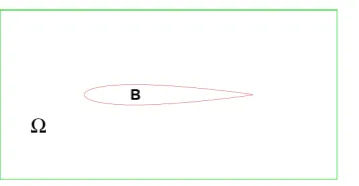
where domain Ω is the exterior of an obstacle B with boundary γr (see Figure 1), ∂Ω = Γ ∪γr, and Γ is the boundary of a rectangle. The γr is defined by the design variable r, r U∈ , where U is the set of admissible design parameters. We require that the set U is compact. Coefficient
ρ ν
, ≥0,( )
1 2
0 r
g ∈H γ ,
( )
1 2 1
Figure 1. A domain around an obstacle.
According to the boundary Lagrangian fictitious domain method [5], the Di-richlet boundary condition on
γ
is enforced by using Lagrangian multiplier onthe boundary. We can consider the problem in the extended rectangular domain
ˆ
Ω: Ω = ∪ Ωˆ B . Problem (1) is equivalent to the following variational problem:
Find
( )
1 2
,
g
u V∈ λ∈H− γ , such that
( )
ˆ , ˆ d d 0,
a u z f z z z V
γλ γ
Ω =
∫
Ω x+∫
∀ ∈ (2)(
)
12( )
0 d 0
u g H
γµ γ µ γ
−
− = ∀ ∈
∫
(3)where
{
1( )
}
1 ˆ , on
g
V = z z∈H Ω z=g Γ , V0=
{
z z∈H1( )
Ωˆ ,z=0 onΓ}
,(
)
(
)
ˆ , ˆ d
aΩ u z =
∫
Ω αuz+ ∇ ⋅∇ν u z x. The u and f are the extensions of u andf in Ωˆ , respectively, and u|Ω=u, f |Ω= f .
The problem (2)-(3) can be solved by GCG iterative method. We describe the algorithm presented by [13] as follows:
Algorithm 0: Step 0: Initialization.
• Set initial Lagrangian multipliers: 0 2
( )
L
λ ∈ γ and a number
ε
≥0 smallenough for the convergence criterion.
• Find 0
g u ∈V by
(
0)
0ˆ , ˆ d d , 0.
aΩ u z =
∫
Ωf z x+∫
γλ z γ ∀ ∈z V (4)• Calculate 0 2
( )
g ∈L
γ
by(
)
( )
0 0 2
0
d d , .
g u g L
γ µ γ = γµ − γ ∀ ∈µ γ
∫
∫
• Set the initial descent direction 0 0
w =g .
To obtain λn+1, n1
u + , n1
g + and wn+1 from λn, un, n
g and wn, one proceeds as follows:
Step 1: Find descent direction.
• Solve n
u by
( )
0ˆ , d , .
n n
aΩ u z =
∫
γw z γ ∀ ∈z V (5)• Calculate ρn by
2
d n d .
n n
n γ g γu w
ρ =
∫
γ∫
γ (6)1
,
n
n n
n
u + =u −ρ u
1
.
n n n
nw
λ + =λ −ρ
• Calculate the new gradient n1 2
( )
g + ∈L
γ
by( )
1 2
d d n d , .
n n
n
g g u L
γ µ γ γ µ γ ρ γ µ γ µ γ
+ = − ∀ ∈
∫
∫
∫
Step 2: Construct convergence criterion and update descent direction.
If 12 02
d d
n
g g
γ γ γ γ ε
+ ≤
∫
∫
, then take the solution being λ λ= n+1, 1n
u =u + . Otherwise
2 2
1
d d ,
n n
n γ g γ g
γ =
∫
+ γ∫
γ1 1 .
n n n
n
w+ =g + +γ w
Set n= +n 1 and return to Step 1.
It can be seen from the above algorithm that we need calculate elliptic varia-tional problems (4) and (5). Convenvaria-tionally we solve them by the finite element method. In the computation procedure of the finite element discretizations, the mesh of the extended domain is constructed from a rectangular triangulated mesh by locally fitting this mesh to the irregular obstacle boundary. The conven-tional finite element discretizations result the problem in the solution of huge algebraic system of equations and will meet the trouble of computing the boun-dary integrals. In order to avoid these difficulties and solve more efficiently the extended problem, we will incorporate the technique of the immersed boundary method into the framework of the fictitious domain method. The main idea is to use Dirac delta function to improve the computation procedure of the discreti-zations. We describe the algorithm presented by [13] as follows.
We construct a regular Eulerian mesh on Ωˆ
(
)
{
0 0}
ˆ , , 0 ,
k x xij ij x ih y jh i j I
Ω = = + + ≤ ≤
where h is the mesh width (for convenience, kept the same both in x- and in
y-directions). Assume the configuration of the simple closed cure
γ
is given in a parametric form X s( )
, 0≤ ≤s L. The discretization of the boundaryγ
employs a Lagrangian mesh, represented as a finite collection of Lagrangian points Xk, 0≤k≤J, apart from each other by a distance ∆s, usually taken as being h/2.Let δ
( )
⋅ be a Dirac delta function. In the following calculation procedure,δ
is approximated by the distribution function δh. The choice here is given by the product (see [10])( )
( ) ( )
h dh x dh y
δ x =
where
( )
0.25 1 cos 2 , 2 ,0, > 2 .
h z z h h h d z z h π + ≤ =
partial differential equations (4) and (5) to the strong forms and then solve them by Fast Poisson Solvers such as the fast Fourier transform or cyclic reduction. In mathematical view, we need the following Lemma (see [14]).
Lemma 1. Assume that the simple closed cure
γ
, the configuration of which is given in a parametric form X s( )
, 0≤ ≤s L is Liplischit continuous,(
)
2
0,
f∈L L . Then F defined by
( )
0L( )
(
( )
)
dF x =
∫
f sδ
x−X s s ∀ ∈Ωxis a distribution function belonging to H−1( )Ω defined as follows: for all 1
0( )
v∈H Ω
( )
(
( )
)
11
0( )
( ) , 0 d
L
H
H− Ω F v Ω =
∫
f s v X s sBy Lemma 1, we can write the right hand in (5) as following form:
1 1 0 ˆ ˆ ( ) ( ) d , n n H H
z W z
γω γ = − Ω Ω
∫
where( )
0( )
(
( )
)
ˆ
d .
L
n n
W x =
∫
ω
sδ
x−X s s ∀ ∈Ωx (7)That is, ωn calculated over the Lagrangian points are distributed over the Eu-lerian points by (7). Thus we can write (5) in the strong form below:
ˆ in .
n n n
u u W
α − ∆ν = Ω (8) In the same way, (4) also can be written in the strong form below:
0
0 0 in ˆ,
u u f R
α − ∆ = +ν Ω (9) where
( )
( )
(
( )
)
0 0 0 ˆ d . LR x =
∫
λ
sδ
x−X s s ∀ ∈Ωx (10)Note that (8) and (9) are defined in the rectangular domain Ωˆ . We can solve
their discrete forms by Fast Poisson Equation Solvers such as the fast Fourier transfer or cyclic reduction on Cartesian mesh ˆ
k
Ω . In order to calculate d
n n
u w
γ γ
∫
in (6), we calculate nu over Lagrangian points Xk, 1≤ ≤k N by n
u over neighboring Eulerian points obtained by (8). We use the following
formula due to the property of
δ
( )⋅ (see [10]),( )
(
)
ˆ( )
(
( )
)
d .n n
u X s =
∫
Ωu x δ x−X s x (11)The discrete form of (7) is
( )
(
)
ˆ .n n
ij k h ij k ij h
k
W x =
∑
ω δ x −X ∆s ∀ ∈Ωx (12)The discrete form of (10) is
( )
(
)
0 0 ˆ .
ij k h ij k ij h
k
R x =
∑
λ δ x −X ∆s ∀ ∈Ωx (13)The discrete form of (11) is
(
)
21 .
n n
k ij h ij k
ij
Based on the above analysis, we have the discrete algorithm of GCG for solving (2)-(3) as follows:
Algorithm 1: Step 0: Initialization.
1) Distributed λ0 over the Lagrangian points to the Eulerian points by (13).
2) Calculate (9) for 0
u over the neighboring Eulerian points of the boundary
γ
.3) Calculate 0
u over Lagrangian points by u0 over neighboring Eulerian points by using
(
)
0 0 2
= 1 .
k ij h ij k
ij
u
∑
u δ x −X h ∀ ≤ ≤k N (15)4) Calculate g0 over Lagrangian points by
0 0
0 1 .
k k k
g =u −g ≤ ≤k N
5) Set the initial descent direction 0 0
k k
w =g , 1≤ ≤n N. To obtain λn+1, n1
u + , n1
g + and wn+1 from λn, n u , n
g and wn, one proceeds as follows:
Step 1: Find descent direction. 1) Distributed ωn
over the Lagrangian points to the Eulerian points by (12). 2) Solve (8) for n
u over the neighboring Eulerian points of the boundary
γ
.3) Calculate n
u over Lagrangian points by un over neighboring Eulerian
points by using (14). 4) Calculate ρn by
2
.
n k k
n n n
k k
k
g s
u w s
ρ ∆ = ∆
∑
∑
5) Let 1, 1 .
n n n
k k nwk n N
λ + =λ −ρ ≤ ≤
6) Calculate the new gradient gn+1 by
1 n, 1 .
n n n
k
k k k
g + =g −ρ u ≤ ≤k N
Step 2: Construct convergence criterion and update descent direction. For given
ε
≥0 small enough, if n12 02k k
k k
g + ∆s g ∆ ≤s ε
∑
∑
, then take λ λ= n+1over the Lagrangian points, and calculate its correspondent solution u by us-ing
, in
u u f R
α − ∆ = +ν Ω
where
( )
ij k h(
ij k)
ij h.k
R x =
∑
λ δ x −X ∆s ∀ ∈ΩxOtherwise
2 2
1
,
n n
n k k
k k
g g
1 1
, 1 .
n n n
k k n k
w+ =g + +γ w ≤ ≤k N
Set n= +n 1 and return to Step 1.
It can be seen from steps 4, 5, and 6 in Step 1 that the calculations are done over the Lagrangian points and we need solve (8) only for n
u over the
neigh-boring Eulerian points of the boundary
γ
when we use FFT. Thus the above approach can lead to a significant reduction in computational effort and memo-ry requirement. It need not make use of the finite element discretizations. The main advantage of the proposed method is that in the optimization process Eu-lerian mesh on Ωˆ is fixed unlike in many of the other approaches such asob-stacle fitted meshes and solution procedure is often efficient. The proposed me-thod has a simple structure and is easily programmable.
3. Shape Optimization Problem
Our shape optimization problem is a shape reconstruction problem. We con-sider the airfoil design for the two-dimension incompressible inviscid uniform flows. We want to find the shape of an airfoil γ0 when the pressure coefficient
0
p
C on γ0 is known. Below we will give the formulation of this problem.
Suppose the uniform flow around an arbitrary airfoil B is from the left toward the right and of velocity profile U∞=1. For the discretization computation, this
exterior problem is truncated by introducing an artificial boundary Γ which is
a rectangle. The domain Ω is the rectangle excluding the airfoil B with boun-dary
γ
, whose leading edge is in origin (see Figure 1). By formulating this problem for stream function u, the corresponding partial differential equationwith Dirichlet boundary condition is:
0 in ,
0 on ,
on .
u u
u y
γ
−∆ = Ω
=
= Γ
(16)
In order to solve the shape optimization problem numerically, the boundary
γ
must be parametrized using a finite number of design parameters. Let thevector of design parameter
(
1, 2, ,)
m m
a a a R
= ∈
r define the boundary curve
γ
. One possible way to perform it is to use the Bezier curves; see [15], forexam-ple. These Bezier curves are just polynomial functions expressed in the Bernstein polynomial basis. The design parameters (or variables) are given by the nodal coordinates of the control points defining the Bezier curves. Since the design parameter r defining uniquely
γ
, in the following, the cost functional isas-sumed to be of the form J u r
( )
, . We discretize the shape of airfoilγ
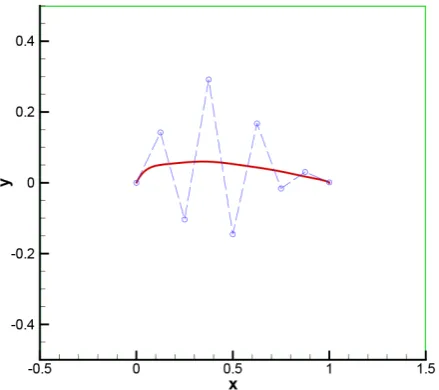
using one Bezier curve for upper part of airfoil and another Bezier curve for lower part. The x-coordinates of the control points are evenly spaced between 0 andcase. As a symmetric example, Figure 2 illustrates the Bezier curve for the upper side of the NACA0012 profile. Nine circles in the figure are Bezier control points.
For given
γ
corresponding design parameters r, pressure coefficientdistri-bution on
γ
is:( )
(
)
( )
( )
( )
2 2
2
, ,
, , 1 , , ,
p
u u
x y x y
x y
C u x y x y
U∞ γ
∂ ∂
+
∂ ∂
= − ∈
r
where u solves (16).
Now, the reconstruction problem reads: find the design parameter r0
cor-responding γ0 when the pressure coefficient 0
p
C on γ0 is known. We have
chosen to formulate our reconstruction problem as a minimization problem, where we minimize an objective function J measuring the difference between
( )
(
,)
p
C u x r and the desired pressure coefficient C0p. We define objective func-tion to be
( )
(
( )
)
0( )
, p , p d .
O
J u r =
∫
C u x r −C x x (17)The reconstruction problem in a minimization problem form reads:
(
0 0)
0( )
Find such that
, , ,
U
J u J u U
∈
≤ ∀ ∈
r
r r r (18)
where U is the set of admissible design parameters. We require that U is com-pact and r∈U , where the design parameter r corresponds the boundary
γ
.4. Numerical Experiments
[image:9.595.265.485.522.717.2]First we do numerical experiments to demonstrate the efficiency of the algo-rithm in section 2. We use the Algoalgo-rithm 1 to solve station Equation (16) which simulate the two-dimension incompressible inviscid uniform flows around an arbitrary given airfoil B.
We take the fictitious domain Ω = ∪ Ω = −ˆ B
[
0.5,1.5] [
× −0.5, 0.5]
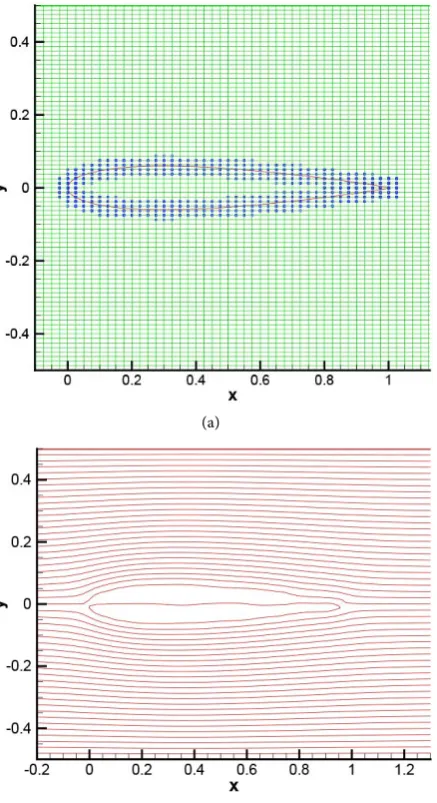
. The testproblem has been solved with rectangular Eulerian mesh 80 × 80 nodes. Figure 3(a) shows the Lagrangian grids and Eulerian grids which have been used to calculate solutions for (16). In Figure 3(b), the plots in solid lines represent streamline obtained by the algorithm based on the immersed boundary.
Next we solve the reconstruction problem (18). We take the NACA0012 air-foil as γ0. As we stated in section 3, the shape of airfoil
γ
is discretized usingone Bezier curve for upper part of airfoil and another Bezier curve for lower part. Since the airfoil is symmetric during the optimization, we can take seven design variables in the optimization process. In order to keep the design accept-able, we have added box constrains for design variables. Hence, there is a lower limit and upper limit for all variables. We require that they satisfy the constraints
0.5 ak 0.5
− ≤ ≤ , k=1, 2,, 7. The set of admissible designs U contains all
(a)
(b)
[image:10.595.267.486.280.682.2]Figure 4. The target design and the design obtained as the result of optimization.
domains which are possible to obtain by using this parametrization and con-straints.
We run genetic algorithm (GA) to find seven design variables r0 in (18). The
major structure of this GA (see for example [6]) is as follows: 1) Evaluation of fitness functions, 2) Roulette wheel selection, 3) Crossover, 4) Mutation. And we used the following parameters: Population size 20, Crosseover probability 0.3, Mutation probability 0.2. The above steps were repeated until the stopping crite-rion was satisfied. In our case the algorithm ended after a constant number of evaluations of the fitness function. The algorithm is based on function evalua-tions which are implemented by repeatedly solving the state Equaevalua-tions (16). Af-ter 2400 times of function evaluations we reached the result of optimization problem (18):
(
)
0 1.266 1, 7.284 2, 2.572 1, 1.261 1, 1.384 1, 7.238 3, 2.788 2 .
e e e e
e e e
= − − − − − −
− − − −
r
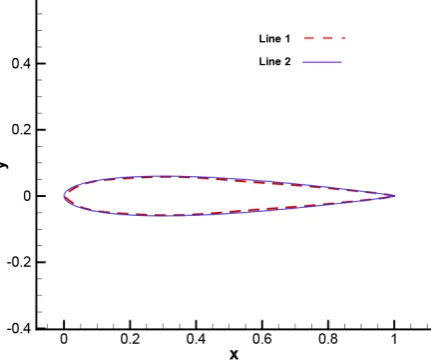
In Figure 4, Line 2 is the target design and Line 1 is the final design obtained as the result of optimization. The euclidean distance between the two lines is 0.5e−2. The computations were run on a personal computer with Intel core CPU @ 2.30 GHz and 2.0 GB RAM. One optimization takes about 5 minutes of CPU time.
Conclusion
The results of numerical experiments show that our proposed method is feasible and effective for the optimal shape design problem.
References
[1] Haslinger, J. and Neittaanmäki, P. (1996) Finite Element Approximation for Optim-al Shape, MateriOptim-al and Topology Design. Wiley, New York.
Mul-timodal Function Optimization. Genetic Algorithms and their Applications: Pro-ceedings of the Second International Conference on Genetic Algorithms, 41-49. [3] Goldberg, D.E. (1989) Genetic Algorithms in Search, Optimization and Machine
Learning. Addison-Wesley.
[4] Saulev, V.K. (1963) On the Solution of Some Boundary Value Problems on High Performance Computers by Fictitious Domain Method. Siberian Mathematical Jour-nal, 4, 912-925. (In Russian)
[5] Glowinski, R., Pan, T.W. and Periaux, J. (1994) A Fictitious Domain Method for Di-richlet Problem and Applications. Computer Methods in Applied Mechanics and Engineering, 111, 283-303. https://doi.org/10.1016/0045-7825(94)90135-X
[6] Haslinger, J. and Jedelský, D. (1996) Genetic Algorithms and Fictitious Domain Based Approaches in Shape Optimization. Structural Optimization, 12, 267-264.
https://doi.org/10.1007/BF01197366
[7] Raino, A.E., et al. (2000) A Moving Mesh Fictitious Domain Approach for Shape Optimization Problems. Mathematical Modeliling and Numerical Analysis, 34, 32- 34.
[8] Peskin, C.S. (1977) Numerical Analysis of Blood Flow in the Heart. Journal of Computational Physics, 25, 220-252. https://doi.org/10.1016/0021-9991(77)90100-0
[9] Peskin, C.S. (2002) The Immersed Boundary Method. Acta Numerica, 11, 479-517.
https://doi.org/10.1017/S0962492902000077
[10]Enriquez-Remigio, S.A. and Roma, A.M. (2005) Incompressible Flows in Elastic Domains: An Immersed Boundary Method Approach. Applied Mathematical Mod-eling, 29, 35-54. https://doi.org/10.1016/j.apm.2004.07.007
[11]Lima, A.L.F., Silva, E., et al. (2003) Numerical Simulation of Two-Dimensional Flows over a Circular Cylinder Using the Immersed Boundary Method. Journal of Computational Physics, 189, 351-370.
https://doi.org/10.1016/S0021-9991(03)00214-6
[12]Deng, J., Shao, X.M. and Ren, A.L. (2006) A New Modification of the Immersed- Boundary Method for Simulating Flows with Complex Moving Boundariesd. Int. J. Numer. Meth. Fluids, 52, 1195-1213. https://doi.org/10.1002/fld.1237
[13]Chen, H. and Rao, L. (2009) The Technique of the Immersed Boundary Method: Applications to the Numerical Solution of Incompressible Flows and Wave Scatter-ing. Modern Physics Letters B, 23, 437-440.
https://doi.org/10.1142/S021798490901859X
[14]Daniele, B. and Lucia, G. (2003) A Finite Element Approach for the Immersed Boundary Method. Computers and Structures, 81, 491-501.
https://doi.org/10.1016/S0045-7949(02)00404-2
Submit or recommend next manuscript to SCIRP and we will provide best service for you:
Accepting pre-submission inquiries through Email, Facebook, LinkedIn, Twitter, etc. A wide selection of journals (inclusive of 9 subjects, more than 200 journals)
Providing 24-hour high-quality service User-friendly online submission system Fair and swift peer-review system
Efficient typesetting and proofreading procedure
Display of the result of downloads and visits, as well as the number of cited articles Maximum dissemination of your research work