Original citation:
Shadmehr, Mehdi and Bernhardt, Daniel . (2015) State censorship. American Economic Journal : Microeconomics , Volume 7 (Number 2). pp. 280-307.
Permanent WRAP url:
http://wrap.warwick.ac.uk/68350
Copyright and reuse:
The Warwick Research Archive Portal (WRAP) makes this work by researchers of the University of Warwick available open access under the following conditions. Copyright © and all moral rights to the version of the paper presented here belong to the individual author(s) and/or other copyright owners. To the extent reasonable and practicable the material made available in WRAP has been checked for eligibility before being made available.
Copies of full items can be used for personal research or study, educational, or not-for profit purposes without prior permission or charge. Provided that the authors, title and full bibliographic details are credited, a hyperlink and/or URL is given for the original metadata page and the content is not changed in any way.
Publisher’s statement:
Copyright © 2015 by American Economic Association.
Citation: Shadmehr, Mehdi, and Dan Bernhardt. 2015. "State Censorship." American Economic Journal: Microeconomics, 7(2): 280-307.
Published version: http://dx.doi.org/10.1257/mic.20130221
A note on versions:
The version presented here may differ from the published version or, version of record, if you wish to cite this item you are advised to consult the publisher’s version. Please see the ‘permanent WRAP url’ above for details on accessing the published version and note that access may require a subscription.
http://dx.doi.org/10.1257/mic.20130221
State Censorship
†By Mehdi Shadmehr and Dan Bernhardt *
We characterize a ruler’s decision of whether to censor media reports that convey information to citizens who decide whether to revolt. We find: (i) a ruler gains (his ex ante expected payoff increases) by committing to censoring slightly less than he does in equilibrium: his equilibrium calculations ignore that censoring less causes citizens to update more positively following no news; (ii) a ruler gains from higher censorship costs if and only if censorship costs exceed a crit-ical threshold; (iii) a bad ruler prefers a very strong media to a very weak one, but a good ruler prefers the opposite. (JEL D72, D74, D83)
W
e analyze the strategic choices by a ruler (an authoritarian state) of when tocensor the information available to citizens to avoid revolution. In particular, we investigate how a ruler’s expected payoffs are influenced by his ability to commit
to a censorship law (censorship strategy); communication technologies that raise
cen-sorship costs; and the media’s ability to uncover news about the regime.
The ruler tries to manage information transmission by preventing dissemination of unfavorable news by the media to citizens to mitigate the likelihood of revolt. In
practice, most censorship takes this simple form. For example, Tai’s (2014, 195)
analysis of the Chinese government’s directives to the media from March 2007 to April 2013 shows that most of these directives were outright bans on reporting particular news events. Censoring a news event can benefit a ruler whenever the likelihood of revolt following that news exceeds that following no news. Citizens understand a ruler’s incentives to conceal bad news, so they update negatively about a regime when they see no news, inferring that there might have been bad news that was censored. In equilibrium, provided that the direct censorship cost is not too high, there exists a unique threshold level of news such that the ruler censors a news event if and only if it is worse than that threshold. At the threshold, the gains from the reduced probability of revolution just equal the direct cost of censorship.
Moreover, when the media is more likely to uncover politically-relevant news, the news must be worse for a ruler to censor, as citizens update to conclude that an absence of news was more likely due to censorship. Thus, in a country with a
AQ 1
* Shadmehr: Department of Economics, University of Miami, 5250 University Drive, Coral Gables, FL 33146
(e-mail: [email protected]); Bernhardt: Department of Economics, University of Illinois, 1407 W. Gregory Drive,
Urbana, IL 61801 (e-mail: [email protected]). We thank Raphael Boleslavsky, Ethan Bueno de Mesquita, Odilon
Camara, Georgy Egorov, Soroush Ghazi, John Londregan, Paulina Marek, Aya Kachi, Patrick Kuhn, Arturas Rozenas, and participants at the 2010 and 2011 MPSA conferences, and seminars at Caltech, UIUC departments of economics and political science, University of Miami finance department, University of Kansas economics depart-ment, and Berkeley Haas School of Business for helpful suggestions and comments.
† Go to http://dx.doi.org/10.1257/mic.20130221 to visit the article page for additional materials and author
disclosure statement(s) or to comment in the online discussion forum.
strong media that often uncovers news, a ruler censors only very bad news; while in a country with a weak media, a ruler censors even modestly bad news. So, too, when there is more uncertainty about the possible news, a ruler ceases to censor marginally bad news in order to prevent citizens from drawing inferences that the news could have been far worse.
This initial analysis presumes that a ruler cannot commit to a censorship cutoff, and hence only weighs the direct consequences of censorship decisions. In partic-ular, a ruler does not internalize that even though a freer media is risky because it raises the probability of revolt following bad news, the gains from improving citi-zens’ trust in media may offset those risks because citizens update less negatively following no news. This observation leads us to consider a ruler who can credibly set up institutions that allow him to commit to censoring at other than the “equilib-rium” level of censorship. By delegating censorship decisions to bureaucrats and threatening punishment if they deviate from censorship laws, a ruler might be able to commit to censoring slightly more or less than what he otherwise would with-out those institutions. Still, large deviations are likely infeasible—for example, a bureaucrat has strong incentives to censor very bad news that would inevitably result in revolt and hence severe punishment of members of the regime, or a ruler would find other ways to get good news out. We address whether and when a ruler would be better off if he could commit to censoring slightly more or less.
Remarkably, we find that from an ex ante perspective, a ruler would always be strictly better off if he censored slightly less than he does in the equilibrium where he cannot commit—a ruler would always benefit from a slightly freer press. A rul-er’s equilibrium tradeoff equates the marginal costs and benefits of censoring,
ignor-ing the impact of his censorship cutoff on how citizens update when the media does
not report politically-relevant news. Paradoxically, were a ruler to censor slightly less, citizens would draw more favorable inferences about the regime following no news, and hence would be less likely to revolt. We show that the likelihood citizens revolt following no news is a single-peaked function of a ruler’s censorship cutoff, and that the equilibrium censorship cutoff is always to the left of the peak whenever censorship is costly.
This analysis yields insights into how changes in censorship costs or in the media’s ability to uncover news affect a ruler. One may think that a ruler must be harmed by new technologies such as the Internet or cell phones that raise censor-ship costs and reduce the probability that censorcensor-ship succeeds, or by the entry of a media organization such as Al Jazeera that uncovers more news. However, our initial analysis suggests that such changes could benefit a ruler: we showed that a ruler would be better off if he could commit to censoring less, and higher censor-ship costs or a stronger media cause a ruler to censor less in equilibrium. Thus, the ruler may observably delegate censorship to agents with higher censorship costs, so that citizens understand that censorship level is lower than what the ruler would choose—when he cannot commit.
censorship cost; but the probability of revolt given no news is insensitive to a marginal reduction in censorship. However, when censorship costs are higher, a ruler is less likely to censor, and the probability of revolt is more sensitive to the censorship
thresh-old. We show that, as a result, increases in censorship costs benefit a ruler (increase
his ex ante expected payoff) if and only if censorship costs are already high enough.
Finally, we prove that when the revolution payoff is low, a ruler prefers a weak media that uncovers almost no news—in effect censoring both bad news and good— to a strong media that uncovers almost all news. In contrast, when the revolution payoff is high, the ruler prefers a strong media that serves to commit the ruler to censoring almost nothing to a weak media. Intuitively, when revolution payoffs are high, a ruler values a strong media that might uncover good news about the status quo that then forestalls a revolution; but when revolution payoffs are low, a ruler fears a strong media that might uncover bad news about the status quo that then precipitates a revolution.
Literature Review.—The closest paper is Besley and Prat (2006), which analyzes
media capture in a democracy. The media can send a binary (good versus bad) signal
to voters about the incumbent who can bribe the media to conceal the bad signal. They find that an incumbent bribes the media if and only if the costs of bribery
(which reflect the number of outlets that must be bribed, and transactions costs) are
not too large. Binary signals simplify characterizations, but are not rich enough to permit an analysis of the effects of commitment on citizen beliefs, or the effects of
changes in censorship costs and media strength on a ruler’s/incumbent’s expected
payoff, issues that are at the heart of our paper.
Based on Besley and Prat’s model, Gehlbach and Sonin (2012) explore media
bias caused by a government that cares both about inducing citizens to take an action and generating advertising revenue. In their two state model, citizens can obtain a costly binary signal about the true state. They show that media bias is greater if the government owns the media and hence does not have to give bribes, or if it cares less about advertising revenue.
In Egorov, Guriev, and Sonin (2009), a ruler can manipulate a binary (good
ver-sus bad) signal sent by media about the regime’s economic performance that directly
affects the likelihood citizens revolt, and indirectly affects this likelihood via the effect on incentives of bureaucrats to exert effort that increases taxable economic output. They assume that the ruler does not see the actual economic performance, but, rather, only observes the possibly distorted media reports. As a result, a ruler trades off between inducing bureaucrats to perform well and directly discouraging citizens from revolting.
Edmond (2013) studies information manipulation in dictatorships when a
Our finding that a ruler censors sufficiently bad news (Proposition 2) has analogues
in the literature on the disclosure of accounting information (Dye 1985; Verrecchia
1983). In these papers, like ours, complete unraveling as in Grossman and Hart (1980), Grossman (1981), Milgrom (1981), or Milgrom and Roberts (1986), does not occur because there is a chance that nothing happened or that no information was uncovered. That literature studies precommitment to disclose information in the context of infor-mation sharing in oligopoly markets, a very different setting from ours (see Beyer et al.
2010; Dye 2001; and Verrecchia 2001 for comprehensive reviews).1
There are related analyses of information disclosure by an expert/advisor to a
deci-sion maker. For example, in Che and Kartik (2009), an advisor must decide whether
to reveal his signal to a decision maker. The advisor and decision maker share the same preferences, but their priors over the state of the world have different means, so that the advisor’s preferred action always differs by a constant from the decision maker’s. This leads the advisor to censor a bounded interval of signals. See also de
Bettignies and Zabojnik (2014). In particular, our result that, even when censorship
is costless, the ruler does not censor all the bad news (Corollary 1) resonates with
Dziuda (2011) who shows that a biased expert may provide information unfavorable
to his preferences to convince the decision maker that the expert is not biased. Our result that the ruler always gains if he can commit to censoring slightly less that the equilibrium level (Proposition 3) resonates with the result of Khalil (1997)
in the context of optimal contracts with auditing/monitoring, who shows that the
principal audits less often if he can precommit to an auditing strategy. However, the underlying reason in that paper is that “when threats are credible, they need not be
used as often” (Khalil 1997, 630), while in our paper, precommitment allows the
ruler to manipulate the citizen’s beliefs following no news.
A more distantly-related literature looks at the incentives of the media to selectively report news about candidates that affects how citizens update, and hence electoral
out-comes. In Balan, DeGraba, and Wickelgren (2004); Duggan and Martinelli (2011); or
Anderson and McLaren (2012), the incentives of media outlets to selectively report
news devolves from their partisan views, which lead them to have a preferred
candi-date or policy outcome; in Bernhardt, Krasa, and Polborn (2008), media compete in
their news mix for audiences that value hearing news that conforms with their views;
in Chan and Suen (2008), media outlets commit to binary editorial recommendation
cutoffs on the state of nature for recommending a left or right party that maximize their viewers’ welfare, and these cutoffs feed back to influence party policy choice;
and in Gentzkow and Shapiro (2006), the media care about reputation, which can
lead to censoring of stories that do not conform with reader expectations.2 This
litera-ture focuses on consumer choice of media outlet, the competition between media
out-lets for audiences, including the effects of mergers and merger policy (Anderson and
McLaren 2012, or Balan, DeGraba, and Wickelgren 2004), and the role of endogenous
1 Typically, two firms play a two-stage game. First, firms receive private information about demand or marginal
costs of production. Then, they engage in Cournot or Bertrand competition. Precommittment amounts to
determin-ing whether to disclose their information prior to receivdetermin-ing it (Vives 2001, 237–62).
2 For a model where voters do not update about media bias (sequential rationality does not hold) see Mullainathan
and Shleifer (2005).
media bias on electoral outcomes (Bernhardt, Krasa, and Polborn 2008, Duggan and
Martinelli 2011) or policy outcomes (Anderson and McLaren 2012).
I. Model
A representative citizen must decide whether or not to revolt against a ruler. If the citizen does not revolt, the status quo prevails; but if he revolts, the revolution
suc-ceeds with probability r ∈ (0,1] . We normalize the ruler’s payoff from preserving
the status quo to 1 and his payoff after a successful revolution to 0. The citizen’s net payoff from successful revolution is R − γ − ϵ , where R is known, but γ and ϵ are uncertain. We normalize the means of ϵ and γ to zero. Thus, R captures the ex ante expected net payoff from successful revolution. A larger R can reflect a society in which the revolution payoff is higher; and/or a society in which, from an ex ante perspective, citizens have a lower assessment of the status quo. If the citizen revolts and the revolution fails, the citizen incurs an expected punishment μ > 0 , i.e., μ is the probability a failed revolter is caught times the punishment.
The representative citizen privately observes the realization of ϵ , which we assume is distributed according to a strictly positive, continuously differentiable density g on 핉 , with associated cdf G . The citizen does not directly observe γ , but has a prior that γ ∼ f , where f is a strictly positive, continuously differentiable density on 핉 . To ease exposition, we assume that ϵ and γ are independently distributed.3
The citizen learns the realization of γ if and only if the media observe γ and
report it. With probability q(γ) , the media and ruler observe the realization of γ , where q(·) : 핉 → (0,1) is a continuously differentiable function, mapping the level
of news γ to a likelihood that it is discovered by the media; but with probability
1 − q(γ) the realization is unobserved by the media. Thus, q(γ) captures the prob-ability that an event occurs that is informative about γ and the media learn about it.
We allow the probability q(γ) that the media discover information about γ to vary
with the magnitude of the news, γ . For example, the media may be more likely to
uncover very bad or very good news. The analysis extends if a ruler may sometimes
learn γ when the media do not, and when γ is verifiable, the ruler can sometimes
credibly convey the news γ to the media at his discretion, in which case the media
may be more likely to observe good news.4
To focus on a ruler’s censorship decisions, we abstract from strategic
dissemi-nation decisions by the media (see e.g., Duggan and Martinelli (2011) or the other
papers in our literature review). Thus, we assume that when the media observes γ
and the ruler does not censor, the media publicly reveals γ .5 However, the ruler can
censor the media at a cost c ≥ 0 , preventing the media from conveying γ to the
representative citizen, in which case the citizen does not receive any further
infor-mation about γ . For example, if a ruler censors a prison massacre of dissidents, the
3 With added parametric structure (e.g., ϵ and γ are jointly normally distributed), incorporating correlation is
straightforward. Note that ϵ can also be interpreted as a valence parameter or an idiosyncratic political preference.
4 What matters is that the ruler observes γ any time the media does (or else he has no censorship decision).
5 Our findings are qualitatively unaffected if the media and the ruler observe γ with noise; or if a citizen observes
a media report with noise.
citizen never learns about it. Given his information, which includes γ only if the media learned about it and the ruler did not censor, the citizen decides whether to revolt.
The timing is as follows. First, γ and ϵ are realized and the representative citizen observes ϵ . Then with probability q(γ) the media learn γ , which they publicly report
unless the ruler (who also observes the media’s information) censors it. After the
ruler makes his censorship decision, the citizen decides whether to revolt. Finally, payoffs are realized.
We next establish the existence of a unique Perfect Bayesian Equilibrium, and derive its properties. Following this analysis, we characterize outcomes when the ruler has limited commitment powers, and can commit to levels of censorship that differ from what he does in the Perfect Bayesian Equilibrium without commitment.
Analysis.—The representative citizen’s strategy is a function σ c mapping his
private information ϵ and any public information into a decision about whether to
revolt, where σ c = 1 indicates that he revolts, and σ c = 0 indicates that he does not. A strategy for the ruler is a function σ r mapping γ into a decision about whether to censor, where σ r (γ) = 1 indicates that the ruler censors γ , and σ r (γ) = 0 indi-cates that he does not.
We begin with the representative citizen’s choice of whether to revolt. The citi-zen has private information ϵ and public information Ω ∈ 핉 ∪ {∅} about γ , where
∅ indicates there has not been a media report about γ . The citizen revolts if and
only if the net expected payoffs from doing so are positive, i.e., if and only if 0 < r E[R − γ − ϵ|Ω] − (1 − r)μ. Rearranging, the citizen revolts if and only if
(1) ϵ < R − E[γ|Ω] − μ r ,
where μ r ≡ ____1 − r r μ . Denoting the right-hand side of (1) by ρ(R, Ω) = R − E[γ|Ω] − μ r , it follows that the probability of successful revolution P(ρ) is
(2) P(ρ) = rG(ρ).
Good news for the ruler is any news that decreases the citizen’s expectation of the net payoff from successful revolution, while bad news is the opposite. Thus, bad news raises ρ . Proposition 1, which directly follows from equation (2), characterizes the properties of the citizen’s equilibrium behavior.
PROPOSITION 1: Bad news raises the likelihood of successful revolt: ___P∂ ρ(ρ) > 0 . The citizen almost always revolts when the news is very bad, lim ρ→∞ P(ρ) = r ; but almost never revolts when it is very good, lim ρ→−∞ P(ρ) = 0.
Our substantive findings only rely on this structure together with modest distribu-tional assumptions such as log concavity. Appendix A presents a multicitizen model, where citizens must coordinate for a revolution to succeed. The natural equilibrium to this multicitizen model delivers exactly the same key properties. Section V shows that our qualitative conclusions extend when the ruler does not always succeed in concealing news when he attempts to censor it. That is, we allow the likelihood that censorship succeeds to depend continuously on the resources that the ruler devotes to concealing the news. We also establish robustness to the possibility that the citi-zen cares differently about ϵ and γ .
Censorship Equilibrium.—Let Pγ be the probability of revolution following a report γ , and P∅ be the probability of revolution following no report about γ : Pγ = r G(R − γ − μ r ) and P∅ = r G(R − E[γ|∅] − μ r ) . The ruler censors a report
γ if and only if his expected payoff from censoring, 1 − P∅ − c , exceeds that of not censoring, 1 − Pγ . That is,
(3) σ r (γ) = 1 if and only if Pγ − P∅ > c.
Pγ decreases monotonically in γ and P∅ does not depend on γ . Thus, the ruler adopts a cutoff strategy in equilibrium, censoring γ if and only if it is below some critical cutoff, γ – .
LEMMA 1: The ruler’s equilibrium censorship strategy takes a cutoff form: there exists a γ – ∈ 핉 ∪ {±∞} such that σ r (γ) = 1 if and only if γ < γ – for some γ – ∈ 핉 ∪ {±∞}, where γ – = −∞ corresponds to never censoring, and γ – = ∞
cor-responds to censoring everything.
The ruler censors reports of γ whenever the likelihood of revolution following that
report, Pγ , exceeds the probability of revolution following no report P∅ by a margin that exceeds the censorship cost c . In equilibrium, the citizen’s beliefs must be consistent with the ruler’s equilibrium censorship cutoff γ – e : P∅ implicitly depends on the equilib-rium censorship cutoff γ – e . Thus, γ – e is an equilibrium strategy of the ruler if and only if
(4) Pγ − P∅ ( γ – e ) > c for all γ < γ – e, and Pγ − P∅ ( γ – e ) ≤ c for all γ ≥ γ – e .
The equilibrium threshold depends on how the representative citizen updates when there is no media report concerning γ . Given a censorship cutoff γ – , the representa-tive citizen’s beliefs about γ following no media report depend on γ – via Bayes’ rule:
(5) E[γ| ∅; γ – ] = ∫ −∞ γ
–
γ dF(γ) + ∫ γ –∞ γ (1 − q(γ)) dF(γ)
___________________________
1 − ∫ γ –∞ q(γ) dF(γ)
= _________________E[γ] − ∫ γ –∞ γ q(γ) dF(γ) 1 − ∫ γ –∞ q(γ) dF(γ) = −
∫ γ –∞ γ q(γ) dF(γ)
______________
where f and F are the pdf and cdf of the prior distribution over γ , and the last
equal-ity reflects the normalization of E[γ] to zero. When a ruler always censors, i.e.,
when γ – = ∞ , the absence of a media report conveys no information about γ , so that E[γ| ∅; γ – = ∞] = E[γ] = 0 − , i.e., E[γ| ∅; γ – = ∞] approaches 0 from below. When, instead, a ruler never censors, i.e., when γ – = −∞ , the absence of a media report can
contain information about γ because the likelihood q(γ) that the media discovers
news can hinge on the nature of the news:
(6) γ ̂ ≡ lim
γ
– →−∞ E[γ|∅; γ – ] = −
∫ −∞∞ γ q(γ) dF(γ)
____________
1 − q – ,
where q – ≡ ∫ −∞∞ q(γ) dF(γ) is the mean likelihood that the media uncovers some news. For example, if the media is more likely to discover good news and the ruler never censors, then the absence of news makes the citizen update negatively, i.e., when q(γ) is increasing in γ , then γ ̂ < E[γ] = 0 . Alternatively, if the ruler never censors and q(γ) is constant or q(γ) and f(γ) are both symmetric, then the absence of media report conveys no information about γ , so that γ ̂ = E[γ] = 0 . Differentiating equation (5) with respect to γ – yields
(7) _______dE[γ| d γ –∅ = ; γ – ] [ γ
–q( γ – )f( γ – )]
[1 − ∫ γ –∞ q (γ) dF(γ)] − [q( γ – )f( γ – )] [− ∫ γ –∞ γ q(γ) dF(γ)]
__________________________________________
[1 − ∫ γ –∞ q(γ) dF(γ)] 2
= _____________q( γ – )f( γ – )
1 − ∫ γ –∞ q(γ) dF(γ) ( γ
– − E[γ|∅; γ – ]).
Figure 1 illustrates the two key features describing how the citizen updates follow-ing no media report: (i) how E[γ|∅, γ – ] varies with the censorship threshold γ – , and (ii) how the citizen would update were he to see the threshold news γ – . The citizen always updates more negatively following extremely bad news than following no media report, because there is always a chance that no news is due to the media not observing γ rather than censorship: E[γ|∅, γ – ] > γ – for sufficiently low γ – . That is, when a ruler only censors very bad news, the marginal news censored γ – is worse than the average E[γ| ∅; γ – ] . Thus, when a ruler censors more, then, as equation (7) shows, the citizen updates more negatively following no news up to the point where the marginal news equals the average, i.e., up to the γ – m that solves E[γ|∅, γ – m ] = γ – m . Thereafter, the marginal news γ – exceeds the average E[γ|∅; γ – ] , so censoring more causes the citizen to update less negatively following no media report. Moreover, since 0 = E[γ] > E[γ|∅, γ – ] , for all γ – > 0 , it must be that at the unique value of γ – solving γ – = E[γ|∅, γ – ] that γ – m < 0 , implying that the marginal news censored is bad news, and no news is bad news.
LEMMA 2: The citizen’s estimate E[γ|∅; γ – ] of γ following no media report and given the ruler’s censorship cutoff γ – has a unique extremum (a minimum) at γ – m < 0 , where E[γ|∅; γ – m ] = γ –m . E[γ|∅; γ – ] > γ – if γ – < γ – m , and E[γ|∅; γ – ] < γ – if γ – > γ – m . Moreover, E[γ|∅; γ – ] is continuous in γ –, with lim γ – →∞ E[γ|∅; γ – ] = E[γ] = 0 and
lim γ – →−∞ E[γ|∅; γ – ] = γ ˆ .
These features of the representative citizen’s belief imply that censoring extremely bad news benefits a ruler because the citizen updates less negatively following no media report than following extremely bad news:
c – ≡ lim
γ – →−∞ [ P γ – − P∅ ( γ – )] = r − P γ – = γ ˆ = r − rG(R − γ ˆ − μ r ).
As a ruler censors more, this gain P γ – − P∅ ( γ – ) falls until it becomes zero at γ – = γ – m .
Beyond this point, a ruler is better off allowing the threshold news γ – to reach the citizen rather than censoring it. It follows that there is a unique, finite, equilibrium censorship cutoff, γ – e , at which P γ –e − P∅ ( γ – e ) = c as long as the censorship cost is
low enough relative to the payoff from preventing successful revolution, i.e., as long as c < c – :
PROPOSITION 2: There is a level of censorship costs c – ∈ (0,r) above which the ruler does not censor. If c < c – , then in the unique equilibrium, the ruler censors all media reports worse than a threshold news γ – e ∈ 핉 , where γ – e is the unique solution to P γ – e − P∅ ( γ – e ) = c .
The next corollary highlights that it is the structure of the citizen’s belief following no media report, and not the cost of censorship, that discourages a ruler from cen-soring all bad news: revealing modestly bad news that slightly lowers the citizen’s expectation below the prior (i.e., γ – m < γ < E[γ] = 0 ) is better for a ruler than no news, because news that is concealed could be far worse.
COROLLARY 1: Even when censorship is costless, a ruler never censors all bad news. That is, γ – e (c = 0) = γ – m < E[γ] = 0 .
45°
E[γ|∅, γ]
γ γˉm
ˉ
[image:10.528.118.409.80.286.2]ˉ
Figure 1. E[γ|∅; γ – ] as a Function of γ –
In the analysis that follows, we assume that c < c – . We next show how the primi-tives of the economy affect which media reports are censored.
COROLLARY 2: Increases in the cost c of censorship reduce a ruler’s equilib-rium censorship cutoff, γ – e . Suppose that the likelihood that the media uncovers news does not depend on the nature of the news, i.e., q(γ) = q . Then, increases in q reduce a ruler’s equilibrium censorship cutoff, γ – e ; in addition, suppose that for γ – < E[γ] = 0 , both F( γ – ) and E[γ|γ < γ – ] decrease with the variance σ 02 of γ . Then, increases in σ 02 (which captures the amount of potential news about γ), reduce a ruler’s equilibrium censorship cutoff, γ – e .
That higher censorship costs reduce censorship is obvious. A ruler also censors less
when the media is more likely to uncover γ . This result can be generalized: raising
q(γ) for γ > 0 or γ < γ – causes the citizen to update more negatively following no news. That is, fix any censorship cutoff, and raise the probability on “bad news,” i.e., on news worse than the cutoff. Then, following no media report, the citizen updates more pessimistically about concealed news, making it less attractive to conceal the
news. Next, consider raising the probability of “good news,” γ > 0 . Then,
follow-ing no media report, the citizen believes that it is more likely due to censorship (as
it is less likely that the good, uncensored, news was not revealed), so that he again
updates more negatively. In sum, when the media is more likely to uncover news that is either good or sufficiently bad that it is censored, then ceteris paribus, the citizen updates more negatively following no reported news, reducing the attraction of
cen-sorship to the ruler.6 So, too, a ruler censors less when there is more potential news:
a higher σ 02 (e.g., when news is normally distributed) causes the citizen to update
more negatively when there is no report because there is more probability mass on bad tail news. Therefore, a ruler ceases to censor more marginally bad news to pre-vent the citizen from drawing inferences that the news might have been far worse.
The environment may place enough structure on how q(γ) varies with γ that we
can characterize the consequences for censorship. For example, if the ruler some-times directly observes γ when the media do not, and can verifiably convey γ to the media (possibly at a cost), then the ruler censors less. The ruler never has an incen-tive to convey bad news to the media, but he may have an incenincen-tive to convey good news. This has an effect analogous to raising q(γ) for γ sufficiently greater than γ – . It follows directly for any fixed censorship cutoff γ – that E[γ| ∅, γ – ] is reduced—the citizen updates more negatively when no news is reported. In turn, this means that bad news γ must be worse for the ruler to censor it.
We next describe how the extreme limits of a very strong and very weak media affect a ruler’s censorship decisions.
6 Only when q(γ) is increased for γ ∈ [ γ –,0) can a more active media cause the citizen to update more positively
following no media report, raising the attraction of censorship. When q(γ) = q , the effect of raising q on this interval is
swamped by raising it for other γ s. More generally, let δ__________E[γ|∅, γ –,q(γ)]
δq(γ) ≡ lim ϵ→ 0 E[γ|∅, γ
–,q(γ) + ϵ] − E[γ|∅, γ –,q(γ)]
________________________ϵ .
One can show that as long as ∫ γ –∞ γ q(γ) dF(γ) ≥ 0 , we have δE[γ|∅, γ
–,q(γ)]
__________
δq(γ) < 0 . Note that when q(γ) is constant,
∫ γ –∞ γ q(γ) dF(γ) = q ∫ γ –∞ γ dF(γ) = q(1 − F( γ – ))E[γ|γ > γ – ] > 0 .
COROLLARY 3: Let qs = supq(γ) and qi = inf q(γ) . A ruler censors almost noth-ing if the media almost always uncover γ . Conversely, a ruler censors almost all bad news if censorship is almost costless and media almost never uncover γ . That is, lim q γ i →1 –e = −∞ and lim c, qs →0 γ
–
e = 0 .
II. Commitment in Censorship
A ruler’s equilibrium censorship decisions weigh the gains from reducing the
likelihood of revolution when a (bad) media report is censored against the costs
of censorship, ignoring the consequences for the level of the citizen’s trust in the media. We now show that a ruler would always be better off were he able to commit to censoring slightly less than he does in equilibrium, because the citizen would then update more positively when there is no media report. We first calculate a ruler’s ex ante expected payoff from an arbitrary censorship cutoff γ – :
(8) W( γ –,c,q(γ)) ≡
∫
−∞γ –
(1 − P∅ ( γ – ) − c)q(γ) dF(γ) +
∫
γ –∞
(1 − Pγ )q(γ) dF(γ)
+
∫
−∞+∞ (1 − P∅ ( γ – ))(1 − q(γ)) dF(γ)= 1 − [
∫
−∞ γ –
q(γ) dF(γ) + (1 − q – )] P∅ ( γ – ) −
∫
γ –∞
Pγ q(γ) dF(γ)
− c
∫
−∞γ –
q(γ) dF(γ) .
With probability 1 − q(γ) the media do not observe γ , so the ruler’s payoff is
1 − P∅ ( γ – ) . With probability q(γ) the media observe γ . But the ruler censors any report of γ < γ – , in which case his payoff is 1 − P∅ ( γ – ) − c . If γ exceeds γ – , the ruler does not censor, so the citizen learns γ , and the ruler’s payoff is 1 − Pγ .
The citizen’s belief about γ in the absence of a media report depends on the
ruler’s censorship policy. However, the ruler ignores this in his decision making:
his censorship decisions maximize his expected payoff given the citizen’s (
equi-librium) belief. If, instead, a ruler can ex ante commit to a censorship level, he can
“internalize” how his censorship rule affects updating by the citizen. For example, a ruler may be able to do this by passing censorship laws and delegating enforce-ment to bureaucrats, threatening to punish them if they adopt a different cutoff. Alternatively, a ruler may delegate to someone with a smaller stake in preserving the regime. Still, a ruler’s ability to commit is limited. For example, a bureaucrat
who fails to censor very bad news is likely to be punished (either by the ruler or by
citizens following the likely resulting successful revolution); or a ruler with good
Remarkably, if censorship has any costs, i.e., if c > 0 , then a ruler’s equilibrium censorship choice is never optimal from an ex ante perspective:
PROPOSITION 3: If censorship is costly, a ruler’s ex ante expected payoff would be raised if he could commit to censoring slightly less than he does in equilibrium: dW____d γ –( γ – | ) γ – = γ – e < 0 .
Small reductions in the censorship cutoff below the equilibrium threshold have three effects: (i) When there is a report, the citizen now sees marginal realizations of γ that are slightly worse than the equilibrium cutoff γ – e . For these marginal news events, the probability of revolution rises from P∅ ( γ – ) to P γ – . However, (ii) the ruler does not
incur censorship costs. At equilibrium, fixing the citizen’s belief, these two effects just offset each other, as a ruler’s equilibrium cutoff γ – e equates these marginal costs and benefits of censorship. Thus, the net impact on a ruler’s ex ante expected payoff equals the third effect: (iii) A slight reduction in the censorship cutoff reduces the probability of revolution P∅ ( γ – ) when there is no media report. To see this, recall that as a ruler censors more news, the citizen updates more negatively following no media report, up to the point where the ruler censors all news worse than γ – m (see Figure 1); and γ – e < γ – m when censorship is costly. Therefore, the probability of revolution P∅ ( γ – ) is rising in γ – at the equilibrium cutoff γ – e . Hence, the net effect of marginally reducing the censorship cutoff is to raise the ruler’s ex ante expected payoff.
The sole restriction in the proposition is that censorship be costly. The reason is that when censorship is costless, the citizen’s belief becomes locally insensitive to changes in the equilibrium censorship cutoff: When c = 0 , we have γ – e = γ – m , i.e., the ruler’s equilibrium level of censorship minimizes E[γ|∅; γ – ] . Hence, marginal changes in γ – do not affect the citizen’s belief about E[γ|∅; γ – ] (see Lemma 2 and Figure 1), i.e., ______dE[γ| d γ –∅ = ; γ – ] 0 . This directly implies that dW( γ
–
e ) _____
d γ – = 0 , which might lead one to conjecture that this censorship cutoff minimizes or maximizes the ruler’s ex ante expected payoff. However, this is not so:
Remark 1: When censorship is costless, i.e., when c = 0 , a ruler’s equilibrium censorship cutoff is an inflection point of his ex ante expected payoff. That is, not only is _____dW( γ – e )
d γ – = 0 , but so, too is d
2W( γ –
e ) _____
d γ – 2 = 0 .
III. Censorship Costs and Media Strength
New technologies such as the Internet and cell phones have significantly increased the costs of censorship. The extensive use of these technologies in the Arab Spring, the
Green Movement in Iran, and the Orange Movement in Kuwait (Wheeler 2010) has
led many to conclude that technologies that make censorship difficult, i.e., increase censorship costs, must work against dictators. We show that such assessments are only partially correct. To the contrary, higher costs of censorship can sometimes increase a ruler’s chance of survival. In fact, these gains can be high enough to offset the greater direct costs of censorship and make the ruler better off. Similarly, one might suspect
This conjecture is also wrong. In fact, when the ruler faces a serious risk of revolution,
he prefers a strong media that almost always uncovers γ to a weak media.
A. Higher Censorship Costs
Higher censorship costs have direct and indirect effects. The direct effect reduces a ruler’s ex ante expected payoff because a ruler must pay more each time he cen-sors. The indirect effect is that higher censorship costs cause a ruler to censor less in equilibrium. We just established that decreases in the equilibrium level of cen-sorship cause the citizen to update less negatively following no media report—this indirect effect of increases in censorship costs raises a ruler’s ex ante expected pay-off. Proposition 4 shows that when the costs of censorship are small, the direct effect always dominates, so that marginal increases in censorship costs reduce the ruler’s ex ante expected payoff. However, when censorship costs are higher, and the expected payoffs from successful revolution exceed the expected punishment from failed revolt, then the indirect effect eventually dominates, so that further increases in censorship costs benefit the ruler:
PROPOSITION 4: Suppose F(γ) and q(γ) are log-concave, G(ϵ) is strictly
uni-modal with a median that does not exceed its mean, and rR ≥ (1 − r) μ . Then there exists a critical censorship cost c ˆ > 0 such that increases in a ruler’s cost of censorship raise his ex ante expected payoff if and only if c > c ˆ .
When censorship is costless, i.e., when c = 0 , the equilibrium level of censorship is at the minimum of E[γ|∅; γ – ] , i.e., γ – e = γ – m . Hence, marginal changes in the extent of cen-sorship do not affect the citizen’s belief about γ following no media report. Therefore, a marginal increase in censorship cost from zero only has the direct effect of impos-ing positive censorship costs on the ruler. This reasonimpos-ing extends whenever censorship costs are sufficiently low, in which case the ruler is likely to censor (thereby incurring the higher censorship cost), but the improvement in the citizen’s belief is modest.
However, the proposition identifies sufficient conditions such that once censorship costs are high enough, the indirect effect dominates: for censorship costs exceeding c ˆ , further increases in censorship costs raise the ruler’s expected payoff due to the less pessimistic updating by the citizen, and to the fact that the ruler is less likely to incur the censorship cost. Intuitively, the indirect effect can dominate once censor-ship costs are intermediate so that P ∅
(
γ – = γ –e (c))
is sensitive to extent of censorship, γ – , and the censorship cutoff is low enough that the ruler is not too likely to censor(and thus incur the higher direct censorship costs). See Figure 2. It follows that there exists a cost threshold c ̃ < c ˆ such that once censorship costs reach c ̃ , the ruler would be strictly better off with censorship costs that are so high that they discourage all
censor-ship. Log-concavity of f(γ)q(γ) alone is enough to guarantee that the ruler’s ex ante
expected payoff rises once c is sufficiently high (close enough to c – = r − P γ – = γ ˆ ).
The remaining structure implies that g_____________(R g−(R μ r −− μ Er −[γ| –γ ∅e ; )γ – e ]) decreases in c, which is a
B. Media Strength
Increases in censorship costs work as a commitment device for the ruler, making him censor less in equilibrium. This logic suggests a similar role for the likelihood q(γ) that the media uncover γ . Suppose q(γ)= q . Then, marginal increases in q benefit the ruler by making him censor marginally less in equilibrium, but increases in q raise the expected censorship costs qF( γ – e )c . However, there is also a third effect: given any censorship cutoff γ – , increases in q cause the representative citizen to update more negatively following no media report. This third effect makes a comprehensive analysis intractable absent strong distributional assumptions. This leads us, instead, to analyze the ruler’s ex ante expected payoff in the two polar cases where the media
almost always uncovers γ and where the media almost never uncovers it.
A ruler facing a weak media that almost never uncovers γ is in the same
situa-tion as a ruler who commits to censoring almost everything—when censorship is costless. In both cases, the citizen updates only marginally negatively following no media report. Conversely, a ruler facing a strong media that almost always
uncov-ers γ is in the same situation as a ruler who commits to censor almost nothing.
Proposition 5 compares a ruler’s ex ante expected payoff if he censors almost every-thing with his expected payoff if he censors almost noevery-thing.
PROPOSITION 5: Suppose G(ϵ) is strictly unimodal and q(γ)f(γ) is symmetric.
When R or c is sufficiently large, a ruler’s ex ante expected payoff is higher if he cen-sors nothing than if he cencen-sors everything: lim γ – → ∞ W( γ – ; R) < lim γ – → −∞ W( γ – ; R).
Conversely, when R and c are sufficiently small, the opposite result obtains: lim γ – →∞ W( γ – ;R) > lim γ – →−∞ W( γ – ; R).
When g(ϵ) is symmetric, one can strengthen the proposition: when c = 0 , a ruler is better off censoring nothing than censoring everything if and only if rR>(1 − r)μ . The intuition is that when R is high enough that the citizen is likely to revolt based on his prior, a ruler is better off rolling the dice on media reports, hoping for good
news that would forestall revolution: unimodality of G and symmetry of f(γ)q(γ)
imply that when R is high, bad news only marginally increases the likelihood of revolt, but good news can sharply reduce that probability. If, instead, R is low, it
0.1 0.2 0.3 0.4 0.5 0.6 c 0.46
0.48 0.5
W(c)
0.2 0.4 0.6 0.8 1 c 0.78
0.8 0.82
W(c)
Figure 2
takes unusually bad news to make the citizen revolt—the effect of good news on the probability of revolt is marginal, while the adverse effect of bad news is sharp,
so the ruler prefers to censor everything rather than nothing.7 Corollary 4 states the
implications for a ruler’s ex ante preference for the strength of media.
COROLLARY 4: Suppose G(ϵ) is strictly unimodal and f(γ) and q(γ) are
sym-metric. Then there exists a critical threshold R ∗ such that if R > R ∗ , a ruler prefers a strong media that almost always uncover γ to a weak media that almost never does: if R > R ∗ , lim q s →0 W( γ – e (q); R) < lim q i →1 W( γ –e (q);R). If, instead, R < R ∗ , a ruler prefers a weak media to a strong one: if R < R ∗ , then lim
q s →0 W( γ –e (q);R) >
lim q i →1 W( γ –e (q); R).
When revolution is likely, i.e., when the revolution payoff appears high relative to the ex ante status quo payoff, a ruler’s best hope for survival is that the citizen receives good news and updates positively. The chances that media uncovers and reports such good news is highest when the media is very strong ( q i ≡inf q(γ) → 1). Of course, a strong media may uncover bad news that further raises the likelihood of revolt, but because this likelihood is already very high, the possible gains from sharply positive news outweigh any loss from more bad news that can only raise the likelihood of revolt marginally. This result offers a rationale for why dictators
some-times relax censorship amidst unfolding revolutions. For example, Milani (2011,
388) notes that the Shah relaxed censorship in 1978 during the unfolding of the 1979
Iranian Revolution (see also Milani 1994, 117; Arjomand 1984, 115).
IV. Extensions
We study two extensions of the model. First, we make the state’s choice of censor-ship continuous, so that an attempt to censor news is more likely to succeed when the state devotes more resources to censoring. We then generalize the citizen’s payoff (from successful revolution) from R −γ− ϵ to R − λγ− ϵ, to capture how the degree of relative importance of news in the citizen’s payoff affects censorship decisions.
Continuous Choice of Censorship.— In practice, a ruler’s attempts to censor a media report may fail. Advances in communication technologies have not only increased the cost of censorship, but have also raised the possibility that censorship may fail. For example, a ruler may not be able to conceal beatings of protesters if videos can be taken with cell phones and uploaded to YouTube. One can model this by assuming
that a ruler who tries to censor succeeds in concealing the news with probability ζ .
We focus on ζ= 1, but the effects of ζ < 1 are straightforward to derive. In par-ticular, when ζ is smaller, the ruler reduces his cutoff, as censorship is less effec-tive. Consequently, the citizen updates less negatively following no media report
7 Kamenica and Gentzkow (2011) analyze a sender’s design of a signal technology that provides a decision
maker (receiver) a signal about the state of the world. Our result contrasts with their finding that it can be optimal
for the sender to design a signal technology that reveals everything to the receiver if interests are closely aligned,
because it is less likely due to censorship. Qualitatively, the impact of a higher ζ is similar to that of a stronger media that uncovers γ with a higher probability q.
To illustrate more nuanced implications, we now suppose that the likelihood the ruler succeeds in censoring a media report depends on the level of resources he devotes to censoring that news. In particular, if the ruler expends c , he succeeds in censor-ing with probability ζ(c), where ζ(0) = 0, ζ′ (·) > 0, ζ″(·) < 0, and ζ(1) < 1 means that it is never optimal to spend enough to guarantee that censorship succeeds. Thus, with probability 1 − ζ(c) > 0, censorship fails and the citizen sees the media report of γ. The ruler’s expected payoff if he devotes c to censoring γ is ζ(c)(1 − P ∅ )+ (1 − ζ(c))
(
1 − P γ)
− c. Hence, the ruler’s optimization problem simplifies tomax
c≥ 0 ζ(c)( P γ − P ∅ ) − c.
Let C(γ) be the function indicating the resources devoted to censorship when the
media would reveal γ, and let P ∅ (C) be the equilibrium probability of revolution
following no report. Focusing on the case where ζ′(0) is large enough that some
efforts at censorhip are optimal when the news is extremely bad, there exists a news threshold γ – at which ζ′(0)( P γ – − P ∅ ) = 1. Then, the resources C(γ) that the ruler
devotes to censoring γ solve
(9) ζ′(C(γ))( P γ − P ∅ ) = 1 for γ< γ – , and C(γ) = 0 for γ≥ γ – .
Because P γ decreases in γ, it follows that C(γ) decreases in γ: the ruler devotes more
resources to censoring worse news. To ease presentation, suppose that q(γ) = q,
for all γ(the analysis extends routinely). Then, given the ruler’s strategy C(γ), the
citizen’s belief about the expected value of γ following no news becomes:
(10) E[γ|∅; C(γ)] = q ∫ −∞
∞ γζ(C(γ)) dF(γ)
____________________
1 − q + q ∫ −∞∞ ζ(C(γ)) dF(γ) ,
which determines the equilibrium P ∅ (C). The ruler's ex ante expected payoff is
W(C) = (1 − q)
(
1 − P ∅ (C))
+ q
∫
−∞ γ –
[ζ(C(γ))(1 − P ∅ (C)) +
(
1 −ζ(
C(γ))
)
(
1 − P γ)
] dF(γ)− q
∫
−∞ γ –
C(γ) dF(γ) + q
∫
γ –∞
(
1 − P γ)
dF(γ). Algebra reveals that 1 − W(C) simplifies to(1 − q) P ∅ (C) − q
∫
−∞γ –
{ζ(C(γ))[ P γ − P ∅ (C)] − C(γ)} dF(γ) + q
∫
−∞∞
Taking the pointwise derivative with respect to C yields:8
δW
___
δC = q
∫
−∞ γ–
{ζ′(C(γ))[ P γ − P ∅ (C)] − 1} dF(γ)
−
(
q∫
−∞ γ
–
ζ(C(γ)) d P ______∅ (C)
dC dF(γ) + (1 − q)
d P ∅ (C)
______
dC
)
= −
(
(1 − q) ______d P ∅ (C) dC + q∫
−∞γ –
ζ(C(γ)) ______d P ∅ (C)
dC dF(γ)
)
at equilibrium,where the second equality follows from the equilibrium condition (9). Moreover,
from equation (10), ______δE[γ|δC∅ ;C] < 0 for γ< γ – . Thus, ____δ P ∅ (C)
δC > 0, and hence ___δδWC < 0 at equilibrium. For each γ< γ – , the ruler equates the marginal benefit from greater censorship to its marginal cost, ignoring the adverse consequences for how the citizen updates following no report. It follows that, facing a bad report that would reveal γ< γ – , the ruler expends excessive resources trying to reduce the probability that the citizen receives that report: the ruler would be better off if he devoted slightly less resources to censoring bad news, i.e., if he slightly reduced C(γ) pointwise for each γ< γ – .
Relative Importance of News.—We assumed that the citizen values γ and ϵ equally.
Now, we introduce a parameter λ> 0 that captures the relative importance of γ and
ϵ for citizen payoffs: the citizen’s net payoff from successful revolution becomes
R−λγ− ϵ . Then, the citizen’s decision of whether to revolt hinges on whether
ϵ< R − λ E[γ|Ω]− μr . Because the decision of whether to censor depends on the
[image:18.528.109.431.107.220.2]difference in the citizen’s updating following news γ versus following no report (see
Figure 1), we only need to derive the impact of λ on λ(E[γ|∅]−γ) . But λ enters as a scaling factor: increases in λ widen the gap between γ and E[γ|∅], which, in turn, widen the gap between P γ and P ∅ . It follows directly that raising the payoff weight on γ results in greatercensorship: d ___dλγ – e > 0.
Our paper investigates the dilemma of an unpopular ruler facing citizens who are deciding whether or not to revolt based on the public and private information that they gather. A ruler can manipulate their information-gathering process through censorship, preventing the media from disseminating information about the regime that would raise the likelihood of revolt. Unfortunately for the ruler, citizens account for his incentives to conceal bad news. Not knowing whether an absence of news was due to censorship or because the media failed to uncover politically-relevant news, citizens update negatively when no news is reported—“no news” becomes “bad news.” And yet, because citizens are not sure whether an absence of news is due to censorship, when bad news arrives, the ruler can increase his chances of sur-vival by censoring it.
8 By δ___W
δC we mean li m ϵ→0
W[C(γ) + ϵ] − W[C(γ)]
Remarkably, we show that a ruler’s ex ante expected payoffs are always increased if he can commit to censoring slightly less than what he does in equilib-rium in order to induce citizens to update less negatively in the absence of news, i.e., so that “no news” becomes “not quite so bad news.” This does not mean that less censorship always maximizes the ruler’s ex ante expected payoffs, only that slightly less censorship is always better than the equilibrium level of censorship. Ironically, when ex ante expected revolution payoffs are high so that revolution is likely, a ruler is better off with a strong media that uncovers almost all news, causing the ruler to censor almost nothing, than with a weak one that uncovers almost nothing. However, when ex ante expected revolution payoffs are low, so that revolution is unlikely, a ruler prefers a weak media, in effect costlessly
censor-ing almost all news, to a strong media. So, too, higher censorship costs (induced
by new communication technologies) can make a ruler better off, increasing his
ex ante chances of survival. Indeed, a ruler’s ex ante expected payoffs first fall and then rise with the costs of censorship.
We focus on the censorship of media. However, our model can be reposed to study elections in dictatorships, where a dictator has incentives to conceal public information. Researchers have pointed out that one role of elections in dictatorships
is to send a public signal to potential protesters (Egorov and Sonin 2012),
opposi-tion (Rozenas 2010), or government officials (Gehlbach and Simpser forthcoming)
about a regime’s support. Electoral fraud aside, a decision of whether to hold an election is related to the choice of which news to censor: A ruler has private infor-mation about the extent of his support, and holding an election gives potential pro-testers, etc., a signal about this support.
Appendix
A. Multicitizen Game
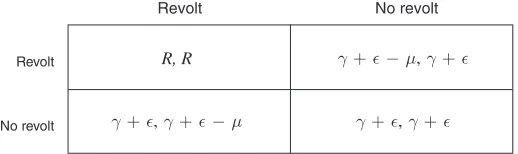
Our previous analysis abstracts from coordination among citizens. To analyze strategic interactions among citizens, we modify the game analyzed in Shadmehr
and Bernhardt (2011) by adding an uncertain element to citizen payoffs about which
they may receive a public signal. We show this framework also delivers the minimal
structure (Proposition 1) that our results rely on, namely that better net news about
the status quo reduces the likelihood of revolution, and there is almost always a revolution following extremely bad news, but almost never a revolution following extremely good news.
Two representative citizens, A and B, can challenge a ruler by mounting a revolu-tion. A revolution succeeds if and only if both citizens revolt; otherwise, the status
quo prevails. The expected value to citizens of the status quo is γ+ϵ, and their
expected payoff from successful revolution is R. If a citizen revolts and revolution
fails, she receives the status quo payoff minus an expected punishment cost μ> 0.
R is known, but γ and ϵ are uncertain: γ ∼ f and ϵ ∼ g , where f and g are strictly
positive, continuously differentiable densities on 핉 . Without loss of generality,
we normalize the means of ϵ and γ to zero because only considerations of the net
![Figure 1. E[γ|∅; γ– ] as a Function of](https://thumb-us.123doks.com/thumbv2/123dok_us/9511986.456580/10.528.118.409.80.286/figure-e-g-g-function.webp)
![Figure 1 . widen the gap between on P γλ and P∅γ[γ|] a scaling factor: increases in ) enters widen the gap between](https://thumb-us.123doks.com/thumbv2/123dok_us/9511986.456580/18.528.109.431.107.220/figure-widen-gl-scaling-factor-increases-enters-widen.webp)