Study of Effect of Concentration on Adsorption
of Methyl Red Dye using different Adsorbents
Prashant A. Giri1, Sunil M. Badgujar2, Raju K. Marag3 1, 2, 3
Department of Chemical Engineering, Finolex Academy of Management and Technology, Ratnagiri
Abstract: Textile processing industries are now widespread sectors in many developing countries. Among the various processes in the textile industry, dyeing process uses large volume of water for dyeing, fixing and washing processes. Thus, the wastewater generated from the textile processing industries contains suspended solids, high amount of dissolved solids, un-reacted dyestuffs (colour) and other auxiliary chemicals that are used in the various stages of dyeing and processing. The conventional method of textile wastewater treatment consists of chemical coagulation, biological treatment followed by activated carbon adsorption. However, wastewater containing dyes is very difficult and complex to treat, since the dyes are recalcitrant organic molecules, resistant to aerobic digestion, and are stable to light, heat and oxidizing agents due to their molecular structure and size. Adsorption techniques have gained popularity in recent years because of their proven efficiency in the removal of pollutants from Textile industry effluents which are too stable for conventional treatment methods. Apart from the high quality product obtained, the processes have proved economically feasible. In most of the textile processing industries, activated carbon is generally used as aadsorbent to remove dyes in wastewater due to its excellent adsorption ability. For the study presented here Activated carbon (Commercial), Charcoal (Cashew-nut shell) and Charcoal (Wood) were used as an adsorbent. The experimental investigations have been made to find the effect of concentration of dye on adsorption rate of different adsorbents and to find the inexpensive alternative adsorbents in order to minimize the cost of effluent treatment from Textile industry. Keywords: Synthetic Dyes, Adsorption, Effluents, Adsorbent, Cashew nut shells
I. INTRODUCTION
The wastewater generated from the textile processing industries contains suspended solids, high amount of dissolved solids, un-reacted dyestuffs (colour) and other auxiliary chemicals that are used in the various stages of dyeing and processing. The conventional coagulation process generates huge volume of hazardous sludge and poses a problem of sludge disposal. Textile industry causes considerable higher impacts to water pollution by discharging their effluents into various receiving bodies includes ponds, rivers and other public sewer. Major pollutants load from the textile industries are from the several of their wet-processing operations like scouring, bleaching, mercerizing and dyeing. Usually, dyes contain aromatic rings in chemical structures and therefore, have high stability against light, oxidants, and biological degradation. Thus reduction of dye and chemical oxygen demand (COD) from textile wastewaters are difficult. Reactive dyes are widely used to colour cellulose fibers such as cotton which is most widely used fiber in textile industry. Due to hydrophilic properties of reactive dyes, reactive dyes are not absorbed onto biomass to any great degree and generally pass through conventional biological wastewater systems. There are various kinds of physical, biological, and chemical processes to remove dyes from colored wastewater. Dyes are so problematic because the families of chemical compounds that make good dyes are also toxic to humans. Each new synthetic dye developed is a brand new compound, and because it’s new, no-one knows its risks to humans and the environment. Many dyes like Amaranth have entered the market, and then have subsequently been discovered to be carcinogenic and withdrawn. The European Union in particular has been pro-active in banning dangerous dyes and dyes formulated from toxic chemicals. Especially since so many dyes are known to be dangerous and carcinogenic. In addition to the dyes themselves, the garment finish is often equally as harmful. They can also be used as softening agents, and for creating other easy-care treatments.
adsorbent because it has excellent adsorption efficiency for organic compounds, but its use is usually limited due to its high cost. In order to decrease the cost of treatment of textile industry effluent, attempts have been made to find inexpensive alternative adsorbents [1].
II. THEORY
The color manufacturing industry represents a relatively small part of the overall chemical industry. Man has used natural colorants since prehistoric times. Colorants are characterized by their ability to adsorb or emit light in the visible range (400 – 700 nm. Therefore, it is the reasons they appear to be colored. Colorants include both dyes and pigments. Pigments are insoluble in the materials that they are used to color, whereas most dyes are soluble in them. The most important, difference between pigments and dyes is that pigments are used as colorants in the physical form in which they are manufactured. Pigments particles have to be attached to substrates by additional compounds, such as by a polymer in paint. Dyes, on the other hand are applied to various substrate (textile materials, leather, paper and hair) from liquid in which they completely, or at least partly soluble. In contrast to pigments, dye must possess a specific affinity to the substrates for which they are used. Conventional dyeing of textile substrate is an energy intensive process [2].
It requires huge amount of energy as well as time to accomplish the process. A number of research studies have been carried to study the effects of non-conventional dyeing techniques on the reaction rates and quality parameters of dyed fabric. Some studies have also been made on the consumption of water, energy, chemicals etc. Schuler (1957) investigated the mechanism of carrier action in dyeing Dacron polyester fiber. Most commercial systems currently use activated carbon as sorbent to remove dyes in wastewater because of its excellent adsorption ability. Adsorption techniques have gained favor in recent years because of their proven efficiency in the removal of pollutants from effluents too stable for conventional treatment methods. Apart from the high quality product obtained, the processes have proved economically feasible. The successful removal of acid dyes by fixed beds of activated carbon has been demonstrated by Walker and Weatherly [3, 4]. Activated carbon (powdered or granular) is the most widely used adsorbent because it has excellent adsorption efficiency for organic compounds, but its use is usually limited due to its high cost. Earlier, synthetic dyes are used in textile industries only but now a day’s these dyes serve many industries such as; Medicine, chemistry, plastics, paint, printing ink, rubber, cosmetics etc[5, 6].
Colour in dye house effluents has always been a difficult problem to solve and the utilization of dyes has made it even more serious. Cooper (1993) summarized the technologies used until then in order to remove or at least reduce colour, mentioning that some them have certain efficiency; Coagulation and/or flocculation, membrane technologies, chemical oxidation technologies, biochemical oxidation and adsorbent utilization. Among various treatment technologies, adsorption onto activated carbon has proven to be one of the most effective and reliable physicochemical treatment methodologies [7, 8]. The adsorption process has an edge over the other treatment methods due to its sludge free operation, and complete removal of dyes even from dilute solutions. The wide usefulness of activated carbon is a result of its chemical and mechanical stability, high adsorption capacity and high degree of surface reactivity [9, 10, 11].
III.MATERIALANDMETHOD A.Material
Adsorbents used for the experimentation were Activated carbon (Commercial Grade), Charcoal (Prepared from Cashew-nut shell) and Charcoal (Prepared from Wood), and Methyl Red (LR) was used to prepare the dye solution.
B.Preparation of Adsorbent
The preparation of Adsorbent from cashew-nut shell was carried out by following procedure;
1) Washing: The samples of Cashew-nut shell were collected from Konkan region of Maharashtra State. The collected samples of Cashew- nut shell were washed with water (2 to 3 times) to remove the dust particles and to remove the sticky material.
2) Drying: After washing, sample was placed on filter paper to remove the water and oil content and placed in sunlight for 4 to 5 days for complete removal of oil.
3) Grinding: To obtain fine powder, the sample was crushed in a mixer. The crushed sample contains large amount oil which is removed by extraction process.
5) Heating: After removing oil, the sample needed to heat in absence of oxygen which is done in Muffle Furnace for 1 hour at 220˚C.
C.Method
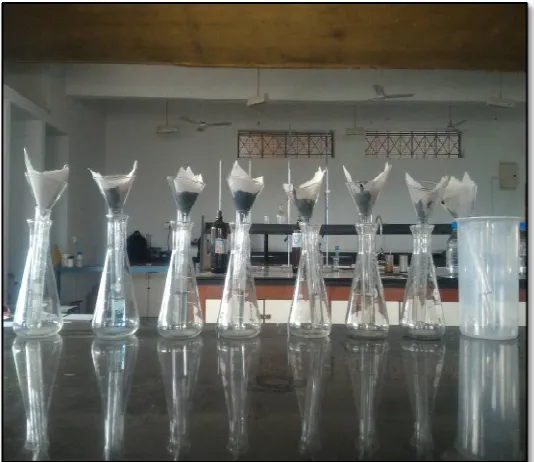
The progress of adsorption treatment of Methyl Red dye on all adsorbents was monitored by collecting samples (10-15 ml) from the dye solution of different concentrations after every 10 min time interval. Total eight (8) batches were prepared for each concentration of Methyl Red dye solution for the experimentation. Collected samples were then filtered to eliminate sludge formed during the process and were examined for absorbance. The dye absorbance was determined using Spectrophotometer (Labtronics
LT-290) at λmax 460 & 410 nm according to Beer-Lambert law, using UV/VIS spectrophotometer. The absorbance measured by
[image:4.612.191.432.221.357.2]Spectrophotometer is directly proportional to the concentration of dye solution. The dye used for experiments such as Methyl Red was purchased from local dyeing industry. All the runs were carried out at room temperature.
Figure 1: Prepared Charcoal from Cashew-nut shell
Figure 2: Experimental Laboratory Batch Setup at room temperature
D.Experimental Procedure
[image:4.612.177.444.389.620.2]IV.RESULTSANDDISCUSSION A. Activated Carbon at different concentrations of Methyl Red Dye at room temperature
5 1 0 1 5 2 0 2 5 3 0 3 5 4 0 4 5
1 . 4 1 . 5 1 . 6 1 . 7 1 . 8 1 . 9 2 . 0 2 . 1
A b s o rb a n c e
T i m e ( m i n )
[image:5.612.123.476.125.296.2]3 . 5 % C o n c e n t r a t i o n 2 % C o n c e n t r a t i o n
Fig. 1: Absorbance vs time plot for Activated Carbon at different concentrations of Methyl Red Dye
The graph of absorbance vs time for different concentration of Methyl Red dye and fixed amount of Activated Carbon as an adsorbent is shown in Figure 1. The graph shows almost equal drop in absorbance at both concentration with respect to time up to20 min. After20 min, the absorbance drops steeply for 3.5% concentration of Methyl Red dye, while for 2.5% concentration it drops linearly with time.The steep decrease in absorbance for 3.5% concentration is due to the existence of higherconcentration gradient, which shows higher rate of adsorption at high concentration. The linear drop in absorbance for 2.5% concentration is due to lower mass transfer rate, which shows lower rate of adsorption at low concentration.
B. Cashew nut Shell at different concentrations of Methyl Red Dye at room temperature
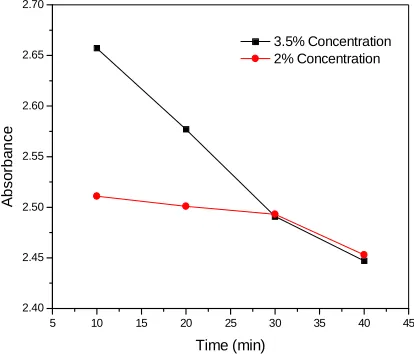
Figure 2 shows the graph of absorbance vs. time for different concentration of Methyl Red dye for Charcoal prepared from Cashew nut Shell as an adsorbent. The graph shows steeply drop in absorbance for 3.5% concentration of Methyl Red dye, while for 2.5% concentration it drops linearly with time up to 30 min. However after 30 min, absorbance value for both the concentration is almost equal and drops linearly, which shows equal of mass transfer rate and absorbance is independent on concentration of dye, the drop in absorbance is linear due to lower mass transfer rate.
5 10 15 20 25 30 35 40 45
2.40 2.45 2.50 2.55 2.60 2.65 2.70 A b s o rb a n c e Time (min) 3.5% Concentration 2% Concentration
[image:5.612.196.403.529.706.2]C. Charcoal at different concentrations of Methyl Red Dye at room temperature
For Charcoal prepared from Wood as an adsorbent, the graph of absorbance vs time for different concentration of Methyl Red dye is shown in Figure 3. The graph shows almost equal drop in absorbance at both concentration with respect to time up to 20 min. After 20 min, the absorbance drops linearly with time for 3.5% as well as 2.5% concentration of Methyl Red dye. However after 30 min, there is steep decrease in absorbance with time for 3.5% concentration of dye. But for 2.5% concentration, the drop in absorbance is linear due to lower mass transfer rate.
5 10 15 20 25 30 35 40 45
1.89 1.92 1.95 1.98 2.01 2.04 A b so rb a n ce
Tim e (m in)
3.5% Concentration 2% C oncentration
Fig. 3: Absorbance vstime plot for Charcoal (Wood)at different cconcentrations of Methyl Red Dye
V. CONCLUSIONS
The results obtained from the Experiments shows that the concentration of Methyl Red dye affects the rate of adsorption. At 3.5% concentration of dye, the rate of adsorption for all adsorbents used is more as compared to 2% concentration of dye. The steep decrease in absorbance for higher concentration is due to the existence of higher concentration gradient, hence lower mass transfer resistance which indicates adsorption is the limiting step. The linear drop in absorbance for lower concentration is due to lower mass transfer rate, which shows lower rate of adsorption at low concentration. The present experimental study with different adsorbents has also been performed to find inexpensive alternate adsorbents in order to decrease the cost of treatment. For Charcoal prepared from Cashew nut shell, absorbance value for both the concentration is almost equal and drops linearly, which shows equal resistance of mass transfer and independent on concentration of dye. Cashew nut shell is showing satisfactory results of adsorption of dye as compared to other two adsorbents at different concentration. Cashew nut shells are readily available and the preparation of charcoal from it is cheaper, it can be used as an alternative adsorbent.
REFERENCES
[1] Badgujar S. M., GiriP. A., Dere S. B., Gurav S. M., Panjari M. M., (2017), “Experimental study of Methyl Red dye adsorption using Cashewnut Shell as an alternate adsorbent”, International Journal of Emerging Technologies and Innovative Research, 4(11), 380-383.
[2] Sun, Q. and Yang, L., (2003), “The adsorption of basic dyes from aqueous solution on modified peat-resin particle”, Water Research, 37, 1535.
[3] Walker, G. M. and L. R. Weatherley, (1997), “Adsorption of acid dyes on to granular activated carbon in fixed beds”, Water Research, 31(8), 2093-2101. [4] Ravi Kumar, M. N. V., Sridhari, T. R., Bhavani, K. D., Dutta, P. K, (1998), “Trends in color removal from textile mill effluents”, Colorage, 40, 25–34. [5] Jain, A. K., Gupta, V. K., Bhatnagar, A., Suhas, (2003), “Utilization of industrial waste products as adsorbents for the removal of dyes”, Journal of Hazardous
Material, B101, 31–42.
[6] Ho, Y. S., McKay, G., (2003), “Sorption of dyes and copper ions onto biosorbents” Process Biochemistry, 38, 1047–1061.
[7] McKay G., (1981), “Design models for adsorption systems in wastewater treatment”, Journal of Chemical Technology and Biotechnology, 81(31), 717–731. [8] Jumasiah, A., Chuah, T. G., Gimbon, J., Choong, T. S. Y., and Azni, I, (2005), “Adsorption of basic dye onto palm kernel shell activated carbon: sorption
equilibrium and kinetics studies”, Desalination, 186, 57-64.
[9] Laszlo, J. A., (1994), “Removing Acid Dyes from Textile Wastewater Using Biomass For Decolorization”, American Dyestuff Reporter, 83, 17-21. [10] McKay, G., El Geundi, M., and Nassar, M. M., (1987), “Equilibrium studies during the removal of dyestuffs from aqueous solutions using baggasse pith”,
Water Research, 21, 1513-1520.