5
IV
April 2017
Technology (IJRASET)
©IJRASET: All Rights are Reserved
868
Design Aids as per IS 800:2007 using Computer
Aided Design for Tension Member
Priyanka Gupta1, Satyendra Dubey2
1
Student - M. Tech (Structural Engineering), 2Assistant Professor, Department of Civil Engineering GGITS, Jabalpur, M.P., India
Abstract: The B.I.S. recently revised the new IS 800:2007 . this is based on limit state method. This new code includes variety in elements like tension members, compression members, flexural members , combined axial and bending design of members. The B.I.S. has yet not published any design aids based on new IS 800:2007 For saving time in various design of structural steel section, one need to have their own computer program or design aids or spreadsheet which is based on IS 800:2007 . In this project we have developed C++ programming for design the tension member , compression member , flexural member and made an excel spreadsheet which is very helpful for calculating the load bearing capacity in steel . we can use the C++ programming software turboC because all civil software like Autocad , SAP2000, Primavera , Etabs , Revit , STAAD Pro , structural Analysis software S-frame etc are very very costly and not easily available. This project are very helpful in steel designing for all civil engineers. This project comprises three principal sections: general guidance, Design data and design table.
Keywords: IS 800:2007 , limit state design , c++ programming , load bearing capacity.
I. INTRODUCTION
The code of practice for general construction in steel is IS: 800. The IS: 800-1984 was based on elastic method of design. To reflect the latest developments and the state of the art, the third revision of IS: 800 is released in 2007. The IS: 800-2007 is based on limit state method of design. IS 800:2007 is recently modified using the limit state approach, in order to make the standard more useful and in line with standard of other developed nations. The design of tension members in IS 800:2007 has provided C++ programming to compute the tensile stress of a given angle section to reduce the computational effort. However, these C++ programming are more useful for finding the load bearing capacity if the cross section of the tension member is known. It still takes certain effort particularly for the students and inexperienced designers, to select an appropriate section from steel table for given axial tension and effective length.
In limit state method of design, the reliability of design is ensured by satisfying the requirement Design action ≤ Design strength
A. Tension Member
Technology (IJRASET)
©IJRASET: All Rights are Reserved
869
fig1.1– Tension member is structure
B. Type of Tension Member
1) Minor Tension Member: Rod , bolt , plate
2) Major Tension Member: Bridge, truss , Tie , Wire , Cable , Angle section , T-section, built-up member.
C. Design Strength of Tension Member
The factored design tension T, in the member shall satisfy the following requirement: T < Td
Where, Td = design strength of the member.
The design strength of a member under axial tension , Td is the lowest of the design strength due to yielding of gross section Tdg ; rupture strength of critical section,Tdn and block shear Tdb , given in 6.2,6.3, and 6.4 respectively in (IS 800:2007)
1) Design Strength due to Yielding of Gross Section: The design strength of members under axial tension, Tdg as governed by yielding of gross section, is gross section , is given by
Tdg = Ag* fy / ϒmo Where, fy = yield stress of the material,
Ag = gross area of cross- section
ϒmo = partial safety factor for failure in tension by yielding
2) Design Strength due to Rupture of Critical Section:
a) Single Angles: The rupture strength of an angle connected through one leg is affected by shear lag. The design strength, Tdn as governed by rupture at net section is given by:
Tdn = 0.9 * Anc * fu / ϒm1 + β * Ago * fy / ϒmo
Where, β = 1.4 – 0.076 (w/t) ( fy/ fu) ( Bs/ Lc ) ≤ (fu * ϒmo/ fy * ϒm1 ) ≥ 0.7
where,
W = outstand lag width Bs = shear lag, and
Lc = length of the end connection , that is the distance between the outermost bolt direction or length of the weld along the load direction.
Technology (IJRASET)
©IJRASET: All Rights are Reserved
870
Tdn = α * An * fu / ϒm1
Where,
α= 0.6 for one or two bolt, 0.7 for three bolts and 0.8 for four or more bolts along the length in the end connection or equivalent
weld length;
An = net area of the total cross-section; Anc = net area of the connected leg;
Ago = gross area of the outstanding leg; and t = thickness of the leg
3) Design Strength due to Block Shear: The strength as governed by block shear at an end connection of plates and angle is calculated as given in –
a) Bolted Connections: The block shear strength , Tdb of connection shall be taken as the smaller of, Tdb = ( Avg * fy / (√3 * ϒmo ) + 0.9 * Atn * fu / ϒm1 )
Or
Tdb = (0.9 * Avn * fu / √3 * ϒm1 ) + Atg * fy / ϒmo ) Where
Avg ,Avn = minimum gross and net area in the shear along bolt line parallel to external force , respectively. Atg,Atn = minimum gross and net area in tension from the bolt hole to the toe of the angle, end bolt line, perpendicular to the line of force respectively.
Fy,fu = ultimate and yield stress of the material , respectively.
Q. (A) The angle Section (65*65*6) mm. find out load carrying capacity (factored load) if 04 No. of bolt 16mm diameter used in connection.
C++ Programming for Tension Member :
#include <iostream.h> #include <conio.h> #include<math.h> Void main() {
Float s,t, SA, w, Ag, fy, gamamo, Tdg, fu, gamam1, W1, ed, bs, db, B , Z , Anc , Ago, Tdn ,Avg , Avn, Atn , Atg , Tdb1, Tdb2, Nb, Lc, small;
Clrscr(); Fy = 250 ; gamamo = 1.1 ; fu = 410; gamam1 = 1.25 ;
cout<<end<<” enter the value of gross area”<<endl ; cin>>Ag;
cout<<endl<<”value of Tdg =”; Tdg = Ag*(fy/gamamo); Cout<<Tdg;
Cout<<endl<<”enter the weight per m (w) =”<<endl; Cin>>w;
Cout<<endl<<”enter edge distance (ed) = “<<endl; Cin>>ed;
Cout<<endl<<”value of w1 = “; w1 = w – ed;
cout<<endl<<”value of w1 =”<<w1;
Technology (IJRASET)
©IJRASET: All Rights are Reserved
871
cout<<endl<<”value of bs =”; bs = w + w1 – t;
cout<<bs;
cout<<endl<<”enter the value of end connection(Lc) = “<<endl; cin>>Lc;
cout<<endl<<”value of B”<<endl; B = 1.4 – 0.076*(w/t)*(fy/fu)*(bs/Lc); Cout<<B;
Cout<<endl<<”value of Z”<<endl; Z = (fu*gamamo)/(fy/gamam1); Cin>>Z;
Cout<<endl<<”enter the value of db =”; Cin>>db;
If (B<=Z &&Z>=0.7) {
Anc = (w – db – t/2)*t;
Cout<<endl<<”value of Anc”<<Anc; Ago = (w – t/2)*t;
Cout<<endl<<”value of Ago = “<<Ago;
Tdn = 0.9*Anc*(fu/gamam1) + B*Ago*(fy/gamamo); Cout<<endl<<”value of Tdn”<<Tdn;
Avg = Lc*t;
Cout<<endl<<”value of Avg”<<Avg; Cout<<endl<<”enter no. of bolt”; Cin>>Nb;
Avn = (Lc – (Nb – 0.5)*db)*t;
Cout<<endl<<”value of Avn = “<<Avn; Atn = (ed – db/2)*t;
Cout<<endl<<”value of Atn = “ << Atn; Atg = ed*t;
Cout<<endl<<”value of Atg”<<Atg;
Tdb1 = ((Avg*fy)/(sqrt(3)*gamamo)) + (0.9*Atn*(fu/gamam1)); Cout<<endl<<”value of Tdb1 = “ << Tdb1;
Tdb2 = (0.9*Avn*(fu/(sqrt(3)*gamam1)))+(Atg*(fy/gamamo)); Cout<<endl<<”value of Tdb2 = “ <<Tdb2;
Cout<<endl<<”smaller value between Tdb1 and Tdb2”; If (Tdb1<Tdb2)
{
Small = Tdb1;
Cout<<endl<<”small = Tdb1”; }
Else {
Small = Tdb2;
Cout<<endl<<”small = tdb2”; }
If (Tdg<=Tdn) {
Technology (IJRASET)
©IJRASET: All Rights are Reserved
872
{
Cout<<endl<<”enter value is Tdg = “; Cout<<Tdg;
} Else {
Cout<<endl<<”smaller value is”; Cout<<small;
} }
Else {
If (Tdn<= Tdb1 II Tdn<= Tdb2) {
Cout<<endl<<”smaller value Tdb =”; Cout<<Tdn;
} Else {
Cout<<endl<<”smaller value is”; Cout<<small;
}
} } Else {
Cout<<endl<<” you are enter wrong value so please put again all values because we get wrong value of B =”; Cout<<B;
} Getch(); }
D. Output
Enter the value of gross area = 744mm2 Value of Tdg = 169090.90N
Enter the weight per meter (w) = 65 Enter edge distance (ed) = 30 Value of w1 = 35
Enter value of thickness(t) = 6mm Value of bs = 94
Enter value of end connection (Lc) = 150 Value of B = 1.0853
Value of Z = 1.443
Technology (IJRASET)
©IJRASET: All Rights are Reserved
873
Enter no. of bolt = 4 Value of Avn = 532.5 mm2 Value of Atn = 127.5 mm2 Value of Atg = 180mm2 Value of Tdb1 = 155732.37N Value of Tdb2 = 131665.09N Smaller value between Tdb1 & Tdb2 Small = Tdb2
Smaller value is = 131665.09 N or 131.665 KN ans.
E. Result
The Load carrying capacity (factored load) if The angle Section (65*65*6) mm 04 No. of bolt 16mm diameter = 131.665KN .
II. CONCLUSION
A. According to IS 800:2007 using limit state approach , tables are prepared for design tensile strength of a given angle section with respect to the effective length.
B. The designer can select the appropriate steel section using these tables which ensures that the section is capable of resisting the anticipated loading with an adequate margin of safety.
C. It removes the tedious trial and error method of design.
D. Many developed country have prepared tables for design aids as per their standard code. In india there are no such types of tables according to the new IS 800:2007 code which is based on limit state method design.
E. We can prepared a computer program in C++ programming language may be prepared to compute the tensile strength of various section available in the steel table.
F. Finally a design aids is given in ready reference tabulated format for various angle section.
III. FUTURE SCOPE
A. Design of tension member using varios section like channel section, T-section, plate section etc.
B. Design of HSFG bolt can be included.
C. Tension member using welding connection.
D. Two, three or more row can be considered in spreadsheet.
[image:7.612.53.562.247.432.2]E. Revision of SP-6 can be done by now IS800-2007.
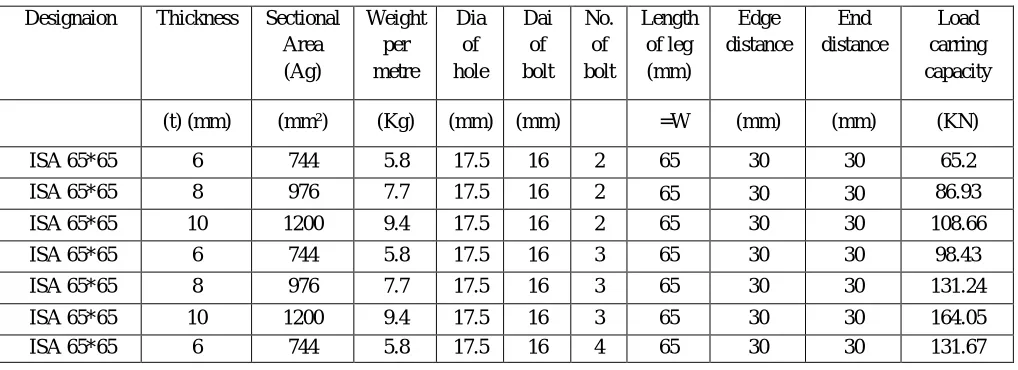
Table : Design table of tension members (Using Bolt)
Designaion Thickness Sectional Area (Ag) Weight per metre Dia of hole Dai of bolt No. of bolt Length of leg (mm) Edge distance End distance Load carring capacity
(t) (mm) (mm²) (Kg) (mm) (mm) =W (mm) (mm) (KN)
ISA 65*65 6 744 5.8 17.5 16 2 65 30 30 65.2
ISA 65*65 8 976 7.7 17.5 16 2 65 30 30 86.93
ISA 65*65 10 1200 9.4 17.5 16 2 65 30 30 108.66
ISA 65*65 6 744 5.8 17.5 16 3 65 30 30 98.43
ISA 65*65 8 976 7.7 17.5 16 3 65 30 30 131.24
ISA 65*65 10 1200 9.4 17.5 16 3 65 30 30 164.05
Technology (IJRASET)
©IJRASET: All Rights are Reserved
874
REFERENCES
[1] IS CODE 800:2007 Indian Standard Code of Practice For General Construction in Steel, Bureas Of Standards, New Delhi.
[2] B.Jena ,SSCI (2004), An Overview of Limit State Design Of Steel Structures And IS 800-84,NIT, Rourkela.
[3] Gupta Mohan and Gupta L.M., “Design Aids For Steel Compression Members as Per New IS 800. “Nov 07-08,2008, Bhilai Institute Of
Technology,Durg(C.G.).
[4] Handbook Of structural steelwork, 3rd BCSA,SCL, Londan.
[5] Kalyanaraman, V., (2002). “ A Review of IS 800 Revision Process”, IIT ,Madras.
[6] Subramanian, N.,( (2008). Design of Steel Structures, Oxford University Press, New Delhi.
[7] Subramanian, N.,(2005), “Design using Advanced Analysis of Steel structures” , New Building Materials and Construction.
[8] Handbook Design of steel structure by “ S.K. DUGGAL”.
[9] The C programming language paperback – 2015 by brain W. kerrighan/ Dennis Ritchie (author).
[10] Design of steel structure by “B.C.PUNMIA”.
[11] IS 800:1984 code of practice for general construction in steel.
[12] M.K.S. &S.I. units steel tables by R. AGOR.
[13] The C Programming Language by Brian W. Kernighan, Dennis M. Ritchie .
[14] C Programming in 12 Easy Lessons by Greg Perry.
[15] C Programming: A Modern Approach by K.N. King Highly recommended.