Knowledge Externalities: An Application to the Turkish
Manufacturing Industry
Huseyin Dastan
*, Hasan Gunes, Gurkan Calmasur
Faculty of Economics and Administrative Sciences, Erzurum Technical University, Turkey
Copyright © 2015 by authors, all rights reserved. Authors agree that this article remains permanently open access under the terms of the Creative Commons Attribution License 4.0 International License
Abstract
In the sequel of technological breakthroughs as advanced in recent years, the notion of mileage have started to eradicate on Earth. Created knowledge and innovations disseminate along distinct people or institutions promptly. Fast paced technological advancements of communication and attaining have brought countries closer so as to transform the world to a, so to say, "global village". In this new world's order, where economical and social circumscriptions fade out gradually, the economy shall be undertaken as an entirety as circumscriptions are being glossed over. Knowledge and innovations of a company which the same are created by disseminate promptly in the new world's order which is being unfold, and introduce positive influences to the other companies and industries. The influences, here concerned are, observed on the closely positioned companies and industries along with the ones so remotely positioned to each other. In this study, the presence of a limited number of studies on externalities taking place in the Turkish manufacturing industry, the importance of externalities, will be a related topic aimed to generate resources for research. In line with this idea and with consider to NACE Rev.2 classification, knowledge externalities that arise in Turkish manufacturing industry are analyzed for the entirety of the industry and for each sub-sector distinctively within the 2003-2013 years of period. With regard to the test results of GMM estimator, where the tests were conducted separately for each of the sub-sectors of manufacturing industry; MAR, Jacobs, Porter, and III variable might have both positive and negative influences. MAR knowledge externalities (resulting from specialization) were probed to be meaningful in 9 sectors; whereas Jacobs’s (resulting from diversity) in 7 sectors, and Porter’s (resulting from competition) in 6 sub-sectors of the manufacturing industry. Also, III variable (resulting from innovation) was proved to be meaningful for the 9 sub-sectors of the manufacturing industry.Keywords
Knowledge Externalities, MAR, Jacobs, Porter, Turkish Manufacturing Industry, GMM1. Introduction
In the sequel of technological breakthroughs as advanced in recent years the concept of mileage has started to eradicate in Turkey as well as on Earth. Created knowledge and innovations disseminate along with distinct people or institutions promptly. As the consequence of the globalization, governments which lose their teeth on the economy and multinational companies become prevalent. Social, political and economical transformations penetrate beyond the boundaries and sway whole world. As a significantly concrete example of this, the financial crisis in USA in 2008 and its ripple effects on other countries can be taken into account.
Administered industrial policies have a significant precedence for a country to possess power in the international competition and development. Manufacturing industry which part takes in the sub-sectors of the production industry constitutes quite an importance within this context. Knowledge externalities which occur with the knowledge created via innovative activities performed by manufacturing industry, and the benefits of which these activities facilitate for the other industries or financial units that do not bear the costs of these activities as they are being performed, are of much importance conceptually and should be valued during policy administration processes of the decision making units. To this regard, knowledge externalities which usually arise as positive externalities are the substantial moving forces of modern economic growth and development. Manufacturing industry is quite important in consideration of positive externalities which it facilitates for both national and regional development along with the industrialization.
Knowledge externalities are classified as Marshall-Arrow-Romer, Jacobs and Porter knowledge externalities with regard to their resources as well as static and dynamic knowledge externalities according to the periods which they are effective [2].
This study scrutinizes influences of the knowledge externalities that emerge the consequences of innovative activities performed by the companies and industries, on Turkish manufacturing industry. In the field the analysis of the Turkish manufacture industry externalities occur (see if arise works here too) to compare rates with other countries; this dilemma is discussed in our study with the aim of Turkish manufacture industry. Also the subject is intended to set an example for those who will investigate. With regard to this purpose, knowledge externalities that arise in manufacture industry in Turkey have been analyzed in each of the sub-sectors distinctively and for the entirety of the industry as of 2003-2013 periods by taking NACE Rev.2 classification into account.
This study consists of 5 major chapters. In the second chapter, the concept of externalities and knowledge externalities have been introduced along with the historical development and varieties of knowledge externalities; in the third chapter the data used in the study, methodology and a brief of the literature; in the fourth chapter empirical findings have presented. In the fifth and the last chapter the results which have been obtained via the research have stated.
2. The Concept of Externalities and
Knowledge Externalities
Alfred Marshall, founder of the Cambridge University, is accepted as economist who put forward the theory about the concept of externalities. Externalities in the context of economic theory are based on studies conducted by Marshall. Alfred Marshall took matter in hand the internal economies with external economies to explain increased returns at his study in order to determine a company's production costs, including the UK and other European countries. Marshall tried to understand the production phase of the firms in the industry of external economies, whether affect the competitive conditions.
It seems to be the external economy stronger than the internal economy in Marshall’s study. According to Marshall, external economies, depending on the development of the industry, the benefits are earned by firms in the industry [3]. In addition to Marshall, externality issues are discussed in the neoclassical economics approach. However, in neoclassical economics approach, the externalities issues have been studied within the framework of the Pigou’s analysis. Therefore, the generally accepted opinion has been Pigou’s analysis and interpretation. The most important study for opposing view of Pigou’s analysis is Coase studies.
Differently the classic externality is seen as damage creator, examined within neoclassical economic lines, as a result of mutual activities of the externality issues. Coase
suggested that the formation of reciprocity framework of externalities, has defended the idea of the events in question can be resolved in a market externality. According to neoclassical economics approach, the externalities in the market, internalized in the market and cannot be understood.
Therefore, adopted by the market, for eliminate the externalities which cannot be solved, the state that outside from the market, has been defended that should take a regulatory role [4].
This situation can be expressed as the concept of externalities in the literature, provide benefit and create cost and with this benefit, not to pay any cost for the benefit. Externalities in the most general sense, as a result, the economic activities of economic decision making units (production and consumption) other economic decision units of the benefits or the costs they incur, are associated with the positive or negative influence [5]. Thus, externalities, the decisions units that affect each other, providing benefits to other individuals or companies, in exchange for these benefits, which cannot take any money or received, charged cost and as a result of this cost, effects are not cover the damage. Knowledge incurred high costs to produce, but the low cost of re-use; may spread faster than money, manpower, goods and services. Therefore, knowledge dissemination speed, allows limitless society formation [6]. Economic unit with that performs innovative activities, new knowledge is generated. This innovative activities that carried out by the company or the costs and assumed by the industry partner of other non-economic units, occurring as a result of externalities that kind of advantage, is defined as knowledge externality [7].
Knowledge externalities have significant effects on the economy. In the literature, three main knowledge externalities separation is seen as important for growth and innovation was performed. These externalities, Marshall-Arrow-Romer externalities [8], [9], [10], Jacobs’s externalities [11] and Porter externalities [12], [13].
MAR externalities emphasize the spread of knowledge as a result of emerging specialization and local monopoly. Jacobs’s externalities, express the competition results that occurred as a result of industrial diversity and local knowledge. The Porter externalities express the specialization and the local competition, taking advantage of knowledge externalities [14].
correspond to decentralization of the economy. Marshall in 1890, as a result of industrial concentration occurring in the city, to ensure the spread between the companies and knowledge mentioned that this spread will be easier. Because of this situation, growth occurs both in the city and industry [16]. The scope of MAR theory, situated in a city with more concentration of companies involved in a specific industry, new product development rate increases, existing products are developed and production methods renew and improve. Knowledge externalities were theorized in a different way by Jane Jacobs in 1969. Proposed by Jacobs- according to the theory of diversity based on knowledge externalities, knowledge externalities, contrary to local monopolization, has championed diversity in the region is based on industry [17].
According to Jacobs, monopolies are damaging to the city and reach the level that reach the city's economy and is caused to failing capture capacity which they may have. Formed in monopoly prices, even though they are damaging, he has argued that this situation that brought disadvantages are the most insignificant. The basis of this adduction is the reason that the state-owned monopoly that constitute an obstacle the existence of products and services to create alternative production methods [18]. The diversity in the industry has been described as hastening the spread of knowledge and innovation in Jacobs’s externalities. Consequently, it has been advocated that the development is positively affected by the diversification of industry [19]. Discussed and defended in 1990 by Porter, Competitive Knowledge Externalities, also advocates certain criteria from both the MAR and Jacobs’s externalities knowledge. Porter externalities of knowledge, manufacturers and consumers (buyers and sellers) to create the industry are advocated that occurred in knowledge dissemination. Porter is specified as buyers and sellers of nearness to each other, which causes the formation of knowledge externalities [20]. Porter externalities of knowledge, defends that specialization and concentration in the industry have won locally, resulting in the formation of the rapid dissemination of knowledge that triggered growth [21]. This kind of knowledge externalities, espoused by MAR knowledge externalities, as opposed to local monopoly, innovation will speed up the formation of the local competition. However, the opinion of innovation and adoption should be the creation of knowledge.
3. Literature Review, Data and
Methodology
The Classical School of Economics, output and present information that ranges from externalities as, the 1990’s have brought in the economy of knowledge externalities effects and externalities have varieties as many studies have been conducted.
It made most of these studies have been done for a large part of Europe and the United States economies. Studies on this subject in Turkey are very low [22]. The main interest of
industry, as there is no study to measure the impact on a sectoral basis of knowledge externalities, this study is expected to serve as an example of such study. NACE Rev. 2 classification study took into account, and as the period of 2003-2013, Turkey was included in the analysis sub-sectors of the manufacturing industry, and knowledge externalities were examined. It is more significant in terms of providing healthy test results with work time series data covering long in econometric studies. However, manufacturing data have been published in different classifications. Therefore, the study is considered more recent classification NACE Rev. 2 classification and time size is narrowed. In this study were used sub-sectors of the manufacturing industry 2003-2013 period data. The data that used, released by Turkey Statistical Institute, Annual Industry and Service Statistics and Published by Turkish Patent Institute According to the Patent and Utility Model Application NACE classification, the Sectoral Breakdown are obtained from the data.
Generalized Method of Moments (GMM), according to the standard method of negligible bias on the possession, use all the knowledge contained in the model offers significant advantages for growth estimate. However, it was designed to provide dynamic models and the application to allow the weakness of the externalities of the explanatory variables is important flexibility. Generalized Method of Moments (GMM), Hansen's (1982) general conditions of the time emerged with her work could be used in a manner consistent parameter estimates under weak assumptions. Instrumental Variables Method and many standard estimators including in the Least Squares Method are special cases of GMM. The advantage of GMM methods, models and specific estimators without the need for a strong distribution assumption is that it offers the opportunity to formulate. GMM if certain conditions exist is based on simple estimators and has some advantages. In this context, GMM’s advantage that the parameters of the model estimation stage, means that the number of variables is defined as an excess, which means it may not allow more than necessary. The disadvantage of GMM estimators is known to be poor although an effective method for large samples, small sample properties. The data used in this study, it subjected to analysis as t: 11 time interval and n: 20 sub-sectors of manufacturing industry. Patent data used in the study were not published according to the NACE Rev. 2 classification, the method of combining the sector tested according to NACE Rev. 2. One of the variables used on the model established in this study as dependent, was used total of nine variables. It was examined the relationship of other variables with AV (added value) as dependent variable. As independent variables; were used, Manufacturing Sub-Sector Annual Revenue Data, Manufacturing Subsector Annual Employment Data, Manufacturing Subsector Annual Workers’ Salaries, Manufacturing Subsector Annual Purchases of Goods and Services data, MAR knowledge externality index, Jacobs externalities index knowledge, Porter knowledge externality index, III (Innovative Intensity Index). Used in the study,
MAR, Jacobs and Porter knowledge externalities and III variable indices, are calculated by us. In the literature review, MAR, Jacobs and Porter knowledge externalities were examined on a regional basis. In this study, knowledge externalities are considered as industrial. Therefore indexes, calculated on the stage were again formulated with sectoral data. Externalities argument as to the knowledge contained in the model index is formulated as follows:
(1)
Ec.(1) Xest, are shown; e industry s sectors’ total
manufacture and Xet, e industry total manufacture.
(2) In Jacobs index, Xst, related sector manufacture and Xet, it
shows the manufacture of all sectors in the industry. (3) In Porter knowledge externalities formula, shows that; Est,
numbers of firms Xst, total production of the sector, Eet, the
number of firms in the industry and Xet, the total manufacture
in the industry.
(4)
Innovative intensity index variable (III), expressed as a percentage of sectoral employment rate of patent applications at the sectoral level. Türkcan and Kumral (2013) in the study III variable calculated for the manufacturing sub-sectors and have been included in the model. Time series and panel data analysis are used to test the relationship between the variables in the study:
(5)
Ln AV as the dependent variable on the model represents added value. β1 represents constant term. Independent
variables where are located in model; lnSAW employees’ salaries and wages; lnTURN turnover values; lnEMP, number of employees; lnPUR, for the purchase of goods and services; MAR, MAR knowledge externalities; JAC, Jacobs externalities of knowledge; POR, Porter knowledge externalities and III, Innovative Intensity Index and ε the error term in the model.
4. Empirical Findings
value added of the factors that may affect these externalities, time series analysis and panel data analysis. In the analysis phase, the first, time series analysis is made for the manufacturing industry sub-sectors. In the analysis, the classification of sub-sectors of the manufacturing industry is predicated on NACE Rev. 2 encoding.
Subsectors where are used in the study; Manufacture of food products and beverages (C10-C11), Manufacture of tobacco products (C12), Manufacturing of textiles (C13) Manufacturing of Apparel (C14), Manufacture of leather and related products (C15), Wood and Wood Products, Toadstool Products Manufacturing (except furniture); Knitting from Reeds, hay and similar materials production of goods (C16), Manufacture of paper and paper products (C17), Manufacture of Cocking Coal and refined petroleum products (C19), Manufacturing of chemicals and chemical products (C20), Regarding Manufacture of basic pharmaceutical products and pharmaceutical materials (C21), Manufacture of rubber and plastic products (C22), Other Non-Metallic Minerals Manufacturing (C23), Basic Metals (C24), Manufacture of fabricated metal products (except machinery and equipment) (C25), computers, manufacturing of electronic and optical products (C26), Electrical Equipment Manufacturing (C27), Not Elsewhere Classified Machinery and Equipment Manufacturing (C28), Motor Vehicles, Trailers (trailers) and semi-trailers (semi-trailers) Manufacturing (C29), Manufacture of Other Transport Equipment (C30) and the furniture- Other Manufacturing and Machine Setup (C31-C32-C33).
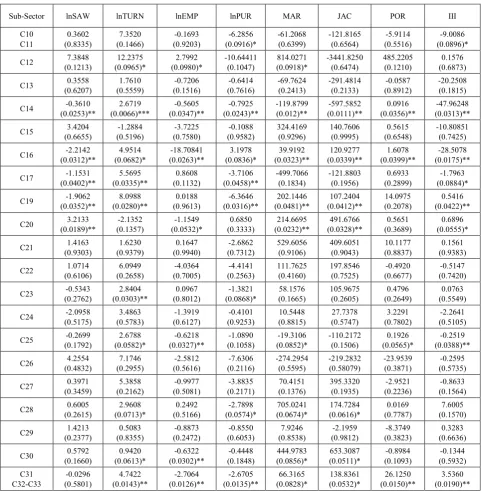
In the tables showing the test results, MAR Jacobs and Porter knowledge externalities and beside III variable, are given to the statistical results of the other independent variables used in the analysis. Results were evaluated according to statistical significance with 1%, 5% and 10% significance levels. Coefficients of independent variables can take positive or negative values. Take positive values of the coefficient of arguments against a change will occur in the dependent variable (Value Added) represents the same way that a change occurred. However, stated that the coefficients of the independent variables are being negative valuable, a change will occur against, independent variable and opposite direction change occurred in dependent variables. The first autocorrelation to test the error term ( see if you can use miscalculation) in the multiple regression analysis, the relation between successive values Breush-Godfrey Serial Correlation studies (LM) and altering variance for determining the dispersion with a constant variance of the error term Heteroskedasticity (White) Tests were carried out.
In the first study, it was investigated whether there is autocorrelation and the heteroscedasticity problem.
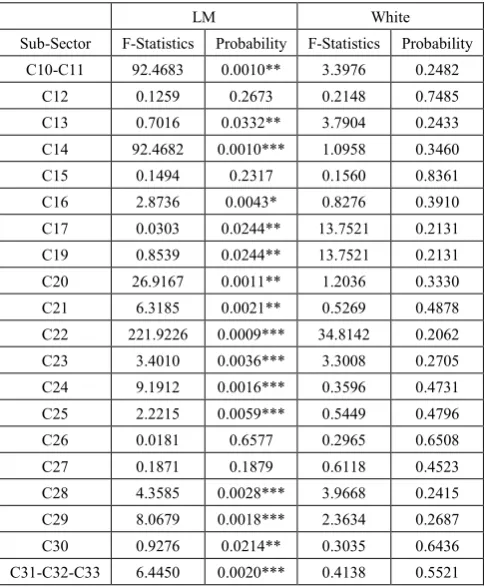
[image:5.595.311.554.154.448.2]Autocorrelation for each sub-sector and Breush-Godfrey Serial Correlation whether changing variance (LM) and heteroscedasticity has been tested and HAC correction is made.Table 1 shows results of test for sub-sectors.
Table 1. Breush-Godfrey Serial Correlation (LM) and Heteroscedasticity (White) Test Results of Sub-Sector
LM White
Sub-Sector F-Statistics Probability F-Statistics Probability
C10-C11 92.4683 0.0010** 3.3976 0.2482
C12 0.1259 0.2673 0.2148 0.7485
C13 0.7016 0.0332** 3.7904 0.2433
C14 92.4682 0.0010*** 1.0958 0.3460
C15 0.1494 0.2317 0.1560 0.8361
C16 2.8736 0.0043* 0.8276 0.3910
C17 0.0303 0.0244** 13.7521 0.2131
C19 0.8539 0.0244** 13.7521 0.2131
C20 26.9167 0.0011** 1.2036 0.3330
C21 6.3185 0.0021** 0.5269 0.4878
C22 221.9226 0.0009*** 34.8142 0.2062
C23 3.4010 0.0036*** 3.3008 0.2705
C24 9.1912 0.0016*** 0.3596 0.4731
C25 2.2215 0.0059*** 0.5449 0.4796
C26 0.0181 0.6577 0.2965 0.6508
C27 0.1871 0.1879 0.6118 0.4523
C28 4.3585 0.0028*** 3.9668 0.2415
C29 8.0679 0.0018*** 2.3634 0.2687
C30 0.9276 0.0214** 0.3035 0.6436
C31-C32-C33 6.4450 0.0020*** 0.4138 0.5521
NB:***, **, * denotes statistical significance at 1%, 5% and 10% level respectively.
As shown in Table 1, C10-11 LM according to the test result, C13, C14, C16, C17, C19, C20, C21, C22, C23, C24 and C25 relation between variables in the sector (autocorrelation) according to White test C10-11, C12, C13, C14, C15, C16, C17, C19, C20, C21, C22, C23, C24, C25 and C26 sectors are understood that there is no difficulty in changing variance.
Table 2. Generalized Method of Moments Estimation Results for Sub-Sector
Sub-Sector lnSAW lnTURN lnEMP lnPUR MAR JAC POR III
C10
C11 (0.8335) 0.3602 (0.1466) 7.3520 (0.9203) -0.1693 (0.0916)* -6.2856 -61.2068 (0.6399) -121.8165 (0.6564) (0.5516) -5.9114 (0.0896)* -9.0086
C12 (0.1213) 7.3848 (0.0965)* 12.2375 (0.0980)* 2.7992 -10.64411 (0.1047) (0.0918)* 814.0271 -3441.8250 (0.6474) 485.2205 (0.1210) (0.6873) 0.1576
C13 (0.6207) 0.3558 (0.5559) 1.7610 (0.1516) -0.7206 (0.7616) -0.6414 -69.7624 (0.2413) -291.4814 (0.2133) (0.8912) -0.0587 -20.2508 (0.1815)
C14 (0.0253)** -0.3610 (0.0066)*** 2.6719 (0.0347)** -0.5605 (0.0243)** -0.7925 -119.8799 (0.012)** (0.0111)** -597.5852 (0.0356)** 0.0916 (0.0313)** -47.96248
C15 (0.6655) 3.4204 (0.5196) -1.2884 (0.7580) -3.7225 (0.9582) -0.1088 324.4169 (0.9296) 140.7606 (0.9995) (0.6548) 0.5615 -10.80851 (0.7425)
C16 (0.0312)** -2.2142 (0.0682)* 4.9514 (0.0263)** -18.70841 (0.0836)* 3.1978 (0.0323)** 39.9192 (0.0339)** 120.9277 (0.0399)** 1.6078 (0.0175)** -28.5078
C17 (0.0402)** -1.1531 (0.0335)** 5.5695 (0.1132) 0.8608 (0.0458)** -3.7106 -499.7066 (0.1834) -121.8803 (0.1956) (0.2899) 0.6933 (0.0884)* -1.7963
C19 (0.0352)** -1.9062 (0.0280)** 8.0988 (0.9613) 0.0188 (0.0316)** -6.3646 (0.0481)** 202.1446 (0.0412)** 107.2404 14.0975 (0.2078) (0.0422)** 0.5416
C20 (0.0189)** 3.2133 (0.1357) -2.1352 (0.0532)* -1.1549 (0.3333) 0.6850 (0.0232)** 214.6695 (0.0328)** 491.6766 (0.3689) 0.5651 (0.0555)* 0.6896
C21 (0.9303) 1.4163 (0.9379) 1.6230 (0.9940) 0.1647 (0.7312) -2.6862 529.6056 (0.9106) 409.6051 (0.9043) 10.1177 (0.8837) (0.9383) 0.1561
C22 (0.6106) 1.0714 (0.2658) 6.0949 (0.7005) -4.0364 (0.2563) -4.4141 111.7625 (0.4160) 197.8546 (0.7525) (0.6677) -0.4920 (0.7420) -0.5147
C23 (0.2762) -0.5343 (0.0303)** 2.8404 (0.8012) 0.0967 (0.0868)* -1.3821 (0.1665) 58.1576 105.9675 (0.2605) (0.2649) 0.4796 (0.5549) 0.0763
C24 (0.5175) -2.0958 (0.5783) 3.4863 (0.6127) -1.3919 (0.9253) -0.4101 (0.8815) 10.5448 (0.5747) 27.7378 (0.7802) 3.2291 (0.5105) -2.2641
C25 (0.1792) -0.2699 (0.0582)* 2.6788 (0.0327)** -0.6218 (0.1058) -1.0890 (0.0852)* -19.3106 -110.2172 (0.1506) (0.0565)* 0.1926 (0.0388)** -0.2519
C26 (0.4832) 4.2554 (0.2955) 7.1746 (0.5616) -2.5812 (0.2116) -7.6306 -274.2954 (0.5595) -219.2832 (0.58079) -23.9539 (0.3871) (0.5735) -0.2595
C27 (0.3459) 0.3971 (0.2162) 5.3858 (0.5081) -0.9977 (0.2171) -3.8835 (0.1376) 70.4151 395.3320 (0.1935) (0.2236) -2.9521 (0.1564) -0.8633
C28 (0.2615) 0.6005 (0.0713)* 2.9608 (0.5166) 0.2492 (0.0574)* -2.7898 (0.0674)* 705.0241 (0.0616)* 174.7284 (0.7787) 0.0169 (0.1570) 7.6005
C29 (0.2377) 1.4213 (0.8355) 0.5083 (0.2472) -0.8873 (0.6053) -0.8550 (0.8538) 7.9246 (0.9812) -2.1959 (0.3823) -8.3749 (0.6636) 0.3283
C30 (0.1660) 0.5792 (0.0613)* 0.9420 (0.0302)** -0.6322 (0.1848) -0.4448 (0.0856)* 444.9783 (0.0511)* 653.3087 (0.1093) -0.8984 (0.5932) -0.1344
C31
C32-C33 (0.5801) -0.0296 (0.0143)** 4.7422 (0.0126)** -2.7064 (0.0135)** -2.6705 (0.0828)* 66.3165 (0.0532)* 138.8361 (0.0150)** 26.1250 (0.0190)** 3.5360 NB:***, **, * denotes statistical significance at 1%, 5% and 10% level respectively.The statements in parentheses indicates the probability values.
Table 3. Sargan Test Results for Sub-Sector Sub
Sector J-Statistic Sub-Sector J-Statistic Sub-Sector J-Statistic Sub-Sector J-Statistic Sub-Sector J-Statistic C10
C11 (0.1423) 2.1524 C15 (0.1359) 2.2228 C20 (0.1282) 2.3138 C24 (0.1978) 1.6585 C28 (0.1124) 2.5196
C12 (0.1313) 2.2764 C16 (0.1103) 2.5493 C21 (0.1281) 2.3145 C25 (0.1399) 2.1781 C29 (0.1329) 2.2575
C13 (0.9306) 0.1815 C17 (0.1148) 2.4867 C22 (0.1047) 2.6317 C26 (0.1086) 2.5736 C30 (0.1883) 1.7304
[image:6.595.65.549.612.731.2]In addition, the presence of the sub-sectors as knowledge externalities, Food and Beverage Manufacturing (C10-C11) in the sector, MAR, Jacobs and Porter have been identified that the knowledge is not statistically significant of the knowledge externalities. Food and Drink Manufacturing (C10-C11) in the sector, specialization, diversity and competition on the basis of knowledge externalities have been found to occur. According to the GMM estimate results, III variable was found as significant which is analyzed as an innovative variable density, for food products and beverages manufacturing industry, as the statistical significance level of 10%. A change will occur in III variable, Value Added will change in the opposite direction. Manufacture of tobacco products (C12) in the sector, MAR knowledge externalities was found to be statistically significant at the 10% level. In this sector, the specialization has been identified as a result of knowledge externalities occur. Value added in the same way there will be a change at value added in the same way with a change in MAR knowledge externality.
In Manufacturing of textiles sector (C13) MAR, Jacobs and Porter’s externalities and III variable, has been identified that not significant as statistically. In this sector, specialization, diversity and competition it has reached the conclusion that based on the occurrence of knowledge externality. In the industry of Manufacturing of Apparel (C14), MAR, Jacobs and Porter’s knowledge externalities and III variable, were found statistically significant as a result of GMM analysis at 5% level. Occurring in this sector specialization, diversity, competition, and innovation, it has been found that lead to the formation of the knowledge externality. A change in Porter knowledge externalities, there will be the same changes at Value added. If changes will be at III variables, Value added will be changes as opposite direction. In Manufacture of leather and related products (C15) sector, It was obtained that MAR, Jacobs and Porter knowledge externalities and III variable are not statistically significant. Manufacture of leather and associated products (C15) in the Industry, Specialization, diversity, competition and innovation in the sector, it has been observed that create the knowledge externality.
Wood and Wood Products, Toadstool Products Manufacturing (except furniture); Reed, Hay and similar materials Productions-Knitting products sector (C16), MAR, Jacobs and Porter knowledge externalities and III variable are statistically 5% significance level. In this sector, specialization, diversity, competition and innovation occurred, it was determined that the effects of knowledge externality. If there will an increase at MAR, Jacobs and Porter knowledge externalities, value added will change the same direction. III variable occurs in response to a change in the future, Value Added will be changed as opposite direction. III variable has 10% significant level at Manufacture of Paper and Paper Products (C17) sector, as result of innovations in the industry; it has been found that generates a knowledge externality. If III variable changes, Value Added will be changed as opposite direction.
Specialization, diversity and competition as a result of the knowledge externality in this sector create-not to have been found. Manufacture of Coking Coal and refined petroleum products (C19) industry, MAR and Jacobs externalities of knowledge, significance level is 5%, III variable is 10% significance level. MAR and Jacobs knowledge externality and a change where will be occurred in III variable, Value Added will be changed as the same level. Specialization, diversity, and innovation in this sector, it has been found that the knowledge externality generates. However, competition in the sector, the knowledge externality, it has been observed that they create. Manufacturing of chemicals and chemical products (C20) sector, MAR and Jacobs’s knowledge externalities are 5% significance level and III variable has 10% significance. C20 in the Industry specialization, diversity and innovation, it has been found that lead to the formation of the knowledge externality. If MAR, Jacobs and III variables change in C20 sector, Value Added will be changed in the same way. Regarding the manufacturing of basic pharmaceutical products and pharmaceutical materials (C21) sector, MAR, Jacobs and Porter knowledge externalities and III variable are important as statistically. In this sector, specialization, diversity, competition and innovation to create it has been observed that the knowledge externality. Manufacture of Rubber and Plastic Products (C22) sector, MAR, Jacobs and Porter knowledge externalities and III variable are not statistically important. Manufacture of Other Non-Metallic Mineral Products (C23) and Basic Metals (C24) sectors, as in C22 sector, MAR, Jacobs and Porter knowledge externalities, and III variable are not significant as statistically. Manufacture of fabricated metal products (except machinery and equipment) (C25) sector, MAR and Porter knowledge externalities have 5% significant level and III variable has 10% significant variable. Occurring in sector specialization, competition and innovation it has been found that generates knowledge externalities. In C25 sector, If MAR knowledge externality and III variable change, value added will be changed to the opposite direction. Value added will be changed in the same direction if Porter knowledge externality changes. Computer, Electronic and Optical Products Manufacturing (C26) sector, has been identified that MAR, Jacobs and Porter knowledge externalities and III variable are statistically not significant.
this sector, create competition and innovation it has been observed that the knowledge externality. Motor vehicles, trailers and semi-trailers (semi-trailers) Manufacturing (C29) in the sector as seen in Table 16, MAR, Jacobs and Porter knowledge externalities, and III variable are not significant statistically. In this sector, specialization, diversity, competition and innovation, it is determined that the sourced knowledge externality did not occur. Manufacture of other transport equipment (C30) sector, MAR and Jacobs’s knowledge externality 10% significance level were significant, it was determined. MAR and Jacobs knowledge konowledge in the face of a change occurred in the value added in the same direction a change will occur.
Furniture-manufacture and installation of other machines (C31-32-33) sector, MAR and Jacobs knowledge externalities 5% significance level, Porter knowledge externalities and III variables with 10% significance level, it was determined that were statistically significant. In the Industry, specialization, diversity, competition and innovation occurred when it was determined that the sourced knowledge externalities. MAR, Jacobs and Porter knowledge externalities and III variable in the face of a change in the added value that will occur in the same direction a change will occur.
Variable set of tools used in the analysis, placed Sargan test result in table 3. As it is seen in the table, in consideration of sub-sector, variable set of tools where are used in model, obtained that they are significant.
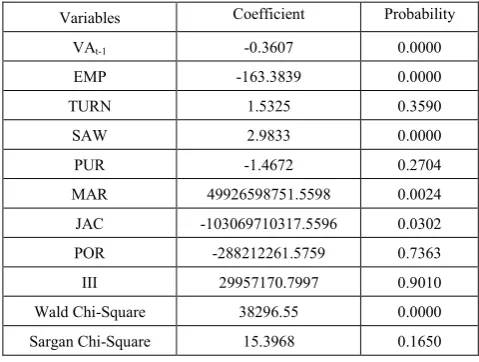
[image:8.595.57.297.516.697.2]In order to examine Turkish manufacturing industry as a whole, in addition to the time series analysis for sub-sector, panel data analysis was used. Estimation results Panel data analysis is located in Table 4. The prediction model before the model as a whole to test the meaningfulness, Wald test and to test variable set of tools, Sargan test is applied and the results are given in Table 4.
Table 4. First-Diff Generalized Method of Moments Estimation Results
Variables Coefficient Probability
VAt-1 -0.3607 0.0000
EMP -163.3839 0.0000
TURN 1.5325 0.3590
SAW 2.9833 0.0000
PUR -1.4672 0.2704
MAR 49926598751.5598 0.0024
JAC -103069710317.5596 0.0302
POR -288212261.5759 0.7363
III 29957170.7997 0.9010
Wald Chi-Square 38296.55 0.0000
Sargan Chi-Square 15.3968 0.1650
According to Table 4, EMP and SAW independent variables are statistically significant as 1% level in the manufacturing industry. TURN and PUR independent variables are not significant as statistically. If SAW variable changes, value added will be changed too. If EMP
independent variable changes, value added will changed as opposite direction. According to the table, MAR knowledge externalities are statistically 1% significant level. In other words, specializing in the Turkish manufacturing industry, depend on the knowledge externality occur.The knowledge externalities of Jacobs’s knowledge externality seem to be statistically 5% significant level. So, depending on the variety, it was determined that the information disable occurred. According to the results, Porter knowledge externalities and III variable found to be statistically insignificant. Unlike specialization and diversity, creating competition and innovation in the Turkish manufacturing industry, they identified the knowledge externality. If MAR knowledge externalities change, value added will be changed in the same direction. If Jacobs’s knowledge externalities change, value added will be changed as opposite direction. Test the significance of the presence of the arguments used by the Wald test at dynamic panel data analysis is intended to control of the estimators real-time significance. So, the variables in the model as a whole are tested for significance. Thus, the estimated coefficients and the validity of the model are confirmed. All variables in the null hypothesis H0 and 1% significance level are expressed
as zero. H0 hypothesis is rejected, according to the test
result. According to the test results of the independent variable coefficient is zero. Accordingly, the explanatory variable used in the model, it is seen that an effect on the dependent variable. The test results, according to Sargan, the null hypothesis are accepted. Accordingly, the explanatory variable used in the model, it appears to be effective on the dependent variable. According to Sargan test result, the null hypothesis is accepted. So, it was found to be statistically significant variable set of tools.
5. Conclusions
and similar materials with knitting, Coking Coal and Refined Petroleum Products Manufacturing, Manufacturing of chemicals and chemical products, Manufacture of fabricated metal products, Manufacture of machinery and equipment-not elsewhere classified, Manufacture of Other Transport Equipment and Furniture-Other Manufacturing and Machinery sector of the installation, were found to be statistically 5% and 10% importance. In those sectors that are statistically meaningful MAR knowledge externalities, knowledge externalities resultant from specialization occur. Porter knowledge externalities, Manufacturing of Apparel, Wood and Wood Products Cork Products Manufacturing (except furniture); Reeds, hay and Manufactured from similar materials, Manufactured from Fabricated Metal Products and Machinery and Furniture Manufacturing, Installation of machinery, statistical significance was found in 5% and 10% level of importance. In those sectors that are statistically meaningful Porter knowledge externalities, as knowledge externalities based on competition that are composed.
III variable, Manufacture of food products and beverages, manufacture of wearing apparel, wood, wood products and toadstool products manufacturing (excluding furniture); Reeds, hay and from similar materials Manufacture of Goods, Manufacture of paper and paper products, Coking Coal and Refined Petroleum Products Manufacturing, Manufacturing of chemicals and chemical products, Manufacture of Fabricated Metal Products and Furniture-Other Manufacturing and installation of the machinery sector, the level of significance were identified as 5% to 10% level.
In short period of time series analysis as a result of specialization, diversity, competition, and innovation in manufacturing industry sub-sectors it has been found that generates knowledge externalities.
MAR knowledge externalities for 9 sectors, Jacobs’s knowledge externalities for 7 sector and Porter knowledge externalities for 4 manufacturing industry sub-sectors- are found significant. The III variable is found statistically significant for 8 manufacturing sub-sectors.
According to the results of panel data analysis for Turkish manufacturing industry, knowledge externalities arising from specialization and diversity occur (arise). According to the panel data analysis, Turkey sub-sectors of the manufacturing industry, MAR knowledge externalities were statistically significant at the 1% level. Jacobs knowledge externalities knowledge has been found statistically significant 5% level. According to the results, Porter knowledge externalities and III variable found to be statistically insignificant. According to the panel data analysis, independent variables (SAW and EMP), show significance level of the independent variable, found statistically 1% significant level. It was concluded to be pointless that TURN and PUR independent variables are at insignificant level.
REFERENCES
[1] A. Kalça, Y. Atasoy. Ekonomik Büyüme Aracı Olarak Bilgi Yayılmaları ve İnovasyon, The Journal of Knowledge Economy & Knowledge Management, 3, 95-110, 2008. [2] N. Türkcan, N. Kumral. Yüksek Teknolojili Endüstrilerde
Bilgi Dışsallıkları: İzmir Örneği, http://www.iibf.ege.edu.tr/e conomics/tartisma, 5, 2013.
[3] E. Manisalıoğlu. Dışsal Ekonomiler ve İktisadi Gelişme, Sermet Matbaası, İstanbul, 1971.
[4] F. M. Baştürk. Mülkiyet Problemi, Dışsallıklar ve Coasean Çözüm, Yönetim ve Ekonomi, 21(1), 143-154, 2014. [5] J. E. Stiglitz. Economics of the Public Sector, Norton &
Company, New York, 2000.
[6] S. A. İşevi, B. Çelme. Bilgi Çağında Yeni Hazine: Entellektüel Sermaye ile Rekabeti Yakalamak, Bilgi Dünyası, 6(2), 251-267, 2005.
[7] L. G. Branstetter. Looking for International Knowledge Spillovers a Review of the Literature with Suggestions for New Approaches, The Economics and Econometrics of Innovation, 49/50, 517-540, 1998.
[8] A. Marshall. Principles of Economics, Macmillan, London, 1890.
[9] K. J. Arrow. The Economic Implications of Learning by Doing, Rev. Econ. Studies, 29, 155-173, 1962.
[10]P. M. Romer. Increasing Returns and Long-Run Growth, J.P.E. 94, 1002-1037, 1986.
[11]J. Jacobs. The Economy of Cities, Vintage, New York, 1969. [12]E. M. Porter. The Competitive Advantage of Nations, Free
Press, New York, 1990.
[13]E. L. Glaeser, H. D. Kallal, J. A. Scheinkman, A. Shleifer. Growth in Cities, Journal of Political Economy, 100(6), 1126-1152, 1992.
[14]G. A. Carlino. Knowledge Spillovers: Cities’ Role in the New Economy, Federal Reserve Bank of Philadelphia Business Review, Q4, 17-26, 2001.
[15]S. Breschi, F. Lissoni. (2001), Knowledge Spillovers and Local Innovation Systems: A Critical Survey, Industrial and Corporate Change, 10(4), 975-1005, 2001.
[16]F. F. McDonald. Fundamentals of Urban Economics, Pretince Hall, New York, 1997.
[17]G. A. Carlino. Knowledge Spillovers: Cities’ Role in the New Economy, Federal Reserve Bank of Philadelphia Business Review, Q4, 17-26, 2001.
[18]S. Yücer. Türkiye’nin İmalat Sanayinde Sektörel ve Bölgesel Kümelenmelerinin Dışsallık Etkileri, Yayınlanmamış Yüksek Lisans Tezi, Abant İzzet Baysal Üniversitesi Sosyal Bilimler Enstitüsü, 2008.
[19]U. Blien, J. Suedekum. Local Economic Structure and Industry Development, Germany, 1993-2001, IZA Discussion Paper, 1333, 1-15, 2004.
Advertising-Agency Industry, Journal of Economics & Management Strategy, 12(3), 327-362, 2003.
[21]E. L. Glaeser, H. D. Kallal, J. A. Scheinkman, A. Shleifer. Growth in Cities, Journal of Political Economy, 100(6), 1126-1152, 1992.
[22]N. Türkcan, N. Kumral. Yüksek Teknolojili Endüstrilerde Bilgi Dışsallıkları: İzmir Örneği, http://www.iibf.ege.edu.tr/e conomics/tartisma, 5, 2013.
[23]E. L. Glaeser, H. D. Kallal, J. A. Scheinkman, A. Shleifer. Growth in Cities, Journal of Political Economy, 100(6), 1126-1152, 1992.
[24]V. Henderson. Externalities and Industrial Development, Journal of Urban Economics, 42, 449-470, 1997.
[25]P. P. Combes. Economic Structure and Local Growth: France, 1984-1993, Journal of Urban Economics, 47, 329-355, 2000. [26]J. J. de Lucio, J. A. Herce, A. Goicolea. The Effects of Externalities on Productivity Growth in Spanish Industry, Regional Science and Urban Economics, 32(2), 241-258, 2002.
[27]X. P. Zheng. A Cointegration Analysis of Dynamic Externalities, Japan and World Economy, 22, 130-140, 2010. [28]F. Neffke, M. Henning, R. Boschma, K. J. Lundquist, L. O. Olander. The Dynamics of Agglomeration Externalities along the Life Cycle of Industries, Regional Studies, 45(1), 49-65, 2010.
[29]J. P. LeSage, M. M. Fischer. Estimates of the Impact of Static
and Dynamic Knowledge Spillovers on Regional Factor Productivity, International Regional Science Review, 35(1), 103-127, 2012.
[30]Ü. Kıymalıoğlu, D. Ayoğlu. Türk İmalat Sanayinde Yığılma Ekonomileri, Doğuş Üniversitesi Dergisi, 7(2), 198-209, 2006.
[31]N. Türkcan, N. Kumral. Yüksek Teknolojili Endüstrilerde Bilgi Dışsallıkları: İzmir Örneği, http://www.iibf.ege.edu.tr/e conomics/tartisma, 5, 2013.
[32]R. Paci, S. Usai. Externalities, Knowledge Spillovers and the Spatial Distribution of Innovation, GeoJournal, 49, 381-390, 1999.
[33]J. J. de Lucio, J. A. Herce, A. Goicolea. The Effects of Externalities on Productivity Growth in Spanish Industry, Regional Science and Urban Economics, 32(2), 241-258, 2002.
[34]C. King III, A. J. Silk, N. Ketelhöhn. Knowledge Spillovers and Growth in the Disagglomeration of the US Advertising-Agency Industry, Journal of Economics & Management Strategy, 12(3), 327-362, 2003.
[35]A. J. van Stel, H. R. Nieuwenhuijsen. Knowledge Spillovers and Economic Growth: An Analysis Using Data of Dutch Regions in the Period 1987-1995, Regional Studies, 38(4), 393-407, 2004.