© 2015, IRJET ISO 9001:2008 Certified Journal Page 1013
Soft-Switched Boost Converter for Active Power Factor Correction
Vishal N. Jogidas
1, Yogesh B. Satapara
2,Rahul B. Chandegara
31,2,3
Assistant Professor, Department of Electrical Engineering,
Dr. Subhash Technical Campus, Junagadh, Gujarat, India
---***---Abstract -
A fully soft-switched boost-converter using a one auxiliary switch is presented here. Resonating capacitor and inductor value has been chosen through an optimization process. In this optimization process care has been taken for minimum voltage stress on main and auxiliary switches. Circuit description and operation of different operating modes are presented. Average current mode control has been chosen for its ability to accurately program the input current and less sensitive to noise. A 500W-50kHz Soft-Switched boost converter is simulated and analyzed. Based on the design, the principle of operation has been verified with computer simulation. The simulation is done using MATLAB SIMULINK.Key Words: Zero-Voltage-Switching), Soft-Switching,
Boost converter, Average current mode control, Power
factor correction.
1. INTRODUCTION
The power factor is defined as the ratio of real power to apparent power. In linear power system power factor is simply equal to the cosine of the phase angle between the current and voltage. If current waveform is distorted the power factor is defined by equation (1). Which show that power factor depends on the fundamental rms component, distortion factor and input rms component.
Power factor =
=
cos
Φ……(1)Where,
Is1== fundamental RMS component of input current
Is = r.m.s. component of input current
CosΦ= Displacement factor
Total Harmonic Distortion is equal to the rms value of all the harmonics divided by the rms value of fundamental component of input current. Total Harmonic Distortion (THD) is a measure of the harmonic content in the input supply current and is also known as Harmonic Factor. Total Harmonic Distortion for input current is defined by:
THD = ……(2)
The simple solution to improve the power factor is to add a passive filter, which is usually composed of a capacitor and an inductor. However, this passive filter is bulky and inefficient since it operates at the line frequency. So, a power factor correction stage has to be inserted to the existing equipment to achieve a good power factor. The PFC technique reduces current harmonics in utility systems produced by nonlinear loads [1]. Regulatory standards with origins in Europe (EN 61000-3-2) and North America (IEC 1000-3) have been established that aim at protecting the utility grid from excessive harmonics. In order to meet the harmonics limits imposed by these standards, new ac-dc converter designs must employ active power factor correction (PFC) at the input. The boost converter is the most widely used topology for achieving PFC.
© 2015, IRJET ISO 9001:2008 Certified Journal Page 1014 In the conventional converters, hard switching of
the semiconductor device results in reverse recovery losses and electromagnetic interference problems. In recent years, many soft-switching techniques have come forth to reduce the adverse effects of conventional boost power factor correction converters. Soft-switching techniques, especially zero-voltage-transition have become more and more popular in the power supply industries. These converters have an auxiliary circuit connected in parallel to the main switch to help it turn on with zero-voltage-switching. ZVT converters operate at a fixed frequency while achieving zero voltage turn-on of the main switch and zero current turn-off of the boost diode. This is accomplished by employing resonant operation only during switch transitions. During the rest of the cycle, the ZVT network is removed from the circuit and converter operation is identical to conventional boost converter [3].
There are various controlling circuit of boost power factor correction, among which, average current mode control is suitable for high and medium voltage. In order to maintain good EMI performance and reduced switch current ratings, the PFC boost converter is usually operated in the continuous conduction mode (CCM). Currently, average current control is most widely used because of its Total Harmonic Distortion (THD) and EMI is small, it is not sensitive to noise, the switching frequency is fixed, and error between inductive current peak value and average value is small[4].
2. CIRCUIT OPERATION
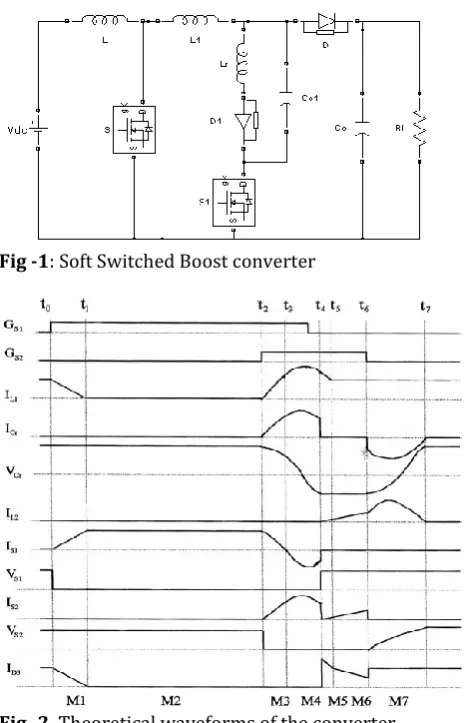
The power stage of the fully soft-switched PWM boost converter is shown in figure 1. This converter uses an auxiliary network in addition to the boost inductor Ls, boost switch S and boost diode D. The auxiliary network consists of one switch, S1, one diode, D1, two inductors, L1
and Lr and one resonant capacitor, Cr. The output voltage is regulated by varying the pulse-width of the main switch, S. The converter has seven operating modes. To analyze the steady-state operation, all components and devices are assumed to be ideal and the boost inductor (L) and output capacitor (Co) are assumed to be large enough to treat as a current source and a voltage source, respectively.
Mode 1 (t0-t1):
Prior to t=t0, main switch S and the auxiliary switch S1 are
off and diode D is on and conducting the full load current.
[image:2.595.309.542.98.460.2]Fig -1: Soft Switched Boost converter
Fig -2. Theoretical waveforms of the converter
The resonant capacitor Cr is initially charged. At t=t0, the boost switch S is turned-on so a constant voltage is applied across L1. As a result, inductor current, iL1 and diode current, iD1 decrease linearly whereas main-switch current, iS1, increases at the same rate.
Mode 2 (t1-t2):
During this mode the entire input current flows through S the boost diode D remains OFF and the converter operation is the same as the conventional boost converter.
Mode 3 (t2-t3):
© 2015, IRJET ISO 9001:2008 Certified Journal Page 1015
Mode 4 (t3-t4):
In this mode, resonant capacitor discharge current, iCr, continues to rise resonantly. The extra current, (iCr-IS), flows through the anti-parallel diode, maintaining almost zero voltage across S. If S is now turned off, it will be with zero-voltage and zero-current. However, the resonant capacitor still discharges towards zero and then recharges to opposite polarity. This mode ends when Cr is charged in the opposite direction to –Vo.
Mode 5 (t4-t5):
As the resonant capacitor, Cr, is charged to the voltage, -Vo, its further charging can not take place and the inductor current, iL1, is shifted from S1 to output through the diode, D, causing the switch current to drop to zero momentarily. At the same instant current, iS2, starts increasing linearly from zero through L2 and D1. Now the current, iL1, being larger than IS, starts lowering rapidly from I0 almost in a linear fashion, transferring the extra energy stored in it to the output. This mode ends when iL1 reduces to IS. The voltage across Cr remains clamped at -Vo during this mode.
Mode 6 (t5-t6):
In this mode iL2 still increases and iD decreases linearly.
This mode ends when gate pulse of S1 is removed at t=t6.
Mode 7 (t6-t7):
As soon as S1 is turned off, iS1 falls to zero and full supply current, IS, shifts to boost diode D. Now, S will turn-off with ZVS since capacitor, Cr (charged to -VO), is connected in series with S1. The inductor current, iL2, now flows through Cr thereby transferring the stored energy in L2 to Cr. Thus Cr first resonantly discharges to zero and then recharges to the original polarity to a voltage Vo+V’0.
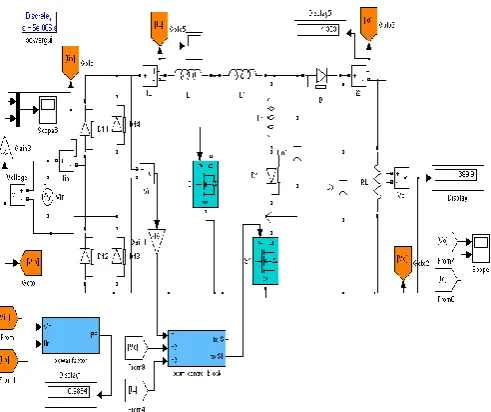
The controller uses average current control mode. The PFC control circuit includes following control loops: Voltage Control Loop and Current Control Loop. The voltage control loop compares output voltage with reference and provides error to loop regulates the output voltage regardless of any variations in load current and the supply voltage. The output of the voltage control loop is a control signal, which determines reference current for the current control loop. The function of the current compensator is to force the current to track the current reference that is given by the multiplier and which has the
same shape as the input voltage. The output of the current compensator decides the duty cycle required for switching the MOSFETs. The output from the current controller loop is compared with the saw tooth wave and generates appropriate PWM signals [5],[6].
3. DESIGN AND SPECIFICATIONS CRITERIA
Following specifications are selected:
Input voltage (Vin) = 176V- 270 Vrms.
Output voltage (Vo) = 400Vdc.
Output Power (Po) = 500W.
Switching Frequency (fs) = 50KHz.
Efficiency > 95%.
Power Factor > 0.990.
THD < 12%.
From the above specifications following parameters are selected:
Boost inductor (L) = 3 mH.
Resonant capacitor (Cr) = 20nF.
Resonant Inductor (Lr) = 15uH
Inductor (L1) = 8uH
Output capacitor (Co) = 470uF.
Load Resistance (RL) = 300 ohm.
4. SIMULATION OF THE PROPOSED BOOST
CONVERTER AND RESULTS
© 2015, IRJET ISO 9001:2008 Certified Journal Page 1016 Without power factor correction correction pf is poor near
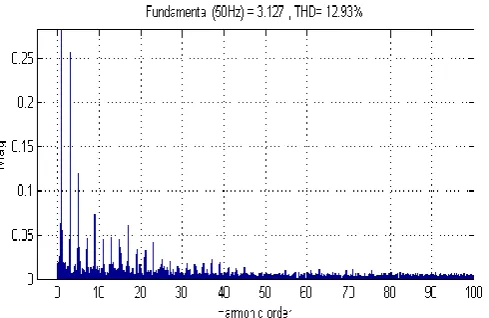
to 0.6. By inserting soft-switched boost converter at the front end of rectifier we get improved power factor (0.9912) near to unity. THD is limited to 12.1% as per IEC 1000-3 limits.
[image:4.595.308.552.105.328.2]Fig-3. Simulation diagram of Soft switched boost converter with average current mode control
[image:4.595.40.286.184.390.2]Fig - 4.Gate pulses for main switch S and auxiliary switch S1.
Fig- 5.Result for output voltage and output current.
Fig - 6. Result for input voltage and current.
[image:4.595.312.554.363.511.2] [image:4.595.37.280.478.623.2] [image:4.595.312.553.549.697.2]© 2015, IRJET ISO 9001:2008 Certified Journal Page 1017 Fig - 8.Total Harmonic Distortion of input current.
5. CONCLUSION
The Boost Power Factor Correction converter employing soft switching technique is presented in this paper. The simulation results show that the power factor at line side of the converter and the converter efficiency are improved using the soft switching technique. Since the active switch is turned-on and turned-off with soft switching, switching losses are reduced and the higher efficiency of the system is achieved.
REFERENCES
[1] Pooja Sharma, and Amita Mahor, A new PWM based
soft switching for dc/dc converters, VSRD-IJEECE, Vol. 2(3), 2012, 120-126.
[2] Amir Ostadi, Xing Gao, and Gerry Moschopoulos, Circuit properties of Zero-Voltage-Transition PWM converters, Journal of power electronics, Vol. 8, No. 1, January 2008.
[3] Jim Noon, UC3855A/B high performance power factor preregulator, Application report, SLUA146A-May 1996-Revised April 2004.
[4] Ren Kaichun, He Chunhan, Su Dan, Wang Yongli, Zhang Xingqi, Lio Xaiojun, Gung Lihong, Zhao Ying, and Liu Peng(2010), Matlab simulations for power factor correction of Switching power, Matlab-Modeling, programming and simulations, Emilson Pereira Leite (Ed.), ISBN: 978-953-307-125-1. [5] M. S. Jayakumar, Ajeesh G, A high efficient high input
power factor interleaved boost converter, IJECE, Vol. 2, No. 3, June 2012.
[6] T. Nageswara Rao, V. C. Veera Reddy, A novel efficient soft switched two ports dc-dc boost converter with open loop and closed loop control, IJCSE, Vol. 3, No. 3, June-July 2012.
[7] Hacy Bodur, A. Faruk Bakan, A new ZVT-PWM dc-dc converter, IEEE transactions on power electronics, Vol. 17, No. 1, January 2002.
[8] Guichao Hua, Ching-Shan Leu, Yimin Jiang, and Fred C.Y. Lee, Novel Zero-Voltage-Transition PWM converters, ieee transactions on power electronics, vol.9, no.2, march 1994.
[9] Ching-Jung Tseng, and Chern-Lin, Novel ZVT-PWM converters with active snubbers, IEEE transactions on power electronics, Vol. 13, No. 5, september 1998. [10] S. S. Saha, B. Majumdar, T. Haldar and S. K. Biswas,
Optimised design of a fully soft-switched boost converter suitable for power factor correction, International Journal of Electronics, Vol 93, No. 11, Nov 2006.
BIOGRAPHIES
Vishal Jogidas received the B.E. degree in Power electronics engineering from Saurashtra University, Gujarat, India, in 2009 and the M.E. degree from Gujarat Technological University, Gujarat, India, in 2013. Presently, he is an
Assistant Professor in the
Department of Electrical
Engineering, Dr. Subhash
Technical Campus, Junagadh, affiliated to Gujarat Technological University. His research interests include power-factor correction
circuits, soft-switching
topologies, switching power
supplies, high frequency power conversion.
Yogesh Satapara has received the B.E. degree in Electronics and Communication from Gujarat University Gujarat, India in 2011 and the M.E. degree from The Maharaja Sayajirao University of Baroda, Gujarat, Indiain 2013. Presently, he is an Assistant Professor in the Department of
Electrical Engineering, Dr.
Subhash Technical Campus,
© 2015, IRJET ISO 9001:2008 Certified Journal Page 1018 Rahul Chandegara has received
the B.E. degree in Electronics and
Communication from Sardar
Patel University Gujarat, India in 2010 and the M.E. degree from
The Maharaja Sayajirao
University of Baroda, Gujarat, Indiain 2013. Presently, he is an
Assistant Professor in the
Department of Electrical
Engineering, Dr. Subhash
Technical Campus, Junagadh, affiliated to Gujarat Technological University. His research interests
include Embedded System,
Advanced Microcontroller Design,
Microprocessor System &
Application.