© 2016, IRJET | Impact Factor value: 4.45 | ISO 9001:2008 Certified Journal
| Page 981
Effect of Process Parameter in Abrasive Water Jet Cutting Using
Response Surface Method
Ganesh Singh Yadav
1, Brijesh Kumar Singh
21
Mechanical Engineering Department, Bundelkhand Institute of Engineering and Technology Jhansi U.P. India
2
Mechanical Engineering Department, Madan Mohan Malaviya University of Technology Gorakhpur U.P. India
---***---Abstract -
This paper tells about the utilisation of
Box-Behnken outline way to deal with arranging the examinations for abrasive water jet cutting with a general goal of streamlining the procedure to yield better surface quality. Abrasive water jet machining is a non–traditional method of evacuation of material by effect disintegration of the pressurised high speed of water and entrained high speed of coarseness abrasives on a work piece. A trial was led to assess the impact of process parameters on surface Roughness (Ra) of aluminium. The philosophy relied on upon Response surface method (BOX BEHNKEN) and analysis of variance (ANOVA) to enhance the procedure strategy parameter for suitable machining and to predict the perfect choice for each, pressure, standoff distance and Traverse rate. The combination generated in the Box-Behnken method by the design of expert software (DOE) test directed and with the assistance of ANOVA, it is found that these parameters affect machining qualities surface harshness (SR). The investigation uncovers that when all is said in done, the standoff distance has very little fundamentally influence while pressure and traverse speed has much influence on surface Roughness (SR). In this paper author use design of experiment software (DX10) for Response surface method.
Key Words: Abrasive Water Jet Machine (AWJM),
optimization, Box-Behnken, ANOVA and Surface Roughness (SR).
1. INTRODUCTION
This While machining a component to achieve fine surface finish it is essential that provide the suitable combination of process parameter, at minimum cost. Surface completion produced on a workpiece in a machining operation has been considered as the whole of two autonomous impacts: ideal surface roughness and the natural roughness. The ideal surface roughness is the result of the geometry of the tool (in AWJM flexible tool abrasive) and the feed and natural roughness is caused by the irregularities in the machining operation. Ideal surface roughness is the best surface finish that can be achieved with a given apparatus shape and feed rate, and can be accomplished if the impact of natural surface finish is wiped out [1]. Numerous scientists have agreed that, it is a trademark that could impact the execution of the mechanical parts and the generation costs. Better surface completion is conceivable by controlling the process
parameters required in machining [2]. As it were, measuring and portraying the roughness of machined surface is considered for assessing the procedure performance [3, 4].
In this study the optimization approach given by the Box–Behnken plan (BBD) of a response surface methodology (RSM) [5]. For applying the methodology, Design-Expert programming (Version DX10.0, Stat-Ease Inc., Minneapolis, USA), was utilised. On the premise of the BBD, the process parameters ( pressure, standoff distance and traverse rate) in the cutting of aluminium could be advanced with a minimum number of test with a target of accomplishing better machined-surface quality bringing about overall cost advantage. Abrasive water jet machining makes utilisation of the standards of both abrasive jet machining and water jet machining. In abrasive water jet machining, a little stream of fine-grained abrasive particles are blended in reasonable extent, which in constrained on a workpiece surface through a nozzle with high velocity of water. The nozzle material also wears out because of disintegration brought about by the effect of abrasive particles passing through it and striking on the work surface. The attributes of the surface created by this strategy rely on upon numerous variables like jet pressure, jet velocity, Stand-off separation of the nozzle from the workpiece, Abrasive flow rate, Traverse rate, works materials. Non-contact of the instrument with the workpiece, no warmth influenced zone, low machining power on the work surface and capacity to machine the extensive variety of materials has expanded the utilisation of abrasive water jet machining over other machining processes. Numerous scientists have been completed on various parameters of AWJM Fecaier et al [6] and Ohlsson and Magnusson [7] examined the power parameters required during AWJ machining. Andreas and Kovacevic [8] examined the properties and structures of fast jets. Tikhomirov [9] took a shot at the conceivable feed rate depending on the standoff distance of the nozzle. Moser et al [10] examined the impact of abrasive grain size dissemination on abrasive waterjet machining process.
© 2016, IRJET | Impact Factor value: 4.45 | ISO 9001:2008 Certified Journal
| Page 982
some efforts have been made to increase the materialremoval rate (MRR) and surface roughness. The AWJM is a non-contact, inertialess and speedier cutting process that offers some point of preference like restricted kerf width, unimportant warmth influenced zone, diminished waste material and adaptability to machining process in an alternate way[13].There are various related parameters and elements of AWJM procedure that can impact the surface nature of the AWJ machined surfaced [14]. MRR increases by expanding abrasive mass flow rate.
Expanding velocity is additionally built MRR. Full factorial design help for examination as no different blend requirements for affirmation test [15]. In this paper author talks about the utilisation of Box-Behnken outline way to deal with arranging the examinations for abrasive water jet cutting with a general goal of streamlining the procedure to yield better surface quality.
2. METHODOLOGY
It can be seen from the literary works that advancements and current practices in the region of procedure change prescribe utilizing RSM for expressing the output parameters (responses), in terms of input variables.
2.1
Response Surface Methodology (RSM)
RSM is a gathering of measurable and numerical techniques that are valuable for the demonstrating and investigating engineering issues. In this method, the principle target is to advance the response surface that is affected by different process parameters. RSM likewise evaluates the relationship between the controllable input parameters and the output response surfaces. The outline technique of RSM is as per the following
Designing of a progression of examinations for satisfactory and solid estimation of the response of interest.
Developing a scientific model of the second request response surface with the best fittings. Finding the ideal arrangement of test
parameters that create a most extreme or least estimation of response.
In the last step represents the immediate and intuitive impacts of process parameters through two or three-dimensional plots.
2.2 Design of Experiments for RSM
RSM plans permit us to gauge connection and even quadratic impacts, and in this way give us a thought of the (nearby) state of the response surface under scrutiny. Box-Behnken
plans and focal composite outlines are proficient plans for fitting second order polynomials to response surfaces since they utilize the generally little number of perceptions to evaluate the parameters. Rotatability is a sensible premise for the determination of a reaction surface outline. The motivation behind RSM is the improvement and the area of ideal is obscure before running the investigation, it bodes well to utilize a configuration that gives the break even with the accuracy of estimation in all bearings. For such purposes, Central Composite Design (CCD) -spherical or face cantered and Box – Behnken outline are the regularly utilized exploratory configuration models for three level three variable investigations.
2.3 Box – Behnken design
Box and Behnken proposed three level outlines for fitting reaction surfaces. These outlines are framed by joining 2k factorials with inadequate block designs. It can be seen that the Box-Behnken configuration is a spherical design with all focuses lying on a sphere radius. Likewise the Box – Behnken design does not contain any point at the vertices of the cubic district made by the upper and lower limits for every variable.
3. EXPERIMENT DETAILS
3.1
Material
In this investigation, the work piece material aluminium was used with the following main properties: Tensile Strength 90 MPa, Modulus of elasticity 69 GPa, and Density 2.71 g/cm3. The abrasive used was garnet with mesh size of 80 and hardness of 7.5 Mohs.
3.2
Equipment
© 2016, IRJET | Impact Factor value: 4.45 | ISO 9001:2008 Certified Journal
| Page 983
3.3 Experimental Design
The experimental layout for the machining parameters using RSM was used in this study. This consists of three control parameters and three levels, as shown in table1. Thus in this study, Author observed the values of surface roughness to see the dependencies of process parameter.
3.4 Selection of Process Parameters
[image:3.595.71.557.73.432.2] [image:3.595.35.564.496.794.2]Process parameters for the study had three levels as given in Table 1. The levels were fixed based on the preliminary experiment-trials, discussion with expert operator of AWJ machine and also the available literatures.
Table -1:
Process parameter with level
Level
Process parameter Pressure
(MPa)
Standoff distance (mm)
Traverse rate (mm/min)
L1 150 1.5 90
L2 220 2.5 150
L3 290 3.5 210
4. RESULTS AND DISCUSSION
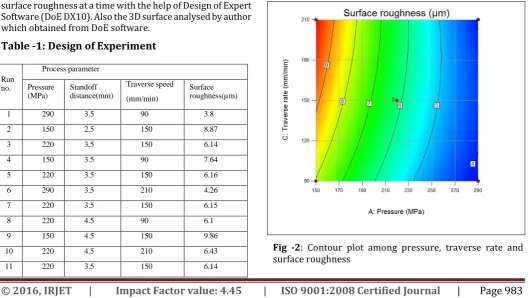
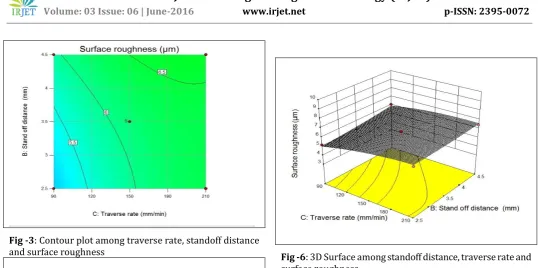
The results of surface roughness gained by an optical Profilometer MicroProf (FRT) mentioned in table no.2. The contour is plotted between two process parameter and surface roughness at a time with the help of Design of Expert Software (DoE DX10). Also the 3D surface analysed by author which obtained from DoE software.
Table -1:
Design of Experiment
Run no.
Process parameter
Pressure (MPa)
Standoff distance(mm)
Traverse speed
(mm/min)
Surface roughness(µm)
1 290 3.5 90 3.8
2 150 2.5 150 8.87
3 220 3.5 150 6.14
4 150 3.5 90 7.64
5 220 3.5 150 6.16
6 290 3.5 210 4.26
7 220 3.5 150 6.15
8 220 4.5 90 6.1
9 150 4.5 150 9.86
10 220 4.5 210 6.43
11 220 3.5 150 6.14
12 220 3.5 150 6.13
13 290 4.5 150 4.13
14 290 2.5 150 4.03
15 150 3.5 210 9.89
16 220 2.5 210 6.2
17 220 2.5 90 5.2
Fig -1: Contour plot among pressure, standoff distance and surface roughness
© 2016, IRJET | Impact Factor value: 4.45 | ISO 9001:2008 Certified Journal
| Page 984
Fig -3: Contour plot among traverse rate, standoff distance and surface roughness
Fig -4: 3D Surface among pressure, traverse rate and surface roughness
Fig -5: 3D Surface among pressure, standoff distance and surface roughness
Fig -6: 3D Surface among standoff distance, traverse rate and surface roughness
3. CONCLUSIONS
The author observed that the pressure and traverse rate has much effect on surface roughness than standoff distance. Even though the effect of standoff distance is less but can’t negotiate. When pressure increases surface quality improve as surface roughness decreases. As traverse rate increases surface quality decreases as surface roughness increases. Standoff distance of lesser than one millimetre produce poor surface finish in the starting cutting region near the top surface but as standoff distance increases greater than two to three millimetre surface roughness again increases. In this paper author has taken standoff distance one to three hence we only found that as standoff distance increases surface quality decreases.
ACKNOWLEDGEMENT
[image:4.595.27.566.60.328.2] [image:4.595.29.293.544.731.2]© 2016, IRJET | Impact Factor value: 4.45 | ISO 9001:2008 Certified Journal
| Page 985
REFERENCES
[1] Boothroyd, Geoffrey. Fundamentals of metal machining
and machine tools. Vol. 28. Crc Press, 1988.
[2] Ezugwu, E. O., and S. H. Tang. "Surface abuse when
machining cast iron (G-17) and nickel-base superalloy (Inconel 718) with ceramic tools." Journal of Materials Processing Technology 55.2 (1995): 63-69.
[3] Aouici, Hamdi, et al. "Analysis of surface roughness and
cutting force components in hard turning with CBN tool: Prediction model and cutting conditions optimization." Measurement 45.3 (2012): 344-353.
[4] Darwish, S. M. "Machining of difficult-to-cut materials
with bonded tools."International journal of adhesion and adhesives 20.4 (2000): 279-289.
[5] Taraman, K. "Multi machining output—multi
independent variable turning research by response surface methodology." International Journal of Production Research 12.2 (1974): 233-245.
[6] Fekaier, A., et al. "Optimization of the abrasive jet cutting
surface quality by the workpiece reaction forces analysis." Proceedings of 12th International Conference Jet Cutting Technology, Oct. 1994.
[7] Ohlsson, L., John Powell, and Claes Magnusson.
"Mechanisms of striation formation in abrasive water jet cutting." 12th International Conference on Jet Cutting Technology: papers presented at the 12th International Conference on Jet Cutting Technology... held in Rouen, France, 25-27 October 1994. London: Institution of Mechanical Engineers, 1994.
[8] Andreas, W. M., and R. Kovacevic. "Properties and
structure of High Speed water Jets." Principle of Abrasive Water Jet Machining (1998).
[9] Courbon, Cedric, et al. "Investigation of machining
performance in high-pressure jet assisted turning of Inconel 718: an experimental study."International Journal of Machine Tools and Manufacture 49.14 (2009): 1114-1125.
[10] Momer, A. W., R. Kovacevich, and R. Schuneman. "The
influence of abrasive grain size distribution on abrasive water jet machining process."Proceedings of the 25th North American Manufacturing Research Conference, Society of Manufacturing Engineers, Dearborn. 1996.
[11] Snoeys, R., F. Staelens, and W. Dekeyser. "Current trends
in non-conventional material removal processes." CIRP Annals-Manufacturing Technology 35.2 (1986): 467-480.
[12] Hashish, Mohamed. "Pressure effects in
abrasive-waterjet (AWJ) machining." Journal of Engineering Materials and Technology 111.3 (1989): 221-228.
[13] Hashish, Mohamed. "A model for abrasive-waterjet
(AWJ) machining."Journal of Engineering Materials and Technology 111.2 (1989): 154-162.
[14] Ramulu, M., and D. Arola. "The influence of abrasive
waterjet cutting conditions on the surface quality of graphite/epoxy laminates." International Journal of Machine Tools and Manufacture 34.3 (1994): 295-313.
[15] Limbachiya, V. J., and D. M. Patel. "An Investigation of