ISSN: 1992-8645 www.jatit.org E-ISSN: 1817-3195
625
ASSESSMENT OF INNOVATION VALUE CHAIN IN ONE
OF MALAYSIA PUBLIC RESEARCH INSTITUTES AND
GOVERNMENT AGENCIES
1ISHAK,I.S., 2ALIAS,R.A., 3ABU HASSAN,R., 4BASARUDDIN,S., 5SURADI,Z. 1,4
Department Of Information Technology, Universiti Selangor, Bestari Jaya Campus, 45600, Selangor, Malaysia
2
Universiti Teknologi Malaysia, UTM Skudai, 81310, Johor, Malaysia.
3
Department Of Computer Science, Universiti Selangor, Bestari Jaya Campus, 45600, Selangor, Malaysia
5
Suradi. Z. Is A Part-Time Lecturer With Unikl IPROM, Kuala Lumpur, Malaysia E-mail: [email protected], [email protected], 3 rohaya@ unisel.edu.my,
4
suzana_b@ unisel.edu.my, 5zurinah@ gmail..com.my
ABSTRACT
Innovation has long been recognized as an important driver and cultivator for organization growth and production of quality new product and services. There are several innovation measurement models or frameworks that can be used to assess innovation. Innovation value chain is one of the assessment tools that can be used to assess innovation process in a given organization. The innovation value chain assessment finding can be used to help organization identify the weaknesses of the innovation process in the organization. This paper presents the status of innovation value chain in one of Malaysia Public Research Institutes and Government Agencies and proposes guidance on how to improve on the identified weaknesses. A survey questionnaire was sent to 140 staffs in an organization representing one of Malaysia Public Research Institutes and Government Agencies. The finding of the study shows that there existed an innovation culture in the selected organization which promotes innovation within the organization. However, they need to improve on some of areas related the processes along the idea generation, conversion and diffusion phase. The result of this research shows that there existed weaknesses and recommends a guidance that could be beneficial for organization that have same problem scenario.
Keywords - Innovation, Innovation Value Chain, Innovation Management Improvement, Research Institutes, GovernmentAgencies
1. INTRODUCTION
Innovation is refers to as a way to improve on product or service, process, thinking and helpful for solving a problem [1],[2],[3],[4],[5]. Usually, the innovation ideas can be commercialized and bring profit to organization. Some examples of innovation benefit to organization are improving organization effectiveness, increasing organization revenue and providing competitive advantage. In public service environment, innovation is mention as one the key enabler that allows the public service to respond timely and effectively to a dynamic global environment [6]. Over the past decade, there has been a continuous discussion at various levels of authority and academician on the critical need for more “innovation” at every level of corporate and government management. Malaysian government as in the National Transformation Agenda and
Tenth Malaysia Plan emphasizes that the involvement of research institutes, government agencies and all communities are to pursue innovation in their organization. Even though Malaysia government provides budget to cultivate and nurture innovation culture in the respective organizations, there still existed weaknesses in certain areas which requires improvement for better results. As ICT Strategic Planning produces ICT Strategies and ICT application that enable innovation in organization.
ISSN: 1992-8645 www.jatit.org E-ISSN: 1817-3195
626 reveals that IPA which used information technology to encourage innovation does have a good innovation value chain practice established in the organization.
2. INNOVATION PERSPECTIVES
Innovation can be seen from different perspectives. Among the innovation perspective that is always been highlighted by researchers is as an innovation field perspective [7], [1], [8], [2], [3]; innovation approach [9],[2],[10]; the perspective on how ICT can promote innovation [7],[11],[12],[13]; innovation process model and innovation measurement frameworks [1],[14],[15],[16],[17].
2.1 Innovation Area
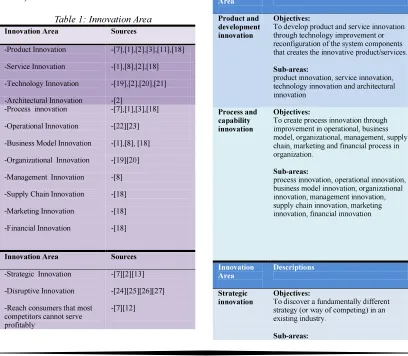
[image:2.595.92.500.405.761.2]From the literature review, the followings are focus research areas in innovation field which are product innovation, service innovation, technology innovation, architectural innovation, process innovation, operational innovation, business model innovation, supply chain innovation, marketing innovation, strategic innovation, creativity innovation, and organizational innovation (Refer Table 1).
Table 1: Innovation Area
Innovation Area Sources
-Product Innovation -[7],[1],[2],[3],[11],[18]
-Service Innovation -[1],[8],[2],[18]
-Technology Innovation -[19],[2],[20],[21]
-Architectural Innovation -[2]
-Process innovation -[7],[1],[3],[18]
-Operational Innovation -[22][23]
-Business Model Innovation -[1],[8], [18]
-Organizational Innovation -[19][20]
-Management Innovation -[8]
-Supply Chain Innovation -[18]
-Marketing Innovation -[18]
-Financial Innovation -[18]
Innovation Area Sources
-Strategic Innovation -[7][2][13]
-Disruptive Innovation -[24][25][26][27]
-Reach consumers that most competitors cannot serve profitably
-[7][12]
-Offer radically new value propositions to consumers that other firms cannot deliver in a cost-efficient way
-[7][12]
-Put in place value chains that no other firm could do efficiently
-[7][12]
-Allows strategic innovators to scale up their business models quickly and so protect themselves from competitive attacks
-[7][12]
-Creativity Innovation -[3],[12]
-Entrepreneurial Creativity
-[28]
This research categorizes the sub areas into four main innovation area based on their objectives; product and development innovation, process and capability innovation, strategic innovation and creativity innovation (refer Table 2).
Table 2: Four Main Innovation Area Category Innovation
Area
Descriptions
Product and development innovation
Objectives:
To develop product and service innovation through technology improvement or reconfiguration of the system components that creates the innovative product/services.
Sub-areas:
product innovation, service innovation, technology innovation and architectural innovation
Process and capability innovation
Objectives:
To create process innovation through improvement in operational, business model, organizational, management, supply chain, marketing and financial process in organization.
Sub-areas:
process innovation, operational innovation, business model innovation, organizational innovation, management innovation, supply chain innovation, marketing innovation, financial innovation
Innovation Area
Descriptions
Strategic innovation
Objectives:
To discover a fundamentally different strategy (or way of competing) in an existing industry.
ISSN: 1992-8645 www.jatit.org E-ISSN: 1817-3195
627 disruptive innovation, reach consumers that most competitors cannot serve profitably, offer radical new value propositions to consumers that other firms cannot deliver in a cost-efficient way, put in place value chains that no other firm could do efficiently and allows strategic innovators to scale up their business models quickly and to protect themselves from competitive attacks into strategic innovation area category.
Creativity innovation
Objectives:
To encourage organizational teams to produce more practical and implementable creative and innovative ideas in organization.
Sub-areas:
creativity innovation and Entrepreneurial Creativity
2.2 Innovation Process Model and Measurement Frameworks
[image:3.595.297.507.78.472.2]There are several measurement frameworks or models available to measure innovativeness (refer Table 3). They are Diamond Model, Innovation Funnel, Innovation Value Chain and OSLO Manual Innovation Measurement Framework. Most of these frameworks or models consider the majority of innovativeness dimensions, however they provide different perspective of focus and how to view innovation process. Most of the frameworks or model considers linkages as an important element in innovation process.
Table 3 Innovation Process Model and Measurement Frameworks (Adapted from [1])
Innovation Process Model And
Measurement Frameworks
Descriptions
Innovation Audit Frameworks (Diamond Model)[16]
Innovative Dimension:
Strategy, Process, Organization, Linkages, Learning
Focus:
• Innovation Process • Enabling factor • Linkages
Innovation Process Model And
Measurement Frameworks
Descriptions
Innovation Funnel [1]
Innovative Dimension:
Strategic Thinking, Portfolio Management and Metric, Research, Ideation, Insight, Targeting, Innovation Development, Market Development, Sales Innovation
Funnel [1]
Focus:
• Technology and Product
Innovation
• Research and development
process is the core activity
Innovation Value Chain [14][15]
Innovative Dimension:
Idea generation, conversion and diffusion,
Accessing knowledge, building innovation, commercializing innovation.
Focus:
• Idea Management • Output Performance • Linkages
OSLO Manual Innovation Measurement Framework [17]
Innovative Dimension:
Innovation, linkage, demand, the institutional framework, innovation policies
Focus:
• Innovation • Linkage
• Output in certain duration
According to Gamal et.al [1], Diamond Model is adequate to measure innovation when the innovation process is at its infancy level. It highlights key dimensions of innovativeness process as well as its enabling institutional factor. Innovation Funnel in contrast is adequate when there is an extensive innovation process in the organization. While Innovation Value Chain emphasizes on the assessment of the output of the innovation process, where as in opposite Oslo Manual Innovation Measurement Framework is very beneficial when considering country level international comparisons. As innovation value chain emphasizes on the assessment of the output of the innovation process, the innovation value chain process was chosen as the innovation measurement framework for this research. Hence, the innovation value chain process and activities will be assessed and evaluated.
[image:3.595.91.289.501.728.2]ISSN: 1992-8645 www.jatit.org E-ISSN: 1817-3195
628 and cross-units collaboration, the selection of ideas, development of ideas and the dissemination of ideas. On the other hand, Roper et. al [15] suggested that the innovation value chain consists of three main phases. It starts with the organization's efforts to obtain the necessary knowledge for innovation. Then the next chain is to transform the knowledge into the physical innovation. Finally, the innovation value chain will be linked to the exploitation of the firm's innovation. Consultants 'Management Centre' had adapted an innovation value chain from Harvard study [29]. They divide the innovation value chain into seven phases: idea generation, idea development, integration across the region, information acquisition from external sources, identification and selection of ideas, development of ideas, diffusion and learning about things that need to be improved.
[image:4.595.82.293.418.582.2]Based on the comparison of the three innovation value chain frameworks, three main phases of innovation value chain were identified (refer Table 4).
Table 4 Innovation Value Chain Phase (Adapted from [7])
Innovation Value Chain Phase
Innovation Value Chain Phase Activities
First phase Information acquisition activities that will generate ideas from internal resources, external and cross-section
Second phase
Knowledge transformation into development of strategic innovation product, service or business process
Third phase Implementation and exploitation of innovation product, services or business process
2.3Malaysia Public Research Institutes
According to MASTIC, there are 33 Government Agencies and Public Research Institutes and Public Research institutes (IPA). IPA plays a critical role in forging the interface between science advancement and the industry sector. One of the roles of IPA is to carry out R&D, provides technical and consultancy services, offers diagnostic services, business joint-venture and licensing.
Previous research conducted showed the IPA that had been using ICT strategies to produce ICT
Strategic Plan seems to encourage innovation in their organization [7]. Table 5 shows the analysis of ICT strategic application that used to support the innovation in the organization. The table also shows that there are ten ICT applications in Organization X which are used to support four area of innovation: creativity area, product development area, process and capability area and strategic area. In strategic area, the ICT applications had helped the organization to provide value propositions to consumers that other organizations cannot deliver the services requested by consumers in a cost efficient-way, put in place value chains that no other firm could do efficiently and allows strategic innovators to scale up their business models quickly and so protect themselves from competitive attacks.
[image:4.595.302.510.469.556.2]Keywords: C=Creativity Area, PD=Product Development Area, PC=Process and Capability Area, S=Strategic Area, SR=reach consumers that most competitors cannot serve profitably, SV=offer radically new value propositions to consumers that other firms cannot deliver in a cost-efficient way, SVC=put in place value chains that no other firm could do efficiently, SI=allows strategic innovators to scale up their business models quickly and so protect themselves from competitive attacks.
Table 5 Analysis of ICT Innovation Application in Organization X
Number of ICT Innovation Application in Organization X
Innovation Area
C P
D P C
S
S R
S V
S V C
S I
9 / / / / / /
3. METHODOLOGY
The first phase of this study is to design the questionnaire. The study adapted Hansen and Birkinshaw [14] questionnaire's to evaluate the Innovation Value Chain (IVC) in organization. The questionnaire objective was to gather data about the strength and weaknesses of IVC in an organization.
ISSN: 1992-8645 www.jatit.org E-ISSN: 1817-3195
629 of the IPA as having the highest ranking amongst IPA that has ICT strategic application which supports innovation. A random sampling technique was used to select the sample in this study. Organization X has 241 staffs at the main headquarter. The minimum sample size identified was 128 staffs. The minimum sample size has been derived from five percent margin of error and at confidence level of 90 percent [30]. The researcher had put an effort to include all Headquarter staff to participate in this survey. The cooperation from all staff was gain through the involvement of Director of IT Division and other directors from other division. The execution of the survey was conducted by officer of organization x that distributed and collected the questionnaires.
The third phase was the data analysis part. The objective of this phase is to analyze the data gathered using statistical technique. The outcome of the analysis is the descriptive statistical analysis. The final phase is about the result documentation of IVC and evaluation of IVC status. The result shall be forwarded to administrator officer for them to improve their innovation approach.
4. RESULT AND DISCUSSION
A total of 79 percent of 140 respondents from Organization X had participated in the Evaluation of Innovation Value Chain (IVC) survey. The respondents were from eight different divisions at the headquarters. Previous studied suggested that 15 percent of respondent is acceptable for organization based research [31][32]. There are a few factors that contributed towards the low responds. One of the factors is because the questionnaire was distributed at the work place. Here, where people tend to be more focus on work and would ignore to respond, prefer to keep things as private and confidentiality, and choose to avoid with tip toeing with rules and regulations of the organizations [33].
Overall result showed that Organization X have a good strength in all of the three IVC that consists of generation of idea from internal, external and cross department; transformation of knowledge to strategic idea; and implementation and exploitation of innovation idea.
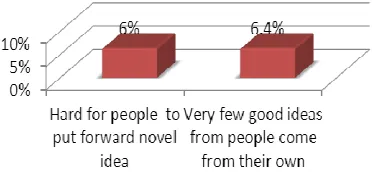
Based on the evaluation of information acquirement for idea generation as in Figure 1, staffs at organization X work in a culture that stimulate staff to propose new idea. Only 6 percent
[image:5.595.315.501.236.322.2]respondents agree that the culture in the organization did not support them in proposing a new idea. The result also shows that not many staffs in the organization generate their own idea. This was based from only 6.4 percent respondents agreed that very few ideas came from their own staffs. This shows Organization X should encourage their staff to participate more in courses that would improve their creativity and innovative skills.
Figure 1: Organization X In-House Idea Generation
In the aspect of acquiring idea from other unit or branches, Organization X innovation project has been involving group teamwork from different unit and branches (refer to Figure 2). Only 36.4 percent of the respondents agreed that innovation project has not been involving different units and branches. Anyhow project collaboration of organization X are across other units and departments. This is based on respondent feedback that only 18.2% respondents stated that collaboration is not cross over other units and departments. Hence, in Organization X, the result indicates that there exists collaboration on projects between and across units and branches.
Figure 2: Cross-Pollination Of Idea Among Unit And Branches
[image:5.595.307.508.514.619.2]ISSN: 1992-8645 www.jatit.org E-ISSN: 1817-3195
[image:6.595.306.507.79.283.2]
630 the idea generation activities by stimulating generation of idea from staffs, increase number of innovation projects involving various departments and encourage ideas collaboration from external organization.
Figure 3: Idea Generation From External Sourcing
[image:6.595.90.285.201.417.2]From the perspectives of selecting innovative idea, it was found that Organization X had allocation in investment for new idea generation. However the organization has being shown to apply a strict terms and condition to get the allocation for a new project. About 54.5 percent of respondent agreed that Organization X has strict rules for investment in new project. However, about 56.4 percent respondents agreed that the organization has been invested in a risky new project. The tough rules on investing in a new project can demotivate the staffs that would like to implement innovation in the organization.
Figure 4: Organization X Selection Of Innovative Idea
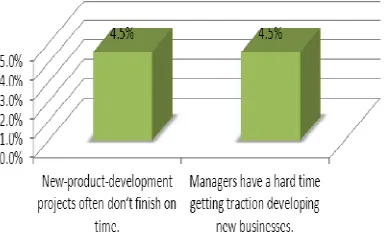
Evaluation towards knowledge transformation activities to strategic idea shows that the developments of product usually complete within the time frame (Refer Figure 5). This was based on that only 4.5 percent respondent agreed that new product project was not completed in the planned time frame. This reflects that the manager in the organization also has the ability to improve and propose new processes, product and services. In general the organization has to improve on allocation and approval of innovation project in organization.
Figure 5: Development Of Innovation Idea In Organization X
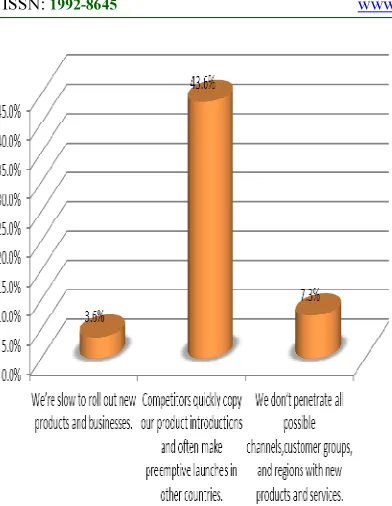
[image:6.595.310.502.459.582.2]ISSN: 1992-8645 www.jatit.org E-ISSN: 1817-3195
[image:7.595.87.283.113.366.2]
631
Figure 6: Implementation And Exploitation Of Innovation Idea Of Organization X
5. CONCLUSION
Based on the results, Organization X are found to have strength in all three Innovation Value Chain phases that are in idea generation phase; transformation of knowledge to development of strategic idea phase and implementation and exploitation of innovation phase. However, there are some areas that can be improved. The areas that need to be improved is on the number of idea generation from staffs, involvement of different department in innovation project, capturing idea from external organization, strict rules on innovation projects approval and also the challenges faces because the organization offer innovation that is also offered by other services provider. In order to improve the situation, Hansen and Birkinshaw [14] suggest several suggestions and advices.
For example, for idea generation phase, Organization X should encourage their staff to generate creative and innovative ideas. Organization X can send their staff to appropriate training to enhance their staff creativity and innovative skills. The key performance indicators to see whether the staff is able to generate their own idea should be based on the number of quality idea of every unit or each section can generate. Organization X also can take a look at the advices
given by Teresa [28] in her book “How to Kill Creativity”. She advises organization not to undermined creativity unintentionally because of every day work environments that were established to maximize business imperatives. Business imperatives such as coordination, productivity, and control can unintentionally kill creativity. Besides that, Kao[35] in his book “Jamming: The Art and Discipline of Business Creativity” offers an approach how managers can stimulate creativity in their employees, explores the impact of information technology on creativity and looks at the globalization of creativity. Kao says that his business version of jamming, is the creative advantage that can give a company a competitive edge. Kao tells how to audit and manage creativity and describes techniques for clearing the mind to render it receptive to the improvisational flow.
In order to improve involvement of different department in innovation project, organization can create a community of practice where staff can participate in idea generation as what has been by P&G practices. The community of practice at Organization X could have similar activities like as in P&G i.e. solve specific problem and attending monthly technology summit with representative of P&G business unit or add her own activities which are appropriate for idea generation. Philips and Bob[36] in their book, Collaboration Rules” said that collaboration rules are the common set of work, communication, and leadership practices that relies on two infrastructure components: a shared pool of knowledge and universally available tools for moving knowledge around. On the other hand, Eisenhardt and Charles[37] in their book “"Coevolving: At Last, a Way To Make Synergy Work," suggest coevolving method. They set the context and then let collaboration (and competition) emerge from business units. Incentives are different, too. Coevolving companies reward business units for individual performance, not for collaboration. Thus, collaboration occurs only when two business-unit managers both believe that a link makes sense for their respective businesses, not because collaboration per se is useful. Finally, managers in coevolving companies recognize the importance of business systems: frequent data-focused meetings among business-unit leaders, external metrics to gauge individual business performance, and incentives that favor self-interest
ISSN: 1992-8645 www.jatit.org E-ISSN: 1817-3195
632 the problem and find the solution through technology research, acquire information from supplier and research lab. Hippel[38] in
democratizing innovation explain how the
emerging process of user-centric, democratized innovation works. He also explain how innovation by users provides a very necessary complement to and feedstock for manufacturer innovation. Kim dan Mauborgne[39] in their book “Blue Ocean Strategy” propose to create uncontested market space that made the competition irrelevant. It will pull in a whole new group of customers who were traditionally noncustomers of the industry that are prepared to pay several times more than the price of a conventional circus ticket for an unprecedented entertainment experience. On the other point of view, Chesbrough[10] in his book Open Innovation: The New Imperative For Creating and Profiting from Technology recommend to pursue
Open Innovation. Open innovation is model of innovation which advise firms to draw on research and development that lie outside their own oundaries. For example is open source software, this research and development can take place in a non-proprietary manner.
Further, more efforts that can be taken to improve the condition where tough or strict rules are placed for investment in a new project and a risky investment. One of the organizations that have successfully implemented innovation by allocating certain amount of budget for innovation was Shell Oil’s GameChanger. Shell Oil’s GameChanger unit has been awarded seed-funding of RM40 billion for development of radical idea.
Organization X can also form a separate business unit that is responsible to develop new idea to support organization strategy. The business unit should be given some freedom to have activities that will encourage idea generation and innovation. In addition, managers that had successfully leaded a collaboration project should be awarded a bonus or other form of rewards. This will in turn encourage more collaboration internally or externally. Hence, perhaps with these there will be more opportunity being open and more profit could be generated each year.
Organization X may also conduct self-audit by focusing on two main questions which are:
1) Does this organization have a good approach in selecting and awarding allocation to new ideas? and
2) Does this organization have a good approach in transforming new idea to product, opportunity and good services?
The organization should also revisit their Key Performance Indicator (KPI) for transformation activity idea to implementation of innovation project that are:
1) How many percent of innovation idea that has
been generated by staffs and external parties will be selected and will be given allocation?
2) How many percent of idea that give allocation
generate profit to organization and number of months before product or services innovation being implemented?
Alternatively, to support the organization to decide on selection of innovation ideas, Organization X is also highly recommended to refer to both of this books: “Bringing Silicon Valley Inside” by Gary Hamel [40] and “Corporate Venturing Creating New Business Within the Firm” by Zenas Block and Ian C. MacMilan [41]. The important advice from Hamel book is on the strategy to strengthen the external discovery network. The strategies must be done by gearing not toward finding a solution but to discovering new ideas within a broad technology or product domain. Besides that, organization also needs to develop different “tentacles” in relevant geographies. The tentacles terminology means to establish a center like Technology-to-Business Center (TTB) that have about 20 team members and the main objective of the TTB is to focus on commercializing technologies from outside the organization. This center should be located in Technology Valley and the team members in this center need to develop numerous personal relationships with scientists, PhD students, venture capitalist, entrepreneurs, governmental labs, universities’ excellence and company research centers. This relationship is important for identifying new technologies that can be used by organization and its branch.
ISSN: 1992-8645 www.jatit.org E-ISSN: 1817-3195
633 venture unless venturing is integral part of your organization’s strategy and is seen as essential to survival and the achievement of organization objective.
In order to overcome the challenges by fulfilling services that also offered by other services provider, Organization X can revise their KPI in term of percentage of penetration in desired market, channels, customer groups, number of month to full diffusion.
REFERENCES:
[1] Gamal, Dalia, Eng Tarek Salah, And Eng Nesreen Elrayyes. "How To Measure Organization Innovativeness?. " Technology Innovation And Entrepreneurship Center.2011. [2] Burgelman, R.A., Christensen, C.M., &
Wheelwright, S.C.. “Strategic Management Of Technology And Innovation”. Boston: Mcgraw-Hill .2009.
[3] Aphelion Consulting,”Innovation Workshop”.
Embarq, [ WWW document ], g http://www.slideshare.net/aphelion/embarq innovation-workshop-presentation-presentation#btnNext
(accessed 1st January 2011).
[4] McKeown, Max . “The Truth About Innovation ”. London, UK: Prentice Hall 2008. [5] Hill, C.W. and Jones, G. “Strategic
Management Theory. An Integrated
Approach”. 4th Ed. Boston, N. Y.: Houghton Mifflin Company.1998.
[6] Malaysian Administration Modernization and Management Planning Unit (MAMPU), “Information Systems Planning (2011-2015)”, 2011, http://www.mampu.gov.my/
pdf/flipbook/ISPplan2011/ (accessed 1st June 2012).
[7] Ishak, I.S, Alinda, R.A, Ishak,I. S.and Suradi, Z.,(2013) “ICT Innovation Strategy at Malaysia Public Research Institutes. International Journal of Computer
Communications and Network. Vol 3.No3.Pp 1-12.
[8] Macaulay, L., Service Innovation as a new paradigm for Information Systems. ICRIIS Workshop, UIA, Malaysia, Nov. 22, 2011 [9] Gassmann, Oliver, Ellen Enkel, and Henry
Chesbrough. "The future of open
innovation." R&D Management. 40.3.2010: 213-221.
[10]Chesbrough, Henry William. “Open
Innovation: The New Imperative For Creating And Profiting From Technology” .Harvard
Business Press, 2003.
[11]J. S. Chen and H. T. Tsou, “Information technology adoption for service innovation practices and competitive advantage: The case of financial firms”, Information Research,
vol.12, no.3, paper 314, 2007.
[12]Anderson,J. and Markides,C., “Creativity Is Not Enough: ICT-Enabled Sttrategic Innovation”. European Journal of Innovation Management, 9 (2): 129-148, 2006
[13]Markides, C. (2006). Disruptive Innovation: In Need of Better Theory*. Journal of product innovation management, 23(1), 19-25.
[14]Hansen, Morten T., And Julian Birkinshaw. “The Innovation Value Chain”. Harvard Business Review 85.6 2007: 121.
[15]Roper, Stephen, Jun Du, And James H. Love. "The Innovation Value Chain." Aston Business School Research Papers .2006.
[16]Tidd,J.,Bessant,J.And Pavvit,K. “Managing Innovation: Integrating Technological, Market And Organizational Change .England: Wiley. [17]Oslo Manual, Third Edition, “Guidelines For
Collecting And Interpreting Innovation Data” (2005)
[18]Downey,J. And Technical Information Service,”Innovation Management”,The Charted Institute Of Management Account (CIMA).2007.
[19]Zheng, Connie, and Bai Xuan Wang. " What Drives Technology Innovation Among The Emerging Chinese Enterprises?." . Pacific Association Of Information System S (PACIS).2011..
[20] Lam,A.”Organizational Innovation.” In Fagerberg J.,Movery, D. Nelson,R. 9eds) The
Oxford Handbook Of Innovation,
Oxford:Oxford University Press.2004.
[21]Kimberly, J.R. And Evanisko, M. J.” Organizational Innovation: The Influence Of Individual, Organizational And Contextual
Factors On Hospital Adoption Of
Technological And Administrative
Innovation.”Academy Of Management Journal, Vol.24, No. 4,Pp 689-713.1981
[22]Hammer, M. (2005). Six steps to operational innovation. Harvard Business School Working
Knowledge for Business, hbswk. hbs.
edu, 8(30).
[23]Hammer, M. (2005). Making Operational Innovation Work. Harvard Management Update, Vol. 10, No. 4.
ISSN: 1992-8645 www.jatit.org E-ISSN: 1817-3195
634 Development Organizations," MIS Quarterly (27:4) 2003b, pp 557-595.
[25]Hamel, G. (2000) Leading the Revolution. Boston: Harvard Business School Press [26]Hamel, G. (1998). Opinion: Strategy
innovation and the quest for value. MIT Sloan Management Review, 39.
[27]Hamel, G. (1996). Strategy as revolution (pp. 69-71). Harvard Business Review.
[28]Amabile, Teresa M. “Creativity and innovation in organizations”. Harvard Business School, 1996
[29]Management Centre Consultant, “Innovation Value Chain Framework”,
http://www.managementcentre.co.uk/pages/inn ovationvalue_chain_framework.html (accessed 1st January 2011).
[30]Raosoft,”Sample Size Calculator”.
2004.http://www.raosoft.com/samplesize.html [31]Baldauf, A., Reisinger, H., and Moncrief,W. C.
,“Examining motivations to refuse industrial mail surveys”. Journal of the Market Research Society, 41, 345-353, 1999.
[32]Baldauf, A., Reisinger, H., and Moncrief,W. C. ,“Examining motivations to refuse industrial mail surveys”. Journal of the Market Research Society, 41, 345-353, 1999.
[33]Tomaskovic- Devey, D., Leiter, J., & Thompson, S. “Organizational survey nonresponse”. Administrative Science Quarterly, 39, 439-457, 1994.
[34]Greer, T. V., Chuchinprakarn, R., and Seshadri, S.,”Likelihood of articipating in mail survey research: Business respondents’ perspectives”. Industrial Marketing Management, 29, 97-109, 2000.
[35]Jamming: The Art and Discipline of Business Creativity, oleh John Kao (HarperBusiness, 1996)
[36]"Collaboration Rules," oleh Philip Evans dan Bob Wolf (HBR Julai-Ogos 2005)
[37]"Coevolving: At Last, a Way To Make Synergy Work," oleh Kathleen M.Eisenhardt dan D. Charles Galunic (HBR Januari-Februari 2000) [38]Democratizing Innovation, oleh Eric von
Hippel (MIT Pres, 2005)
[39]Blue Ocean Strategy, oleh W. Chan Kim dan Mauborgne Dudi (Harvard Business School Press, 2004)
[40]Bringing Silicon Valley Inside," oleh Gary Hamel (HBR September-Okt 1999)
[41]Zenas,B. and Ian C. M. “Corporate Venturing Creating New Business Within the
![Table 3 Innovation Process Model and Measurement Frameworks (Adapted from [1])](https://thumb-us.123doks.com/thumbv2/123dok_us/8912737.960171/3.595.297.507.78.472/table-innovation-process-model-measurement-frameworks-adapted.webp)
![Table 4 Innovation Value Chain Phase (Adapted from [7])](https://thumb-us.123doks.com/thumbv2/123dok_us/8912737.960171/4.595.82.293.418.582/table-innovation-value-chain-phase-adapted.webp)