Introduction (Thesis)
Until I was around ten, my parents read me a picture book every night. Even when I learned how to read them myself, I still begged for “just one story” before bed. It was a treat to be able to listen to their voices and completely focus on the illustrations, losing myself in the worlds of the characters.
Three years ago, my mom asked us to go through the overflowing shelves of children’s books and pick out which ones we couldn’t bear to part with so she could distribute the rest to classrooms at her school. I sat on the floor with my three younger sisters and sifted through the pages that had become my childhood. My “keep” stack grew and grew; my “give away” stack consisted of only the ones that were physically falling apart. I couldn’t let go of the worlds and the characters that had helped make me who I am.
Patricia Polacco taught me never to make snap judgments--always get to know the ins and outs of a person and never assume. Maurice Sendak taught me that it was okay to think about things in a strange way. Don’t run from your creative, odd thoughts--nurture and appreciate them. Shel Silverstein taught me to not take advantage of kindness.
I did eventually realize my absurdity in needing to cling to my childhood, and relinquished the majority of my “keep” pile with the comforting fact that I was helping someone else discover brand new worlds.
For my final thesis, I wanted to create my own brand new world. I wrote,
illustrated, and hand-bound a 32- page children’s book in order to explore the importance of children creating experiences for themselves as a way to learn through exploration. With an eight-hundred word script, my intended audience is seven to ten year-olds. However, picture books have gatekeepers, since parents and educators purchase them. My ink and watercolor drawings, presented on Rives BFK paper, should appeal to wide range of ages.
Therefore, there should be more of an emphasis on learning skills such as collaboration, communication, resilience, empathy, and common sense. All of these skills fall under the umbrella of “emotional intelligence.” Educators, like my mom, are working on ways to incorporate teaching children to be self-aware and self-reflective into the educational system. Ryder, my main character, discovers a new world through his innate desire to know more. Throughout his adventures, he learns to ask questions, follow others’ leads, and maintain his sense of responsibility. He collaborates, communicates, is resilient and empathetic, and has to use common sense in order to problem solve.
Especially in this day and age of easy information and short attention spans, I believe that emotional intelligence can lead to intellectual intelligence. By teaching children how to be aware, how to interact, and how to exist in the world around them (how to exist and communicate outside of technology), we are ultimately teaching them common sense and how to problem solve. Problem solving and knowing what to do in different, new situations are two important skills that carry over into intellectual intelligence.
Ryder goes on adventures with three different Frollicks. Frollicks are the fairy-like creatures that live in the meadow outside of Ryder’s house, and each has a different job within the community. Ryder has to learn their ways through exploration. He has to dive into the adventures. Ryder ends up loving each of the Frollicks and their own occupations, but he knows that he has to be home in time to set the dinner table. It is up to him to maintain his sense of responsibility and figure out how to get back to the “real world”, solving a conflict for himself in an unfamiliar environment. Through acts of collaboration and communication with the Frollicks, problem solving, and self-advocating, Ryder figures out how to exist in a brand new environment while also remembering his obligations.
Contextual Discussion
children learning through curiosity, creating experiences for themselves, and active engagement, as opposed to direct instruction. My second question had to do with the differences between emotional and intellectual intelligence.
Daniel Goleman was the first to coin the term “emotional intelligence.” He came up with the idea that we, as humans, possess two minds. One mind thinks, or is rational, and the other mind feels, or is emotional. Self-awareness and self-regulation involve taking rational thoughts and understanding the feelings and emotions that relate to them. Emotional intelligence can be described as the ability to understand both yourself and the world around you. Goleman thought that all intelligence--not emotional or intellectual, but the overall umbrella of intelligence--should be measured by the ability to self-regulate, and to be both self-aware and aware of the people and world around you, because to be aware of and in charge of your own feelings in relation to the feelings of others means that you are able to use both of your minds.
When we allow children to immerse themselves with their fellow students in the outdoors, a place where the questions to ask are infinite, a place where we do not know and will never know all the answers, we allow them to discover new ideas for themselves on their own. We are giving them the opportunity to explore what it means to rationally and emotionally react in different situations. Simply by paying attention to the natural world and its endless mysteries, children are pushed to become both more self-aware and aware of the world around them.
Jill Bolte Taylor was another person that came up as I began to look into the importance of the connection between our two minds. She gave a Ted Talk in 2008 called
My Stroke of Insight. During her talk, Dr. Taylor explained that she had suffered a stroke that caused her to lose control of the part of her brain that is in charge of making rational decisions. She was left with only the emotional half, and, after healing, was acutely aware of how she had not been taking advantage of the emotional half of her brain, the side that allowed her to be emotionally intelligent. During her stroke, Dr. Taylor no longer
explain where her arm ended and the wall began, and she was able to see everyone and everything as one big, huge, single unit.
After the stroke, Dr. Taylor learned to appreciate both sides of her brain and both types of intelligence. She now looks at the world as a single unit. Being left with only the emotional half of her brain reminded her to work to connect with other individuals in a way she had forgotten was possible. Now, problems that come into her life are no longer simply answered by a yes or a no, but instead by an in-depth process of peeling apart the question in order to make an intellectual, emotional decision. As we grow, we continue to develop both as intellectuals and as emotionally intelligent human beings. Jill Taylor took a brief hiatus from developing as an emotionally intelligent human because she became too focused on herself to take a step back and think about her identity in relation to the world around her.
After her “stroke of insight”, Dr. Taylor realized how important it is to immerse yourself in your environment. By giving students the opportunity to explore and
experiment with other learners, we are allowing students to grow as emotionally intelligent humans. We are showing them what it means to be part of one big, huge, single unit.
Throughout my research, one finding that kept coming up (which was expected) was the importance of taking children outside to learn. Almost every research paper or book I read on early childhood education included the idea of letting children come to their own conclusions—and one of the best ways for them to both formulate their own questions and come up with their own solutions is by allowing them to explore a natural environment.
Suzanne Lamorev wrote the book, Making Sense of a Day in the Woods.
Throughout it, she discusses the primary benefits behind immersion in outdoor activities. Immersing children in a natural, outdoor environment, and giving them activities focused around their immediate environment has been shown to increase personal empowerment, teaming, self-confidence, self-efficacy, and an appreciation for diversity.
indoors, children did not initiate interactions with the teacher, but instead were quiet and closed-off. When outdoors, there was a wider range of contexts in and reasons for which they would interact with a mentor, and, therefore, there were more overall interactions between student and teacher. Being outside in the natural world allowed children to be more comfortable with the idea of exploration and the overall idea of learning. People in general (children included) feel a larger sense of accomplishment when they are able to problem solve for themselves, and the resources to allow this to happen are much more abundant in an outdoor, natural environment.
When I was in fourth grade, my friend came over after school and he and I built a log cabin out of fallen logs and branches in the backyard. While we both had solid backgrounds of Lincoln Logs, stacking logs turned out to be much more difficult in real life. When my dad, an architect, came out with snacks for us, we talked him into helping out. The finished cabin stayed in our backyard for all six years we lived there.
Bettering children’s emotional intelligence is not the only benefit of immersing the younger generations in the outdoors. Richard Louv found in studies that he published in Last Child in the Woods that we can directly link the lack of nature in the lives of today’s young generation with many problematic childhood trends. With the decrease of our connection to nature, there comes an increase in obesity, attention disorders, and depression. Direct exposure to nature is essential for healthy development and for the mental and emotional health of both children and adults. As our world continues to obsess over the speed in which we can do anything and the ability that we now have to do multiple things at once, it’s becoming more and more important to find ways to slow down and reconnect both with our world and the people in our direct lives.
that she had been put in (or had dreamt up…). She had to figure things out for herself. Lewis Carroll and the stories he invents are both crazy and brilliant. There’s no debating that. While I don’t quite have his mind, I did have the opportunity to snag some of his tactics for my own storybook. Carroll inspired me to have my main character arrive in a brand new world and solve his own problems. Just like Carroll, I wanted to promote the importance of adventure through the main character’s exploration of the mysteries within this new environment.
When I wanted to apply to art school, my parents didn’t give me any lectures on finances or “but, Larkin, what if you fail”. Instead, they said go for it, try it out. I came into Stamps with no idea of what I wanted to do with my art, or even if I would end up in an artistic field. But I wanted to try. Just like Alice, I was placed in a strange, new world. I didn’t know what was expected of me and what I was supposed to do every step of the way. I had to figure it out for myself, and came out on the other side feeling much more accomplished because of it.
Aaron Becker, another children’s book author, also influenced me. Beginning with Journey, the first of a series of three picture books, Becker tells his stories without words. I find Journey to be absolutely magical. The first time I read it, all I could do was gape at the pictures and wish that I could exist in this mystical world that Becker had come up with. Reading it the second time through, it was apparent that the story is about the idea of getting outside of your house and the environment that you have become overly comfortable with and being able to explore the extent of your imagination. In
Journey, the protagonist, a young girl, creates and opens a door into a new world (not unlike Harold in Harold and the Purple Crayon by Crockett Johnson). Throughout the 32 pages, she explores this new world, meeting people, encountering problems, and
discovering solutions. I love that the protagonist chooses to leave her colorless life in order to discover this brand new world. It shows all the good that can come from curiosity and courage. Becker would agree that sometimes it is important to be
Throughout my research, the importance of children arriving upon their own conclusions was a common theme. Through creating their own experiences, children are able to take ownership for what they have learned, giving them the feeling that they, themselves, have done something and made a difference. By arriving upon their own conclusions and making their own decisions, they feel more accomplished and intelligent.
When I was in kindergarten, I read my first book. The Boxcar Children. My mom had been reading me a couple chapters every night before bed, and, one night, I wanted to know what happened next so badly that I stayed up and taught myself to read. I still remember the feeling of overwhelming pride that came with finishing the story, knowing that I had achieved something that I had worked hard for.
[image:7.612.377.548.458.685.2]My whole life, I’ve been taught to love exploring, to dive into adventures, and to figure things out. I’ve been taught how to see a problem and how work to solve it, asking for help if need be, and I’ve learned how much more satisfying results are when they’re results that I personally have worked hard for.
Methodology
When I began this project, I had no idea how much work actually goes into creating a children’s book. I had a naïve assumption that my story would fall into place and the entire process would just be me happily drawing fairies.
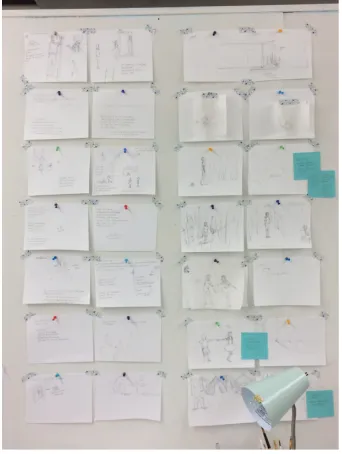
Hindsight being 20-20, I should have spent my entire first month just focusing on the script itself. There’s a reason that people first write children’s books and then send them to illustrators to complete. The script should come first. I ended up re-writing the script three times, putting a huge amount of work into the storyboard for each before finding issues with the story itself and
Publishers market picture books to various age groups, and my target audience is for 7-10 year-olds. Through my research of publishing trends, I learned that these picture books should not be much longer than a thousand words, and my original draft was almost 2,200 words. I also learned that because of binding limitations, the length of picture books must be a multiple of eight; typical picture books are thirty-two pages. My first two storyboards were twenty-four pages long, and I couldn't compress the story into that number of pages; I had some major rethinking and revising to do.
Throughout the project, I struggled with how to make my product unique. Initially, I was positive that fairies would be the central characters. I had to realize that my attachment to the original characters and ideas impeded my creativity. As soon as I let go and abandoned the idea of fairies, making my creatures Frollicks instead, I suddenly had so much more freedom to create—create characters, plotlines, and new and exciting ideas.
One important decision that I did stick with throughout the process was to give the book—the cover, the illustrations, the writing—a natural, almost mystical feel.
Sticking to this decision wasn’t unhealthy; it was actually helpful. It was an overall theme that I could make other decisions regarding, which kept me from drifting too far from my
original intent. My desire for the book to have a natural feel was the reason that I ultimately decided to use brown ink and watercolors. Black felt too aggressive and the blue that I had didn’t look natural enough—it was too bright, almost cerulean.
goal of making it “different”, or “special.” I now had two ways that my book could stand on its own, separate from the rest of pretty watercolor picture storybooks.
It was also because of my desire to give the book a natural feel/look that I decided to bind it myself. Sending it out to get printed was definitely the easier option, but I wanted it to look homemade, as though a real person had taken the time to put it all together.
Creative Work
Throughout both the written and the illustrative process, I thought about how to incorporate my themes. How could I convey the importance of exploration? How could I show that it’s important for children to arrive upon their own conclusions and solve their own problems? And how could I explain how important it is for children to be open to new opportunities and to not have preconceived expectations?
I wanted my illustrations to be whimsical and playful. My favorite picture books when I was little were the ones that I could look at a thousand times, and find something new during each close-read. I wanted my illustrations to be full of hidden surprises, ones that maybe kids wouldn’t stumble upon until the thousandth read. The art itself supported the theme of exploration, and the embroidery added opportunities for my audience to discover and play. On each page, I embroidered a ladybug-- finding the ladybug is a sort of game for the reader. This interactive element promotes exploration and provided additional excitement, offering the experience of satisfaction that comes from finding something. Sense of touch is such an important part of exploring new things. By making my book tactile through the embroidery, I hoped to convey the importance of exploration. Taking inspiration from The Borrowers, by Mary Norton, I included drawings of tiny objects we see in our life, but appearing large from the perspective of the Frollicks. I couldn’t portray the Frollicks as thieves because I didn’t want them to have any malicious intents. Therefore, most of the objects within their world—specifically in Cook’s
kitchen—are objects that you can often find littered on the ground. Finding these objects within the pages also helps to make the illustrations into a sort of game.
Within the writing, the inclusion of my themes is slightly more apparent. In terms of children solving their own problems and arriving at their own conclusions, Ryder must return home to set the dinner table. Even though he was having an amazing time with the Frollicks, he had home-based responsibilities, and he spoke to Cook about how to return home.
Ryder has three adventures, each one offering a learning opportunity. Bee teaches Ryder to pollinate, and the hummingbird he rides during the pollination process inspires him to overcome his fear of flying. With Acorn and her squirrel, he learns how to collect berries. After loving his experience with Bee and the hummingbird, Ryder is more willing and excited to ride the squirrel. He learns to trust. And finally with Cook, who he (unfairly) expected to be the most boring adventure of the three, he helped out with making cookies and learned how to get home and come back to the colony. He asked for help and help was given.
When Ryder heard that he would go on adventures with Bee, Acorn and Cook, he was the least excited about his time with Cook. He assumed she would be the most boring. However, when he got over his preconceived expectations, Cook was his favorite character. She actually listened to him. Ryder and the reader realize that sometimes the most seemingly mundane experiences are the ones with the most value and potential for personal growth and authentic learning.
Conclusion
From the beginning, I have had an adventure with this project. I dove in,
storyboarding and illustrating before I was anywhere near ready to do so. But, bit-by-bit, with a lot of trial and error, pieces of the puzzle fell into place.
Just like Ryder, who explored the preserve outside his house and stumbled upon a brand new world, I was blind when I jumped into creating my first ever book.
Just like Ryder, who looked to the “experts” when embarking on the next
And just like Ryder, who had one of the most magical experiences of his life all because he left the comfortable, boring bubble of his house, I created a piece of work that was outside my comfort zone and that I will always be proud of. I am proud not only because I am happy with the final product, but also because of the work that it took for me to get here. I’ve come a long way since the beginning of the year. I have learned a lot about myself, my work ethic, and my art.
Annotated Bibliography
Research question(s):
What is the importance of learning through curiosity and experiencing things for oneself, especially during the early years?
The brain is hardwired to learn, and exploration/finding your own place in the world is learning. What is the difference of emotional and intellectual intelligence and what is the importance of both?
1. Journey, Aaron Becker
Becker, Aaron. Journey. Candlewick Press, 2013.
Aaron Becker is the wordless wonder. A person of any age could sit down with one of his books and get something out of it. Little kids love his stories for their beauty and hidden treasures--they have something slightly Walt Whitman-esque about them, with details upon details upon details on every page. Older people love it for the reasons I do--for Becker's unbelievable, raw illustrative talent and how amazing it is that he created a complete, understandable story with not a single word.
In a lot of ways, Becker's books are similar to Harold and the Purple Pen, but with no words, lots of color, and more insane dreamt up worlds than I would have thought possible in anyone's brain other than J.K. Rowling.
The idea of exploration, a key theme in my work, is important throughout Aaron
Becker’s trilogy. The protagonist, a young girl, is unhappy with her drab, colorless home, so finds a door and enters into a hidden, colorful, new reality. If she hadn’t been
unsatisfied with her regular lifestyle, she would have never been able to have the adventures she had. The idea that I take away from Becker, and hope to carry out in my book, is that sometimes being unsatisfied is important because it can lead you to find something new and amazing.
2. Alice’s Adventures in Wonderland, Lewis Carroll Carroll, Lewis. Alice’s Adventures in Wonderland. 1865.
Lewis Carroll has been a large influence on my children’s book. I re-read Alice’s
Adventures in Wonderland for the first time in a long time over the summer, and realized that I had forgotten how strange Alice is. She doesn’t quite fit in with the people her age, and her world in general, so in her “dream” she makes up a fantastical world where, strangely enough, she fits in seamlessly. Because it’s a dream, Carroll can take liberties on details not making much sense. His limit is Alice’s fictional imagination. At the end of the story, there’s no question regarding whether or not the story was all a dream.
Everything is just slightly too unrealistic to be believable.
playing into the malleability of a child’s imagination, I’m making it seem as if it’s a world that could be within their grasp.
3. Emotional Intelligence
Goleman, Daniel. Emotional Intelligence. Bantam Dell, 1995.
Goleman talks about the idea that we have two minds--one that thinks, and one that feels. One is rational, and one is emotional. Before Goleman's book, we almost completely ignored measuring emotional intelligence, so, in a sense, we ignored the importance of the right side of our brain. However, Goleman's point is that our EQ, our emotional intelligence, is actually often a much more accurate predictor of our success and happiness in life.
If our EQ is high, it means that we are very aware and have the ability to self-regulate. We understand how we are feeling and why, and when we hear or see things that stimulate a response in our brain, we know how to rationally react. In other words, this part of emotional intelligence revolves around knowing how we are feeling and also being able to choose how to react to those feelings.
It has been proven through other sources I have found that immersing children in the outdoors, and allowing them to discover new ideas for themselves, leads to a stronger ability to self-regulate and to be self-aware and self-sufficient. They are better able to explain themselves in relation to the world around them, and because of this, are given the opportunity to explore what it means to rationally react to different situations.
4. Revealing the interactional features of learning and teaching moments in outdoor activity.
Ibrahim H. Acar, Soo-Young Hong, ChaoRong Wu. (2017) Examining the role of teacher
presence and scaffolding in preschoolers’ peer interactions. European Early Childhood
Education Research Journal 25:6, pages 866-884.
This study took children outdoors and examined how their change in environments impacted their change in reactions.
The study discovered that when indoors, children did not initiate any interaction with the teacher. Outdoors, greater number of child initiations and wider range of contexts in which they would interact. Children initiated interaction by a direct approach where they would offer up information, point out objects, and make requests and conversation. Interactions were also commonly “locally occasioned.” For example, a conversation of death was triggered as the class walked past a graveyard.
and student do not share common passions/interests, the interactions are not sustained, and the child is much less likely to retain the explained information. Being outdoors allowed children to be more excited about learning.
Being outside in the natural world allowed children to be more comfortable with the idea of exploration. Because of this, they were more comfortable with and open to the overall idea of learning as well.
5. Making Sense of a Day in the Woods: Outdoor Adventure Experiences and Early Childhood Teacher Education Students
Lamorey, Suzanne. “Making Sense of a Day in the Woods: Outdoor Adventure Experiences and Early Childhood Teacher Education Students.” Journal of Early Childhood Teacher Education, Routledge. Available from: Taylor & Francis, Ltd. 325 Chestnut Street Suite 800, Philadelphia, PA 19106. Tel: 800-354-1420; Fax: 215-625-2940; Web Site: Http://Www.tandf.co.uk/Journals, 30 Nov. 2012,
eric.ed.gov/?id=EJ1022300.
When I first started reading this article, I assumed it was about the importance of increasing the amount of outdoor time educators provide for their early childhood students. In reality, it was about how adults require outdoor learning in order to become better teachers. I found it very interesting and relevant that most of the findings that the researchers discovered about the adults were the same as what was discovered among children.
Research found that adults grew from immersion in the outdoors/from participating in various outdoor activities. Participant’s experiences were shown to increase personal empowerment, teaming, self confidence, trust, self-efficacy, and an appreciation for diversity. Their participation was shown to decrease stress levels, anxiety and depression. Performing outdoor group activities led to a need for group problem solving, which led to the participants initiating conversations regarding what to do and how.
In conclusion, outdoor education should not be limited to just children. It helps students of all ages learn how to foster relationships, address and work through hesitations and fears, and it creates a feeling of self-empowerment among all individual participants as they learn through trial and error how to best succeed.
6. Just One Change
Rothstein, Dan, and Santana, Luz. Make Just One Change: Teach Students to Ask Their Own Questions. Harvard Education Press, 2014.
Just One Change is a book written by two educators on the importance of children formulating their own questions. Dan Rothstein and Luz Santana discovered after working in a low-income community in Massachusetts when they came upon the
Rothstein and Santana realized was that the parents of these students had never been taught how to ask meaningful, purposeful questions.
Rothstein and Santana took it upon themselves to begin implementing the Question Formulation Technique into their classroom practice. They discovered almost
immediately that when students had to come up with their own questions, as opposed to being spoonfed by instructors what they were supposed to be confused about and why, the students not only performed better, but felt smarter. They found school challenging and stimulating.
Exploration and asking questions and wondering why are the concepts I am hoping to communicate in my children’s book. Ryder, the protagonist, is not given a set list of instructions on how to find the Frollick colony and what he should do upon arrival. It is up to him to use his own judgment and to constantly be asking himself and everyone around him why.
7. My Stroke of Insight, Jill Bolte
“TEDTalks: Jill Bolte Taylor--My Stroke of Insight.” Performance by Jill Bolte Taylor, TED, 2008.
Dr. Taylor was a neuroanatomist when she suffered her own stroke. It took her a while to realize that she even was having a stroke, and the steps that she went through during her realization are fascinating, to say the least. She ends her talk with what it felt like to have this crazy, near-death experience and to finally find "Nirvana," a place where you could step outside your left hemisphere and find your inner peace, a place where you could connect energetically to everyone around you.
Dr. Taylor talks a lot about the importance of appreciating both sides of your brain. Often times, in education, our educators do not concentrate on the right brain as much as the left. They measure our, meaning the students, intelligence through our intellect as opposed to our emotions.