Effect the Host and Donor Genotype on Production of Twin
Mice by Tetraploid Complementation Technology
Erna Balogh
1, Renáta Fábián
1, Babett Bontovics
1, Szilárd Bodó
1,2, Elen Gócza
1*1NARIC, Agricultural Biotechnology Institute, Szent-Györgyi Albert str. 4, 2100 Gödöllő, Hungary 2Szent István University, Páter K. str. 1., 2100 Gödöllő, Hungary
Abstract
Twin mice produced by tetraploid complementation method are identical on both nuclear and mitochondrial DNA level. In our experiment aggregation chimeras were produced for the purpose of creation twin mice with tetraploid complementation technology. This method could be a valuable tool both in biomedical and in agricultural applications.
The host tetraploid embryos were produced by electrofusion. In the first part of the work we set up the optimal fusion parameters and we investigated which could be the best strain for tetraploid embryo production.We used C57BL/6, C57BL/6 albino and CD1 genotype embryos. Later we investigated the effect of host (CD1, C57BL/6 albino) and donor (CD1/EGFP, C57BL/6) embryo genotype regarding to the number of the living newborns. Four-cell stage tetraploid CD1 and C57BL/6 albino mouse embryos were aggregated with 2 or 4 blastomeres derived from the same CD1/EGFP or C57Bl/6 genotype eight-cell stage embryo.
We found that the CD1/EGFP genotype mouse embryos are the best as donor embryos. According to the results of the electrofusion experiments, the CD1 genotype mouse embryos proved to be the more suitable as host embryos. Keywords: identical twins, mouse, tetraploid embryo.
1. Introduction
Research on twins date back several decades. The usefulness of twin studies convincingly supported the new results of knowledge on heart abnormalities and diseases caused by high cholesterol level. Using twin mice in studies could substantially reduce the number of animals, which are required to obtain relevant statistical data [1-3]. Scientist had tired to achieve better results in this area using different methods but till now with low efficiency. In the frame of our experiments we tried to optimise the tetraploid chimera complementation method. Chimeras originally were artificially created entity belonging to two species or breed tissues.
In our experiments aggregation chimeras were produced for the purpose of creation identical twin
* Corresponding author: Elen Gócza, +36 30 300
4967, [email protected]
mice with tetraploid complementation method. Unlike clones produced by nuclear transfer, these identical twin mice are identical both nuclear as well as mitochondrial DNA level [4]. Therefore, the tetraploid embryo complementation method to produce monozygotic twins could be a valuable tool both in biomedical and in agricultural applications [5].
2. Materials and methods
We routinely aggregated embryos with 2 our 4 intact blastomeres derived from 8-cell stage embryos (collected at day 2.5) for chimera production. 2-cell stage embryos (collected at day 1.5) were used for generation the tetraploid embryos by electrofusion. The recovery procedure for both day 1.5 and 2.5 embryos was essentially the same.
Acid Tyrode’s solution was used to remove the glycoprotein membrane (zona pellucida). The aggregation was performed in small hand-made
depressions on the bottom of a Petri dish. After the zona pellucida of the eight-cell stage embryo was removed, we divided it into blastomeres with a special capillary pipette, then two, or four blastomeres were placed into the holes. After that, we placed the previously produced zona pellucida free tetraploid embryo besides. In the end we put the Petri dish into the CO2 incubator for 24 hours.
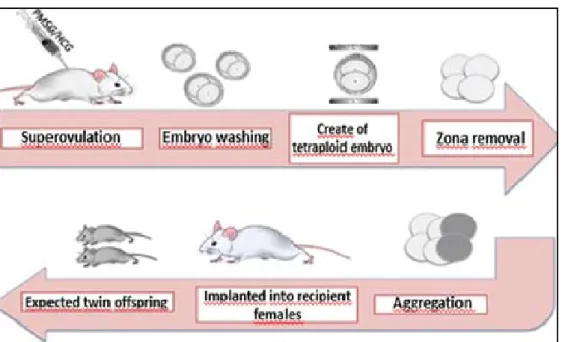
On the following day chimera embryos and helper embryos were transferred into pseudopregnant female (Figure 1.)
Figure 1. The research method
3. Results and discussion
In the first part of the work we set up the optimal fusion parameters and we investigated which could be the best strain for tetraploid embryo production. We fused C57BL/6 albino, CD1/EGFP and CD1 genotype embryos with the CF-150B electrofusion device. 280 embryos were washed out from donor mice. 166 embryos were used for electrofusion. From the fused embryos 107 embryos continued to develop into four-cell stage. Three different sets of fusion parameters were tested. We got the best developmental rate of fused embryos using two repetitions of a 40V and 45μs pulse. According to the preliminary study we used CD1, CD1/EGFP and C57BL/6 albino genotype mice. We achieved the best result by using the CD1 embryos (83%), (Figure 3)
although significant difference was not observed. Thus, in the further experiments we used CD1 and C57Bl/6 albino host embryos.
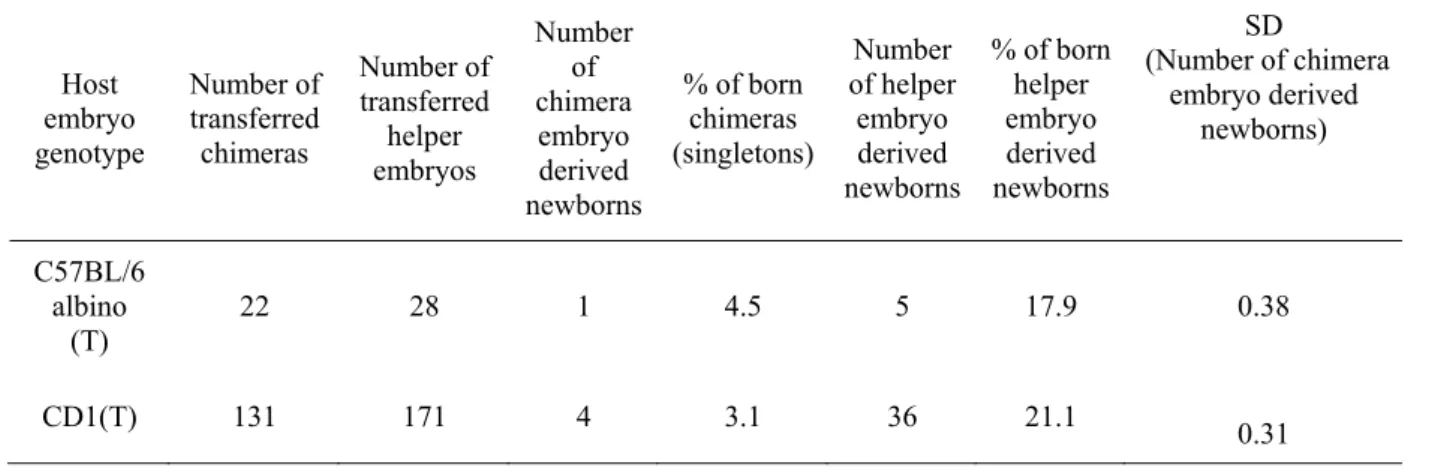
During our experiments we investigated the effect of host (CD1, C57BL/6 albino) and donor (CD1/EGFP, C57BL/6) embryo regarding to the number of the living new-borns. We found that using of CD1/EGFP donor embryos the number of living offspring (singletons) was higher compared to the C57BL/6 strain. Despite the higher rate of CD1/EGFP embryo derived offspring, no significant difference was found between the different genotypes as a consequence of the small number of transferred CD1/EGFP chimeras (Table 1). From the C57BL/6 albino host and C57BL/6 donor blastomeres derived chimeras we transferred to recipient females 22 chimeras (Table 2) and from the CD1 host and C57BL/6 donor blastomeres derived chimeras 131 chimeras. In the first case we obtained 4 embryos, while in the second case we had only one chimera embryo derived new-borns among the new-borns. This means that 3.1% using CD1 host embryo and 4.5% using C57BL/6 albino host embryo
newborns were born. Examining the effect of the host embryo genotype we could not identify significant difference in the ratio of live born singleton mice.
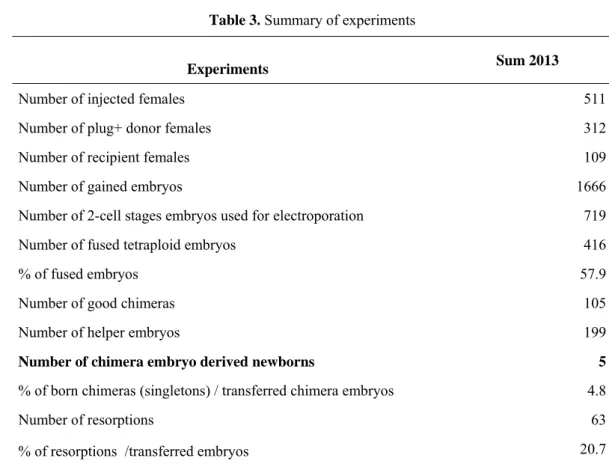
Summarised our experiments1666 embryos were washed out from 511 donor female mice. We got 416 fused, tetraploid embryos (57.9%). We transferred 105 chimeric embryos into 109 recipient females together with 199 helper embryos. 5 out of 105 chimeric embryos were born. The data showed that 4.8% of the transferred embryos found to be chimeric (singletons) (Table 3, Figure 4 and 5). We could not find significant difference in the number of born embryos according host or donor embryo genotype. Summarised all of our results; we concluded that the best donor embryos could be derived from CD1/EGFP mouse strain, while the best host embryos are from the CD1 mouse strain. We are planning to use these mouse strains for our further experiments.
Figure 2. The creation of chimeric embryos using 1 tetraploid CD1 host embryo and two CD1/EGFP
Table 1. Examination the effect of the host embryo genotype
Table 2. Examination the effect of the donor embryo genotype
Figure 4. Newborn singleton derived from CD1/EGFP
donor blastomere (green) and helper newborns. Figure 5. Newborn singleton derived from C57BL/6 donor blastomere (black eyes) and helper newborns Host
embryo genotype
Number of transferred chimeras
Number of transferred
helper embryos
Number of chimera embryo derived newborns
% of born chimeras (singletons)
Number of helper
embryo derived newborns
% of born helper embryo derived newborns
SD
(Number of chimera embryo derived
newborns)
C57BL/6 albino
(T) 22 28 1 4.5 5 17.9 0.38
CD1(T) 131 171 4 3.1 36 21.1 0.31
Donor embryo genotype
Number of transferred chimeras
Number of transferred
helper embryos
Number of chimera embryo derived newborns
% of born chimeras (singletons)
Number of helper embryo derived newborns
% of borne helper embryo derived newborns
SD Number
of chimera embryo derived newborns
C57BL/6 (2-2-2-2
blastomeres) 41 50 1 2.4 5 10.0
7.45
CD1/EGFP
12 16 2 16.7 9 56.3 14.43
C57BL/6 51 80 2 3.9 27 33.8
Table 3. Summary of experiments
4.Conclusion
Consequently, it can be stated that CD1 tetraploid embryos are suitable host and helper embryos and CD1/EGFP embryos are suitable donor embryos. We hope that we will be able to produce more efficiently predetermined sex identical twins, after we optimised the tetraploid complementation technology parameters.
Acknowledgements
This research was funded by grants CAMH ABC II and OTKA K109252.
References
1. Boomsma, D., Busjahn A., Peltonen L., Classical twin studies and beyond, Nat Rev Genet. 2002, 3(11), 872-882
2. Weiss, K.M., Genetic variation and human disease, Cambridge: Cambridge University Press; 1993.
3. Damianopoulos, E.N., Carey, R.J., Apomorphine sensitization effects: evidence for environmentally
contingent behavioral reorganization processes, Pharmacol Biochem Behav. 1993, 45(3), 655-663
4. Wong, A.H., Gottesman, I.I., Petronis, A., Phenotypic differences in genetically identical organism: the epigenetic perspective, Human Mol Genet, 2005, Spec 1, R11-18
5. Nagy A., Gócza, E., Diaz, E.M., Prideaux, V.R., Iványi, E., Markkula, M., Rossant, J., Embryonic stem cells alone are able to support fetal development in the mouse, Development, 1990, 110(3), 815-21.
6. Tsunoda, Y., McLaren, A., Effect of various procedures on the viability of mouse embryos containing half the normal number of blastomeres, Journal of Reproduction and Fertility, 1983, 69(1), 315-322
7. Tarkowski, A.K., Ozdzenski, W., Czolowska, R., Identical triplets and twins developed from isolated blastomeres of 8- and 16-cell mouse embryos supported with tetraploid blastomeres, The International Journal of Developmental biology, 2005, 49(7), 825-832
8. Carstea, B., Catunda L., A.P., Ilie E.D., Gocza, E., Production of identical mouse twins and a triplet with predicted gender, Cloning and Stem Cells, 2007, 9(2), 247-256
Experiments Sum 2013
Number of injected females 511
Number of plug+ donor females 312
Number of recipient females 109
Number of gained embryos 1666
Number of 2-cell stages embryos used for electroporation 719
Number of fused tetraploid embryos 416
% of fused embryos 57.9
Number of good chimeras 105
Number of helper embryos 199
Number of chimera embryo derived newborns 5
% of born chimeras (singletons) / transferred chimera embryos 4.8
Number of resorptions 63