VOLUME 16 ISSUE 1 (2018), Page 231 – 238
ASSESSMENT OF POTENTIAL LOCATIONS FOR BONUS ZONING IN BANDUNG
Tika S. D. Hasan1 & Denny Zulkaidi2
1,2School of Architecture, Planning, and Policy Development
INSTITUT TEKNOLOGI BANDUNG
Abstract
Despite being a common practice in other countries, bonus zoning is still relatively new in Indonesia. Bonus zoning is a zoning regulation tool that allows developers to increase density in exchange for the improvement or provision of public facilities. Bandung, in particular, has already designated areas for bonus zoning within its Local By-law No.10/2015 concerning Detailed Spatial Plan and Zoning Regulation. Its detailed mechanism however is not yet implemented. This research seeks to investigate a) the rationale behind the application of bonus zoning in Bandung; b) the carrying capacity of the areas where bonus zoning could be applied; c) the type of public space to be provided as development compensation; and d) the calculation for compensation. Content analysis was used to review literature and legal documents regarding planning and development in Bandung. This research expects to find which areas are suitable for implementing bonus zoning and come up with its compensation as the basis for sustainable planning in Bandung that not only benefits the developers but also the public as a whole.
INTRODUCTION
Bonus zoning, or in some literature referred to as incentive zoning, is a measure of development and improvement provided to the developer in return for the provision of public facilities such as arcades, plazas, pedestrian ways, loading and unloading space off the street to avoid congestion in accordance with applicable regulations (Costonis, 1972; Homsy, Abrams, & Monastra, 2015; Johnston, Schwartz, Wandesforde-Smith, & Caplan, 1989; Kiefer, 2001; Seyfried, 2007). The practice of bonus zoning has been formally exercised in New York, USA since 1961 when public plazas were built by developers in exchange for supplementary Floor Area Ratio (FAR) for buildings in high-rise areas (Homsy et al., 2015; Smithsimon, 2008).
The City of Chicago makes FAR bonuses available through a single voluntary payment into a Neighbourhood Opportunity Bonus system (City of Chicago, 2017). Previous provisions in the zoning code were regulated by a 2004 regulation that identified a variety of on-site amenities, such as building setbacks, winter gardens, green roofs, and other design features. In 2016, the mayor introduced the following simplified equation for determining the bonus payment system:
Cost of 1 square foot of floor area = 80% x median cost of land per buildable square foot
As example, when a developer wants to build an additional 5,000 square feet beyond what is allowed under the prevailing zoning regulation in an area where the median price is $35 per square foot, the bonus contribution equation for neighbourhood reinvestment would be 5,000 square feet multiplied by 80% of $35 (which is $28).
5,000 sq ft x 80% ($35) = $140,000
Where; C = Compensation value (IDR)
I = Index (as set forth in DKI Jakarta Governor Regulation No. 251/2015 based on the location of the areas where exceeding FAR are allowed with index ranges from 0.6, 0.8, 1.0, 1.2, 1.4, to 1.8)
A = Additional floor area (m2)
FARbase = Allowed FAR in Zoning Regulation
Taxable value of land = Sale value on tax object/NJOP (IDR)
As bonus zoning is still uncommon in Indonesia, its implementation requires caution so it will not give the impression of business as usual where developers can build as much as they desire as long as they can afford the compensation value. The carrying capacity of aspects such as water, land, and road level of service must be carefully taken into account before allowing development beyond what is permitted. When applied correctly, bonus zoning can provide local governments with an additional source of funding to boost development, while maintaining the liveability of its area. Bandung urgently needs a well-defined mechanism and procedure of bonus zoning in order to control the overwhelming demand for developments.
BONUS ZONING: BANDUNG CONTEXT
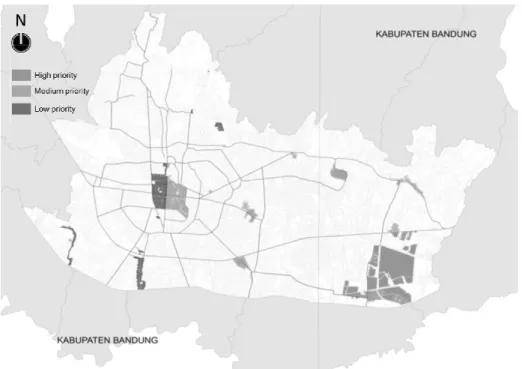
Figure 1: Bonus zoning designated area based on Bandung Local By-law No.10/2015 (Peraturan Daerah Kota Bandung No. 10 Tahun 2015)
Source: Adapted from Bandung Zoning Map within Local By-Law, 2015
Table 1: Score description
0,5 1,0 1,5
Carrying Capacity High density
location
Medium density location
Low density
location
Road Class Local road Collector road Arterial road
Development Policy Northern, Central,
and Western
Bandung
Southern Bandung Eastern Bandung
Safe Flight Path Within Safe Flight Path
Near Safe Flight Path
Outside Safe
Flight Path Development
Impact
Negative Neutral, under
acceptable level of impacts
Positive
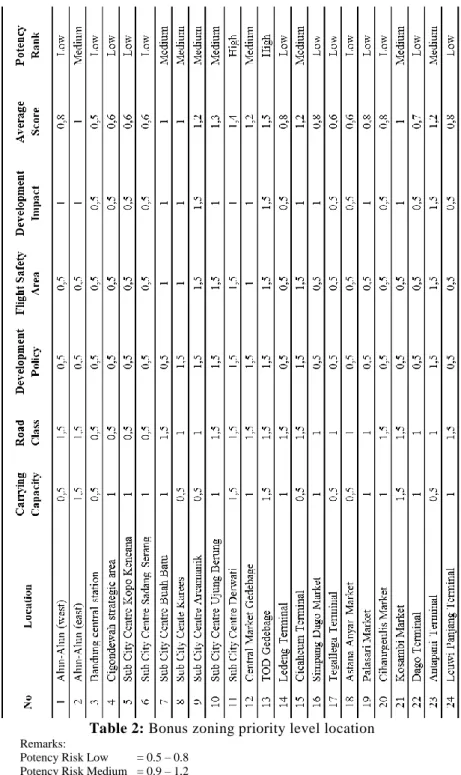
The distribution of locations can be seen in Figure 2 where the lightest shade indicates the highest priority; semi-dark indicates the medium priority; and the darkest shade indicates the lowest priority for additional development intensity – meaning that the dark areas are already high density areas.
Table 2: Bonus zoning priority level location Remarks:
The second part of the analysis established the typology of public space that can be distributed into on-site or off-site improvements, which will be ranked, based on the highest demand, for example parking spaces, parks, the improvement and/or widening of pedestrian pathways, and the provision of bike lanes. The final part was to formulate the FAR that can be given as bonus in Bandung.
As opposed to the method being applied in Jakarta where developers propose certain additional FAR in advance and then the local government calculates the compensation that must be paid, this research argues that the calculation method should be reversed. Instead, the developer must provide public amenities beforehand and then the local government would calculate the bonus FAR based on the type of public space the developer provided. This reversed method is important in order to control developers building as much as they desire just because they can afford the compensation.
At this stage of the study, the indication of public space demand in Bandung points towards the provision of parking spaces and green spaces. In addition, to create more walkable neighbourhoods in Bandung, the quality of pedestrian pathways must also be improved. The bonus FAR was tested using the following formula:
Bonus FAR = 𝑝𝑢𝑏𝑙𝑖𝑐 𝑠𝑝𝑎𝑐𝑒 𝑝𝑟𝑜𝑣𝑖𝑑𝑒𝑑 (𝑠𝑞𝑚)
𝑑𝑒𝑣𝑒𝑙𝑜𝑝𝑚𝑒𝑛𝑡 𝑙𝑜𝑡 𝑎𝑟𝑒𝑎 (𝑠𝑞𝑚) x I x FARbase
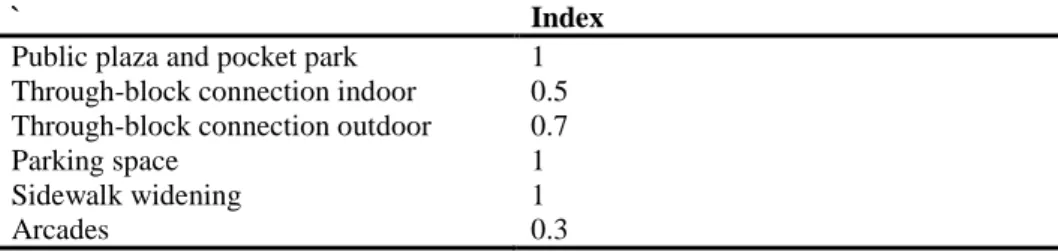
The range of index (I) can be determined based on the type of public space that has been provided by the developer. The range between 0 < I < 1 is prioritised with the following preference Table 3):
Table 3: Index range for public space provision
` Index
Public plaza and pocket park 1
Through-block connection indoor 0.5
Through-block connection outdoor 0.7
Parking space 1
Sidewalk widening 1
Arcades 0.3
Suppose, a developer built additional parking space of 10,000 sqm in a development area of 15,000 sqm within a site with a FARbase of 5. Based on the
formula, the developer shall receive a bonus FAR of 3.
would not be able to accommodate more activities caused by additional floor area; b) not located within a heritage conservation area/building; c) consider the existing availability and capacity of public infrastructure and utilities; and d) consider the standards for public facilities and infrastructure in demand.
CONCLUSION
The current stage of the study indicates that Transit Oriented Development (TOD) Gedebage and the Sub City-Centre of Derwati are the top two potential areas to be awarded bonus zoning in return for the provision of public space. However, the result would be different when variables are added, such as the taxable value of land. Changing the scores and indexes would change the result as well. Thus, additional simulations should be considered before a decision is made.
ACKNOWLEDGEMENT
The researchers would like to acknowledge Ministry of Research Technology and Higher Education of Republic Indonesia for their funding under Higher Education Research of Excellence scheme that made this research possible.
REFERENCES
Bandung City Spatial Planning and Human Settlements Office (2016). Penyusunan kajian dan raperwal tentang teknik pengaturan zonasi bonus zoning. Dinas tata ruang dan cipta karya Kota Bandung
City of Chicago (2017). Neighborhood opportunity bonus: Leveraging downtown zoning to foster neighborhood development and central area growth. Retrieved from https://www.cityofchicago.org /city/en/depts/dcd/supp_info/realigning-zoning-with-neighborhood-growth.html
Costonis, J. J. (1972). The Chicago Plan: Incentive zoning and the preservation of urban landmarks. Harvard Law Review, 85, 574-634.
Homsy, G. C., Abrams, G., & Monastra, V. (2015). Incentive zoning: Understanding a market-based planning tool. Public Administration Faculty Scholarship, 5. Retrieved from https://orb.binghamton.edu/public_admin_fac/5
Johnston, R. A., Schwartz, S. I., Wandesforde-Smith, G. A., & Caplan, M. (1989). Selling zoning: Do density bonus incentives for moderate-cost housing work. Journal of Urban and Contemporary Law, 36, 45-61.
Kiefer, M. J. (2001). Privatizing creation of the public realm: the fruits of New York City’s incentive zoning regulation. Environmental Affairs Law Review, 28(4), 637. Local By-law No.10/2015 (Bandung).
Provincial Regulation of DKI Jakarta No. 210/2016 (Jakarta).
Seyfried, W. R. (2007). Measuring the feasibility of a zoning bonus. Journal of the American Planning Association, 57(3), 348-356.