Original Research Article
A study of pattern of some common infections in children one month to
five years of age
D. Saikia
1, R. K. Sharma
2*
INTRODUCTION
Understanding the causes of child mortality provides important public health insights. Globally 6.9 million deaths in children under-5 occurred in 2011.
Almost two-thirds (64%) were caused by infectious diseases. Worldwide, the leading causes of death among children under-5 include pneumonia (18%), preterm birth complication (14%), diarrhea (11%), intra-partum related
complications (9%), malaria (7%), and neonatal sepsis, meningitis and tetanus (6%). Over 3.1 million children under five years of age die in South East Asia Region. India contributes to 25% of the over 6.9 million under-five deaths occurring worldwide every year. At the national level the mortality rate was estimated at 59 per 1000 live births, and the rate varies from 15 in Kerala to 83 in Assam.1,2 Diarrheal diseases and acute respiratory
infections account for a significant morbidity and mortality among under 5 children. In India acute
1Department of Pediatrics, Chacha Nehru Bal Chikitsalaya, (Associated to Maulana Azad Medical College), Delhi,
India
2Department of Physiology, Lt BRKM Govt Medical College, Jagdalpur, Chhattisgarh, India
Received: 14 June 2018
Accepted: 07 July 2018
*Correspondence:
Dr. R. K. Sharma,
E-mail: [email protected]
Copyright: © the author(s), publisher and licensee Medip Academy. This is an open-access article distributed under the terms of the Creative Commons Attribution Non-Commercial License, which permits unrestricted non-commercial use, distribution, and reproduction in any medium, provided the original work is properly cited.
ABSTRACT
Background: Understanding the causes of child mortality provides important public health insights. Globally 6.9 million deaths in children under-5 occurred in 2011. The objective of the present study was to study the pattern of some common infections in children one month to five years of age
Methods: Observational descriptive study was conducted at Department of Paediatric from July 2012 to June 2013 among 368 randomly selected children. Standard diagnostic criteria for Respiratory tract infection, Diarrhea, Tuberculosis, Urinary tract infection, Malaria, Enteric fever, Measles, Pyoderma, Parasitic infections was followed for all children.
Results: Respiratory tract infection and Diarrhea occurred most frequently in 7 to 24 month of child that was 82 (51.9%) and 53 (58.2%), respectively. Stool examination in Parasitic infestation showed that Amoeba 1 (7.1%), Giardia 1 (7.1%), Ascariasis 6 (42%), and Hookworms were 6 (42%) in total of 14 cases. Anemia was present in URI, Tuberculosis, Malaria, and Parasitic infestation with mean hemoglobin (Hb) ranges from 8.6 to 9.2. Mantoux showed that 20 (87%) cases had mantoux > 10 mm. Malarial species found were Vivax (16, 66.7%). Respiratory tract infection occurred mostly in winter season.
Conclusions: Most common infections in children 1 month to 5 years of age was Respiratory tract infection followed by diarrhea, enteric fever, malaria, tuberculosis, urinary tract infection, parasitic infection, measles and pyoderma.
Keywords: Children, Infections, Pattern
respiratory infection is one of the major causes of death in under-five children. Hospital records from states with high mortality rates show that up to 13 percent of in-patient’s deaths from pediatrics wards are due to ARI. During 2011, there were about 26 million reported episodes of ARI with 2,492 deaths. The proportion of deaths due to ARI in the community is much higher as many children die at home.3 It is estimated that there are
1.7 episodes of diarrhea per child per year in under-fives. An estimated 400,000 children under-five die each year due to diarrhea.4
Wealthy, industrialized countries of the developed world successfully underwent the "epidemiologic transition" from infectious diseases to degenerative diseases but developing countries have not yet achieved that transition.
The advent of modern sanitation and hygiene practices, effective vaccines, and antibiotics have significantly diminished the burden in the developed world, but infectious diseases remain the most common cause of death worldwide.5 India is going through a period of
transition, both epidemiological and demographic transition. Infectious diseases are still persisting as major health problems in spite of having national programmes for the control of most of these diseases for almost half a century now. There are re-emerging infectious diseases which are adding to the burden of diseases.
In addition, there is an increasing prevalence of non-communicable diseases as a result of lifestyle changes and urbanization. These are the challenges that are to be tackled in the new millennium.6 To the best of our
knowledge, there are a few literatures in India that directly shows the profile of common Infective diseases occurring in under five children that leads to frequent hospital visits. Although many studies have been done on the mortality due to individual diseases that reflects the morbidity pattern indirectly.
METHODS
The study was observational and descriptive in nature. The Study was conducted at Department of Paediatric, Chacha Nehru Bal Chikitsalaya, Geeta colony, Delhi (Associated to Maulana Azad Medical College, Delhi). The study took place for twelve months period from July 2012 to June 2013.
Sample size
Existing literature estimates that the prevalence of Acute Respiratory infection is 47.3% and the prevalence of Diarrhea is 26.4%. These two commonest infections account for 73.7% of the whole prevalence of common infections in children under five years of age
Sample size was calculated on the basis of the following formula:
Sample size = [z2 (1- α/2)]/d2
Whereas,
α = Anticipated value of the proportion in the population. d = absolute precision required on either side of the proportion (5%).
z2 (1- α/2) = 1.96
So, Sample size = 368.
Sampling method
• Patients were enrolled on two specific OPD days in a week over a period of one year. On every specific OPD day we recruited patients by using systemic random sampling (Every 15th case attending to
specific OPD fulfilling the inclusion criteria were selected for the study).
• Clinical details of the patient were collected in a predesigned Performa.
• Relevant investigations were done as far as possible to make a diagnosis.
• The cases were enrolled till the target sample size of 368 was reached.
Inclusion criteria
• Children of age group 1 month to 5 years, belonging to all nutritional & socioeconomic status with some specific common infections were included in the study.
• Children fulfilling the diagnostic criteria of following common infections as mentioned below were included in the study.
a) Respiratory tract infection b) Diarrhea
c) Tuberculosis
d) Urinary tract infection e) Malaria
f) Enteric fever g) Measles
h) Pyoderma
i) Parasitic infection
Exclusion criteria
Children having risk factors which predispose infection, except malnutrition were excluded from study (e.g. Malignancy, Immunodeficiency diseases, Nephrotic syndrome and Immunosuppressive drugs).
Methodology
As per the diagnostic criteria for each and every disease studied for the present study, detailed history and thorough clinical examination was carried out. Investigations were done as and when required to confirm the diagnosis.
Data analysis
• All the data was checked and verify thoroughly to reduce the inconsistency.
• Data validation was done prior to analysis.
• Data analysis was entered using Microsoft World Excel 2007.
• Data analysis was done using SPSS version 18.0 and Microsoft World Excel 2007.
• Descriptive analysis was performed and statistical test, chi square test and fisher exact were applied wherever required.
RESULTS
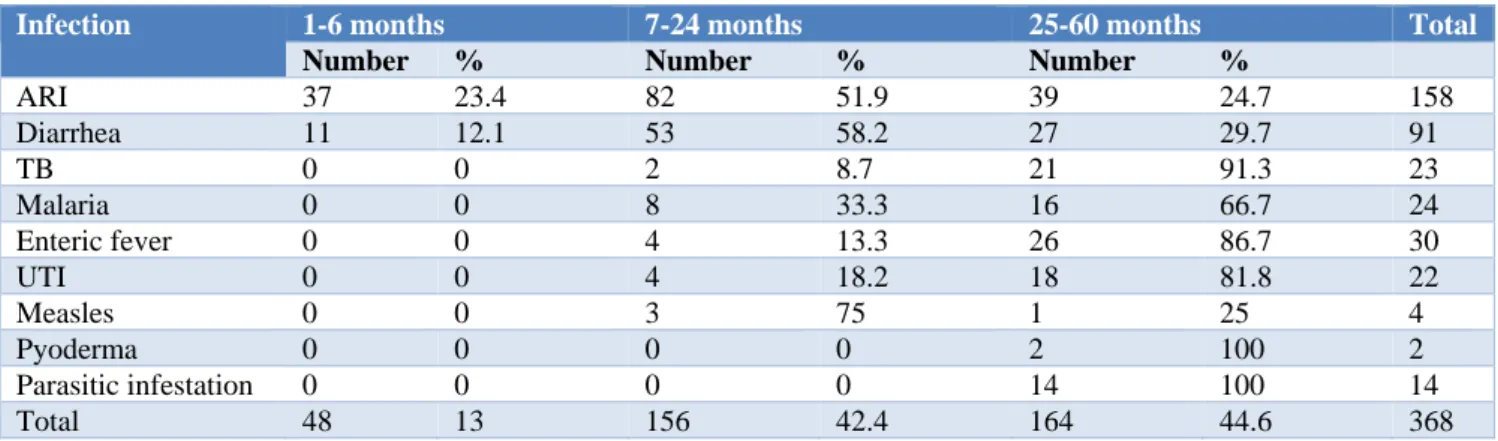
Respiratory tract infection and Diarrhea occurred most frequently in 7 to 24 month of child that was 82 (51.9%) and 53 (58.2%), respectively.
Table 1: pattern of infection in children one month to five years of age (age distribution).
Infection 1-6 months 7-24 months 25-60 months Total
Number % Number % Number %
ARI 37 23.4 82 51.9 39 24.7 158
Diarrhea 11 12.1 53 58.2 27 29.7 91
TB 0 0 2 8.7 21 91.3 23
Malaria 0 0 8 33.3 16 66.7 24
Enteric fever 0 0 4 13.3 26 86.7 30
UTI 0 0 4 18.2 18 81.8 22
Measles 0 0 3 75 1 25 4
Pyoderma 0 0 0 0 2 100 2
Parasitic infestation 0 0 0 0 14 100 14
Total 48 13 156 42.4 164 44.6 368
Other infections as Tuberculosis 21 (91.3%), Malaria 16 (66.7%), Enteric fever 26(86.7%), urinary tract infection 18(81.8%) occurred mostly in 25-60 months of age.
Stool examination in Parasitic infestation showed that Amoeba 1 (7.1%), Giardia 1 (7.1%), Ascariasis 6 (42%), and Hookworms were 6 (42%) in total of 14 cases.
In present study we found that Anaemia was present in URI, Tuberculosis, Malaria, and Parasitic infestation with mean hemoglobin (Hb) ranges from 8.6 to 9.2.
Total leucocytes count (TLC) was higher in Pneumonia (mean=19683, SD=3467), and UTI (mean=16117, SD=3710).
Mantoux done in Tuberculosis cases showed that 20 (87%) cases had mantoux > 10 mm, and 3 (13%) cases had mantoux 5-10 mm. 3 (13%) children with Tuberculosis were sputum for AFB positive.
14 (60.8%) children with Tuberculosis showed chest X-ray patches. Malarial species found were Vivax (16, 66.7%), Falciparum (1, 4.2%), and both 7 (29.2%) in total of 24 cases. In present study, we found that there was seasonal variation in respiratory tract infection, diarrhea and malaria. Respiratory tract infection occurred
mostly in winter season i.e. 71 (44.9%) in respect to 51 (32.3%) in monsoon and 36 (22.8%) in summer.
Table 2: Stool examination in parasitic infestation.
Stool examination result Number %
Amoeba 1 7.1
Giardia 1 7.1
Ascariasis 6 42
Hookworm 6 42
Total 14 100
Whereas Diarrhea occurred mostly in summer season i.e. 38 (41.8%) in respect to 28 (30.8%) in monsoon and 25 (27.5%) in winter.
Malaria occurred mostly in monsoon season 13 (54.2%). Whereas other infections occurred throughout the whole seasons.
DISCUSSION
infective illness episodes were more in the second and third years of life (11.27 and 10.52).7
Overall infection rate was highest beyond 2 years of age which include Respiratory tract infection, Diarrhea and
other infections like Tuberculosis, Enteric fever, Measles, UTI, and parasitic infection. However, if individual disease like Respiratory tract infection and Diarrhea were considered, they were more common in children of age less than 24 months.
Table 3: Investigation (HB and TLC) in infections.
Infection Hb TLC
Mean SE mean SD Mean SE mean SD
URI 8.9 0.0429 0.1134 9261 717 1898
Pneumonia 10.1 0.1612 0.9938 19683 562 3467
Pharyngitis 10 - - 7890 - -
Acute diarrhea 10.2 0.4359 1.2329 10901 1007 2849
Chronic diarrhea 10 0 0 10487 1409 2441
TB 8.6 0.15.6 0.7221 10080 538 2578
Malaria 9.2 0.1817 0.8904 8208 392 1923
Enteric fever 10.5 0.2183 1.1955 5308 161 881
UTI 10.5 0.2637 1.2368 16117 791 3710
Measles - - - -
Pyoderma 9.2 - - 9760 - -
Parasitic infestation 8.8 0.2101 0.7860 7948 518 1939
Males were 228 (62%) and females were 140 (38%). Probably male children are biologically weak and get more attention. However, in present study and in any other major study, there was no statistically significant association for development of infection with male sex. Gladstone BP et al found that that treatment was sought more frequently for boys (1388/2580 episodes, 53.8%) than for girls (1137/2257) episodes, 50.4%) (Wald test, p = 0.12).8 There was a slightly higher proportion of health
care seeking for male children, even among educated mothers and households of higher socio-economic status. Interestingly, despite more morbidity in boys, girls were hospitalized on more occasions (49, 2.5%) than boys (57, 1.9%).
Table 4: Mantoux in tuberculosis.
Mantoux test result Number %
< 5 mm 0 0
5-10 mm 3 13
> 10 mm 20 87
We found that the most common diagnosis was respiratory tract infection (158, 42.9%) followed by diarrhea (91, 24.7%), Tuberculosis (23, 6.3%). Direct comparison of findings between studies is difficult because of differences in study design, study populations, timing and differences in the measures of disease burden. However, our findings were close to study by Gladstone BP et al who showed that a total of 3370 hospital visits were made for 2525 episodes of illness and the most common diagnoses were acute respiratory infections (1593, 47.3%), diarrhea (889, 26.4%).8 Nwolisa CE et al
described the morbidity pattern among pre-school children the five commonest causes of morbidity were malaria (60.7%), acute respiratory infection (35.8%), diarrheal disease (7.4%), skin infection (6.8%) and urinary tract infection (3.6%).9
Table 5: Types of Malarial parasites.
Types of malaria parasite Number %
Vivax 16 66.7
Falciparum 1 4.2
Both 7 29.2
Total 24 100
We found that in Respiratory tract infection, most common were URI 113 (71%) followed by pneumonia 38 (24.5 %) and pharyngitis 7 (0.04%). Other study also shows a similar pattern. Zaman K et al found that the overall incidence of ARI was 5.5 episodes per child-year observed; the prevalence was 35.4 per hundred days observed.10 Most of the episodes (96 percent) were upper
respiratory infections (URI). The incidence of acute lower respiratory infections (ALRI) was 0.23 per child per year. Among the cases of Diarrhea, Acute Diarrhea 88 (23.9%) was common in respect to chronic Diarrhea 3 (0.8%). Ketema et al showed that acute diarrhea is a major public health problem in Ethiopian children under five years of age. Of 5,762 children with all forms of diarrhea seen during the study period 264 (5%) had persistent diarrhea.11 Lindtjorn B et al showed that the
infection 45.2%.12 Black RE et al showed that of the
estimated 8.795 million deaths in children younger than 5 years worldwide in 2008, infectious diseases caused 68% (5.970 million), with the largest percentages due to
pneumonia (18%, 1.575 million, uncertainty range [UR] 1.046 million-1.874 million), diarrhea (15%, 1.336 million, 0.822 million-2.004 million), and malaria (8%, 0.732 million, 0.601 million-0.851 million).13
Table 6: Pattern of infection as per season in children one month to five years of age
Infection July to Oct (Monsoon) Nov to Feb (Winter) March to June (Summer) Total
Number % Number % Number %
ARI 51 32.3 71 44.9 36 22.8 158
Diarrhea 28 30.8 25 27.5 38 41.8 91
TB 6 26.1 9 39.1 8 34.8 23
Malaria 13 54.2 4 16.7 7 29.2 24
Enteric fever 9 30 11 36.7 10 33.3 30
UTI 6 27.3 9 40.9 7 31.8 22
Measles 0 0 2 50 2 50 4
Pyoderma 2 100 0 0 0 0 2
Parasitic infestation 6 42.9 5 35.7 3 21.4 14
Total 48 13 156 42.4 164 44.6 368
The above studies indirectly reflect the morbidity pattern among children due to various infective diseases.
Authors found that Respiratory tract infection and Diarrhea occurred most frequently in 7 to 24 month of child that was 82 (51.9%) and 53 (58.2%), respectively. Islam F et al found that Acute Respiratory tract infections were common in the age group of 1-12 months (38.14%) followed by 13-24 months (21.65%).14 Other study done
by Zaman K et al found that the incidence of URI was highest in 18-23-month-old children, followed by infants 6-11 months old. The highest incidence of ALRI was observed in 0-5-month-old infants followed by 12-17- month-old children.10
In present study, most common clinical presentations were fever (64.9%) followed by cough (54.6%), running nose (41.8%), loose motion (33%), among the children suffering from infective disease.
Duarte DM et al found that Respiratory infections present most frequently with complain of nasal discharge (82.1%) and cough (80.4%). Around 6.1% of the total number of the cases was due to pneumonia (77.7% of the cases involving hospitalization).15 Wang XP et al in their
study found that symptoms and signs upon admission at traditional Chinese medicine (TCM) and western medicine (WM) hospitals were cough (99.3% vs. 98.6%), rales (84.8% vs. 75.0%), and fever (74.9% vs. 84.0%) in frequency. Authors found that Acute Diarrhea presented with fever (30, 34.5%); loose motion (91, 100%); blood or mucous in stool (21, 23.9%); nausea or vomiting (86, 97.7%); some dehydration (8, 8.8%); some were associated with running nose (26, 29.5%) and cough (25, 28.4%).16 Whereas Chronic Diarrhea presented with fever
(66.7%), nausea or vomiting (66.7%) and blood or
mucous in stool (66.7%). Ketema L et al showed that watery diarrhea with no dehydration were the main clinical feature. Nearly 7% of the patients had dysentery.11
In present study we found that Children with Tuberculosis presented with fever (22, 95.7%); cough (15, 65.2%); H/o Koch’s contacts (19, 82.6%); pain abdomen (5, 21%); pallor (22, 95.7%); lymphadenopathy (22, 95.7%), and chest- crepts (10, 43.5%). Marais BJ et al found that children with Tuberculosis presented with persistent non remitting cough of > 2 weeks' duration, documented failure to thrive (in the preceding 3 months), and fatigue provided reasonable diagnostic accuracy in HIV uninfected children (sensitivity: 62.6%; specificity: 89.8%; positive predictive value: 83.6%); the performance was better in the low-risk group (> or = 3 years; sensitivity: 82.3%; specificity: 90.2%; positive predictive value: 82.3%) than in the high-risk group (< 3 years; sensitivity: 51.8%; specificity: 92.5%; positive predictive value: 90.1%).17 In children with an uncertain
diagnosis at presentation, clinical follow-up was a valuable diagnostic tool that further improved diagnostic accuracy, particularly in the low-risk group.
In present study we found that children having malaria presented with fever (24, 100%); nausea or vomiting (29, 95.8%); pallor (17, 70.8%); hepatomegaly (19, 79.2%), and splenomegaly (24, 100%). Gehlawat VK et al found that the clinical features of severe vivax malaria (n = 18) were abnormal sensorium [9 (50%)], multiple seizures [8 (44·4%)], jaundice [5 (27·8%)], severe anaemia [5 (27·8%)], and shock [3 (16·7%)].18
Ascariasis 6 (42%), and Hookworms 6 (42%) in total of 14 cases. Bechir et al in their study found that prevalence of intestinal parasitic infection was 75% (CI 68-83) among women and 60% (CI 53-66) among children. The predominant helminthes species was Ascaris lumbricoides. The hookworm prevalence was 14% (CI 8-20) in women and 18% (CI 13-23) in children.19
Mantoux done in Tuberculosis cases showed that 20 (87%) cases had mantoux > 10 mm, and 3 (13%) cases had mantoux 5-10 mm. 3 (13%) children with Tuberculosis were sputum for AFB positive. 14 (60.8%) children with Tuberculosis showed chest X-ray patches. Seth et al found that a positive Mantoux test was noted in 77% of cases. The most prominent lesion on radiology was parenchymal (51.4%). In nearly two third of cases, both Mantoux test and X-ray chest was positive. A family history of tuberculosis and BCG vaccination was significantly associated with positive Mantoux test (p <0.01).20 Malarial species found were Vivax (16, 66.7%), Falciparum (1, 4.2%), and both 7 (29.2%) in total of 24 cases. Yadav et al found in their study that A total of 131(55.3%) patients with Plasmodium vivax (PV), 79 (33.3%) with Plasmodium falciparum (Pf) and 27 (11.4%) with mixed infections were admitted in Hospital.21
We found that there was seasonal variation in respiratory tract infection, diarrhea and malaria. Respiratory tract infection occurred mostly in winter season i.e. 71 (44.9%) in respect to 51 (32.3%) in monsoon and 36 (22.8%) in summer. Whereas Diarrhea occurred mostly in summer season i.e. 38 (41.8%) in respect to 28 (30.8%) in monsoon and 25 (27.5%) in winter. Malaria occurred mostly in monsoon season 13 (54.2%). Whereas other infections occurred throughout the whole seasons. Zaman K et al also found a seasonal variation in infections. The incidence rates of URI were higher during the monsoon and pre-winter periods, and that of ALRI at the end of the monsoon and during the pre-winter periods.10
CONCLUSION
Most common infections in children 1 month to 5 years of age was Respiratory tract infection followed by Diarrhea, Enteric fever, Malaria, Tuberculosis, Urinary tract infection, Parasitic infection, Measles and Pyoderma.
Funding: No funding sources Conflict of interest: None declared
Ethical approval: The study was approved by the Institutional Ethics Committee
REFERENCES
1. United Nations Children's Fund. State of World’s Children 2009, Special ed. UNICEF; 2009.
Available at
https://www.unicef.org/protection/SOWC09-FullReport-EN.pdf
2. World Health Organization. World Health Statistics
2012. WHO; 2012. Available at
http://www.who.int/gho/publications/world_health_ statistics/EN_WHS2012_Full.pdf
3. Government of India. National Health Profile 2009, Ministry of Health and Family Welfare, New Delhi. Government of India; 2010.
4. World Health Organization. Improving Maternal, Newborn and Child Health in the South-East Asia Region, New Delhi. WHO; 2005. Available at http://apps.searo.who.int/PDS_DOCS/B0263.pdf?ua =1
5. Sanders JW, Fuhrer GS, Johnson MD, Riddle MS. The epidemiological transition: the current status of infectious diseases in the developed world versus the developing world. Sci Prog. 2008;91(1):1-37. 6. Nongkynrih B, Patro BK, Pandav CS. Current status
of communicable and non-communicable diseases in India. J Assoc Physicians India. 2004;52:118-23. 7. Gladstone BP, Das AR, Rehman AM, Jaffar S, Estes
MK, Muliyil J, et al. Burden of illness in the first 3 years of life in an Indian slum. J Trop Pediat. 2009;56(4):221-6.
8. Gladstone BP, Muliyil J, Jaffar S, Wheeler JG, LeFevre AM, Iturriza-Gomara M. Infant morbidity in an Indian slum birth cohort. Arch Dis Child. 2008;93:479-84.
9. Nwolisa CE, Erinaugha AU, Ofoleta SI. Pattern of morbidity among preschool children attending the children's outpatient clinic of Federal Medical
Centre Owerri, Nigeria. Niger J Med.
2005;14(4):378-80.
10. Zaman K, Baqui AH, Sack RB, Bateman OM, Chowdhury HR, Black RE. Acute respiratory infections in children: a community-based longitudinal study in rural Bangladesh. J Trop Pediatr. 1997;43(3):133-7.
11. Ketema L, Lulseged S. Persistent diarrhea: socio-demographic and clinical profile of 264 children seen at a referral hospital in Addis Ababa. Ethiop Med J. 1997;35(3):161-8.
12. Lindtjorn B, Alemu T, Bjorvtn B. Nutritional status and Risk of infection among Ethiopian children. J Trop Pediatr. 1993;39:76-82.
13. Black RE, Cousens S, Johnson HL, Lawn JE, Rudan I, Bassani DG, et al. Child Health Epidemiology Reference Group of WHO and UNICEF. Global, regional, and national causes of child mortality in
2008: a systematic analysis. Lancet
2010;375(9730):1969-87.
14. Islam F, Sarma R, Debroy A, Kar S, Pal R. Profiling acute respiratory tract infections in children from Assam, India. J Glob Infect Dis. 2013;5(1):8-14. 15. Duarte DM, Botelho C. Clinical profile in children
under five-year-old with acute respiratory tract infections. J Pediatr. (Rio J) 2000;76(3):207-12. 16. Wang XF, Liu JP, Shen KL, Ma R, Cui ZZ, Deng L
characteristics of hospitalized children with community-acquired pneumonia in eight eastern cities in China. BMC Complement Altern Med. 2013;13(1):367.
17. Marais BJ, Gie RP, Hesseling AC, Schaaf HS, Lombard C, Enarson DA., A refined symptom-based approach to diagnose pulmonary tuberculosis in children. Pediatr. 2006;118(5):1350-9.
18. Gehlawat VK, Arya V, Kaushik JS, Gathwala G. Clinical spectrum and treatment outcome of severe malaria caused by Plasmodium vivax in 18 children from northern India. Pathog Glob Health. 2013;107(4):210-4
19. Bechir M, Schelling E, Hamit MA, Tanner M, Zinsstag J. Parasitic infections, anemia and malnutrition among rural settled and mobile
pastoralist mothers and their children in Chad. Ecohealth. 2012;9(2):122-31.
20. Seth V, Singhal PK, Semwal OP, Kabra SK, Jain Y. Childhood tuberculosis in a referral centre: clinical profile and risk factors. Indian Pediatr. 1993;30(4):479-85.
21. Yadav D, Chandra J, Aneja S, Kumar V, Kumar P, Dutta AK.. Changing profile of severe malaria in north Indian children. Indian J Pediatr. 2012;79(4):483-7.