Back in control: The episodic retrieval of executive control
1
Back In Control
The episodic retrieval of executive control
Proefschrift
ter verkrijging van
de graad van Doctor aan de Universiteit Leiden
op gezag van de Rector Magnificus Prof. Mr. P. F. van der Heijden
volgens besluit van het College voor Promoties
te verdedigen op woensdag 2 december 2009
klokke 10:00 uur
door
Michiel M. Spapé
geboren te Oost‐Knollendam
in 1981
Contents
2
Promotiecommissie:
Promotor: Prof. Dr. B. Hommel
Overige leden: Dr. M. Brass, Universiteit van Gent
Dr. L.S. Colzato
Prof. Dr. W. Kunde, Technische Universität Dortmund
Prof. Dr. N.O. Schiller Dr. G. Wolters
3
C
ONTENTSChapter 1: Back in control
Chapter 2: The control of event‐file retrieval
Chapter 3: Actions travel with their objects: Evidence for dynamic event files
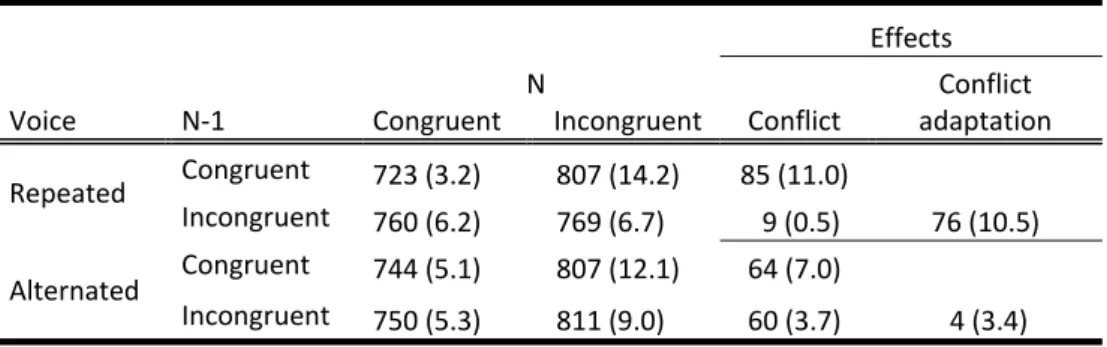
Chapter 4: He said, she said: Episodic retrieval induces conflict adaptation
Chapter 5: Sequential modulations of the Simon effect depend on episodic retrieval
Chapter 6: Sequential effects in the Simon task reflect episodic retrieval but not conflict adaptation: Evidence from LRP and N2.
Chapter 7: Synopsis and discussion References
Acknowledgements Samenvatting
Curriculum Vitae
5
13
23
45
57
a 99
a 123
129
141
143
148
4
Back in control: The episodic retrieval of executive control
5
C
HAPTER1:
B
ACK IN CONTROLPhilosophers, theologians and psychologists have long wondered how, in a
world full of temptation and distraction, humans are able to attain their various, often difficult, goals. Many religions place great importance on self‐control: Christianity, for example, associates temptation with evil and Buddha supposedly reached enlightenment through self‐restraint. Yet, although religion may help in promoting control in its followers (e.g. McCullough & Willoughby, 2008), it tells us
little about the mechanics by which we are supposed to achieve this.
Early psychologists also sought to explain the mystery of the will in terms of two sides of the same coin: the intention‐, or goal‐related, head and the distraction, or automaticity‐related tail. William James (1890) painted a vivid scenario in which the problem of intention truly becomes clear: “We know what it
is to get out of bed on a freezing morning in a room without a fire, and how the very vital principle within us protests against the ordeal.” Inspired by Lotze (1852), he hypothesized that we are able to do this due to a mechanism that associates outcomes to actions, and that the mere thinking about this outcome can then produce the action. Thus, thinking about all the things one can do outside of bed
should prompt abandoning the warmth of the bed. As for the distraction, an early example may be found in Sigmund Freud (1923), who, noting that our subconscious is driven by erotic and violent urges, installed a more rational agent in his model of psychoanalysis, which could suppress the secret desires from fully coming to the
fore.
Both ideas, and many of the proposed mechanisms, are surprisingly alive in modern thinking about how we exercise control. To empirically test James’ ideomotor model, Elsner & Hommel (2001) designed a task in which, first, participants’ free‐choice actions produced audible consequences. In the second
6
they were now presented with effects A and B and asked to perform action 1 or 2.
Proving that, apparently, bi‐directional links had been established between the actions and their associated effects, participants took longer to produce actions that previously were not followed by the effect (such as performing action 2 after hearing effect A).
The other side, related to temptation and distraction, has never ceased its
hold over the public, and psychological, imagination. In the wider psychological literature, the concept of temporal discounting refers to the ability to delay short term gratification in favour of reaching long‐term goals (cf. Mischel, Shoda & Rodriguez, 1989). Recent research in that area suggests that there is a limited
capacity for self‐control and that after exercising it, a state of fatigue that Baumeister, Vohs & Tice (2007) term ‘ego‐depletion’ sets in. Apparently, although we are able to restrain ourselves from acting upon temptations, there is an ironic limit to freedom: will‐power.
Several effects in experimental psychology also illustrate how distraction
affects behaviour. Research has shown that it is hard to name the colours in which words are printed if they do not match the word themselves (Stroop, 1935), to respond left to stimuli appearing right (Simon & Rudell, 1967) or to ignore the flankers of a central stimulus (Eriksen & Eriksen, 1974). Similar to ideas of temptation and distraction, such effects have often been taken to involve an
automatic dimension to stimuli – automatic reading of words in the Stroop task, responding towards the source in the Simon effect, and processing the peripheral stimuli in the flanker task. And, similar to the urge‐suppressing qualities of the ego, the eventual (after some 20 to 80 ms) success in not being tricked by this automatic route was implemented by means of an inhibiting agent, commonly referred to as
executive control.
7 both, as well as to their interaction. The key to this will be the concept of episodic
retrieval, the mechanism by which earlier memories, or episodic traces, can be
brought back by being reminded of them, and that may help or hinder present processing. Our bed‐stricken William James, for example, was reminded of his many tasks of the day, and only then came to action. It may be that he brought back such ideas by pure volition, but more in line with present thinking on this
subject that take a more mechanistic stance towards the will (c.f. Libet, Gleason, Wright & Pearl, 1983; Haggard, 2008), merely looking at the window next to his bed may have reminded him; the idea that a world is out there, in essence, retrieved.
Chapter 2 introduces the experimental paradigm of which several variations are used throughout this dissertation. An arrow pointing left or right cues an initial left or right response (R) to two words that follow immediately after, and that, together, comprise the first stimulus (S1). After a blank inter‐stimulus interval (ISI), again two words appear (S2), one of which is underlined. Now, the
participant is to respond with a left key‐press if the underlined word describes an animated object or life‐form, and else respond right (though vice versa in half the subjects).
According to the Theory of Event Coding (Hommel, Müsseler, Aschersleben & Prinz, 2001), the co‐occurrence of S1 with a response should result in a mental
representation that effectively integrates the stimuli and response. The episodic traces thus bind the number of visual and motor components of this event into one coherent whole, which is retrieved if parts of it are encountered again. As a result, if the subsequent event is exactly the same (i.e. if the two words of S2 are the same as the two words of S1 and the required response of S2 is the same as the cued
8
of S2 were the same as S1, but the required response would be different, the
retrieved event should hinder the new response (Hommel, 1998).
In Chapter 3, this framework of feature‐integration and retrieval is expanded to include adaptive processes. Suppose, for example, we see a cup of coffee. This would normally involve integrating its features; it is warm, located about thirty centimetres from my hand, has a cylinder shape and white outer
colour with black substance inside, and would maybe come with a strong grasp affordance. Consider, however, if we would see a similar cup at a different location. How does the brain bind the features of cup A without confusing it with cup B? Or, is it actually the same cup, but moved to the new location?
A series of three experiments show that bindings are not only retrieved, but can also be adapted. As in Chapter 2, participants were cued to respond to an initial display (S1), this time comprising a circle or star in one of two boxes on a screen. After a short ISI, another circle or star was shown in one of the two boxes, but now (during S2), a key‐press response was to be made on the basis of the
shape. As location‐repetition, shape‐repetition and response‐repetition was fully randomised, the three bindings, and the cost of repeating one, but not the other, could be studied separately (as in Hommel, 1998). Of crucial importance to our purposes, however, during the ISI, the boxes – in which the shape had previously been presented – gradually rotated around their axis. According to Kahneman,
Treisman & Gibbs (1992), this should effectively result in representations that has the shapes localised in the box (e.g. if the shape first appeared up, then rotated 180°, it would be represented down). Going beyond that prediction, we showed that not only the location‐shape binding is updated, but also the location‐response binding, whereas the only feature‐pair that does not include location (shape‐
9 In Chapter 4, the issues of conflict and control are again picked up. As
stated before, akin to the Freudian idea of the ego suppressing unwanted actions, experimental psychological models of executive control typically argue for the existence of inhibiting processes that resolve conflict. Data from sequential conflict studies are often taken to support such views. Gratton, Coles & Donchin (1992), for instance, observed that after an initial conflict effect (e.g. responding right to
<<><<), participants are better in resolving further conflict (<<><<). Likewise, Stürmer, Leuthold, Soetens, Schröter & Sommer (2002) found better performance with incompatible Simon‐tasks (responding left to a stimulus right) if they followed incompatible stimulus‐response conditions than if they followed compatible trials.
This effect, that is usually called conflict‐adaptation or the ‘Gratton‐effect’, can be seen as evidence for the conflict‐monitoring model (Botvinick, Nystrom, Fissell, Carter & Cohen, 1999). The anterior‐cingulate cortex (ACC) continuously monitors for the occurrence of stimulus‐response conflict and, when found, adjusts attention either by inhibiting the location‐to‐response route (Stürmer et al., 2002) or by
changing decision‐making strategies in order to avoid the re‐occurrence of conflict (Botvinick, 2007). Thus, in marked contrast to the ego‐depletion mentioned before, after experiencing distraction once, it becomes easier to resist it the second time.
Despite the elegance of this model, testing it with sequential conflict paradigms has some caveats. Mayr, Awh & Laurey (2003), for instance, noted that
it is well‐known (e.g. Bertelson, 1963; Meyer & Schvaneveldt, 1971) that repeating stimuli or responses typically lead to enhanced performance, and that, therefore, response‐priming could account for the performance benefits of some conflict‐ conflict sequences (such as when a ‘>><>>’‐trial is followed by a ‘>><>>’‐trial) without referring to any higher‐order mechanisms. Even if no feature is repeated,
10
alternating events (such as ‘>><>>’ Æ ‘<<><<’) are expected to have faster reaction
times, not due to their conflict being repeated, but due to their bindings not overlapping. In Chapter 5, the hypothesis that sequential effects basically boils down to overlapping features rather than repeating conflict is referred to as our radical position.
As a consequence, various studies sought to disentangle response‐priming,
feature‐integration and conflict‐adaptation using complex designs or clever statistical techniques. Kerns et al. (2004), for example, kept feature‐repetitions constant, while Wühr & Ansorge (2005) used four‐alternatives Simon effects and included repetitions as independent factors in their design, whereas Notebaert &
Verguts (2007) used multiple regression to find the source of sequential effects. Although such approaches are not without problems (see introduction to Chapter 5), the evidence they brought forth suggests both conflict‐monitoring and feature‐ integration account for part of the variance in sequential conflict studies.
Another possibility that is largely unexplored, however, may be that the
two accounts are not so mutually exclusive or even independent as portrayed. Studies showing the boundaries of conflict‐adaptation indicated this possibility initially. Conflict adaptation seems to be absent, for example, if no similarities exist between the current and previous task (Notebaert & Verguts, 2008; Akçay & Hazeltine, 2008). As task‐parameters may be bound in event files (Waszak, Hommel
& Allport, 2003), an interesting third option may exist: control‐related parameters might be integrated as parts of event‐files, retrieved if a current event shares features with a previous one. In Chapter 5, this hypothesis is tentatively named the less radical position.
11 Chapter 4 tested this hypothesis using a sequential Stroop effect. In a task
in which participants were to respond “high” and “low” to high and low tones respectively, voices saying “low” or “high” were used as distracters. Importantly, the voice sometimes switched between two trials. If this was the case, for example if a participant first responded “high” to a high tone with a female voice saying “high”, and then “low” to a low tone with a male voice saying “high”, no conflict‐
adaptation occurred. It thus appeared that due to the change in voice – an entirely irrelevant change of features – the retrieval of the previous event was disrupted, and therefore also its control.
In Chapter 5, this investigation, but using a sequential Simon paradigm, is
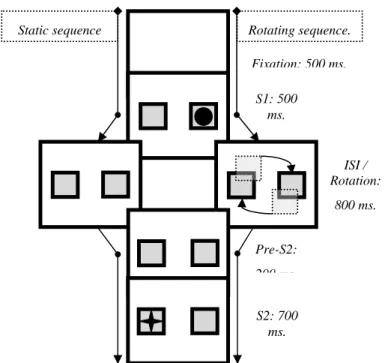
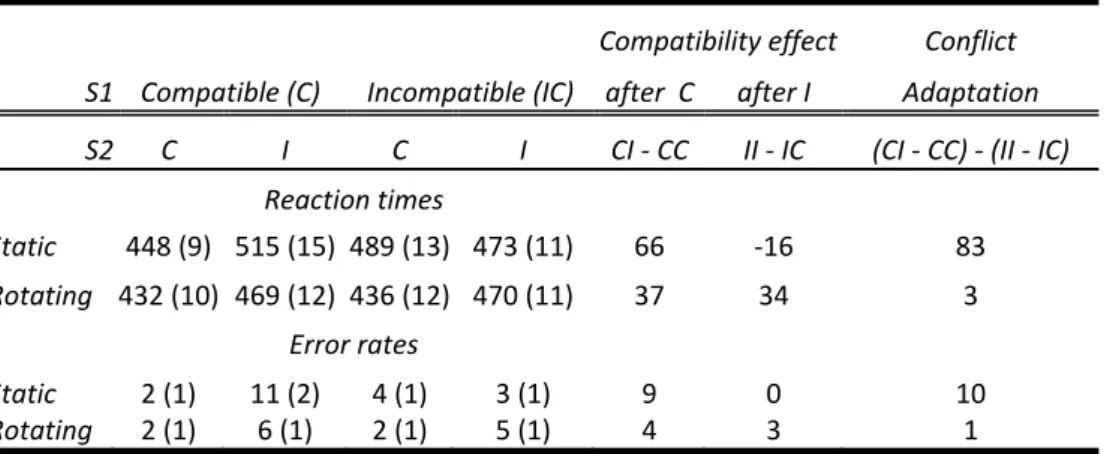
continued. With the adaptive feature‐integration information obtained from Chapter 3, similar conclusions as in Chapter 4 were predicted. In one scenario, for example, participants were first to respond left to a stimulus left, then left to a stimulus right (i.e. a compatible‐incompatible scenario, typically leading to the slowest reaction times). In another, exactly the same compatibility and feature‐
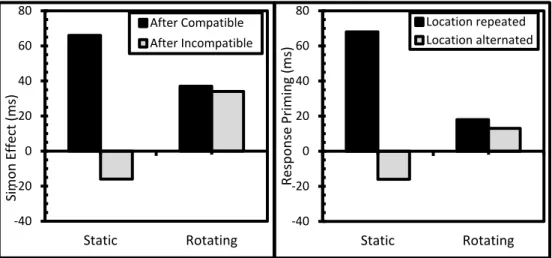
repetition conditions were used, except that during the ISI, the box in which the stimulus initially appeared rotated from left to right. Closely replicating the findings of Chapter 3, this greatly reduced partial repetition costs, but, more importantly, it likewise reduced conflict‐adaptation effects to near‐zero (similar to the findings of Chapter 4). It was thus suggested that the transition from trial to trial changed
episodic retrieval, and because of this, also conflict‐adaptation.
Finally, in Chapter 6, a similar sequential Simon experiment is conducted in an EEG setting to investigate the influence of the rotation on psychophysiological markers of conflict. As Stürmer et al. (2002) found, conflicting location information may activate the response in the erroneous hemisphere (i.e. the one ipsilateral to
12
manipulation of Chapter 5 should modulate this interaction, as well as an evoked
response potential commonly referred to as the N2. Supporting our claim of episodic retrieval induced conflict‐adaptation, rather than proactive interference, all effects showed up as a result of S2 presentation, rather than during S1’s rotation.
In light of the evidence presented in this dissertation, it seems quite
possible that William James got out of bed, exercising control, because he was reminded of his duties. Rather than seeing ‘conflict’ as somehow an intrinsic part of a stimulus in a psychological laboratory, we should also remember how much of conflict and control are only there because of retrieval processes. Conflict, in a
Stroop task, depends on the instruction – which presumably by reading triggers the correct stimulus‐response associations. For example, the word green in black ink only becomes conflicting because we have learnt to read very fast, rather than naming colours of everything we see. One may even say that, in essence, we are
primed to read words and, in models on language we retrieve their (lexical,
semantic, phonetic) features from memory as a result. Similarly, in a Simon task, the stimuli can be conflicting only because our goal is to respond left and right (Hommel, 1993), not merely because they happen to be left and right. Therefore, priming or episodic retrieval should not be seen as the common, “low” mechanism that is independent from conflict, but as having a pivotal role as to why we need
executive control in the first place, and how we use it to get to where we want.
13
C
HAPTER2:
T
HE CONTROL OF EVENT‐
FILE RETRIEVALSingle co‐occurrences of stimulus events and actions are integrated and
encoded into episodic “event files”. If later presented with one or more of the
constituent features of such a file, the other previously bound features are
retrieved, which creates conflict if these do not match the current episode (partial‐
repetition costs). Partial‐repetition costs depend on the task relevance of the
repeated features: task‐relevant features create higher costs, suggesting that the
handling of event files is under contextual control. To disentangle whether control
affects the creation or the retrieval of event files, we employed a task that
prevented the control of creating stimulus‐response bindings. Participants were
precued to carry out a manual response to the onset of two irrelevant words, before
categorizing one of two words (the target) by means of a manual binary choice
response while ignoring the other word (the foil). Repeating the target word
interacted with response repetition, showing the standard partial‐repetition cost,
while repeating the foil had no effect. This does not necessarily rule out that event‐
file creation is under contextual control, but it demonstrates that event‐file retrieval
is.
14
Introduction
Just like that of other primates, the human brain is highly modular and processes the different features of an event, and of the action it possibly requires, in various cortical areas. Though this division of labour lends many useful qualities to the brain, it also raises the question how all the processes devoted to coding a given event are coordinated. Impressed by the considerable number of visual
areas, researchers assume that visual features belonging to a given event are somehow bound into what Kahneman, Treisman, and Gibbs (1992) have called an object file. Research on feature integration has indeed provided evidence that the features of an object are spontaneously bound, so that repeating one of these
features is particularly beneficial for performance if the other features also repeated (for an overview, see Hommel, 2004).
Modularity and parallel processing is not restricted to the visual system, suggesting that binding processes cross borders between sensory modalities and perception and action. Indeed, if participants carry out two actions in a row (R1 and
R2) in response to two stimuli (S1 and S2), stimulus repetition effects and response repetition effects interact: performance is better if either both stimulus and response are repeated or if they both change than if the stimulus is repeated and the response alternates or vice versa (Hommel, 1998). In other words, there are
partial‐repetition costs (as compared to complete repetitions or alternations),
suggesting that a single co‐occurrence of a stimulus and a response is sufficient to integrate the two into a kind of event file (Hommel, 1998, 2004). This file is retrieved automatically if it matches at least one feature of the present stimulus or response, which creates conflict if this entails the retrieval of a stimulus or response feature code that is actually not present or necessary. For instance,
15 same response a second later retrieves this trace, which creates conflict if either
another response is required more the present letter is different from X.
Further research has revealed that stimulus‐response binding is not
comprehensive, in the sense that a whole object is bound to an action, but feature based. For instance, if people attend to shape information, they show strong evidence of shape‐response binding but not of color‐response binding; if they
attend to color information, this pattern reverses to show strong color‐response binding (e.g., Hommel, 1998). This means that feature binding is spontaneous, in the sense that it takes place even in tasks that do not require the integration of features, but controlled through the current attentional set to particular feature
dimensions. The main question of the present study was which aspect of the handling of event files is being controlled. On the one hand, it may be that the creation of bindings is under attentional control. Features from dimensions that are task relevant may be primed or selected for integration, and thus be more likely to enter the object or event files being created. On the other hand, it may be that the
retrieval of bindings is under attentional control. The creation of bindings may (or may not) be entirely nonselective, but bindings that include task‐relevance features may be more likely to be retrieved when a stimulus and/or a response related to the given binding is encountered (cf., Logan, Taylor & Etherton, 1996). The standard paradigms to investigate repetition effects and their interactions are not
suitable for distinguishing between these two possibilities: A binding effect can only be present if a given binding was both created and retrieved, and its absence does not tell us anything about which of the two preconditions failed to operate.
The present study was designed to overcome this limitation and to modify the standard paradigms accordingly (see Fig. 1). S1, the prime display, consisted of
16
response (R1) that was to be carried out as soon as S1 was presented. That is, the
content of S1 was entirely uninformative but its presence had to be noticed to trigger the prepared R1. A second later, S2 appeared, again two different words. One word was underlined, indicating that this word was to be categorized as referring to an animate or a non‐animate object (requiring a left vs. right keypressing response). This set up required the selection of a target word from the
S2 display, which appeared at a position that was not known when S1 was presented. Accordingly, control processes could affect S2 processing but not S1 processing. The main question was whether the repetition of the (later) target (the word that was underlined and to be responded to upon S2 presentation) would
interact with response repetition to show the standard partial‐repetition costs (i.e., worse performance if the target is repeated but the response alternates, or vice versa), and whether this pattern would also be obtained for the (later) nontarget or foil (i.e., for the word that was not underlined and to be ignored).
If it would be the retrieval of event files that is controlled, one would
expect partial‐repetition costs for the target word but not (or significantly less) for the foil. In contrast, if it would be the creation of event files that is controlled, one would expect equivalent partial‐repetition costs for the target word and the foil. As neither the location nor the identity of the later target could be known upon S1 presentation, any S1 word should be equally bound to the respective R1. If retrieval
would be purely automatic (i.e., unaffected by task relevance), word‐response bindings should be retrieved irrespective of whether the target or the foil word is repeated. Hence, both target repetition and foil repetition should interact with response repetition. If, however, retrieval is controlled by task relevance, only the word‐response binding matching the current target word would be retrieved.
Hence, target repetition should matter while foil repetition should not.
17
Method
Participants
Thirty students from Leiden University voluntarily participated in this experiment for a small fee or course credits. Data from one participant did not enter analysis due to an error rate of more than 50%.
Apparatus and stimuli
Stimuli were presented on a 17” monitor in 800 x 600 pixels resolution and a refresh‐rate of 100 Hz. A Pentium‐III 450 MHz PC running E‐Prime (1.1, SP3) on Windows 98 SE controlled stimulus‐presentation and recorded reactions. The 120 words of animate and 120 words of inanimate referents consisted of 3‐10 18‐point‐
sized characters and varied in width accordingly. For presentation of S1 and S2 two horizontally centered words appeared, one 23 mm above the vertical screen center
and the other 23 mm below the center. Letters were pres
ented
in
black,
bold
‐
printed,
“
New Courier” font on a grey (RGB values 192, 192, 192) background.18
Procedure
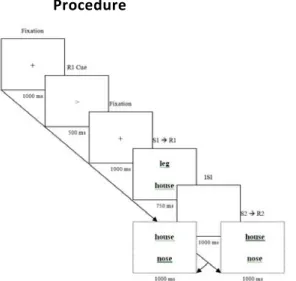
Figure 1: Sequence of events in a single trial. From top‐left to bottom‐left: foil
repeated, target alternated; from top‐left to bottom‐right: foil alternated, target repeated.
As outlined in Fig. 2, a fixation cross was presented for 1000 ms, followed by a small arrow (the R1 cue). The arrow stayed for 750 ms and was replaced by
the fixation cross for another 1000 ms, so that participants had ample time to prepare the cued R1. This response was to be executed on display of S1, two uninformative words. One word was animate and the other non‐animate, with the locations (top or bottom) varying randomly. Participants were not required to attend the words or respond to them in any other way than pressing the pre‐cued
key: <Q> for the left –, <P> for the right‐pointing arrow. After 750 ms, a blank screen was displayed for 1000 ms, creating a stimulus‐onset asynchrony of 1750 ms. Then S2 was shown for 1000 ms, consisting of one word from the animate list and one from the inanimate list, one of them underlined. Half of the participants
were to press <Q> if the underlined word was animate or <P> if it was not, and the other half had the opposite response mapping.
19 3000 ms showing a warning message. The ITI was also used every eighth trial to
give participants feedback regarding their average number of correct responses and average reaction time. The experimented lasted about 30 minutes.
Design
The experiment used a three‐factor (response‐repetition x target‐repetition x foil‐repetition) repeated measures design: The response to S2 was either
repeating or not repeating the response to S1; the underlined word of S2 (i.e., the target) was either repeating or not repeating one of the two words making up S1; and the not‐underlined word (i.e., the foil) was either repeating or not repeating one of the words making up S1 (see fig. 2). Each of the eight combinations of these
factors was presented 40 times, and the word locations of animate and non‐ animate words, the location of the target words, and the two responses were distributed evenly across design cells.
Results
From the 29 participants, correct R2 responses from trials with both
responses being correct were analyzed Few errors were made overall (M = 11.8%, SD = 8.6%), although their pattern was largely consistent with the pattern of reaction times.
In a repeated measures analysis of variance with target‐repetition, foil‐ repetition, and response‐repetition as factors, responses were found to be
significantly faster if the target word was repeated, F(1, 28) = 94.45, MSe = 1088.72, p < .001, and if the foil word was repeated, F(1, 28) = 31.76, MSe = 449.73, p < .001. Responses were slower if the response was repeated, F(1, 28) = 21.55, MSe = 326.03, p < .001—indicating an alternation bias. More important for present purposes, response repetition interacted significantly with target‐repetition, F(1,
20
such interaction was obtained between foil repetition and response repetition, F(1,
28) = .04, MSe = 353.59, p > .8.
Error‐data showed no significant effect of target‐repetition, F(1, 28) = 1.77, MSe = 83.58, p > .19 or foil‐repetition, F(1, 28) = 2.30, MSe = 66.54, p > .14. Responses were less accurate when the response was repeated, F(1, 28) = 15.53, MSe = 1071.27, p < .001. Repeating the response showed a trend towards a
significant interaction with repeating the target, F(1, 28) = 2.95, MSe = 97.96, p < .1, but not with repeating the foil, F(1, 28) = 1.72, MSe = 38.29, p > .1.
To allow for direct comparisons of the interactions between target and response repetition on the one hand and foil and response repetition on the other,
we computed the two corresponding interaction terms, which can be taken to represent feature‐overlap‐costs (see Hommel, 1998). Target‐related reaction time and error overlap costs (OCtarget) were calculated as follows: OCtarget = (target
repeated | response alternated + target alternated | response repeated)/2 – (target repeated | response repeated + target alternated | response alternated)/2.
Correspondingly, foil‐related overlap costs (OCfoil) were calculated: OCfoil = (foil
repeated | response alternated + foil alternated | response repeated)/2 – (foil repeated | response repeated + foil alternated | response alternated)/2. As predicted by the retrieval‐control account, OCtarget was significantly larger than
OCfoil; both in reaction time, t (28) = 1.78, p < .05, and error rates, t (28) = 1.84, p <
.04.
21
Table 1. Effects of repeating target, foil and response on mean and SE (italicized) of
RTs, demonstrating calculus of overlap‐costs.
Discussion
Our findings provide direct evidence for the contextual control of event file retrieval. The way our experiment was set up did not allow for selective integration of one of the two words presented as S1—and yet, partial‐repetition costs were
only obtained for words that were marked as targets in S2. Apparently, then, focusing on the target word selectively retrieved the matching word‐response binding created for the previous S1‐R1 episode (in trials where the word was repeated), whereas bindings matching the unmarked word were not retrieved. This does not exclude the possibility that the creation of event files can be affected by
the task context if the experimental set up allows for it, but given that the present design prevented such an impact our observations must reflect retrieval control. Another implication of our findings is that the two words forming S1 were apparently bound to the corresponding R1 independently from each other— otherwise repeating the target would have been sufficient to also retrieve the foil.
This supports the idea that event files do not bind actions to un‐interpreted visual snapshots but, rather, to feature‐based descriptions of the respective visual event.
Target
Response Alternated Repeated Priming effect
Alternated 677 (13) 641 (13) 36
Repeated 694 (14) 646 (15) 48
Partial‐repetition cost: 12
Foil
Response Alternated Repeated Priming effect
Alternated 667 (14) 652 (14) 15
Repeated 678 (13) 662 (15) 16
22
23
C
HAPTER3:
A
CTIONS TRAVEL WITH THEIR OBJECTS:
E
VIDENCEFOR DYNAMIC EVENT FILES
Moving a visual object is known to lead to an update of its cognitive
representation. Given that object representations have also been shown to include
codes describing the actions they were accompanied by, we investigated whether
these action codes “move” along with their object. We replicated earlier findings
that repeating stimulus and action features enhances performance if other features
are repeated, but attenuates performance if they alternate. However, moving the
objects in which the stimuli appeared in between two stimulus presentations had a
strong impact on the feature bindings that involved location. Taken together, our
findings provide evidence that changing the location of an object leaves two
memory traces, one referring to its original location (an episodic record) and
another referring to the new location (a working‐memory trace).
24
Introduction
Due to the modular, distributed organization of the primate brain, human perception relies on the integration of features coded in various cortical areas of the brain (cf. Treisman, 1996). Consider, for example, the neural correlate of perceiving a red cup placed on a green saucer. The two objects activate several brain regions, including those associated with processing locations and colours –
red and green, top and bottom – creating a confusing situation where the features are easily mixed up into green cups and red saucers. To solve problems of that sort, integration processes have been postulated that bind features of the same object into episodic traces or object files (Kahneman, Treisman & Gibbs, 1992).
Evidence for object files has been provided by studies looking into the after‐effects of feature binding. Kahneman et al. (1992), for example, showed that a visual target letter can be identified faster if it appears as part of the same object in a task‐irrelevant preview display. That is, if the preview display consisted of a number of letters appearing inside of boxes, repeating one of those letters yielded
particularly good performance if it also appeared in the same box. This was the case even if all the boxes moved between the presentation of the preview letters and the eventual target, suggesting that the letters remained represented as part of the boxes and thus, in a sense, moved with them. Kahneman et al. suggested that letters and boxes were bound into common object files, which were updated
when the boxes moved and retrieved as a unit when a letter reappeared.
The assumption that moving an object leads to the updating of its cognitive representation is consistent with the outcome of multiple‐object tracking (MOT) studies. Pylyshyn and Storm (1988) showed that even if objects move rapidly and randomly, their constituent features, such as their identities as being either targets
25 be the only pointer towards different objects that are tracked in parallel, but is
most certainly particularly important for object based attention (Blaser, Pylyshyn & Holcombe, 2000) – later studies refocused research interests onto what exactly constitutes an object and how objects are selected and kept within attention or working memory (Mitroff & Alvarez, in press; Pylyshyn & Annan, 2006; Scholl, Pylyshyn & Feldman, 2001).
At present, it is not clear how – or even whether – the ability to track multiple objects across time and space relies on the maintenance of object‐files. Pylyshyn and Storm (1988) argued that MOT is enabled by means of an early system that attaches indices to visual features in a display. Analogous to “sticky
fingers”, these indices ( “fingers of instantiation”, or FINSTs) remain bound to the objects in a MOT task, limited by their number (around four or five, according to Pylyshyn and Storm) and visual task demands such as the velocity of the objects. Kahneman et al. in turn suggested that these indices might be closely related to object files, hypothesising that they may even be the initial phase of object files.
Further research, however, brought evidence that although object files are related to (cf. Oksama & Hyönä, 2004; Carey & Xu, 2001), they can be experimentally differentiated from (Horowitz et al., 2007), FINSTs.
Object files have been claimed to contain perceptual information about an object but may also include memory‐derived knowledge about the object’s identity
and meaning (Kahneman et al., 1992; Horowitz et al., 2007). Indeed, increasing evidence suggests that object representations comprise pragmatic information about action affordances (Barsalou, 1999; Gibson, 1979; Hommel, Müsseler, Aschersleben & Prinz, 2001). Along these lines, Hommel (1998) provided evidence that action features are integrated and kept bound within object representations,
26
above or below a central fixation. Shortly after that, another stimulus (S2) was
presented to signal a binary choice response (R2) to its shape or colour. When one perceptual feature (such as the shape) was repeated between the two displays (S1 and S2), but another (such as the location) was not, participants responded slower than when both perceptual features were either repeated or alternated—thus replicating the observation of Kahneman et al. (1992). However, the same pattern
emerged across perception and action: when a shape was first reacted to with one button‐press, performance benefits only ensued if participants responded to the same shape in the same way or to a different shape in a different way. In other words, repeating a stimulus feature and alternating the response, or vice versa,
created partial‐repetition costs. Apparently, experiencing the co‐occurrence of a stimulus and a response created an event file that was retrieved upon S2/R2 processing if at least one ingredient was repeated—thus inducing conflict between stimulus or response features if other ingredients did not match with the present features.
In the present study, we asked whether object files as investigated in object‐tracking studies are comparable to event files as investigated along the lines of Hommel (1998; for an overview see Hommel, 2004). The Theory of Event Coding (TEC; Hommel et al., 2001) suggests that they are. Even though the resulting representation may well be complex, highly structured, and multilayered, this
account claims that perceptual and action‐related information is integrated into a network that acts like a functional unit. Hence, if perceptual features travel with the object they are a part of, actions should do so as well. We tested this prediction by combining the original previewing design (S1ÆS2/R2) introduced by Kahneman et al. (1992) with Hommel’s (1998) S1/R1ÆS2/R2 extension.
27
Experiment 1
In Experiment 1, participants were pre‐cued to carry out a particular key press (R1) in response to the onset of a visual stimulus (S1), assuming that this would create a binding between the corresponding stimulus features in the response (see figure 1). Then, the second target stimulus (S2) appeared to signal a binary choice response (R2) to its shape. The location of the two stimuli varied
randomly and could thus repeat or alternate. The crucial manipulation was that each target stimulus appeared in one of two boxes, which did or did not rotate by 180 degree in between S1 and S2 presentation. If stimulus features and/or responses would travel with their object, rotation should have a distinct effect: If
S2 appears in the same physical location as S1, this should amount to a repetition of stimulus location with a static display but to an alternation with a rotating display. This might affect two types of interactions. First, the interaction between the repetitions versus alternations of the two varying stimulus features, shape and location. According to the object‐file literature and object‐tracking studies, the
shape of S1 should be integrated with the box in which it appears and thus move with it. If so, rotation of the boxes should render alternations of the physical locations of the stimuli (S1 top Æ S2 bottom, or vice versa) location repetitions, so
that performance should be better if shape repetitions come with changes of physical location and shape alternations with repetitions of physical location. The
crucial question was whether a comparable effect would be obtained for interactions between location repetition and response repetition. If the response information would travel with the moving box, rotation should result in better performance is if response repetitions are combined with changes of physical location and response alternations with repetitions of physical location. In other
28
Method
Eight male and five female students from Leiden University voluntarily participated. Stimuli were presented on a 14.1” TFT monitor in 800 x 600 pixels resolution and a refresh‐rate of 60 Hz. A Dell dual‐core 1.66 GHz laptop PC running E‐Prime 1.2 on Windows XP SP2 was used to control stimulus‐presentation and record reactions. Cues, targets and boxes were presented in black against a silver
(RGB 192, 192, 192) background. Cues consisted of three greater‐than or lesser‐ than signs, and were centrally presented. Targets were presented in one of two black‐lined, gray‐filled (RGB 128, 128, 128) boxes of 60 x 60 pixels, presented 60 pixels above or below the centre of the screen. Rotation consisted of 45 frames,
with each of these rotating 4 degrees and lasting for approximately 27 ms. Targets were either black (RGB 0, 0, 0) circles or four‐pointed stars.
Figure 1. Sequence of events of two trials in experiment 1.
S1
Press cued response
ISI S2
Press [left] if shape is star, else [right]
Cue “Press [right] next screen Repeated location Repeated shape Alternated response Repeated location Alternated shape Repeated response >>> >>>
29 As outlined in Fig. 1, a response‐cue (<<< or >>>) was presented for 1000
ms, during which the participant was asked to prepare the cued response and to press the corresponding key (‘Q’ for <<<, ‘P’ for >>>) upon the onset of the next screen. This next screen (S1) showed two vertically placed boxes, one of them containing a circle or star. Participants were asked and trained to ignore the shape and to merely respond according to the previously shown cue. Following this, the
shape inside one of the boxes disappeared and the boxes either rotated (in the rotation condition), or remained still (the static condition) for another 1200 ms. Then, during S2, a target was presented for 700 ms in one of the boxes, and now participants were required to respond (R2) within this time interval to the shape
with either a left (‘Q’) or a right (‘P’) key‐press (Q, for circles, P for stars, for example), with the stimulus‐response mapping being counter‐balanced across participants. This was followed by an inter‐trial interval of 1100 ms with feedback in terms of a score that reflected both accuracy (1 point was given for each correct reaction) and speed (2 point were given for each accurate and fast reaction). This
system of feedback was explained during training, which consisted of the first twenty trials of the experiment. The experiment took approximately half an hour.
The experiment used a four‐factor repeated measures design with the factors stimulus‐shape, stimulus‐location, and response repetition versus alternations, and rotation (static versus rotated boxes). Each of the 16
combinations of these factors was presented 24 times, and the direction of the rotation (clock‐ or counter‐clockwise) was balanced across design cells.
Results
S2 reaction times were analyzed only if both reactions were correct and fast (< 700 ms). Overall, few errors were made for S1 (M = 3.8%, SD = 4.2%)
30
= 8.55, MSe = 6246.15, p < .02; and if location alternated, F(1, 12) = 6.18, MSe =
2276.20, p < .03. Rotation significantly interacted with location repetition, F(1, 12) = 6.51, MSe = 3790.65, p < .03, such that the alternation bias during static trials (15 ms) disappeared during rotation trials (‐2 ms). The opposite pattern was observed with response‐repetition, which yielded a significant interaction between rotation and response‐repetition, F(1, 12) = 23.00, MSe = 2433.78, p < .001, the response‐
alternation benefit being smaller in static trials (4 ms) than in rotation trials (18 ms).
Replicating the pattern reported by Hommel (1998), partial‐repetition costs were found (see Figure 2): between location repetition and response repetition,
F(1, 12) = 10.22, MSe = 5452.28, p < .01; and between shape repetition and response repetition, F(1, 12) = 45.84, MSe = 19743.78, p < .001; whereas the interaction between shape and location repetition only approached significance, F(1, 12) = 3.53, MSe = 892.75, p < .09. Finally, the three‐way interaction between all three repetition effects was significant, F(1, 12) = 5.77, MSe = 1482.21, p < .04.
More important for the present study, the two two‐way interactions that involved stimulus‐location repetition were modulated by rotation: location‐by‐ shape, F(1, 12) = 10.73, MSe = 2821.06, p < .01, and location‐by‐response, F(1, 12) = 25.95, MSe = 4459.38, p < .001. In contrast, neither the shape‐by‐response interaction nor the three‐way interaction were further modified by rotation, F(1,
12) = .49, MSe = 214.47, p > .4, and F(1, 12) = .32, MSe = 117.79, p > .5, respectively. Table 1 shows the emerging pattern: While quite substantial partial‐ repetition costs1 were obtained for all three combinations of stimulus features and
1
31 response, rotating the boxes eliminated the costs for the two combinations
involving location repetitions and alternations.
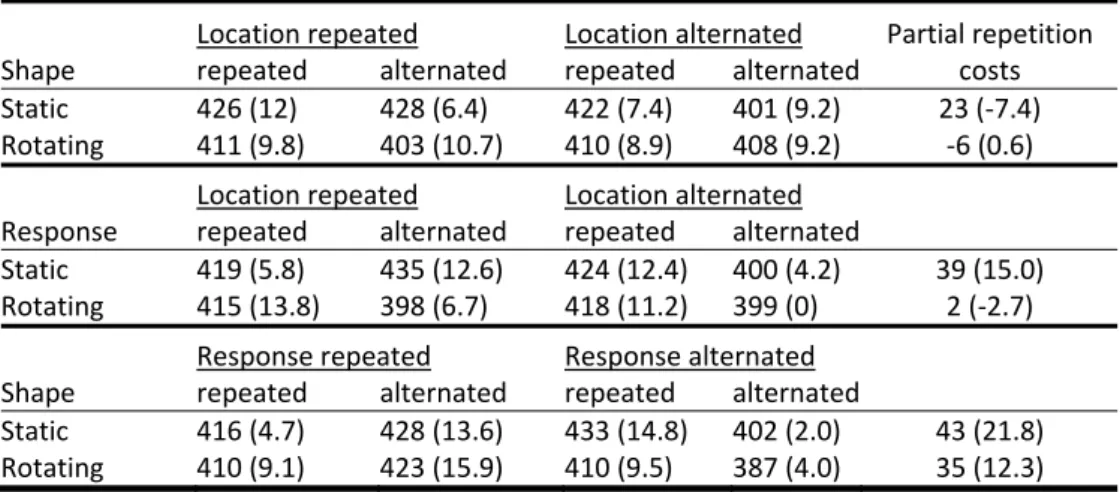
Table 1. Experiment 1: Mean reaction times and error percentages (in parentheses)
as a function of rotation and repetitions versus alternations of shape, stimulus location and
response. For each combination of two features, the partial‐repetition costs are shown.
These were calculated as the interaction term between two features and show the cost in
reaction time resulting from changing either the one feature or the other, as opposed to
changing both or neither one of the two features1.
Location repeated Location alternated Partial repetition
Shape repeated alternated repeated alternated costs
Static 426 (12) 428 (6.4) 422 (7.4) 401 (9.2) 23 (‐7.4)
Rotating 411 (9.8) 403 (10.7) 410 (8.9) 408 (9.2) ‐6 (0.6)
Location repeated Location alternated
Response repeated alternated repeated alternated
Static 419 (5.8) 435 (12.6) 424 (12.4) 400 (4.2) 39 (15.0)
Rotating 415 (13.8) 398 (6.7) 418 (11.2) 399 (0) 2 (‐2.7)
Response repeated Response alternated
Shape repeated alternated repeated alternated
Static 416 (4.7) 428 (13.6) 433 (14.8) 402 (2.0) 43 (21.8)
Rotating 410 (9.1) 423 (15.9) 410 (9.5) 387 (4.0) 35 (12.3)
The analysis of errors was based on proportions and reflected only data from the trials were S1 was correct and sufficiently fast (< 700 ms). In general, the
error patterns followed those of the reaction times. The only reliable main effect indicated that repeating a response yielded more errors than alternating it, F(1, 12) = 5.60, MSe = .05, p < .04. Rotation significantly interacted with response repetition, F(1, 12) = 5.33, MSe = .03, p < .04, and with shape repetition, F(1, 12) = 5.96, MSe = .01, p < .04. Significant interactions were obtained for shape and
shape x response domain were calculated as the response priming‐effect with shape alternated
32
response repetition, F(1, 12) = 55.84, MSe = .38, p < .001, location and response
repetition, F(1, 12) = 8.25, MSe = .05, p < .02, and shape and location repetition, F(1, 12) = 4.85, MSe = .02, p < .05. All three interactions were further modified by rotation: F(1, 12) = 5.97, MSe = .01, p < .04, F(1, 12) = 10.76, MSe = .10, p < .01, and F(1, 12) = 5.08, MSe = .02, p < .05, respectively.
Figure 2. Partial‐repetition costs in Experiment 1 of location‐by‐shape, location‐by‐
response and shape‐by‐response as a function of rotation. The upper part of the figure
shows two conditions in which alternation of one of two features between S2 and S2 results
in partial‐repetition costs.
Discussion
The outcome of Experiment 1 can be considered mixed. On the one hand, it is clear that rotation had a strong effect in the expected direction. Whereas standard partial‐repetition costs were obtained for location and response
repetitions as well as for shape and location repetitions, rotating the empty boxes in between S1 and S2 presentation eliminated these costs. Also as expected, rotation only affected partial‐repetition costs related to location repetitions but not with respect to the interaction of shape and response. On the other hand,
33 update of the respective object or event files. There are at least two interpretations
of this observation.
First, it is possible that moving the boxes induced the creation of a new event file without overwriting the previous one. If, say, a circle appeared in the bottom box before the boxes were rotated, this could have left two shape‐location bindings: one linking circle with bottom and another linking circle with top, the new
location. If the circle would appear again then, it would retrieve two bindings with contradicting spatial information that may cancel out one another. The same logic can be applied to location‐response bindings. Whereas this scenario would be consistent with our main hypothesis, there is a second, theoretically less interesting
possibility however. For various reasons, moving the empty boxes may flush any sort of visual working memory and thus delete any available binding. True, this possibility is ad hoc and does not seem to fit with the results from previewing studies using moving stimuli (Kahneman et al., 1992) and multiple‐object tracking studies (Pylyshyn & Storm, 1988). However, it would be consistent with
assumptions from leading theories on the limitations of working memory capacity and executive control (Gilbert & Shallice, 2002; Logan & Gordon, 2001) and with studies on event segregation (Zacks, Speer, Swallow, Braver & Reynolds, 2007). Accordingly, we considered it important to replicate our findings and to seek for independent evidence supporting the multiple‐binding interpretation.
Experiment 2
We attributed the disappearance of partial‐repetition costs in the rotation condition of Experiment 1 to the existence of two types of event files: one linking shape and response information to the physical location of S1 and another linking this information to the updated location, that is, to the post‐rotation location of
34
than letting it abruptly disappear. Zacks et al. (2007) have claimed, and provided
evidence, that unpredicted visual changes are more likely to lead to the closing of the current event representation and the opening of a new one, whereas predicted changes merely induce an update of the currently open representation. Smoothing the transition between S1 and S2 may thus help linking these two events to one another or, more precisely, the event files representing them. If so, chances are
that only one updated file would be maintained at least in some trials or that the updated file would dominate the previous one more strongly. This should drive the result pattern in the rotation condition more in the expected direction, that is, partial‐repetition costs for location‐related interactions should no longer be zero
but go negative. We thus replicated Experiment 1 but added a further condition in which S1 gradually faded out.
Method
Six male and 10 female students from Leiden University voluntarily participated. The method was as in Experiment 1, except that in fading conditions,
the opacity of the stimulus shown in S1 decreased with each of the 45 frames by approximately 2.2% during the inter‐stimulus interval. Thus, it appeared to gradually fade out, while its position remained anchored to the box of its prior appearance.
Results
Overall, few errors were made for S1 (M = 4.2%, SD = 3.5%) compared to S2 (M = 17.8%, SD = 7.4%). In a repeated measures five‐way ANOVA with fading, rotation, shape‐, location‐ and response‐repetition as factors, responses were found to be slightly (8 ms) slower in fading conditions than in abrupt conditions, F(1, 15) = 11.05, MSe = 8959.92, p < .005, in static conditions than in rotating
35 than alternated, F(1, 15) = 6.68, MSe = 2918.48, p < .02. Neither repeating the
location, p > .1 nor repeating the shape, p > .7, affected reaction time.
The partial‐repetition costs of Experiment 1 were replicated (see Figure 2): reliable interactions were obtained between location repetition and response repetition, F(1, 15) = 17.35, MSe = 12475.48, p < .001; and between shape repetition and response repetition, F(1, 15) = 68.66, MSe = 72317.37, p < .0001; but
not between shape and location repetition, p > .8. The three‐way interaction involving all three repetition effects was far from significant, F(1, 15) =.11, MSe = 68.50, p > .7.
Replicating the main findings from Experiment 1, partial‐repetition costs
involving location repetitions were modulated by rotation: location‐by‐shape, F(1, 15) = 8.04, MSe = 4192.07, p < .02, and location‐by‐response, F(1, 15) = 25.52, MSe = 17819.65, p < .001. Again, neither the shape‐by‐response interaction, F(1, 15) = .24, MSe = 99.77, p > .6, nor the three‐way interaction, F(1, 15) = .03, MSe = 16.06, p > .8, was affected by rotation.
36
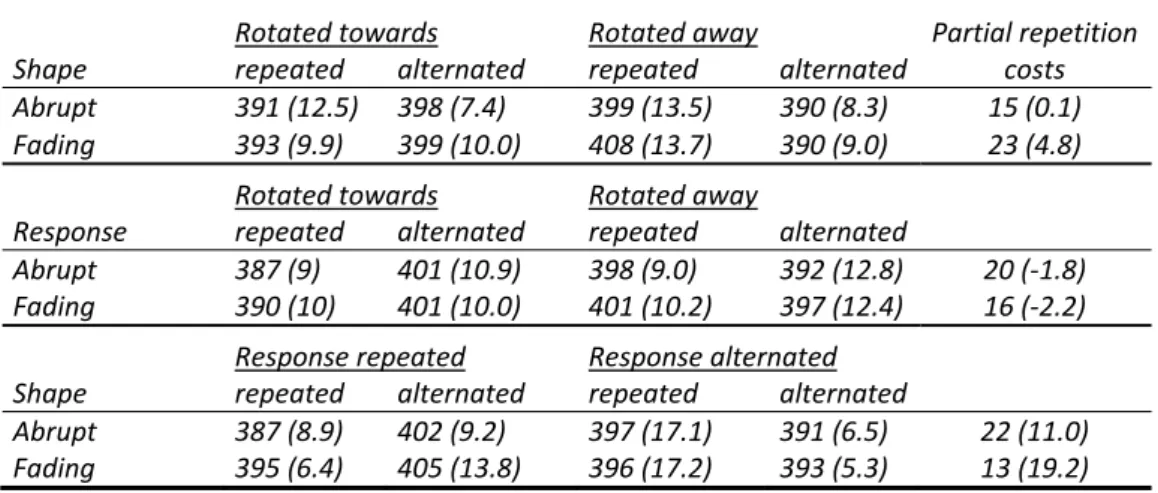
Table 2. Experiment 2: Mean reaction times and error percentages (in parentheses)
as a function of stimulus fading, rotation, repetitions versus alternations of shape, stimulus
location and response.
Location repeated Location alternated Partial rep.
Shape repeated alternated repeated alternated costs
Abrupt Static 430 (12.2) 444 (10.2) 433 (8.8) 425 (9.2) 23 (‐2.4)
Rotating 414 (12.5) 416 (10.0) 412 (8.8) 420 (11.5) ‐7 (‐5.2)
Fading Static 444 (13.0) 442 (10.0) 442 (10.0) 441 (12.0) ‐1 (‐5.0)
Rotating 431 (13.9) 419 (13.9) 418 (11.4) 424 (13.2) ‐17 (‐1.7)
Location repeated Location alternated
Response repeated alternated repeated alternated
Abrupt Static 426 (7.7) 449 (14.8) 438 (11.4) 420 (6.6) 41 (12.0)
Rotating 416 (12.4) 414 (10.1) 421 (10.3) 424 (13.2) 8 (‐2.0)
Fading Static 437 (8.4) 449 (14.7) 458 (15.1) 425 (7.0) 45 (14.4) Rotating 432 (16.3) 419 (11.6) 420 (14.5) 422 (10.1) ‐16 (‐0.1)
Response repeated Response alternated
Shape repeated alternated repeated alternated
Abrupt Static 419 (5.5) 445 (13.6) 444 (15.5) 424 (5.8) 46 (17.7)
Rotating 407 (7.0) 430 (15.7) 419 (14.2) 406 (5.9) 35 (17)
Fading Static 435 (4.5) 460 (18.9) 451 (18.5) 424 (3.1) 52 (29.8)
Rotating 413 (8.0) 438 (22.8) 436 (17.4) 405 (4.3) 57 (27.9)
The fading condition affected this pattern in two significant ways. First, it modulated the interaction between response repetition and rotation that was observed in Experiment 1, F(1, 15) = 5.48, MSe = 1354.86, p < .04: In the fading
condition, the response alternation bias no longer changed after rotation. Secondly, it modulated the interaction between location and shape, F(1, 15) = 9.07, MSe = 2321.87, p < .01: Whereas partial‐overlap costs were positive with abruptly disappearing stimuli, these costs were negative with fading stimuli (see Table 2).
37 location x shape, t(15) = ‐2.41, p < .02, and marginally significant costs for location x
response, t(15) = ‐1.61, p = .06; no effects were reliable in the error data, p’s > .3.
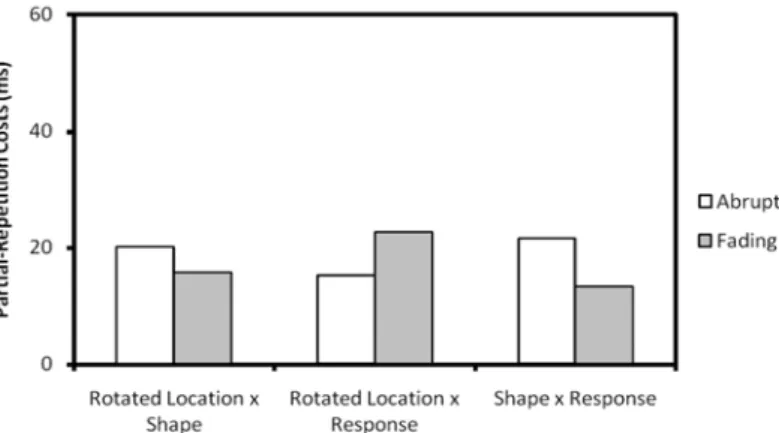
Figure 3. Partial‐repetition costs in Experiment 2 of location‐by‐shape, location‐by‐response
and shape‐by‐response as a function of rotation and fading.
Error patterns followed the reaction times. Fading stimuli increased the error rate, F(1, 15) = 5.24, MSe = .04, p < .04. Location interacted significantly with response, F(1, 15) = 21.11, MSe = .117, p < .0005, as did shape, F(1, 15) = 73.15,
MSe = 1.71, p < .0001. The interaction between location and response was modulated by rotation, F(1, 15) = 18.33, MSe = .16, p < .001. Fading did not interact with any factor or interaction other than the shape x response interaction, F(1, 15) = 11.85, MSe = .107, p < .005, with a greater effect of partial repetition in fading trials (see Figure 3).
Discussion
The outcome is clear‐cut. We were able to replicate the main findings of Experiment 1 with abruptly disappearing stimuli: Substantial partial‐repetition costs were obtained for all three combinations of stimulus features and responses with static boxes, while these costs were eliminated for location‐related
38
similar outcome as in the abrupt condition but rotating the boxes produced a very
different pattern. As expected, the partial‐repetition costs including location were no longer close to zero but significantly inverted. Hence, there is evidence that the fading manipulation had the expected effect of increasing the contribution from the updated (i.e., post‐rotation) event files, which supports the suggestion of Zacks et al. (2007) that smoother and thus more predictable changes between two
events facilitate their integration.
Even though it seems clear that improving the visual link between S1 and S2 led to the integration of the corresponding event representations and that this integration was apparently prevented in Experiment 1, there are still two possible
interpretations of how that may have produced the findings we obtained there. According to one scenario, separate event representations for S1 and S2 were created and maintained in Experiment 1 because the abrupt visual change worked against their integration. The absence of reliable effects in the rotation condition would thus reflect the common impact from two event files that effectively cancel
each other out. According to the other scenario, the more abrupt visual change in Experiment 1 may have simply flushed visual working memory and deleted the representation of S1. Hence, even though Experiment 2 demonstrated that event‐ file updating does take place under conditions that favour event integration, it does not provide sufficient evidence to determine what happens under less favourable
conditions. Experiment 3 was conducted to fix that.
Experiment 3
In Experiment 3, we investigated whether an abrupt visual change between S1 and S2 (as in Experiment 1) only prevents the integration of these events (and, thus, the updating of the S1 representation towards S2) or whether it leads to the