METAL ELEMENTS, ORGANIC AGENTS IN A HERBAL
REMEDY, SPECIES THYMI COMPOSITA, AND ITS
DRUG-CONSTITUENTS
Klára Szentmihályi
a*, Zoltán May
a, Mária Then
b, Mária Hajdú
b, Andrea Böszörményi
b, Andrea
Balázs
b, Éva Lemberkovics
b, Gabriella Marczal
b, Éva Sz
ő
ke
bKeywords: herbal remedy, Species thymi composita, respiratory diseases, essential oil, elements
Beside plant drugs the application of herbal mixtures using in several indication fields is very popular in our time. Since these herbal mixtures contain several bioactive agents, their analysis may cause difficulties. Therefore the description of measurements of components and their standardization is generally missing from the Pharmocopoeias. The examined Species thymi composita (STC) is highly effective because of its cholagog, carminative, expectorant, anticatarrhal etc. activity. STC is the mixture of Althaeae radix et folium
(marshmallow leaf and root), Verbasci flos (mullein flores), Liquiritiae radix (liquorice root) and Thymi herba (thyme). The macroscopic and microscopic identification of components, phytochemical characterization have been described, the element composition of the herbal mixture, plant drugs constituents and teas was studied and the in vitro element absorption was examined. It has been stated that the STC could be characterized by its mucilage content and volatile oil composition. STC and its tea contain elements as well and the in vitro absorption of some of elements showed relatively high amount. The presence of bioactive compounds, volatile oil components, mucilage and elements may be jointly important in the complex effect, although the relatively higher Mg and Zn content in the tea is particularly relevant that acts via signal transduction process.
Corresponding Author Fax: +36-1-438-1139
E-Mail: [email protected]
[a]
Institute of Materials and Environmental Chemistry, Research Centre for Natural Sciences, Hungarian Academy of Sciences, H-1025, Budapest, Pusztaszeri str. 59-67, Hungary[b] Institute of Pharmacognosy, Semmelweis University, H-1085, Budapest Üllői road 26, Hungary
1. Introduction
Herbal mixture is one of the best fashionable form of medicinal plant products, firstly in the circle of senior population, considering that medicinal tea contributes to the replacing of liquid in the organism. Beside herbal mixtures putting into circulation by different forms are fundamentally important. The herbal mixtures official in the Formulae Normales VII. (FoNo VII.)1 and their drug components in
the Hungarian Pharmacopoeia VII. (Ph.Hg.VII.)2. They are
used in numerous indication fields, for example: cholagog, carminative, sedative, laxative, diuretic, antitussive, expectorant and anticatarrhal.
The herbal mixture Species thymi composita is official in all (I.-VII.) FoNo prescriptions, although their composition is various and the drug-components –which are directly responsible for the effect- can be found in each composition (Table 1).
The composition of Species thymi composita was the richest firsty in FoNo IV. in which 10 dried herbs were applied. Beside the expectorant active Thymi herba (thyme
oil), there are Farfarae folium, antitussitive and antibacterial active Althaeae folium et radix (mucilage), Sambuci flos
(flavonoids), Verbasci flos (volatile components, flavonoids and mucilage), antiimflammatory active Liquiritiae radix, Primulae radix (saponins) and Papaveris rhoados flos
(alkaloids, anthocyanins), Pulmonariae herba (silicic acid) 3-7. The Species thymi composita of FoNo V. contains only 7
drugs and in FoNo VI. 6 drug components are only present. The content of water soluble hepatotoxic pyrrolizidine alkaloids justify the omission of Farfarae folium8. The
Primulae radix was also omitted from the tea-mixture regarding the Primula species would be declared as protected plants. The composition of Species thymi official in FoNo VI. and VII. is the same, they consist of 5 drug constituents containing essential oil (tyme), mucilage (marshmallow and mullein), flavonoids (mullein), saponin (liquorice), as active compounds9-14.
The aqueous extract (tea) of Species thymi composita
prepared by prescription of FoNo has very active catarrh- and cough-resolvent and expectorant activities2. Coughing is
a complex reflux, which purifies the respiratory tracts from the foreign substances and the secretion formed in excess. In case of cold diseases the coughing irritation is caused by the inflammation of the respiratory mucous membrane so the respiratory secretion is produced in extreme scale which is already not removed by the mucociliaric transport2. The
secretolytic and secretomotoric activity of expectorant remedies decreased the irritation, consequently they have cough-reliever effect. The thyme belongs to the group of expectorants possessing direct effect mechanism15. The
Table 1. Drug constituents (in weight, g) of species Thymi composita
Drug constituents of herbal mixture
FoNo IV. (1958)
FoNo V. (1967)
FoNo VI. (1987)
FoNo VII. (2004)
Thymi herba 4 4 14 14
Farfarae folium 4 - - -
Pulmonariae herba 4 - - -
Althaeae folium 4 4 10 10
Althaeae radix 4 4 10 10
Sambuci flos 4 4 - -
Liquiritiae radix 4 4 10 10
Primulae radix 4 4 - -
Verbasci flos 2 2 6 6
Papaveris rhoados flos 2 - - -
Since there is no description for studying the mixture
Species thymi composita (STC), the aim of our work was the pharmacobotanical ad phytochemical evaluation of herbal mixture Species thymi composita, official in the last FoNo (VII.) and their drug constituents and aqueous extracts (tea), respectively. Therefore, prominently the contents and composition of essential oils obtained from herbal mixture and drugs were studied. Our main research field was the mineral element analysis of herbal mixture, drugs and their aqueous extracts (teas) as well as the study of element absorption in different circumstances.
2. Experimental
2.1. Plant materials
The following plant drugs were used in the experiment:
Althaeae radix et folium, root and leaves of marshmallow (Althaea officinalis L., Malvaceae); Verbasci flos, flowers of orange mullein /wooly mullein (Verbascum phlomoides
L., Scrophulariaceae); Liquiritiae radix, root of liquorice (Glycyrrhiza glabra L., Fabaceae); Thymi herba, aerial part of common thyme (Thymus vulgaris T. zygis L., Lamiaceae) which was obtained from commercial network (Herbária, Budapest, 2008).
The drug constituents were purchased from trade in cut (scissa) condition. The herbal mixture Species thymi composita (STC) was compounded according to the description of FoNo VII.1
2.2. Extracts
The preparation of aqueous extracts (tea, infusum) of drugs and herbal mixture was the follows: One table spoonful (3-5 g) of herbal mixture is poured off with a cup (300 mL) of hot water and left it to stand for cooling down, then the tea was filtrated (pH=6.2).
The essential oil was obtained by steam distillation, and the determination of essential oil content of herbal mixture and the drugs was carried out by volumetric measuring process according to the Hungarian Pharmacopoeia.16
2.3. Plant morphology and microscopy
The morphological and microscopical examinations were made on the basis of prescriptions of Hungarian and European Pharmacopoeias (Ph.Hg. VIII., Ph.Eur. 5.)16,17.
2.4. Mucilage content
For characterization of mucilage content of marshmallow root and leaf, and the herbal mixture, as well as the swallow value was determined according to Hungarian Pharmacopoeia (Ph.Hg.VIII.)16.
2.5. Gas chromatographic examinations
The analysis of essential oil composition was made by gas chromatographic (GC) ad GC-MS methods: Analysis of composition of essential oils was performed by gas chromatography accomplished with a Fisons 8000 gas chromatograph, equipped with a flame ionisation detector. A Rt-β-DEXm capillary column, 30 m long, 0.25 mm id., 0.25µm film thickness was used. Carrier gas was nitrogen at 6.86 mL/min flow rate: 0.2 µL was injected (5 µL essential oil in 2 mL chloroform). Splitless injection was made at 10 s, split ratio was 1:50. Temperature of injector and detector was 210 ºC and 240 ºC, respectively. Oven temperature increased with a rate of 8 ˚C/min from 60 to 230 ˚C, with a final isotherm at 230 ˚C for 5 min. Percentage evaluation of compounds was carried out by area normalization; identification of peaks was made by comparison of retention times of standards and co-addition of standards. All measurement was made at duplicate.
GC-MS was performed with a coupled system Agilent 6890N GC, 5973N mass selective detector, the Chrom Card Server Ver. 1.2 equipped with A HP-5MS capillary column, 30 m long, 0.25 mm id., 0.25 µm film thickness was used. Carrier gas was helium (pHe was 0.20 MPa), at 1mL/min flow rate: 1 µL (10 µL/mL essential oil in ethanol) was injected at 0.7 mg/mL velocity, splitless-type with an Agilent 7683 autosampler. Temperature of injector was 280 ºC, temperature of transfer line was 275 °C. Oven temperature was programmed initially at 60˚C for 3 min, then increased with a rate of 8 ˚C/min to 200 ˚C, then kept at 200 ºC for 2 min and also increased with a rate of 10 ˚C/min to 250 ˚C with a final isotherm at 250 ˚C for 15 min. MS conditions: ionization energy was 70 eV, mass range was 40-500 mz-1, one analysis/min was made. Identification of
peaks was carried out by comparison with MS and retention data of standards, and spectra from the NIST library.
2.6. Element content
For mineral element analysis, an inductively coupled plasma optical emission spectrometry (ICP-OES) was used by the method of Ladó et al. with Spectro Genesis instrument after digestion of the samples with nitric acid (5 mL) and hydrogene peroxide (2 mL)18. Se content was determined by
During the measurement 2 mL sample, 2 mL HCl (1 M) and 2 mL Cu solution (concentration of 5 mg/L) were added to the polarografic cell and the solution was measured.
Table 2. Accuracy of element determination by measurement of Lucerna p-alfalfa reference material standard
Measured values (mg/kg)
Recovery (%)
Certified values (mg/kg) Al 325.9.0±3.6 98.8 330 As <0.5 0.262 Ba 22.94±0.36 98.0 23.4 Ca 17183±20 98.2 17500 Cd 0.127±0.012 93.4 0.136 Co 0.191±0.017 98.9 0.193 Cr 0.890±0.088 98.8 0.900 Cu 11.27±0.09 96.3 11.70 Fe 321.8±2.1 90.6 355 Hg <0.3 0.0282 K 17535±16 93.8 18700 Mg 3664±13 104.1 3520 Mn 30.48±0.13 89.1 34.20 Mo <0.25 0.200 Na 487.6±21.5 102.9 474 Ni 2.87±0.07 112.9 2.54 P 3028±29 99.9 3030 Pb 1.92±0.05 104.3 1.84 Se 0.0501±0.0030 100.2 0.0500 Sr 89.46±0.70 113.6 78.7 V 0.769±0.027 96.1 0.800 Zn 33.51±0.83 100.9 33.2
The accuracy of element determinations was proved by measurements of a certified biological reference material (12-2-03 Lucerna p-alfalfa, Bratislava, Slovakia). The values ranged between 89.1% and 113.6% compared to certified values which show the accuracy of measurements and the well applied digestion method (Table 2). There is no given concentration for Li in the reference material, that’s why in case of Li the recovery was determined by the standard addition method where the Li standard was added to one of the samples and measured. The recovery was found to be 95.4%.
2.7. In vitro element absorption
The transfer of elements from tea to the stomach (gactric acid of pH=1.1; 1 n HCl (94 g), NaCl (0.35 g) and glycocoll (0.5 g) in 1000 mL of water) and from intestine (pH=6.5; Na2HPO3 (3.9 g) and KH2PO4 (6.1 g) in 1000 mL of water)
to plasma (pH=7.5; Na2HPO3 (20.5 g) and KH2PO4 (2.8 g)
in 1 L of water)) was studied on a Sartorius membrane diffusion model at 37 ºC 21. The tea (10 mL) and
concentrated tea in buffer solution pH=6.5 (10 mL) was poured into a container supplied with a membrane at the bottom of it. The container was plunged into a larger container. The larger outside container contained 100 mL of buffer solution (pH=1.1 or 7.5). Fractions (10 mL) were
taken from the outside container at the following time periods: 30, 60, 90 and 120 min. The aliquot taken was supplied with buffer solution (10 mL, pH=1.1 or pH=7.5 depending on the experiment). The evaluation was omitted in the case of Na at pH=1.1 and of K, Na, P at pH=7.5 because of the K, Na, P content in buffer solutions.
2.8. Statistical analysis
Most of the results were expressed in mean ± standard deviation.
3. Results
3.1. Morphology
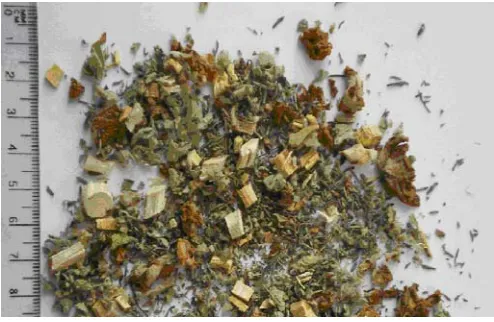
The macromorphological characteristics of scissa drug-costituents could be good recognised in herbal mixture. These diagnostical characteristics of each drug are the follows: the white phloem-fibres of Althaeae radix, the yellow-brawn root pieces of Liquritiae radix, the tomentose leaf-fractions originating from Althaeae folium. The yellowish flow-fractions originating from Verbasci flos, and final the mixture can be recognised firstly on the bases of penetration oder of thyme (Figure 1).
Figure1.Speciesthymi composita
3.2. Micromorphology
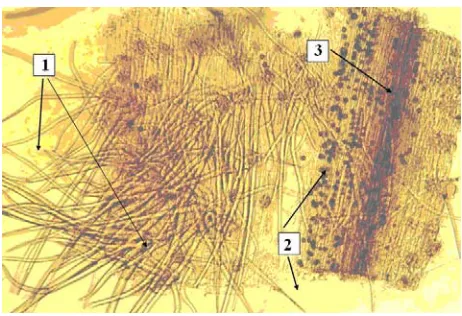
In micromorphplogical point of view the main diagnostical characteristics of STC are the star shaped covering hairs of
Althaeae folium and the branching covering hairs of
Verbasci flos (Figure 2).
We can find the eye-tooth shaped and hooked covering hairs and Labiatae trichomes (glandular hairs) originating from thyme. The calcium oxalate crystals are also characteristics of mixture: rosettes (cluster shaped crystals) from marsmallow and single crystals in fibres of liquorice
radix. The phloem fibres of Althaeae and Liquiritiae radix
Figure 2.Species thymi composita pulvis
1. Liquiritiae radix - fibre containing crystal; 2. Althaeae folium - star shaped trichomes, 3. Cluste r crystals, 4. Liquiritiae radix – fibre bound
Figure 3.Althaeae folium pulvis
Diagnostical characteristic: 1. star shaped covering hairs, 2. cluster crystals; 3. vessels
3.3. Mucilage content
The swallow value of STC is higher than that of Althaeae radix and folium (Table 3).
3.4. Essential oil content and composition
The contents of essential oil obtained from Thymi herba,
STC and its infusum are demonstrated in Table 4. The essential oil content of STC is in good agreement with the expectable value, calculated on the basis of essential oil content measured in the thyme leaf. The composition of essential oil obtained from Thymi herba, STC and the tea is demonstrated in Table 5 and on the gas chromatograms (Figure 4). In the essential oil of thyme seven characteristic components: β-myrcene, p-cymene, γ-terpenene, linalool, terpinene-4-ol, thymol and carvacrol were identified. These components were detectable in essential oil of the herbal mixture and also in its infusum (tea).
The percentile distribution of the components was similar in oil of thyme and mixture but this rate was changed in the oil of tea: the ratio of polaric phenolic compounds, as tymol and carvacrol increased.
Table 3. Mucilage content
Sample Swallow value
Species thymi composita 17
Althaeae radix 10
Althaeae folium 7
Table 4. Content of total essential oil
Sample Oil content
(mL/100g)
Species thymi composita 0.36±0.03
Thymi herba 1.3±0.25
Tea of Species thymi composita 0.01±0.001
Table 5. Quantitative characterization of essential oil composition in Thymi herba, Species thymi mixture and its tea according to gas chromatographic measurements
Percentile distribution (%) of components in essential oil
drug Species thymi composita
Components
Thymi herba
herbal mixture
tea
1 β-myrcene 1.0 0.7 0.05
2 p-cymene 22.9 19.0 4.6 3 γ-terpinene 7.9 6.4 2.8 4 linalool 2.00 2.4 4.3 5 terpinene-4-ol 1.6 1.9 1.9 6 thymol 48.2 52.4 66.1 7 carvacrol 4.1 3.7 5.0
3.5. Mineral element composition
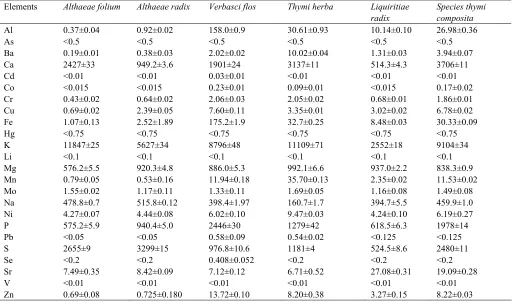
The mineral element content of drug components and STC determined by ICP-OES is found in Table 6.
Concentration under the detection limit was obtained for As and Hg in all cases, while for Cd, Co, Li, Pb, Se and V in some cases. At the same time relatively high amount of Li (Althaeae folium, Verbasci flos, Thymi herba), Pb (Althaeae folium, Thymi herba) and V (Verbasci flos) was found compared to the average plant concentrations, which are under 2, 2 and 1 mg/kg, respectively. A slite soil content is shown by the collectively presence of elevated Al (>200 mg/kg), Cr (>1 mg/kg) and Fe (>300 mg/kg) content in
Figure 4. Gas chromatograms of essential oil of Thymi herba (A),
Species thymi composita (B) and tea of Species thymi composita
(C)
1. β-myrcene; 2. p-cymene; 3. γ-terpinene; 4. linalool; 5. terpinene-4-ol; 6. thymol; 7. carvacrol
Althaeae folium is rich in Ca (>30000 mg/kg), S (>5000 mg/kg) and Sr (>100 mg/kg), Thymi herba contains Mo and Ni over average plant concentration (3 and 10 mg/kg, respectively), while Sr concentration of STC is also salient
22-23. All plant materials contain K in relatively low
concentration (<20000 mg/kg). The poorest herb in mineral elements is Liquiritiae radix in which beside K the concentration of Mn, P, S and Zn also goes under the average plant concentration (<20 mg/kg, <2000 mg/kg, <20 mg/kg, respectively). The mineral element composition of
Althaeae radix is similar to Liquiritiae radix.
The element concentration of most of the toxic and harmful elements in the teas is under the detection limit (Table 7.) which is favourable. According to our previous experiments and papers we can not see any significant concentration in the extracts20-23. The only relevant thing is
that the solvability of Ca seems to be higher in STC which could be happened by the synergic effect of organic components in the drug mixture.
3.6. In vitro transfer of elements
The effect of STC may be connected to the organic bioactive agents but the examination of effectiveness and transfer of compounds is rather difficult. The flavonoid content in tea mixture by usual way was unable to determine because of the disturbing effect of mucilage. Therefore, the transfer of flavonoids is also not measurable and the examination of in vitro absorption of mucilage does not make sense because of its properties. According to our previous measurements the transfer of essential oils and volatile compounds provides only qualitative results20. Since
elements presenting in the extracts may also have favourable effect and they could be well measurable quantitative, the transfer of elements was determined.
Table 8. Amount of elements (µg) transferred from 100 mL aqueous extract of Species thymi composita into buffer solution pH=1.1 and from buffer solution (pH=6.5) with extract of Species thymi composita into buffer solution pH=7.5
30 min. 60 min. 90 min. 120 min.
Into pH=1.1
Al 20.1 21.1 25.2 26.1 Ba 1.4 2.4 2.6 2.5 Ca 1301 1446 1542 1568 Cu 2.2 2.5 2.6 2.7 Fe 10.1 11.3 11.6 12.1 Mg 447 598 703 727 Mn 2.6 3.3 3.6 3.7 Ni 0.31 0.41 0.42 0.44 P 325 409 456 471 S 394 600 702 714 Sr 7.2 8.1 8.6 8.7 Zn 2.5 26 2.9 3.1 Into pH=7.5
Al 3.0 3.4 5.2 6.6 Ba 0.4 0.6 0.8 0.9 Ca 391 443 505 618 Cu 1.7 2.0 2.3 2.4 Fe 3.1 3.7 3.9 4.4 Mg 288 446 562 591 Mn 0.8 1.1 1.5 1.6 S 258 405 537 573 Sr 4.2 4.5 5.0 6.0 Zn 0.82 0.89 0.90 0.91
Table 6. Element content of drug components and Species thymi composita (mg/kgdry weight, n=3)
Elements Althaeae folium Althaeae radix Verbasci flos Thymi herba Liquiritiae radix Species thymi composita
Al 376.6±2.9 83.9±1.54 1168±7 641.7±9.8 47.7±0.3 961.4±20.6 As <0.5 <0.5 <0.5 <0.5 <0.5 <0.5 Ba 13.35±0.03 7.26±0.21 12.05±0.02 74.67±1.32 13.14±0.11 30.50±0.54 Ca 34044±267 6113±20 6616±31 12687±290 9709±63 17480±346 Cd 0.34±0.02 0.25±0.01 0.09±0.01 0.21±0.01 <0.03 0.14±0.01 Co <0.015 <0.015 0.56±0.01 <0.015 <0.015 0.33±0.04 Cr 1.28±0.03 0.97±0.04 3.34±0.05 11.51±0.24 0.90±0.03 3.95±0.07 Cu 15.93±0.02 14.47±0.10 14.88±0.09 12.83±0.23 5.90±0.02 17.59±0.31 Fe 404.2±2.5 66.9±0.35 1288±6 563.5±9.4 69.0±0.2 878.5±13.2 Hg <0.75 <0.75 <0.75 <0.75 <0.75 <0.75 K 17331±79 11343±95 11509±58 15681±255 3946±45 13649±282 Li 5.95±0.46 <0.1 5.98±0.81 4.37±0.46 0.87±0.15 5.86±0.45 Mg 1679±11 1429±8 1758±3 1947±11 1441±11 1833±24 Mn 38.64±0.14 9.70±0.43 46.73±0.23 129.4±2.5 9.19±0.07 54.97±0.99 Mo 2.12±0.30 1.55±0.09 1.57±0.36 12.15±0.43 1.31±0.11 1.92±0.24 Na 883.8±5.01 1006±10 417.1±3 171.2±3.7 436.2±7.2 622.0±15.1 Ni 4.52±0.07 4.63±0.08 7.17±0.09 44.78±0.75 4.29±0.13 6.86±0.14 P 4115±11 3657±23 2946±15 1888±24 1146±8 3220±38 Pb 3.73±0.21 1.29±0.14 1.47±0.06 3.22±0.07 <0.5 1.39±0.07 S 6167±9 3506±7 1454±16 1853±19 876.8±3 3420±17 Se <0.2 0.364 ±0.086 1.26±0.09 <0.2 <0.2 <0.2 Sr 108.6±0.77 61.29±0.49 35.36±0.27 40.45±0.73 334.5±5.2 146.8±3.4 V 1.01±0.14 <0.05 3.45±0.04 1.24±0.09 0.12±0.01 2.23±0.17 Zn 36.43±1.06 23.19±0.82 26.39±0.23 33.17±1.16 10.14±0.12 26.23±0.62
Table 7. Element content in teas of drug constituents and Species thymi composita (µg/100 mL, n=3)
Elements Althaeae folium Althaeae radix Verbasci flos Thymi herba Liquiritiae radix
Species thymi composita
4. Discussion and Conclusions
A tea mixture, Species thymi composita, known from the FoNo used in respiratory diseases was studied for possible analytical methods (morphological study and composition analyses) and the effectiveness was examined in vitro for elements.
The main macro- and micromorphological characteristics of STC belong to the drug components of mixture, which are well recognizable. The applicable analytical procedures for determination of bioactive agents and compositions were essential oil content and composition by GC and GC-MS, mucilage content, element content by ICP.
According to our analysis of Thymus vulgaris oil, the main bioactive compounds are thymol, p-cymene, γ -terpinene, carvacrol and linalool as was found by other authors as well24 , 25. Its volatile oil components with
polyphenolic compounds have relevant antioxidant activities and spasmolytic effect which prove the effectiveness26 , 27. The mucilage containing Althaea officinalis extract has antitussitive activity and inhibits the endothelin-1 (ET-1) induced mitogen activated protein kinase (MAPK) activation and calcium mobilization as well as cough caused by ACE drugs13,27, 28. Exract of Verbascum flos has anti-inflammatory activity29.
Airway inflammation has a key role in the pulmonary and respiratory diseases, as well as in asthma. In these inflammatory processes inflammatory mediators, prostaglandins (PGD2, PGE2), leukotriens and cytokines such as IL-1β, IL-3, IL-5, IL-6, IL-8, IL-13, TNF-α, form by neutrophils, macrophages, lymphocytes, eosinophils and mast cells30-32. At transcriptional level the processes
are regulated by NF-κB. The severity of inflammation is in relation to the elevated activity of NF-κB.
Prostaglandins (PGs) have a role in cough induced by angiotensin-converting enzyme (ACE) inhibitors 33 .
Inhibition of PG synthesis by calcium chanell blockers can reduce this effect34. Non-steroidal antiinflammatory
drugs (NSAID-s) inhibit the biosynthesis of prostaglandins, and the synthesis of iNOS proinflammatory protein as well as proinflammatory cytokines, e.g. Glycyrrhiza glabra proved to have antioxidant activity and reduces inflammatory processes, ACE enzyme activity, PGE2 production, as well as LPS (lipopolysaccharide) induced TNFα and IL-1β, IL-6, mRNA expression 5,35.
In PG synthesis reactive oxigen species formed inhibit the function of cyclooxygenase. The inhibition of COX2 is favourable, while of COX1 is contraindicated36.
Several nutritional polyphenols and others are COX2 inhibitors and iNOS activators, therefore their uses, e.g. in form of tea, are beneficial37. Mainly the flavonoids in Althaeae folium, Thymi herba and Verbasci flos of STC mayparticipate in this favorable effect.
In living organism transition metal ions (Cu, Fe, Mn, Zn) have a key function in both catalysis of biological oxidation by formation of free radicals and antioxidant
system by scavenging free radicals. The alteration of these element concentrations in the cells significantly modifies the signal transduction processes37,38. Metal ions
participate in the activation of NF-κB, AP-1 and the regulation of IκB kinases and other redoxy sytems39.
Magnesium deficiency may induce transient increase in intracellular Ca level, in which process prooxidant cytokines (IL-1, IL-6, IL-8, TNF-α, -β), different growth factors (EGF-α, TGF-β, NFGF, FGF, PDGF), and interferons (IFN-α, –γ) form. The elevated cytokine production induces genes of reactive oxygen species and produces the following enzymes: NADPH oxidase, xanthine oxidase/dehydrogenase, COX, lipoxygenase, Cyt P450, NO synthase, proteins containing iron, Cu,ZnSOD, MnSOD. At the same time increasing of the intracellular Mg level inhibits the production of prooxidant cytikines by activation of corresponding protein phosphatises40. The Mg absorption from the tea of
STC seems to be grantee, since the initial Ca to Mg concentration ratio was 4 in the tea, the ratio decreased to 2 in gastric acid, while in the plasma the ratio decreased further to 1 (Table 5). Meanwhile the normal plasma Ca to Mg concentration ratio is about 4 or 5, the absorption of tea with ratio of 1 indicates a higher Mg absorption that may affect indirectly against the mentioned proinflammatory process. The favourable effect of oral Mg administration in chronic obstructive pulmonary disease confirms this statement41. Since Mg as well as Zn
have bronchodilatotory action and antioxidant flavonoids and Se, Zn, Mn, Cu have relevant effect on respiratory diseases41, 42, the presence and absorption of these
elements in the tea may prove the effect.
The paper summarized the analytical methods that may use in the analysis of and characterize the tea mixture STC. In the development of favourable effect of STC, which acts via signal transduction process, the presence of bioactive flavonoids, volatile oil components, mucilage and elements may be jointly important.
References
1Formulae Normales VII.th Edition (FoNo, VII.).
Medicina Könyvkiadó, 2003.
2Hungarian Pharmacopoeia VII.th Edition (Ph.Hg. VII.).
Medicina Könyvkiadó, 1992.
3 Nosalova, G., Sutovska, M., Mokry, J., Kardosova, A., Capek,
P., Khan, M. T. H., Minerva Biotechnologica 2005, 17, 141.
4 Ozturk, S., Ercisli, S., Pharm. Biol. 2007, 45, 5.
5 Genov
e
se, T., Menegazzi, M., Mazzon, E., Crisafulli, C., DiPaola, R., Dal Bosco, M., Zou, Z., Suzuki, H., Cuzzocrea, S., SHOCK2009, 31, 367.
6 Iskender, N. Y., Yayli, N., Yildrim, N., Cansu, T. B.,
Terzioglu, S., J. Oleo Science2009, 5, 117.
7 Jayaprakasam, B., Doddaga, S., Wang, R., Holmes, D.,
Goldfarb, J., Li, X. M., J. Agric. Food Chem. 2009,
57, 820.
9 Arnal-Schnebelen, B., Hadji-Minaglou, F., Peroteau, J. F.,
Ribeyre, F., de Billerbeck, V. G., Int. J. Aromather. 2004,
14, 192.
10 Atti-Santos, A. C., Pansera, M. R., Paroul, N., Atti-Serafini,
L., Moyna, P., J. Essent. Oil Res. 2004, 16, 294.
11 Héthelyi, B. É., Stoeva, T., Bernáth, J., Oil Soap Cosmetics 2001, 50, 239.
12 Horváth, G., Szabó, G. L., Héthelyi, É., Lemberkovics, É., J. Essent. Oil Res. 2006, 18, 315.
13 Sutovska, M., Nosalova, G., Franova, S., Bratislav. Lek. Listy 2007, 108, 93.
14 Me, Y.C., Dong, X. W., Wu, X. M,, Yan, X. F.,
Xie, Q. M.,. Int. J. Immunopharmaco. 2009, 9, 194.
15 Babaei, M., Abarghoei, M. E., Ansari, R., Vafaei, A. A.,
Taherian, A. A., Akhavan, M. M., Toussy, G., Mousavi, S., Nat. Prod. Res. 2008, 22, 1143.
16 Hungarian Pharmacopoeia VIII. Edition (Ph.Hg. VIII).
Medicina Könyvkiadó, 2004.
17European Pharmacopoeia 5. Edition (Ph.Eur. 5.),
Council of Europe, 2004.
18 Ladó, K., Then, M., May, Z., Szentmihályi, K., Acta Aliment. Hung. 2007,36, 415.
19 May, Z., Ladó, K., Taba, G., Csedő, K., Fekete, T., Bíró, E.,
Szentmihályi, K., Proceedings of The 12th Symposium on
Analytical and Environmental Problems, 2005 430.
20 Szentmihályi, K., Hajdú, M., Fodor, J., Kótai, L., Blázovics,
A., Somogyi, A., Then, M., Biol Trace Elem. Res. 2006,
114, 143.
21 Szentmihályi, K., Then, M., Acta Aliment. Hung. 2000, 29, 43. 22 Then, M., Szöllősy, R., Vásárhelyi-Perédi, K.,
Szentmihályi, K., Acta Hort. 2004, 629, 123.
23 Szentmihályi, K., Then, M., Acta Aliment. Hung.2007, 36,
231.
24 Hudaib, M., Aburjai, T., Flavor Fragrance J. 2007, 22,
322.
25 Stoilova, I., Bail, S., Buchbauer, G., Krastanov, A.,
Stoyanova, A., Shmidt, E., Jirovetz, L., Nat. Prod. Commun. 2008, 3, 1047.
26 Sliwinska, A., Bazylko, A., Strzelecka, H., Herba Pol.2001, 47, 56.
27 Chizolla, R., Michitsch, H., Franz, C., J. Agric. Food Chem. 2008, 56, 6897.
28 Rouhi, H., Ganji, F., Pakistan J. Nutr. 2007, 6, 256-8. 29 Tatli, I. I., Akkol, E. K., Yesilada, E., Akdemir, Z., Pharm.
Biol.2008, 46, 781.
30 Birring, S. S., Parker, D., Brightling, C. E., Bradding, P.,
Wardlaw, A. J., Pavord, D., Am. J. Resp. Crit. Care Med.
2004, 169, 15.
31 Sastre, B., Fernandez-Nieto, M., Molle, R., Lopez, E. L., Allergy2008, 63, 58.
32 Blázovics, A., Lugasi, A., Hagymási, K., Szentmihályi, K.,
Kéry, A., Phytochemistry and Pharmacology II., Editors: Majumdar, D. K., Govil, J. N., Sigh, E., SCI TECH Publishing LLC, 2003. Chapter 8, 107.
33 Ito, K., Ito, K., Sawada, Y., Kamei, J., Misawa, M., Iga, T., J. Pharmacol. Exp. Ther. 1995, 275, 920.
34 Fogari, R., Zoppi, A., Mugellini, A., Preti, P., Banderali, A.,
Salvetti, A., Curr. Ther. Res. Clin. Exp. 1999, 60, 121.
35 Hong, Y. K., Wu, H. T., Ma, T., Liu, W. J., He, X. J., Int. J. Biol. Macromol. 2009, 4, 61.
36 Dicpinigaitis, P. V., Pulm. Pharmacol. Ther. 2001, 14, 93. 37 Blázovics, A., Curr. Signal Transduction Ther. 2007, 2, 226. 38 Stefanovits-Bányai, É., Szentmihályi, K., Hegedűs, A.,
Koczka, N., Váli, L., Taba, G., Blázovics, A., Life Sci.
2006, 78, 1049.
39 Kudrin, A. V., J. Trace Elem. Med. Biol. 2000,14, 129. 40 Caddell, J. L., Am. Soc. Clin. Nutr.2007, 71, 851. 41 do Amaral, A. F., Rodriguez, A. L., Terra, J.,
Vannucchi, H., Martinez, J. A. B., Med. Sci. Monit .2008, 14, CR524.
42 Pipinc. I. S., Macan, J., Kanceljak-Macan, B., Period. Biol. 2009, 111, 41.