International Journal Advances in Social Science and Humanities
Available online at: www.ijassh.com
REVIEW ARTICLE
Effective Leadership through BCE Model: A Rejoinder to Obi-Nwosu’s
BCE Leadership Paradigm
Chidozie Edwin Nwafor, Harry Obi-Nwosu*, Cynthia Onyejiaka
Department of Psychology, Nnamdi Azikiwe University, Awka, Nigeria.
*Corresponding Author: E-mail: [email protected]
Abstract
Leadership is visible and manifest when it can move an organization forward hence, leadership is the key factor to the survival of any organization. Analysis of successive university administrations which rated the Egboka’s administration highly as articulated by Obi-Nwosu [1] shows that encoded in the acronym (BCE) is the secret of his administrative success. These secrets are: Bridging communication gaps, Contingencies, and Evocative orientation. These special skills were examined theoretically in juxta position with existing paradigms on effective leadership and there were some resemblance, therefore the claims of the BCE leadership paradigm possess theoretical validation. The paradigm should in like manner have positive effect on desirable organizational outcomes such as low turnover intensions, absenteeism, OCB, and productivity. These are the assumptions that were discussed in the
present paper.
Keywords: BCE leadership paradigm,Effective leadership, organizational outcome.
Introduction
According to Barling, Christie, and Hoption [2] leadership is a fascinating and controversial topic about which much is known and much remains to be learned. Authors such as [3,4] described leadership as a process of interaction between leaders and followers where by the leader attempts to influence followers to achieve a common goal. Leaders are persons in charge of the following functions in an organization; planning, organizing, staffing, directing, coordinating, reporting and budgeting [5]. In concordance with these functions of leaders Barnard [6] defined leadership as the ability of a superior (leader) to influence the behavior of subordinates (followers) and persuade them to follow a particular course of action in an attempt to carry out their functions.
Generally, every organization need effective leaders because it is the key factor in the life and success of the organization [7].Effective
leadership transforms the organizational
potential into reality and proposes new paradigms when old ones lose their effectiveness. In line with this perspective, Obi-Nwosu [1] analyzed the University administration of Professor Boniface
Chukwukadibia Egboka giving his success and break through which took the University to the
height of being one of the best Universities in Nigeria. He extracted the special leadership attributes of the administration and examined them with existing leadership styles and paradigm in perspective. He further discovered that the powerful attributes could be encoded in the acronym B C E; where B implies Bridge of Communication Gaps; C implies Contingencies; and E implies Evocative Orientation.
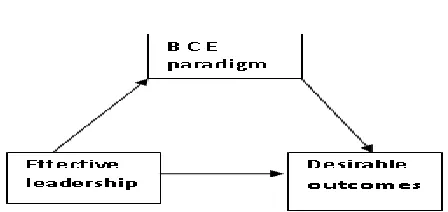
The present paper is a rejoinder of the B C E leadership paradigm and it proposes that B C E is a potent mediating factor between the existing effective leadership paradigm and many other desirable organizational outcomes such as; job satisfaction, reduced burnout, psychological wellbeing /health and organizational citizenship behavior (OCB). The paper is based on secondary source whereby evidence to support the assumptions were gathered from Journals, textbooks and the basic existing leadership theories.
outcomes such as psychological wellbeing, OCB, reduced burnout, and job satisfaction.
Conceptual Model
Fig. 1: Conceptual diagram of the mediating role of BCE on effective leadership and desirable organizational outcomes
Leadership Theories
This section is not meant to give a detailed description of these theories but to highlight some of the elements in the theories that are important for the present paper. Researchers interested in leadership have overtime proposed a number of theories which include;
Trait theory
This generally assumes that leaders are different from the average person in terms of personality traits and some traits are particularly suited for leadership such as intelligence, perseverance and ambition [8,9].
Behavioral Theories
These generally assumed that leaders can be made rather than born, and effective leadership is based on definable, learnable behavior. It also assumes that leaders exhibit two behaviors “concern for people” and “concern for production”.
Participative Leadership Theory
The main assumption here is that follower’s involvement in making decisions will improve their understanding of the issues, policies and tasks they are to carry out therefore, their behavior or attitude towards work or the organization. There are three Participatory leadership styles: i. Autocratic leadership style; here leaders make decisions without consulting with others. ii. Democratic leadership styles; here leaders involve the people or the representatives of people in the decision making. iii. Laissez-Faire Leadership style; leaders minimizes their involvement in decision making.
Transactional Leadership Style
This style of leadership assumes that leadership comprises three different behaviors [10] and they
are; i, Laissez-Faire; this is where a leader avoids and denies their responsibility and neglect to take any action even in dire situations. ii. Management-by exception; leaders of this kind are either described as active management –by-exception in which case leaders monitor and focused vigorously on followers’ mistake and
failures to meet standards or passive
management –by-exception, in which case, leaders focus on errors but do not monitor the followers rather they wait until the mistakes are such consequences that they can no longer ignored and iii. Contingent reward, these are leaders who set goals, provide feedback, and
ensure that followers’ behaviors have
consequences, both positive and negative.
Transformational Leadership Style
This theory was made popular by and works of Burns [11] and Bass [12].Presently, it is accepted that transformational leadership comprises of four different behaviors to Barling, Christie, and Hoption [2] and they are i. Idealized influence, this is applicable when leaders choose to do what is ethical or what is best for the organization rather than what is expedient. It include behavior such as providing a vision for the future and creating a collective sense of mission; ii. Inspirational motivation, these are leaders who encourage their employees to achieve more than what was once thought possible by setting high but realistic standards and inspiring members to surmount psychological setbacks and external obstacle; iii. Intellectual stimulation, this is the ability of a leader to encourage followers to think for themselves, question their own commonly held assumptions, reframe problems, and approach matters in innovative ways and iv. Individualized consideration, this characterizes leaders who pay special attention to followers’ personal need for achievement and development and act as mentors.
BCE Leadership Paradigm
The C Component is Contingencies; the major work on contingency theory of leadership was done by Fiedler, 1967 and House & Mitchell 1974. Fiedler’s Contingency theory categorizes leaders
as either task-motivated or relationship
motivated and effectiveness of these categorizes depend on three basic situations; leader-follower relations, performance goal clarity and formal authority or power [13].Similarly, Path goal leadership theory by House & Mitchell [14] explores the behaviors of effective leaders and the situational contingencies that modify those behaviors.
House and Mitchell [14] identify four categories of leadership behaviors that motivate followers to achieve their goals these include; participative leadership behavior, directive path-goal clarifying behavior, supportive behavior and achievement-oriented behavior. House and Mitchell [14] also noted that the effectiveness of these leadership behaviors might depend on some situational factors such as organizational environment, job design and follower characteristics.
Obi-Nwosu’s analysis captures some blends of these basic contingency theories especially path-goal leadership theory. Prof B.C Ebgoka’s administration showed participative leadership behavior by involving followers in decision making and soliciting followers’ feedback. It showed directive path-goal clarifying leadership behavior through motivation of workers, providing task structure, feedback and procedures that reduce role ambiguity; it also links workers effort to performance and goal attainment and communicates the rewards contingent on performance.
In the aspect of supportive leadership behavior, the administration demonstrated its concern for the needs and best interests of workers and therefore removes some of the potential obstacles that may prevent followers from obtaining their goals. The administration also showed an
achievement-oriented leadership behavior
through creation of challenging and high standard performance goals and expresses confidence in workers’ abilities to meet such challenges. These attributes undeniably motivated workers to respond with greater self-efficacy and make more effort toward common goal attainment.
Evocative Orientation
Generally, an evocative leader uses his/her special skill to summon, inspire, or educe qualities critical for sustainable team cohesion and productivity in the organization. An evocative
leader leads by inspiration and example and they draw forth the best from those they interact with as well as evoke some higher consciousness needed to address the volatile, complex and ambiguous issues faced by the organization. Evocative leaders achieve leadership effectiveness through the following attributes;
Inspire and generate creative approaches
Empower trusting relationship and
environments
Focus on bringing individual and organizational action into alignment with a large sense of purpose and contribution for the greater achievement of goals.
Support and maintain self-organizing and high performing teams.
Maintain a holistic perspective amid complex interdependencies.
Foster collaboration and learning among diverse groups and tradition.
Nurture important initiatives into their full expression.
Anticipate, welcome and adapt to change with agility.
Coordinate people masterfully to make vision real.
Discern right action and make courageous decisions.
Effectively ensure that all perspectives are heard.
Inspire workers enthusiasm to act with integrity and take a stand for what is life-affirming.
Effective resolution of conflict.
Cultivate personal discipline through a daily reflective practice.
Change undesirable behavior by changing identified underlying factors.
[15,16,1]
Effective Leadership and Desirable
Organizational Outcomes
Many empirical literatures have shown that effective leadership will lead to many desirable organizational outcomes, therefore creating some possible supports that BCE (which is proposed to be an effective leadership paradigm) will have a positive significant link with other effective leadership styles; desirable organizational outcomes and positive mediatory effect on the relationship between other effective leadership style and desirable organizational outcomes as proposed in the conceptual model (fig. 1).
Studies by Arnold, Turner, Barling, Kelloway & Mckee [17]and Mckee, Driscoll, Kelloway & Kelley
[17] showed that effective leadership
and psychological wellbeing. In another study on effective leadership and job satisfaction on team citizenship, Yun, Cox, & Sims [18] found that effective leadership (transformational) is positively linked with job satisfaction and team citizenship. Yet in another study on leadership behavior and burnout, Rad and Gohalenoei [19] found that a significant relationship existed between leadership style of coaches and burnout among athletes, whereby effective leadership style (participative) was negatively related to burnout.
Since BCE paradigm not only contains some already identified attributes of effective leadership, but presents succinct positive behaviors, this paper also assumes that like other effective leadership style it will enhance desirable organizational outcomes and possibly mediate the effect of other leadership styles on the desirable organizational outcomes.
Conclusion
It is obvious that to institute a paradigm is a difficult task starting from conceptualization to theory formation and empirical testing of the
theory over time to ensure consistency. Obi-Nwosu [1] initiated the BCE paradigm after a careful analysis of successive administrations of a university.
Mostovicz [20] stated that every good paradigm on leadership must have three components [21-23]. They are “What” which represents the goals that the leader hopes to attain and these are found in the evocative orientation. “How” which explains the way the leader reaches the goals and these are found in the bridging communication gap and contingencies. “Why” which explains the reasons behind selecting the leadership method for attaining the goals, and this is explained by the benefits of the interaction among B+C+E = why.
Indeed, the BCE paradigm is promising because the concept is measurable and can be learned through training. It will not likely cause harm to an organization and since it shows that leaders can have positive influence in the organization,
the BCE paradigm enhances desirable
organizational outcomes.
References
1. Obi-Nwosu H (2014) Psychological Health,
Leadership and the BCE Leadership Paradigm. Paper Presented at Symposium Organized by Department of Psychology Nnamdi Azikiwe
University Awka ( 4th April).
2. Barling J, Christie A, Hption A (2010) Leadership.
In S. zedeck et.al (Ed). Handbook of Industrial and
Organizational Psychology (pp. 183-240).
Washington DC: American Psychological
Association.
3. Yukl GA (2005) Leadership in organizations (6th
ed.). Upper Saddle River, NJ: Prentice-Hall.
4. Northouse PG (2010) Leadership, theory and
practice (5th ed.). Sage, Thousand Oaks, CA
5. Gulick L (1937) Notes on the theory of
organization. In L. Gulick & L. Urwick (Eds.), Papers on the Science of Administration(pp. 1-‐
46). New York: Institute of
Public Administration.
6. Barnard CI (1938) The function of executive.
Harvard University Press: Cambridge, M.A., Thirtieth Anniversary Edition.
7. Voon ML, Lo MC, Ngui1 KS, Ayob NB (2011) The
influence of leadership styles on employees’ job satisfaction in public sector organizations in Malaysia International Journal of Business, Management and Social Sciences, 2(1): 24-32.
8. Judge TA, Cable DM (2004) The effect of physical
height on work place success and income: preliminary test of a theoretical model. Journal of Applied Psychology, 89: 428-441.
9. Judge TA, Colbert AE, Ilies R (2004) Intelligence
and leadership. A quantitative review and test of theoretical propositions. Journal of Applied Psychology, 89:542-552.
10.Bass BM, Riggio RE (2006) Transformational
leadership(2nd ed.). Mahwah, NJ: Erlbaum.
11.Burns J (1978) Leadership. New York: Harper.
12.Bass BM (1985) Leadership and performance
beyond expectations. New York: Free Press.
13.Fiedler FE (1967) A Theory of Leadership
Effectiveness, New York: McGraw-Hill
14.House RJ, Mitchell TR (1974) Path-goal theory of
leadership. Journal of Contemporary Business, 3:81-97.
15.Ehama Institute (2013) Activating the Skill of
Evocative Leadership Mastery. Evocative
Leadership Mastery Retreat Lotus Heart Centre, Brighton Toronto Ontario.
16.Nevis EC (1983) Evocative and Provocative modes
of Influence in the Implementation of Change. Massachusetts Institute of Technology Cambridge.
17.McKee MC, Driscoll C, Kelloway EK , Elizabeth
Kelley E (2011) Exploring linkages among transformational leadership, workplace spirituality and well-being in health care workers. Journal of Management, Spirituality & Religion, 8(3):233-255. 18.Yun S, Cox J, Sims HP (2007) Leadership and
19.Rad LS, Ghalenoei M (2013) The relationship between leadership behavior and burnout among coaches and athletes. European Journal of Experimental Biology, 3(3):195-205.
20.Mostovicz EI (2008) Understanding of Consumers’
Needs for Luxury: The Mechanism of Interpretation and its Role in Knowledge Creation, Unpublished doctoral dissertation, University of Northampton, UK.
21.Arnold, KA, Turner N, Barling J, Kelloway EK,
McKee MC (2007).
22.Transformational Leadership and Psychological
Well-Being: The Mediating Role of
23.Meaningful Work. Journal of Occupational Health
Psychology 12(3):193-203.