CASO CLÍNICO
DATA CONFIDENTIALITY
The authors declare having followed the protocols in use at their working center regarding patients’ data publica-tion.
PATIENT CONSENT Obtained.
CONFLICTS OF INTEREST
All authors report no conflict of interest.
FUNDING SOURCES
This research received no specific grant from any fund-ing agency in the public, commercial, or not-for-profit sec-tors.
REFERENCES
1. Corbett EL, Watt CJ, Walker N, Maher D, Williams BG, Raviglione MC, et al. The growing burden of tuberculosis: global trends and interactions with the HIV epidemic. Arch Intern Med. 2003;163:1009-21.
2. Koenig SP, Riviere C, Leger P, Joseph P, Severe P, Parker K, et al. High mortality among patients with AIDS who received a diagnosis of tuberculosis in the first 3 months of antiretroviral therapy. Clin Infect Dis. 2009;48:829-31.
3. Etard JF, Ndiaye I, Thierry-Mieg M, Guèye N, Guèye P, Lanièce I, et al. Mortality and causes of death in adults receiving highly active antiretroviral therapy in Senegal: a 7- year cohort study. AIDS. 2006;20:1181-9.
4. Direção Geral da Saúde. Programa Nacional para a Infeção VIH, SIDA e Tuberculose 2017. [consulted 2017 Dec 16]. Available from: http:// www.dgs.pt/portal-da- estatistica-da- saude/diretorio-de- informacao/ diretorio-de- informacao/por-serie- 845551- pdf.aspx?v=11736b14-73e6- 4b34-a8e8- d22502108547.
5. Zhang J, Fan YK, Wang P, Chen QQ, Wang G, Xu AE, et al. Cutaneous tuberculosis in China: a multicenter retrospective study of cases diagnosed between 1957 and 2013. J Eur Acad Dermatol Venereol. J Eur Acad Dermatol Venereol. 2018;32:632-8.
6. Kivanc-Altunay I, Baysal Z, Ekmekçi TR, Koslu A. Incidence of cutaneous tuberculosis in patients with organ tuberculosis. Int J Dermatol. 2003;42:197-200.
7. van Zyl L, du Plessis J, Viljoen J. Cutaneous tuberculosis overview and current treatment regimens. Tuberculosis. 2015;95:629-38.
8. Beyt BE Jr, Ortbals DW, Santa Cruz DJ, Kobayashi GS, Eisen AZ, Medoff G. Cutaneous mycobacteriosis: analysis of 34 cases with a new classification of the disease. Medicine. 1981;60:95-109.
9. Hill MK, Sanders CV. Cutaneous tuberculosis. Microbiol Spectr. 2017;5. 10. Ilgazli A, Boyaci H, Basyigit I, Yildiz F. Extrapulmonary tuberculosis: clinical and epidemiologic spectrum of 636 cases. Med Res Arch. 2004;35:435-41.
11. Concha RM, Fich SF, Rabagliati BR, Pinto SC, Rubio LR, Navea DÓ, et al. Cutaneous tuberculosis: two cases and review. Rev Chilena Infectol. 2011;28:262-8.
12. Kim GW, Park HJ, Kim HS, Kim SH, Ko HC, Kim BS, et al. Delayed diagnosis of scrofuloderma misdiagnosed as a bacterial abscess. Ann
Dermatol. 2012;24:70-3.
13. Ramos-e- Silva M, Castro MC. Mycobacterial infections. In: Bolognia JL, Schaffer JV, Cerroni L. Dermatology. Elsevier; 2018. p. 1296-318. 14. Hsiao PF, Tzen CY, Chen HC, Su HY. Polymerase chain reaction
based detection of Mycobacterium tuberculosis in tissues showing granulomatous inflammation without demonstrable acid-fast bacilli. Int. J. Dermatol. 2003;42:281-6.
15. Bento J, Silva AS, Rodrigues F, Duarte R. Diagnostic tools in tuberculosis. Acta Med Port. 2011;24:145-54.
RESUMO
A pneumonite granulomatosa é uma complicação rara da imunoterapia com bacillus Calmette-Guerin após administração intravesical de bacillus Calmette-Guerin. Os autores apresentam um caso incomum de um homem de 67 anos de idade que desenvolveu sintomas ligeiros e inespecíficos, após instilações de bacillus Calmette-Guerin intravesical. Os exames revelaram características da
A Rare Case of Granulomatous Pneumonitis Due to
Intravesical BCG for Bladder Cancer
Um Caso Raro de Pneumonite Granulomatosa
Secundária a Instilação Intravesical de BCG no Contexto
de Neoplasia da Bexiga
1. Pulmonology – Thorax Department. Centro Hospitalar Lisboa Norte. Lisboa, Portugal. 2. Pulmonary Diagnosis Center Dr. Ribeiro Sanches. Lisboa. Portugal.
Autor correspondente: Vera Clérigo. [email protected]
Recebido: 15 de janeiro de 2018 - Aceite: 17 de agosto de 2018 | Copyright © Ordem dos Médicos 2019
Vera CLÉRIGO1, Ana CASTRO2, Teresa MOURATO2, Conceição GOMES2
Acta Med Port 2019 Apr;32(4):316-320 ▪ https://doi.org/10.20344/amp.10250 ABSTRACT
Granulomatous pneumonitis is a rare complication of bacillus Calmette-Guerin immunotherapy following intravesical administration of bacillus Calmette-Guerin. The authors present an unusual case of a 67-year-old man who developed mild and non-specific symptoms, following intravesical bacillus Calmette-Guerin instillations. Examinations revealed features of miliary tuberculosis and granuloma sug-gestive of mycobacterial infection. Anti-tuberculosis treatment resulted in a remarkable improvement in his symptoms and gradually upgrading of radiological appearance. The symptoms were less severe than some others described but this case provides evidence that, even in some cases, specific treatment may be necessary. We highlight the importance of recognizing miliary Mycobacterium bo-vis as a probable complication of bacillus Calmette-Guerin immunotherapy. The clinical disease course can be mild, despite extensive bilateral miliary nodules on primary presentation.
CASO CLÍNICO
INTRODUCTION
Urinary bladder cancer is the most frequent urinary sys-tem malignancy, being ninth in worldwide cancer incidence.1
Intravesical administration of bacillus Calmette-Guérin (BCG), a live attenuated strain of Mycobacterium bovis, is the cornerstone of adjunctive therapy for superficial bladder cancer.2
BCG immunotherapy is typically well tolerated due to low virulence in immunocompetent patients,3 although
lo-cal and systemic complications may occur. Severe adverse symptoms are uncommon. Additionally, disseminated BCG infections that present as granulomatous pneumonitis or hepatitis are quite rare.
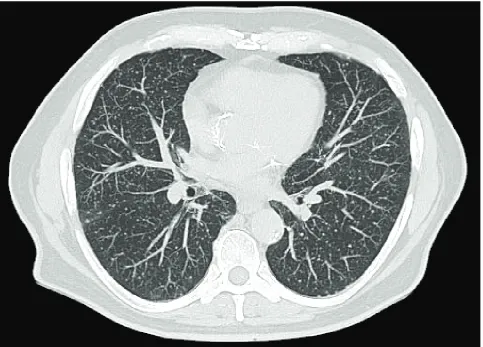
We report a case of an immunocompetent adult patient with a history of urinary bladder cancer that presented with disseminated BCG pneumonitis, after intravesical BCG im-munotherapy, with mild and non-specific symptoms, even though having a thoracic computed tomography (CT) scan with extensive bilateral miliary nodules on his primary
appearance.
CASE REPORT
A 67-year-old male was diagnosed with urinary bladder carcinoma, and was placed on intravesical BCG immuno-therapy. Six days after the sixth BCG instillation therapy, the patient exhibited a continuous low-grade fever, with an isolated peak of high-grade fever. He was treated with a short-term course of ciprofloxacin without improvement due to suspicion of complicated urinary tract infection. Due to the persistence of symptoms for a month, the patient was referred to the regional Pulmonology Diagnosis Center. A physical examination indicated fine inspiratory crackles in both lungs. Laboratory data were as follows: white blood cell count, 5100/μL (neutrophils, 53.4%; lymphocytes, 33.0%); haemoglobin, 12.8 g/dL; platelet count, 23.4 x 10⁴/ μL; C-reactive protein (PCR), 0.8 mg/dL. Chest radiogra-phy revealed bilateral diffuse reticulonodular infiltrates.
tuberculose miliar e granuloma sugestivo de infeção por micobactérias. O tratamento antibacilar resultou numa melhoria notável na sua sintomatologia e na melhoria progressiva das alterações radiológicas. Os sintomas foram de menor gravidade comparativamente a outros casos relatados na literatura, mas este caso fornece evidências de que, mesmo em algumas situações, um tratamento específico pode ser necessário. Destacamos a importância de reconhecer o Mycobacterium bovis disseminado como uma provável complicação da imunoterapia a bacillus Calmette-Guerin. O curso clínico da doença pode ser ligeiro, apesar da extensa disseminação miliar bilateral na apresentação primária.
Palavras-chave: Granuloma/induzido quimicamente; Neoplasias da Bexiga Urinária/tratamento; Pneumonia/induzida quimicamente; Vacina BCG
CASO CLÍNICO
He was subsequently subjected to a thoracic CT that dem-onstrated miliary dissemination with pulmonary micronodu-lation (Fig. 1).
Additionally, he underwent a flexible bronchoscopy with bronchoalveolar lavage fluid (BALF) and transbronchial bi-opsy collection. Flow cytometric analysis of the BALF re-vealed a predominance of lymphocytes (53%). The Ziehl-Neelsen staining and real-time PCR performed on BALF and lung tissue specimens were negative. The lung tissue histopathological examination obtained by transbronchial biopsy revealed epithelioid granulomas in the absence of caseous necrosis and Langerhans giant cells. Furthermore, HIV1/2 antigen/antibody screening was negative. Blood, urine and sputum cultures were also negative for mycobac-teria, as well as for common bacteria and fungi.
According to the patient’s history of recent intravesical BCG treatment, disseminated BCG pneumonitis was as-sumed and BCG immunotherapy was discontinued. Anti-tuberculous treatment was added (isoniazid 5 mg/kg/day, rifampicin 10 mg/kg/day, ethambutol 20 mg/kg/ day) as well as a short-course pf oral prednisolone (0.5 mg/kg/day). Clinical symptoms and abnormal findings on thoracic CT scan improved after 2 months of treatment. Prednisolone was tapered to complete withdrawal in a two-month period, with no clinical relapse.
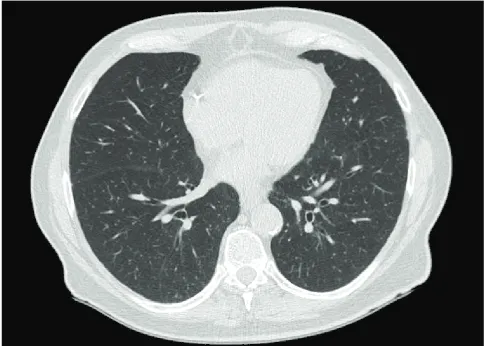
The patient continued receiving anti-tuberculous therapy with no reported problems, under the supervision of his phy-sicians that included isoniazid and rifampicin for 12 months, with a two-month intensive phase including ethambutol. The treatment period was extended for a total of 12 months, due to slow imaging improvement suggestive of active disease at nine months of treatment. Chest CT at 12-month treat-ment showed considerable improvetreat-ment with resolution of majority of the intrapulmonary nodules and calcification of the remaining (Fig. 2).
DISCUSSION
The BCG mechanism that leads to complications is not entirely acknowledged, and neither is its mechanism in cancer as an immunotherapeutic agent.4 Furthermore, it is controversial whether complications associated with in-travesical BCG are an active infection or a hypersensitivity reaction.
Local or systemic complications of intravesical BCG instillations can arise. Mild adverse effects such as low-grade fever, dysuria and urinary frequency, develop in 3% – 5% of patients.5 The most severe complications concern disseminated infection, being sepsis the most fulminant display, but organ infection can also occur. Distant organ complications are even less common and can manifest, as
Figure 2 – Axial image of repeat chest computed tomography scans performed 12 months after initiation of anti-tuberculosis medications:
CASO CLÍNICO hepatitis, pneumonitis, osteomyelitis and arthritis, for
ex-ample.6 In the largest retrospective study reported to date,
dissemination as pneumonitis and/or hepatitis occurred in 0.7% of over 2000 patients.3
In some patients with disseminated BCG infection, pneumonitis is characterized by an interstitial or miliary nodular pattern on chest radiography and CT scanning, most frequently present in patients with sepsis.7,8 However, relatively asymptomatic patients with only mild symptoms or subclinical cases are even rarer and have been described.9 Chest radiograph should not be chosen over thoracic CT scanning, since it is not adequately sensitive, leading to misdiagnosis. In fact, chest radiograph failed to reveal a miliary dissemination pattern in a quarter of the cases, rec-ognized in a thoracic CT scanning.
The approach to complications related to intravesical BCG treatment depends on their type and severity. Relaps-ing fever with night sweats persistRelaps-ing beyond 48 hours or evidence of more acute serious systemic symptoms, are usually signs of BCG infection that requires antituberculous therapy.6 M. bovis is susceptible to most of the
anti-tuber-culous therapy with the exception of pyrazinamide and cy-closerine, to which it is typically resistant.11M. bovis is quite
sensitive to later-generation fluoroquinolone antibiotics. A regimen that includes isoniazid, rifampicin, ethambutol and a fluoroquinolone can be typically used for six months, but there is limited evidence to support standard recommenda-tions for the treatment of human disease due to M. Bovis.12 This period may be extended due to symptoms relapse or refractory disease. Adjunctive therapy with corticosteroids has shown to be effective in decreasing symptoms in cases with suspected hypersensitivity, with attentiveness during tapering due to high risk of symptom relapse and formation of granuloma.7
Several studies have been done to demonstrate effec-tive measures in preventing the occurrence of disseminated BCG infection, such as fluoroquinolone short prophylaxis use after each BCG administration. A multicenter, rand-omized and prospective study13 showed that ofloxacin
re-duced the incidence of severe local reactions and the use of anti-tuberculosis treatment. However, no cases of BCG sepsis were reported and the ability of ofloxacin to prevent more severe complications was not evaluated. Fluoroqui-nolone prophylaxis might reduce the antitumor activity of BCG, but no clear evidence has been found to recommend routine fluoroquinolone prophylaxis. Another study using prulifloxacin reported very comparable findings.14
It can be discussed that in this report, the patient’s symptoms were caused by a hypersensitivity reaction
instead of disseminated BCG, due to the absence of acid-fast bacilli on direct microscopy and negative culture re-sults. Nevertheless, the presence of formed granuloma in transbronchial biopsy, added to anti-tuberculous treatment that led to clinical and radiological improvement supports disseminated BCG infection as a more probable diagnosis. Additionally, the lack of identification of M. bovis may be related to several modifying factors, such as culture tech-niques, the number of organisms, and its low virulence in an immunocompetent host. The patient presented in this case had some atypical features, for instance mild non-specific symptoms as low-grade fever, despite extensive pulmonary involvement; and only anti-tuberculous treatment with corti-costeroids led to clinical and radiological improvement de-spite a slow image upgrading.
In conclusion, we report a rare complication of intravesi-cal BCG instillation presenting as disseminated BCG pneu-monitis. This case highpoints the importance of identifying disseminated mycobacterial infection as a complication in any patient receiving intravesical BCG instillation even if there are mild and non-specific symptoms.
ACKNOWLEDGEMENTS
The authors thank the collaboration of all elements of the Pulmonology Diagnosis Center Dr. Ribeiro Sanches – Lisbon, Portugal.
PROTECTION OF HUMANS AND ANIMALS
The authors declare that the procedures were followed according to the regulations established by the Clinical Re-search and Ethics Committee and to the Helsinki Declara-tion of the World Medical AssociaDeclara-tion.
DATA CONFIDENTIALITY
The authors declare having followed the protocols in use at their working center regarding patients’ data publica-tion.
PATIENT CONSENT Obtained.
CONFLICTS OF INTEREST
The authors declare to have no conflict of interest di-rectly or indidi-rectly related to the manuscript contents.
FUNDING SOURCES
This research received no specific grant from any fund-ing agency in the public, commercial, or not-for-profit sec-tors.
REFERENCES
1. Ploeg M, Aben KK, Kiemeney LA. The present and future burden of urinary bladder cancer in the world. World J Urol. 2009;27:289–93. 2. Alexandroff AB, Jackson AM, O’Donnell MA, James K. BCG
immunotherapy of bladder cancer: 20 years on. Lancet. 1999;353:1689– 94.
3. Lamm DL. Efficacy and safety of bacilli Calmette-Guerin immunotherapy
in superficial bladder cancer. Clin Infect Dis. 2000;31:86–90.
4. Mitropoulos DN. Novel insights into the mechanism of action of intravesical immunomodulators. In Vivo. 2005;19:611.
CASO CLÍNICO
in superficial cancer and carcinoma in situ of the bladder. Int J Urol. 2005;12:145–51.
6. Delimpoura V, Samitas K, Vamvakaris I, Zervas E, Gaga M. Concurrent granulomatous hepatitis, pneumonitis and sepsis as a complication of intravesical BCG immunotherapy. itis and sepsis as a complication of intravesical BCG immunotherapy. BMJ Case Rep. 2013;2013. 7. Elkabani M, Greene J, Vincent A, VanHook S, Sandim R. Disseminated
mycobacterium bovis after intravesicular bacillus calmette-Guérin treatments for bladder cancer. Cancer Control. 2000;7:476-81. 8. Mignon F, Chevrière A, Mesurolle B, El Hajam M, Morel H, Lacombe P.
Miliary induced by intravesical BCG immunotherapy for carcinoma of the bladder: CT Findings. J Radiol. 2002;83:368-71.
9. Choi CH, Lee SO, Smith G. Subclinical miliary Mycobacterium bovis following BCG immunotherapy for transitional cell carcinoma of the bladder. BMJ Case Rep. 2014; 2014.
10. Pérez-Jacoiste Asín MA, Fernández-Ruiz M, López-Medrano F, Lumbreras C, Tejido A, San Juan R, et al. Bacillus Calmette-Guérin (BCG) infection following intravesical BCG administration as adjunctive
therapy for bladder cancer: incidence, risk factors, and outcome in a single-institution series and review of the literature. Medicine. 2014;93:236.
11. Durek C, Rüsch-Gerdes S, Jocham D, Böhle A. Sensitivity of BCG to modern antibiotics. Eur Urol. 2000;37:21-5.
12. Lan Z, Bastos M, Menzies D. Treatment of human disease due to mycobacterium bovis: a systematic review. Eur Respir J. 2016;48:1500– 3.
13. Colombel M, Saint F, Chopin D, Malavaud B, Nicolas L, Rishmann P. The effect of ofloxacin on bacillus calmette-guerin induced toxicity in patients with superficial bladder cancer: results of a randomized, prospective, double-blind, placebo controlled, multicenter study. J Urol. 2006;176:935-9.