http://dx.doi.org/10.4236/jcc.2014.24001
Timing Attack Analysis on
AA
β
Cryptosystem
A. H. A. Ghafar1, M. R. K. Ariffin2
1Al-Kindi Cryptography Research Laboratory, Institute for Mathematical Research, Universiti Putra Malaysia
(UPM), Serdang, Malaysia
2Mathematics Department, Faculty of Science, Universiti Putra Malaysia (UPM), Serdang, Malaysia
Email: [email protected], [email protected]
Received September 2013
Abstract
Timing attack is an attack on the implementation of a cryptographic primitive. The attack collects leaked secret data via certain implementation techniques either on software or hardware. This
paper provides an analysis of a theoretical timing attack on the AAβ algorithm. The attack dis-
cussed in this paper gives avenues for secure implementation of AAβagainst timing attacks. The
simulation of the attack is important to provide invulnerability features for the algorithm in order to be implemented and embedded on applications. At the end of the attack, a method to overcome
it will be introduced and it is called AAβblinding.
Keywords
Timing Attack; Side-Channel Attack; Public-Key Cryptosystem; AAβPublic Key Cryptosystem
1. Introduction
The AAβ cryptosystem utilizes the integer factorization problem (IFP) coupled with the square root problem as its cryptographic primitive. The algorithm claims to have a complexity order of 2
( )
O n compared to renowned RSA and ECC algorithms which both have 3
( )
O n in encryption and decryption process [1]. Although Rabin cryptosystem also shares the same cryptographic primitive, but its decryption is 4-to-1 which makes the de- crypted plaintext hard to distinguish. But AAβ overcomes this decryption failure without losing computational power and speed.
Several cryptanalysis have been conducted on this cryptosystem and have pointed out that to find solution for the cryptosystem is infeasible [1]. However, this cryptosystem has never been analyzed or attacked from imple- mentation point of view. The reason for this is because AAβ has not yet been implemented in a real-world application. Nevertheless, it is important to launch a theoretical attack on its implementation to provide future guidance for future implementers. This paper intends to do that and we will use one common type of side chan- nel attack which is timing attack.
not have any knowledge about the secret key.
In order to prevent this kind of attack on RSA, Rivest introduced a defense mechanism called RSA blinding [3]. It works by generating a random number, r which will ’blind’ the product of Cd(modN)
and essentially makes it impossible for attacker to determine the computational time. We will make use of this blinding concept to come out with our own strategy for the AAβ algorithm. Like the RSA, random numbers also play a role in our blinding mechanism to make sure that the decryption process time will be obscured.
This paper is structured as follows. Section 2 will dive into some algorithms that are commonly used to op- timize both modular multiplication and exponentiation. Section 3 gives an overview of AAβ algorithm while we will discuss on how timing attack is to be conducted on the algorithm in Section 4. We will also discuss the AAβ blinding in Section 5 to prevent any further timing attack on it in the future. Future works and conclusion are in Section 6 and 7 respectively.
2. Design of Timing Attacks on Modular Exponentiation and Multiplication
The process of modular exponentiation and modular multiplication is essentially very time consuming process especially when involves exponentiation of very large integers. They can slow down the whole process of de- cryption and this is non-economical in commercial applications such as smart cards and real-time web commu- nication which need fast response time. However, various methods have been introduced to speed up both oper- ations.
First and the most basic method to increase the computational speed of this equation is repeated squaring al- gorithm. This algorithm is mostly used in power constrained hardware such as smart card due to its low com- plexity in calculation. However, it was exploited by Kotcher in the earliest timing attack on cryptosystem’s hardware. Consider the decryption process of RSA.
(mod )
d
P≡C N
Kotcher cleverly observes this process as signal which has been corrupted by the ’noise’ of unknown bits of d. The attack emulates the decryption process and captures the calculated time of decryption using chosen pri- vate keys until each bits of actual d is exposed.
Generally, for chosen private keys, u and v which have size of 𝑛𝑛-bits
0, ,1 , i1, 0, i1, n1, n
u=u u …u− u+ …u− u
0, ,1 , i1, 0, i1, n1, n
v=v v …v− v+ …v− v
the only difference between both chosen private keys is bit at point i (Assume that both u and v already have same arrangement of bits with actual private key, d up until position i−?1).
Let Cj be the calculation time to complete decryption using the actual private key, d. Also let Tu be the calculation time from bit u to 0 u using first emulated key, i u and Tv be the calculation time from bit v0 to vi using second emulated key, v. We assign
(
T′u v,)
=Cj−Tu v,Hence, variance of timing after point i for both u and v are regarded as
(
)
( )
var Cj−Tu =var Tu′ +var( )Te
which uses the ‘expensive’ division operation. Montgomery reduction transforms the multiplication of
(mod )
a b⋅ N
to
(mod ) and (mod )
a′=aR N b′=bR N
for which we said a′ and b′ are in Montgomery form and R=2k for k∈ [4]. The algorithm executes multiplication in R reduction where a computer can easily and cheaply calculate because the division of 2k in binary is just a simple shift by k bits. One good explanation and example of Montgomery reduction can be read here [5]. The pseudo codes of both algorithms and how they work together are explained in Algorithm 1.
To calculate modular exponentiation, most implementations use the Chinese Remainder Theorem (CRT) ap- proach. This approach divides the modular exponentiation which is in the form of modular N= ⋅p q to the form of modulo p and q. Values of p and q are normally stored in decryption machine. The logic behind this approach is because the value of p and q are smaller than N, hence the modular exponentiation will be more computationally efficient due to their decreased size. To get the original result, the results in modulo p
and modulo q are combined.
Later, Schindler produced a significant observation for RSA implementation that uses repeated squaring, CRT and Montgomery reduction approach [6]. Schindler observes that the extra reduction in Montgomery algorithm to ensure s≤N (refer Algorithm 2) caused atiming difference for different a and b. From this observa- tion, Schindler derived the probability of an extra reduction occurring for adp(mod )p which is
(mod ) (extra reduction)
2
a p
P
R
= (1)
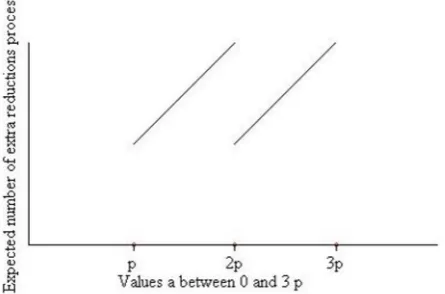
Observation from (1) shows that there is discontinuity after certain number of extra reduction process which happens to be a multiple of p.
When a is approached by values less than a multiple of p as shown in Figure 1, number of reduction
Algorithm 1. Repeated squaring algorithm.
Figure 1. Number of extra reductions in a Montgomery re- duction as function (1) of the input a.
increases. But, right after the multiple of p, the number of extra reduction drops significantly. This drop can help us to derive the multiple of p hence factorize N.
Another algorithm known as the Karatsuba multiplication is regarded as the most efficient multiplication al- gorithm of two numbers with the same numbers of digits [7]. This works by assuming that addition is much cheaper than multiplication operation. The algorithm is explained as follows.
Given that we want to multiply a and b that have n numbers of digits. We can write
?1 0 110
n
a a= + ⋅a −
?1 0 110
n
b b= + ⋅b −
Basic arithmetic shows that
( ) ( )
? ?
? ? ?
? ?
1 1
0 1 0 1
1 1 2 1
0 0 0 1 1 0 1 1
1 2 1
0 0 0 1 1 0 1 1
( 10 )( 10 )
10 10 10
10 10
n n
n n n
n n
a b a a b b
a b a b a b a b
a b a b a b a b
− −
− − −
− −
⋅ = + ⋅ + ⋅
= + ⋅ + ⋅ + ⋅
= + + + ⋅
If we define
0 0 0
z =a b
1 0 1 1 0
z =a b +a b
2 1 1
z =a b
It is easy to see that
? 2
1 0 1 0 1 0
z a a b b z z
= − − − −
And the product of a and b is
( ) ?1 2 ?1
0 110 210 .
n n
[image:4.595.203.426.90.237.2]slightly moves toward less than p, the number of extra reductions in the Montgomery reduction (Algorithm 2) increases. It involves the multiplication of two numbers that are about the same size hence Karatsuba multiplication is used. Meanwhile, whenever the value of C moves to be larger than p, the re- duction in
Algorithm 2 will decrease. Long multiplication is used here because the multiplication involves two numbers that have significant different sizes.
The attack’s aim is to find the binary structure of p:
(
0, ,1 , i1, ,i , n1, n)
2p= b b …b− b …b− b
where b0=1 and has size of n-bits. This will solve the factorization of N= ⋅p q and lead to a total break of RSA algorithm. The following method is used to recover the bit of p at point-i:
1) Suppose that bits of p have been determined from b0 to bi−1. Let
(
)
0 0, ,1 , i1, 0, 0, 0
C = b b …b− … and
(
)
1 0, ,1 , i1,1, 0, 0
C = b b …b− …
That is, the only difference between the two chosen ciphertexts is the bit at point-i. C0 and C1 are the candidates of prime p.
2) Assign T C( 0) and T C( 1) as the measured decryption times for C0 and C1 respectively. 3) Assign ∆ =T C
( )
0 −T C( 1) i.e the timing difference between T C( 0) and T C( 1).4) If C0< <p C1, then ∆ is “large”. This indicates bi=0. If C0<C1<p, then ∆ is “small”. This indicates bi=1. The thresholds of “large” and “small” are set by the previous values of ∆.
5) The previous steps are repeated to obtain bits at points bi+1,bi+2,bi+3,… until half of the bits p have been recovered.
After obtaining half of bits of p, Coppersmith has extensive methods to recover the whole bits of p and consequently factorizes N [10]. Value of reveals whether extra reductions of Montgomery multiplication or multiplication (normal versus Karatsuba) predominates during the decryption process at point i.
3. AA
βAlgorithm
The Rabin cryptosystem utilized the square root modulo problem as its cryptographic primitive [11]. The alluring factor in Rabin cryptosystem is it has a very small exponent key, e=2. But the cryptosystem has a decryption failure which is caused by the 4-to-1 mapping during decryption. This trade-off deterred Rabin cryptosystem to be widely used in modern application.
In 2013, Ariffin et al. proposed a new cryptosystem which also utilized the same problem but without any decryption failure. The algorithm is workable with lower complexity order compared to DHKE, El-Gammal, RSA and ECC [1]. Algorithms 3-5 show the whole cryptosystem.
The decryption algorithm uses multiplication together with a one time modular reduction. This lack of expensive operation makes AAβ to be an ideal candidate for future public key cryptosystem.
We now analyze the operation given by
(mod )
W ≡ ⋅C d pq
Algorithm 4. AAβ encryption.
Algorithm 5. AAβ decryption.
and discuss whether the time calculation of this operation can be exploited. Later, we will enhance the capability of an attacker to obtain W which consequently will continue onto the calculation of
1
4 (mod ) p
p
x W p
+
≡
and
1 4 (mod ) q
q
x W q
+
≡
modular exponentiation. Based on this assumption, we now observe the first multiplication in the AAβ decryption algorithm which is
(mod )
W ≡ ⋅C d pq (2)
Since C~ 27n and d~ 22n, the inequality in the size of C and d will not give us a choice to use Karatsuba reduction in the implementations of AAβ. This is because Karatsuba algorithm requires both multiplication elements to be in the same size to make it efficient as stated in Section 2.
As for other method, Montgomery multiplication, it is also not practical in this multiplication process because the reduction only works better than long multiplication if there is an exponentiation operation involved. However Equation (2) does not involve exponentiation.
In short, to compute C d⋅ efficiently, one only use long multiplication. Next, we increase the advantage for the attacker by assuming that value W can be manipulated or collected. This loose assumption is realistic due to misuse implementation or hardware faulty. We also assume that equation
(
)
p 1 4 p
x W mod p +
≡ (3)
is implemented using the same method of RSA SSL implementation. Implementors are lured to the same method because the method can use dynamically Montgomery and Karatsuba multiplication for fast modular exponentiation—depends on the exponents given.
If that is the case, we will show that p can be obtained by measuring computational time of (3), using the same method by Brumley and Boneh which eventually gives out p. The method is as follows:
1) Suppose that bits of p have been determined from b0 to bi−1. Let
(
)
0 0, ,1 , i 1, 0, 0, 0
W = b b …b− …
and
(
)
1 0, ,1 , i1,1, 0, 0
W = b b …b− …
that is, the only difference between the two chosen ciphertexts is the bit at point-i. W0 and W1 are the candidates of prime p.
2) Assign T W( 0) and T W( 1) as the measured decryption times for W0 and W1 respectively. 3) Assign ∆ =T W
( )
0 −T W( 1) i.e. the timing difference between T W( 0) and T W .( 1)4) If W0< <p W1, then ∆ is “large”. This indicates bi=0. If W0<W1< p, then ∆ is “small”. This indicates bi=1. The thresholds of “large” and “small” are set by the previous values of ∆.
5) The previous steps are repeated to obtain bits at points bi+1,bi+2,bi+3,… until half of the bits p have been recovered.
It is clear that AAβ is susceptible to timing attack if value of W is leaked. Hence further improvement is
needed to overcome the attack. Section 5 will show how this kind of attack can be addressed by a method called AAβ blinding.
5. AA
βBlinding
We begin this section under strong assumption that a timing analysis can be conducted upon C d⋅ prior to compute W≡ ⋅C d(mod )pq and an attacker would be able to derive the private key d bit per bit. Hence there is a need to blind the multiplication process of C d⋅ before the modulo reduction of pq. We called this process as AAβ blinding.
Based on its name, it is clear that the method uses the same principle with RSA blinding.We will introduce a random number, r into AAβ decryption algorithm. Instead of deterministic decryption of time, the algorithm
will have randomized timing decryption. The randomization will increase the difficulty for the adversary to find out the exact value of the private key, d. The alteration occurs within the AAβ decryption algorithm
(Algorithm 5); starting from Step 1. The procedure is detailed in Algorithm 6. Observe
1 ( )(mod )
W ≡ ⋅ ⋅C r Q pq
Algorithm 6. AAβblinding.
(
)
2 mod .
W ≡ ⋅C R pq
This value will be computed in
p 1 4
1 2
( ) (mod )
p
x W W p
+ ≡ + and
(
)
1 4 1 2( ) mod .
q
q
x W W q
+
≡ +
It is easy to see that
(
)
1 1 4 4 1 2 1 1 4 4( ) ( ) (mod )
( ( )) (mod ) ( ) mod .
p p
p p
W W C r Q C R p
C r Q R p C d p
+ + + + + ≡ ⋅ ⋅ + ⋅ ≡ ⋅ + ≡ ⋅ and
(
)
1 1 4 4 1 2 1 1 4 4( ) ( ) (mod )
( ( )) (mod ) ( ) mod .
q q
q q
W W C r Q C R q
C r Q R q C d q
+ +
+ +
+ ≡ ⋅ ⋅ + ⋅
≡ ⋅ + ≡ ⋅
which are exactly following the original steps 5 and 6 in Algorithm 5.
By using this blinding method, we change the deterministic characteristic in the decryption algorithm to a probabilistic one. The size of randomized element, r is n-bit which makes it infeasible to be determined. We will now simulate an example.
Example Let n=16. Along will choose primes, p=53887, q=53891 and N=4070567597. We choose d=6381159375677 and r=544373306496 randomly.
We obtain Q=1004100545 dna R=21477. The public keys are
1) eA1=156489158370179 2) eA2=12180361837718376
Let the derivatives of the messages that Busu want to send are 1) U =9414048941460394886
2) V =1281821555
Thus, C=21486341075284587745963757517831994. The blinding starts when
1
2
mod 4070567597 1344015274 mod 4070567597 mod 2175088081mod 4070567597
W C r Q
W C R pq
≡ ⋅ ⋅ ≡
≡ ⋅ ≡
and Along obtains
53888 4
(134401527 2175088081) mod 53887 11486 mod 53887
p
with the timing attack that has been discussed in this paper.
Furthermore, a deeper analysis is required to test the randomness generated in AAβ blinding to make sure that the decyrption algorithm will always be a probabilistic process.
7. Conclusion
AAβ decryption algorithm is susceptible to timing attacks that simulates the Brumley and Boneh attack on SSL. However, a method to randomize the output on AAβ can overcome this problem. The blinding process changes the deterministic characteristic in the decryption algorithm to become probabilistic and this makes the data sampling procedure for the attack infeasible.
References
[1] Ariffin, M.R.K., et al. (2013) A New Efficient Asymmetric Cryptosystem Based on the Square Root Problem. Malay- sian Journal of Mathematical Sciences, 7, 19-37.
[2] Kocher, P. (1996) Timing Attacks on Implementations of Difie-Hellman, RSA, DSS, and Other Systems. CRYPTO’96, Santa Barbara, 18-22 August 1996, 104-113.
[3] Kaliski, B. (1996) Timing Attacks on Cryptosystems. RSA Laboratories Bulletin, 2.
[4] Montgomery, P. (1985) Modular Multiplication with Trial Division. Mathematics of Computation, Mathematics of Computation, 44, 519-521. http://dx.doi.org/10.1090/S0025-5718-1985-0777282-X
[5] Buell, D.A. (2005) Montgomery Multiplication. http://cse.sc.edu/buell/csce557/Dlecturenotes/
[6] Schindler, W. (2000) A Timing Attack against RSA with the Chinese Remainder Theorem. Workshop on Cryptogra- phic Hardware and Embedded Systems 2000(CHES 2000), Worcester, 17-18 August 2000, 109-124.
[7] Karatsuba, A. and Ofman, Y. (1963) Multiplication of Many-Digital Numbers by Automatic Computers. Physics-Dok- lady, 7, 595-596.
[8] Stamp, M. and Low, R.M. (2004) Applied Cryptanalysis. John Wiley & Sons Inc., Hoboken.
[9] Brumley, D. and Boneh, D. (2003) Remote Timing Attacks Are Practical. Proceedings of 12th Conference on USENIX Security Symposium, 4-8 August 2003, Washington DC.
[10] Coppersmith, D. (1997) Small Solutions to Polynomial Equations, and Low Exponent RSA Vulnerabilities. Journal of Cryptology, 10, 233-260. http://dx.doi.org/10.1007/s001459900030