ISSN 2307-7743 http://scienceasia.asia
_______________
2010 Mathematics Subject Classification: 80A20.
Key words and phrases: Heat generation/absorption, Magnetohydrodynamics, Ohmic dissipation, thermal radiation, stretching sheet, chemical reaction, Similarity transformation.
© 2015 Science Asia 1 / 23
MHD MIXED CONVECTION OF A VISCOUS DISSIPATING AND CHEMICALLY REACTING STAGNATION –POINT FLOW NEAR A VERTICAL PERMEABLE PLATE IN A POROUS
MEDIUM WITH THERMAL RADIATION AND HEAT SOURCE/SINK
ADETUNJI ADENIYAN
Abstract: The particular aim of this paper is to investigate the steady laminar flow and heat transfer of a viscous incompressible electrically conducting and chemically reacting fluid permeated by a uniform transverse magnetic field over a vertical permeable linearly stretching sheet bathed in a saturated porous medium with prescribed nonlinear surface temperature, taking into account the effects of the heat source or sink, thermal radiation and Ohmic dissipation. Use was made of appropriate similarity transformations to covert the governing coupled nonlinear partial differential equations into a system of coupled nonlinear ordinary differential equations. The numerical solutions were obtained by means of the fourth order Runge-Kutta technique alongside the Newton-Raphson iteration scheme, and the results lineated on graphs and tables for selected values of various pertinent flow heat and mass transfer parameters characterizing the flow as to discuss their influences on the fluid behavior. The numerically computed results indicate that all the emerging flow parameters demonstrate very pronounced effects on the flow, mass and heat transfer characteristics.
1. Introduction
generation analysis. Das (2011) conducted a study of heat and mass transfer incorporating radiation and chemical reaction effects on natural convection flow of an optically thin fluid near a vertical plate. This study is devoid of viscous and Ohmic dissipations, thermal radiation and internal heat generation or absorption. Jat and Chaudhary (2009), who analyzed the stagnation-point flow with radiation over an impermeable stretching sheet in non-porous medium without consideration for heat generation. Also, Jat and Chaudhary, in their analysis of MHD boundary layer flow over a uniformly stretching sheet with effects of porosity, thermal radiation and heat generation, Ohmic dissipation effect was not considered. Syed et al. (2012) presented parametric study of stagnation point hydromagnetics boundary layer flow over an axisymmetric permeable shrinking sheet with viscous dissipation and heat transfer in an expanse of an electrically conducting fluid ignoring the influence of thermal radiation and Ohmic dissipation. Of late, Ibrahim (2014) analyzed two-dimensional radiative MHD boundary layer flow of an incompressible, viscous and electrically conducting fluid caused by a non-isothermal linearly stretching sheet placed at the bottom of a fluid saturated with a porous medium in the presence of thermal radiation, viscous dissipation and homogeneous chemical reaction. Up to date, to the best awareness of the author, in the open literature the present problem of interest, motivated by the simultaneous neglect of thermal radiation, heat generation and Ohmic dissipation in boundary layer MHD flow of a viscous electrically conducting laminar flow over a permeable plate was not considered in spite of the practical importance in technological and industrial processes such as metallurgical production of metals and alloys in which the plate temperature is not isothermal, and transport processes around deep geological repositories for the disposal of high-level nuclear waste, for example the use of magnetic fields to curtail unwanted natural convection in the casting of aluminium, which are detrimental to the ingot structure, Davidson (2001).
2. Mathematical Analysis
Fig. 1. Physical model and coordinate system
Two equal but opposite forces are applied along the parallel to the plate to initiate its stretching, keeping Origin, O the stagnation point of the flow fixed. The flow is partly induced into motion in effect to the plate stretching with a velocity 𝑈𝑤 = 𝑏𝑥 (𝑏 > 0), which is proportional to distance x from O. Assuming that the magnetic Reynolds number is negligibly small in comparison with the imposed magnetic field, Sparrow and Cess (1978), the governing equations of flow, heat and mass transfer, taking into consideration of Boussinesq and boundary layer approximations are:
Governing Equations
𝜕𝑢 𝜕𝑥 +
𝜕v
𝜕𝑦 = 0 (1)
𝑢𝜕𝑢 𝜕𝑥+ v
𝜕𝑢 𝜕𝑦 = −
1 𝜌
𝜕𝑝 𝜕𝑥+ 𝒱
𝜕2𝑢
𝜕𝑦2+ 𝑔𝛽(T − T∞) + 𝑔𝛽
∗(𝐶 − 𝐶 ∞) −
𝜎𝑒
𝜌 𝐵𝑂(𝐸𝑜+ 𝐵𝑂u) − 𝒱
𝐾𝑢 (2)
0 = −1 𝜌
𝜕𝑝
𝜕𝑦 (3)
u∂T ∂x+ v
∂T ∂x =
k ρCp
∂2T ∂y2 +
Q
ρCp(T − T∞) + 𝜎𝑒BO2
ρCp (u − ue) 2 − 1
ρCp ∂qr
∂y (4)
u∂C ∂x+ v
∂C ∂x= Dm
𝜕2𝐶
𝜕𝑦2− 𝐾𝑟(𝐶 − 𝐶∞)
𝑛 (5)
Boundary Conditions:
y = 0: 𝑢(𝑥, 0) = 𝜎𝑈𝑤 , v(𝑥, 0 ) = 𝑉𝑤 , 𝑇 = 𝑇𝑊= 𝑐𝑥 + 𝑇∞, 𝐶 = 𝐶𝑊= 𝑑𝑥 + 𝐶∞
pressure, 𝒱 is the kinematic viscosity of the fluid, k is the thermal conductivity, 𝑐𝑃 is the specific heat capacity at constant pressure, 𝑞𝑟 is the radiative heat flux, 𝐾𝑟 is the reaction rate constant, with 𝐾𝑟> 0 for destructive chemical reaction and 𝐾𝑟 < 0 for generative chemical reaction, n is the order of homogeneous chemical reaction, T is the fluid temperature, C is the species concentration, 𝑇𝑊 is the wall temperature of heated plate , 𝐶𝑊 is the species concentration at the wall, 𝑇∞ is the free stream temperature, 𝐶∞ is the free stream species concentration, 𝜎 is the stretching/shrinking parameter, with 𝜎 > 0 for stretching and 𝜎 < 0 for shrinking, and Q is the volumetric rate of heat generation (source) /absorption (sink) , with 𝑄 > 0 for heat generation and 𝑄 <0 for heat absorption .
. In eqn. (2), allowance has been made for the possibility of an imposed electric field , 𝑬𝑜 in the z-direction , whereby the corresponding Ohm’s law which relates the electric current density J to the electric field and the fluid velocity u , and electromagnetic force 𝑭𝒆 are (see Davidson, 2001):
𝐽 = 𝜎𝑒(𝐸𝑜+ 𝐵𝑜𝑢) , 𝑭𝒆= 𝑱 × 𝑩𝒐 = −𝜎𝑒𝐵𝑜(𝐸𝑜+ 𝐵𝑜𝑢) (7) Our model presumes that not only the stretching plate and free stream vary linearly in distance x from a fixed point located on the plate but also the wall temperature and the wall species concentration.
It may be mentioned here, that the fluid considered in this study shall be assumed to be thin (gray), emitting/absorbing radiation but not a scattering porous medium, Damseh et al. (2006). Also it is presumed that only the fluid can radiate thermally, and that account is made only for unidirectional heat flux perpendicular to the horizontal plates. Assumption is made of the local thermal equilibrium between porous matrix of the medium and the electrically conducting fluid. Taking into account of all stated premises above, use is made of Rosseland diffusion approximation to reduce the radiation term of eqn. (4) to that devoid of sacrificing appreciable accuracy within engineering context following Siegel and Howell (1972), the radiative heat flux is posited in the form:
𝑞𝑟 = − 4𝜎∗ 3𝑘∗
𝜕𝑇4
𝜕𝑦 , (8)
where 𝜎∗ is the Steffan-Boltzman constant and 𝑘∗ is the mean absorption coefficient. Essentially, the use of Taylor’s theorem for the expansion of temperature dependent function F(T) about the stream temperature 𝑇∞, lends itself to the smallness of temperature difference 𝑇 − 𝑇∞. Consequent upon which
F(𝑇) = 𝐹(𝑇∞) + (𝑇 − 𝑇∞)𝐹′(𝑇∞) + 1
2!(𝑇 − 𝑇∞) 2𝐹′′(𝑇
∞) + ⋯ (9)
where prime signifies differentiation with respect to T.
On replacing F(T) by T4 in eqn. (9), neglecting higher order terms , one obtains 𝑇4 ≈ 𝑇∞3(4𝑇 − 3𝑇∞) .
𝑞𝑟 = −16𝜎∗𝑇∞3 3𝑘∗
𝜕𝑇 𝜕𝑦 ,
∂𝑞𝑟 ∂y = −
16𝜎∗𝑇∞3 3𝑘∗
𝜕2𝑇
𝜕𝑦2 (10) Outside the boundary layer, in the far field the boundary layer solution must be matched to the inviscid flow solution, where
𝑦 → ∞, 𝑢 → 𝑢𝑒 , 𝑝 → 𝑝∞ , 𝜌 → 𝜌∞ , 𝑇 → 𝑇∞ (11) Substituting the boundary conditions (11) into eqn. (2), one obtains (see Shivamoggi , 1985)
𝑢𝑒 𝑑𝑢𝑒
𝑑𝑥 = − 1 𝜌∞
𝑑𝑝∞ 𝑑𝑥 −
𝜎𝑒
𝜌 𝐵𝑜(𝐸𝑜+ 𝐵𝑜𝑢) − 𝒱
𝐾𝑢𝑒 (12)
It is self indicating from eqn. (3) that 𝑝 = 𝑝(𝑥) only. Eliminating 𝑑𝑝∞
𝑑𝑥 between eqns. (2) and (12), dropping subscript ∞ , we obtain
𝑢𝜕𝑢
𝜕𝑥+ v 𝜕𝑢 𝜕𝑦 = 𝑢𝑒
𝑑𝑢𝑒 𝑑𝑥 + 𝒱
𝜕2𝑢
𝜕𝑦2+ 𝑔𝛽(T − T∞) + 𝑔𝛽∗(𝐶 − 𝐶∞) − 𝜎𝑒
𝜌𝐵0
2(𝑢 − 𝑢 𝑒) −
𝒱
𝐾(𝑢 − 𝑢𝑒) (13) Convincingly, the electric field has no contributing influence on the MHD boundary layer equations as seen in eqn.(13).
Substituting (9) – (11) into (4), we obtain
𝑢𝜕𝑇 𝜕𝑥+ v
𝜕𝑇 𝜕𝑥 =
𝑘 𝜌𝑐𝑃(1 +
16𝜎∗ 𝑘𝑘∗)
𝜕2𝑇 𝜕𝑦2 +
𝑄
𝜌𝑐𝑃(𝑇 − 𝑇∞) + 𝜎𝑒𝐵𝑂2
𝜌𝑐𝑃 (𝑢 − 𝑢𝑒)
2 (14)
3. Method of solution
In order that continuity equation (1) be satisfied, the stream function 𝜓(𝑥, 𝑦) is introduced such that the velocity components u, v are defined by
𝑢 =𝜕𝜓
𝜕𝑦 , v = − 𝜕𝜓
𝜕𝑥 (15)
Appropriate similarity transformation for this present problem is the set of the following expressions
𝜂 = 𝑦√𝑏
𝒱 , 𝜓(𝑥, 𝑦) = 𝑥√𝒱𝑏𝑓(𝜂), 𝜃(𝜂) = 𝑇−𝑇∞
𝑇𝑤−𝑇∞, 𝜙(𝜂) = 𝐶−𝐶∞
𝐶𝑤−𝐶∞ (16)
where 𝜂 is the similarity variable, 𝑓(𝜂)is the dimensionless stream function and the non-dimensional temperature and species concentration fields are 𝜃(𝜂) and 𝜙(𝜂) respectively. By substituting (15) and (16) into the momentum, energy and species concentration equations (2)− (5), and also boundary conditions (6) , one obtains the following nonlinear coupled ordinary differential equations:
𝑓′′′+ 𝑓𝑓′′− (𝑓′)2+ 𝐺𝑟𝜃 + 𝐺𝑐𝜙 − (𝑀 + 𝐴)(𝑓′− 𝜀) + 𝜀2 = 0 (17)
(1 +4 3𝑅𝑎) 𝜃
′′+ 𝑃𝑟𝑓𝜃′− 𝑃𝑟𝑓′𝜃 + 𝑃𝑟𝑆𝜃 + 𝑃𝑟𝐸𝑐𝑀(𝑓′− 𝜀)2 = 0 (18)
𝜙′′+ 𝑆𝑐𝑓𝜙′− 𝑆𝑐𝑓′𝜙 − 𝑆𝑐𝐾𝜙𝑛 = 0 (19) together with the transformed boundary conditions:
𝜂 = 0: 𝑓(𝜂) = 𝐹𝑤, 𝑓
′(𝜂) = 𝜎 , 𝜃(𝜂) = 1, 𝜙(𝜂) = 1
where prime denotes differentiation with respect to 𝜂.
The existence of similarity solutions demands that 𝑉𝑤 be of the form (Yian et al., 2011; Adeniyan and Ogwuegbu, 2014 )
𝑉𝑤 = −√𝑏𝒱 𝐹𝑤 (21) where 𝐹𝑤 = 𝑓(0), with 𝐹𝑤 > 0 𝑎𝑛𝑑 𝐹𝑤 < 0 respectively stand for mass suction (or mass withdrawal) and mass injection (or mass blowing). The dimensionless quantities involved in this boundary layer problem, nomenclature-wise are the suction/injection parameter 𝐹𝑤, the Prandtl number 𝑃𝑟, the magnetic parameter 𝑀, the porous medium permeability parameter 𝐴, the velocity ratio parameter 𝜀, the Eckert number Ec, the heat generation or absorption parameter S, the thermal radiation parameter Ra, the Schmidt number Sc, the chemical reaction rate parameter 𝐾, the respective modified thermal and solutal Grashof numbers 𝐺𝑟 and 𝐺𝑐. These parameters are as given:
𝐹𝑤 = − 𝑉𝑤
√𝒱𝑏, 𝑃𝑟 =
𝒱
𝛼 , 𝑀 =
𝜎𝑒𝐵02
𝜌𝑏 , 𝐴 = 𝒱 𝐾𝑏,
𝜀 =𝑎
𝑏, 𝐸𝑐 =
𝑈𝑤2
𝐶𝑝(𝑇𝑊−𝑇∞), 𝑆 =
𝑄0
𝑏𝜌𝐶𝑝, 𝑅𝑎 = 4 𝜎∗𝑇∞3
𝑘𝑘∗,
𝑆𝑐 = 𝒱
Dm, 𝐾 = 𝐾𝑟
𝑏 [(𝐶𝑤 − 𝐶∞)𝜙]
𝑛−1, 𝐺𝑟 =𝑔𝛽(𝑇𝑊−𝑇∞)𝑥
𝑈𝑤2 , 𝐺𝑐 =
𝑔𝛽∗(𝐶𝑤−𝐶∞)𝑥 𝑈𝑤2 }
(22)
It is worth noting that in practice n, the order of homogeneous chemical reaction takes on the values 𝑛 = 1, 2, 3 for meaningful practical situation. Also K<0 and K>0 respectively demonstrate generative and destructive chemical reactions.
4. Skin-Friction, Heat and Mass Transfer Coefficients
Some pertinent flow, heat and mass transfer characteristics in this study include the local skin friction coefficient 𝐶𝑓𝑥, the local Nusselt number 𝑁𝑢𝑥 , and the local Sherwood number
𝑆ℎ𝑥 posited respectively as
𝑢 = 𝑏𝑓′(𝜂), v = −√𝒱𝑏𝑓(𝜂) (23)
𝐶𝑓𝑥 = 𝜏𝑤
𝜌𝑢∞2 , 𝑁𝑢𝑥 =
𝑥𝑞𝑤(𝑥)
𝑘(𝑇𝑊−𝑇∞) , 𝑆ℎ𝑥 =
𝑥𝑞𝑚(𝑥)
Dm(𝐶𝑤−𝐶∞) , (24)
where 𝜏𝑤 the wall shear stress, 𝑞𝑤 the wall surface heat flux and 𝑞𝑚 the wall surface mass flux are
𝜏𝑤 = 𝜌𝒱 (𝜕𝑢 𝜕𝑦+
𝜕𝑣
𝜕𝑥) (𝑥, 0) , 𝑞𝑤 = −𝑘 (1 + 4 3𝑅𝑎)
𝜕𝑇
𝜕𝑦(𝑥, 0), 𝑞𝑚 = −Dm 𝜕𝐶
𝜕𝑦(𝑥, 0) (25)
In terms of the local Reynolds number 𝑅𝑒𝑥 =𝑥 𝑢𝑤
𝒱 , the reduced forms of physical quantities of importance are
𝐶𝑓𝑅𝑒𝑥 1
2 = 𝑓′′(0), 𝑁𝑢 𝑥𝑅𝑒𝑥
−1
2= − (1 +4 3𝑅𝑎) 𝜃
′(0), 𝑆ℎ 𝑥𝑅𝑒𝑥
−1
5. Numerical Simulation
The set of highly nonlinear coupled 3rd and 2nd order ordinary differential equations (17) – (19) subject to the boundary conditions (20) constitutes two-point boundary value problems (BVPs). In order to tackle these equations numerically using Runge-Kutta-Fehlberg integration scheme, one often needs first and foremost, to convert the BVPs into a system of initial value problems (IVPs). The procedural steps of which are itemized in the published papers of Ibrahim and Makinde (2010, 2011), Makinde(2011), Mukhopadhyay (2012, 2013 ), among others Another issue of challenge crucial to this scheme is the appropriate choice of finite values of 𝜂 as 𝜂 → ∞. The scheme involves the discretization of the problem domain 0 ≤ 𝜂 ≤ 𝜼𝒎𝒂𝒙, where 𝜼𝒎𝒂𝒙 is a large finite value selected by trial-and-error which conveniently replaces 𝜂 → ∞. It is important to notice that these present problem equations as IVPs, involve 7 first order simultaneous equations and in order to proffer solutions for them using the scheme, one requires seven in initial conditions as against the prescribed four, namely 𝑓(0), 𝑓′(0)on 𝑓(𝜂), 𝜃(0)on 𝜃(𝜂) and 𝜙(0)𝑜𝑛 𝜙(𝜂). However, the 3 unspecified conditions 𝑓′′(0) on 𝑓(𝜂), 𝜃′(0)on 𝜃(𝜂)and 𝜙′(0)on 𝜙(𝜂) with assigned guesses, are then evaluated using the asymptotic values 𝑓′(𝜼𝒎𝒂𝒙) = ℰ, 𝜃(𝜼𝒎𝒂𝒙) = 0 and 𝜙(𝜼𝒎𝒂𝒙) = 0, by means of an efficient shooting technique alongside the integration scheme. Further yet-to resolve issue of challenge is minimization of errors in the guessed values of the un-prescribed initial conditions up to the desired significant accuracy. However, the last challenging issue is addressed using selected value of 𝜼𝒎𝒂𝒙 along with the guessed initial boundary conditions, and then carry out the numerical integration using the Runge-Kutta-Fehlberg integration scheme. The process is repeated for each 𝜼𝒎𝒂𝒙 such that differences between two successive values of 𝑓′′(0) , 𝜃′(0) and 𝑡ℎ𝑜𝑠𝑒 𝑜𝑓 𝜙′(0) are less than 10−7 with step size Δ𝜂 = 0.001 to obtain the numerical solution with a seven decimal place accuracy as criterion for convergence in nearly all cases considered and 𝜼𝒎𝒂𝒙 = 10. The executions of solution were implemented on a computer program that uses the symbolic and computational language, in Maple (Heck, 2003). It is now a general perception that nonlinear system of differential equations alongside the appropriate boundary conditions for a well-posed problem may admit more than one solution, provided that each of the solutions is stable (Merkin, 1985; Ridha, 1996; Makinde and Olanrewaju, 2012).
6. Results and Discussion 6.1 Tabular Results
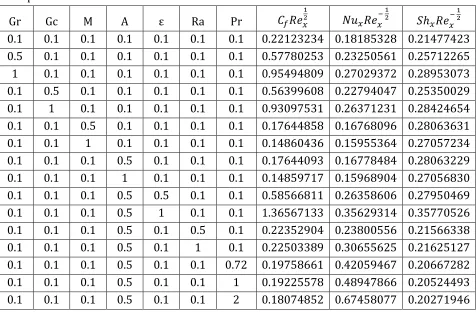
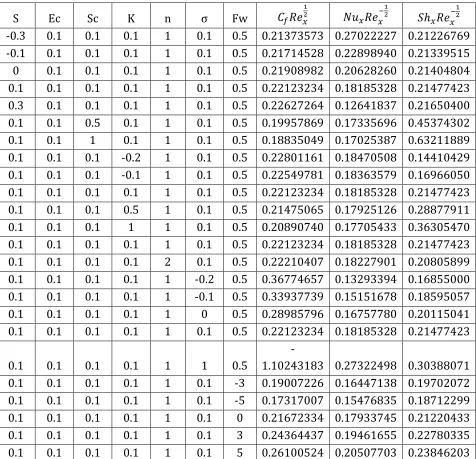
thermal Grashof number 𝐺𝑟, solute Grashof number 𝐺𝑐, Prandtl number 𝑃𝑟, Eckert number 𝐸𝑐, Schmidt number 𝑆𝑐, thermal radiation parameter 𝑅𝑎, Suction/injection parameter 𝐹𝑤, Magnetic parameter 𝑀, porous medium permeability parameter 𝐴, chemical reaction rate parameter 𝐾, the heat generation or absorption parameter 𝑆, velocity ratio 𝜀, and stretching/shrinking parameter 𝜎. This parametric study has been carried out adopting the following values 𝐺𝑟 = 𝐺𝑐 = 𝑃𝑟 = 𝑆𝑐 = 𝐸𝑐 = 𝑅𝑎 = 𝑀 = 𝐴 = 𝐾 = 𝑆 = 𝜎 = 𝜀 = 0.1, 𝐹𝑤 = 0.5 and 𝑛 = 1 for the basic flow parameters. Thusly, situation in which each parameter adjusts values, in the tables has been appropriately highlighted therein, and on the graphs depicted specifically on the figure legends. Tables 1 and 2 depict the comparison of Ishak et al. (2007) reported results as special cases of the present work, therefore indicating favorable agreement and our numerical code is adduced credible. The crux of this present work is centered on cooling problems with applications in engineering and related areas, the relevant situations are those for which the buoyancy force parameters (𝐺𝑟, 𝐺𝑐)are nonenegative. Tables 3-4 present the variations in the reduced local skin
friction coefficient 𝐶𝑓𝑅𝑒𝑥 1
2 = 𝑓′′(0) , reduced local Nusselt number 𝑁𝑢 𝑥𝑅𝑒𝑥
−1
2 = − (1 +
4 3𝑅𝑎) 𝜃
′(0) and reduced local Sherwood number 𝑆ℎ 𝑥𝑅𝑒𝑥
−1
2 = −𝜙′(0) for various values of
Table 1: Computations showing comparison of the Nusselt number with Ishak et al.[2007]
result when 𝑃𝑟 = 1, 10, 𝜎 = 1, 𝐺𝑟 = 𝐺𝑐 = 𝑆𝑐 = 𝑅𝑎 = ℰ = 0 Flow
parameters With fixed
values
Fw Ishak et al.[2007]
Present study
𝑁𝑢𝑥𝑅𝑒𝑥− 1
2 𝑁𝑢
𝑥𝑅𝑒𝑥 − 1
2
Pr=1 -1 0.6181 0.6182
-0.6 0.7441 0.7441
-0.4 0.8198 0.8199
-0.2 0.9050 0.9050
0 1.0000 1.0000
0.2 1.1050 1.1050
0.4 1.2198 1.2198
0.6 1.3440 1.3440
1 1.6180 1.6180
Pr=10 -1 0.9418 0.9417
-0.6 1.4709 1.4708
-0.4 1.9681 1.9679
-0.2 2.7096 2.7094
0 3.7208 3.7207
0.2 4.9765 4.9763
0.4 6.4260 6.4258
0.6 8.0178 8.0177
Table 2: Computations showing comparison of the Skin-friction coefficient and the Nusselt number with Ishak et al. [2007] results when Pr=1, 𝜎 = 1, 𝐺𝑟 = 0, −0.1, 1 while 𝐺𝑐 = 𝑆𝑐 = 𝑅𝑎 = 𝐹𝑤 = 0.
Flow parameters
With fixed values
𝜀 Ishak et el.[2007] Present result
𝐶𝑓𝑅𝑒𝑥 1
2 𝑁𝑢
𝑥𝑅𝑒𝑥 − 12
𝐶𝑓𝑅𝑒𝑥 1
2 𝐶
𝑓𝑅𝑒𝑥 1 2
Pr=1, Gr=0 0 −0.9980 −0.9985
0.1 −0.9694 −0.9694
0.2 −0.9181 −0.9181
0.5 −0.6673 −0.6673
2 2.0175 2.0178
3 4.7294 4.7843
10 36.2603 36.5751
Pr=1, 𝐺𝑟 = −0.1,
0 -1.0513 0.9856 -1.0514 0.98558
0.01 -1.0490 0.9880 -1.0490 0.987943
0.05 -1.0372 0.9977 -1.0372 0.997694
0.1 -1.0176 1.0079 -1.0176 1.010402
0.2 -0.9638 1.0362 -0.9638 1.036868
0.5 -0.7075 1.1186 -0.7075 1.118574
1 -0.0343 1.2502 -0.0343 1.250185
2 1.9899 1.4855 1.9899 1.485551
5 11.7331 2.0418 11.7609 2.064926
Pr=Gr=1 0 -0.5608 1.0873 -0.56092 1.087214
0.01 -0.5596 1.0881 -0.5597 1.088082
0.05 -0.5528 1.0921 -0.55772 1.091849
0.1 -0.5398 1.0982 -0.5398 1.098245
0.2 -0.5002 1.1133 -0.50018 1.113302
0.5 -0.2846 1.1714 -0.28458 1.171363
1 0.3350 1.2827 0.334974 1.282694
2 2.2913 1.5020 2.291024 1.503357
Table 3: Computations showing the reduced Skin-friction coefficient 𝐶𝑓𝑅𝑒𝑥 1
2 , reduced
Nusselt number 𝑁𝑢𝑥𝑅𝑒𝑥− 1
2, reduced Sharwood number 𝑆ℎ 𝑥𝑅𝑒𝑥
− 1
2 for various indicated basic
flow parameter values
Gr Gc M A ε Ra Pr 𝐶𝑓𝑅𝑒𝑥
1
2 𝑁𝑢
𝑥𝑅𝑒𝑥 − 1
2 𝑆ℎ
𝑥𝑅𝑒𝑥 − 12
Table 4: Computations showing the reduced Skin-friction coefficient 𝐶𝑓𝑅𝑒𝑥 1
2 , reduced
Nusselt number 𝑁𝑢𝑥𝑅𝑒𝑥− 1
2, reduced Sharwood number 𝑆ℎ 𝑥𝑅𝑒𝑥
−1
2 for various indicated basic
flow parameter values
S Ec Sc K n σ Fw 𝐶𝑓𝑅𝑒𝑥
1
2 𝑁𝑢
𝑥𝑅𝑒𝑥 −1
2 𝑆ℎ
𝑥𝑅𝑒𝑥 −12
-0.3 0.1 0.1 0.1 1 0.1 0.5 0.21373573 0.27022227 0.21226769 -0.1 0.1 0.1 0.1 1 0.1 0.5 0.21714528 0.22898940 0.21339515 0 0.1 0.1 0.1 1 0.1 0.5 0.21908982 0.20628260 0.21404804 0.1 0.1 0.1 0.1 1 0.1 0.5 0.22123234 0.18185328 0.21477423 0.3 0.1 0.1 0.1 1 0.1 0.5 0.22627264 0.12641837 0.21650400 0.1 0.1 0.5 0.1 1 0.1 0.5 0.19957869 0.17335696 0.45374302 0.1 0.1 1 0.1 1 0.1 0.5 0.18835049 0.17025387 0.63211889 0.1 0.1 0.1 -0.2 1 0.1 0.5 0.22801161 0.18470508 0.14410429 0.1 0.1 0.1 -0.1 1 0.1 0.5 0.22549781 0.18363579 0.16966050 0.1 0.1 0.1 0.1 1 0.1 0.5 0.22123234 0.18185328 0.21477423 0.1 0.1 0.1 0.5 1 0.1 0.5 0.21475065 0.17925126 0.28877911 0.1 0.1 0.1 1 1 0.1 0.5 0.20890740 0.17705433 0.36305470 0.1 0.1 0.1 0.1 1 0.1 0.5 0.22123234 0.18185328 0.21477423 0.1 0.1 0.1 0.1 2 0.1 0.5 0.22210407 0.18227901 0.20805899 0.1 0.1 0.1 0.1 1 -0.2 0.5 0.36774657 0.13293394 0.16855000 0.1 0.1 0.1 0.1 1 -0.1 0.5 0.33937739 0.15151678 0.18595057 0.1 0.1 0.1 0.1 1 0 0.5 0.28985796 0.16757780 0.20115041 0.1 0.1 0.1 0.1 1 0.1 0.5 0.22123234 0.18185328 0.21477423
0.1 0.1 0.1 0.1 1 1 0.5
-1.10243183 0.27322498 0.30388071 0.1 0.1 0.1 0.1 1 0.1 -3 0.19007226 0.16447138 0.19702072 0.1 0.1 0.1 0.1 1 0.1 -5 0.17317007 0.15476835 0.18712299 0.1 0.1 0.1 0.1 1 0.1 0 0.21672334 0.17933745 0.21220433 0.1 0.1 0.1 0.1 1 0.1 3 0.24364437 0.19461655 0.22780335 0.1 0.1 0.1 0.1 1 0.1 5 0.26100524 0.20507703 0.23846203
6.2. Graphical Results
5.2.1. Effect of parametric variation on velocity Velocity field
injection parameter (Fw<0), but reduces with rise in suction parameter (Fw>0). It may be mentioned here that the physical phenomenon characterized by suction may be useful for putting into practice in technological and industrial processes where fluid velocity needs to be stemmed as to delay the boudary layer transition.
6.2.2. Effect of parametric variation on Temperature Field
The plots of the dimensionless temperature distribution against the the transverse distance for several emerging flow parameters are illustrated in Figs. 11 − 15 wherein the distribution assumes the wall surface value of unity and subsequently decreases monotonically to admit its zero farfield value asymptotically. As it can be observed in Fig. 11, the fluid temperature within the boundary layer cools down considerably on raising the thermal Grashof number from 0.1 through 1.0. The same feature prevailed for increasing Solutal Grashof numbers (not reported here for space economy). Interstingly, this physical phenomenon has practical importace in some engineering problems where the fluid temperature in the thermal boundary layer demands control. Fig. 12 unveils the features of the variation of the magnetic field parameter (M) on the fluid dimensionless temperature field. An observable increase in temperature occurs when M strengthens from 0.1 through 1.0. A similar report was recorded when the solutal Grashof number was adjusted in the same range (not shown). The variation of temperation field 𝜃(𝜂) with respect to 𝜂 is signposted in Fig. 13 wherein the fluid temperature within the boundary layer deminishes rapidly in values as the Prandtl number (Pr) increases from 0.72 (air) through 1.0 (geothermal water) to 2.0 (low temperature aquifer). The effects of heat generation/absurption on thermal profiles as observed in Fig. 14 shows that the fluid temperature can be raised by inceasing the heat generation parameter (S>0) while reverse trend manifests for the heat absurption parameter (S<0). Fig. 15 depicts the plots of the temperature field 𝜃(𝜂) versus 𝜂 for various values of the stretching /shrinking parameter 𝜎 in interval (−0.2, 1.0). The revelation lends to a rise in fluid temperature when shrinking parameter strengthens in values. On the other hand, there occurs a fall in temperature as the stretching parameter increases in values. From the other results not reported here for space saving, the effects of the suction or fluid withrawal dampened the thermal temperature and those of the injection or mass blowing raised it.
6.2.3. Effect of parametric variation on Concentration Field
values of the Grashof number (Gr). As Gr increases from 0.1 𝑡𝑜 1.0, a decrease in 𝜙(𝜂) occurs. This same feature, though omitted, was recorded for the variations accompanied by increase in the solutal Grashof number. Fig. 17 shows that the concentration profiles rise with increasing magnitude of the magnetic field parameter (M) and similar trend was observed when the porous medium permeability parameter (A) increases within the boundary layer (omitted). Fig. 18 depicts the variation of the species concentration profiles for varying Scmidt number (Sc). As it can be seen, the species concentration decreases in values as the Scmidt number increases. The effect of the velocity ratio (ℰ) was exacly similar in trend to those revealed by the Schmidt number, and subsequently omitted. The variation of dimensionless concentration 𝜙(𝜂) in the boundary layer as the chemical reaction parameter ranges from −0.2 through 1.0 is unveiled Fig. 19, wherein 𝜙(𝜂) rises with incresing generative chemical reaction parameter (K<0) in contrast with that of the destructive chemical reaction parameter (K>0). Figs. 20-21chacterize the effects of the shrinking/stretching and injection/suction parameters on the dimensionless species concentration respectively. As observed, both the shrinking and injection parameters cause a rise in the concentration whereas the stretching and suction parameter indicate the reverse trend.
6.2.4. Effect of parametric variation on the local skin friction, reduced local Nusselt and Sherwood numbers
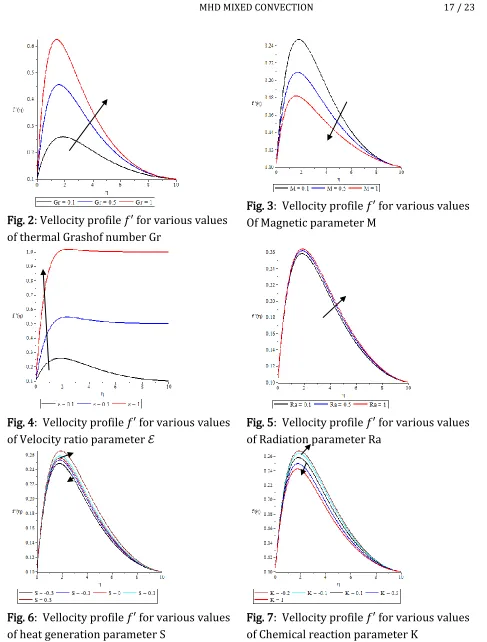
Fig. 2: Vellocity profile 𝑓′ for various values of thermal Grashof number Gr
Fig. 3: Vellocity profile 𝑓′ for various values Of Magnetic parameter M
Fig. 4: Vellocity profile 𝑓′ for various values of Velocity ratio parameter ℰ
Fig. 5: Vellocity profile 𝑓′ for various values of Radiation parameter Ra
Fig. 6: Vellocity profile 𝑓′ for various values of heat generation parameter S
Fig. 8: Vellocity profile 𝑓′ for various values of chemical reaction order n
Fig. 9: Vellocity profile 𝑓′ for various values of strething parameter 𝜎
Fig. 10: Vellocity profile 𝑓′ for various values of strething parameter Fw
Fig. 11: Temperature profile 𝜃 for various values of thermal Grashof number Gr
Fig. 12: Temperature profile 𝜃 for various
Fig. 14: Temperature profile 𝜃 for various values of heat generation /absorption parameter S
Fig. 15: Temperature profile 𝜃 for various values of stretching parameter 𝜎
Fig. 16: Concentration profile 𝜙 for various values of stretching parameter Gr
Fig. 17: Concentration profile 𝜙 for various values of stretching parameter M
Fig. 18: Concentration profile 𝜙 for various
Fig. 20: Concentration profile 𝜙 for various values of stretching parameter 𝜎
Fig. 21: Concentration profile 𝜙 for various values of stretching parameter F
Fig. 22 : Variation of reduced Sherwood
number 𝑆ℎ𝑥𝑅𝑒− 12 = 𝜙′(0) With Eckert number Ec for various of Magnetic parameter M
Fig. 23: Variation of reduced Sherwood
number 𝑆ℎ𝑥𝑅𝑒− 12 = 𝜙′(0) With Eckert number Ec for various values of Magnetic parameter M
7. Conclusions
A similarity analysis has been carried out to investigate the influences on the steady, laminar boundary layer flow of the magnetoconvection heat and mass transfer near the vertical permeable plate encompassed in an electrically conducting fluid, stretching or shrinking linearly with respect to the axial distance and permeated by a uniform transverse magnetic field in the presence of uniform porous medium permeability, nth order chemical reaction and Joule heating. A linear assumption in the variation of the fluid temperature and species concentration with respect to the axial distance has been adduced. The results of our numerical findings are thus summarized:
The local skin friction, the reduced local Nusselt and Sherwood numbers all increase in values as the buoyancy parameters (Gr, Gc), radiation (Ra), velocity ratio (ℰ), chemical reaction order (n), suction (Fw>0) and stretching (𝜎 > 0) intensify, in contrast to increase in the magnetic field (M), permeability`(A), injection (Fw<0) and shrinking (𝜎 < 0) parameters.
The fluid velocity rises as buoyancy parameters (Gr, Gc) increase in values while reverse is the case for temperature and species concentration. More so, the magnetic field and permeability parameters intensify in values as to raise the magnitudes of fluid temperature and species concentration.
Schmidt number (Sc) as well as the destructive chemical reaction (K>0) increment leads to a fall in not only the local skin friction but also the local Nusselt number. In addition, Sc and Pr reduce the fluid velocity 𝑓(𝜂) as they separately rise in values.
Rise in the generative chemical reaction parameter (K<0) causes increment in both fluid velocity and species concentration but increase in heat generation parameter (S>0) raises the fluid velocity and temperature.
Increase in the stretching parameter decreases both the dimensionless temperature and species concentration but opposite effect are cast by rising shrinking parameter (S<0).
The local skin friction and reduced local Sherwood number fall in magnitudes when Prandtl number and heat absorption parameter rise in values but the reduced local Nusselt number responds oppositely.
The reduced local Sherwood number falls in magnitude as the velocity ratio (ℰ) intensifies.
REFERENCES
[1] Adeniyan, A., Ogwuegbu, C. S (2014), Effects of Chemical Reaction and Heat Generation on a Mixed Convection Stagnation Point Flow, Heat and Mass Transfer towards a Stretching Vertical Porous Flat Plate, Asian Research Publishing Network [ARPN] J. Engng. & Appl. Sci., vol. 9, no. 12, pp. 2676-2686 [2] Anderson, J. D (2005), Ludwig Prandtl’s boundary layer, American Institute of Physics, Physics
[3] Aziz, A. (2009), A similarity solution for laminar thermal boundary layer over a flat plate with a convective surface boundary condition, Commun. Nonlinear Sci. Numer. Simulat., 14, pp. 1064-1068. [4] Chamkha, A (1998), Unsteady hydromagnetic flow and heat transfer from a non-isothermal stretching
sheet immersed in a porous medium, Int. Comm. Heat Mass Transfer, vol. 25, No. 6, pp. 899-906. [5] Crane, L. J (1970), Flow past a stretching plate, Z. Angews. Math. Phys. (ZAMP), 21, 645-647.
[6] Damseh, R. A., Duwairi, H. M., Al-Odat, M (2006), Similarity analysis of magnetic field and thermal radiation effects on forced convection flow, Turkish J. Eng. Env. Sci. , 30, pp. 83-89.
[7] Das, K (2011), Effects of heat and mass transfer on MHD free convection flow near a moving vertical plate of a radiating and chemically reacting fluid, Journ. Sib. Feb. Univ. Math. & Phys. 4(1), pp.18-31. [8] Davidson, P.A (2001), An Introduction to Magnetohydrodynamics, Cambridge Univ. Press, UK [9] Heck, A (2003), Introduction to Maple, 3rd Edn., Springer-Verlag, New York, Inc.
[10]Hiemenz , K (1911) The Boundary Layer Analysis of a Uniformly Flowing Liquid Circulating in Straight Circular Cylinder (in German), Dinglers Polytech. J., 326 (1911), pp. 321-324.
[11] Hossain, M. S., Samand, M. A (2013), Heat and mass transfer of an MHD free convection flow along a stretching sheet with chemical reaction, radiation and heat generation in presence of magnetic field, Research Journ. of Mathematics and Statistics, 5(1-2): 05-17.
[12] Ibrahim, S. M (2014), Effects of chemical reaction on dissipative radiative MHD flow through a porous medium over a nonisothermal strtching sheet, Joorn. of Industriam Mathematics, vol. 2014, ID 243148, 10 pages.
[13] Ibrahim, S. M and Reddy, N (2013), Similarity solution of heat and mass transfer for natural convection over a moving vertical plate with internal heat generation and a convective boundary condition in the presence of thermal radiation, viscous dissipation, and chemical reaction, Thermodynamics, Article ID 790604, 10 pages. doi.org/10.1155/790604
[14] Ibrahim, S. Y and Makinde, O. D (2010), Chemically reacting MHD boundary layer flow of heat and mass transfer over a moving vertical plate with suction, Scientific Research and Essays, vol. 5(19), pp. 2875-2882.
[15] Ibrahim, S. Y and Makinde, O. D (2011), Chemically reacting Magnetohydrodynamics (MHD) boundary layer flow of heat and mass transfer past a low-heat-resistant sheet moving vertically downwards, Scientific Research and Essays, vol. 6(22), pp. 4762-4775.
[16] Ishak A, Nazar R, Arifin N.M and Pop I (2007) Mixed convection of a stagnation point flow towards a stretching permeable sheet. Malaysian Journal of Mathematical sciences 1(2) 217-226
[17] Jat, R. N and Chaudhary, S (2009), MHD flow and heat transfer over a stretching sheet, Applied Mathematica Sciences, vol. 3, No. 26, pp. 1285-1294.
[18] Makinde, O. D (2011), Second law analysis for variable viscosity hydromagnetic boundary layer flow with thermal radiation and Newtonian heating, Entropy 13, pp. 1446-1464
[19] Makinde, O. D., Charles, W. M (2010), Computational dynamics of hydromagnetic stagnation flow towards a stretching sheet, Appl. Comput. Math., 9(2), 2010, pp 243 – 251
[20] Makinde, O. D., Olanrewaju, O. D (2012), Combined effects of internal heat generation and buoyancy force on boundary layer flow over a vertical plate with a convective surface boundary condition, Canadian J. of Chem. Engng., vol. 90, pp. 1289-1294.
[21] Makinde, O. D., Zima, K,. Anwar Beg, O (2012), Numerical study of chemically reacting hydromagnetic boundary layer flow with Soret/Dufour effects and a convective surface boundary condition, Int. J. of Thermal & Environmental Engineering, vol. 4, No. 1, pp. 89-98.
[23] Mukhopadhyay, S (2012): Analysis of boundary layer flow and heat transfer along a stretching cylinder in a porous medium, Int. Sholarly Research Network-Thermodynamics, Article ID 704984, Article ID 704984, 7 pages.
[24] Mukhopadhyay, S (2013): Chemically reactive solute transfer in MHD boundary layer flow along a stretching cylinder with partial slip, Int. J. of Appl. Math. and Mech. 9(1): 62-79
[25] Olanrewaju, P. O., Alao, F. I., Adeniyan, A., Bishop, S. A (2013), Double-diffusive convection from a permeable vertical surface under convective boundary condition in the presence of heat generation and thermal radiation, Nonlinear Sci. Lett. A, vol. 4, No. 3, pp. 76-90
[26] Olanrewaju, P. O., Makinde, O. D (2011), Effects of thermal diffusion and diffusion thermo on chemically reacting MHD boundary layer flow of heat and mass transfer past a moving vertical plate with suction/injection, Ara. J. Sci. Eng, 36, 1607-1619.
[27] Ridha, A (1996), Aiding flows non-unique similarity solutions of mixed convection boundary-layer equations, Z. Angew Math. Phys. (ZAMP), vol. 47, No. 3, pp. 341-352.
[28] Sakiadis, B. C (1961), Boundary layer behavior on continuousln solid surfaces: I. Boundary-layer equations for two-dimensional and axisymmetric flow, AIChE J., 7, 26-28.
[29] Shivamoggi, B. K (1985), Theoretical Fluid Dynamics, Kluwer Academic Publishers, Hingham, [30] shrinking sheet, Sains Malasiana, vol. 40, no. 10, pp. 1179-1186.
[31] Siegel, R. S., Howell, J. R (1972), Thermal radiation heat transfer, International Student Edn., McGraw-Hill, New York.
[32] Sparrow, E. W., Cess, D. R (1978), Radiation Heat Transfer, Augmented Edition, Hemesphere Publishing Corporation, Washington D.C.
[33] Syed, K. S., Ahmad, S., Ashraf, M (2012), Study of magnetohydrodynamic and thermal characteristics of axisymmetric stagnation point flow with viscous dissipation over a strtching surface, World Applied Sciences J. 18(1): 43-54.USA.
![Table 1: Computations showing comparison of the Nusselt number with Ishak et al.[2007]](https://thumb-us.123doks.com/thumbv2/123dok_us/7821359.2087654/10.612.79.382.85.494/table-computations-showing-comparison-nusselt-number-ishak-et.webp)