Residential Relocation and the Risk of Attempted Suicide in Adolescents
David B. Sommer
A Master's Paper submitted to the faculty of The University of North Carolina at Chapel Hill
In partial fulfillment of the requirements for The degree of Master of Public Health in
The Public Health Leadership Program.
Chapel Hill 2003
Abstract
Objective: To examine whether frequency of residential relocation was
associated with increased risk of attempted suicide in a large, nationally
representative sample of adolescents (ages 12 to 17).
Method: Data on over 19,000 adolescents from the 2000 National Household
Survey on Drug Abuse (NHSDA) were analyzed. Logistic regression was
performed to determine the odds ratio for attempted suicide comparing
adolescents in three categories of relocation frequency with adolescents who did
not move during the preceding five years. Analyses were stratified on
demographic characteristics to test for effect modification. Demographic control
variables were then added to the regression model to generate adjusted odds
ratios.
Results: Compared to adolescents reporting no moves in the preceding five years,
crude odds ratios (and 95% confidence intervals) for a suicide attempt among
adolescents by number of moves in the last five years were: 1.23 (0.97-1.57) for
one move, 1.53 (1.22-1.91) for two or three moves, and 3.11 (2.32-4.16) forfour
or more moves. Odds ratios did not change substantially when adjusted for sex,
age, race/ethnicity, family income, family structure, and population density.
Conclusions: A dose-response relationship was observed between frequency of
a clinically useful marker to assist school and medical professionals in identifying
at-risk adolescents for further evaluation.
Table of Contents
List of Tables List of Figures
Introduction
Materials and Methods Results
Discussion References Tables Figure
Acknowledgements
Page v
VI
I
II
List of Tables
Page 1. Frequency of Residential Relocation by Demographic 29
Characteristics
2. Suicidality by Demographic Characteristics 30 3. Crude Association Between Frequency of Relocation and 31
Suicidality
4. Stratified Odds Ratios for Suicide Attempt by Frequency 32 of Relocation
List of Figures
Page
I. Adjusted Odds Ratios for Suicide Attempt by Frequency 34
Introduction
Although a rare event, suicide among American adolescents aged 12 to 17
years was the second leading cause of death in this population during the year
2000 with 1044 deaths recorded in the National Center for Health Statistic's Vital
Statistics System. 1 Rates of suicide among young adults have nearly tripled
between 1952 and 1996. 2 Among adolescents, suicidal ideation and attempted
suicide are much more common than completed suicide. Data from the 2000
Youth Risk Behavior Study indicate that, during the preceding year, 19% of high
school students "seriously considered attempting suicide" and 8.8% did attempt
suicide. 3 The prevention of adolescent suicide is a difficult undertaking given the
high prevalence of suicidal ideation, the relative rarity of completed suicide, and
the large proportion of individuals with identified risk factors who do not commit
suicide4 Nonetheless, the Surgeon General's Call to Action to Prevent Suicide 2
urges a concerted effort in the public health community to develop effective
prevention strategies. The report emphasizes that an evidence-based public health
approach to prevention requires a better understanding of the risk and protective
factors related to suicide and suicidal behavior in specific populations. This paper
aims to enhance the epidemiologic research base by examining the contribution of
residential relocation to the risk of attempted suicide in American adolescents.
Attempted suicide is an imperfect predictor of completed suicide in
adolescents. Suicide attempts are 100 times more frequent than completed
suicides, and females are more likely to attempt suicide, while males are more
important correlate for completed suicide in adolescents. 5 Furthermore, the
relatively high prevalence of attempted suicide means that sufficient numbers of
cases will be present in a large nationally representative sample to make
meaningful statistical inferences about associated factors. Retrospective
case-control designs with proxy informants must be used when examining completed
suicides, increasing the possibility of selection and informant biases. Therefore,
attempted suicide is accepted as a valid proxy, and several epidemiologic studies
have used attempted suicide as the dependent variable to examine risk factors for
suicidality. 6
Identified risk and protective factors for adolescent suicide are numerous.
In 2000, Beautrais conducted an extensive literature review on risk factors for
suicide and attempted suicide in adolescents and young adults for the National
Health and Medical Research Council of Australia.7 She classified risk factors for
which empiric support existed into five categories: 1) socioeconomic
disadvantage, 2) childhood and family adversity (parental psychopathology,
marital dysfunction, child abuse), 3) individual vulnerabilities (genetic
predisposition, personality characteristics), 4) mental disorders, and 5) exposure
to stressors (interpersonal losses, legal or disciplinary problems). A more recent
review of risk factors for suicidal behavior in youth was conducted by Gould,
Greenberg, Velting, and Shaffer at Columbia University8 Their compiled list of
risk factors did not differ substantially from that of Beautrais, although Gould et
al. placed a greater emphasis on the importance of psychopathology. Depression,
associated with adolescent suicidality include substance abuse, anxiety disorders, and psychotic disorders. 8•4·7•9
Many studies identifying risk factors are of poor methodologic quality owing to the use of convenience samples, the lack of non-suicidal comparison subjects, failure to account for confounding variables, and the lack oflongituclinal observation.7 A rigorous analysis was performed on a nationally representative sample of 13,110 American students in grades 7 through 12 using the 1995
National Longitudinal Study of Adolescent Health (Add Health),5 identified as the most important risk factors for attempted suicide: a previous suicide attempt, suicidal behavior in a friend, somatic symptoms, history of mental health
treatment (the study did not assess specific diagnoses), same-sex attraction, school problems, violence victimization, violence perpetration, alcohol use, and illicit drug use. The most important protective factors were parent-family
connectedness and emotional well-being. All analyses controlled for age, family structure, and welfare status and were stratified by race/ethnicity and sex. The effect of relocation on suicidality was not examined in the Add Health study, nor was relocation mentioned as a risk factor in either of the major reviews by Beautrais 7 and Gould et al8
However, residential relocation has been implicated as a risk factor for adolescent suicidality in at least two case-control studies. In a study of 129 serious suicide attempts among individuals aged less than 25 years living in Christchurch, New Zealand between 1991 and 1994 compared with 153
with increased odds of suicide attempt (OR 2.2, 95% CI 1.3-3.6).6 In a study of
153 nearly-lethal suicide attempts among residents of Houston, TX aged 15 to 34
years between 1992 and 1994 compared to 513 community controls, Potter eta!.
found that the risk of suicide attempt was increased if the subject had moved
during the past 12 months (crude OR 3.1, 95%CI 2.2-4.5).10 When they
controlled for age, sex, the presence of depression, and alcoholism, the adjusted
odds ratio was 2.1 (95%CI 1.4-3.3.) Furthermore, they found that the risk
increased with the number of moves during the last 12 months. For subjects who
had moved one, two, or three or more times, the adjusted odds ratios were 1.5,
1.7, and 6.2 verses not moving at all. Thus, frequent residential relocation may be
a qualitatively different and stronger risk factor than the occurrence of any
relocation.
While these studies suggest that residential relocation is associated with an
increased risk of a suicide attempt in adolescents, they are limited in three
important ways. First, they include subjects aged 18 to 34 years. In fact, persons
over 17 years old comprised the majority of cases in both studies. The typical life
circumstances of persons aged 12 to 17 years and persons aged 18 to 34 years are
sufficiently different that they warrant separate consideration. Second, they both
focused upon a single metropolitan area. A geographically diverse sample would
allow for more confident generalization of findings to broader populations.
Finally, the case-control design imparts bias because subjects are selected based
upon an outcome of interest. The use of a random population sample would
To describe a theoretical causal model for the association between
relocation and suicidality, Potter et al.10 rely on the century-old model of Emile
Durkheim, who described egoistic and anomie suicide. They hypothesize that
moving forces an individual to become more isolated and self-reliant, while
creating a void of social regulation, thus increasing the risk for both egoistic an
anomie suicide. Decreased social support and increased subjective isolation are
recognized as important effects of residential relocation and may increase the risk
of suicidality. Current etiologic explanations of suicidal behavior, however, focus
mainly on psychopathology. Over 90% of adolescents who commit suicide
suffered from an associated psychiatric disorder at the time of death. 9 In her
review of the literature on risk and protective factors, 7 Beautrais synthesized
current theories to create a causal model in which psychiatric morbidity interacts
with environmental factors to cause suicidal behavior. Therefore, the most
plausible causal model, stated in contemporary language, is that moving is an
environmental stressor that creates or exacerbates psychopathology and thus
increases risk for suicidal behavior.
Evidence suggests that moving does, in a broad sense, adversely affect
adolescents' psychological well-being and/or development. Epidemiologic
studies on this subject date back to at least 1942, when Tietze, Lemkau, and
Cooper analyzed the 1936 Mental Hygiene Study in Eastern Baltimore and found
that, controlling for age, ethnicity, and relief status, the proportion of children
with "behavioral problems" (broadly defined to include all serious
residence.11 More recently, Wood eta! examined data for 9,915 children aged 6
to 17 years from the 1988 National Household Interview Survey and found that
frequent movers (defined as the top decile when subjects were ordered by moves
per year over the course of their lifetime) were significantly more likely than
non-movers to have four or more behavioral problems. (OR 1.77, 95%CI 1.37-2.29).12
Brown and Orthner surveyed 720 adolescents aged 12-14 years in 5
geographically and socioeconomicly diverse middle schools in the United States
and found that life satisfaction significantly decreased with increased frequency
and recency of moves.13
While the evidence supporting some adverse psychological effects of
moving is strong, evidence linking relocation with depression, the form of
pathology most strongly associated with suicidality is weaker. Brown and
Orthner, also assessed depression in their subjects, but failed to find a significant
difference between movers and non-movers. Hendershott studied a sample of 205
middle school students in the Southwestern United States and found a significant
but small (OR 1.16) increase in the prevalence of depression among students who
had moved during the preceding year. 14
The theoretical literature on the effects of residential mobility on youth
offers more insight as to the role relocation may play in causing or enhancing
psychopathology. In a review of the literature, Scanlon and Devine15 discuss two
mechanisms by which moving may decrease psychological well-being. The first
is the creation of psychological stress by thinking about, planning for, and
accentuated because they typically have little input as to the planning and timing
of the move. The second mechanism is a loss of social capital incurred as a result
of changing location. Social capital describes an individual's power derived from
social relationships both within and outside of the family unit. Moving puts stress
on family relationships, disrupting intrafamily social capital and also severs
important ties to friends, other families, teachers, administrators and neighbors.
Strong social capital can be a protective factor against depression, 14 and loss of
important social connections may place the adolescent at greater risk for
psychological pathology. One empiric study in adolescents lends support to the
social capital hypothesis. In a prospective comparison of36 movers and 37
non-movers, Vemberg found that mobile adolescents had fewer contacts with friends
and reported less intimacy with their best friend.16
While most of the theoretical literature focuses upon the effect of a single
move, Humke and Schaefer hypothesize that the more life stresses a young person
experiences, including relocation, the higher that individual's risk of
psychological maladjustment will be.17 Therefore, the total number or frequency
of moves may be a more important predictor of psychopathology (and hence
suicidality) than would be a dichotomous classification (moved versus didn't
move).
While a crude association between the frequency of relocation and the risk
of suicidality would represent clinically useful information, several demographic
variables may modify or confound the effect of relocation and thus should be
race/ethnicity, family structure, family income, and population density (rural vs.
urban). An effect modifier would be a variable associated witb a differential
effect of relocation on tbe risk of suicidality. In other words, if adolescents were
stratified by an effect -modifYing demographic characteristic, the relationship
between relocation and suicidality would be different in different strata. A
confounding variable, on the other hand, would be a characteristic associated with
a differential rate of relocation, and a differential risk of suicidality, but not a
differential effect of relocation on tbe risk of suicidality. Therefore, the
relationship between relocation and attempted suicide would be exaggerated or
diminished if group membership were not accounted for in an analysis. In other
words, if adolescents were stratified by a confounding demographic characteristic,
the relationship between relocation and suicidality would be similar across strata
but significantly different than tbe relationship described in the unstratified
analysis.
Whether moving will affect the risk of suicidality differently for females
than for males is unclear. The literature on differential effects of moving by
gender has been inconsistent and contradictory.15 Females attempt suicide at
much higher rates tban males.4 However, it is unlikely that males and females
move at different rates. Therefore, gender will not likely be an important
confounder. The relationship of age to relocation and suicidality is similar to that
of gender. Older adolescents attempt suicide with greater frequency; 7 however, it
Race/ethnicity may potentially be a confounder or an effect modifier. In
previous studies, African-Americans have had greater rates of relocation than
other groups.17•18 Also, relocation may, on average, represent a different
experience for African-Americans than for other groups. 18 In prior studies,
African-Americans had lower rates of attempted suicide, while Hispanics had
higher rates of attempted suicide than non-Hispanic whites. 5 The literature on
relocation in adolescents does not address the possible differential effect of
relocation on Hispanic adolescents.
The number of parents in an adolescent's household and whether those
parents are biological, step, foster, or adoptive, may be associated with
differential effects of relocation on psychological well-being. A study on the
effect of relocation on "school life" (a construct involving behavioral and
academic components) found that living with both biological parents was a
protective factor against the adverse effects of relocation.19 Children in single
parent households have been shown to move more frequently than children in two
parent households. 12 Thus, family structure may be both a confounder and an
effect modifier.
Several studies have found frequent relocation to be more common among
persons with low income.15·20 Low family income has also been associated with
increased rates of suicide attempts.7 Therefore, family income may be an
important confounder. Scanlon and Devine15 also imply that moving may be a
more stressful experience for low-income adolescents, so family income may be
Finally, living in a rural area has been implicated as a risk factor for
suicidality. 7 While it is unclear whether persons in rural areas relocate more or
less frequently than persons in non-rural areas, this possibility and the possibility
that living in a rural area modifies the effect of relocation on suicidality merit
investigation.
Given the strong theoretical link between relocation and psychological
distress in adolescents, as well as the empiric link between psychopathology and
suicidality, an association between relocation and suicide attempts in adolescents
seems plausible. The positive results of the two case-control studies cited above
suggest the presence of this association. However, there have been no
population-based investigations of this association. I hypothesize that, in a large, nationally
representative, sample of 12 to 17 year olds, a positive association will exist
between recent residential relocation and the risk of a suicide attempt.
Furthermore, I hypothesize that the risk of a suicide attempt will increase as the
number of recent past moves increases and that this association will persist after
important confounding demographic variables have been controlled for in a
Materials and Methods
The National Household Survey on Drug Abuse (NHSDA) is a nationwide
personal interview survey conducted on a year-round basis by Research Triangle
Institute (Research Triangle Park, North Carolina) for the Substance Abuse and
Mental Health Services Administration (SAMHSA). (The name of this project
changed in 2002, and it is currently called the National Survey on Drug Use and
Health [NSDUH].) While the primary aim of the study is to obtain data on the
prevalence and correlates of drug use in the United States, the 2000
administration contained questions about residential relocation and suicidality as
well as several demographic factors and thus was selected as the data source for
my study. The study population is a random sample of the civilian,
non-institutionalized population of the United States aged 12 and older. The details of
the sampling design are described elsewhere.21 In 2000, 71,764 persons in total
completed the computer-assisted interview (CAl). The weighted response rate for
the CAl was 74%.
Before making the NHSDA data publicly available, SAMHSA processed
the data in multiple ways to ensure confidentiality of the respondents. First,
demographic variables were recoded so that an individual respondent could not be
identified with any combination of variables. Second, a randomly selected subset
of the 71,764 records in the full data set was dropped. This left 58,680 records, of
which 19,430 are for 12-17 year-olds. The analytic weights were reassigned after
the first subsample. Therefore, these 19,430 records were weighted to represent
Finally, a smaller random subsample of records was selected and responses for
certain variables were swapped between donor and recipient records selected for
their overall similarity. The resultant data set comprises the Public Use File
(PUF) for the 2000 NHSDA, which is maintained by the Inter-University
Consortium for Political and Social Research (IUCPSR) as part of the Substance
Abuse and Mental Health Data Archive (SAMHDA). The codebook21 for the
dataset provides several comparisons of population prevalence estimates made
using the PUF and the original full unaltered data set. For comparisons in which
at least 60 respondents per cell are represented in the PUF, the differences in
prevalence estimates made using the two data sets are minimal.
The 2000 NHSDA was an in-home interview and utilized two different
interviewing modalities. The majority of the survey was performed using an
audio computer-assisted self-interview (ACASI). Respondents listened to
prerecorded audio files of questions through headphones and entered responses on
a computer keyboard. The interviewer did not have access to the respondent's
answers. This design was intended to allow the greatest degree of privacy for
respondents. Demographic information was obtained using a computer-assisted
personal interview (CAPI), in which the interviewer asked questions aloud to the
respondent and entered answers on the computer for the respondent.
The presence and informed consent of a parent or guardian was required to
begin an interview with a 12-17 year-old respondent unless that respondent was
legally emancipated or living in a college dormitory. Adolescent respondents
other survey questions used in this study were addressed only to the respondent, information about family income was also asked of the respondent's parent or guardian who consented to the interview.
The sequence of questions and the wording of individual questions for the 2000 NHSDA are contained in the codebook and questionnaire, both of which are available on-line.21 The questions of primary interest for this study were "How many times have you moved in the past 5 years?"; "During the past 12 months, has there been a time when you thought seriously about killing yourself?"; and "During the past 12 months, have you tried to kill yourself?". The two questions about suicidality were asked as part of the depression section of the DISC
Predictive Scales (DPS), a psychological screening instrument that was administered in its entirety to all adolescent respondents of the 2000 NHSDA. The section consisted offour gate questions (including suicidal ideation) and three follow-up questions (including suicide attempt). A positive response to any of the four gate questions led to the three follow-up questions being asked of the respondent. Therefore, while the question about suicidal ideation was asked to every respondent, the question about suicide attempt was only addressed to 66% of the respondents due to the skip logic described above.
The survey module commands in Stata utilize variables for the analytic weight,
sampling stratum, and sampling cluster of each record in all calculations to
produce accurate population estimates of parameters and their variance.
Since the outcome of primary interest was attempted suicide, and the
suicide attempt question was only addressed to 66% of respondents, I classified
respondents as having made a suicide attempt only if they answered positively
both the question about suicidal ideation and the question about suicide attempt.
This eliminated the bias induced by the skip logic of the DPS since every
respondent who answered positively the question about suicidal ideation was
subsequently asked the question about suicide attempt. This decision excluded 96
individuals who answered negatively the question about suicidal ideation and
positively the question about suicide attempt. A sensitivity analysis was
performed to examine the effect ofthis decision on study findings.
In categorizing the number of moves in the past 5 years, I attempted to
approximate Wood et a!.' s 12 category of the top I 0% of movers. Therefore, I
created the top category of persons who reported four or more moves (6.6% of the
population). Rather than simply compare this group to the non-movers, I coded
the persons who had moved at least once but less than four times into two roughly
equal-sized categories (one move and two or three moves) so that I could better
describe the dose-response relationship between relocation and suicidality.
I recoded the respondents' ages into three groups (12 to 13, 14 to 15, and
16 to 17), and condensed race/ethnicity into four categories (White, non-Hispauic;
for each category of relocation frequency and suicidality within each demographic
category.
Annual family income was categorized in the PUF by multiples of
$10,000 up to $50,000 (with the highest category being $75,000 and over). I
condensed the family incomes below $20,000 (a level which contains all families
under the federal poverty line
i
2 into a single category. I retained the top categoryand created intermediate categories in the way that provided the most even
distribution of respondents across categories. This resulted in a four-level
categorization of family income ($0- $19,999; $20,000- $49,999;
$50,000-$74,999; and $75,000 and over).
A household composition module on the NHSDA determined whether the
respondent's mother and/or father were living with the respondent. Individuals
were considered parents by the NHSDA whether they were biological, step,
adoptive, or foster parents. I could not, therefore differentiate among these
categories. I therefore treated family structure as a two level variable: living with
a mother and a father (regardless of type), and any other arrangement.
Population density was coded in three levels in the PUF: not in
metropolitan statistical area (MSA), in MSA with fewer than I ,000,000 people,
and in MSA with over 1,000,000 people. Because large MSA's contain both
densely urban and suburban areas, I was tmable to differentiate between these
environments. I did, however, assume that if a respondent was not in an MSA (an
I therefore created a two level variable to differentiate rural versus non-rural
settings.
I began analysis by determining the number of respondents (and the
associated estimated population proportion) in each category of relocation
frequency and suicidality both for the entire sample and for each demographic
category. I then performed logistic regression with suicidality as the dependent
variable and appropriate dummy variables for frequency of relocation as the only
independent variables in order to determine the crude odds of a suicide attempt
for adolescents in each category of relocation frequency compared to adolescents
reporting no relocation. I then repeated this regression on subpopulations defined
by each of the demographic categories described above to check for effect
modification. A variable was considered a significant effect modifier if the
confidence interval for any stratified odds ratio did not overlap with the
confidence interval of the corresponding crude odds ratio. I then iterated the
original logistic regression with each demographic variable as the only control to
assess for confounding. I considered a confounder to be important if the
difference between the crude and adjusted odds ratios were greater than 5 % at
any frequency of relocation. I then produced two sets of adjusted odds ratios.
The first set adjusted only for demographic variables determined to be important
confounders, while the second set adjusted for all demographic variables. Finally,
I performed a sensitivity analysis recoding the 96 respondents with ambiguous
Results
Of the 19,430 available records, 19,009 had complete information for both
suicidality and frequency of relocation and were thus usable for analysis. Among
these respondents, 751 (4.0%) reported both suicidal ideation and a suicide
attempt in the past 12 months. These 7 51 respondents constituted the "cases" for
all regression analyses, while the remaining 18,258 respondents comprised the
"controls." The estimated population prevalence of at least one suicide attempt in
the preceding 12 months was 4.0% (standard error 0.17%). The estimated
percentages of the population reporting zero, one, two or three, and four or more
moves during the last five years were 50.6%, 23.6%, 19.2%, and 6.6%
respectively.
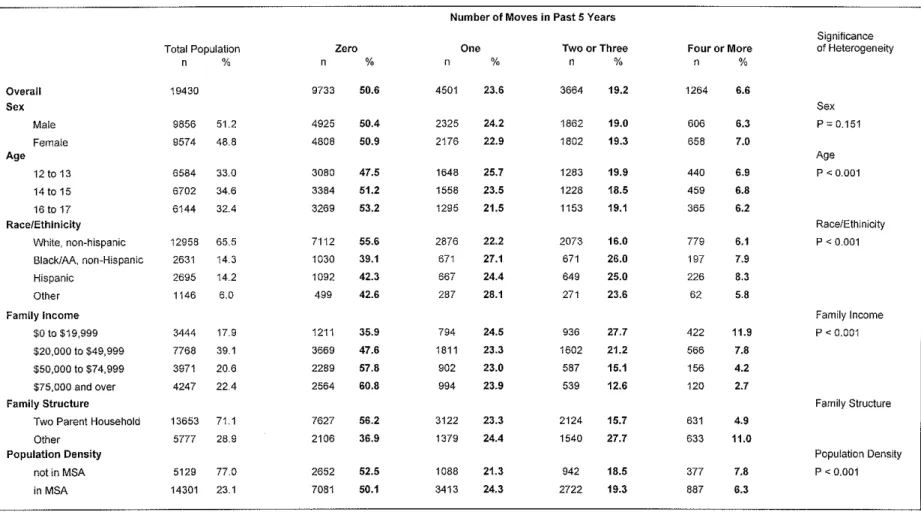
The demographic characteristics of the subpopulations reporting each
category of relocation frequency are reported in table I. Design-based Pearson
tests indicate significant heterogeneity in all demographic domains except gender
(P < 0.01 to compensate for multiple comparisons). Differences are only
substantial (variation of more than 20%) and consistent, however, within
race/ethnicity, family income, and family structure. Notable findings include the
over representation of African-Americans and Hispanics among all non-zero
frequencies of relocation, an inverse relationship between family income and
frequency of relocation, and a decreasing proportion of two-parent households
with increasing frequency of relocation.
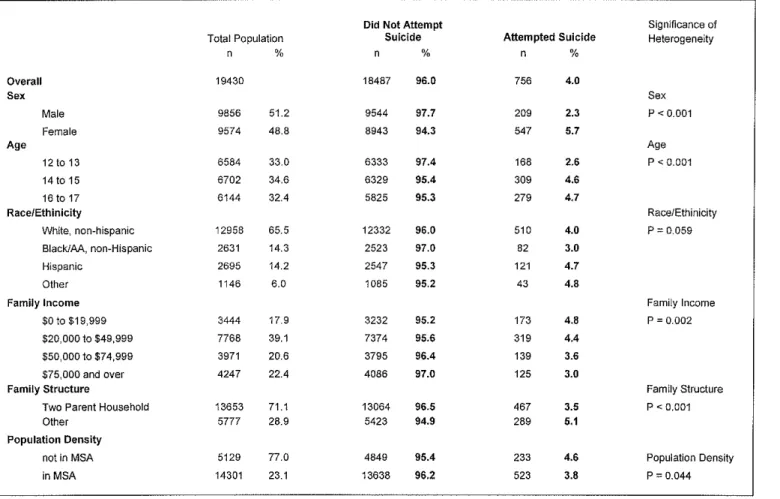
The demographic characteristics of respondents who reported a suicide
tests indicate significant heterogeneity in sex, age, family income, and family structure. Females attempted suicide at a rate 2.3 times that of males. Both 14 to 15 year-olds and 15 to 16 year-olds attempted suicide at nearly double the rate of 12 to 13 year-olds, though there was little difference between the two older groups. Family income was negatively related to the rate of suicide attempts with families earning under $50,000 over-represented among attempters, and those earning over $50,000 under-represented among attempters. Respondents in two-parent households were less likely to attempt suicide.
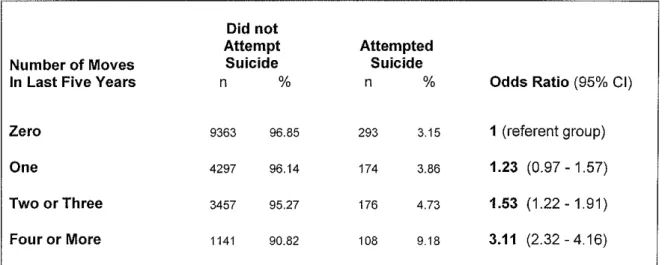
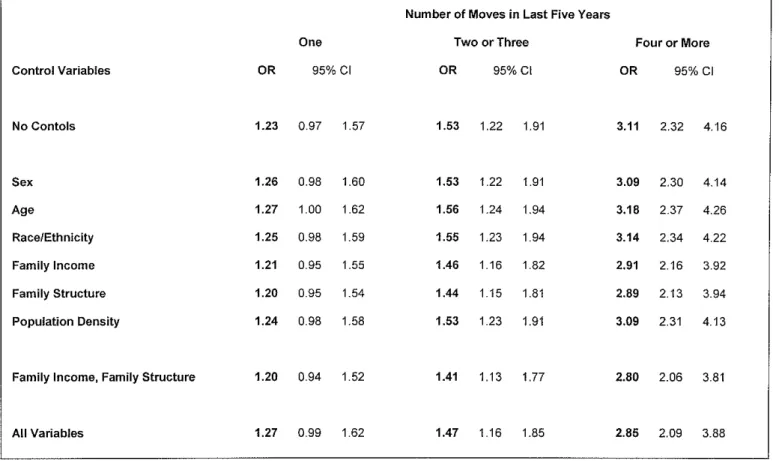
The crude association between frequency of relocation and suicidality is presented in table 3. The crude odds ratios and 95% confidence intervals for attempted suicide having moved one, two or three, or four or more times during the last five years compared to the referent group of non-movers are 1.23
(0.97-1.57), 1.53 (1.22-1.91), and 3.11 (2.32-4.16) respectively.
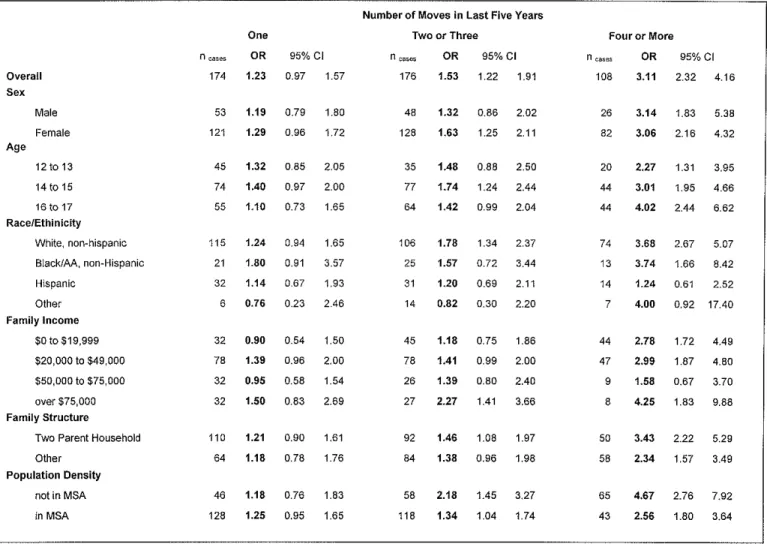
In table 4, the odds ratios for attempted suicide having moved one, two or three, or four or more times during the last five years compared to the referent group of non-movers are presented for members of the subpopulation defined by each demographic characteristic. The 95% confidence intervals for all odds ratios in table 4 overlap with the confidence intervals for the crude odds, indicating no significant effect modification.
suicide attempt at any frequency of relocation. When only these variables are
controlled for, the adjusted odds ratios and their 95% confidence intervals for
attempted suicide having moved one, two or three, or four or more times are 1.20
(0.94-1.52), 1.41 (1.13-1.77), and 2.80 (2.06-3.81). When all demographic
variables (sex, age, race/ethnicity, family income, family structure, and population
density) are controlled for, the adjusted odds ratios and their 95% confidence
intervals for attempted suicide having moved one, two or three, or four or more
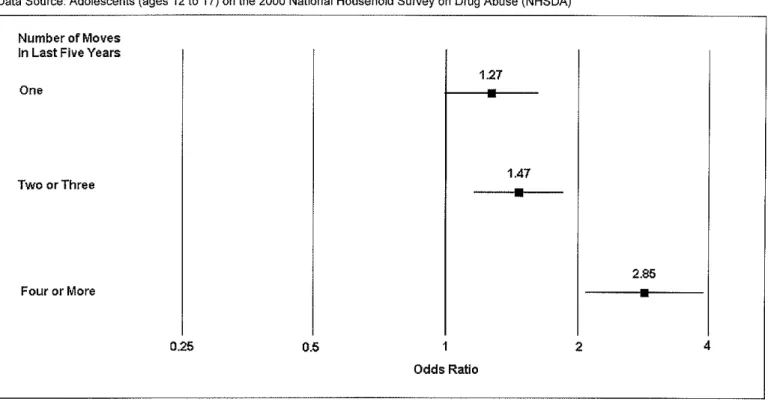
times are 1.27 (0.99-1.62), 1.47 (1.16-1.85), and 2.85 (2.09-3.89). These fully
adjusted odds ratios are represented graphically in figure 1.
The sensitivity analysis recoding the 96 respondents with ambiguous
suicidality status as suicide attempters revealed no significant difference in crude
or adjusted odds ratios for suicide attempts by frequency of relocation. The
adjusted odds ratios and 95% confidence intervals with all demographic controls
Discussion
This is the first population-based study to examine the association between
residential relocation and suicidality in adolescents. The principal finding of this
study is that adolescents (ages 12 to 17) who have moved two or more times in
the last five years are at a significantly increased risk of attempting suicide when
compared to adolescents who have not changed residence during the last five
years. The increase in risk is particularly notable for adolescents who have
moved four or more times. These highly mobile adolescents have odds of a
suicide attempt that are two to four times those of adolescents reporting no
residential relocation. The relationship between frequency of relocation and the
risk for suicide attempt remains qualitatively unchanged when several
demographic characteristics are incorporated into the model as controls.
Three features of the study may limit the validity of the findings. First,
because respondents on the NHSDA self-report suicide attempts, the attempts
reported are likely to include many which are not life-threatening. Some
researchers argue that life-threatening suicide attempts are a much more relevant
clinical endpoint than self-defined suicide attempts. 6·10 Nonetheless, in order to
classify an attempt as serious or life-threatening, documented interaction with
medical personnel is required. The many suicide attempts that do not result in
medical attention, are still important indicators of psychopathology and are still
considered an important risk factor for eventual suicide completion. 7'8
without concerns about differences in definition applied in geographic regions or at specific institutions.
Second, respondents' recall and report of relocation history and the occurrence of a suicide attempt may be somewhat unreliable. It is unlikely that report of relocation frequency was subject to classic recall bias (i.e. persons who attempted suicide being more likely to report a high number of moves) because the questions about suicidality and relocation were asked in different sections of the interview, and moving is not commonly thought of as predisposing an individual to attempt suicide. Nonetheless, it is possible that adolescents who attempted suicide, were more acutely aware of and likely to report stressful past experiences (including relocation) than were adolescents who did not attempt suicide. If this were true, the magnitude of the effect of relocation on the odds of attempted suicide would be artificially exaggerated. The reliability of
adolescents' self report of suicide attempt on the NHSDA is uncertain. However, the design of the interview was such that incentives for respondents to not report an actual suicide attempt or to falsely report an attempt (such as getting a reaction out of the interviewer) were substantially mitigated. The prevalence of an attempt in the preceding 12 months estimated from this study (4.0 %) is consistent with the same prevalence estimated from the Add Health study (3.6 %)5 Both of these figures are lower, however, than the 8.8% estimated on the 2001 National Youth Risk Behavior Survey (YRBS).3
before the suicide attempt. Unfortunately, given the cross-sectional nature of the
NHSDA and the time frames outlined in the questions about relocation history
and suicidality, it is impossible to know for certain whether any or all of the
moves reported by individuals who attempted suicide occurred before the suicide
attempt. While important to recognize, this problem is unlikely to seriously limit
the validity of the primary findings. If the precise dates of reported moves and
suicide attempts were evenly distributed over the five-year and one-year time
-~
frames in question, then 90% of reported moves would predate a reported suicide
attempt. Even if not temporally causal, the munber of moves remains clinically
useful as a screening tool for suicidal risk.
The etiology of adolescent suicide is complex/ and the finding of an
association between relocation and suicide attempts in this study does not
represent evidence of causality. While some theoretical literature cited in the
introduction to this report describes possible mechanisms by which moving could
increase an individual's risk for attempted suicide, it is impossible to establish
causality from this cross-sectional data.23 Additionally, several factors that have
been documented as strongly related to the risk of suicide attempt in adolescents
(e.g. family dysfunction, history of abuse, family history of suicide attempt)7•8
could not be adequately examined in this study.
Evidence of causality, however, is not necessary for the association
between relocation and attempted suicide to be clinically important and useful.
Based on this study, a history of frequent residential relocation in an adolescent is
this term is often interpreted as implying a causal relationship. There may indeed be nothing causal about the link between residential relocation and suicidality in adolescents. For instance, if severe family dysfunction caused families to move frequently and also augmented adolescents' risk for attempted suicide, then family dysfunction could completely account for the observed association between frequent moves and a higher risk for attempted suicide. Clearly, the family dysfunction is causal in this case rather than the relocation itself.
Nonetheless, a history of frequent relocation would still be a valid marker for risk, because an adolescent with this history would more likely suffer from family dysfunction.
A history of frequent relocation is a clinically useful risk marker because this information is easily obtained without a formal psychosocial evaluation and is frequently available to professionals working with adolescents. While a report of four or more moves in the preceding five years is neither a highly sensitive (16 % of suicide attempters reported four or more moves) nor highly specific (9% of adolescents reporting four or more moves attempted suicide) predictor of a
suicide attempt, the increase in relative odds is substantial. Therefore, a history of frequent relocation in an adolescent should raise a professional's index of
disorders, which might have otherwise gone untreated, then the use of frequent relocation as a marker for risk could lead to a reduced risk of suicide on a population level. Whether or not inclusion of relocation history as a risk marker actually enhances the effectiveness of screening programs is a question that warrants further investigation.
Two environments in which a history of frequent relocation may be useful as a risk marker are schools and primary care medical settings. Although the efficacy of school-based depression screening programs in reducing rates of adolescent suicide has not been proven, the screening approach -- identifying at-risk students for further evaluation and possible intervention -- holds promise for the prevention of adolescent suicide. Nonetheless, most school administrators are reluctant to implement school-wide screening programs.8 Scholars in the
educational field have suggested that multi-faceted programs, involving contact with both peers and professionals, be implemented in schools to welcome new students and mitigate the well-documented adverse effects of relocation on psychological well-being and academic performance24 It is conceivable that screening programs for suicide risk could be built into such welcoming programs and thus be more effectively targeted at a high-risk population.
half of adolescents are screened for depression in this setting. Incorporation of a
history of frequent relocation as a risk marker into educational materials provided
to primary care physicians may help increase the proportion of adolescents
screened for suicidality.
While regressions analyses stratified on demographic subgroups were
performed to test for effect modification, the lack of significant differences
between groups is largely attributable to inadequate power to detect subgroup
differences. Furthermore, the stratified analyses must be interpreted with caution
given the small cell sizes. Nonetheless, three non-significant trends merit
attention. The data suggest that frequent relocation (four of more moves) has a
stronger effect on older adolescents than it does on younger adolescents.
Hispanic ethnicity is possibly protective against the effect of relocation on
suicidality. Finally, frequent relocation appears to more strongly affect rural
adolescents. Further investigation may be warranted to determine if true
differences in effect exist for Hispanic adolescents and rural adolescents.
However, these differences, if real, do not importantly alter the principal findings
of this study, and speculation as to reasons for these differences is beyond the
scope of this report.
Suicide among adolescents ages 12 to 17 remains a serious problem in
America and a difficult case for prevention. The formulation of effective
preventive interventions requires a solid understanding of the epidemiology of
suicide and suicidal behavior in this population. This study enhances that
frequent residential relocation and suicide attempts. While such an association
had been suggested previously, residential relocation is not commonly listed as a
marker for risk in epidemiologic reviews. Hopefully, this report will lead to
systematic evaluation of the clinical utility of relocation history as a predictor of
risk in future investigations. In the meantime, the knowledge that frequent relocation is associated with increased risk for suicide may help primary care and
References
CDC National Center for Injury Prevention and Control. Web-Based Injury Statistics Query and Reporting System. Available at: http://www.cdc.gov/ncipc/wisqars/default.htrn. Accessed May 12, 2003.
2 US Public Health Service. The Surgeon General's Call to Action to Prevent Suicide. Washington, DC: US Public Health Service; 1999.
3 Grunbaum JA, Kahn L, Kinchen SA eta!. Youth risk behavior surveillance- United States, 2001. MMWR CDC Surveil/ SUMM 2002;5l(SS4):1-64.
4 Zametkin AJ, Alter MR, Yemini T. Suicide in teenagers: assessment, management, and
prevention. JAMA. 2001;286:3120-3125.
5 Borowsky IW, Ireland M, Resnick MD. Adolescent Suicide Attempts: Risks and Protectors. Pediatrics. 2001; 107:485-493.
6 Beautrais AL, Joyce PR, Mulder RT. Risk factors for serious suicide attempts among youth aged 13 through 24 years. JAm A cad Child Ado/esc Psychiatry. 1996;35: 1174-1182. 7 Beautris AL. Risk factors for suicide and attempted suicide among young people. Aust N Z J
Psychiatry. 2000;34:420-236.
8 Gould MS, Greenberg T, Velting DM, Shaffer D. Youth suicide risk and preventive interventions: a review of the past 10 years. JAm A cad Child Ado/esc Psychiatry. 2003;42:386-405.
9 Shaffer D, Ffeffer CR, Work Group on Quality Issues. Summary of the practice parameters for the assessment and treatment of children and adolescents with suicidal behavior. JAm A cad Child Ado/esc Psychiatry. 2001;40:495-499.
10 Potter LB, Kresnow M, Powwell KE, Simon TR, Mercy JA, Lee RK, Pankowski RF, Swann AC, Bayer T, O'Carroll PW. The influence of geographic mobility on nearly lethal suicide attempts. Suicide Life Threat Behav. 2001;32:S42-S48.
11 Tietze C, Lemkau P, Cooper M. Personal disorder and spatial mobility. Am J Social. 1942;48:29-29.
12 Wood D, Halfon N, Scarlata D, Newacheck P, Nessim, S. Impact offamily relocation on children's growth, development, school function, and behavior. JAMA; 1993;270:1334-1338. 13 Brown AC, Orthner DK. Relocation and personal well-being among early adolescents. J
Eraly Ado/esc. 1990;10:336-381.
14 Hendershott AB. Residential mobility , social support, and adolescent self-concept. Adolescence. 1989;24(93):217-232
15 Scanlon E, Devine K. Residential mobility and youth well-being: research, policy, and practice issues. J Social Soc Welf 2001 ;28: 119-138.
16 Vemberg, EM. Experiences with peers following relocation during early adolescence. Am J
17 Humke C, Schaefer C. Relocatiou: a review of the effects of residential mobility on children and adolescents. Psychology. 1995;32: 16-23
18 Kerbow D. Patterns of Urban Student Mobility and Local School Reform. J Educ Students Placed at Risk. 1996;1:147-169.
19 Tucker CJ, Marx J, Long L. Moving on: residential mobility and children's school lives. Social Educ. 1998;71:111-129.
20 Hassan R, Zang X, McDonnel-Baum S. Why Families move: a study of residential mobility in
Australia. Aust N Z J Social. 1996;32:72-85.
21 U.S. Dept. of Health and Human Services, Substance Abuse and Mental Health Services Administration, Office of Applied Studies. National Household Survey on Drug Abuse, 2000 [computer file]. ICPSR version. Research Triangle Park, NC: Research Triangle Institute [producer], 2002. Ann Arbor, MI: Inter-university Consortium for Political and Social Research [distributor], 2002. Available at: http://www.icpsr.umich.edu:8080/SAMHDA-SER1ES/00064.xml. Accessed February 12, 2003.
22 U.S. Census Bureau. Poverty Thresholds in 2000. Available at:
http://www.census.gov/hhes/poverty/threshld/threshOO.html. Accessed May 12, 2003.
23 Breed W. Suidice, migration, and race: A study of cases in New Orleans. J Soc Issues. 1966;22:30-43.
Table 1: Frequency of Residential Relocation by Demographic Characteristics
Data Source: Adolescents (ages 12 to 17) on the 2000 National Household Survey on Drug Abuse (NHSDA)
Number of Moves in Past 5 Years
Significance
Total Population Zero One Two or Three Four or More of Heterogeneity
n % n % n % n % n %
Overall 19430 9733 50.6 4501 23.6 3664 19.2 1264 6.6
Sex Sex
Male 9856 51.2 4925 50.4 2325 24.2 1862 19.0 606 6.3 P=0.151
Female 9574 48.8 4808 50.9 2176 22.9 1802 19.3 658 7.0
Age Age
12 to 13 6584 33.0 3080 47.5 1648 25.7 1283 19.9 440 6.9 p < 0.001
14 to 15 6702 34.6 3384 51.2 1558 23.5 1228 18.5 459 6.8
16 to 17 6144 32.4 3269 53.2 1295 21.5 1153 19.1 365 6.2
Race/Ethinlcity Race/Ethinicity
White, non-hispanic 12958 65.5 7112 55.6 2876 22.2 2073 16.0 779 6.1 p < 0.001
Black/AA, non-Hispanic 2631 14.3 1030 39.1 671 27.1 671 26.0 197 7.9
Hispanic 2695 14.2 1092 42.3 667 24.4 649 25.0 226 8.3
Other 1146 6.0 499 42.6 287 28.1 271 23.6 62 5.8
N
I
Family Income'D Family Income
$0 to $19,999 3444 17,9 1211 35.9 794 24.5 936 27.7 422 11.9 p < 0.001
$20,000 to $49,999 7768 39.1 3669 47.6 1811 23.3 1602 21.2 566 7.8
$50,000 to $74,999 3971 20.6 2289 57.8 902 23.0 587 15.1 156 4.2
$75,000 and over 4247 22.4 2564 60.8 994 23.9 539 12.6 120 2.7
Family Structure Family Structure
Two Parent Household 13653 71.1 7627 56.2 3122 23.3 2124 15.7 631 4.9
Other 5777 28.9 2106 36.9 1379 24.4 1540 27.7 633 11.0
Population Density Population Density
not in MSA 5129 77.0 2652 52.5 1088 21.3 942 18.5 377 7.8 p < 0.001
in MSA 14301 23.1 7081 50.1 3413 24.3 2722 19.3 887 6.3
Notes: The individual cell numbers do not necessarily sum to the population total for each characteristic since some records contain bad/missing data. The percentages are population estimates computed using analytic weights for each record.
Table 2: Suicidality by Demographic Characteristics
Data Source: Adolescents (ages 12 to 17) on the 2000 National Household Survey on Drug Abuse (NHSDA)
Did Not Attempt Significance of
Total Population Suicide Attempted Suicide Heterogeneity
n % n % n %
Overall 19430 18487 96.0 756 4.0
Sex Sex
Male 9856 51.2 9544 97.7 209 2.3 p < 0.001
Female 9574 48.8 8943 94.3 547 5.7
Age Age
12 to 13 6584 33.0 6333 97.4 168 2.6 p < 0.001
14 to 15 6702 34.6 6329 95.4 309 4.6
16 to 17 6144 32.4 5825 95.3 279 4.7
Race/Ethinicity Race/Ethinicity
White, non-hispanic 12958 65.5 12332 96.0 510 4.0 p = 0.059
Black!AA, non-Hispanic 2631 14.3 2523 97.0 82 3.0
Hispanic 2695 14.2 2547 95.3 121 4.7
u> Other 1146 6.0 1085 95.2 43 4.8
0
Family Income Family Income
$0to$19,999 3444 17.9 3232 95.2 173 4.8 p = 0.002
$20,000 to $49,999 7768 39.1 7374 95.6 319 4.4
$50,000 to $74,999 3971 20.6 3795 96.4 139 3.6
$75,000 and over 4247 22.4 4086 97.0 125 3.0
Family Structure Family Structure
Two Parent Household 13653 71.1 13064 96.5 467 3.5 p < 0.001
Other 5777 28.9 5423 94.9 289 5.1
Population Density
not in MSA 5129 77.0 4849 95.4 233 4.6 Population Density
inMSA 14301 23.1 13638 96.2 523 3.8 p = 0.044
Notes: The individual cell numbers do not necessarily sum to the population total for each characteristic since some records contain bad/missing data. The percentages are population estimates computed using analytic weights for each record.
u>
-Table 3: Crude Association Between Frequency of Relocation and Suicidality
Data Source: Adolescents (ages 12 to 17) on the 2000 National Household Survey on Drug Abuse (NHSDA)
Did not
Attempt Attempted
Number of Moves Suicide Suicide
In Last Five Years n % n % Odds Ratio (95% Cl)
Zero 9363 96.85 293 3.15 1 (referent group)
One 4297 96.14 174 3.86 1.23 (0.97 - 1.57)
Two or Three 3457 95.27 176 4.73 1.53 (1.22 -1.91)
Four or More 1141 90.82 108 9.18 3.11 (2.32-4.16)
Notes: Percentages are population estimates calculated using analytic weights for each record.
(Jj N
Table 4: Stratified Odds Ratios for Suicide Attempt by Frequency of Relocation
(compared to adolescents reporting no moves in last five years)
Data Source: Adolescents (ages 12 to 17) on the 2000 National Household Survey on Drug Abuse (NHSDA)
Overall Sex Age Male Female 12to 13 141015 16 to 17 Race/Ethinicity
White, non-hispanic
Black/AA, non-Hispanic
Hispanic
Other
Family Income
$0 to $19,999
$20,000 to $49,000 $5o,ooo to $75,000
over $75,000 Family Structure
Two Parent Household
Other
Population Density not in MSA in MSA
n cases
174
53
121
One
OR 95% CJ
1.23 0.97 1.57
1.19 0.79 1.80 1.29 0.96 1.72
45 1.32 0.85 2.05 74 1.40 0.97 2.00 55 1.10 0.73 1.65
115 1.24 0.94 1.65 21 1.80 0.91 3.57 32 1.14 0.67 1.93 6 0.76 0.23 2.46
32 0.90 0.54 1.50 78 1.39 0.96 2.00 32 0.95 0.58 1.54 32 1.50 0.83 2.69
110
64
1.21 0.90 1.61 1.18 0.78 1.76
46 1.18 0.76 1.83 128 1.25 0.95 1.65
Number of Moves in Last Five Years Two or Three
n oaoeo
176 48 128 35 77 64 106 25 31 14 45 78 26 27 92 84 58 118
OR 95%CI
1.53 1.22 1.91
1.32 0.86 2.02 1.63 1.25 2.11
1.48 0.88 2.50 1.74 1.24 2.44 1.42 0.99 2.04
1.78 1.34 2.37 1.57 0.72 3.44 1.20 0.69 2.11 0.82 0.30 2.20
1.18 0.75 1.86 1.41 0.99 2.00 1.39 0.80 2.40 2.27 1.41 3.66
1.46 1.08 1.97 1.38 0.96 1.98
2.18 1.45 3.27 1.34 1.04 1.74
Four or More n cases
108 26 82 20 44 44 74 13 14 7 44 47 9 8 50 58 65 43
OR 95%CI 3.11 2.32 4.16
3.14 1.83 5.38 3.06 2.16 4.32
2.27 1.31 3.95 3.01 1.95 4.66 4.02 2.44 6.62
3.68 2.67 5.07 3.74 1.66 8.42 1.24 0.61 2.52 4.00 0.92 17.40
2.78 1.72 4.49 2.99 1.87 4.80 1.58 0.67 3.70 4.25 1.83 9.88
3.43 2.22 5.29 2.34 1.57 3.49
Table 5: Adjusted Odds Ratios for Suicide Attempt by Frequency of Relocation (compared to adolescents reporting no moves in last five years)
Data Source: Adolescents (ages 12 to 17) on the 2000 National Household Survey on Drug Abuse (NHSDA)
Number of Moves in Last Five Years
One Two or Three Four or More
Control Variables OR 95% Cl OR 95%CI OR 95% CJ
No Contois 1.23 0.97 1.57 1.53 1.22 1.91 3.11 2.32 4.16
Sex 1.26 0.98 1.60 1.53 1.22 1.91 3.09 2.30 4.14
Age 1.27 1.00 1.62 1.56 1.24 1.94 3.18 2.37 4.26
'-'' w
I
Race/Ethnicity 1.25 0.98 1.59 1.55 1.23 1.94 3.14 2.34 4.22Family Income 1.21 0.95 1.55 1.46 1.16 1.82 2.91 2.16 3.92
Family Structure 1.20 0.95 1.54 1.44 1.15 1.81 2.89 2.13 3.94
Population Density 1.24 0.98 1.58 1.53 1.23 1.91 3.09 2.31 4.13
Family Income, Family Structure 1.20 0.94 1.52 1.41 1.13 1.77 2.80 2.06 3.81
u>
.j>.
Figure I: Adjusted Odds Ratios for Suicide Attempt by Frequency of Relocation
(compared to adolescents reporting no moves in last five years)
Data Source: Adolescents (ages 12 to 17) on the 2000 National Household Survey on Drug Abuse (NHSDA)
Number of Moves In Last Five Years
One
Two or Three
Four or More
0.25
1.27
1.47
0.5
Odds Ratio
2
2.85
Notes: Odds ratios for suicide attempt from multivariable logistic regression controlling for the sex, age, race/ethnicity, family income, family structure, and area population density of respondents. Bars indicate 95% confidence intervals.
Acknowledgements
The author sincerely thanks the following individuals for their assistance.
My advisors, Drs. Hogan and Bravender, for generosity with their time, guidance in designing the study, and editorial assistance in preparing the report.
Dr. Gail Tudor in the Department of Biostatistics at the UNC School of Public Health for helping me understand the sampling design of the NHSDA and correctly setting up the survey estimation commands in Stata.