246
STUDY ON TAXI SYNERGIC OPERATION DISPATCH
SYSTEM BASED ON INFORMATION INTEGRATION
1GUOQIANG PAN
1 Assoc. Prof., Department of Transport Management, Zhejiang Institute of Communications
E-mail: 1 [email protected]
ABSTRACT
The current taxi operation mode features high ratio of vacant taxies roaming the streets, while lots of potential customers complaining being unable to find a taxi. The major reason for this inefficiency is that the current taxi dispatch system is incapable of exchanging information between taxi drivers, customers and the dispatch system in a real-time manner. This paper presents an approach to a taxi synergic operation dispatch system based on GPS and GMS technologies. With this new system, the potential customers send taxi service requests by mobile phones to the taxi dispatch center, which after collecting the service requests locates the effective taxies within the effective areas and sends them dynamic service requests simultaneously. The system enables the synergic operation by continuously matching the dynamic demands and supplies of taxi services, hence greatly improves the overall taxi operation efficiency.
Keywords: Taxi, Synergic Operation, Dispatch System, Information Integration
1. INTRODUCTION
Taxi services, as an important part of the city transit system, are gaining more and more popularity, especially in urban areas. At present there are mainly three ways for a taxi to pick up customers: pre-arranged pick-ups, street pick-ups, or taxi stand pick-ups. Although the modern communication technology and taxi dispatch system can satisfy pre-arranged pick-up requests very efficiently, most taxi service demand nowadays still comes from street pick-ups and taxi stand pick-ups, which are highly stochastic and variable. Such being the case, currently there is a significant portion of vacant taxies roaming the streets while many potential customers still complaining being unable to find a taxi, resulting in a waste of resource and aggravation of city traffic congestion [1]-[3].
As taxi service is closely related to city dwellers’ daily life satisfaction and a tough issue to addressing city congestion and environment pollution, it has drawn a lot of attention from both the academia and industry sector. Liao [4] and Lee et al. [5] provided reviews on how technology innovations like GPS and real-time communication infrastructure can be incorporated to provide high-quality services. Bian Yang et al. [6] presented an equilibrium model of taxi service network. TANG Lu-liang et al. [7] studied the taxi drivers routing selection by taking floating car data (FCD)
collected by taxi GPS. ZHOU Xiao-min et al. [8] suggested a GPS-based taxi calling and scheduling system. In addition to the above technological solutions, there are many other studies focusing on the taxi operation management, including government supervision, taxi license issuing and market accession, taxi fare rate and taxi pooling methods etc.
Despite the past efforts in addressing the issue of inefficient operation of city taxi service, no specific model so far has been found to integrate these solutions to obtain a unified model for improving the overall operation efficiency of taxi service. A more realistic and efficient model should take into consideration the real-time communication between taxi drivers, customers and the taxi dispatch center, reducing the idle roaming time of taxies and shortening the waiting time of customers. This requires a more intelligent taxi dispatch system based on real-time information sharing between drivers, customers and the taxi dispatch center.
247 operation of city taxies. The rest of the paper is organized as follows: Sections 2 presents the basic architecture of the improved dispatch system; Section 3 presents the method taxi routes selection; Section 4 introduces the software design for the dispatch system; Section 5 introduces the realization of the dispatch system program. Finally the conclusion of this paper is drawn in Section 6.
2. ARCHITECTURE OF DISPATCH
SYSTEM
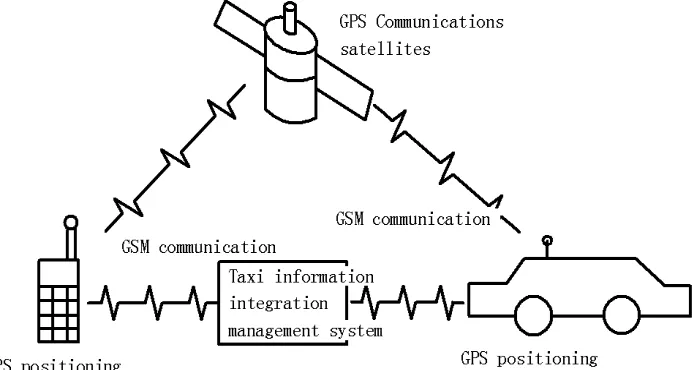
According to system architecture design principle, the architecture of information integration based taxi dispatch system basically consists of three parts: positioning system, servers and communication terminals as shown in Figure1.
Figure1 Architecture Of Dispatch System
The positioning system, which monitors information from GPS on a real-time basis, receives requests from taxi drivers and potential customers, and then computes the coordinate positions and directions of the taxies and potential customers. The potential customer sends, via test message on his mobile phones, service request to the taxi dispatch center. The potential customer’s current location (longitude and latitude) is sent at the same time to the dispatch center. The dispatch center after receiving the text message from the potential customer, searches based on the shortest route principle effective taxies within the customer’s effective area (taking one kilometer extended from the customer as the basic reference). The taxi searching mode is shown in Figure 2.
The dispatch server enquires through the in-vehicle GPS the specific coordinate positions of the taxies, and sends to the effective taxies the service request from the customer. Whoever would like to take this order, the taxi driver only needs to press down the taxi light. The first driver who presses down the taxi light will be eligible for taking this order and the order information will be sent to the dispatch center through GPS and GSM. At the same time, the dispatch center will send the taxi information to the customer and monitor the
[image:2.612.138.488.196.381.2]real-time information of both the taxi and the customer. The taxi ordering procedure is shown in Figure 3.
Figure 2 Taxi Searching Mode
3. ROUTE SELECTION
248 …… on the electronic map as p2(x2, y2), p3(x3, y3), p4(x4, y4)……as shown in Figure 2. The coordinate method is employed to compute the minimum linear distance between the potential customer and the taxi. The conversion of coordinates to distance is shown in Eq.1.
2 2
1 2 1 2 1 2
2 2
1 3 1 3 1 3
2 2
1 4 1 4 1 4
( ) ( )
( ) ( )
1
[image:3.612.151.475.253.420.2] [image:3.612.184.437.453.663.2]( ) ( )
...
p p x x y y
p p x x y y
km
p p x x y y
= − + −
= − + −
≤
= − + −
(1)
The drawback of Eq. (1) is that it is unable to differentiate effective (vacant) taxies. A solution to this is to partition the city into several parts and disqualify the taxies that either have customers in or that have already taken an order, so as to improve the server’s computation and search efficiency.
Figure 3 Taxi Ordering Procedure
249
4. SOFTWARE DESIGN
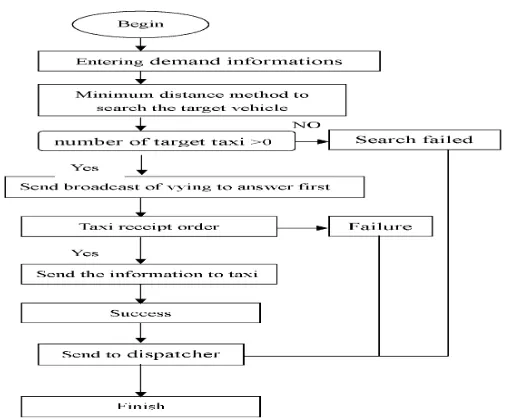
Process flowchart of the dispatch system consists of three parts: input program for customer service, search monitoring program and dispatch control program as shown in Figure4.
A new dispatch process begins when the customer service center receives taxi service requests by text message from potential customers. The dispatch system starts to search effective taxies and sends them service requests after the customer service center having sorted the service requests and puts the service requests into the system to generate orders for taxi service. Orders will be taken on the first-respond-first-take basis. After the order is taken, the dispatch system will automatically and simultaneously send the details of
the service request to the effective taxi driver. Details of the service request include the customer’s mobile phone number and his/her location. Accordingly, the information of the taxi that has taken the order will at the same time be sent back to the customer. In case that the taxi service order is not taken by any taxi, a failure notice will be sent to the dispatch system.
A/D sampling subprogram is employed for sampling signal. Then the search monitoring program is initiated to construct the relation between the monitoring parameters and control functions, so as to finalize the data collection logical relations. If the logic is “yes”, then goes to dispatch control program; if “no”, goes to failure alarm program.
Figure5 Order Generation Window
5. PROGRAM DEVELOPMENT
The vehicle dispatch center is responsible for the taxi dispatch scheduling. The dispatch program is as follows [10]:
(1) // receive customer orders
Order*customer =new order(
New order _number(), // Order number Time // Time
Place // Location
Name //Customer
Telephone number // Telephone number);
Save to database (customer) // Save to database
Order. add (customer);
(2)Vehicle locating
// Take the customer location (x, y) as the center of a circle and add taxies within a radius of R to the potential taxi list.
Car list =car search (x, y, R);
………
(4)preemptive answer
Car car =get car ();
250 Order customer =customers.get by ID(customer _id);
………
After the ending of run, the window for dispatch list is as shown in Figure 5.
6. CONCLUSIONS
In this paper, a management system for integrated taxi information based on GPS and GMS technologies was presented; a shortest route algorithm based on city grid division was introduced; a novel intelligent dispatch system for the synergic operation of taxies was designed; the development of dispatch system software was introduced. The dispatch system enables real-time communication between potential taxi customers, taxi drivers and the dispatch center, thus achieving dynamic match of service supplies and demands between potential taxi customers and taxies. Not only is the dispatch system technically ready, but also it is capable of reducing the time for the customers to find taxies and the taxies to find their customers. When adopted in the industry, it is of great significance to improving citizen’s transit convenience and overall taxi operation efficiency, and helping to address issues like traffic congestion and environment pollution which plague most cities nowadays.
A key point for the successful operation of this system is that both the customers and taxi drivers should be serious with their requests and service offers. Once the information is matched, drivers should not take other passing-by taxies and taxies should not take nearby customers. Thus it is important for future studies to work on a kind of credibility system that can be incorporated into this dispatch system to ensure effective operation.
ACKNOWLEDGEMENTS
This work was financially supported by Zhejiang Provincial Department of Education Foundation (Y201122141) and Zhejiang Province’s Social Science League Foundation (No. 2011B033).
REFRENCES:
[1] Liu Yaoxia, Zhang Shuang. The combined taxi [J].Traffic and Safety Journal, 2008, 178 (06): 76-78.
[2] Zhou Heping, Zhong Biqiang, Peng Xiahua, Xia Xi. The Route Choice and Rate Optimization
Model of Taxi Pooling[J]. Journal of Changsha University of Science and Technology (Natural Science), 2011(8): 20-23.
[3] Z.Liao, “Real-time Taxi Dispatching Using Global Positioning Systems,” Communications of the ACM, vol. 46, No. 5, pp. 81–83, 2003. [4] D.-H. Lee, H. Wang, R. L. Cheu, and S. H. Teo,
“A Taxi Dispatch System Based on Current Demands and Real-time Traffic Information,” Transportation Research Record, vol. 1882, pp. 193–200, 2004.
[5] Bian Yang, Wang Wei, Lu Jian, “Equilibrium Model of Urban Taxi Service Network,” Journal of Traffic and Transportation Engineering, vol.7, No.1. pp. 93–898, 2007.
[6] Tang Luliang, Chang Xiaomeng, Li Qingquan, SHAW S L, “Public Travel Route Optimization Based on Ant Colony Optimization Algorithm and Taxi GPS Data,” China Journal of Highway and Transport. vol. 24, No. 2, pp. 89–95, 2001. [7] Zhou Xiao-min, Zhao Hong-yu, YU Jian-xin,
“Taxi Calling and Scheduling System Based on GPS,” Computer Engineering and Design, vol. 30, No. 21, pp. 4995–4997, 2009.
[8] Catherine Morency. The Ambivalence of Ridesharing [J]. Transportation, 2007 (34): 245-251.
[9] Ding Shuping,XIA Kai. Application of Urban Taxi Inventory Forecasting Algorithm Based on GRNN[J]. Journal of Hefei University of technology, 2009, 32(6):876-879.
[10] Lu Fang, Zhang Yue, Yang Hong Ye. GPS Taxi Dispatch System of Tsinghua Embedded [J]. Computer Measurement and Control, 2003,