James N. Curry III. Promotional Support: A Content Analysis of Diverse Teen Representation in Public Library Promotional Materials. A Master’s paper for the M.S. in L.S. degree.
April, 2018. 34 pages. Advisor: Casey Rawson
This study describes a quantitative content analysis of promotional materials found in five sampled branches of an urban library system. The content analysis was conducted to determine if elements of diverse teen populations were represented in the promotional materials distributed and on display in the library branches.
Materials analyzed included brochures, business cards, flyers, posters, signs, and other
advertising techniques such as displays. The materials included illustrations of race/ethnicity, gender, sexual orientation, religion, disability, and socioeconomic status. Each sampled branch presented different numbers and types of resources. Sampled community branches offered more variety of promotional resources than the larger, central library branches. A need for a more uniform distribution of promotional materials throughout the library system as well as templates for materials created by individual branches is justified. Suggested practices for future
marketing of services to diverse teens are included.
Headings:
Content analysis (Communication)
Library advertising
Marketing of public libraries
PROMOTIONAL SUPPORT: A CONTENT ANALYSIS OF DIVERSE TEEN REPRESENTATION IN PUBLIC LIBRARY PROMOTIONAL MATERIALS
by
James N. Curry III
A Master's paper submitted to the faculty of the School of Information and Library Science of the University of North Carolina at Chapel Hill
in partial fulfillment of the requirements for the degree of Master of Science in
Library Science.
Chapel Hill, North Carolina April, 2018
Approved by:
1
Introduction
Teen services of all library systems must advocate for inclusivity so that the developmental and social needs of all teen demographics are met. How libraries promote their programs and services can impact the teens who attend them. The promotional materials should include the diverse elements of the community the library is attempting to reach. Through a university internship with one of the state’s public library systems, I was able to gain firsthand experience creating programs and services for teens from and visiting the area. The city, City X, hosts a diverse community of patrons.
Census data reports an estimated 2016 population of City X at 808,834 persons. The estimated foreign born population is 129,560 individuals. 15.8% of City X residents are below the poverty level. Racial demographics are estimated at 50% White, 35% Black or African American, 14% Hispanic, 6% Asian, and the remainder identifying as Other (U.S. Census Bureau, 2011).
Teens are an incredibly diverse demographic of library patrons. From identity to ability, teens represent a wide array of backgrounds. It is crucial that marginalized groups of teens (including, but not limited to, LGBTQ+, physically or mentally disabled, low socioeconomic status, and racialized youth) feel they are welcomed in the library and that programs and services are designed with them in mind.
2
community hub for all, though many do not enter its doors due to lack of outreach or feelings of exclusion. Kumasi writes, “many youth...feel like outsiders in library spaces and deem the...library as sole “property” of the librarian,” (2012). She goes on to write that we must account for “marginalized viewpoints and experiences.” Of all library patrons, teens are among the most challenging to attract to the library and retain.
To assess the library system’s marketing to all teen demographics, my research will attempt to answer the essential question: To what extent are library promotional materials of programs and services representative of diverse teen populations?
3
Literature Review
The need for library spaces and services for teens is well-documented in the literature, as is the importance of creating inclusive environments for all patrons. Researchers have observed that “libraries have a responsibility to contribute to solving and alleviating the problems that negatively impact teens and to help all of them grow up to be successful, productive members of society” (Braun et al., 2014). The responsibility to serve teens of diverse identities is called for as well. The YALSA Competencies for Library Staff call for expanding, “opportunities for unserved and underserved teens to build meaningful connections with the library that helps them develop a sense of
belonging and ownership,” (YALSA, 2018). Many libraries ensure that, “by promoting services and advocating for underserved youth, we demonstrate our commitment to and empathy for teen patrons along with promoting the well-being of our community as a whole” (Phillips, 2017). But how are libraries embracing teen identities and in what ways are libraries getting word of their services for diverse populations out within their spaces?
Development of Teen Identities
4
competencies also emphasize the need for library staff to advocate “for library policies that support teen developmental needs and growth,” (YALSA, 2018), preparing teens for college, careers, and life.
One of the skills which can be acquired through the developmental assets is advocacy for one’s self and others. Advocacy is defined as “standing up, speaking out, and asking for support” (Braun, 2013). The goals of advocacy can overlap with those of library marketing. Library “programs targeting smaller groups of teens actually work better to establish relationships and provide opportunities for teens to build the developmental assets” (Honnold, 2010).
The primary goal of this paper will be to determine if one library system’s advocacy for diverse teen identities extends to their marketing materials. If these teens see themselves represented in these materials, they are not only more likely to find relevant programming and services within the library, but will feel that their unique differences are valid and valued. By advocating for diverse teens, libraries can lead them to advocate for themselves.
The Library as Space for Teens
5
socializing with friends, teens interact with the library in many different ways, (Flowers, 2014).
Teens need their own spaces within libraries. Having a space empowers a
particular group, indicating that they matter and belong (Velasquez, 2016). A teen library space must be reflective of both the social and learning needs of the teen while
supporting the library’s mission (Feinberg, 2010). Whether this is a corner of an existing space or a separate room entirely, teens must know it belongs to them. Libraries are encouraged to experiment with “spacial practices, methods, and techniques” to best serve their teens, (Agosto & Hughes-Hassell, 2010). The YALSA Competencies also
recognize space as learning environment, stating that library staff should provide space to teens “(physical and virtual, in the library and in the community) that is engaging for all teens and encourages them to join in individual, group, and collaborative activities to learn formally and informally, (YALSA, 2018). We should be consulting with teens, seeking their feedback input on how the library space should look and what it should offer to best meet their needs (American Library Association, 2012). This includes a focus on the promotional materials located within that space.
Inclusive Programs and Services
6
and socioeconomic biases that pervade the popular culture, as well as our own
preconceptions, and see them as individuals, (Agosto & Hughes-Hassell, 2010). It can start internally. Policies and procedures must adapt to changing patron demographics (Frostick, 2009) to ensure that all teens have equal access to services and materials. Libraries must hire more professionals who come from diverse backgrounds (Hastings, 2015) and train those who do not. Teens want to and benefit from interacting with persons who mirror their lives (Craig, 2010).
Serving diverse teens goes beyond matters of race, though there are many strategies to encourage a multicultural patronage within the library (Smallwood & Becnel, 2013). Serving diverse teens may range from the developmentally disabled through collaboration with local professional organizations, training library staff, and supporting caregivers as well as teens (Wray, 2013) to LGBTQ+ students who need safe spaces or community groups (Horn, 2015). Library services should validate a teen patron’s intersecting identities. Fostering diversity creates a heterogeneous environment in the library in which opportunities are created for access for all (Brimhall-Vargas, 2015).
Marketing Library Services
After creating inclusive programming, the next step is to make people aware of them. A library that effectively markets its services to users establishes the library’s brand and communicates their value in the community (Kenneway, 2006). “Marketing” is defined as “a process that assists libraries in achieving user goals and priorities,
7
the form of physical resources such as newsletters, business cards, pens, postes, keychains - anything that advertise the library. Signage is one of the most common marketing methods for libraries. Stempler’s study found that signs must be “consistent, concise, and free of jargon and punitive language,” (2013) and that library staff must be conscious of signs’ location, language, and design.
Richardson and Kennedy define marketing differently, saying, “marketing is not about creating business but strategically making patrons aware of what services libraries provide them,” (2014). Treating marketing as more of a relationship is more effective. Shontz et al.’s 2004 study found, “marketing knowledge and experience was positively correlated with years of library experience.” But even with library staff on board, how do libraries get this message across to teens?
When marketing to teens, Biggs and Calvert found that library marketing is “predominantly organic and informal,” (2013). Their study revealed word of mouth promotion to be the most effective, drawing again upon the need for a relationship between library staff and teen patrons. Horn notes the importance of online marketing to teens, stressing the importance of “a teen Web site, blog, Facebook account, or any other platform,” or any combination of the like, (2011). She goes on to provide strategies for online marketing, including that online tools must be updated regularly and made easily accessible if you want teens to use them effectively. To reach diverse teen populations, Decker and Tomlinson discuss using digital media to “open conversations about
8
issues, or experiences quite different from their own,” and to create “a safe place wherein teachable moments are created and awareness enhance,” (2014).
Teens have specific information-seeking needs that allow them to act
9
Methods
Promotional materials were analyzed from five branches of a public library system using quantitative content analysis. “Quantitative content analysis” is defined as “the systematic, objective, quantitative analysis of message characteristics,” (Neuendorf, 2002). In this study, the promotional materials used by the sampled branches of the City X system will serve as the messages. A content analysis was selected because it would be easy for me to access materials, and the method quickly identified gaps in marketing strategies. Bringing these gaps to the system's attention could create new strategies that reach diverse teen populations more effectively. I served as an investigator of the analysis and interviewer of Teen Librarians.
Promotional materials were specific to an individual branch or used system-wide. Marketing representation was compared to a control of actual teen population data in City X, as determined by U.S. census data or the National Center for Education Statistics. There are many facets of “diverse” teen populations. This study examined dimensions of race/ethnicity, gender, sexual orientation, physical and mental abilities, socioeconomic status, and religion. Possible values for each dimension are listed as follows (note, the lists below are not intended to be inclusive of all possibilities):
· Race/ethnicity: White, African American, Hispanic/Latino, Native American, Asian · Gender: Male, Female
10
· Religion: Christian, Jewish, Muslim, Hindu, Atheist
To collect the promotional materials analyzed here, I traveled to 5 library branches within the system, searching for and observing all promotional materials available and documenting materials I could not remove from the libraries by taking photos. Only physical resources were documented. Data collection occurred between December 2017 and February 2018.
The unit of sampling was each library branch. The five library branches selected served as a convenience sampling of the 20+ branches found in library system. These branches will be referred to as Gryffindor branch, Hufflepuff branch, Ravenclaw branch, Slytherin branch, and Ilvermorny branch. The branches were also selected to create a large sample of diverse teens. Knowing that different regions of City X served higher numbers of diverse elements (such as race or socioeconomic status), the branches were chosen from the northern, southern, eastern, western, and central regions of City X.
Each branch had a unique layout. At each of these branches, I conducted a walkthrough of the entire library, followed by a more thorough exploration of the designated teen spaces. I collected physical materials and photographs as I went through each space. These five branches helped to generalize marketing practices as compared to the system’s community demographics.
In addition to content analysis, an interview follow-up was conducted with a Teen Librarian from City X via email.
11
Results
The first branch I visited was the Ilvermorny branch, the branch of City X’s library system which houses the majority of materials intended for children and teens. I expected this branch to yield the most materials, but it was beaten by another branch. I began a walkthrough of the first floor, stopping at information kiosks and the welcome desk where I could find brochures and flyers. The teen space was located on the second floor. My walkthrough continued past another welcome desk, bulletin boards, and posters. Some materials were found on counters in unmarked spaces. An art gallery above the teen space revealed more examples of diversity through murals and other displays. Photos were taken of all materials found.
At the Ilvermorny branch, I found 7 brochures, 3 business cards, 7 flyers, 12 signs, and 4 instances of art and displays. All seven brochures included pictures of persons of color. Though some were tinted with colored filters, I found 14 persons who appeared to be teens of color. All brochures seem to be intended for adults, but could be used by teens. One brochure depicted a young girl holding a cane, indicating a visual disability. Four of the brochures included Spanish text. One brochure depicted a young girl with a visual disability. The three business cards could be used by adults or teens. Two of the cards used Spanish text. Of the seven flyers, all are intended for adults or teens. Four flyers depicted persons of color, but only three seemed to depict teens of color, twice showing teens in a colored tint again. Half of the posters and signs showed persons of color, 3 showing teens of color. Ilvermorny materials depicted males
12
At the Gryffindor branch, just a block away from the Ilvermorny branch in downtown, I didn’t expect to find much, as I knew the children and teen section of this branch only takes up one small corner of the building. I started again at help desk
displays of brochures and flyers. Signage near the youth space indicated age restrictions. Additional signage nearby designated assistive technologies and AV materials. The Gryffindor branch also has a Makerspace and Job Help Center, both of which promoted services with signage and physical materials displaying teens. The second floor held the branch’s nonfiction, fiction, and periodicals. Two help desks on this floor held additional resources which were documented.
The Gryffindor branch supplied 11 brochures, 5 flyers, 11 posters and signs, and 1 display. Three of the brochures depicted persons of color, including teens of color. One of these three, despite it being intended for adults, showed teens of color and a woman wearing a hijab (indicating religious diversity). Two of the brochures were intended for patrons with disabilities, one depicted a young girl with a visual disability. Four of the flyers were intended for adults and teens and showed teens of color. A fifth flyer also showed teens of color but was intended for adults. One sign depicted a woman in a wheelchair as well as a young man with a developmental disability. Gryffindor materials depicted males approximately 27 times and females approximately 47 times.
13
in Spanish between the teen space, information kiosks, and computer lab in the back of the branch. As I was leaving, I noticed an art display on top of shelves in the children’s wing displaying portraits of teens of color.
Hufflepuff branch produced 5 brochures, 10 flyers, 17 posters and signs, and 3 display pieces. 100% of the brochures were intended for teens, and all five included pictures of teens of color. Three of the five included Spanish text. Of the flyers, four were intended for teens and six were intended for adults or teens. One flyer depicted teens of color. One flyer contained Spanish text, a second contained French, the third contained Hmong text, and a fourth contained Vietnamese. Eight of the signs depicted teens of color. One sign used rainbow patterns to advertise to LGBTQ+ youth. Another sign depicted a woman wearing hijab. The art display showed portraits and bios of two teens of color who were available for adoption in City X. Hufflepuff materials depicted males approximately 50 times and depicted females approximately 72 times.
The Slytherin branch in the east of City X was the most surprising. This branch recently underwent renovations which lasted over a year. It reopened in December with newly designed spaces and technologies. But I could find little to no physical resources. A community bulletin board hung on a wall in the entrance way. A small information kiosk could be found in the lobby. The new teen space was upstairs and tucked away in a corner. A very few resources were found near the front of the room, but almost no
14
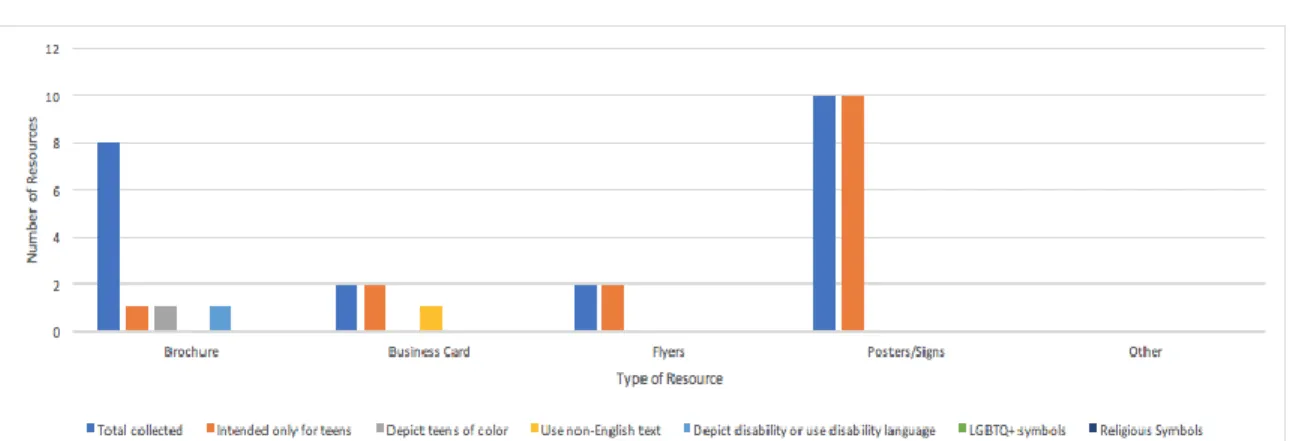
Slytherin branch yielded the fewest materials including 8 brochures, 2 business cards, 2 flyers, and 10 posters and signs. Of the brochures, only one was intended for just teens, only one showed a teen of color, and one showed a child with a white cane,
indicating a visual disability. Both business cards were intended for teens, and one contains Spanish text. All flyers, posters, and signs were intended for teens, though none incorporated elements of diversity. Slytherin materials depicted males 8 times and females 18 times.
Finally, the Ravenclaw branch yielded the most resources. Another one-story open floor plan in western City X, the Ravenclaw branch had signage advertising programs right inside the door. I did a slow walkthrough of the shared library spaces, noticing several of the same system-wide brochures and flyers I’d seen at other branches. I stumbled upon a section of resources written in other languages, many in Spanish. Making my way to the back of the space, I found the teen zone. Signage indicated this space was reserved for teens. Many resources lined the bookshelves advertising local organizations that support LGBTQ+ youth, teens help hotlines, and many programs happening at the library. Student relief forms and other financial information were nearby as well.
15
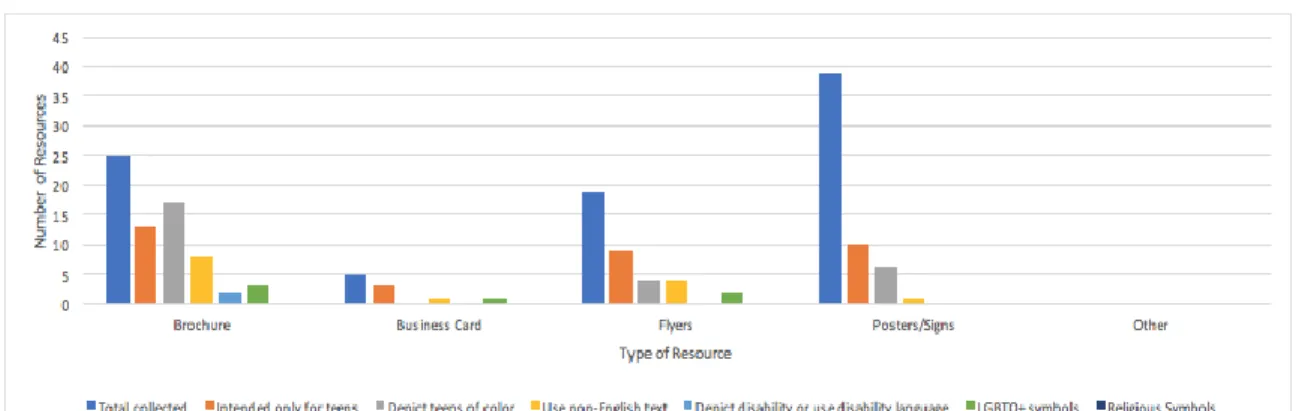
LGBTQ+ and incorporated symbols such as the rainbow flag. Two brochures mentioned disabilities, one depicting a girl with a visual disability. Eight brochures used Spanish text. Three of the business cards are intended for teens, and the other two are intended for adults and teens. One business card is intended for teens of the LGBTQ+ community. One card used Spanish text. Of the flyers, eight are intended for adults and teens, nine are for teens, one is for teens and children, and one is for children. Four flyers depicted teens of color. Three used Spanish text, and one flyer used Hmong text. Two flyers are intended for LGBTQ+ teens. Of the posters and signs, six depicted teens of color and one used Spanish text. Ten signs were are intended just for teens. Ravenclaw materials depicted persons presenting as male 140 times and persons presenting as female 181 times.
16
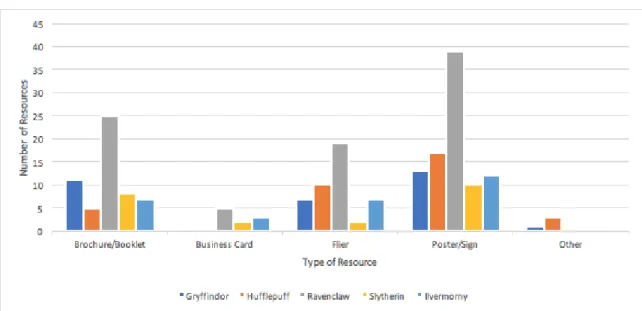
The charts below represent the distribution of promotional materials found at the branches sampled:
Table 1. Resources Found at Sampled Branches
17
Table 3. Gryffindor Promotional Resources
Table 4. Hufflepuff Promotional Resources
18
Table 6. Ravenclaw Promotional Resources
19
Discussion
Of the coding categories established for this study, examples of race and ethnicity were the most prevalent in the libraries’ promotional materials through depictions of persons and use of non-English texts. Resources for various sexual orientations also yielded multiple results, though only two of the branches sampled promoted them. Socioeconomic status resources usually took the form of FAFSA and other government funding materials for teens to pay for college which several branches (but not all) had in supply. The majority of resources intended for teens were brochures and flyers directing teens to financial assistance. Of all the resources collected, females were depicted more than males. I was pleased to find even one example of physical/mental abilities and religion, as I predicted these would be among the least represented. I was correct in that assumption.
20
Most of the distributable materials were developed by the City X library system and distributed to all branches. A large percentage were developed by third party
organizations from the City X community and were made available at different branches. It is interesting to see that some branches distribute these third party materials for teens but not all. Several of the resources advertising accessibility services were created by City X’s State Library and distributed to systems throughout the state. While the
distributable materials were more generic, the posters and signs were often unique to the library branch, some made in-house and others made from images on the web.
Though elements of diversity were found on the libraries’ promotional materials, they were often singular instances. Very few materials incorporated two or more
diversity elements on the same material. Future promotional materials should be representative of intersectionality, reaching out to patrons whose identities are multifaceted and have specific needs of the library.
21
When asked how much of the materials are distributed from the central library offices and when they are distributed by third party entities she said, “If there is an event that the library is participating in...chances are, we will have signage and material sent to the different branches. This is very helpful since the material usually includes all the branches that are participating, what dates they’re holding events, and what they’re doing exactly. Most of the third party advertising come from government or community
organizations.” The big events and services gain the advertising support of the Marketing and Communications department. Day to day program marketing is the responsibility of the branch librarians. This makes sense, as the branches know their communities better. And yet, I saw so much differentiation between the system-distributed materials at the sampled branches. It seems as though some branches (such as Ravenclaw and
Hufflepuff) mesh their independent marketing with that of the system and community to present a wide range of materials for all teens while others (such as Slytherin, Gryffindor, and Ilvermorny) rely so heavily on the system to market services that there is often a lack of materials most teens would be able to use. The marketing department and the
branches need to revamp their collaborations.
22
our audience is.” Though she didn’t say what she could and could give teens a say in, I was pleased by her wanting teen input. Most branches have their own Teen Advisory Boards. It seems as though these boards could be utilized in more ways than just creating programming ideas. Giving them more voice through advertising collaboration may reduce the need to bribe teens to assist their branches.
23
Limitations
I was concerned that promotional materials may be too generic and not target any teen demographic and that the program calendar may be sparse during my visits. I was also limited by my ability to travel to the branches, the frequency of programs being promoted by the libraries, and the teen librarians’ availability. This study was limited to a single library system, therefore results cannot be generalized to all public libraries. However, the methods used in this study could easily be replicated by librarians in other systems to analyze their own promotional materials.
Implications
By analyzing the libraries’ teen promotional materials, the research may increase the system’s awareness of the needs of diverse teen populations. Awareness of
representation gaps or shortcomings may lead the library to incorporate better policies and practices of advocacy and inclusion through promotion.
24
Conclusion
Given these study data, City X libraries have varied levels of promotional resources from branch to branch. The final goal of this study was to determine if City X libraries represent diverse teen populations in their promotional materials for programs and services. Each branch produced different numbers of materials. Of those materials, different elements of diversity were represented, though not always pertaining to teens.
Library branches located outside of the uptown area of City X provided more materials to their regional communities. The Hufflepuff and Ravenclaw branches yielded higher numbers of distributable materials and signage that included diverse elements. Each sampled branch provided at least one material that was not offered by another.
Based on City X’s current promotional materials, I propose the following practices for the marketing department to follow:
● Recognize intersectionality by incorporating 2 or more elements of diverse teens into promotional materials intended for teens.
● Create unique system marketing templates for each patron age group (children, teens, adults)
● Use a variety of print and digital advertising techniques that are effective for teens, as well as word of mouth.
● Recruit and utilize a diverse group of City X teenagers to assist in designing teen programming materials.
25
These practices may be adopted by additional library systems as they advertise their materials and services to teens of all backgrounds.
The majority of resources found were posters and other signage advertising services and programs. Distributable materials yielded more examples of diverse populations. Many of the resources were not intended only for teens. As teens are among the more challenging demographics to attract to the library and attracting diverse teens is even more challenging, ensuring the promotional materials intended to inform these teens are both welcoming and inclusive. Additional research might gather data on how teens interact with these resources.
26
Appendices ● Interview questions:
○ How do you cater to diverse teens in terms of programming, service, and marketing?
○ What demographics of teens do you see in the library most frequently? ○ How do you promote your services to teens?
■ Do patrons respond better to certain types of advertising? ○ What are your thoughts on the importance of diversity as it pertains to
teens in the library?
○ How would you market to teens differently than the system currently does?
○ Are there any marketing strategies you feel the library should implement that you feel would be more effective?
27
Bibliography
Agosto, D. (2016, November 29). Hey! The Library Is Kind of Awesome! Current Trends in US Public Library Services for Teens. Retrieved from
http://publiclibrariesonline.org/2016/11/hey-the-library-is-kind-of-awesome-current-trends-in-us-public-library-services-for-teens/
Agosto, Denise E., Ph.D., and Hughes-Hassell, Sandra, Ph.D. (2010). Urban Teens in the Library: Research and Practice. Chicago, US: ALA Editions. ProQuest ebrary. Web.
American Library Association. (2012). Teen Space Guidelines. National Teen Space Guidelines. http://www.ala.org/yalsa/guidelines/teenspaces
Barnard, Madalene Rathbun. (2013). “Color outside the library lines: serving NVLD and Asperger Syndrome teens.” Voice of Youth Advocates 36(5): 28.
Biggs, H., & Calvert, P. (2013). Marketing to teens: A study of two new zealand public libraries. Library Management, 34(8/9), 705-719. doi:10.1108/LM-04-2013-0033
Boeglen, T., & Cherrington-Stoddart, B. (2017). Advocating for Teens in Public
Libraries+: Exploring the ways library staff can advocate for teens in the library. Young Adult Library Services, 15(3), 25-29.
Bosman, E., & Rusinek, C. (1997). Creating the user-friendly library by evaluating patron perception of signage. Reference Services Review, 25(1), 71-82.
28
Braun, L., Hartman, M., Hughes-Hassell, S., Kumasi, K., & Yoke, B. (2014, January 8). The Future of Library Services for and with Teens: A Call to Action. Retrieved From http://www.ala.org/yaforum/sites/ala.org.yaforum/files/content/
YALSA_nationalforum_final.pdf
Brimhall-Vargas, M. (2015). Where the rubber meets the road: the role of libraries and librarians in bringing equitable access to marginalized communities. The Library Quarterly, 85(2), 193-199.
Colvin, S. (2017). Letting Teens Lead the Way toward Diversity. Voice Of Youth Advocates, 40(1), 40-41.
Copeland, & Gavigan. (2015, November 24). Examining Inclusive Programming in a Middle School Library: A Case Study of Adolescents Who Are Differently- and Typically-Able. Retrieved from
http://www.yalsa.ala.org/jrlya/2015/11/examining-inclusive-
programming-in-a-middle-school-library-a-case-study-of- adolescents-who-are-differently-and-typically-able/
Core professional values for the teen services profession. (2015). Young Adult Library Services, 14(1), 4-6. Retrieved from
http://libproxy.lib.unc.edu/login?url=https://search-proquest-com.libproxy.lib.unc.edu/docview/1723378454?accountid=14244
Craig, A. (2010). Focus on diversity: YALSA diversity taskforce. Young Adult Library Services, 8(3), 6-7. Retrieved from
http://libproxy.lib.unc.edu/login?url=https://search-proquest-com.libproxy.lib.unc.edu/docview/338448806?accountid=14244
Decker, E. N., & Tomlinson, M. D. (2014). Using Blogs in the Library to Reach Diverse and Non-Traditional Student Groups. Journal Of Library Innovation, 5(2), 60-70.
Dubicki, E. (2007). Basic marketing and promotion concepts. The Serials Librarian, 53(3), 5-15.
29
Feinberg, Sandra, and Keller, James R., AIA. (2010). Designing Space for Children and Teens in Libraries and Public Places. Chicago, US: ALA Editions. ProQuest ebrary. Web.
Field, C. (2015). A WINDOW OPENED ON THE LIBRARY: AN ANALYSIS OF PUBLIC LIBRARY MARKETING. (Unpublished master's thesis, 2015). University of North Carolina Chapel Hill. doi:https://cdr.lib.unc.edu/record/uuid:4b38de54-9d2d-49d7-bc3f-059891418ee4
Flowers, Sarah. (2014). Evaluating Teen Services and Programs. New York, US: ALA Neal-Schuman. ProQuest ebrary. Web.
Frostick, C. M. (2009). The myth of equal access: Bridging the gap with diverse patrons. Children & Libraries, 7(3), 32-37.
Gruenthal, H. (2012). A school library advocacy alphabet. Young Adult Library Services, 11(1), 13.
Hanna, K., Cooper, M., & Crumrin, R. (2011). Diversity programming and outreach for academic libraries. Elsevier.
Hastings, S. K. (2015). If diversity is a natural state, why don’t our libraries mirror the populations they serve?. The Library Quarterly, 85(2), 133-138.
Helmig, B. s., & Thaler, J. (2010). On the Effectiveness of Social Marketing-What Do We Really Know?. Journal Of Nonprofit & Public Sector Marketing, 22(4), 264-287.
Hill, N. M. (2016, Jan). What diversity looks like on an ordinary day. Public Libraries, 55, 20-21. Retrieved from http://libproxy.lib.unc.edu/login?url=https://search- proquest-com.libproxy.lib.unc.edu/docview/1773243122?accountid=14244
Honnold, R. (2010). The Diversity of Our Teen Audience. Voice Of Youth Advocates, 33(3), 193.
30
Horn, T. (2015, September 18). Serving Your LGBT Teen Patrons. Retrieved from http://publiclibrariesonline.org/2015/09/serving-your-lgbt-teen-patrons/
Kenneway, M. (2006). Branding for libraries: communicating your value to increase reader awareness and usage of the library service. Serials, 19(2).
King, K. (2012). Advocacy, Teens, and Strategic Planning. Young Adult Library Services, 11(1), 24.
Kotler, P. (1982). Marketing for nonprofit organizations.
Kumasi, K. (2012). Roses in the Concrete. Knowledge Quest, 40(5), 32-37.
McCabe, R. B. (2001). Civic librarianship: Renewing the social mission of the public library. Scarecrow Press.
Mehra, B. b., & Davis, R. (2015). A strategic diversity manifesto for public libraries in the 21st century. New Library World, 116(1/2), 15-36.
Mehra, B. & Davis, R. (2014). A framework to evaluate diversity representation on academic library websites in state universities in the United States: An exploratory study. Paper presented at the 6th International Conference on Qualitative and Quantitative Methods in Libraries QQML in Istanbul, Turkey, May 30, 2014.
Moore, G. M. (2012). IMPROVING TEEN LIBRARY PROGRAM ATTENDANCE: YOUNG ADULT LIBRARIANS' PERSPECTIVES (Unpublished master's thesis, 2012). University of North Carolina Chapel Hill.
Myhill, W. N., Hill, R. F., Link, K., Small, R. V. and Bunch, K. (2012), Developing the capacity of teacher-librarians to meet the diverse needs of all schoolchildren: Project ENABLE. Journal of Research in Special Educational Needs, 12: 201– 216. doi:10.1111/j.1471-3802.2012.01240.x
31
Noh, Y., Ahn, I. J., & Park, M. (2011). A Study on Librarian Service Providers' Awareness and Perceptions of Library Services for the Disabled. International Journal of Knowledge Content Development and Technology, 1(2), 29-42.
Pfeil, Angela B. 2004. Going Places with Youth Outreach : Smart Marketing Strategies for Your Library. Chicago, US: ALA Editions. ProQuest ebrary. Web.
Potter, N. (2012). The library marketing toolkit. Facet Publishing.
Richardson, H. A., & Kennedy, M. R. (2014). How to Market Your Library’s Electronic Resources. The Serials Librarian,67(1).
Rowley, J. (1998). Promotion and marketing communications in the information marketplace. Library review, 47(8), 383-387.
Search Institute. 40 Developmental Assets for Adolescents. (n.d.). Retrieved from http://www.search-institute.org/content/40-developmental-assets-adolescents-ages-12-18
Shepherd, S., Kay, A., Chartrand, T., & Fitzsimons, G. (2015). Cultural diversity in advertising and representing different visions of america. Advances in Consumer Research, 43, 23.
Shontz, M. L., Parker, J. C., & Parker, R. (2004). What do librarians think about marketing? A survey of public librarians’ attitudes toward the marketing of library services. The Library Quarterly, 74(1), 63-84.
Smallwood, C., & Becnel, K. (Eds.). (2013). Library services for multicultural patrons: strategies to encourage library use. Rowman & Littlefield.
Snowball, C. (2008). Enticing teenagers into the library. Library Review, 57(1), 25-35.
Srivastava, G. G., & Bhatt, R. d. (2016). Library Services in Inclusive Environment: Role of Marketing Tools. International Journal Of Information Dissemination &
32
Stempler, A. F., & Polger, M. A. (2013). Do you see the signs? Evaluating language, branding, and design in a library signage audit. Public Services Quarterly, 9(2), 121-135.
Taylor, C. (2017). Getting Our House in Order: Moving from Diversity to Inclusion. The American Archivist, 80(1), 19-29.
Urquhart, C. (2013). Top Ten Tips for Marketing to Teens. Young Adult Library Services, 12(1), 20-23.
U.S. Census Bureau (2011). Selected housing characteristics, 2007-2011 American Community Survey 5-year estimates.
Velasquez, J. (2016). A Place of Their Own. Retrieved from
https://americanlibrariesmagazine.org/2016/09/01/library-teen-spaces-place-of-their-own/
Vogel, V. (2008). Library Outreach to Teens with Physical Challenges. Young Adult Library Services, 7(1), 39.
White, L. L. (2010). Better none than bad. American Libraries, 41(8), 23. Retrieved from
http://libproxy.lib.unc.edu/login?url=https://search-proquest-com.libproxy.lib.unc.edu/docview/736324269?accountid=14244
Wildemuth, B. M. (2009). Applications of social research methods to questions in information and library science (p. vii, 421 p. : ill.). Westport, Conn.: Libraries Unlimited.
Wonkeryor, E. L. (2015). Diversity in advertising in the twenty-first century. Peter Lang.
Wray, H. w. (2013). Protecting the Rights of the Most Vulnerable by Creating a Culture of Inclusion. Feliciter, 59(3), 26-30.
YALSA. (2018). Teen Services Competencies For Library Staff. Retrieved from