Cover Page
The handle http://hdl.handle.net/1887/21017
holds various files of this Leiden University
dissertation
Author: Balevic, Ana
Title: Exploiting
multi-level parallelism in streaming applications for heterogeneous
platforms with GPUs
Exploiting Multi-Level Parallelism
in Streaming Applications for
Heterogeneous Platforms with
GPUs
Exploiting Multi-Level Parallelism in Streaming
Applications for Heterogeneous Platforms with
GPUs
Proefschrift
ter verkrijging van
de graad van Doctor aan de Universiteit Leiden,
op gezag van Rector Magnificus Prof.mr.dr. C.J.J.M. Stolker,
volgens besluit van het College voor Promoties
te verdedigen op woensdag 26 juni 2013
klokke 12:30 uur
door
Ana Balevic
geboren te Belgrado, Yugoslavia
Samenstelling promotiecommissie:
promotor Prof. Dr. Ed F. Deprettere (Universiteit Leiden) co-promotor Dr. Bart Kienhuis (Universiteit Leiden)
overige leden: Prof. Dr. Joost Kok (Universiteit Leiden) Prof. Dr. Harry Wijshoff(Universiteit Leiden)
Prof. Dr. Simon Portegies Zwart (Leiden Observatory) Prof. Dr. K. Joost Batenburg (Universiteit Leiden) Dr. Ana Lucia Varbanescu (Universiteit van Amsterdam) Dr. Rob van Nieuwpoort (Netherlands eScience Center)
Advanced School for Computing and Imaging
This work was carried out in the ASCI graduate school. ASCI dissertation series number 283.
Exploiting Multi-Level Parallelism in Streaming Applications for Heterogeneous Platforms with GPUs
Ana Balevic
.-PhD Thesis, Universiteit Leiden. - With index, ref. - With summary in Dutch.
c
2013 by Ana Balevic, The Netherlands.
Contents
1 Introduction 1
1.1 Research Framework . . . 4
1.2 Problem Statement . . . 6
1.3 Approach and Contributions . . . 8
1.4 Related Work . . . 9
1.5 Thesis Outline . . . 15
2 Preliminaries 17 2.1 Compiler Techniques for Automatic Parallelization . . . 17
2.2 Polyhedral Process Networks . . . 26
2.3 Parallel Computing with GPU Accelerators . . . 31
3 Identification and Exploitation of Data Parallelism in PPNs 37 3.1 Introduction . . . 37
3.2 Problem Statement . . . 38
3.3 Overview of the Solution Approach . . . 40
3.4 Data Parallelism Identification . . . 42
3.4.1 Data Parallelism . . . 42
3.4.2 Space-Time Mapping of PPN Processes . . . 43
3.4.3 Target Domain Characterization . . . 46
3.5 Intermediate Model: A Data Parallel View (DPV) . . . 47
3.5.1 Data Parallel Process . . . 49
3.5.2 Data Parallel Channel . . . 51
3.5.3 Synchronous Data Parallel Execution . . . 53
3.6 Mapping and Code Generation for GPU Accelerators . . . 54
3.6.1 Introduction . . . 54
3.7 Scaling . . . 59
3.7.1 Introduction . . . 59
3.7.2 Tiling for Coarse-Grain Data Parallelism . . . 60
3.7.3 Consequences for GPU Mapping . . . 61
3.8 Extensions and Optimizations . . . 65
3.8.1 Memory Optimizations . . . 65
3.8.2 Task Parallelism . . . 68
3.8.3 Token Composition and Reuse . . . 71
3.9 Results . . . 73
3.10 Conclusions . . . 77
4 Multi-Level Parallelization for Heterogeneous Platforms 79 4.1 Introduction . . . 79
4.2 Solution Approach . . . 83
4.3 Preliminaries . . . 87
4.3.1 Data Space Representation in Polyhedral Model . . . 87
4.3.2 Encapsulation Support: Composite Tokens . . . 89
4.3.3 Introducing Concepts of Depth (Level) and Derived Statements 90 4.4 Hierarchical Polyhedral Reduced Graph (HiPRDG) . . . 94
4.5 The Slicing Transformation . . . 98
4.5.1 Node Splitting . . . 99
4.5.2 Dependence Placement . . . 100
4.6 Construction of a Multi-Level Program (MLP) . . . 100
4.6.1 Preparatory Step . . . 103
4.6.2 Program Module Body Generation . . . 104
4.6.3 Encapsulation/Interface Generation . . . 106
4.6.4 Automatic Type Conversion . . . 107
4.7 Results of MLP Construction . . . 108
4.8 Conclusions and Future Work . . . 110
5 PPN Execution on Heterogeneous Platforms with GPUs 111 5.1 Introduction . . . 111
5.2 Approach . . . 113
5.3 Model-Driven Communication Design . . . 116
5.3.1 Classification of PPN Channels . . . 116
5.3.2 SMC Design . . . 116
5.3.3 Synchronous DMC Design . . . 117
5.4 Asynchronous Offloading of Kernels (AOK) . . . 119
5.4.1 Asynchronous Stream Buffer Design . . . 119
5.5 Experimental Results . . . 123
5.5.1 Platform Specification . . . 124
5.5.2 Platform Micro-Benchmarks . . . 124
5.5.3 Stream Buffer . . . 127
5.5.4 PPN Execution with Asynchronous Kernel Offloading . . . 129
5.6 Conclusions . . . 129
6 M-JPEG Case Study 131 6.1 Introduction . . . 131
6.2 M-JPEG Encoder and its PPN . . . 131
6.3 Experimental Setup . . . 132
6.3.1 Application Configuration . . . 132
6.3.2 Platform . . . 132
6.3.3 Experiments . . . 133
6.4 The Performance of Default M-JPEG PPN . . . 133
6.5 Adjusting Token Granularity by Encapsulation . . . 134
6.6 Leveraging Data Parallelism for GPU Acceleration . . . 136
6.6.1 DCT Kernel Execution . . . 136
6.6.2 Offloading Computation to the GPU . . . 138
6.7 Overall Performance Results with GPU Acceleration . . . 140
6.8 Conclusions . . . 144
7 Conclusion 147 7.1 Summary of Work and Contributions . . . 147
7.2 Prerequisites for Further Progress . . . 150
7.3 Directions for Future Work . . . 150
Appendix A Application Source Codes 153 A.1 Predictor . . . 153
A.2 Grid . . . 153
A.3 Sobel . . . 154
Appendix B KPN2GPU 157 B.1 Predictor . . . 157
B.1.1 PPN Model . . . 157
B.1.2 NodeP2: Space-Time Mapping . . . 157
B.1.3 NodeP2: DPV Components . . . 158
B.1.4 Predictor: Host Code . . . 161
B.1.5 NodeP02: CUDA Kernel (Default) . . . 161
B.1.6 NodeP02: CUDA Kernel (Optimized) . . . 163
Appendix C M-JPEG Encoder 169
C.1 Overview . . . 169 C.2 Code Listings . . . 170 C.3 M-JPEG PPN . . . 172
Bibliography 172
Index 185
Samenvatting 188
Acknowledgments 191
Chapter
1
Introduction
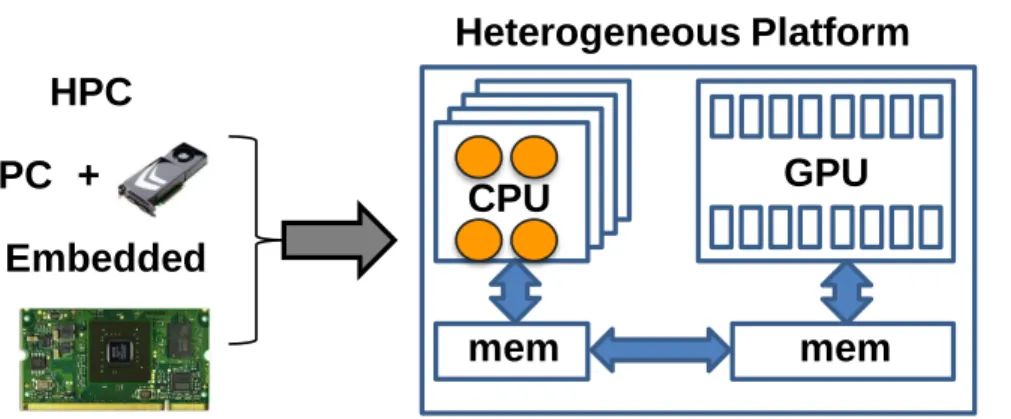
What started off as a simple graphics card is nowadays a pervasive programmable accelerator called a Graphics Processing Unit (GPU). The success of GPU as an accelerator for data parallel computationally intensive tasks inspired numerous appli-cation designers to parallelize their appliappli-cation hot-spots and port them askernelsto the GPU architecture. Modern GPUs exhibit massive parallelism and can be used for general purpose computing, i.e. they are compute-capable. As such, GPUs are well-suited to address the ever increasing computational demands in automotive, medical, entertainment and bio-informatics fields. Nowadays, CPUs are often combined with GPUs and intellectual property (IP) cores implementing special functions, to form aheterogeneous platform. The emergence of heterogeneous platforms increasingly blurs the distinction between the embedded systems domain and the high perfor-mance computing (HPC) domain.
V
mem
mem
CPU
GPU
GPU
Heterogeneous Platform
Embedded
HPC
+
PC
Figure 1.1: A heterogeneous platform featuring a quadcore CPU and a GPU.
and thread-level parallelism [72]) typically found in multiprocessor systems. A com-bination of parallelism at different levels of the platform results inmulti-level paral-lelism[31].
Leveraging task, pipeline and data parallelism on the same platform makes it nec-essary to use different programming models and APIs. The architectural diversity between platform components puts additional pressure on the designer, since diff er-ent platform componer-ents typically require different programming models and skill sets. Numerous languages, libraries and tools have been developed which share the same goal - to make the parallelization process easier for the designer. While it is hard to set a clear boundary, we roughly classify the parallelization approaches into three main categories according to the degree of automation:
• Explicit parallel programming
• Semi-automatic approaches (parallel languages, directive-based compilation, run-time environments)
• Automatic parallelization (transformation frameworks)
Explicit parallel programming using the programming model and the application programming interface (API) provided by the vendor is still the most dominant cat-egory used for parallelizing applications today. Parallelization for multicore pro-cessors includes writing a multi-threaded application using C/C++POSIX Pthreads, Win32MT, or Boost libraries, which provide concepts for expressing task parallelism (i.e. using threads) and implementing synchronization in the parallel program. GPUs are typically programmed using a vendor specific programming language such as NVIDIA’s CUDA [37], or using the OpenCL standard [122] for heterogeneous par-allel programming.
The semi-automatic approaches have been rapidly gaining momentum in the last few years. Examples of semi-automatic parallelization approaches include languages for expressing parallelism explicitly, e.g. StreamIt [127], directive-based compila-tion, e.g. OpenMP [40, 102], OpenACC [103], run-time libraries and task-scheduling environments, such as StartPU [9, 10], or a combination of a run-time environment and directive-driven code parallelization, as in HMPP [47] and OmpSs [11, 48]. While the designer still needs to partition the application and identify parallel tasks, semi-automatic approaches relive the programmer of having to explicitly write par-allel code using vendor specific APIs and libraries. Instead, the parpar-allel code is gen-erated following the designer’s parallelization directives.
The automatic transformation of sequential code into a parallel executable is one of the ultimate parallel computing goals [49]. While we are still a long way from automatic parallelization of arbitrary code, significant progress has been made in parallelization of more specific applications under some constraints (see Chapter 2).
1.1. RESEARCH FRAMEWORK
as task, data, and pipeline parallelism, for efficient mapping onto heterogeneous plat-forms with massively parallel computing accelerators (such as GPUs).
1.1
Research Framework
The research work that resulted in this dissertation began in late 2009 within an industry-academia research cooperation in the framework of the Tera-Scale Multi-Core Architectures (TSAR) project. The TSAR project (2008-2012) is an European project in the MEDEA+framework conducted by an international consortium of in-dustrial and academic institutions comprised of BULL, UPMC/LIP6, Thales Com-munications, FZI, Philips Medical Systems, ACE Associated Compiler Experts bv, Compaan Design bv, and Leiden Embedded Research Center (LERC).
During the TSAR project, there was a close collaboration between LERC and Lei-den University’s spin-offcompany Compaan Design on novel solutions for the chal-lenges of automatic parallelization for heterogeneous platforms with GPU accelera-tors. The role of LERC was to capture the total system view of high-performance streaming applications on platforms with a GPU accelerator, while using and further advancing tools and techniques developed at LERC and Compaan.
LERC and Compaan have a long tradition of research [2,81,97,98] on the Kahn Pro-cess Networks (KPNs) [76] model of computation and its polyhedral variant called Polyhedral Process Networks (PPNs). The Kahn Process Network (KPN) model of computation was introduced in 1974 by the prominent French scientist Gilles Kahn [76]. The initial purpose of the KPN model was modeling parallel programs in distributed systems. In the period 2000 - 2009, the Kahn Process Networks (KPN) and its variants gained large acceptance in embedded systems design due to the clear separation of communication and computation [83]. A Kahn Process Network de-scribes an application as a network of concurrent autonomous processes that com-municate via tokens over channels. For example, on heterogeneous platform in Fig-ure 1.1, each KPN process can be concurrently executed on a different architectural component that has its own private memory. In the KPN, the tokens are transmitted over unidirectional communication channels. Each KPN communication channel has exactly one writer process and exactly one reader process. Furthermore, each KPN channel is an infinite, first-in first-out (FIFO) queue of tokens.
1.1. RESEARCH FRAMEWORK
properties (see e.g., Chapter 2). While significant progress has been made on extend-ing the boundaries of programs that could be represented in the polyhedral model, see e.g. [119], in this thesis we consider only the programs that can be expressed as
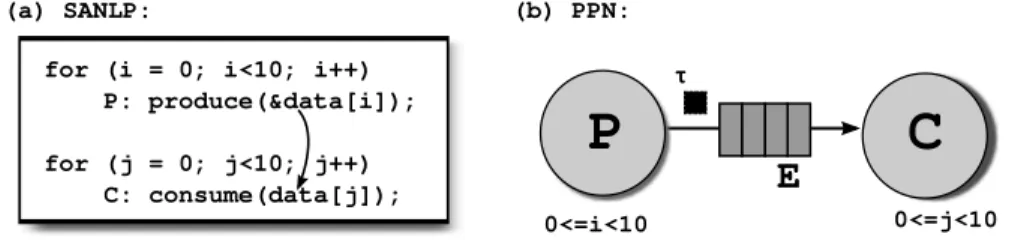
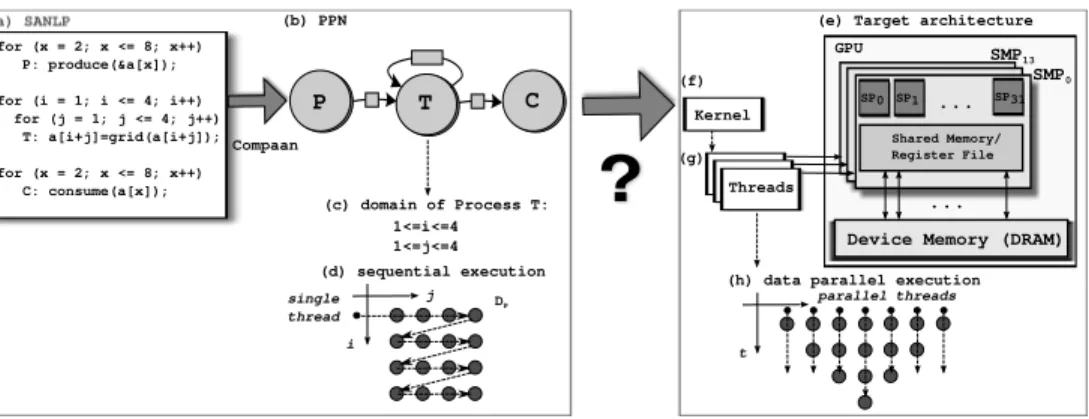
Static Affine Nested Loop Programs(SANLPs) (Section 2.1). A Polyhedral Process Network (PPN) [134] emerged as an important variation of the KPN model, where program statements, dependence edges, and the input and output arguments of the statements are described as polytopes automatically obtained by polyhedral analysis of SANLPs [3, 134]. A PPN of a SANLP can be automatically derived from its C code using, e.g., the Compaan compiler. A simple two-node PPN is illustrated in
(b) PPN: (a) SANLP:
for (i = 0; i<10; i++) P: produce(&data[i]);
for (j = 0; j<10; j++)
C: consume(data[j]);
E
C
P
0<=i<10
0<=j<10
τ
Figure 1.2: SANLP containing two loop nests surrounding statementsPandC, and the corresponding PPN model.
Figure 1.2. The produce function writes an element ofdataarray, and the consume function reads an element ofdataarray. The PPN containing two nodes is depicted in Figure 1.2(b). NodesPandCrepresent aproducer-consumer(P/C) pair of tasks. The tasks are automatically derived from the SANLP shown in Figure 1.2(a). The nodes PandC sequentially execute iterations of their loops in the program source code, i.e. nodePexecutes iterations of thei-loope, and nodeCexecutes iterations of the j-loop. The dependence relationship between a producer iteration and a consumer iteration is known exactly, i.e. we know on which iterations it exists. The nodes com-municate over the channel E by sending and receiving data packets called tokens. After the nodePfires, i.e. executes statementproduce, the tokenτk is written into channelE. After the consumer nodeC fires and reads tokenτk from channel E, it executes the next iteration of the statementconsume. If no data exists onE, process
1.2. PROBLEM STATEMENT
1.2
Problem Statement
One of the major challenges in the domain of parallel programming is how to auto-matically parallelize sequential streaming applications and map them onto heteroge-neous platforms, such as the platform illustrated in Figure 1.3 that features architec-turally diverse components (such as CPUs, GPUs, FPGAs). Heterogeneous platforms with accelerators provide numerous parallelization opportunities but require different programming models and APIs.
To address the parallelization challenge for mapping streaming applications onto heterogeneous platforms we build upon the work done at LERC and Compaan on the parallelization of C code [81, 131]. The tools developed in the scope of the prior work give us a parallel specification of the application as the starting point. More specifically, applying the Compaan compiler to a sequential streaming application leads to a parallel model of the input application in the form of a PPN specification.
V V
mem mem
CPU GPUGPU
Heterogeneous Platform
Programming Challenge
C
Sequential
Applications
?
1
3 2
+
Figure 1.3: The Programming Challenge.
This parallel model can be instantiated, for example, as task-parallel C/C++code. Compaan generates tasks that are mapped on threads, e.g. implemented using POSIX Pthreads or Intel’s Thread Building Blocks (TBB) libraries, for parallel execution on one or more microprocessors. As indicated in Section 1, GPUs became the off -the-shelf hardware of choice for accelerating computationally intensive data parallel workloads on heterogeneous platforms. The natural next question that arises in the context of PPN-based parallelization is how to make use of the tremendous com-putational power of data parallel accelerators such as GPUs, while still reaping the benefits of task and pipeline parallelism at the platform level. In this context, we formulate our main research question as follows:
How to parallelize sequential streaming applications and efficiently map them onto heterogeneous platforms with massively parallel computing accelerators (such as a GPUs) using a model−based approach?
1.2. PROBLEM STATEMENT
To address this question we broke it down into the following three sub-questions:
• How to generate data parallel kernels for execution on massively parallel computing accelerators, such as GPUs, from the PPN model. To exploit the computational power of massively parallel accelerators, such as GPUs, the data parallelism in the application must be made explicit and brought into a form that is compliant with the accelerator’s programming model. Although the PPN model provides a parallel specification, it primarily captures task par-allelism. The question is how to identify data parallel operations in the PPN, and transform the components of the PPN model into the form of data parallel kernels that can be executed on a massively parallel accelerator, such as GPU.
• How to derive multi-level parallel programs featuring task, pipeline, and data parallelism from the standard polyhedral specification. A heteroge-neous platform contains parallelism at many levels - from platform-level task parallelism between different cores to data parallelism within a GPU acceler-ator and vector processing units. Parallelizing compilers today enable us to target parallelism within a single platform component, such as a single CPU, a GPU, or an FPGA. To efficiently exploit heterogeneous platforms it is neces-sary to exploit parallelism within different platform components. The question is how to derive at compile-time structured, multi-level programs in which each module can be transformed into a well-suited parallelism form for the given target architecture.
• How to efficiently solve the problem of host-accelerator communication overhead. As numerous experiments in the literature have shown (see e.g., [66]), computational acceleration of kernels is only one side of the performance coin. For streaming applications, the actual performance is often dominated by the time to transfer the input data to the accelerator and transfer the results back. The data transfer time can easily outweigh the benefits of the GPU accel-eration. The question that we want to address is how to reduce host-accelerator communication overhead by overlapping data transfers and computation on host and its accelerator in a model-based manner.
1.3. APPROACH AND CONTRIBUTIONS
1.3
Approach and Contributions
To address the challenges presented in Section 1.2, we present a novel compile-time approach for the transformation of sequential streaming applications into multi-level parallel programs that can exploit task, data and pipeline parallelism on heteroge-neous platforms with GPUs. Figure 1.4 illustrates the contributions of this thesis
V
mem mem
CPU GPU
PCIe (KPN2GPU)
Coarse-Grain Task Parallelism
Data Parallelism
VIN DCT Q VLE
C
Efficient Host-Accelerator Data ExchangeData Parallelism Identification and Mapping to GPU
Multi-Level Parallelization
3
1
2
PipelineParallelism
M-JPEG PPN
(Chapter 4) (Chapter 5)
(Chapter 3) “zoom in”
Figure 1.4: Parallelization and Mapping of Streaming Applications onto Heteroge-neous Platform: A Compiler-assisted Approach for Generation of Multi-Level Pro-grams, GPU Acceleration and Efficient Host-Accelerator Data Exchange.
on the example of multi-level parallelization and mapping of a sample streaming ap-plication (the M-JPEG encoder) onto a heterogeneous platform featuring a quadcore CPU and a GPU accelerator.
1.4. RELATED WORK
the proposed approach. In addition, we leverage the task-parallel nature of the PPN specification to exploit task parallelism on the second generation Fermi-architecture GPUs.
• Contribution II [16, 21]: We propose novel transformations and concepts for capturing the notions of program structure and hierarchy in the polyhedral model. We first introduce support for a hierarchical intermediate representation in the polyhedral model, which we callHierarchical Polyhedral Reduced De-pendence Graph (HiPRDG) (see Section 4.4). Second, we present the concept of theslicing(see Section 4.5) for transformation of the standard polyhedral model of an application into its HiPRDG. The slicing allows the designer to se-lect the desired granularity of tokens that are communicated between program modules and have consistent code and data structures generated at compile-time. Once a HiPRDG is obtained, we present a method for automatic deriva-tion of a multi-level program (see Secderiva-tion 4.6). Each node of a HiPRDG is transformed into an independent program module, making it possible to derive a multi-level parallel program using state of the art polyhedral techniques and tools.
• Contribution III [17, 20]: We also propose a novelstream bufferdesign (see Section 5.4.1) to improve the efficiency of the communication between host and accelerator(s). Leveraging the stream buffer design, we introduce support forasynchronous kernel offloading(see Section 5.4) in a PPN, and provide a model-based approach for data-driven execution with overlapping of commu-nication and computation on host and accelerator(s).
All these novel methods and techniques contribute significantly to the efficient par-allelization and mapping of streaming applications using the PPN model onto hetero-geneous platforms. Our approach enables model-based generation of task and data parallel kernels for accelerators and provides improved host-accelerator communi-cation, ultimately leading to improved performance. Moreover, it also extends the polyhedral model in such a way that it makes possible to derive multi-level programs with desired type and granularity of parallelism at each level.
1.4
Related Work
1.4. RELATED WORK
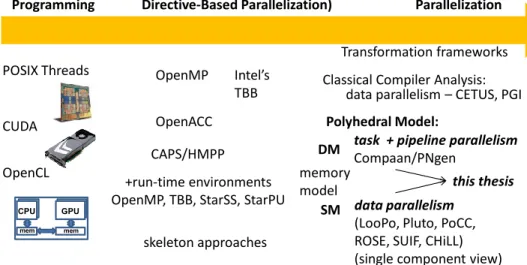
landscape of parallel computing and then address related work with respect to each of three main challenges addressed in this thesis.
Automatic Parallelization Explicit Parallel
Programming POSIX Threads CUDA OpenMP OpenCL OpenACC Semi-Automatic (Languages, Directive-Based Parallelization)
task + pipeline parallelism
Compaan/PNgen
data parallelism
(LooPo, Pluto, PoCC, ROSE, SUIF, CHiLL) (single component view) Intel’s
TBB
Transformation frameworks Classical Compiler Analysis:
Polyhedral Model:
SM
data parallelism – CETUS, PGI
CAPS/HMPP memory model DM this thesis V V mem CPU GPU +run-time environments OpenMP, TBB, StarSS, StarPU
skeleton approaches
GPU
mem
Figure 1.5: The Landscape of Parallel Programming
In the field of explicit parallel programming, the prominent examples include multi-threaded programming using POSIX PThreads, Win32MT, and Boost libraries for programming multicore CPUs, and CUDA for programming GPUs. The CUDA pro-gramming model has been generalized by industry into the OpenCL standard target-ing portable programmtarget-ing of heterogeneous platforms with accelerators. OpenCL is a promising standard for future work since it introduces supports for programming microprocessors, graphics processing units, and other future accelerators in a portable manner. We leverage the parallel programming APIs and libraries to automatically generate the compilable source code for the target platform.
re-1.4. RELATED WORK
cently introduced by Cray and NVIDIA. The OpenACC API uses directives and com-piler analysis to compile regular C and Fortran for the GPU. The OpenACC standard is introduced not only to make GPU programming easier, but also to allow the pro-grammer to maintain a single source version. Ignoring the OpenACC directives will compile the program for the CPU. In C++, support for multi-threaded constructs was introduced via Intel Thread Building Blocks (TBB) and Microsoft Parallel Patterns li-brary (PPL). Both Intel’s TBB and Microsoft’s PPL use C++templates and run-time threading support. The TBB provides loop parallelization constructs and parallel programming skeletons (templates) as a part of the language syntax, concurrent data structures, locks, and support task based programming, but requires from the pro-grammer to apply them appropriately. There is also an increasing number of environ-ments that combine multiple features of parallel programming, such as for example CAPS’ HMPP, StarSs, and CHPS. CAPS’ HMPP is a directive-based compiler target-ing multi and many-core architectures with accelerators. HMPP enables offloading of functions or regions of code on GPUs and many-core accelerators as well as the trans-fer of data to and from the target device memory. StarSs (OMPSs, OpenMPT) is a task based programming model that also provides pragmas to annotate tasks in source code, and then performs computation of dataflow dependencies between tasks, and provides a runtime system supporting different platforms [61, 92, 107]. CHPS [73] is a collaborative execution environment that allows to cooperatively execute a sin-gle application on a heterogeneous desktop platform with a GPU, and to do so relies on its own task description scheme. Explicit and semi-automatic parallelization ap-proaches can also be combined with run-time task scheduling frameworks, such as StarPU [9, 10]. In addition, there is an increasing number of skeleton based program-ming approaches that provide template libraries for common parallel programprogram-ming patterns [41, 51, 87]. However, the use of a semi-automatic approach still requires an experienced parallel programmer aware of different parallel programming patterns, methods, and mapping mechanisms to identify parallelism in the application and pro-vide parallelization directives in the framework-specific format.
Automatic parallelization frameworks analyze the sequential code, convert it into some intermediate representation, and automatically generate parallel code for the given target architecture. Within the field of automatic parallelization frameworks, most work is done using classical compiler analysis with major players including compiler frameworks such as CETUS [12, 85] and PGI [126].
1.4. RELATED WORK
[54, 55, 58]. Once the dependences are known, it is possible to apply various trans-formations, such as scheduling [42, 56, 57, 67, 86]. Recent advances in the polyhedral model include tiling and fusion [32], vectorization [129], parametric tiling [23], and iterative optimizations [110, 111]. The breakthrough in code generation in the poly-hedral model by the CLooG tool [28], made the polypoly-hedral model more applicable to real world problems. The polyhedral model is gradually being adopted by leading edge research and commercial compiler tool-flows. This highly active area of re-search resulted in several polyhedral frameworks, such as Stanford University’s SUIF [136], University of Passau’s LooPo [68, 86] University of Ohio’s PLuTo [33], joint open source effort PoCC [1], University of Utah’s CHiLL [36, 70], gcc GRAPHITE [108], and the commercial R-stream compiler [117], to name a few. We classify poly-hedral frameworks in two main categories based on the memory model used for com-munication into shared memory (SM) and distributed memory (DM) frameworks. While most of the compiler frameworks presented above belong to the first category, the pn and Compaancompilers based on the long line of research on dataflow and pro-cess network models of computation [46, 77, 79, 81, 114, 116, 120, 131] belong to the second category. These compilers assume a distributed memory model in which each autonomous process communicates with other processes exclusively via tokens. The research work presented in this thesis is highly influenced by the work done on the Compaan [81] and the Daedalusframeworks [2, 97, 98, 128], the work of Rijpkema on deriving process networks from nested loop algorithms [46, 114, 115], the work of Stefanov on code transformations like skewing and unfolding [119, 120], the work of Meijer on node splitting for asynchronous data parallelism [94], the work of Turjan on deriving and characterizing process networks [131], the work of Zissulescu on Read/Execute/Write code generation format [145], and the modelling work and ini-tial GPU experiments done by Nikolov [99]. The research in this dissertation makes a step towards combining the two directions in the parallelizing compiler research based on the polyhedral model as indicated in Figure 1.5. Inspired by the Y-Chart paradigm [80] that promotes matching between the application and the architecture specification, we aim to make it possible to combine tools develop in SM and DM research by generating multi-level programs (MLPs), in which each program module can be parallelized using some of the polyhedral frameworks above, and mapped onto the desired component on the heterogeneous platform. Inspired by the distributed memory model adopted by dataflow approaches, we make independent execution of program modules on diverse architectural components possible using private memory within each module and token-based communication between program modules.
Next, we discuss related work in the context of three main challenges addressed in this thesis:
1.4. RELATED WORK
proposed partitioning (also known as tiling) [74, 75, 112, 123, 125, 137, 138] of itera-tion domain into tiles that are assigned to different processors for execution. Bond-hugula [32, 33] was the first to integrate the tiling transformation in the polyhedral model. This work resulted in the polyhedral framework PLuTo targeting coarse-grain parallelization on chip multicore processors and locality optimization. Fur-ther, Baskaran adopted the tiling approach in PLuTo for generation of data parallel CUDA kernels for GPUs [24–26]. Semi-automatic approaches for GPU paralleliza-tion are for example, extensions of the CETUS research compiler [12, 85] for auto-matic conversion of OpenMP-annotated code into GPU code [84], the HMPP codelet approach [47], and OpenACC directive-based GPU parallelization supported by the PGI compiler [126].
Our approach to model-drive code generation for GPUs was inspired by the struc-tured scheduling approach proposed by Feautrier [60]. Instead of specifying the graph of independent tasks manually, we automatically obtain a task-graph struc-ture in form of a PPN automatically from the application SANLP using the Compaan compiler. We then leverage the task-graph structure of the PPN model to generate independent tasks for processing on the GPU or CPU. We obtain data parallel CUDA kernels by applying scheduling transforms on each PPN node separately. We use Feautrier’s time-optimal scheduling algorithm to illustrate identification of data par-allel operations within the nodes [56]. The result of parpar-allelizing each PPN process is a CUDA kernel featuring maximal data parallelism. Such kernels could be further optimized using CUDA auto-tuning tools, such as e.g., [144]. Our methodology for data parallelism identifcation and intermediate representation is however not tied to a specific scheduling algorithm, which makes it possible to combine the work done in this thesis with advanced scheduling and tiling techniques that are being developed in the compiler community. Recently, NVIDIA introduced support in CUDA for con-current kernel execution [105] on GPU. As a natural application of the task-parallel PPN model which is used as the basis for accelerator mapping, we also provide sup-port for exploiting task parallelism on accelerators.
1.4. RELATED WORK
the context of PPN mapping on heterogeneous platforms, Nikolov [99] experimented with synchronous kernel offloading via replacement of sequential code within a PPN node with synchronous GPU host code. We advance execution of PPNs on platforms with GPU accelerators, by introducing the asynchronous stream buffer design for more efficient implementation of host-accelerator PPN channels. By combining the dataflow nature of the PPN model with the concepts for asynchronous transfers, we present a model-driven solution for generation of asynchronous code for overlapping computation and communication.
1.5. THESIS OUTLINE
1.5
Thesis Outline
The remainder of this thesis is organized as follows:
In Chapter 2, we list the requirements for representing programs in the polyhedral model, give an overview of compiler concepts and techniques used in this thesis, and briefly present the architecture and programming model of compute-capable GPUs.
In Chapter 3, we present a three-step transformation approach for identification and exploitation of data parallelism in PPN representation for mapping onto massively parallel accelerators, such as GPUs. Furthermore, we present several memory-related optimization techniques and show how to exploit task-parallelism on accelerators.
In Chapter 4, we present our novel hierarchical internal representation in the poly-hedral model, i.e. Hierarchical Polypoly-hedral Reduced Dependence Graph (HiPRDG) and describe a method for derivation of the HiPRDG representation from the standard application specification in the polyhedral model. Furthermore, we present a novel approach for hybrid generation of structured, multi-level programs featuring multiple forms of parallelism.
In Chapter 5, we present an approach for reduction of host-accelerator overhead which makes use of a novel stream buffer design for model-based overlapping of host-accelerator communication and computation leading to asynchronous data-driven ex-ecution of PPNs on heterogeneous platforms with accelerators.
In Chapter 6, to evaluate the concepts and techniques presented in Chapters 3, 4, and Chapter 5, we perform an extensive parallelization case study on an example stream-ing multimedia application (the M-JPEG encoder). We show the benefits achieved through exploiting data parallelism on a GPU accelerator, token adjustment and multi-level parallelization, and wrap up by discussing the overall performance gains.
Chapter
2
Preliminaries
2.1
Compiler Techniques for Automatic Parallelization
The polyhedral model is an appealing model to represent and manipulate program statements enclosed in loop nest structures found in static affine nested loop pro-grams (SANLP) [86, 109]. Performance hot-spots in many application domains are naturally expressed in this form of static affine nested loop programs. Numerous examples can be found in multimedia streaming applications in consumer electron-ics, modeling and simulation applications in high performance computing, molecular biology, radio astronomy, medical imaging, and high energy physics. This thesis con-siders programs which are (or can be transformed) into the form of a SANLP, and can thus be represented in the polyhedral model. Once the polyhedral model is extracted from a SANLP, data dependence analysis and different loop restructuring transforma-tions such as, e.g., loop fusion, loop fission, and strip-mining can be applied. Before we introduce mathematical concepts and notation required for compile-time program analysis in the polyhedral model, let us define which requirements a program needs to satisfy to be in the form of a SANLP. The definitions in this section have been compiled from the compiler literature [3, 4, 42, 86, 93, 114, 130, 134, 142].
Definition 1 (Static affine nested loop program (SANLP))
A static affine nested loop program (SANLP) is a program in which each program statement is enclosed by one or more loops and if-statements, and where the following conditions hold:
• for-loop bounds are affine expressions of the enclosing loop iterators, static program parameters, and constants,
2.1. COMPILER TECHNIQUES FOR AUTOMATIC PARALLELIZATION
• if-statements have affine conditions in terms of the enclosing loop iterators, constants, and static program parameters,
• index expressions of array references are affine expressions of the enclosing loop iterators, constants, and static program parameters,
• data flow between statements is explicitly defined.
An example of a static affine nested-loop program is given in Listing 2.1.
1 #define M 4
2 #define N 3
3 int i, j;
4
5 for (int i = 1; i <= M; i++) {
6 for (int j = i; j <= N; j++) {
7 f(in[i][j], &tmp[i][j]); // statement S
8 g(tmp[i][j], &out[i][j]); // statement T
9
10 }
11 }
Listing 2.1: Example of a regular C program (SANLP).
A loop in an imperative language such as C can be represented using an n-entry column vector called its iteration vector:
~
x=[x1,x2, . . . ,xn]T
wherexkdenotes thek-th loop index andndenotes the innermost loop. The
surround-ing loops and conditionals of a statement define its iteration domain. The statement is executed once for each element of the iteration domain. When loop bounds and conditionals depend only on surrounding loop iterators, static program parameters and constants, the iteration domain can be specified by a set of linear inequalities defining a polyhedron.
The static program parameters MandN in the program above are defined at lines 1-2. Static program parameters can be also used in expressions that define for-loop bounds and array indices. For example, the upper bound of the for-loop with iterator
2.1. COMPILER TECHNIQUES FOR AUTOMATIC PARALLELIZATION
argument in[i][j] and output argument tmp[i][j], and the statement T at line 8 corresponds to the function callgwith input argumenttmp[i][j] and output argument
out[i][j]. The indexes of function argumentsin,tmp, andoutare affine forms of loop indicesiand j. Data flow between statementsS andT is made explicit through array variabletmp. Below, we define several concepts required for program modeling and compile-time analysis:
Definition 2 (Iteration vector)
Theiteration vector of a statement is a vector consisting of values of all indices of the loops surrounding the statement, from the outermost to the innermost. With
~xS = [x1,x2, ...,xm]T, we denote the iteration vector~xS of a statement S surrounded
by m nested loops.
Definition 3 (Program parameters vector)
Theprogram parameters vectoris a vector of static program parameters.
While there is an iteration vector for each statement, there is only a single program parameters vector per program. Together, the iteration vector and the vector of pro-gram parameters form theindex vector of a statement. For simplicity, we often use the terms index vector and iteration vector interchangeably.
Definition 4 (Iteration domain)
The iteration domain (domain) of a statement is a set of all values of its iteration vector~xS.
In the polyhedral model, the iteration domain of a statementS is represented by a polyhedronDS.
Definition 5 (Polyhedron)
Arational polyhedronPis a subspace ofQd bounded by a finite number of linear inequalities (affine hyperplanes) i.e.,
P={x∈Qd|Ax≥b} (2.1)
where A is an integral m×d matrix and b is an integral vector of size m.
AZ-polyhedron is the set of integer pointsP ∩Zd(a lattice), i.e. the intersection of the rational polyhedronP ⊆Qdwith a lattice. AZ-polyhedron is also referred to as
integer polyhedron. Apolytopeis a bounded polyhedron.
In this thesis, we use both the terms polyhedron and polytope interchangeably to refer to bounded, parametricZ-polyhedra. Note that polyhedra can be parametrized
2.1. COMPILER TECHNIQUES FOR AUTOMATIC PARALLELIZATION
Let us illustrate the notation introduced above on the simple SANLP code snippet given in Listing 2.1. Figure 2.1 shows the polytopeDSassociated with statementS
nested within for-loops at lines 5-7.
1 2 3 4 i
3
2
1
D
S0
M
j
i<=j
j<=N
N
i<=M
1<=i
Figure 2.1: PolyhedronDSrepresenting the iteration domain of statementS in
List-ing 2.1 is the closed space bounded by hyperplanes defined by four linear inequalities 1≤i,i≤ j,i≤ M, and j≤N.
The polytopeDSlies in a two-dimensional space (i,j). Each dimension corresponds
to the iterators of for-loops within which statement S is nested, i.e. x1 = i and
x2= j. The iteration domainDSis defined by a system of affine inequalities that are
derived from the upper and lower bounds of for-loops and if-statements surrounding the statementS:
i≥0 (2.2)
i≤ M−1 (2.3)
j≥i (2.4)
j≤N−1. (2.5)
The system of (affine) inequalities represented in a homogeneous matrix notation is given below:
1 0 0 0 0
−1 0 1 0 −1
0 1 0 0 0
0 −1 0 1 −1
i j M N 1
2.1. COMPILER TECHNIQUES FOR AUTOMATIC PARALLELIZATION
This representation is commonly used internally in various polyhedral compiler frame-works, such as [1, 81].
The iteration vector~xStakes the values in set{(1,1),(1,2),(1,3),(2,2),(2,3),(3,3)}.
The order in which the iteration vector takes the values in setDScorresponds to the
order in which the sequential program is executed.
Below, we introduce concepts related to SANLP execution:
A fundamental concept required to discuss program execution is the notion of an
operation. As an operation we consider a single invocation of a program statement, i.e. the operation is a statement instance. For example, the for loop with iteratoriin Listing 2.2 executes three times statementS and three times statementT, resulting in 6 operations:S(0),S(1),S(2),T(0),T(1), andT(2).
1
2 for (int i = 0; i < 3; i++) {
3 S: ....
4 T: ....
5 }
Listing 2.2: There is an operation for each invocation of a statement in the program code. The for loop executes 6 operations:S(0),S(1),
S(2),T(0),T(1), andT(2).
Definition 6 (Operation)
A statement S is executed for each value of the iteration vector~xS defined by the
for-loops surrounding S . Each execution instance of a statement S , is called an op-eration. An operation is uniquely identified by statement S and the value of iteration vector~xS, and denoted as S(~xS).
A notation also commonly found in literature for an operation of statementS is also (S, ~xS). We will use the two notations interchangably.
The operations are carried out in a predefined order, which is called the sequential order. We denote the sequential order as <seq. The sequential execution order is always assumed is stems from the lexicographical order of the program source code.
Definition 7 (Lexicographical order)
We say that~a is lexicographically smaller than~b, i.e. ~a ≺~b, if it holds a(i) < b(i)
for the first position i in which the vectors are different, where a(i)is the ith element of~a and b(i)is the ith element of~b. Formally, lexicographical order is defined as a disjunction of affine inequalities or equalities. If~a and~b are two vectors of size n, then~a≺~b iff:
~
a≺~b≡ n
_
i=1
(a(i)<b(i)∧ i−1
^
j=1
2.1. COMPILER TECHNIQUES FOR AUTOMATIC PARALLELIZATION
In addition, different statements S and T, s.t. S! = T which are enclosed by a common set of loops are executed in the order in which they appear in the text. This order it know astextual order, and denoted as<text.
The sequential orderis determined by the lexicographic order defined on the iter-ation vectors components corresponding to the loops which enclose both operiter-ations under consideration. In the case of equality for the lexicographical order, sequential order is determined by the textual order, i.e.:
(S, ~xS)<seq(T, ~xT)⇔(~x0S <lex ~x 0 T)∨(~x
0 S = ~x
0
T ∧S <text T)
where~x0S and~x0T denote the components of iteration vectors belonging to common for-loops, i.e. for-loops which enclose both statementsS andT.
When execution order is discussed, the sequential execution order is assumed im-plicitly. Besides the sequential order, different execution orders of operations are possible. A different execution order of operations can be imposed by specifying a schedule, which is typically stored in form of ascattering matrix. Code genera-tion tools, such as CLooG [27, 29], generate code from the polyhedral model of the program according to the specification of the original statement domainDS and its
schedule.
While different execution orders exist, not all possible execution orders are legal. An execution order is legal only if it preservesdata dependencesbetween operations. According to Bernstein [30], two operations are data dependent if they share some written variable and if at least one access is a write access. A dependence between two operationsS(~xS) andT(~xT), denoted as
S(~xS)⇒T(~xT)
isloop-independentif it occurs for a given iteration of all loops that surround both statements S and T, i.e. ~x0S = ~x0T, where ~x0S and ~x0T are the vector components up to the common nesting level. Otherwise, a dependence is loop-carried, which means that the dependence occurs between operations with different values of the loop counter, i.e. ~xS <> ~xT.
Definition 8 (Distance vector)
A dependence S(~xS)⇒T(~xT)has adistance vector~x0T−~x0S, where~x0T and~x0S denote
components of the vectors~xT and~xS up to the common nesting level.
As the dependence is always directed according to the sequential order [42], the dependence vector is always lexicographically non-negative, i.e. ~x0T−~x0S ≥lex~0.
We classify data dependences in four types. The first three types of dependences, i.e.
2.1. COMPILER TECHNIQUES FOR AUTOMATIC PARALLELIZATION
based on a write to a shared variable. These three dependence types are calledwrite dependences. A read dependence is not truly a data dependence, however read-after-read accesses are significant for reuse analysis and data locality optimization.
• Dataflow dependence: Read-after-write (RAW). If a write operation to a shared variable is followed by a read operation from the same location, the value read depends on the value written. This type of dependence is also known as atrue dependence, and it is the main dependence type considered in PPN construction.
• Output dependence: Write-after-write (WAW). If two operations write to the same location, the value of memory location will have the wrong value after both operations are performed if the operations are permuted.
• Anti-dependence:Write-after-read (WAR). If a read operation from a shared variable is followed by a write operation to the same location, the value read from the memory location will be wrong if the operations are permuted.
• Read dependence:Read-after-read (RAR). A read dependence exists if one operation reads the same location as the other.
As explained in [4], anti dependences are a byproduct of using a shared memory model, where the same memory location can be used to write data multiple times. The same holds for output dependencies. Anti-dependences and output dependences are referred to asstorage dependences. Storage dependences are not true data depen-dencies, and they can be eliminated by using different locations for each write.
The Compaan compiler used in this thesis considers only dataflow dependences. This is legal, because all storage dependences are eliminated first by conversion of the program intosingle assignment code(SAC) [81]. In SAC, each variable (storage location) can be read many times, but it can be written (assigned) only once. For more information on static single assignment form, interested reader is referred to the seminal paper of Cytron [39]. The SAC representation of a program corresponds to itsdataflow dependence graph, or simply dataflow graph. This fact is used during PPN construction by the Compaancompiler.
In PPN construction, only dataflow dependences are considered, as there is no logi-cal re-use of memory cells for writing. More specifilogi-cally, PPN dependence edges are annotated with theexact dependence specification, which for each dataflow depen-dence directed to operationT(~j) provides the iteration vector ofthe last operation
2.1. COMPILER TECHNIQUES FOR AUTOMATIC PARALLELIZATION
addition, read dependences are considered through multiplicity analysis introduced by Turjan [130, 132].
Different abstractions for representing data dependences have been introduced in compiler literature [43]. Some of the widely used dependence abstractions are dis-tance vectors (Definition 8), then level of dependence introduced by Allen and Kennedy [6], and used in their parallelism detection algorithm [5], direction vector introduced by Wolfe [141] and used in Wolf and Lam’s parallelism detection and locality opti-mization algorithm [137, 138], and dependence polyhedra introduced by Irigoin and Triolet [74] and used in their supernode partitioning algorithm [75]. For a detailed overview and comparison of different dependence abstractions and algorithms that use them, interested reader is referred to the book by Darte et al. [42].
Here we give only a brief overview of selected dependence abstractions and related concepts:
Definition 9 (Loop nest depth)
Thedepth of a loop nestdLis the number of for-loops in the given loop nestL.
Definition 10 (Loop nesting level, Loop depth)
Thenesting levelli (loop depth) of loop i in loop nestLis one plus the number of
the loops in the surrounding loop nest. The nesting level of the outermost loop thus equals one, i.e.
1≤li ≤dL
Definition 11 (Common nesting level)
We define the common nesting level nS,T of two statements S and T as the number of
for-loops that surround both S and T . Vectors~x0S and~x0T are the vectors formed by the first nS,T components of iteration vectors~x0S, and~x0T respectively. If statements S
and T do not share any enclosing loops, then nS,T =0.
Definition 12 (Level of dependence)
Level of dependence l(e)is the depth (one plus the number of surrounding loops) of the outermost loop for which the loop counters of two dependent operations are different.
This definition of level of dependence follows Allen and Kennedy’s seminal pa-per [6]. The dependence level is always below or at the common nesting level of de-pendent operations from the statementsS andT, i.e.l(e)≤nS,T. Allen and Kennedy
allow values between [1..nS,T]∪ {inf}for the dependence level. The dependence level
l(e) is determined according to the two cases:
• loop-independent dependence: l(e) = inf if S(~xS) ⇒ T(~xT) with ~x0S = ~x0T.
2.1. COMPILER TECHNIQUES FOR AUTOMATIC PARALLELIZATION
are nested at the same levelnS,T and all vector components equal, i.e. textual
order between operations of statementsS andT needs to be respected.
• loop-carried dependence: l(e) ∈[1..nS,T] ifS(~xS) ⇒T(~xT) and the first
non-zero component of the vector~x0S −~x0T is thel(e)-th component.
This definition of the level of dependence follows Allen and Kennedy’s original pa-per [6], however we will further refine it in Chapter 4 for the needs of our hierarchical parallelization algorithm.
A data dependence is said to becarried at level kif dependent operations accessing the same location belong to the same iteration of the firstk−1 outermost loops but not to the same iteration of thek-th loop [7]. The level at which dependence is carried can be detected by examining the components of the distance vector. If the firstk−1 components of the distance vector are zero and thek-th component is strictly positive, then the dependence is carried at levelk. Adependence polyhedronPS,T represents
the set of dependence distance vectors (Definition 8) for all dependences between statementsS andT.
Dependences between operations define a set of precedence constraints. The prece-dence constraints can be represented in form of a graph, called thedependence graph. Let us define a dependence graphG=(V,E), as a directed multigraph that consists of a set of verticesV(or nodes) and a set of directed edgesE(or arcs). In an expanded dependence graph, the nodes are defined as the set of all program operations, i.e.:
V ={Si(~xSi)| ∀i,Si ∈ P ∧~xSi ∈ DSi∧
[
Si
=P}
whereSi is a program statement with iteration domain DSi andPis the set of all
statements in the program. In the dependence graph, there is an edgee ∈Efor each pair of dependent operationsS(~xS) ⇒ S(~xT). A dependence graph with dataflow
dependences only is called the dataflow graph. The dataflow graph corresponds to the SAC formulation of the program.
The dependence graph can be subsumed by a more compact representation called
reduced dependence graph (RDG). An RDG is a statement-level dependence graph. The set of verticesV of an RDG contains only s nodes, where s is the number of statements in program, with each node corresponding to a different program state-ment. In this graph, a single edge e between statements S and T represents one or more dependences in the setRS,T, whereRS,T is the set of all dependence pairs
between operations of statementsS andT.
2.2. POLYHEDRAL PROCESS NETWORKS
which describes the exact dependence relationships between dependent operations that is obtained as a result of dataflow analysis. The dependence relations are given as affine forms of for-loop iterators, program parameters, and constants.
Definition 13 (Polyhedral Reduced Dependence Graph (PRDG))
A statement-level Polyhedral Reduced Dependence Graph G = (V,E)is a directed multigraph that consists of a set of vertices V (nodes) and a set of directed edges E, where:
• The set of vertices V of a PRDG contains s nodes, where s is the number of statements in program P, i.e. |P| = s. Each node NSi in the PRDG is
defined by the program statement Si, dimensionality of the statement dSi(which
corresponds to the number of surrounding for-loops), its iteration vector, and its iteration domainDSi ∈ZdS i.
• For each set RS,T, where RS,T is a non-empty set of dependence pairs between
operations of statements S and T , there is a (directed) edge eS,T ∈E from node
S to node T in the graph.
• Each edge eS,T ∈ E is annotated with the exact mapping between dependent
operations. The mapping between producer (write) and consumer (read) oper-ations is an affine function in iterators, program parameters, and constants.
2.2
Polyhedral Process Networks
A Polyhedral Process Network (PPN) [134] is a variation of the Kahn Process Net-works model of computation [76], which describes an application as a network of concurrent autonomous data-driven processes that communicate via channels using a blocking read. Tokens are used as means of communication between processes. The KPN processes pass tokens via unidirectional communication channels. Each communication channel has one writer (producer) and one reader (consumer). We refer to two processes connected by a channel as a producer-consumer (P/C) pair of processes.
2.2. POLYHEDRAL PROCESS NETWORKS
which is described below. The producer-consumer relationships between processes are also described by polyhedra. In this section, we give fundamental PPN definitions and explain its execution model on a simple example.
During PPN derivation as described in [130, 131, 135], an autonomous process is created for each program statement in the SANLP. The simple SANLP code snip-pet presented in Figure 1.2(a) (Section 1.1) shows two statements, named P(as in producer), andC (as in consumer), which results in the simple PPN shown in Fig-ure 1.2(b) with two nodes corresponding to these statements.
Each PPN process has aread-execute-write(R/E/W) structure, i.e. internally it is structured into three phases:
1. Read (R)- in this phase, a process reads input data from incoming channels into local variables. If input data is not available, the process blocks.
2. Execute (E)- in this phase, a process executes the process function (program statement) on the input data in local variables, and produces output data.
3. Write (W)- in this phase, a process writes the output data from local variable into outgoing channels.
Together, the three phases form the body of a process. The process iteration domain, or simply node domain, specifies a set of iteration points for which the process body is executed. The node domain typically corresponds to the iteration domain of the program statement represented by the given process. For example, the node domain of processPin Figure 1.2(b) is defined by linear inequalities 0 ≤ iandi≤ 9. PPN processes are informally classified into three categories: producers,transformers, andconsumers. As the name says, the producer process, e.g. process P in Fig-ure 1.2(b), only produces output data, and as such it has only the execute and write phases. The transformer process reads input data, transforms input into outputs by executing process function, and writes output data. It has all three phases. Finally, the consumer process, such as processC in Figure 1.2(b), just reads in the data and consumes it, thus it has only the read and execute phases.
The definitions that follow are adopted from Meijer [93].
Definition 14 (PPN Process)
A PPN process is an autonomous execution entity specified by:
1. Aprocess domainthat specifies all process iterations,
2.2. POLYHEDRAL PROCESS NETWORKS
3. A process function to processes the input arguments and to produce output arguments, and
4. A specification ofoutput port domainsto write the function output arguments to the corresponding output channels.
The body of the PPN process follows theread-execute-writestructure.
Definition 15 (Process function)
Aprocess functionrepresents the computational part of a process. It corresponds to a function call statement in the sequential application that is a pure function without side-effects which only reads/writes through its input/output arguments.
In the example given in Figure 1.2, the process function of processPis the program functionproduce(...), while the process function of processCis the program func-tionconsume(...).
Definition 16 (Process body)
The body of a process (process body) includes communication and computation parts of the process. The process body is structured in three phases: read phase, execute phase, and write phase. First all input data is read from incoming channels (read phase), the process function is executed (execute phase), and subsequently all output data is written to outgoing channels (write phase).
Definition 17 (Process iteration)
Aprocess iteration of a process P is defined as a (single) execution of the process body, i.e. the evaluation of the process function on a single set of input and output arguments.
All iterations of a process are described by a process iteration domain. Thus, process
Pexecutes 10 times.
Definition 18 (Process iteration domain (Node domain))
Theprocess iteration domain(also known asnode domain) of a process P, denoted by DP, is defined as a set of all process iterations of process P.
The process iteration domain of a PPN node corresponds to the iteration domain of the matching statement in SANLP.
2.2. POLYHEDRAL PROCESS NETWORKS
appear on the input ports of the process, the process executes the process function. Then it needs to write the output data from a local variable into the outgoing PPN channel connected to the relevant consumer node. The write can also block if there is no space in the PPN channel.
During PPN construction, a PPN channel is derived for each dependence edge be-tween a pair of nodes. Each PPN channel is associated with a dependence polyhedra that specifies the affine mapping between the iterations of the producer node and the dependent iterations of the consumer node. We refer to a PPN channel that has the same producer node and the same consumer node as aself-link. Definitions of PPN properties relevant for realizing communication in polyhedral process networks are given below:
Definition 19 (Input Port Domain (IPD))
The k-th input port domain (IPD) of process Pi, denoted by IPDPi,k, is a subset
of the node domain where input data is read from the k-th incoming channel, i.e., IPDPi,k ⊆DPi.
Similarly, we define an output port domain which represents the process iterations for which output data is written to a given PPN channel.
Definition 20 (Output Port Domain (IPD))
The k-thoutput port domain (OPD)of process Pi, denoted by OPDPi,k, is a subset
of the node domain where output data is written to the k-th outgoing channel, i.e., OPDPi,k ⊆DPi.
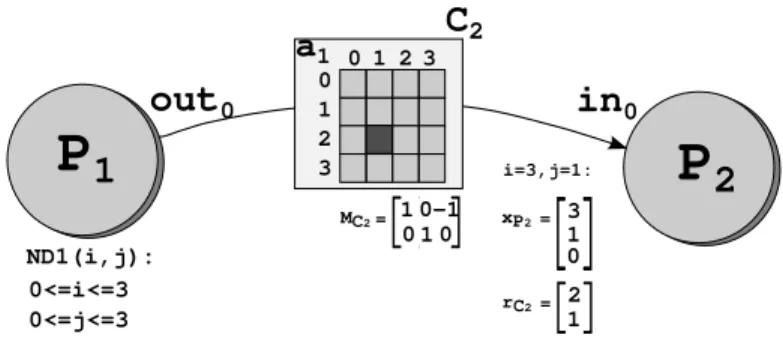
Finally, each channel is annotated with a mapping function that for each pair of producer-consumer (P/C) nodes specifies the relationship between producer itera-tions and consumer iteration. Using the mapping function, for each input argument of the consumer node it is possible to determine the identity of the node that produced it and at which iteration it was produced.
Definition 21 (Mapping)
An affine mapping Mk is a function that specifies producer-consumer relationship between two processes. The mapping Mk maps the iteration points from the k-th input port domain of a consumer process PCto the corresponding iteration points of
its producer process PP, i.e.,
OPDPP,l = M k
(IPDPC,k).
2.2. POLYHEDRAL PROCESS NETWORKS
thelast write access[55, 78, 135]. This is relevant because in shared memory model, multiple iterations could write to the same memory location. However, only the last iteration to write before a read occurs is the actual source of the dependence. In the simple P/C PPN example, the IPDs and OPDs are equal to the process domains, but in general this is not the case. The mapping function specifies how consumer’s iteration vector~xC = [j] maps into producer’s iteration vector~xP = [i], i.e. given a value of
iterator jin producer node, we need to find out what was the value of iteratoriin the consumer node for the dependence edge E. In this case, the mapping function is the simply equalityi = j, which means that input data of, for example the 7th iteration of producer node are provided by the 7th iteration of the consumer node.
2.3. PARALLEL COMPUTING WITH GPU ACCELERATORS
2.3
Parallel Computing with GPU Accelerators
Heterogeneous Platforms with GPU Accelerators Over the years, GPUs evolved from wired VGA controllers to programmable parallel processors. On the hard-ware side, the fixed logic on early graphics cards dedicated to graphics processing was replaced by programmable processors. On the software side, a programming environment was created to allow GPUs to be programmed using the familiar C/C++ programming language with minimal extensions for supporting parallelism. This in-novation made a GPU a fully general-purpose, programmable, manycore processor, and enabled the use of what were previously gaming devices for high performance computing. As such, the modern GPUs are frequently used as data parallel acceler-ators on heterogeneous platforms. Since the CPU and the GPU architecture have a different design point, the best results are achieved when each is used for processing certain types of computation. The unified GPU architecture that evolved in the last decade excels at acceleration of data parallel computations.
Below we give an overview of the wide-spread GPU computing architecture and programming model introduced by NVIDIA, called Compute Unified Device Archi-tecture (CUDA). We compiled this short overview from several resources [38, 88, 96, 105, 106]. The compute device architecture and programming model introduced by CUDA inspired the Open Compute Language (OpenCL) standard for heterogeneous computing with accelerators. OpenCL is an open, royalty-free standard for program-ing parallel, compute intensive applications on heterogeneous platforms with acceler-ators. Due to the maturity of tools supporting OpenCL, majority of GPU developers still use CUDA as the GPU API of choice. In this thesis, we use CUDA as a model of choice for GPU, but translation to OpenCL is straightforward.
Architecture The GPU architecture is based on a parallel array of programmable processors [89]. The GPU processor array contains many simple processors, which are called CUDA cores orstreaming processors(SPs). The SPs are organized into multi-threaded multiprocessors, which are also known asstreaming multiprocessors
(SMPs). Figure 2.2 shows a GPU device composed of 16 SMPs. Each SMP in Fig-ure 2.2 contains 32 SPs, a common instruction unit, on-chip memory (shared memory and register files), and special function units. The number of SPs and their organiza-tion into SMPs varies with the architecture version. The first CUDA-programmable GPU, the NVIDIA GeForce 8800 with the Tesla architecture, features 128 SPs cores, structured as 16 SMPs with 8 SPs each. In this thesis, we made experiments using a second-generation GPU Tesla C2050 with the Fermi architecture. The Tesla C2050 GPU contains 448 SPs, structured as 14 SMs with 32 SPs each.
multiple-2.3. PARALLEL COMPUTING WITH GPU ACCELERATORS
Host (CPU)
Host Memory Device Memory (DRAM)
GPU
Execution Queue Control
SMP0
PCIe
On-Chip Memory
Data
Schedule/Dispatch
SP0 SP1 ... SP31
...
SMP1
On-Chip Memory Schedule/Dispatch
SP0 SP1 ... SP31
...
...
SMP15
On-Chip Memory Schedule/Dispatch
SP0 SP1 ... SP31
...
Figure 2.2: High-Level Overview of The GPU Architecture.
thread(SIMT) paradigm introduced by NVIDIA. The SMP creates, manages, sched-ules, and executes threads in groups of 32 parallel threads calledwarps. The GPU overlaps execution of instructions from warps assigned to the same SMP. A warp of 32 threads executes one common instruction at a time across 32 SPs in the given SMP. Individual threads composing a warp start together at the same program ad-dress, but they have their own instruction address counter and register state. Threads within a warp are free to branch and execute independently. However, full efficiency is realized with SIMD-like execution of threads that compose a warp, i.e. when all 32 threads in a warp follow the same execution path.
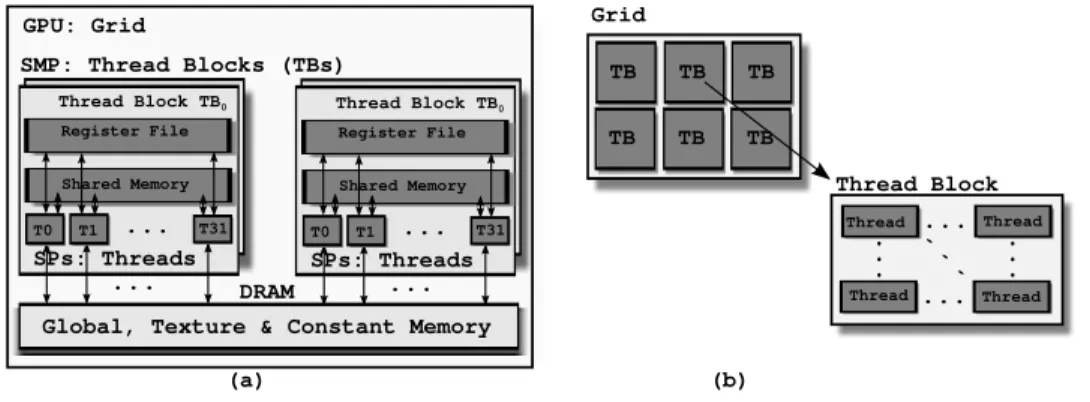
The GPU memory hierarchy has several layers and it is programmer managed. Physically, there is a device memory on the GPU and on-chip memory in each of SMPs. Device memory realized as DRAM is the main interface between the GPU and the rest of the heterogeneous platform, as shown in Figure 2.2. Device memory is accessible by all threads executing on the GPU. It is structured into several ad-dress spaces: global memory,texture memory, andconstant memory, shown within device memory in GPU memory model in Figure 2.3(a). The SMP on-chip memory is partitioned into thread-private memory (registers), and so calledshared memory, which is used for sharing data between threads running on multiprocessor’s SPs. To run a program on a GPU, it is necessary to first transfer the input data (if any) from the host memory to the device memory on the GPU via a host-accelerator intercon-nection link. The host-accelerator link is realized as a PCIe bus. After the GPU has finished the computation, the results are typically transfered back to the host for further processing.
2.3. PARALLEL COMPUTING WITH GPU ACCELERATORS
DRAM GPU: Grid
SMP: Thread Blocks (TBs)
...
Thread Block TB0
T0 T1 ... T31 Register File
Shared Memory
SPs: Threads
...
...
Thread Block TB0
T0 T1 ... T31 Register File
Shared Memory
SPs: Threads
Thread
Thread
Global, Texture & Constant Memory (a)
Grid
Thread Block TB TB TB
TB TB TB
Thread
... Thread
... ... ...
(b)
Figure 2.3: GPU Programming Model
programmers to bypass the graphics API and simply program the GPU in C/C++. The GPU programming model is fundamentally different from programming models used for multicore CPUs. The CUDA programming model exposes GPU’s parallel processing resources to the programmer as a structured hierarchy of programmable, light-weight CUDA threads, as shown in Figure 2.3(b). There are two main levels of parallelism: coarse-grain data parallelism and fine-grain data parallelism. In ad-dition, starting with the second-generation of GPUs (Fermi architecture), there is a support for task parallelism on the GPUs [105].
The CUDA programming model follows a single-program multiple-data (SPMD) software style. The SPMD is a software style for programming a multiple-instruction multiple-data (MIMD) parallel architecture in Flynn’s taxonomy [22, 62]. In SPMD style, a single program is written to run on all processors of a MIMD computer, using conditional statements when different processors should execute different code. A CUDA program (kernel) is written for an independent thread. However, the kernel is instatiated for Nthreads, and the computation within the CUDA kernel is executed byN threads on the GPU in parallel. Each kernel instance is parametrized by using the thread’s unique identifier which is provided by the CUDA environment.