Elevated coagulation factor levels affect the tissue factor-threshold in
thrombin generation
Inge M. Rietveld
a, Mark Schreuder
a, Pieter H. Reitsma
a,
Mettine H.A. Bos
aa Division of Thrombosis and Hemostasis, Einthoven Laboratory for Vascular and Regenerative Medicine, Leiden University Medical Center, Leiden, The Netherlands.
Corresponding author:
Mettine H.A. Bos, Ph.D.
Division of Thrombosis and Hemostasis
Einthoven Laboratory for Vascular and Regenerative Medicine
Leiden University Medical Center
Postal zone C7-Q, Albinusdreef 2
2333 ZA Leiden, the Netherlands
Phone: +31 71 526 8133
E-mail: [email protected]
Article type: full length manuscript
abstract: 209 (max 250)
word count: 3051 (max 5000-6000)
references: 16
Abstract
Introduction:
Altered levels of factor (F)VIII, prothrombin, or antithrombin have been associated with an
increased risk for venous thromboembolism (VTE). However, the exact molecular
mechanism by which these altered factor levels modulate the risk is incompletely
understood. Here we hypothesize that elevated factor levels affect the pro- and
anticoagulant balance in coagulation such that even minute amounts of tissue factor (TF) will
initiate thrombin formation, thereby contributing to the VTE risk.
Materials and methods: To test this so-called TF-threshold hypothesis, we monitored
thrombin generation initiated by very low TF concentrations in FXII-deficient plasma, to avoid
any contact pathway-mediated thrombin formation. Furthermore, similar experiments were
performed in the presence of increasing concentrations of pro- and anticoagulant proteins.
Results: A TF-threshold was established in the FXII-deficient plasma, which is subject to
inter-individual variation. Elevated plasma levels of procoagulant factors, such as FVIII or
prothrombin, enhanced thrombin generation and reduced the amount of TF required for the
initiation of thrombin formation. Conversely, elevated levels of the coagulation inhibitor
antithrombin increased the TF-threshold.
Conclusions: Our findings support a mediating role for the TF-threshold in the association
between high procoagulant factor levels and the risk for VTE. Furthermore, elevated levels
of anticoagulants may have a protective effect on the development of VTE.
Keywords
• Tissue factor, TF, F3, CD142, TF, TFA
• Factor VIII, FVIII, F8, AHF, DXS1253E, HEMA
• Antithrombin, AT, SerpinC1, AT3, AT3D, ATIII, THPH7
Highlights
• A minimum amount of tissue factor (TF) is required to initiate coagulation
• This TF-threshold is subject to inter-individual differences
• The TF-threshold decreases with increasing factor VIII and prothrombin concentrations
• The TF-threshold increases with increasing antithrombin concentrations
Introduction
Hemostasis is tightly regulated by pro- and anticoagulant pathways. Any irregularity in these
regulatory pathways may shift the balance to a hypercoagulable state, which in turn could
lead to venous thromboembolism (VTE). Elevated levels of the procoagulant proteins factor
VIII (FVIII) and von Willebrand factor (VWF) are associated with a moderate to high risk for
VTE [1]. For instance, individuals with FVIII levels >150 IU/dL have a 6-fold increased risk
for VTE relative to those with FVIII levels lower than 100 IU/dL [1]. Conversely, reduced
plasma levels (85 IU/dL) of the anticoagulant antithrombin (AT) are also associated with
VTE risk [2]. However, the exact molecular mechanism by which these altered pro,- and
anticoagulant protein levels modulate the VTE risk is incompletely understood.
Several studies have aimed at uncovering the relationship between factor levels and
VTE occurrence. In vitro methods in which the plasma conditions can be manipulated are
commonly used, such as the calibrated automated thrombogram (CAT). The CAT is utilized
to study the plasma potential to form thrombin, thereby demonstrating the coagulant
potential and hypo- or hypercoagulability of the plasma sample. Employing CAT analysis, it
has been shown that increased procoagulant factor levels including FVIII can induce a
hypercoagulable plasma state [3].
Tissue factor (TF) is the physiologically relevant initiator of coagulation. While TF is
mainly found in the subendothelial tissue, other sources of TF have been defined [4]. For
example, TF is found on microparticles that are released from various cell types such as
endothelial cells, monocytes, and cancer cells [5, 6]. The release of these microparticles is
associated with cytokine stimulation and various diseases including cancer, myocardial
infarction, and thrombosis [5, 6]. However, TF-expressing microparticles also circulate in
very low concentrations in the plasma of healthy individuals [7]. Given that the constant
exposure to these minute concentrations of TF does not seem to initiate full-blown clotting,
supported by previous studies using purified component coagulation systems demonstrating
that significant thrombin generation follows when surmounting the factor VIIa-TF treshold [8].
Here, we assess the hypothesis that altered coagulation factor levels affect this so-called
TF-threshold, thereby inducing a hypercoagulable state. As such, this might explain the
Materials and Methods
Materials
Calibrator and fluorescent substrate (FluCa) were from Thrombinoscope (Maastricht, the
Netherlands). Plasma-derived prothrombin, factor IXa, and antithrombin were from
Haematologic Technologies (Essex Junction, VT, US). Recombinant tissue factor (TF) was
from Siemens Healthcare Diagnostics (Innovin; Marburg, Germany). The concentration of TF
was determined using the ZYMUTEST total tissue factor enzyme-linked immunosorbent
assay (ELISA) (Hyphen Biomed, Neuville-sur-Oise, France). Factor VIII (Aafact) was from
Sanquin (Amsterdam, the Netherlands). Recombinant wild-type human factor X (FX) and
factor Xa (FXa) were obtained as described previously [9]. Antithrombin was from
Haematologic Technologies (Essex Junction, VT, USA). Small unilamellar phospholipid
vesicles (DOPC:DOPS) composed of 75% (w/w) 1,2-dioleoyl-sn-glycero-3-phosphocholine
(DOPC) and 25% (w/w) 1,2-dioleoyl-sn-glycero-3-phospho-L-serine (DOPS) (Avanti Polar
Lipids, Alabaster, AL, USA) were prepared as described previously [9]. Paired antibodies to
determine factors II, IX, X, XI, and antithrombin (AT) antigen were obtained from Cedarlane
(Burlington, Canada). Plasma factor V (FV) antigen was measured essentially as described,
using the FV light chain-directed monoclonal antibody V-6 as coating antibody and
biotinylated V-39 against the FV heavy chain as conjugate [10]. Plasma factor VIII (FVIII)
activity was assessed employing the HemosIL FVIII assay using the ACL TOP 700 analyzer
(Instrumentation Laboratories, Bedford, MA, USA). Factor VIIIa cofactor activity was
determined using a factor X activation assay, in which assay mixtures containing factor IXa
(90 nM) and PCPS (20 μM) in 20 mM Hepes, 0.15 M NaCl, 5 mM CaCl2, 0.1% polyethylene
glycol 8000, pH 7.5 (assay buffer) were incubated for 5 minutes at 25°C before
non-activated FVIII (0.5-1.5 U/ml) was added. The reaction was initiated with FX (170 nM). At
various time points (0-5 minutes), aliquots (10 μl) of the reaction mixture were quenched by
mixing with 90 µl of 20 mM Hepes, 0.15 M NaCl, 50 mM EDTA, 0.1% polyethylene glycol
velocities of Spectrozyme FXa (250 μM; Sekisui Diagnostics) hydrolysis were determined.
Measured rates were related to the concentration of FXa from the linear dependence of
initial velocity on known concentrations of FXa determined in each experiment.
Thrombin-specific peptidyl substrate hydrolysis was measured in assay buffer using 100 μM S2238
(Instrumentation Laboratories, Bedford, MA, USA) and initiated with prothrombin (8 nM –
2.33 μM). Molecular weights and extinction coefficients (E0.1%, 280 nm) of the various proteins used were taken as follows: prothrombin, 72,000 and 1.47; FX, 59,000 and 1.16;
FXa, 46,000 and 1.16; FIXa, 45,000 and 1.4; and AT, 58,000 and 0.62.
Plasma characteristics
Normal human pooled plasma from 19 healthy donors was obtained from Sanquin and used
as standard for coagulation assays and ELISAs. Factor XII (FXII)-deficient plasma of two
FXII-deficient individuals was obtained from George King Bio-Medical, Inc. (Overland Park,
KS, USA). The plasma levels of factors II (90-93%), V (90-95%), VIII (75%), X (110%), XI
(100%), and antithrombin (120-125%) were within the normal range, while those of factor IX
(140-150%) were slightly elevated as compared to normal pooled plasma.
Thrombin generation assay
The thrombin generation assay was adapted from protocols earlier described [11]. Briefly,
TF was relipidated with phospholipids (DOPC:DOPS 75:25, 20 µM final) for 1 hour at 37°C
in a buffer containing 25 mM Hepes, 175 mM NaCl, and 5 mg/ml BSA (pH 7.5). Various
concentrations of TF (0-15000 fM final concentration) or calibrator were incubated for 10
minutes at 37°C together with plasma (67% v/v). Coagulation factor levels of the
procoagulant FVIII and the anticoagulant AT were elevated by adding an additional 50 U/dL
by the addition of fluorescent substrate (FluCa) in a calcium-containing buffer. Fluorescence
was measured every 20 seconds for 120 minutes at 37°C in a Fluoroskan Ascent
fluorometer (ThermoLabsystem, Helsinki, Finland), and the results were corrected for the
calibrator using the Thrombinoscope 5.0 software. The lag time, thrombin peak (peak), time
to thrombin peak (ttpeak), and the ETP (the area under the thrombin generation curve) were
determined in three individual experiments each performed in duplo. Please note that the
datasets shown in the figures are derived from experiments performed on the same day. The
measurements were considered background when the software-determined cut-off values
were not met (cut-off values: lag time <45 minutes, ttpeak <90 minutes, peak >5 nM), and
the ETP was set to 0 nM.min. For those analyses in which little to no detectable thrombin
was formed, the slope of the crude fluorescence trace at 100-120 min. was determined,
which represents the formation of the alpha-2-macroglobulin-thrombin complex and is
proportional to the concentration of thrombin, as the substrate consumption and the inner
Results
Establishing the tissue factor-threshold
While previous research has shown the presence of a TF-threshold in a purified component
system [8], here we test the hypothesis that a minimal concentration of TF is required for the
initiation of coagulation by direct assessments in plasma. We first set out to determine this
TF-threshold under normal conditions. To do so, we monitored thrombin generation initiated
by various concentrations of TF (0-15 pM) in FXII-deficient plasma. Factor XII-deficient
plasma was used to avoid any contact pathway-mediated thrombin formation, which would
hamper data interpretation. Addition of corn trypsin inhibitor (CTI) to exclude effects of traces
of activated FXII did not affect the thrombin generation profiles (data not shown). As
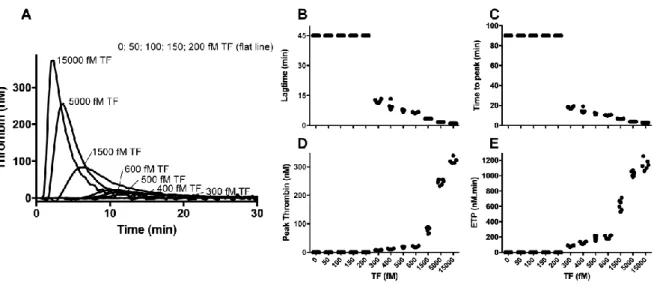
anticipated, no thrombin generation was observed in the absence of TF (Figure 1). Whereas
the addition of minute amounts of TF (50-200 fM) did not result in detectable thrombin
formation, substantial thrombin was generated in the presence of higher TF concentrations
(300-15000 fM).
Figure 1. Thrombin generation initiated by increasing concentrations of tissue factor.
Thrombin generation was initiated using a TF / DOPC:DOPS (0-15000 fM / 20 µM) mixture
‘Materials & Methods’. From the thrombin generation profiles (panel A), the lag time (panel
B), ttpeak (panel C), peak thrombin (panel D), and ETP (panel E) were determined and
plotted versus the TF concentration. The data are derived from individual experiments
performed on the same day and represent three experiments each performed in duplo.
To study the TF-threshold in further detail, the raw fluorescence traces representing
thrombin formation initiated with 0-300 fM of TF were analyzed for the velocity of
alpha-2-macroglobulin-thrombin complex formation, which is proportional to the concentration of
thrombin generated at these very low TF concentrations [12]. Using this method, thrombin
formation was observed upon TF-triggers as low as 50 fM (Figure 2). However, TF
concentrations of 50-100 fM triggered thrombin generation in some, but not all of the
experiments. This on-off effect shows that at these very low TF concentrations thrombin is
not generated in a consistent manner, suggesting that the system is very sensitive to minor
changes. Higher TF concentrations (150-300 fM) resulted in thrombin generation in all
experiments. Collectively, these raw data indicate that for consistent thrombin formation to
occur in this system >100 fM and ≤150 fM of TF is required. A slightly different threshold was
found when the processed data was used (>200 fM and <300 fM, figure 1). Since both
methods result in comparable thresholds and the raw, unprocessed data is not reliable at
high TF concentrations (up to 15 pM in this paper), the processed data will be used in the
Figure 2. Thrombin generation initiated by 0-300 fM of tissue factor. Thrombin
generation was initiated using a TF / DOPC:DOPS (0-300 fM / 20 µM) mixture in
FXII-deficient plasma and was monitored as described in ‘Materials & Methods’. The slope of the
crude fluorescence trace at 100-120 min. was determined and plotted versus the TF
concentration. The data are derived from individual experiments performed on the same day
and represent three experiments each performed in duplo.
Shifting the tissue factor-threshold with altered coagulation factor levels
The plasma levels of coagulation FVIII are strongly associated with VTE [1]. However, the
mechanism by which high FVIII levels might increase the thrombotic risk has not been
identified thus far. Therefore, we studied the TF-threshold under conditions with normal and
elevated plasma levels of FVIII: 100%, 150%, and 200% of FVIII, corresponding to 75 IU/dL,
125 IU/dL and 175 IU/dL, respectively. These FVIII concentrations are within the same range
as those observed in both VTE patients and healthy individuals [13]. While no lag time,
ttpeak, thrombin peak, or ETP could be detected in plasma with 100% FVIII following
initiation with 200 fM TF, substantial thrombin was generated in the presence of elevated
FVIII levels (150 and 200% FVIII; Figure 3A-C) following the same TF trigger, resulting in
detectable parameters of thrombin generation. Furthermore, in the presence of higher
concentrations of TF (500-600 fM) thrombin generation with FVIII levels of 150% or 200%
relative to that observed with 100% FVIII present. An even larger increase in peak was
observed for higher concentrations of TF in the presence of 150 and 200% FVIII as
compared to 100% FVIII (data not shown). These data corroborate with previous findings [3,
14]. The lag times and ttpeak values were not affected by increasing FVIII levels with higher
TF triggers (500-600 fM, data not shown). While these findings indicate that elevated plasma
levels of FVIII shift the TF-threshold and enhance the sensitivity of plasma coagulation for a
TF-trigger, the mechanism explaining this remains elusive. Control experiments using a
purified component factor X conversion assay revealed that the non-activated purified
plasma-derived FVIII used in these studies was capable of generating 0.4 0.2 nM factor
Xa/min/Unit FVIII, which may be due to trace amounts of partially activated forms of FVIII
and/or co-purified proteases. It cannot be ruled out that this contributed to some extent to the
observed thrombin generation.
To further study the effect of elevated procoagulant levels on the TF-threshold in
thrombin generation, we next focused on prothrombin, given that elevated prothrombin
levels are also associated with the risk of developing VTE [15] and affect on thrombin
generation to a large extent [16]. Plasma prothrombin levels of 100%, 150%, and 200% were
studied in plasma from a second FXII-deficient individual (‘plasma B’) and correspond to 90
IU/dL, 140 IU/dL and 190 IU/dL, respectively. While the TF-threshold identified in this plasma
was observed to correspond to lower TF triggers (5 fM > TF ≤ 50 fM; Figure 3D), an on-off
effect was observed for thrombin generation initiated with these very low TF concentrations
similar to previous findings. Furthermore, higher amounts of thrombin were generated in
plasma B relative to plasma A following the same TF trigger. This is in agreement with
earlier observations on high inter-individual variability in thrombin generation following (low)
TF triggers [17, 18]. Consistent with our findings for FVIII, increasing the plasma levels of
prothrombin reduced the lower limit of the TF-threshold range, from 5 fM to 1.5 fM of TF
(Figure 3E,F), and thus shifting the TF-threshold. In addition, at higher TF concentrations
relative to normal prothrombin levels (Figure 3F). At these TF concentrations, peak thrombin
was also increased in the presence of higher prothrombin levels, which is in accordance with
previous research. [3, 16]. Control experiments using a peptidyl substrate conversion assay
confirmed that the plasma-derived prothrombin used in these studies did not contain
detectable levels of thrombin. Collectively, these findings indicate that elevated levels of the
procoagulants FVIII and prothrombin lower the TF-threshold.
Figure 3. Thrombin generation with increasing plasma levels of procoagulant factors.
Panels A-C: Thrombin generation was initiated using a TF / DOPC:DOPS (0-600 fM / 20 µM)
mixture in FXII-deficient plasma A in the presence of normal (100% FVIII, panel A) or
elevated (150% or 200% FVIII, panels B,C) levels of FVIII and monitored and analyzed as
described in ‘Materials & Methods’. Panels D-F: Thrombin generation was initiated using a
TF / DOPC:DOPS (0-500 fM / 20 µM) mixture in FXII-deficient plasma B in the presence of
normal (100% prothrombin, panel D) or elevated (150% or 200% prothrombin, panels E,F)
levels of prothrombin and monitored and analyzed as described in ‘Materials & Methods’.
experiments performed on the same day and represent three experiments each performed in
duplo.
After studying the effect of elevated procoagulant factors, the TF-threshold was
assessed in the presence of normal (100%; 185 μg/mL) and increased (150 and 200%; 260
μg/mL and 335 μg/mL, respectively) levels of the anticoagulant antithrombin (AT), which has
been demonstrated to largely mediate thrombin generation [19]. Here we observed a
dose-dependent increase in the amount of TF required to initiate thrombin generation upon
increasing the plasma concentrations of AT (Figure 4A-C). Furthermore, at the highest TF
concentrations employed (5000-15000 fM) the elevated plasma levels of AT resulted in an
up to 3- to 4-fold decrease in ETP and peak, respectively, which is consistent with previous
findings [19]. The lag times and the ttpeak values were slightly prolonged relative to normal
AT levels (data not shown). The same assessment was performed in FXII-deficient plasma B
and resulted in similar findings (Figure 4D-F), further supporting the observation that
increased plasma levels of AT attenuate the sensitivity of plasma to the TF-dependent
Figure 4. Thrombin generation with increasing plasma antithrombin levels. Thrombin
generation was initiated using a TF / DOPC:DOPS (0-15000 fM / 20 µM) mixture in
FXII-deficient plasma A (panels A-C) or plasma B (panels D-F) in the presence of normal AT
levels (100% AT, panel A) or with elevated AT levels (150% AT, panel B; or 200% AT, panel
C) and monitored and analyzed as described in ‘Materials & Methods’. The ETP was plotted
versus the TF concentration. The data are derived from individual experiments performed on
Discussion
In the present study we confirmed the existence of a TF-threshold for the formation of
thrombin. Whereas this threshold was previously identified at 10-20 pM TF [8], we observed
that very low levels of TF, in the fM range, were required to trigger thrombin generation. The
differences between these findings might be explained by the definition of the threshold: we
defined this as the change from no thrombin formation to the start of thrombin formation,
while van ‘t Veer and Mann determined the change from slow to explosive thrombin
generation [8]. Furthermore, the use of a purified component-based system versus our
studies in plasma might also have affected the results. While our experiments in
FXII-deficient plasma imply the presence of this so-called TF-threshold, the exact concentration
of TF needed to initiate thrombin generation varies between individual plasmas, from 5 fM >
TF ≤ 50 fM to 100 > TF ≤ 150 fM (Figure 2, Figure 3D). We speculate that this, among
others, may be due to the varied presence of TF-expressing microparticles in the plasma.
Furthermore, our findings corroborate previously observed substantial inter-individual
variability in TF-initiated thrombin generation [17, 18].
It is important to note that the TF-threshold observed here will not be reached under normal
conditions, since the concentration of blood-borne active TF in healthy individuals is
estimated to be lower than 20 fM [20]. In disease states, however, the TF-threshold may be
surpassed since levels up to 0.9 pM TF activity were measured in patients with acute
coronary syndrome [21].
To assess how altered coagulation factor levels affect this so-called TF-threshold, we
demonstrated that elevated plasma levels (up to 200%) of either the procoagulant FVIII or
prothrombin decrease the TF-threshold (Figure 3). Very low TF concentrations that were not
able to generate thrombin at physiological FVIII or prothrombin levels initiated detectable
thrombin formation in the presence of 150 of 200% FVIII or prothrombin. At higher TF
peak thrombin parameters, which is in agreement with findings of Machlus and colleagues
[3]. Allen and co-workers also observed an increase in ETP and thrombin peak with high
prothrombin, while elevated FVIII resulted in an increase in thrombin peak only [16]. This
discrepancy might be due to the use of a purified component system without addition of
anticoagulation factors by Allen et al., versus plasma assays in our set-up. The shift in
TF-threshold may indicate that conditions of high FVIII and/or prothrombin prime the plasma
towards the action of TF, which may render it more susceptible to VTE. Interestingly, plasma
concentrations of FVIII or prothrombin similar to or higher than 200% have been detected in
individuals. More specifically, levels up to 552 IU/dL FVIII and up to 190 U/dL prothrombin
have been described for patients with VTE [13, 22]. Conversely, increased plasma levels of
the anticoagulant AT increased the TF-threshold, thereby reducing the plasma sensitivity to
the actions of TF. As such, these findings would support a mechanism for the link between
altered coagulation factor levels and an increased risk for VTE, as the former impact the
TF-threshold thereby potentially inducing a hypercoagulable state. Further studies are required
to examine whether this mechanism contributes to the development of VTE.
A limitation of this study is that not all experiments could be repeated in plasma from
both individuals due to limited plasma availability. However, we observed the same trends
for both plasmas, although the TF-threshold varied between the individual plasmas. Whether
this is due to the presence of varying levels of TF-bearing microparticles remains to be
determined. Furthermore, in this study we used platelet-poor plasma, which may affect the
results. However, a systematic comparison of platelet-free and platelet-rich plasma by
Wolberg and colleagues demonstrated no difference in the peak height and ETP [3].
Furthermore, the protein C pathway was not included in our set-up. While the group of
Wolberg further demonstrated that thrombomodulin slightly prolonged the lag time and
reduced both the thrombin peak and ETP following triggering with 1 pM TF [3], the effect of
thrombomodulin and the action of the protein C pathway at very low TF concentrations
Based on our observations, we conclude that in order for thrombin generation to be
initiated, the TF-threshold needs to be met. The exact TF concentration that is required to
meet this threshold seems to be subject to inter-individual variation. Elevated plasma levels
of procoagulant factors, such as FVIII or prothrombin, enhance thrombin generation, thereby
reducing the amount of TF required for the initiation of thrombin formation. Conversely,
elevated levels of the coagulation inhibitor AT increase the TF-threshold. As such, our
findings support a mediating role for the TF-threshold in the association between high
procoagulant factor levels and the risk for VTE. The results also indicate that elevated levels
Acknowledgements
This work was supported by Technology Foundation STW (project: E-coagulation) and The
Center for Translational Molecular Medicine (CTMM; project: Innovative Coagulation
References
[1] Koster T, Blann AD, Briet E, Vandenbroucke JP, Rosendaal FR. Role of clotting factor VIII in effect of von Willebrand factor on occurrence of deep-vein thrombosis. Lancet (London, England). 1995;345(8943):152-5.
[2] Bucciarelli P, Passamonti SM, Biguzzi E, Gianniello F, Franchi F, Mannucci PM, et al. Low borderline plasma levels of antithrombin, protein C and protein S are risk factors for venous thromboembolism. J Thromb Haemost. 2012;10(9):1783-91.
[3] Machlus KR, Colby EA, Wu JR, Koch GG, Key NS, Wolberg AS. Effects of tissue factor, thrombomodulin and elevated clotting factor levels on thrombin generation in the calibrated automated thrombogram. Thromb Haemost. 2009;102(5):936-44.
[4] Versteeg HH, Heemskerk JW, Levi M, Reitsma PH. New fundamentals in hemostasis. Physiol Rev. 2013;93(1):327-58.
[5] Langer F, Spath B, Haubold K, Holstein K, Marx G, Wierecky J, et al. Tissue factor procoagulant activity of plasma microparticles in patients with cancer-associated disseminated intravascular coagulation. Ann Hematol. 2008;87(6):451-7.
[6] Morel O, Pereira B, Averous G, Faure A, Jesel L, Germain P, et al. Increased levels of procoagulant tissue factor-bearing microparticles within the occluded coronary artery of patients with ST-segment elevation myocardial infarction: role of endothelial damage and leukocyte activation. Atherosclerosis. 2009;204(2):636-41.
[7] Berckmans RJ, Nieuwland R, Boing AN, Romijn FP, Hack CE, Sturk A. Cell-derived microparticles circulate in healthy humans and support low grade thrombin generation. Thromb Haemost. 2001;85(4):639-46.
[8] van 't Veer C, Mann KG. Regulation of tissue factor initiated thrombin generation by the stoichiometric inhibitors tissue factor pathway inhibitor, antithrombin-III, and heparin cofactor-II. J Biol Chem. 1997;272(7):4367-77.
[9] Verhoef D, Visscher K, Vosmeer C, Cheung K, Reitsma P, Geerke D, et al. Engineered factor Xa variants retain procoagulant activity independent of direct factor Xa inhibitors. Accepted for publication in Nature Communications.
[10] Guasch JF, Cannegieter S, Reitsma PH, van't Veer-Korthof ET, Bertina RM. Severe coagulation factor V deficiency caused by a 4 bp deletion in the factor V gene. Br J Haematol. 1998;101(1):32-9.
[11] Hemker HC, Giesen P, Al Dieri R, Regnault V, de Smedt E, Wagenvoord R, et al. Calibrated automated thrombin generation measurement in clotting plasma. Pathophysiol Haemost Thromb. 2003;33(1):4-15.
[12] Hemker HC, Kremers R. Data management in thrombin generation. Thrombosis research. 2013;131(1):3-11.
[13] Yap ES, Timp JF, Flinterman LE, van Hylckama Vlieg A, Rosendaal FR, Cannegieter SC, et al. Elevated levels of factor VIII and subsequent risk of all-cause mortality: results from the MEGA follow-up study. J Thromb Haemost. 2015;13(10):1833-42.
[14] Sinegre T, Duron C, Lecompte T, Pereira B, Massoulier S, Lamblin G, et al. Increased factor VIII plays a significant role in plasma hypercoagulability phenotype of patients with cirrhosis. J Thromb Haemost. 2018;16(6):1132-40.
[15] Poort SR, Rosendaal FR, Reitsma PH, Bertina RM. A common genetic variation in the 3'-untranslated region of the prothrombin gene is associated with elevated plasma prothrombin levels and an increase in venous thrombosis. Blood. 1996;88(10):3698-703.
[16] Allen GA, Wolberg AS, Oliver JA, Hoffman M, Roberts HR, Monroe DM. Impact of procoagulant concentration on rate, peak and total thrombin generation in a model system. J Thromb Haemost. 2004;2(3):402-13.
[17] van Veen JJ, Gatt A, Cooper PC, Kitchen S, Bowyer AE, Makris M. Corn trypsin inhibitor in fluorogenic thrombin-generation measurements is only necessary at low tissue factor concentrations and influences the relationship between factor VIII coagulant activity and thrombogram parameters. Blood Coagul Fibrinolysis. 2008;19(3):183-9.
[19] Butenas S, van't Veer C, Mann KG. "Normal" thrombin generation. Blood. 1999;94(7):2169-78.
[20] Butenas S, Bouchard BA, Brummel-Ziedins KE, Parhami-Seren B, Mann KG. Tissue factor activity in whole blood. Blood. 2005;105(7):2764-70.
[21] Butenas S, Undas A, Gissel MT, Szuldrzynski K, Zmudka K, Mann KG. Factor XIa and tissue factor activity in patients with coronary artery disease. Thromb Haemost. 2008;99(1):142-9.