By
Stephanie V Orihood
A Capstone Paper submitted to the faculty of the University of North Carolina at Chapel Hill
in partial fulfillment of the requirements for the degree of Master of Health Sciences
in the Physician Assistant Program
Chapel Hill December 2019
First Reader: Kim Faurot PA, MPH, PhD
Abstract
Background Cervical cancer is a female specific cancer and the fourth most common cancer type worldwide with incidence rates in the United States of 8.1 cases per 100,000 women. Cervical cancer mortality has decreased since the start of screening programs with the Papanicolaou testin the 1940s, but more can be done to ensure screening reaches increasing numbers of women. One of the methods that could be used in the future to reach women for screening is using self-sampling testing for high risk HPV strains that cause over 90% of cervical cancers.
Objectives This review aims to answer the question: Is hrHPV testing via self-sampling an accurate and acceptable method of screening for cervical cancer when compared with the reference of cervical cytology otherwise known as the Papanicolaou test.
Methods PubMed, Medline and Embase were searched using the terms “cervical cancer”, HPV, “human papillomavirus” “cervical HPV”, “Pap”, “Papanicolaou”, “cytology”, “HPV cotesting”, “self-sampling” and “hrhpv testing.” Three primary research studies and three systematic review were included.
Results Sensitivity of HPV testing in self samples ranged between 51% and 93% for CIN2+32
and between 63% and 94% for CIN3+32. Rates of hrHPV positivity in self versus clinician
collected samples were very similar (560 positive results self-collected, 554 positive results clinician collected15.) Noninferiority of HPV self-sampling was indicated by one included RCT16.
80% of women in an underserved area returned self-testing samples14 and most of these women
indicated a positive experience with self-testing. Women were found to be twice as likely to be screened if they used self-sampling compared to standard of care screening (RR: 2.13, 95% CI 1.89-2.40)17. One review found that there was no consensus among women whether clinician or
self-collected testing was preferred18.
Conclusions Overall, self-sampling appears to be an accurate method of testing for hrHPV in women. Most papers in this review point to the acceptability of self-testing among women. More research is most definitely needed surrounding accuracy of self-testing methods and how to encourage follow up care.
Key Words: high risk HPV, cervical cytology, cervical cancer, cervical dysplasia, self-testing
Cervical cancer is a female specific cancer and the fourth most common cancer type worldwide
with incidence rates in the United States of 8.1 cases per 100,000 women17,26. This cancer is most
often caused by the Human Papilloma Virus (HPV) and screening for this cancer has existed
since the 1940s22. One of the issues with screening for any type of cancer, is the accessibility of
that screening. This review will focus on a specific modality of screening, self-sampling for
HPV, that could possibly allow more women to be reached for screening of a relatively treatable
cancer.
Epidemiology
While cervical cancer is one of the most preventable types of cancer with screening and
treatment available in developed countries, it is still impacting women in the United States (US).
As stated above, the National Institutes of Health quote the incidence rate in the United States to
be 8.1 cases per 100,000 women26. According to the Center for Disease Control and Prevention,
in 2019 there will be around 13,000 new cases of invasive cervical cancer diagnosed4. Even more
disheartening is the fact that 200,000 women worldwide, and around 4,000 in the United States,
are estimated to die from cervical cancer in 20194,20. This is a huge improvement from historical
levels; in the 1940s cervical cancer was one of the leading cancer deaths in women26. The death
rate in the United States has decreased as screening has improved. But according to the
American Cancer Society, few additional gains have been made with the rate of death mostly
unchanged in the last 15 years5.
The mean age of diagnosis is 52.2 yearsand it is not often seen in women younger than 20 but
can develop at the extremes of age as well5. Cervical cancer follows a bimodal distribution, with
peaks between 35-39 followed by 60-6435. Cervical cancer is more prevalent in Hispanic women
followed by African American, Asian, and white women5. Cervical cancer is still a leading cause
women who are getting regularly screened4. In fact, if caught early enough via screening
practices, we can cure or prevent the dysplasia from developing into a malignancy26.
Pathophysiology
Cervical cancer starts with dysplasia of cervical cells. Different types of cervical cells include the
glandular and simple columnar cells of the endocervix, the inner part of the cervix, and the
squamous cells of the ectocervix, the vaginal portion of the cervix1. These two cell types,
columnar and squamous, meet in what is called the transformation zone2. The transformation
zone is the area of the cervix where columnar cells develop into squamous cells. Cervical
dysplasia is most likely to occur in this area of constant cell change. The transformation zone
location changes as women grow and develop. In younger women, it is on the outer surface of
the cervix and is more susceptible to infection. The transformation zone in older women may be
inside the cervical canal2.
The most common forms of cervical cancer are squamous cell carcinoma (SCC), over 70% of
cases, and adenocarcinoma. SCC develops around the transformation zone of the cervix whereas
adenocarcinoma develops from the glandular cells of the endocervix. Around 4% of cervical
cancer diagnoses are types other than SCC and adenocarcinoma6. Cervical cancer is typically a
slow growing cancer but can vary. One study found the average tumor doubling time to be 314
days (+/- 37 days) but with a range of 58-1500 days37.
These cancers are preceded by dysplasia or precancerous lesions of the cervix. This is called CIN
or cervical intraepithelial neoplasia and is diagnosed via biopsy during a colposcopy. CIN can be
divided into classes by its severity: CIN1, CIN2, and CIN3 (which also includes carcinoma in
situ (CIS)). Other classification of cervical change can be made with the abnormal Pap test
results including atypical squamous cells of undetermined significance (ASC-US), low-grade
atypical squamous cells, cannot exclude HSIL (ASC-H), and atypical glandular cells (AGC).
These Pap test results currently help guide referral for colposcopy and biopsy to gain insight into
the severity of neoplasia as well as acting as a guide for follow up7.
There are over 100 different strains of HPV27. At least 12 of these strains are considered
high-risk28. A high-risk HPV strain causes over 90% of cervical cancers6, with strains 16 and 18
responsible for up to 70% of cervical cancer cases13. This discovery was exciting progress, but
that excitement is tempered some by the fact that HPV infection is very common in sexually
active women with over 75% of sexually active women exposed to the virus35. Most women, up
to 90% of those infected, will clear HPV on their own within months of the active infection8. To
put this into perspective, only 5% of these infections result in CIN2+ over the course of 3 years.
Only 40% of CIN3 will eventually progress to invasive cervical cancer within 30 years8. This
presents a unique challenge when screening for this cancer. If most cases of cervical cancer are
caused by HPV, screening for HPV infection seems the logical choice. But if most of those
infections, especially for a woman in her twenties, will be cleared independently of treatment,
care must be taken to have age-specific screening guidelines in place.
Screening Guidelines
Screening for cervical cancer started in the United States in the 1940s, when the Papanicolaou
test was developed. This “Pap smear”, which involved collecting cells from the cervix using a
brush or spatula and evaluating them (cervical cytology)29, quickly became the world-wide
accepted method of screening for cervical cancer22. Countries with cervical cytology programs
program22. Decades later, HPV was linked to the pathophysiology of this disease and screening
for this specific virus has been incorporated more into screening practices22.
Current USPSTF screening recommendations in the United States were updated in 2018 for
average risk women and are age specific due to HPV clearance rates. Women start screening at
the age of 21. From 21-29 years old, due to the prevalence of HPV infection, only cervical
cytology is recommended with a screening interval of 3 years. Women 30-65 are given more
options: either cervical cytology alone every 3 years, or hrHPV testing alone every 5 years with
optional cytology co-testing every 5 years. No screening is recommended for women over 65 if
prior screening has been adequate or for women who have had a complete hysterectomy9.
Consider how much these guidelines have changed in less than twenty years. Prior to 2018, no
primary hrHPV testing was offered as a screening option10. Prior to 2003, all sexually active
women under 65 with a cervix required a yearly Pap test6. With hrHPV causing over 90% of
cervical cancer cases6 and the high sensitivity of HPV testing31 it is no mystery why we are
seeing more and more HPV testing incorporated into screening strategies after the age of thirty.
Some experts are reluctant to move away from cervical cytology as a primary or secondary mode
of screening and debate the safety of longer screening periods. However, primary hrHPV
screening, when done with PCR based assays, can detect CIN3+ with equal or greater sensitivity
when compared with cytology6. One 2007 study in the New England Journal of Medicine
showed HPV testing had a much higher sensitivity (94.6%, 95% confidence interval [CI], 84.2 to
100) for cervical dysplasia than cervical cytology alone (55.4%, 95% CI, 33.6 to 77.2; P=0.01)31.
This higher sensitivity for cervical dysplasia when testing for HPV allows for the longer interval
between testing, from three years with cytology alone to five years with co-testing or primary
hrHPV testing. A systematic review from 2017 concluded that a negative HPV result was more
CIN3+ HPV testing versus conventional cytology 1.46 (95% CI: 1.12 to 1.91)37. Many other
countries have already started to move towards primary HPV testing as their cervical cancer
screening including the United Kingdom, Australia, and the Netherlands22. As it currently stands
in the United States, hrHPV is being incorporated more into our screening practices.
Screening has saved many lives in the United States and abroad- but only if women can get to
that screening. While all the above-mentioned research and advancement in screening is
encouraging, many want to know how to extend this screening to more women. A literature
review in Canada in the early 2000’s reported that the percentage of women screened within a
three-year period by any method was 70.2%23. This was in a country rich in resources with an
established screening program. How many more women are being missed by screening practices
across the globe in countries or areas with little to no screening program in place? Factors
associated with less screening include women identifying as LGBTQ, women at extremes of age,
minorities, immigrants, and women of low SES23.
One method of reaching more women for screening is with self-sampling HPV testing. This
method allows women to take a cervico-vaginal sample at home to test for hrHPV strains24. This
could potentially reach more women for screening and remove the barriers of in office testing.
This review aims to answer the question: Is hrHPV testing via self-sampling an accurate and
acceptable method of screening for cervical cancer when compared with the reference standard
of cervical cytology.
Methods
PubMed, Medline and Embase were searched using the terms “cervical cancer”, HPV, “human
papillomavirus” “cervical HPV”, “Pap”, “Papanicolaou”, “cytology”, “HPV cotesting”,
Articles were considered that could be used as background information versus evaluated in this
narrative review. Any studies already in the systematic reviews included in this review were
excluded from the study as individual articles. Studies were excluded that did not compare
hrHPV testing to cytology as the gold standard when considering accuracy. Qualitative studies
were excluded that did not include the acceptability of self-testing versus clinician collected
samples in some way.
Risk of bias was assessed using Cochrane Risk of Bias Tool for RCTs, QUADAS2 Tool for
diagnostic accuracy studies, and AMSTAR2 for systematic reviews.
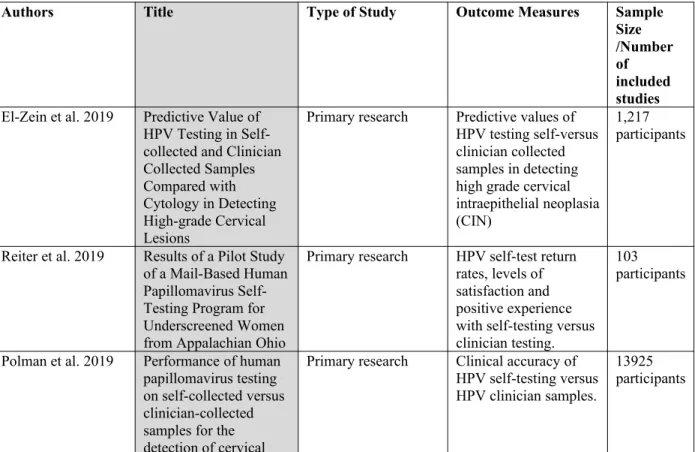
Table 1: Included Primary Research Studies and Systematic Reviews
Authors Title Type of Study Outcome Measures Sample
Size /Number of included studies
El-Zein et al. 2019 Predictive Value of HPV Testing in Self-collected and Clinician Collected Samples Compared with Cytology in Detecting High-grade Cervical Lesions
Primary research Predictive values of HPV testing self-versus clinician collected samples in detecting high grade cervical intraepithelial neoplasia (CIN)
1,217 participants
Reiter et al. 2019 Results of a Pilot Study of a Mail-Based Human Papillomavirus Self-Testing Program for Underscreened Women from Appalachian Ohio
Primary research HPV self-test return rates, levels of satisfaction and positive experience with self-testing versus clinician testing.
103 participants
Polman et al. 2019 Performance of human papillomavirus testing on self-collected versus clinician-collected samples for the detection of cervical
Primary research Clinical accuracy of HPV self-testing versus HPV clinician samples.
intraepithelial neoplasia of grade 2 or worse: a randomized, paired screen-positive, non-inferiority trial
Yeh et al. 2019 Self-Sampling for HPV testing: a systematic review and meta-analysis
Systematic Review Screening uptake, screening frequency, and linkage to treatment of hrHPV versus clinician collected HPV testing/cytology. 33 studies with 369,017 participants
Morgan et al. 2019 Acceptability of Women Self-Sampling versus Clinician-Collected Samples for HPV DNA Testing: A systematic review.
Systematic Review Acceptability of self-sampling HPV DNA testing versus clinician collected sampling.
23 articles
Arbyn et al. 2014 Accuracy of human papillomavirus testing on self-collected versus clinician-collected samples: a meta-analysis
Systematic Review
and meta-analysis Accuracy of self-collected HPV samples versus clinician collected HPV samples
36 studies with 154,556 participants Results Accuracy
When evaluating self-collection of vaginal samples for HPV testing it is important to know if the
testing is accurate. Specifically, are self-collected samples comparable in sensitivity and
specificity to clinician-collected samples. Two of the primary research articles and one of the
systematic reviews in this study attempted to answer this question. In the study by El Zein et al,
they compared the predictive values of HPV testing (self vs clinician collected) to cytology when
detecting CIN13. This study included women, 16-70 years old between June 2015 and April 2016,
already referred for colposcopy. At their colposcopy appointment, a sample was taken by the
clinician and the patient themselves took a self-sample. These samples were evaluated for hrHPV
strains using DNA amplification by PCR13. These results were also compared to the reference
self-collected vs clinician collected samples13. See Table 2a below for abbreviated results and
Table 2b in the appendix for full results.
Table 2a: Characteristics of the overall study population (n=1,217) by recruitment site
Clinic A n=392
N (%) Clinic B n=643N (%) Clinic C n=182N (%)
hrHPV Positivity Self Swab
194 (51.7) 298 (47.5) 68 (38.0)
hrHPV positivity
Physician sample 196 (52.6) 299 (48.0) 59 (33.9)
(El-Zein et al., 2019)
When looking at positive and negative predictive values of HPV by genotype, the results when
comparing self vs physician collected samples were again similar.
Table 3: Predictive values of HPV genotyping and cytology in detecting disease
Disease Definition of
positive PPV %HerSwab PPV% Physician NPV% HerSwab NPV%Physician
CIN2+ HPV16 47.1 46.7 90.3 90.3
HPV18 21.7 19.0 85 84.7
Any hrHPV 28 29.7 96.4 97.8
Cytology ASCUS
NA 26.6 NA 94.7
Cytology LSIL NA 31.3 NA 92.4
CIN3+ HPV 16 26.3 26.5 95.7 95.8
HPV 18 13.0 14.3 92.7 92.7
Any hrHPV 15.0 14.9 99.4 99.2
Cytology
ASCUS NA 13.2 NA 98.3
Cytology LSIL NA 15.9 NA 97.1
(El-Zein et al, 2019)
Polman et al. conducted a randomized, non-inferiority trial in the Netherlands asking similar
questions about the accuracy of HPV self-collecting16. It was conducted with women 29-61 years
old randomly allocated to self-sampling or clinician sampling groups. All samples were tested
for hrHPV using DNA amplification with PCR. Seven-point four percent (7.4%) of self-collected
0.92-1.17)16. Very little difference was found between self or clinician sampling regarding
CIN2+ sensitivity or specificity16. See Table 4 below for results.
Table 4: Clinical performance of self-sampling compared with clinician-based sampling
% (95% CI) Relative accuracy (95% CI)
CIN2 or worse
Self-Sampling Sensitivity 93.1 (88.1-98) 0.97 (0.91-1.03)
Clinician Sensitivity 96.3 (93.0-99.7)
Self-Sampling Specificity 94 (93.5-94.6) 1.00 (0.99-1.01)
Clinician Specificity 94.3 (93.7-94.9)
CIN3 or worse
Self-Sampling Sensitivity 95.2 (89.1-100) 0.99 (0.92-1.07)
Clinician Sensitivity 95.8 (91.3-100)
Self-Sampling Specificity 93.5 (93.0-94.1) 1.00 (0.99-1.01)
Clinician Specificity 93.5 (93.0-94.2)
(Polman et al. 2019)
This study was one of the first RCTs to show non-inferiority of HPV self-sampling when using
PCR based methods of HPV testing. Non-inferiority of HPV self-testing when compared with
clinician testing was found for the sensitivity of the test as well as the specificity of the test. A
relative specificity margin of 98% was noted for less than CIN2+ (adjusted p <0.001) and less
than CIN3(adjusted p<0.001). A relative sensitivity margin of 90% was noted for CIN2+
(adjusted p=0.0162) and CIN3+ (adjusted p=0.0064)16.
The review by Arbyn et al set out to answer the same question- how clinically accurate is HPV
testing on self-samples when detecting high grade CIN or invasive cancer32. Thirty-six studies
were included in this systematic review and meta-analysis. (See Table 5 in the appendix for
study quality and risk of bias.) The sensitivity of HPV testing in self samples ranged greatly in
studies between 51% and 93% for CIN2+32 and between 63% and 94% for CIN3+32. The
specificity for excluding CIN2+ was between 67% and 93%32. The heterogeneity of the study
results could be in part due to interstudy differences including type of HPV testing run and type
emerges. Tests run on self-samples with PCR showed significantly higher sensitivity than other
testing types32. See Table 6 below for differences in sensitivity/specificity between test types.
Table 6: Relative sensitivity and specificity by self-testing hrHPV test type
Test Type Relative Sensitivity Relative Specificity
HC2 Brush (non-PCR) 0.89 (0.89-0.98) 0.97 (0.96-0.99)
HC2 Lavage (non-PCR) 0.82 (0.65-1.02) 0.68 (0.35-1.33)
HC2 Swab (non-PCR) 0.82 (0.86-0.90) 0.95 (0.89-1.01)
HC2 Tampon (non-PCR) 0.71 (0.62-0.83) 1.01 (1.00-1.02)
GP5/6 PCR Brush 0.95 (0.86-1.04) 1.08 (0.93-1.25)
GP5/6 PCR Lavage 0.95 (0.85-1.06) 1.23 (0.74-2.05)
Abbott Real Time hrHPV
test (PCR) Lavage 1.00 (0.75-1.34) 1.07 (0.65-1.78)
(Arbyn et al, 2014)
Overall, Arbyn et al concluded that the sensitivity and specificity of self-samples was lower for
the detection of CIN than those of clinician-based samples with one caveat. When using PCR
based assays, the sensitivity and specificity was similar in self and clinician collected samples32.
Acceptability
If self-collected samples for HPV testing are clinically accurate, the next question to ask is if this
type of self-testing is acceptable to women. One of the primary research studies and two of the
systematic reviews included in this study attempt to answer this question of acceptability.
Reiter et al conducted a study in 2015/2016 in Ohio regarding screening uptake of women when
mailed self-testing kits14. Women in this study were eligible if they were 30-65 years old, had no
Pap test done in the last 3 years, no history of invasive cervical cancer, hysterectomy, or
pregnancy in the last 3 months14. Kits returned were tested with DNA amplification via PCR and
women during this process and logistic regression models were used to compare study arms and
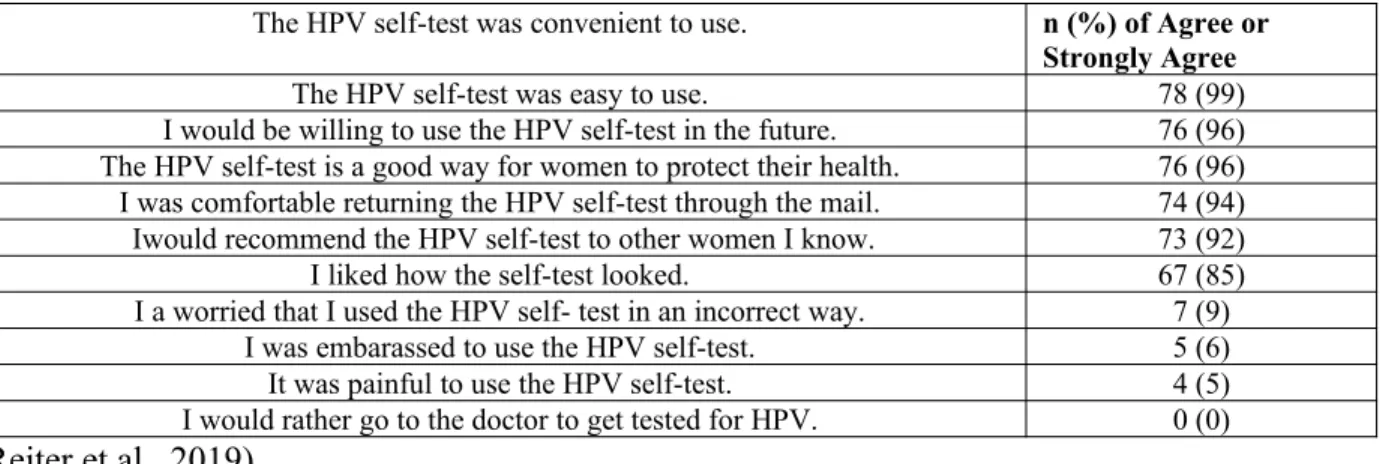
outcomes14. Patient responses to surveys are in Table 7 below.
Table 7: Women’s Satisfaction and Experiences with HPV Self-Testing (n=79)
The HPV self-test was convenient to use. n (%) of Agree or
Strongly Agree
The HPV self-test was easy to use. 78 (99)
I would be willing to use the HPV self-test in the future. 76 (96)
The HPV self-test is a good way for women to protect their health. 76 (96)
I was comfortable returning the HPV self-test through the mail. 74 (94)
Iwould recommend the HPV self-test to other women I know. 73 (92)
I liked how the self-test looked. 67 (85)
I a worried that I used the HPV self- test in an incorrect way. 7 (9)
I was embarassed to use the HPV self-test. 5 (6)
It was painful to use the HPV self-test. 4 (5)
I would rather go to the doctor to get tested for HPV. 0 (0)
(Reiter et al., 2019)
Overall, women that did return their test said the process was convenient and that they had a
positive experience with self-testing. Women who did not return their test either forgot or were
concerned they would self-test incorrectly14. This study suggested that as 80% of the participants
returned their HPV self-test in a low screening uptake area, self-sampling is a promising way to
reach under-screened women14.
A systematic review and meta-analysis by Yeh et al in 2019 evaluated, among other things, the
uptake, frequency and link to treatment of patients when using HPV self-sampling17. This
review included women 30-60 years old and compared HPV self-sampling and a comparison
with risk of bias deemed generally low. (See tables 8 and 9 in the appendix for risk of bias
evaluations for the included studies in this systematic review.)
While this review had marked heterogeneity, women were found to be twice as likely to be
screened if they used self-sampling when compared to standard of care screening (RR: 2.13, 95%
CI 1.89-2.40, I-squared: 99.34)17. One study in Finland showed that sending a test kit to a
patient’s home, something called “opt-out testing”, increased patient uptake even further17. “Opt
out testing” being any test sent directly to the patient with their only choice being to “opt-out”
versus having to “opt-in” to a test by traveling to an office of reaching out to contact a provider.
This type of opt-out testing was universally more successful in screening uptake when compared
to control, with women being over two times more likely to participate in screening (RR: 2.37,
95% CI 1.12 to 5.03, I-squared: 99.72)17. One study from the review showed medically
underserved women responded more to an offer of a self-sampling kit than to a free Pap test with
a clinician17. Increased uptake was shown regardless of setting (rural vs urban) or socioeconomic
status17. There was a slightly higher impact on uptake in older women verses younger women
(RR:2.25, 95% CI1.44-3.50, I-squared 99.18)17 as well as high uptake among self-samplers that
were supervised (RR: 2.21, 95% CI 1.80-2.73, I-squared: 99.10)17. Despite the heterogeneity
across studies, likely due to different countries, testing strategies, and differing controls; this
review concludes that hrHPV self-sampling methods increased uptake of screening17. Opt-out
methods were especially successful at increasing screening uptake17. (See Table 10 in the
appendix for AMSTAR2 critical appraisal of this systematic review.)
Another systematic review by Morgan et al in 2019 set out to gauge the acceptability of HPV
self-sampling as a screening modality for cervical cancer when compared with clinician collected
samples18. Twenty-three articles were chosen for this review; nineteen cross sectional and four
measure of these studies was “acceptability” and there was no consensus. Eleven studies found
self-sampling more acceptable, one study found both methods equally acceptable and two studies
could not differentiate between methods18. The remaining nine studies found clinician collected
samples preferred by women18. When broken down into influencing demographics, the only two
groups that showed higher preference for self-sampling were those that had attained higher
education and non-Hispanic whites18. A study in Mexico indicated that increased income is
positively associated with increased preference for self-sampling. Women who had a history of
increased sexual partners and STIs also saw self-sampling as more acceptable18.When surveyed
about why self-sampling was preferred, women described it as easier to perform, less painful,
more private, and less embarrassing than clinician-collected samples18. Women who had
preferred clinician collected samples reported a lack of confidence that they were completing the
sampling correctly or that they did not want to lose the professional gynecological exam that
accompanies the clinician-collected sample18. This study showed a great degree of variability
mostly because studies were conducted across different ethnic, racial, and country lines. These
studies were split, with a small preference towards self-sampling, especially in higher income,
more educated women.
Follow up
If self-sampling is an accurate and acceptable form of cervical cancer screening, does it
encourage follow up care? This question becomes increasingly important when one considers
that the self-sampling is the beginning of the screening process for some of these women.
Women with positive hrHPV results should follow up with clinicians for more testing or
treatment. One study and one systematic review included in this paper touched on the subject of
follow up14,17. Reiter et al discouragingly reported that the positive experience women had with
treatment if indicated14. Yeh et al contained six studies that commented on the link to treatment
after self-sampling. Here again, no difference was shown after meta-analysis between the rate of
follow up care in self-screened women versus standard of care women17. Lower income countries
showed lower rates of follow-up care (RR 0.66, 95% CI 0.43-1.00)17 when compared to their
higher income country counterparts (RR: 0.94, 95% CI 0.78-1.14, I-squared 86.03)17. As
expected, countries with organized programs for screening showed higher rates of follow-up
compared to those with less organized screening programs17. Both the study and review
recommended that further research be done on women’s experiences with self-sampling and how
to encourage follow-up care post screening.
Discussion Accuracy
Elzein et al and Polman et al both found that self-testing and clinician-testing were similar in
sensitivity and specificity for hrHPV testing13,16. El Zein et al found particularly high value in the
negative predictive value of self-testing hrHPV13. This points to self-testing as an excellent
option to rule out a patient having hrHPV. At first glance, the Arbyn et al review discouragingly
concludes that self-collected samples are less specific and sensitive when compared to
clinician-collected samples for hrHPV testing32. This review was comparing multiple different types of
hrHPV tests, which explains a great deal of heterogeneity in the study. One of the tests achieved
signal amplification via microplate chemiluminescence, another signal amplification via “signal
to noise value” and still others that were PCR-based32.33.34. When using PCR based methods of
testing, which Arbyn et al called “more analytically sensitive”32 the sensitivity and specificity of
self-sampling was closer to that of physician collected. (Of note, both El Zein et al and Polman et
out that hrHPV self-sampling was equally as sensitive as cytology when detecting CIN3+, but
less sensitive when detecting anything below CIN332. Here again, this points to using
self-sampling as a reliably accurate test to “rule out” high grade cervical lesions. Limitations of these
studies include heterogeneity due to interstudy differences in testing strategies and controls32.
There is also some risk with the El Zein study of population bias as the women in the study had
already been referred for colposcopy and therefore the predictive values could be influenced by
the high disease prevalence when compared to the general population13.
Acceptability
On the topic of acceptability, Reiter et al, while limited by its small sample size, found that the
majority of women in their study found self-testing easy to use and that they would use it again
in the future14. This study also showed that in an underserved and under screened area of the
country, 80% of women in this study returned their test kits14; making this seem a viable option
to screen underserved women. The women that had concerns surround self-testing worried about
user error and that they would somehow complete the testing incorrectly. Yeh et al’s review,
while having high heterogeneity due to interstudy differences in methods, testing and controls;
still found that women were twice as likely to choose self-sampling over clinician-collected
sampling if given the choice17. Of specific note was that “opt out” testing was even more
successful and over doubled screening uptake 17. Morgan et al’s study showed no real consensus
of acceptability of testing. It did comment on the fact that while there was a large amount of
variability between studies, there was an increase in acceptability of self-sampling in women
with higher incomes and higher education18. Women across the study did like the experience of
the test. They also reported they did not want to lose the professional gynecological exam that
would come with the clinician collected sample18.
These papers suggest that self-sampling hrHPV testing could be particularly effective at reaching
underserved and under screened women and that “opt-out” methods of testing, such as mailing a
kit directly to a home, are especially effective at increasing uptake. They also strongly suggest
that more education is needed surrounding screening for cervical cancer. If women knew how
the tests worked and what it was testing for, they may be less worried about completing the test
incorrectly. If women understood that this test is a method of screening and that it does not
replace the care of a primary care provider or OB/GYN, they may be less worried about missing
out on a gynecological exam. Women engaging in this type of screening must be educated on the
fact that follow up after screening is an important part of the process.
Follow up
As stated above, one of the most important parts of cervical cancer screening is follow up. We
can increase uptake of screening but without follow up, are still not treating these women
effectively. Both Reiter et al and Yeh et al found no correlation between positive experiences
with self-testing and follow up. Countries with organized screening programs for cervical cancer
did have higher rates of follow up among women in these studies. Here again, we see a need for
increased education on the importance of follow up care after screening. Both Reiter and Yeh
emphasized that more work needs to be done on how to encourage this care.
Conclusion
Overall, self-sampling appears to be an accurate method of testing for hrHPV in women. This
becomes especially accurate when using it as “rule out” method due to its high negative
point to the acceptability of self-testing among women. This acceptability could be improved
with increased education on cervical cancer, HPV and how testing for hrHPV works. Possibly
most importantly, this review showed that women who use self-testing still were not more likely
to seek follow-up care. More education should be done to inform women of how important
follow-up care is when concerning cancer screening and that self-testing is not a replacement for
a visit to their primary care provider or gynecologist. More research is most definitely needed
surrounding accuracy of self-testing methods and how to encourage follow up care.
Table 2b: El Zein et al Study: Characteristics of the overall study population (n=1,217) by recruitment site
Clinic A n=392 N (%)
Clinic B n=643 N (%)
Clinic C n=182 N (%)
35 years old or younger
221 (56.4) 281 (56.4) 85 (46.7)
Over 35 years old 171 (43.6) 362 (56.3) 97 (53.3)
NILM 201 (51.3) 249 (38.7) 100 (55)
ASC-US 82 (20.9) 87 (13.5) 21 (11.5)
LSIL 51 (13) 131 (20.4) 32 (17.6)
HSIL 24 (6.1) 63 (9.8) 9 (5.0)
ACG 1 (0.3) 4 (0.6) 3 (1.7)
Cancer 1 (0.3) 8 (1.2) 0 (0)
Missing 9 (2.3) 64 (10) 7 (3.9)
hrHPV Positivity Self Swab
194 (51.7) 298 (47.5) 68 (38.0)
hrHPV positivity Physician sample
196 (52.6) 299 (48.0) 59 (33.9)
(El-Zein et al., 2019)
Table 5: Arbyn et al Systematic Review: Included studies and risk of bias
Study Authors, year published
ROB: Patient Selection ROB: Index and comparator test
ROB: Reference Test
Morrison et al, 1992 Moderate Moderate Low
Hillemanns et al, 1999 Moderate Moderate Low
Sellors et al, 2000 Low Low Low
Wright et al, 2001 Moderate Low Low
Belinson et al, 2001 Low Low Low
Lorenzato et al, 2002 Low Low Low
Nobbenhuis et al, 2002 Low Moderate Low
Garcia et al, 2003 Low Low Low
Brink, 2006 Moderate Low Low
Daponte et al, 2006 Low Moderate Low
Girianelli et al, 2006 Moderate Low Low
Holanda et al, 2006 Moderate Low Low
Seo et al, 2006 Moderate Low Low
Szarewski et al, 2007 Low Low Low
Qiao et al, 2008 Low Low Low
Bhatla et al, 2009 Low Low Low
Balasubra et al, 2010 Low Low Low
Gustavsson et al,2011 Moderate Moderate Low
Lazcano-P, 2011 Low Low Low
Taylor et al, 2011 Low Low Low
Twu et al, 2011 Moderate Low Low
Wikstrom et all, 2011 Low Low Low
Belinson et al, 2012 Moderate Low Low
Dijkstra et al, 2012 Moderate Low Low
Longatto-F et al, 2012 Low Low Moderate
Van Baars et al, 2012 Moderate Moderate High
Zhao et al, 2012 Low Low Low
Darlin et al 2013 Moderate Moderate Low
Geraets et al, 2013 Low Moderate Low
Guan et al, 2013 High Moderate Low
Jentschke et al, 2013a Moderate Moderate Low
Jentschke et al, 2013b Moderate Low Low
Nieves et al, 2013 Low Low Moderate
Table 8: Quality assessment using Cochrane risk of bias tool of included studies (RCTs) in Yeh et al Systematic Review
Type of Bias
Selection Performance Detection Attrition Reporting
Author Year Random Sequence generation Allocation concealment Blinding of participants and personnel Blinding of outcome assessment Incomplete outcome data Selective reporting
Arrossi et al
2015 Medium Low Low Low Low Low
Bais et al 2007
Low Medium Low Low Low Low
Broberg et
al 2014 Medium Medium Low Low Low Low
Cadman et al 2015
Low Low Low Low Low Low
Carrasquillo
et al 2018 Low Low Low Low Low Low
Darlin et al
2013 Medium Medium Low Low Low Medium
Giorgi Rossi et al 2011
Low Low Low Low Low Low
Giorgi Rossi
et al 2015 Low Low Low Low Low Low
Gok et al 2010
Low Medium Low Low Low Low
Got et al
2012 Low Medium Low Low Low Medium
Gustavsson
et al 2018 Low Low Low Low Low Low
Haguenoer et al 2014
Low Low Low Low Low Low
Ivanus et al
2018 Low Low Low Low Low Low
Kellen etal 2018
Low High Low Low Low Low
Lazcano-Ponce et al 2011
Medium Low Low Low Low Medium
Modibbo et al 2017
High Medium Low Low Low Medium
Moses et al
2015 Low Low Low Low Medium Low
Murphy et
al 2016 Low Low Low Low Low Low
Piana et al
2011 Low Medium Low Low Medium High
Racey et al
2016 Low Low Low Low Medium Low
Sancho-Garnier et al 2013
Medium Medium Low Low Low Medium
Sewali et al
2015 Low Low Low Low Low Low
Sultana et al 2016
Low Low Low Low Low Medium
al 2011 Tranberg et al 2018
Low Low Low Low Low Low
Tranberg et al 2018 subanalysis
Low Low Low Low Low Low
Virtanen et
al 2011 Low Medium Low Low Low Low
Viviano et al
2017 Low Low Low Low Low Low
Wikstrom et al 2011
Medium Medium Low Low Low Low
Zehbe et al
2016 Medium Medium Low Low Medium Medium
(Yeh PT, et al. 2019)
Table 9: Quality assessment of included studies (non-RCTs) in Yeh et al Systematic Review
Auth or, year Pre and Postinterve ntion data included Control or compari son group Coh ort stud y desig n Sociodemogr aphic baseline equivalent Outco me measu res Rando m assignm ent Particip ants randoml y selected for assessme nt Control for potential confoun ders Follo w up 75% or great er? Castle et al 2011
No Yes No No Not
reporte d
No Yes No Yes
Duek et all 2015
Yes Yes No Yes Yes No Yes Yes Yes
Lam et al 2017
No Yes Yes Yes Yes Yes Yes No Yes
Virta nen et al 2015
Yes Yes Yes Yes Not
reporte d
Yes No Yes No
(Yeh PT, et al. 2019)
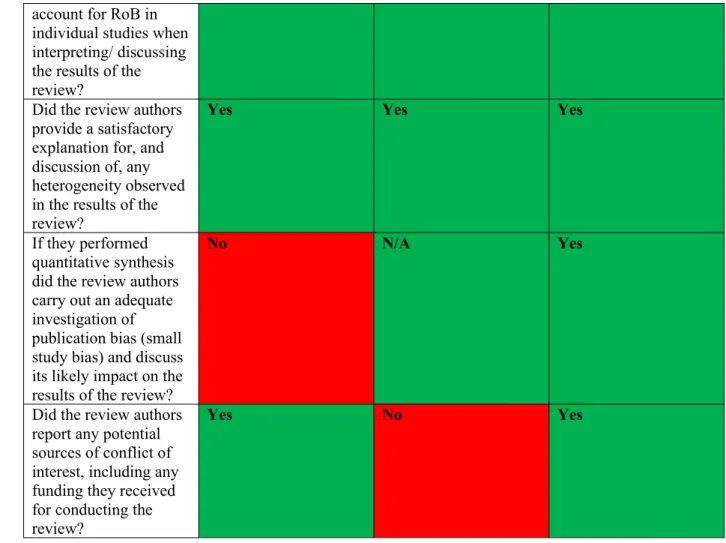
Table 10: AMSTAR219 Critical Appraisal of Systematic Reviews Included in this Paper
Yeh et al. 2019 Morgan et al 2019 Arbyn et al. 2014
Did the research questions and inclusion criteria for the review include the components of PICO?
Yes Yes Yes
Did the report of the review contain an explicit statement that the review methods were established prior to the conduct of the
review and did the report justify any significant deviations from the protocol? Did the review authors explain their selection of the study designs for inclusion in the review?
Yes Yes Yes
Did the review authors use a comprehensive literature search strategy?
Yes Yes Yes
Did the review authors perform study selection in duplicate?
Yes Yes Unclear
Did the review authors perform data extraction in duplicate?
Yes Yes Unclear
Did the review authors provide a list of excluded studies and justify the exclusions?
No No Yes
Did the review authors describe the included studies in adequate detail?
Yes Partial Yes Yes
Did the review authors use a satisfactory technique for assessing the risk of bias (RoB) in individual studies that were included in the review?
Yes Yes Yes
Did the review authors report on the sources of funding for the studies included in the review?
Yes Yes Yes
If meta-analysis was performed did the review authors use appropriate methods for statistical combination of results?
Yes N/A Yes
If meta-analysis was performed, did the review authors assess the potential impact of RoB in individual studies on the results of the meta-analysis or other evidence synthesis?
Yes N/A Yes
account for RoB in individual studies when interpreting/ discussing the results of the review?
Did the review authors provide a satisfactory explanation for, and discussion of, any heterogeneity observed in the results of the review?
Yes Yes Yes
If they performed quantitative synthesis did the review authors carry out an adequate investigation of publication bias (small study bias) and discuss its likely impact on the results of the review?
No N/A Yes
Did the review authors report any potential sources of conflict of interest, including any funding they received for conducting the review?
Yes No Yes
Table 11: Evidence Available from Studies Included in the Systematic Review by Morgan et al.
Author Test Method Home or Clinic Acceptability Experience Khanna et al. 2007 Cervical brush Clinic 79.8% prefer self
collection
Berner et al. 2013 Flocker swab Clinic 59% believe physician sampling was more reliable.
82% Easy to perform. 84% not
embarrassing. Hx of Pap smear associated with greater acceptability of self-collection.
Ortiz et al. 2012 Dacron swab and cytobrush
Clinic Majority acceptable self-collection
Not embarrassing. Less pain.
Dzuba et al. 2002 Dacron swab Clinic Majority acceptable self-collection
Clinician based more painful. Self-collect less embarrassing.
Waller et al. 2006 Cytobrush Clinic Majority acceptable
self-collection Lack of confidence thetest was done correctly.
Agorastos et al. 2005 Cytobrush Clinic 93% favor self
collection Self-collection less embarrassing.
Anhang et al. 2005 Dacron Swab Clinic 68% prefer clinician
Castle et al. 2011 Kit with collection device
Home 64.7% prefer self-collection.
Flores et al 2003 Not mentioned Clinic 68% prefer self-collection.
Less pain, discomfort, embarrassment and more privacy with self-collection.
Guan et al. 2012 Cervical brush Clinic 74% preferred clinician collected.
Lack of confidence the test was done correctly.
Kahn et al. 2004 BBL culture swab Clinic Majority preferred clinician collected
Lack of confidence in one’s ability to collect a sample.
Karwalajtys et al.
2006 Dacron swab Clinic 46-47% preferred self-collection
Oranratanaphan et al. 2014
Self-sampling kit Clinic Acceptability quite good. Reliability questioned.
Easy to use, less painful, less embarrassing.
Quincy et al. 2012 Self-collection
brushes and swab. Clinic Self-sampling highly acceptable. No pain, less embarrassment. Comfortable more privacy.
Rosenbaum et al.
2014 Self-sampling device Clinic Majority preferred self-collection Easy to use, o pain, nodiscomfort, no embarrassment
Szarewskji et al. 2007
Cotton swab Clinic 73% preferred self-collection.
Instruments easy to understand.
Racey et al. 2015 Dacron swab Home 89.7% preferred
self-collection 90% likely to use self-collected HPV testing in the future.
Wong et al. 2016 Self-sampling kit Clinic Both methods equally acceptable.
Less anxiety, discomfort, embarrassment, an pain with self-sampling.
Winer et al. 2016 Self-sampling kit Clinic 62% preferred self-collection
Easy to collect and no discomfort.
Szarweski et al. 2009 Kit Majority preferred clinician collected
Fear of not doing the test correctly.
Bansil et al. 2014 Not mentioned Majority preferred self-collection.
Easy to collect.
Peneranda et al. 2014 Kit Positive attitude
towards self-collection Ease, convenience, less embarrassment. Fear of not doing the test properly.
Barata et al. 2008 Tampon or swab Less discomfort, fear of injuring themselves or not completing properly. (Morgan et al. 2019)
Table 12: Cochrane Risk of Bias Evaluation for included studies
El-Zein et al.,
2019 Reiter et al. 2019 Polman et al.2019
Random sequence generation Unclear Low risk Low risk
Allocation concealment Unclear Low risk Low risk
Blinding of participants and
personnel Low risk Low risk High risk
Blinding of outcomes
assessment Low risk Low risk High risk
Selective reporting Unclear Unclear Unclear
Other bias Low risk Low risk Low risk
Table 13: QUADAS-2 Tool for the Quality Assessment of Diagnostic Accuracy Studies
El-Zein et al. 2019 Polman et al. 2019
Patient Selection
Risk of Bias Low Low
Applicability Concerns
High Low
Index Tests
Risk of Bias Low Low
Applicability Concerns
Low Low
Reference Standards
Risk of Bias Low Low
Applicability Concerns
Low Low
Flow and Timing
Risk of Bias Low Unclear
Table 14: Abbreviations Associated with Cervical Cancer and Screening
ACG Atypical glandular cells
AGUS Atypical glandular cells of undetermined significance
ACIS Endocervical adenocarcinoma in situ
ASC-H Atypical squamous cells-cannot exclude HSIL
ASC-US Atypical squamous cells of undetermined significance
CIN Cervical intraepithelial neoplasia
CIS Carcinoma in situ
ECC Endocervical curettage
HPV Human papillomavirus
hrHPV High-risk human papillomavirus
HSIL High grade squamous intraepithelial lesion
ICC Invasive Cervical Cancer
LCB Liquid based cytology
LEEP Loop electrosurgical excision procedure
LSIL Low grade squamous intraepithelial lesion
PCR Polymerase chain reaction
SCC Squamous cell carcinoma
References
1.
What Is Cervical Cancer? https://www.cancer.org/cancer/cervical-cancer/about/what-is-cervical-cancer.html. Accessed June 3, 2019.2.
Transformation Zone of the Cervix.https://myhealth.alberta.ca/Health/pages/conditions.aspx?hwid=stt11635&. Accessed June 3, 2019.
3.
Definition of endocervix - NCI Dictionary of Cancer Terms - National Cancer Institute. (n.d.). Retrieved from https://www.cancer.gov/publications/dictionaries/cancer-terms/def/ endocervix4.
CDC - Cervical Cancer Epidemiology in the U.S. - Gynecologic Cancer Curriculum - Inside Knowledge Campaign. https://www.cdc.gov/cancer/knowledge/provider-education/cervical/epidemiology.htm. Accessed June 3, 2019.5.
Key Statistics for Cervical Cancer. https://www.cancer.org/cancer/cervical-cancer/about/ key-statistics.html. Accessed June 3, 2019.6.
Melnikow J, Henderson JT, Burda BU, Senger CA, Durbin S, Weyrich MS. Screening for Cervical Cancer With High-Risk Human Papillomavirus Testing: Updated Evidence Report and Systematic Review for the US Preventive Services Task Force. JAMA. 2018;320(7):687-705. doi:10.1001/jama.2018.104007.
Abnormal Cervical Cancer Screening Test Results - ACOG.https://www.acog.org/Patients/FAQs/Abnormal-Cervical-Cancer-Screening-Test-Results?IsMobileSet=false. Accessed June 3, 2019.
8.
Cervical Cancer: Practice Essentials, Background, Pathophysiology.9.
Practice Advisory: Cervical Cancer Screening (Update) - ACOG. https://www.acog.org/ Clinical-Guidance-and-Publications/Practice-Advisories/Practice-Advisory-Cervical-Cancer-Screening-Update?IsMobileSet=false. Accessed June 10, 2019.10.
Final Update Summary: Cervical Cancer: Screening - US Preventive Services Task Force. (WWW Document).https://www.uspreventiveservicestaskforce.org/Page/Document/UpdateSummaryFinal/ cervical-cancer-screening.
11.
Flanagan MB. Primary High-Risk Human Papillomavirus Testing for Cervical Cancer Screening in the United States: Is It Time? Arch Pathol Lab Med. 2018;142(6):688-692. doi:10.5858/arpa.2018-0001-RA12.
HPV primary cervical screening pilot report published in BMJ - PHE Screening. https://phescreening.blog.gov.uk/2019/02/12/hpv-primary-cervical-screening-pilot-report-published-in-bmj/. Accessed June 10, 2019.13.
El-Zein M, Bouten S, Louvanto K, et al. Predictive Value of HPV Testing in Self-collected and Clinician-Collected Samples Compared with Cytology in Detecting High-grade Cervical Lesions. Cancer Epidemiol Biomarkers Prev. 2019;28(7):1134-1140. doi:10.1158/1055-9965.EPI-18-133814.
Reiter PL, Shoben AB, McDonough D, et al. Results of a Pilot Study of a Mail-Based Human Papillomavirus Self-Testing Program for Underscreened Women From Appalachian Ohio. Sex Transm Dis. 2019;46(3):185-190.doi:10.1097/OLQ.0000000000000944
15.
El-Zein M, Bouten S, Louvanto K, et al. Validation of a new HPV self-sampling device for cervical cancer screening: The Cervical and Self-Sample In Screening (CASSIS) study. Gynecol Oncol. 2018;149(3):491-497. doi:10.1016/j.ygyno.2018.04.00416.
Polman NJ, Ebisch RMF, Heideman DAM, et al. Performance of human papillomavirus testing on self-collected versus clinician-collected samples for the detection of cervical intraepithelial neoplasia of grade 2 or worse: a randomised, paired screen-positive, non-inferiority trial. Lancet Oncol. 2019;20(2):229-238. doi:10.1016/S1470-2045(18)30763-017.
Yeh PT, Kennedy CE, de Vuyst H, Narasimhan M. Self-sampling for humanpapillomavirus (HPV) testing: a systematic review and meta-analysis. BMJ Glob Health. 2019;4(3):e001351. doi:10.1136/bmjgh-2018-001351
18.
Morgan K, Azzani M, Khaing SL, Wong Y-L, Su TT. Acceptability of Women Self-Sampling versus Clinician-Collected Samples for HPV DNA Testing: A Systematic Review. J Low Genit Tract Dis. 2019;23(3):193-199.doi:10.1097/LGT.0000000000000476
19.
Shea BJ, Reeves BC, Wells G, et al. AMSTAR 2: a critical appraisal tool for systematic reviews that include randomised or non-randomised studies of healthcare interventions, or both. BMJ. 2017;358:j4008. doi:10.1136/bmj.j400820.
Gupta S, Palmer C, Bik EM, et al. Self-Sampling for Human Papillomavirus Testing: Increased Cervical Cancer Screening Participation and Incorporation in International Screening Programs. Front Public Health. 2018;6:77. doi:10.3389/fpubh.2018.0007722.
Flanagan MB. Primary High-Risk Human Papillomavirus Testing for Cervical Cancer Screening in the United States: Is It Time? Arch Pathol Lab Med. 2018;142(6):688-692. doi:10.5858/arpa.2018-0001-RA23.
Madzima TR, Vahabi M, Lofters A. Emerging role of HPV self-sampling in cervical cancer screening for hard-to-reach women: Focused literature review. Can Fam Physician. 2017;63(8):597-601.24.
“HPV Self Sampling.” (n.d.). Retrieved July 14, 2019, fromhttp://www.cuhk.edu.hk/sphpc/hpvselfsampling/en/self-samping.html
25.
What is PCR (polymerase chain reaction)? | Facts | yourgenome.org.https://www.yourgenome.org/facts/what-is-pcr-polymerase-chain-reaction. Accessed October 11, 2019.
26.
Centers for Disease Control and Prevention (CDC). FDA licensure of bivalent human papillomavirus vaccine (HPV2, Cervarix) for use in females and updated HPVvaccination recommendations from the Advisory Committee on Immunization Practices (ACIP). MMWR Morb Mortal Wkly Rep. 2010;59(20):626-629.
27.
Types of Human Papillomavirus | NYU Langone Health.https://nyulangone.org/conditions/human-papillomavirus-in-adults/types. Accessed August 18, 2019.
28.
Definition of Pap smear - NCI Dictionary of Cancer Terms - National Cancer Institute. https://www.cancer.gov/publications/dictionaries/cancer-terms/def/pap-smear. Accessed August 18, 2019.29.
Sprenger E, Schwarzmann P, Kirkpatrick M, et al. The false negative rate in cervical cytology. Comparison of monolayers to conventional smears. Acta Cytol. 1996;40(1):81-89. doi:10.1159/00033358830.
Pap Smear vs. HPV Screening Tests for Cervical Cancer. American Family Physician. June 2008.31.
Arbyn M, Verdoodt F, Snijders PJF, et al. Accuracy of human papillomavirus testing on self-collected versus clinician-collected samples: a meta-analysis. Lancet Oncol.2014;15(2):172-183. doi:10.1016/S1470-2045(13)70570-9
32.
Reliable HPV detection with HC2 technology - QIAGEN.https://www.qiagen.com/at/resources/knowledge-area/hpv-row/principle%20of %20hc2%20technology/. Accessed August 25, 2019.
33.
Boers A, Slagter-Menkema L, van Hemel BM, et al. Comparing the Cervista HPV HR test and Hybrid Capture 2 assay in a Dutch screening population: improved specificity of the Cervista HPV HR test by changing the cut-off. PLoS ONE. 2014;9(7):e101930. doi:10.1371/journal.pone.010193034.
Cervical Cancer Causes, Diagnosis and Symptoms : NCCC. https://www.nccc-online.org/ hpvcervical-cancer/cervical-cancer-overview/. Accessed October 4, 2019.35.
Mayrand M-H, Duarte-Franco E, Rodrigues I, et al. Human papillomavirus DNA versus Papanicolaou screening tests for cervical cancer. N Engl J Med. 2007;357(16):1579-1588. doi:10.1056/NEJMoa07143036.
Koliopoulos G, Nyaga VN, Santesso N, et al. Cytology versus HPV testing for cervical cancer screening in the general population. Cochrane Database Syst Rev.2017;8:CD008587. doi:10.1002/14651858.CD008587.pub2