BEHAVIORAL AND MONOAMINERGIC RESPONSES TO THE SOCIAL ENVIRONMENT THROUGHOUT THE LIFE OF A SONGBIRD (MELOSPIZA LINCOLNII)
Susan Michelle Lyons
A dissertation submitted to the faculty at the University of North Carolina at Chapel Hill in partial fulfillment of the requirements for the degree of Doctor of Philosophy in the Department
of Biology in the College of Arts and Sciences.
Chapel Hill 2016
© 2016
ABSTRACT
Susan Michelle Lyons: Behavioral and monoaminergic responses to the social environment throughout the life of a songbird (Melospiza lincolnii)
(Under the direction of Keith Sockman)
Individuals live in dynamic social environments and should benefit from integrating information about their environment and adjusting their behavior accordingly. Individuals could integrate information about the social environment through changes to neural pathways that are responsible for processing social signals. In this dissertation, I tested the hypothesis that variation in songs in the social environment influences both social behavior and the auditory system of songbirds. In a series of experiments, I exposed male and female Lincoln’s sparrows (Melospiza lincolnii)to songs with digitally manipulated trill performance, which is a measurement of the competitive quality and attractiveness of song. I found that exposure to high- compared to low-performance songs during development caused males to elevate their trill low-performance in
adulthood. This pattern suggests that males invest differently in their song performance based on the social environment that they experience during development. I also found that females that were exposed to high- compared to low- performance songs during adulthood were subsequently less attracted to novel songs. I hypothesized that the behavioral plasticity in males and females in response to trill performance in the social environment was regulated by neuroplasticity in brain regions responsible for processing songs. Central monoamines regulate experience-dependent
differed in trill performance. Exposure to high- compared to low-performance songs during development affected both dopaminergic and noradrenergic activity at different periods in the
male’s life. However, in a separate study I found that exposure to high- compared to low-performance songs in adulthood did not influence monoamines in the auditory telencephalon of
males, although it did decrease noradrenergic activity in the auditory telencephalon of females, suggesting that monoamines play different roles in sensory processing of adult males compared
to adult females. Together, the effects of the social environment on behavior and on
ACKNOWLEDGEMENTS
This work would not have been possible without the guidance and support of several people and institutions. I owe a debt of gratitude to my advisor, Keith Sockman. My education under his tutelage has been highly integrative. Keith taught me how to run an avian biology field station, how to conduct research in behavioral neuroendocrinology, how to design and deliver a compelling research talk, and perhaps most importantly for my career as a biologist, how to conduct a rigorously designed experiment. Thanks to Keith’s mentorship, I am a more confident and focused scientist than I could have imagined five years ago.
My committee has played a valuable role in my development as a scientist. Through coursework, casual conversation, and committee meetings, Sabrina Burmeister, John Godwin, Ken Lohmann, and Karin Pfennig taught me excellence in neurobiology and animal behavior. I thank them for their support and their valuable feedback. Thank you also to Ty Hedrick, Michael Beaulieu, Veronica Rodriguez, Samuel Caro, and to the several undergraduate students who helped me with lab work and fieldwork, including Laura Hamon, Riley Hurst, Katie Russell and Sam Lucier.
During my time at UNC, I developed amazing friendships and interacted with brilliant people. I am grateful for the support, friendship, patience and comic relief from Rob Aldredge, Heidi MacLean, Alice Drozdiak, Eric Earley, Kate Woodruff, Rob Woodruff, Nick Garcia, Jill Richardson Aldredge, Jessica Higgins, Chris Higgins, and Yuxiang Liu. I am lucky enough to have amazing parents and siblings. To Mom, Dad, JJ, Molly, and Katie, thank you for believing in me and for all of the years of advice and guidance. To my husband, Chris, having you by my side for the past five years has made the good parts of graduate school exceptional and has made the hard parts of graduate school manageable. Thank you for your love, patience,
TABLE OF CONTENTS
List of Tables ... xi
List of Figures ... xii
List of Abbreviations ... xiii
Chapter One: Introduction - Behavioral and monoaminergic responses to the social environment throughout the life of a songbird (Melospiza lincolnii) ... 1
Figure legend ... 7
References ... 8
Chapter Two: Signs of competition during development change the brain and competitive behavior of adult songbirds ... 12
Summary ... 12
Introduction ... 13
Methods ... 16
Developmental treatment songs ... 16
Experimental Procedure ... 17
Quantification of catecholamines, metabolites, and protein ... 19
Analysis ... 21
Results ... 23
Catecholamines in developing males ... 23
Song characteristics of adult males ... 23
Catecholamines in adult males ... 24
Discussion ... 25
Table and Figure Legends ... 32
References ... 42
Chapter Three: Fighting brawn with brains: selective improvement of song performance to contrast inferior components of competitor song ... 49
Summary ... 49
Introduction ... 49
Methods ... 52
Treatment Songs ... 52
Experiment methods ... 53
Analysis ... 54
Results ... 56
Effect of playback on aggressive behavior ... 56
Effect of playback on focal male song ... 57
Mechanism of song modulation in focal males ... 59
Discussion ... 59
Table and Figure Legends ... 65
References ... 74
Chapter Four: Contrast influences female attraction to performance-based sexual signals in a songbird ... 78
Summary ... 78
Introduction ... 79
Material and methods ... 80
Song exposure ... 80
Behavioural assay ... 81
Analyses ... 82
Figure Legends ... 85
References ... 88
Chapter Five: Female Lincoln’s sparrows (Melospiza lincolnii) show greater monoaminergic sensitivity to trill performance than males ... 90
Summary ... 90
Introduction ... 91
Methods ... 93
Animals and Housing ... 93
Song Treatments ... 94
Experimental Procedure ... 94
Quantification of Monoamines, Metabolites, and Protein ... 95
Analyses ... 97
Results ... 98
Discussion ... 100
Table and Figure Legends ... 107
References ... 112
Chapter Six: Conclusions ... 118
References ... 124
Appendix 1: Calculation of trill performance using upper bound regression ... 127
Figure Legend ... 129
References ... 130
Appendix 2: Digital manipulation of trill performance using quantile regression ... 131
Table and Figure Legends ... 133
LIST OF TABLES
Table 2.1 Effects of treatments on catecholamines in juveniles ... 34
Table 2.2 Effects of treatments on adult song ... 35
Table 2.3 Effects of treatments on catecholamines in adults ... 36
Table 3.1 Summary of treatment songs ... 67
Table 3.2 Loadings from PC1 of male body size ... 67
Table 3.3 Loadings from PC1 of male behavior ... 67
Table 3.4 Effects of treatment and male size on male song ... 68
Table 3.5 Differences between focal male song and assigned treatment song ... 69
Table 5.1 Effects of treatment on monoamines in CMM ... 108
Table 5.2 Effects of treatment on monoamines in NCM ... 109
LIST OF FIGURES
Figure 1.1 Annual variation in trill performance ... 7
Figure 2.1 Exemplars of treatment songs ... 37
Figure 2.2 Treatment songs compared to the population of songs ... 38
Figure 2.3 Schematic of experiment design ... 38
Figure 2.4 Effects of treatment on dopamine metabolites in juveniles ... 39
Figure 2.5 Effects of treatments on adult song ... 40
Figure 2.6 Effects of treatments on MHPG in adults ... 40
Figure 2.7 Relationships between norepinephrine activity and trill rate ... 41
Figure 3.1 Exemplars of focal male songs highlighting a shared syllable type ... 70
Figure 3.2 Effects of treatment songs on aggressive behavior ... 70
Figure 3.3 Effects of treatment songs on focal male song ... 71
Figure 3.4 Comparisons between focal male song and assigned treatment song ... 72
Figure 3.5 Relationship between focal male trill performance and body size ... 73
Figure 4.1 Exemplars of treatment songs ... 86
Figure 4.2 Effect of treatment songs on phonotaxis behavior ... 87
Figure 5.1 Treatment songs compared to the population of songs ... 110
Figure 5.2 Effects of sex and treatment on serotonin ... 110
Figure 5.3 Effects of sex and treatment on noradrenergic activity ... 111
Figure A.1.1 Upper bound regression to calculate trill performance ... 129
LIST OF ABBREVIATIONS 5-HIAA 5-hydroxyindoleacetic acid (serotonin metabolite)
CMM Caudomedial mesopallium (region of songbird auditory telencephalon) DOPAC 3,4-Dihydroxyphenylacetic acid (dopamine metabolite)
HPLC-ECD High-performance liquid chromatography with electrochemical detection HVA Homovanillic acid (dopamine metabolite)
CHAPTER ONE: INTRODUCTION - BEHAVIORAL AND MONOAMINERGIC RESPONSES TO THE SOCIAL ENVIRONMENT THROUGHOUT THE LIFE OF A SONGBIRD (MELOSPIZA LINCOLNII)
For many organisms, the developmental and adult social environments vary in space and time, and can have long- and short-term influences on social behavior, including sexual and competitive behavior, and on responses to social stimuli [Kasumovic and Brooks 2011]. Organisms modulate their behavior in response to experience with the social environment by modulating their perception of and responsiveness to incoming sensory information [Sockman et al. 2002; Sockman et al. 2005; George and Cousillas 2013; Weitekamp and Hofmann 2014]. Research that examines behavioral and neural responses to different social environments allows us to understand how organisms integrate social information throughout life [Weitekamp and Hofmann 2014].
Songbirds represent an excellent model system for examining the influence of the social environment on responses to social signals in a naturalistic, behaviorally relevant context. Songbirds learn a species-specific song during a short period of development, and exposure to different songs during this period can have consequences for adult singing behavior and neural responses to song [Catchpole and Slater 2008]. Developing songbirds often hear songs that differ
in quality [Sockman 2009], measured through song’s ability to attract mates and deter rivals
[Catchpole and Slater 2008]. Exposure to high quality songs during development could signal a
competitive environment [Kasumovic and Brooks 2011], suggesting that developing males
should be sensitive to song quality and should invest in competitive behavior (potentially at the
[Bailey et al. 2010].
Adult songbirds also experience variation in song quality. For adults in a social
environment composed of high quality songs, males should behave more competitively to match
the perceived quality of their rivals [Sockman et al. 2009], while females should increase
selectivity for mates to ensure that they mate with high quality males [Collins et al. 2006; Lyons
et al. 2014]. Previous studies supporting these hypotheses found that exposure to high quality
songs increases singing behavior in male songbirds [Sockman et al. 2009; Sewall et al. 2010],
and that female songbirds have stronger preferences for songs from natal compared to foreign
dialects if they had previous experience with natal songs [MacDougall-Shackleton et al. 2001].
Song quality in the social environment could have long- and short-term influences on
social behavior by changing regions of the brain that perceive and process information about song [Weitekamp and Hofmann 2014]. Monoaminergic neuromodulators might facilitate integration of the social environment within the songbird brain [Castelino and Schmidt 2010;
Kubikova and Kostal 2010; Hurley and Hall 2011]. Neuromodulators act on neurons to increase
or decrease their excitability and sensitivity to neurotransmitters [Oades 1985; Cooper et al.
2003]. Norepinephrine, dopamine, and serotonin are monoaminergic neuromodulators that
regulate learning, attention, and sensory processing by modifying sensitivity to sensory input and synaptic transmission [Popova 2006; Sara 2009; Kubikova and Kostal 2010]. Therefore,
throughout an individual’s life, these monoamines in brain regions that process song could
mediate the social environment’s influence on singing and mate preference behavior by
modifying the sensory detection of and responsiveness to song.
If monoamines mediate the influence of song on social behavior, then variation in song
within the auditory forebrain of the songbird brain [Brainard and Doupe 2002; Jarvis 2004]. Ascending auditory information travels to two forebrain regions, the caudomedial nidopallium (NCM) and the caudomedial mesopallium (CMM) [Jarvis 2004]. There is evidence that NCM and CMM are responsible for processing socially relevant stimuli in songbirds [Gentner et al. 2004]. Studies support that these regions are responsible for experience-dependent processing of conspecific song [Sockman et al. 2002; Gentner and Margoliash 2003; Gentner et al. 2004], and for processing female and male responses to variation in conspecific song [Gentner et al. 2001; Gentner et al. 2004; Sockman 2007]. Monoamines regulate sensory perception in the auditory
system of many species [Oades 1985; Hurley et al. 2004], including birds, and the songbird
auditory forebrain receives strong monoaminergic input [Castelino and Schmidt 2010;
Matragrano et al. 2013]. Previous studies have found that exposure to more salient stimuli, such as songs compared to tones [Matragrano et al. 2012], or more attractive song compared to less attractive song [Sockman and Salvante 2008; Salvante et al. 2010; Sewall et al. 2013] generally increases monoaminergic activity in the auditory telencephalon. These findings are consistent with the general function of monoamines to increase neural sensitivity to relevant stimuli over background noise [Appeltants et al. 2002; Cardin and Schmidt 2004; Aston-Jones and Cohen 2005; Ikeda et al. 2015], to increase the selectivity of responses to auditory signals [Hurley and Pollak 1999; Hurley and Pollak 2005; Hurley and Hall 2011], and to regulate plasticity of the auditory system by modulating responsiveness to salient stimuli [Bao et al. 2001].
The goal of this dissertation is to examine how, at a behavioral and neural level,
individuals integrate information about the social environment across different life stages.
Specifically, I examined how variation in trill performance in the social environment influences
measurement of a biomechanical constraint on the rapid production of trilled syllables in a song.
High trill performance songs maximize both trill rate and frequency bandwidth of trilled
syllables, and males are likely constrained in their ability to produce these trills [Podos 1997;
Wilson et al. 2014]. It is difficult for males to produce high-compared to low-performance songs
[Podos 1996; Podos 1997; Podos et al. 1999], females find high- compared to low-performance
songs more attractive [Ballentine et al. 2004; Catchpole and Slater 2008; Caro et al. 2010], and
males are more threatened by and aggressive towards high- compared to low-performance songs
[Illes et al. 2006; DuBois et al. 2011; Moseley et al. 2013]. In addition, trill performance for a
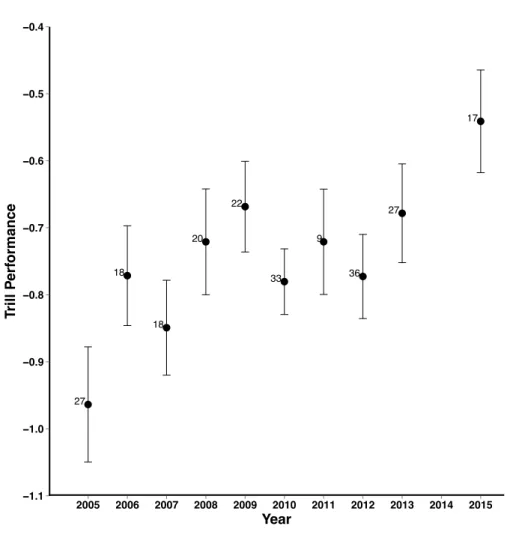
study population of Lincoln’s sparrows varies annually (Figure 1). It might be adaptive for
individuals to optimize their mating and competitive behaviors based on trill performance of
their social environment [Sockman 2009]. Therefore, it is biologically relevant to ask how
Lincoln’s sparrows respond to social environments that differ in trill performance over their
life-course.
developmental song environments would have long-term influences on adult competitive
behavior and on responses to songs in adulthood [Podos et al. 2009]. I tested these hypotheses by measuring monoamines and their metabolites, as an estimate of monoaminergic secretion, in the auditory telencephalon of juvenile males during the developmental exposure and by testing the effects of the developmental exposure on singing behavior and on monoaminergic activity in males that I reared to adulthood.
Previous research indicates that trill performance is a sexually salient signal for female Lincoln’s sparrows [Caro et al. 2010], and that trill performance is a salient competitive signal for males songbirds [Illes et al. 2006; DuBois et al. 2011; Moseley et al. 2013]. However, no studies have yet assessed the competitive salience of trill performance for male Lincoln’s sparrows. Therefore, in Chapter Three I conducted simulated territorial intrusions on free-living male Lincoln’s sparrows at a field site in Molas Pass, CO to assess the competitive salience of trill performance. This study allowed me to better understand the biological relevance for results from Chapter Two (the developmental study) and allowed me to determine if males respond similarly to trill performance during development and in adulthood.
model, I predicted that following exposure to a social environment composed of
low-performance songs, females would be more attracted to (i.e. overvalue) a novel song but that following exposure to a social environment composed of high-performance songs, females would be less attracted to (i.e. undervalue) the same novel song.
Chapter Two and Chapter Three study the effects of trill performance in the social environment on male behavior and on auditory monoamines while Chapter Four studies the effect of the social environment on female behavior. My final chapter determines if trill performance affects auditory monoamines in females and males differently. If the social environment has the same effect on males and females, it would suggest that a common
mechanism underlies behavioral modification in males and females, even though the behaviors (song compared to phonotaxis) and the valence of the song (competitive compared to sexual) differ between the sexes.
The world is not a stable place. If it were, we would see less evolution, less plasticity, and the study of biology would be much less interesting. But the world is not stable; instead,
FIGURE LEGEND
Figure 1.1. Annual variation in trill performance for songs recorded from a population of Lincoln’s sparrows breeding at Molas Pass, CO. The max trill performance of songs differ significantly between years (F1,9 = 2.32, p = 0.015). Labels to the left of each point indicate the number of males recorded in each year.
Figure 1.1 Annual variation in trill performance
27 18
18 20
22
33 9
36 27
17
−1.1
−1.0
−0.9
−0.8
−0.7
−0.6
−0.5
−0.4
2005 2006 2007 2008 2009 2010 2011 2012 2013 2014 2015
Year
T
rill P
erf
REFERENCES
Appeltants D, Del Negro C, Balthazart J (2002) Noradrenergic control of auditory information processing in female canaries. Behav Brain Res 133:221-235.
Aston-Jones G, Cohen JD (2005) An integrative theory of locus coeruleus-norepinephrine function: adaptive gain and optimal performance. Annu Rev Neurosci 28:403-450.
Bailey NW, Gray B, Zuk M (2010) Acoustic experience shapes alternative mating tactics and reproductive investment in male field crickets. Curr Biol 20:845-849.
Ballentine B, Hyman J, Nowicki S (2004) Vocal performance influences female response to male bird song: an experimental test. Behav Ecol 15:163-168.
Bao S, Chan VT, Merzenich MM (2001) Cortical remodelling induced by activity of ventral tegmental dopamine neurons. Nature 412:79-83.
Bateman PW, Gilson LN, Ferguson JWH (2001) Male size and sequential mate preference in the cricket Gryllus bimaculatus. Anim Behav 61:631-637.
Bateson M, Healy SD (2005) Comparative evaluation and its implications for mate choice. Trends Ecol Evol 20:659-664.
Brainard MS, Doupe AJ (2002) What songbirds teach us about learning. Nature 417:351-358.
Cardin JA, Schmidt MF (2004) Noradrenergic inputs mediate state dependence of auditory responses in the avian song system. J Neurosci 24:7745-7753.
Caro SP, Sewall KB, Salvante KG, Sockman KW (2010) Female Lincoln's sparrows modulate their behavior in response to variation in male song quality. Behav Ecol 21:562-569.
Castelino CB, Schmidt MF (2010) What birdsong can teach us about the central noradrenergic system. J Chem Neuroanat 39:96-111.
Catchpole CK, Slater PJB (2008) Bird Song: Biological Themes and Variations. New York, NY: Cambridge University Press.
Collins EJ, McNamara JM, Ramsey DM (2006) Learning rules for optimal selection in a varying environment: mate choice revisited. Behav Ecol 17:799-809.
Cooper JR, Bloom FE, Roth RH (2003) The Biochemical Basis of Neuropharmacology. New York, NY: Oxford University Press.
DuBois AL, Nowicki S, Searcy WA (2011) Discrimination of vocal performance by male swamp sparrows. Behav Ecol Sociobiol 65:717-726.
Gentner TQ, Hulse SH, Duffy D, Ball GF (2001) Response biases in auditory forebrain regions of female songbirds following exposure to sexually relevant variation in male song. J Neurobiol 46:48-58.
Gentner TQ, Margoliash D (2003) Neuronal populations and single cells representing learned auditory objects. Nature 424:669-674.
Gentner TQ, Hulse SH, Ball GF (2004) Functional differences in forebrain auditory regions during learned vocal recognition in songbirds. J Comp Physiol A Sens Neural Behav Physiol 190:1001-1010.
George I, Cousillas H (2013) How social experience shapes song representation in the brain of starlings. J Physiol Paris 107:170-177.
Gibson RM, Langen TA (1996) How do animals choose their mates? Trends Ecol Evol 11:468-470.
Hurley LM, Pollak GD (1999) Serotonin differentially modulates responses to tones and frequency-modulated sweeps in the inferior colliculus. J Neurosci 19:8071-8082.
Hurley LM, Devilbiss DM, Waterhouse BD (2004) A matter of focus: monoaminergic modulation of stimulus coding in mammalian sensory networks. Curr Opin Neurobiol 14:488-495.
Hurley LM, Pollak GD (2005) Serotonin modulates responses to species-specific vocalizations in the inferior colliculus. J Comp Physiol A Sens Neural Behav Physiol 191:535-546.
Hurley LM, Hall IC (2011) Context-dependent modulation of auditory processing by serotonin. Hearing Res 279:74-84.
Ikeda MZ, Jeon SD, Cowell RA, Remage-Healey L (2015) Norepinephrine modulates coding of complex vocalizations in the songbird auditory cortex independent of local neuroestrogen synthesis. J Neurosci 35:9356-9368.
Illes AE, Hall ML, Vehrencamp SL (2006) Vocal performance influences male receiver response in the banded wren. Proc R Soc B 273:1907-1912.
Jarvis ED (2004) Brains and birdsong. In: Nature's Music: The Science of Birdsong (Marler P, Slabberkoorn, H., ed), p 46. New York: Elsevier-Academic Press.
Kasumovic MM, Brooks RC (2011) It's all who you know: the evolution of socially cued anticipatory plasticity as a mating strategy. Q Rev Biol 86:181-197.
Kubikova L, Kostal L (2010) Dopaminergic system in birdsong learning and maintenance. J Chem Neuroanat 39:112-123.
MacDougall-Shackleton SA, MacDougall-Shackleton EA, Hahn TP (2001) Physiological and behavioural responses of female mountain white-crowned sparrows to natal- and foreign-dialect songs. Can J Zool 79:325-333.
Matragrano LL, Beaulieu M, Phillip JO, Rae AI, Sanford SE, Sockman KW, Maney DL (2012) Rapid effects of hearing song on catecholaminergic activity in the songbird auditory pathway. PLoS ONE 7:e39388.
Matragrano LL, LeBlanc MM, Chitrapu A, Blanton ZE, Maney DL (2013) Testosterone alters genomic responses to song and monoaminergic innervation of auditory areas in a seasonally breeding songbird. Dev Neurobiol 73:455-468.
Moseley DL, Lahti DC, Podos J (2013) Responses to song playback vary with the vocal performance of both signal senders and receivers. Proc R Soc B 280:20131401.
Oades RD (1985) The role of noradrenaline in tuning and dopamine in switching between signals in the CNS. Neurosci Biobehav Rev 9:261-282.
Podos J (1996) Motor constraints on vocal development in a songbird. Anim Behav 51:1061-1070.
Podos J (1997) A performance constraint on the evolution of trilled vocalizations in a songbird family (Passeriformes: Emberizidae). Evolution 51:537-551.
Podos J, Nowicki S, Peters S (1999) Permissiveness in the learning and development of song syntax in swamp sparrows. Anim Behav 58:93-103.
Podos J, Lahti DC, Moseley DL (2009) Vocal performance and sensorimotor learning in songbirds. Adv Study Behav 40:159-195.
Popova NK (2006) From genes to aggressive behavior: the role of serotonergic system. Bioessays 28:495-503.
Salvante KG, Racke DM, Campbell CR, Sockman KW (2010) Plasticity in singing effort and its relationship with monoamine metabolism in the songbird telencephalon. Dev Neurobiol 70:41-57.
Sara SJ (2009) The locus coeruleus and noradrenergic modulation of cognition. Nat Rev Neurosci 10:211-223.
Sewall KB, Dankoski EC, Sockman KW (2010) Song environment affects singing effort and vasotocin immunoreactivity in the forebrain of male Lincoln's sparrows. Horm Behav 58:544-553.
Sockman KW, Gentner TQ, Ball GF (2002) Recent experience modulates forebrain gene– expression in response to mate–choice cues in European starlings. Proc Roy Soc B 269:2479-2485.
Sockman KW, Gentner TQ, Ball GF (2005) Complementary neural systems for the experience-dependent integration of mate-choice cues in European starlings. J Neurobiol 62:72-81.
Sockman KW (2007) Neural orchestration of mate-choice plasticity in songbirds. J Ornithol 148:225-230.
Sockman KW, Salvante KG (2008) The integration of song environment by catecholaminergic systems innervating the auditory telencephalon of adult female European starlings. Dev Neurobiol 68:656-668.
Sockman KW, Salvante KG, Racke DM, Campbell CR, Whitman BA (2009) Song competition changes the brain and behavior of a male songbird. J Exp Biol 212:2411-2418.
Sockman KW (2009) Annual variation in vocal performance and its relationship with bill morphology in Lincoln's sparrows, Melospiza lincolnii. Anim Behav 77:663-671.
Wade J, Lampen J, Qi L, Tang YP (2013) Norepinephrine inhibition in juvenile male zebra finches modulates adult song quality. Brain Res Bull 90:132-136.
Weitekamp CA, Hofmann HA (2014) Evolutionary themes in the neurobiology of social cognition. Curr Opin Neurobiol 28:22-27.
CHAPTER TWO: SIGNS OF COMPETITION DURING DEVELOPMENT CHANGE THE BRAIN AND COMPETITIVE BEHAVIOR OF ADULT SONGBIRDS
SUMMARY
Central catecholamines are key regulators of experience-dependent neuroplasticity in vertebrates, and they may facilitate integration of information about the environments that individuals encounter across their life-course.We tested the hypothesis that developmental exposure to social environments varying in song performance influence auditory catecholamines and adult behavior in a seasonally breeding songbird. We exposed juvenile male Lincoln’s sparrows (Melospiza lincolnii) to conspecific songs that we digitally manipulated to be of low or high trill performance. Songs of high trill performance maximize trill rate and frequency
bandwidth of trilled syllables and are challenging to produce. We collected tissue from the
auditory telencephalon of half the males during development and collected tissue from the other half months later in adulthood after exposing them to intermediate-performance songs and scoring their behavior. Using high-performance liquid chromatography with electrochemical detection, we measured levels of catecholamines and their metabolites, as an indicator of their secretion, in the auditory telencephalon. During development, exposure to high-performance songs increased dopamine metabolites compared to exposure to low-performance songs;
consistent with the hypothesis that dopamine regulates experience dependent neuroplasticity in the developing auditory telencephalon. Compared to the low-performance developmental
between norepinephrine activity and trill rate, suggesting that norepinephrine is sensitive to trill
rate. Together, these results suggest that the developmental social environment could modulate adult competitive behavior by modulating how adults process competitive sensory signals. INTRODUCTION
Faced with unpredictable variation in the social environment, animals must modulate their behavior to respond to changing environmental conditions. One mechanism by which individuals might integrate and respond to information about their past and current social environment is through experience-dependent changes in perception [Sockman et al. 2002; Sockman et al. 2005; Cousillas et al. 2006; George and Cousillas 2013; Weitekamp and Hofmann 2014; Lyons et al. 2014]. If the social environment causes long-term changes to sensory processing, this would influence perception of, and therefore response to social signals in the future [Hauber et al. 2007; Sockman 2007; George and Cousillas 2013].
A sensory system may be especially sensitive to the social environment during development, when many systems of the organism, including the central nervous system, are plastic [Komers 1997; Dufty et al. 2002; Knudsen 2004]. Adaptive plasticity of developing sensory systems occurs when individuals are exposed to social environments during
2012], it is less clear how competitive signals in the social environment during development influence the sensory systems that process social information.
Songbirds learn songs during development, and developmental song exposure has long-term consequences for adult singing behavior and sensitivity to song [Marler 1997; Riebel 2003;
Catchpole and Slater 2008; Woolley 2012]. Dopamine and norepinephrine are catecholaminergic
neuromodulators that are involved in the regulation of social behavior, including singing
behavior [Barclay et al. 1996; Ball and Balthazart 2002; Lynch et al. 2008], and could facilitate neural integration of the social environment within the developing and adult songbird brain
[Salvante et al. 2009; Castelino and Schmidt 2010; Kubikova and Kostal 2010; Sewall et al.
2013]. Catecholamines modulate neuroplasticity in response to auditory signals, both in
development [Shepard et al. 2013; Moncalvo et al. 2013; Shepard et al. 2015] and in adults [Bao et al. 2001; Velho et al. 2012]. In songbirds, catecholaminergic activity and innervation patterns change throughout the auditory system during song learning [Soha et al. 1996; Harding et al. 1998; Kubikova et al. 2010], and systemic changes in catecholamine levels during development can have long-term influences on song quality and song output [Harding 2004; Wade et al. 2013].
et al. 2004; Velho et al. 2012], whereas the CMM is responsive to familiar songs [Gentner and Margoliash 2003; Gentner et al. 2004]. Catecholaminergic activity in these auditory regions likely regulates aspects of attention and perception [Maney 2013; Ikeda et al. 2015]. Therefore exposure to songs that vary in quality during development could modulate song processing in the short and long term through its influence on catecholamines in the auditory forebrain.
Trill performance is an aspect of song challenge that reflects a biomechanically imposed
constraint between the rate with which individuals produce syllables of a trill and the frequency bandwidth of those syllables [Podos 1997; Wilson et al. 2014]. High trill-performance songs maximize both trill rate and frequency bandwidth of trilled syllables [Podos 1997; Wilson et al.
2014], and adult males perceive high-performance songs as presenting a greater social challenge
than low-performance songs [Illes et al. 2006; de Kort et al. 2009; DuBois et al. 2011; Moseley
et al. 2013]. Previous studies indicate that developing songbirds are sensitive to trill
performance [Podos et al. 2009]. Exposure to songs that vary in trill performance during
development can have long-term consequences for song learning and adult singing behavior in
swamp sparrows (Melospiza georgiana) [Podos et al. 2004; Podos et al. 2009; Lahti et al. 2011].
If the auditory system integrates information about trill performance in the social environment
during development, this integration could shape subsequent social and singing behavior.
I predicted that, relative to low-performance songs, high-performance songs would elevate
catecholaminergic activity in the auditory forebrain of developing males, reflecting the role of
catecholamines in modulating attention, sensitivity to auditory stimuli, and auditory tuning [Bao
et al. 2001; Cardin and Schmidt 2004; Ikeda et al. 2015]. I also measured the influence of this
developmental experience on adult singing and catecholaminergic activity in the auditory
forebrain. I predicted that relative to the low-performance treatment, the males that were exposed
to the high-performance songs in development would elevate adult song performance. However,
I also predicted that the developmental treatments would influence how males responded to
conspecific songs of intermediate trill performance in adulthood. Specifically, I predicted that
relative to the high-performance treatment, males that were reared in the low-performance
treatment would elevate trill performance and auditory catecholamines during exposure to
intermediate performance songs.
METHODS
Developmental treatment songs
I constructed developmental treatment songs by selecting 18 different songs from six different males (three songs per male) from our collection of Lincoln’s sparrow songs that our lab recorded from 2005-2011 at our study site in Molas Pass, CO (37.74°N, 107.69°W)
(Figure 1). Manipulated trills differed from each other (trill rate mean ± SEM: low performance 8.84 ± 0.30; high performance 10.56 ± 0.40; paired t-test t = 9.84, df = 71, p < 0.001; vocal performance mean ± SEM: low performance -1.65 ± 0.04; high performance -1.55 ± 0.04; paired t-test t = 9.84, df = 71, p < 0.001) and fell within the natural range of variation in trill rate and performance recorded for our study population (Figure 2).
Experimental Procedure
In early July of 2013, I worked with field assistants to collect 8-day old male and female Lincoln’s sparrows from their nests at our field site in Molas Pass, CO (37.74°N, 107.69°W). We reared the nestlings in cages in a research trailer at our campsite for two to three weeks on a diet of Roudybush Formula 3 (Roudybush Inc., Woodland, CA) mixed with water until birds could feed independently, at which point we transitioned them to Roudybush Daily Maintenance (Roudybush Inc., Woodland, CA). We then transported the birds inside the trailer to our facilities at the University of North Carolina at Chapel Hill. When the birds were between 34 and 41 days posthatch, I divided them across 18 sound chambers, with 3 birds (males and females) in each sound chamber. I randomly assigned half the chambers to the high-performance treatment and the other half to the low-performance treatment. Through a speaker in each chamber, I then began to broadcast treatment songs daily from 0505h – 1055h in 20-minute intervals with 10-minute silent periods between each interval. I played the treatment songs in random order.
Starting at 0800h and ending at 1100h on the morning of the ninth day of exposure to treatment songs, I collected brains via rapid decapitation from one bird from each chamber (N=16 males, Figure 3). I collected brains in alternating treatment order. I immediately fresh
froze each hemisphere and stored samples at -80° C until subsequent analysis of dopamine and
detection (HPLC-ECD, methods described below). For the two remaining birds in each sound chamber, I extended exposure to the developmental treatment songs for a total of 57 days, ending when birds were 91 - 98 days old (Figure 3). Following exposure to developmental treatment songs, I housed males in mixed sex aviaries until adult song recording. Females were used in a separate experiment.
I separated males into two groups. Each group contained males from both low- and high-performance developmental treatments. Starting March 22, 2014 for group 1 and March 26, 2014 for group 2, males were shifted from a natural photoperiod (12 Light: 12 Dark) to a 13L: 11D photoperiod which subsequently increased in daylight by one hour every week until it reached 16L: 8D. Males remained at 16L: 8D for approximately 3 weeks until May 06, 2014 (group 1), and May 10, 2014 (group 2) when males were between 308 and 321 days posthatch. At that time, I began to record male song in individual sound-attenuation chambers (Figure 3). I used eight sound-attenuation chambers housed within a single room and alternated developmental treatment groups across the chambers. Between groups, I alternated treatment assignment of the chambers. I had 9 males from the low-performance treatment and 7 males from the high-performance treatment. Therefore, one chamber housed only males from the low performance treatment in both groups. Each chamber contained a cage with food cups, water bottles, two perches, and a microphone.
For each group, I moved the males to the attenuation chambers at 1600h and allowed them to acclimate overnight. I began recording their song the following morning from 0500h – 1000h (baseline singing). I recorded songs using audio recording methods described in
[Sockman et al. 2009], with one microphone from each sound-attenuation chamber connected to
had at least 27 consecutive oscillogram peaks that exceed an average of 80 dB for at least 3
seconds.
For the three days following baseline singing, I continued to record male songs, but also exposed males to songs of intermediate trill performance (playback singing). For each chamber, I selected three songs from each of two different males that had a trill rate and trill performance intermediate to that of the developmental treatment songs (mean ± SEM: trill rate 9.56 ± 0.19; trill performance -1.62 ± 0.02). I broadcast intermediate trill-performance songs using a speaker positioned in the middle of the chamber (Pioneer Corp. TS-G1040R) that was attached to mono-amplifiers (Audiosource Amp 5.1A, Portland, OR, USA) that I interfaced (M-Audio Delta 1010, Irwindale, CA, USA) to a central computer (Apple Inc., Cupertino, CA, USA). Each day of intermediate song exposure, I broadcast songs from 0500h – 1040h in 10-minute intervals with 20-minute silent cycles between each interval. On the morning of the third day of song exposure, from 0900h – 1040h, I rapidly decapitated males and collected their brains (Figure 3). I collected brains in alternating treatment order and immediately froze them on dry ice and stored them at -80° C for future analysis.
Quantification of catecholamines, metabolites, and protein
I used a cryostat to section one hemisphere of brains collected from the juvenile and adult
males at 40 µm in the sagittal plane for Nissl staining. I sectioned the opposite hemisphere into
punches from CMM and two consecutive 1-mm-diameter punches from NCM and area X. Upon collection, I stored tissue samples in 1.9 ml polypropylene microcentrifuge tubes at -80° C.
When dopamine and norepinephrine are secreted from a neuron, they are metabolized [Moore 1986; Eisenhofer et al. 2004; Meiser et al. 2013]. Therefore, by measuring the
catecholaminergic metabolites, one can obtain an estimate of secretion. However, since some amount of a secreted, non-metabolized catecholamine can be taken back up by the pre-synaptic neuron, and since metabolism also occurs intraneuronally [Moore 1986; Eisenhofer et al. 2004; Meiser et al. 2013], this estimate may not capture the total amount of catecholamine secreted, and it likely also reflects levels of monoamine produced and stored in the neuron.
I used methodology described in [Sewall et al. 2013] to quantify dopamine and norepinephrine activity. I measured dopamine and the dopamine metabolites
3,4-Dihydroxyphenylacetic acid (DOPAC) and homovanillic acid (HVA), and norepinephrine and
the norepinephrine metabolite 3-methoxy-4-hydroxyphenylglycol (MHPG) using
high-performance liquid chromatography with electrochemical detection (HPLC-ECD). In brief, I added 100 µl of mobile phase to each tissue sample tube. I sonicated tissue samples in a mobile phase solution, centrifuged them at 16,000 g at 4°C for 16 minutes, and then injected 10 µl of the supernatant into an HTEC-500 stand-alone HPLC-ECD system (Eicom, San Diego, CA, USA) using a Midas autosampler (Spark Holland, Netherlands). The mobile phase solution was at pH 3.5 and was composed of citric acid (8.84 g), sodium acetate (3.10 g), sodium octyl sulfonate (215 mg), EDTA (5 mg), methanol (200 mL), and ultra pure water (800 mL) (Sigma-Aldrich, St. Louis, MO, USA).
against an Ag/AgCl reference electrode. The applied potential of the electrode caused an
oxidation or reduction reaction of each compound, and the resulting electron flow was measured as current, which is a function of the type and quantity of the compound. The HPLC-ECD
system determined the amount of each compound relative to a two-point standard curve. The two standards were concentrated at 1 pg/ml and 10 pg/ml of each of the five compounds of interest. I included with each standard and sample an internal standard (1 pg/ml isoproterenol, added prior to sample processing) to control for sample loss during preparation. I used PowerChrom software (eDAQ, Colorado Springs, CO, USA) to compare the area under the curve for each compound within each sample to the area generated by the two standards. In all cases, I used the peak area ratio function in order to account for variation in isoproterenol across samples.
After determining the amount of each compound in the 10 µl of injected supernatant, I needed to control for variation in the amount of tissue from which the compounds were obtained. Therefore, I dissolved the remaining tissue sample in 0.2 M NaOH (20 µl for 0.5-mm-diameter samples, 50 µl for 1-mm-diameter samples) and used a Bradford protein-dye binding assay (Quickstart Bradford Protein Assay, BioRad, Hercules, CA, USA) to measure the amount of protein in each tissue sample. I used bovine serum albumin as a standard and performed all analyses on a UQuant microplate spectrophotometer (BioTek, Winooski, VT, USA). Analysis
I calculated the final amount of each compound as the amount of compound (in pg) in the initial 100 µl of mobile phase added to each tissue sample divided by the amount of protein measured from the Bradford assay (in mg). For juvenile males (in which only one individual was collected from a treatment chamber), I used two-tailed t-test to test for the effect of the
ensure that the measurements conformed to a normal distribution, values were subjected to log or square-root transformation as needed.
For analyses of songs from the adult males, I measured trill performance, trill rate, and frequency bandwidth from five songs that I randomly selected each hour from 05:00 – 10:00
during the first three days of song recording and from 05:00 – 09:00 on the final day of song
recording. I then determined the mean trill performance, trill rate, and frequency bandwidth of
each song. I used linear mixed effects models with the R package lme4 [Bates et al. 2015] to
analyze the influence of treatment, day of song recording (as a continuous variable), and their
interactive effects on trill performance, trill rate (log transformed), and frequency bandwidth (log
transformed). To determine if males copied the trill performances of the developmental treatment
songs, for song characteristics in which I found an effect of developmental treatment on adult
song, I determined how the songs of the focal males compared to the developmental treatment
songs within each treatment. I included the average song trait for each focal male (across all days
of recording) and for each male from the treatment playback as the dependent variable, and I
included the recording type (either recorded from the focal male or used as a treatment song) as
the fixed factor.
I used linear mixed effects models with the R package lme4 [Bates et al. 2015] to test the
influence of developmental song treatment on catecholamines in the auditory forebrain of adult
males. For each model, I included the compound amount as the dependent variable, and the
treatment as the independent variable. I subjected all compound measurements to log-transformation to meet the requirements for normal distribution.
for all analyses. For analyses with multiple song measurements from each male across multiple days, I nested song within male as a random intercept and random coefficient on day. I used Satterthwaite approximations for degrees of freedom for F or t-tests of the linear mixed models. I used R version 3.2.2 for all analyses [R Core Team 2015].
RESULTS
Catecholamines in developing males
For juvenile males, relative to the low-performance treatment, the high-performance
treatment had elevated levels of DOPAC (Table 1, Figure 4a) and HVA (Table 1, Figure 4b) but
not dopamine in CMM. I was unable to detect significant effects of the developmental song
exposure on dopaminergic activity in NCM or area X, or of noradrenergic activity in CMM or
NCM (Table 1).
Song characteristics of adult males
For adult males, relative to the low-performance treatment, the high-performance
treatment elevated adult trill performance. The effect of day and the interactive effect of day and
treatment were not significant (Table 2; Figure 5b). In order to determine if males copied the trill
performances of the developmental treatment songs, I also compared trill performance of each
adult male’s songs to the songs that I exposed them to during development. Trill performance of
the adult males did not differ significantly from the developmental treatment songs for either the
low-performance (Est. ± SEM = -0.02 ± 0.12, F1,4.66= 0.02, p > 0.2) or high-performance
treatments (Est. ± SEM = -0.01 ± 0.07, F1,1.90= 0.01, p > 0.2).
For adult males, relative to the low-performance treatment, the high-performance
treatment elevated adult trill rate. The effect of day and the interactive effect of day and
significantly from the developmental treatment songs for either the low-performance (Est. ± SEM = 0.14 ± 0.08, F1,13= 3.33, p = 0.09) or high-performance treatments (Est. ± SEM = 0.14 ±
0.10, F1,11= 2.22, p = 0.16).
There was no significant effect of treatment, day, or interactive effect of treatment and
day on frequency bandwidth (Table 2).
Catecholamines in adult males
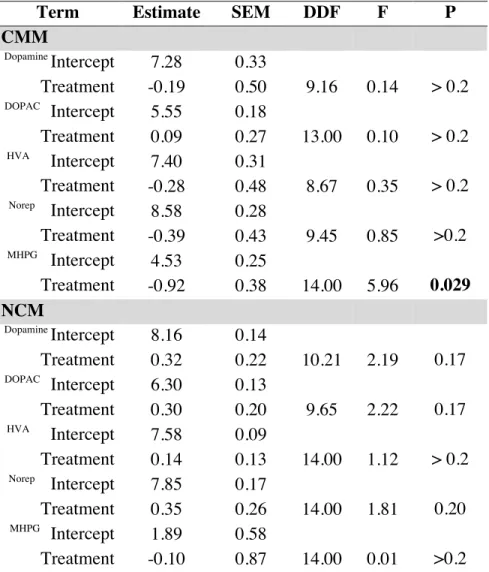
I found no significant effect of treatment on dopamine, DOPAC or HVA in either CMM
or NCM (Table 7). I found an influence of the developmental treatments on MHPG but not
norepinephrine in the CMM and no significant effect of treatment on MHPG or norepinephrine
in NCM (Table 3). Compared to males exposed to the low-performance treatments, males
exposed to the high-performance treatments during development had significantly lower levels
of MHPG in the CMM in adulthood (Figure 6).
If noradrenergic activity in the CMM mediates the effects of the developmental
treatments on trill rate or performance, then I would expect to find a relationship between MHPG
and trill rate or trill performance. In addition, because MHPG is indicative of higher levels of
noradrenergic secretion or intracellular metabolism [Moore 1986; Eisenhofer et al. 2004; Meiser
et al. 2013], I would also expect to find a relationship between norepinephrine and trill rate or trill performance. Therefore, I tested for a relationship between MHPG and norepinephrine in the
CMM and mean trill rate and trill performance of the final five songs on the final day of adult
song playback. I selected the final five songs (rather than all of the songs) as a reasonable sample
of songs that most closely preceded brain collection. I found a positive correlation between trill
rate and MHPG in CMM (treatment: Est. ± SEM -0.96 ± 0.35, F1,12 = 7.55, p = 0.017; trill rate:
between trill rate and norepinephrine in CMM (treatment: Est. ± SEM -0.44 ± 0.36, F1,9.82 = 1.48,
p >0.2; trill rate: Est. ± SEM 0.23 ± 0.05, F1,2.88 = 21.28, p = 0.021). For norepinephrine, there
was a single data point for which Cook’s distance equaled one, suggesting that it was an outlier,
but removal of that point did not change the overall result (outlier removed: treatment: Est. ±
SEM -0.21 ± 0.27, F1,8.59 = 0.62, p >0.2; trill rate: Est. ± SEM 0.19 ± 0.05, F1,2.97 = 15.66, p =
0.029, Figure 7b).
DISCUSSION
Developmental plasticity allows individuals to invest in traits that maximize competitive success. This study found that developmental experience with social environments that vary in competitive signaling influences adult signaling behavior. In addition, through measurement of auditory catecholamines, this study elucidated potential mechanisms that could underlie the influence of the developmental environment on adult song. During development, juvenile males exposed to high-performance songs had increased amounts of dopamine metabolites in the auditory telencephalon compared to juvenile males exposed to low-performance songs. When exposed to intermediate performance songs as adults, males exposed to high-performance (compared to low-performance) songs during development had increased trill rate and trill
Catecholamines in developing males
Dopamine metabolites were higher in the auditory telencephalon of males exposed to high-performance songs in development compared to males exposed to low-performance songs in development. This increase in dopamine metabolites indicates that a greater amount of dopamine was metabolized in the auditory telencephalon of males exposed to the
high-performance songs compared to males exposed to the low-high-performance songs. Metabolism of dopamine could occur either intracellularly or could occur after secretion from dopaminergic cells [Moore 1986; Eisenhofer et al. 2004; Meiser et al. 2013]. Importantly, dopamine itself did not significantly differ between the two treatment groups. The similarity in dopamine levels, but difference in metabolite levels suggests that dopamine was produced and then metabolized in greater amounts in the males exposed to the high-performance songs.
Dopaminergic activity in the auditory system of songbirds may mediate developmental acquisition of song or modulate song perception [Kubikova and Kostal 2010]. Dopamine is thought to encode aspects of reward [Berridge and Robinson 1998; Maney 2013] and regulate learning and synaptic plasticity [Wise 2004; Hoffmann et al. 2016], including cortical plasticity in the mammalian auditory system [Bao et al. 2001; Shepard et al. 2013]. In developing
results in cortical remodeling of the auditory telencephalon in mammals, suggesting that dopamine modifies representation of auditory input [Bao et al. 2001; Shepard et al. 2013; Puschmann et al. 2014]. Therefore, the increased amounts of dopamine metabolites observed in the current study could correspond to a dopamine-dependent tuning of the auditory telencephalon during development, which could have long-term influences on song perception.
Song characteristics and catecholamines in adult males
Experience with subtle differences in the competitive environment during development changed the competitive behavior of adults. Adult males from the high-performance treatments sang songs of higher performance and higher trill rate compared to the adult males from the low-performance treatments. In addition, trill low-performance and trill rate of recorded songs did not differ significantly from the playback songs. These findings indicate that, like other aspects of song [Marler and Peters 1977; Marler 1997] males likely learn trill rate and trill performance from the songs they are exposed to during development [Podos et al. 2009].
Lincoln’s sparrows experience annual variation in average trill performance in the
population [Sockman 2009]. This heterogeneity in the social environment indicates that in some
years, males will develop and learn songs in social environments composed of high-performance
songs, and in other years, males will develop and learn songs in social environments composed
of low-performance songs. The results from the current study suggest that the variation in trill
performance that males experience during development will affect their trill performance in
adulthood, which could potentially shape the future social environment. However, if the trill
performance from one year shapes the subsequent year’s social environment, I would expect trill
performance in the social environment to remain stable over time, rather than vary as observed
There are at least two potential explanations for the discrepancy between the results of
the current study (that trill performance in adulthood is similar to the trill performance of the
developmental social environment) and the annual variation in trill performance observed in the
study population. First, there are low rates of philopatry in the study population [Sockman 2012],
suggesting that males may not contribute to the trill performance of their natal social
environment. Second, previous work indicates that variation in ecological factors could
contribute to variation in trill performance [Sockman 2009; Sockman 2012], and in swamp
sparrows, males modulate their trill performance in competitive contexts [DuBois et al. 2009].
These studies raise the hypothesis that males are plastic in trill performance in adulthood. In a
test of this hypothesis, I exposed males from both treatments to songs of intermediate
performance in adulthood. I predicted that males would modulate their trill performance over the
course of exposure to the intermediate performance songs, and that the developmental treatments
would influence the direction of the modulation. However, I did not detect an interactive effect
of treatment and day of recording on trill performance or trill rate, indicating that the
developmental treatments did not reliably influence modulation of song. Rather, across all of the
days, males from the high-performance treatments tended to sing higher performance songs than
males from the low-performance treatments. While the lack of a significant interaction does not
rule out the possibility that males are plastic in trill performance in adulthood, it does suggest
long-term stability in the effects of the developmental social environments on adult song
performance [Podos et al. 2009].
sparrowsto songs with high trill rates found that, as adults, males decreased trill rate relative to the tutor songs, omitted notes from trilled syllables, or had broken syntax, in which silent gaps interspersed groups of syllables within a trill [Podos 1996; Podos et al. 1999; Podos et al. 2004; Podos et al. 2009; Lahti et al. 2011]. These studies support the hypothesis that there is a
biomechanical constraint on the ability of males to increase trill rate and performance beyond a certain limit [Podos 1996; Podos 1997; Podos et al. 2004]. A more detailed analysis would be necessary to determine if Lincoln’s sparrows from the high-performance treatments of the current study exhibited broken syntax or skipped syllables, but we did not find that males
decreased trill rate relative to their tutor songs. However, the treatment songs in the current study were within the range of trill rate and trill performance recorded from free-living Lincoln’s sparrows [Sockman 2009]. Therefore, it is likely that the high-performance songs in the current study were within the range of production capability for Lincoln’s sparrows, while that may not have been the case for the swamp sparrow studies [Podos et al. 2004; Podos et al. 2009].
Males from the high-performance treatment had lower levels of the norepinephrine
metabolite MHPG in the CMM compared to males from the low-performance treatment. This
finding suggests that norepinephrine secretion or intracellular metabolism was lower in the
CMM of males from the high-performance group compared to the low-performance group
[Moore 1986; Eisenhofer et al. 2004; Meiser et al. 2013]. In sensory systems, including the
songbird auditory system, norepinephrine enhances responses to salient stimuli by enhancing the signal to noise ratio of neural responsiveness [Appeltants et al. 2002; Hurley et al. 2004; Cardin and Schmidt 2004; Shepard et al. 2013; Ikeda et al. 2015].
salient (i.e. of relatively higher performance) for the males from the low-performance treatment compared to males from the high-performance treatment. This explanation is consistent with the patterns found in previous studies - that noradrenergic activity is greater following exposure to more salient songs [Sockman and Salvante 2008; Salvante et al. 2009; Sewall et al. 2013], and is consistent with the proposed function of norepinephrine in regulating arousal and goal directed behaviors by enhancing responses to salient stimuli [Berridge and Waterhouse 2003; Aston-Jones and Cohen 2005; Sara 2009; Shepard et al. 2013].
The modulation in perception could occur, in part, through each male’s comparison of his own songs to the intermediate performance songs [Todt and Naguib 2000; Ten Cate et al. 2002; Arnott and Elwood 2009]. Specifically, males from the low-performance treatment may have perceived the intermediate performance songs as relatively more salient, which could have increased noradrenergic release in the auditory telencephalon [Lynch et al. 2012], while males from the high-performance treatment may have perceived these same songs as relatively less salient. An alternative explanation for the levels of MHPG in the adult males is that exposure to high-performance songs in development caused a life-long decrease in noradrenergic tone. However, previous work that manipulated norepinephrine in developing songbirds suggests that norepinephrine in adulthood does not necessarily reflect levels in development [Wade et al. 2013].
Both norepinephrine and MHPG in the CMM were positively correlated with trill rate on the final day of exposure to song. This correlation is consistent with the hypothesis that
2004]. Previous studies in swamp sparrows found that sensorimotor cells in HVC fire in a pattern that is phase-locked to both auditory input and motor output of syllables in a song’s trill [Prather et al. 2008; Prather et al. 2009; Prather et al. 2012]. These studies indicate that HVC cells encode auditory and motor information about trill rate [Prather et al. 2008]. Therefore, noradrenergic integration of information about a song’s trill rate could, through CMM’s projections to HVC [Vates et al. 1996; Jarvis 2004], lead to modulation of trill rate.
TABLE AND FIGURE LEGENDS
Table 2.1. Mean ± SE and results from t-tests showing effects of developmental song treatments
on levels of dopamine, norepinephrine, and their metabolites (measured as pg/mg protein) in
CMM, NCM and area X (dopamine only) of juvenile males.
Table 2.2. GLMM analyzing the effects of developmental song treatments and day of song
recording on trill performance, trill rate, and frequency bandwidth of adult males. Day was coded
as a continuous variable. The low-performance treatment was coded as 0, the high-performance
treatment was coded as 1.
Table 2.3. GLMM analyzing the effects of developmental song treatments on dopamine,
norepinephrine and their metabolites in CMM and NCM of adult males. The low-performance
treatment was coded as 0, the high-performance treatment was coded as 1.
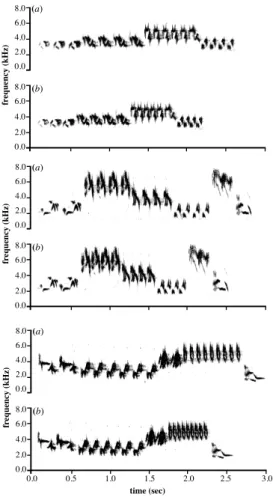
Figure 2.1. Exemplars of recorded songs from the high- and low-performance treatment (a) low-performance version of each exemplar, (b) high-performance version.
Figure 2.2. Experimental songs and the total population of songs recorded at the field site near Molas Pass, CO from 2005 – 2015. Treatment songs fell within the range of trill rate and performance for the population.
Figure 2.3. Schematic of experiment design.
Figure 2.4. Effect of developmental treatments on levels of (a) DOPAC and (b) HVA in the juvenile male CMM.
Figure 2.5. Effect of developmental treatment on (a) adult trill performance and (b) adult trill rate. There was an effect of treatment, but not day, on both measurements of song.
Table 2.1 Effects of treatments on catecholamines in juveniles
High mean ± SE (ng/mg)
Low mean ±
SE (ng/mg) DF t P CMM*
Dopamine 0.80 ± 0.11 0.68 ± 0.06 14 0.88 >0.2 DOPAC 0.23 ± 0.03 0.15 ± 0.01 14 2.70 0.017
HVA 0.81 ± 0.10 0.51 ± 0.06 14 2.77 0.015 Norepinephrine 1.75 ± 0.18 1.65 ± 0.21 14 0.39 >0.2
MHPG 0.05 ± 0.01 0.10 ± 0.04 14 1.07 >0.2 NCM**
Dopamine 3.27 ± 0.81 3.28 ± 1.26 14 0.52 > 0.2 DOPAC 0.48 ± 0.10 0.45 ± 0.19 14 0.89 > 0.2 HVA 1.31 ± 0.31 0.87 ± 0.10 14 1.52 0.15 Norepinephrine 1.71 ± 0.59 0.85 ± 0.14 14 1.18 > 0.2
MHPG 0.0195 ± 0.0183 0.0012 ± 0.0005 14 0.91 > 0.2 Area X
Dopamine 67.29 ± 6.46 58.38 ± 9.00 14 0.81 > 0.2 DOPAC 10.95 ± 1.78 9.07 ± 1.42 14 0.83 > 0.2
HVA*
8.47 ± 1.17 6.07 ± 0.88 14 1.60 0.13
*
compounds are square-root transformed **
Table 2.2 Effects of treatments on adult song
Term Est. SEM DDF F P
Trill Performance
Intercept -1.69 0.05
Treatment 0.14 0.07 14.28 4.63 0.049 55 Day 0.01 0.01 24.63 0.01 >0.2 Treat X Day -0.02 0.02 24.63 1.64 >0.2 Trill Rate
Intercept 2.27 0.06
Treatment 0.21 0.09 12.13 6.15 0.029 14 Day 0.01 0.01 4.69 0.07 >0.2 Treat X Day -0.03 0.02 4.69 1.77 >0.2 Frequency Bandwidth
Intercept 0.17 0.03
Table 2.3 Effects of treatments on catecholamines in adults
Term Estimate SEM DDF F P
CMM Dopamine
Intercept 7.28 0.33
Treatment -0.19 0.50 9.16 0.14 > 0.2 DOPAC
Intercept 5.55 0.18
Treatment 0.09 0.27 13.00 0.10 > 0.2 HVA
Intercept 7.40 0.31
Treatment -0.28 0.48 8.67 0.35 > 0.2 Norep
Intercept 8.58 0.28
Treatment -0.39 0.43 9.45 0.85 >0.2 MHPG
Intercept 4.53 0.25
Treatment -0.92 0.38 14.00 5.96 0.029 NCM
Dopamine
Intercept 8.16 0.14
Treatment 0.32 0.22 10.21 2.19 0.17 DOPAC
Intercept 6.30 0.13
Treatment 0.30 0.20 9.65 2.22 0.17 HVA
Intercept 7.58 0.09
Treatment 0.14 0.13 14.00 1.12 > 0.2 Norep
Intercept 7.85 0.17
Treatment 0.35 0.26 14.00 1.81 0.20 MHPG
Intercept 1.89 0.58
Figure 2.1 Exemplars of treatment songs 8.0 6.0 4.0 2.0 0.0 8.0 6.0 4.0 2.0 0.0
0.0 0.5 1.0 1.5 2.0 2.5 3.0
fr eq u en cy (k H z) time (sec) (a)
(b)
8.0 6.0 4.0 2.0 0.0 8.0 6.0 4.0 2.0 0.0 fr eq u en cy (k H z)
(a)
(b)
8.0 6.0 4.0 2.0 0.0 8.0 6.0 4.0 2.0 0.0 fr eq u en cy (k H z)
(a)
Figure 2.2 Treatment songs compared to the population of songs
Figure 2.3 Schematic of experiment design
0 1 2 3
0 10 20 30 40
Trill Rate (syllables/sec)
Frequenc
y Band
width
Song Type high low field
Novel song exposure
High performance song exposure
Low performance song exposure
318 Harvest
brains
95 38 47
Harvest brains (juveniles)
315
Average age (days post-hatch) 314 Begin song
Recording
Figure 2.4 Effects of treatment on dopamine metabolites in juveniles
a
Figure 2.5 Effects of treatments on adult song
Figure 2.6 Effects of treatments on MHPG in adults
a
Figure 2.7 Relationships between norepinephrine activity and trill rate
a
REFERENCES
Appeltants D, Del Negro C, Balthazart J (2002) Noradrenergic control of auditory information processing in female canaries. Behav Brain Res 133:221-235.
Arnott G, Elwood RW (2009) Assessment of fighting ability in animal contests. Anim Behav 77:991-1004.
Aston-Jones G, Cohen JD (2005) An integrative theory of locus coeruleus-norepinephrine function: adaptive gain and optimal performance. Annu Rev Neurosci 28:403-450. Bailey NW, Gray B, Zuk M (2010) Acoustic experience shapes alternative mating tactics and
reproductive investment in male field crickets. Curr Biol 20:845-849.
Ball GF, Balthazart J (2002) Neuroendocrine mechanisms regulating reproductive cycles and reproductive behavior in birds. In: Hormones, Brain and Behavior (Pfaff DW, Arnold AP, Fahrbach SE, Etgen AM, Rubin RT, eds), pp 649-798. San Diego, CA: Academic Press.
Ballentine B (2009) The ability to perform physically challenging songs predicts age and size in male swamp sparrows, Melospiza georgiana. Anim Behav 77:973-978.
Bao S, Chan VT, Merzenich MM (2001) Cortical remodelling induced by activity of ventral tegmental dopamine neurons. Nature 412:79-83.
Barclay SR, Harding CF, Waterman SA (1996) Central DSP-4 treatment decreases
norepinephrine levels and courtship behavior in male zebra finches. Pharmacol Biochem Behav 53:213-220.
Bates D, Mächler M, Bolker B, Walker S (2015) Fitting linear mixed-effects models using lme4. Journal of Statistical Software 67:1-48.
Berridge CW, Waterhouse BD (2003) The locus coeruleus–noradrenergic system: modulation of behavioral state and state-dependent cognitive processes. Brain Res Rev 42:33-84. Berridge KC, Robinson TE (1998) What is the role of dopamine in reward: hedonic impact,
reward learning, or incentive salience? Brain Res Rev 28:309-369.
Byers J, Hebets E, Podos J (2010) Female mate choice based upon male motor performance. Anim Behav 79:771-778.
Cardin JA, Schmidt MF (2004) Noradrenergic inputs mediate state dependence of auditory responses in the avian song system. J Neurosci 24:7745-7753.
Castelino CB, Schmidt MF (2010) What birdsong can teach us about the central noradrenergic system. J Chem Neuroanat 39:96-111.
Catchpole CK, Slater PJB (2008) Bird Song: Biological Themes and Variations. New York, NY: Cambridge University Press.
Cousillas H, George I, Mathelier M, Richard JP, Henry L, Hausberger M (2006) Social experience influences the development of a central auditory area. Naturwissenschaften 93:588-596.
de Kort SR, Eldermire ERB, Cramer ERA, Vehrencamp SL (2009) The deterrent effect of bird song in territory defense. Behav Ecol 20:200-206.
DiRienzo N, Pruitt JN, Hedrick AV (2012) Juvenile exposure to acoustic sexual signals from conspecifics alters growth trajectory and an adult personality trait. Anim Behav 84:861-868.
DuBois AL, Nowicki S, Searcy WA (2009) Swamp sparrows modulate vocal performance in an aggressive context. Biol Lett 5:163-165.
DuBois AL, Nowicki S, Searcy WA (2011) Discrimination of vocal performance by male swamp sparrows. Behav Ecol Sociobiol 65:717-726.
Dufty AM, Clobert J, Møller AP (2002) Hormones, developmental plasticity and adaptation. Trends Ecol Evol 17:190-196.
Eisenhofer G, Kopin IJ, Goldstein DS (2004) Catecholamine metabolism: a contemporary view with implications for physiology and medicine. Pharmacol Rev 56:331-349.
Gentner TQ, Hulse SH, Duffy D, Ball GF (2001) Response biases in auditory forebrain regions of female songbirds following exposure to sexually relevant variation in male song. J Neurobiol 46:48-58.
Gentner TQ, Margoliash D (2003) Neuronal populations and single cells representing learned auditory objects. Nature 424:669-674.
Gentner TQ, Hulse SH, Ball GF (2004) Functional differences in forebrain auditory regions during learned vocal recognition in songbirds. J Comp Physiol, A 190:1001-1010. George I, Cousillas H (2013) How social experience shapes song representation in the brain of
starlings. J Physiol Paris 107:170-177.
Groothuis TG, Carere C (2005) Avian personalities: characterization and epigenesis. Neurosci Biobehav Rev 29:137-150.