Effects of baseline abdominal pain and bloating on response to
lubiprostone in patients with irritable bowel syndrome with
constipation
L. Chang*, W. D. Chey†, D. Drossman‡, T. Losch-Beridon§, M. Wang§, P. Lichtlen¶& S. Mareya§
*David Geffen School of Medicine at UCLA, Los Angeles, CA, USA.
†University of Michigan, School of
Medicine, Ann Arbor, MI, USA.
‡University of North Carolina and
Drossman Gastroenterology, Chapel Hill, NC, USA.
§Sucampo Pharma Americas, LLC,
Bethesda, MD, USA.
¶Sucampo AG, Zug, Switzerland.
Correspondence to:
Dr L. Chang, David Geffen School of Medicine at UCLA, 10833 Le Conte Avenue, CHS 42-210, Los Angeles, CA 90095-7378, USA.
E-mail: [email protected]
Publication data
Submitted 7 June 2016 First decision 27 June 2016 Resubmitted 31 August 2016 Accepted 1 September 2016 EV Pub Online 27 September 2016
The Handling Editor for this article was Professor Alexander Ford, and it was accepted for publication after full peer-review.
SUMMARY
Background
Lubiprostone (8 lg b.d.) received US Food and Drug Administration
(FDA) approval in 2008 for the treatment of constipation-predominant
irri-table bowel syndrome (IBS-C) in women aged ≥18 years. In 2012, the FDA
issued new guidance for IBS-C clinical trials, recommending a composite endpoint incorporating both abdominal pain and stool frequency.
Aim
In a post hoc analysis, similar criteria were applied to data from two pivotal, phase 3, double-blind, randomised trials of lubiprostone in patients with IBS-C.
Methods
Included patients had a baseline spontaneous bowel movement (SBM)
fre-quency <3/week and abdominal pain or bloating ratings ≥1.36 on a 5-point
scale [0 (absent) to 4 (very severe)]. Responders (composite endpoint) had
a mean pain reduction ≥30% compared with baseline, and an increase from
baseline of ≥1 SBM/week for ≥6 of the 12 treatment weeks. Lubiprostone
effects on abdominal pain alone were also evaluated, as were bloating alone and in a composite endpoint with stool frequency.
Results
In pooled data, 325 patients received lubiprostone and 180 received pla-cebo. Rates of response were higher with lubiprostone vs. placebo for the composite endpoint of improved pain and stool frequency (26.3% vs.
15.3%, respectively; P = 0.008) and the composite endpoint of improved
bloating and stool frequency (23.8% vs. 12.6%, respectively; P = 0.012).
Response rates were also higher with lubiprostone vs. placebo for
abdomi-nal pain alone (P = 0.005) and bloating alone (P = 0.012).
Conclusion
Lubiprostone was significantly more effective than placebo in improving
abdominal pain or bloating, and also in composite endpoints that included stool frequency.
Aliment Pharmacol Ther2016; 44: 1114–1122
ª2016 The Authors.Alimentary Pharmacology&Therapeuticspublished by John Wiley&Sons Ltd.
INTRODUCTION
Irritable bowel syndrome (IBS) is a functional bowel dis-order that affects approximately 11% of individuals
worldwide.1 The identifying symptoms of IBS are
abdominal pain or discomfort associated with defecation or altered bowel habits, with supportive symptoms that may include bloating, straining, a feeling of incomplete
bowel movements and urgency.2 IBS is categorised into
three major subtypes based on stool consistency: IBS with predominant constipation (IBS-C), IBS with
pre-dominant diarrhoea (IBS-D) or mixed IBS (IBS-M).2, 3
Pharmacological treatment options for patients with
IBS-C are limited,3 as only three agents, including
lubiprostone, have received US Food and Drug Adminis-tration (FDA) approval, and one was subsequently
with-drawn from US marketing.4, 5Lubiprostone, an activator
of the ClC-2 chloride channel on the apical surface of enterocytes in the small intestine, was approved in 2008
for the treatment of IBS-C (8 lg b.d.) in women
≥18 years of age.6 A combined analysis from two
pla-cebo-controlled, 12-week, phase 3 studies found that
lubiprostone treatment was effective and well-tolerated,7
and an open-label extension study demonstrated a
favourable safety and tolerability profile, and preliminary
evidence of long-term efficacy.3 The primary efficacy
endpoint in these studies was calculated from weekly assessments of symptom relief based on a balanced scale
ranging from significantly worse to significantly relieved.7
Monthly responders were defined as those who rated IBS
symptoms as being at least moderately relieved for all
weeks or significantly relieved for at least half of the
weeks of the given month.7In addition, responders could
not rate symptoms as moderately or significantly worse.7
A patient was considered an overall responder if they were a monthly responder for at least two of the three
study months.7 This endpoint has been considered
relatively stringent.
In 2012, after the approval of lubiprostone for IBS-C, the FDA issued a new guidance for industry for clinical studies in patients with IBS that recommended changes
to study entry criteria and endpoints.8 Current guidance
recommends that patients eligible for clinical studies of IBS-C have a weekly average of worst daily abdominal
pain (in past 24 h) score of≥3.0 on a 0–10 scale and ≤3
complete spontaneous bowel movements (CSBMs) per
week.8 Regarding study endpoints, prior studies used
assessments such as the single-item Subject’s Global
Assessment of Relief of IBS symptoms; these endpoints do not provide detailed symptom evaluations. Current
guidance recommends the use of composite endpoints that measure the effect of treatment on abdominal pain
and stool frequency, major defining features of IBS-C.9
Treatment response is defined as achievement of a
decrease≥30% in weekly average score of worst
abdomi-nal pain in the past 24 h compared with baseline and an
increase of ≥1 CSBM per week compared with baseline
for≥50% of treatment days or weeks.8
In consideration of the updated FDA guidance, we retrospectively analysed data from the two pivotal, pla-cebo-controlled, phase 3 studies of lubiprostone in
patients with IBS-C. The efficacy of lubiprostone for
abdominal pain was assessed in patients with a baseline
level of abdominal pain as specified in current guidance.
The efficacy of lubiprostone for patients with abdominal
bloating at baseline was similarly assessed. Finally, we
evaluated the efficacy of lubiprostone using a composite
endpoint of abdominal pain and stool frequency, refl
ect-ing current FDA recommendations for treatment
response. A composite endpoint of bloating and stool frequency was also evaluated.
METHODS
This post hoc analysis included data from two similarly designed phase 3, double-blind, randomised, placebo-controlled studies of lubiprostone in patients with IBS-C (NCT00380250, NCT00399542). Study designs
have been described in detail previously.7 Briefly, the
studies consisted of a 4-week baseline/screening period and a 12-week treatment period in which patients were
randomised to receive either lubiprostone (8lg b.d.) or
placebo.7 Patients in these pooled studies included men
and women (nonpregnant and nonlactating) ≥18 years
of age meeting the Rome II Modular Questionnaire
cri-teria for IBS-C.7 Patients who were excluded had
previ-ous gastrointestinal or abdominal surgery (except for common causes unrelated to IBS); organic disorders of the small or large intestine (e.g. ulcerative colitis,
Crohn’s disease); mechanical obstruction; or any
medi-cal condition associated with constipation other than
IBS.7
Efficacy analyses
Each study was analysed separately and as a pooled anal-ysis. All included patients had a spontaneous bowel
movement (SBM) frequency <3/week at baseline.
pain scores or baseline bloating scores, respectively, of
≥1.36 on a 5-point scale [0 (absent) to 4 (very severe)].
A score of ≥1.36 on a 5-point scale corresponds to the
current FDA-recommended trial entry criteria of baseline
pain score of ≥3 on an 11-point scale (0–10).8 In order
to determine whether there were differential effects of lubiprostone related to different baseline pain or baseline bloating severity scores, subgroups of patients with
respective baseline scores of ≥1.5, ≥2.0, ≥2.5 and ≥3.0
were also evaluated. Responders were defined as patients
with ≥30% improvement (mean reduction in pain or
bloating compared with baseline) for ≥6 weeks of the
12-week treatment period.
Changes in abdominal pain and stool frequency were analysed as composite endpoints to match the treatment
responder definition recommended by the FDA. A
com-posite endpoint of bloating and stool frequency was also evaluated. Composite endpoints were analysed in a sim-ilar manner as individual endpoints (i.e. patients included in this analysis also had baseline pain or
base-line bloating scores of ≥1.36 on a 5-point scale and
sub-groups of patients with respective baseline scores of
≥1.5, ≥2.0, ≥2.5 and ≥3.0 were evaluated). Responders
were defined as those having a mean pain or bloating
score reduction ≥30% compared with baseline and an
increase from baseline of ≥1 SBM/week for≥6 of the 12
treatment weeks. Complete SBMs were not analysed because completeness of evacuation was not included as one of the assessments at the time these studies were conducted, which was prior to the issuance of FDA guidance.
Safety assessments
Treatment-emergent adverse events (AEs) were recorded and evaluated for severity and relationship with treatment.
Statistical analyses
Efficacy analyses were performed in the intent-to-treat
(ITT) population, defined as patients who were
ran-domised to double-blind treatment and received≥1 dose
of study medication. The Cochran–Mantel–Haenszel test
stratified by pooled site was used to determine
differ-ences in response rates between patients treated with lubiprostone and those who received placebo. The last observation carried forward method was used to impute
missing efficacy data. Safety analysis was performed in
the safety population, defined as patients who received
≥1 dose of study medication; the analysis is based on the
actual treatment received.
RESULTS
Patients
The pooled ITT population with SBM frequency
<3/week at baseline included 505 patients who were
ran-domised to double-blind lubiprostone treatment (8lg
b.d.; n =325) or placebo (n= 180; Figure 1). Study 1
consisted of 170 and 88 patients randomised to lubipros-tone treatment or placebo, respectively, and Study 2 con-sisted of 155 and 92 patients randomised to lubiprostone treatment or placebo respectively. In placebo and lubiprostone-treatment patients combined, 68 (26.4%) and 54 (21.9%) patients discontinued therapy in Study 1 and Study 2 respectively. Demographic and baseline dis-ease characteristics of patients in the ITT population were generally well balanced between the placebo and lubiprostone groups, as well as across the individual studies and the pooled analysis (Table 1). However, there
was a significant difference in Study 2 for mean (s.d.)
SBM frequency/week between patients who received lubiprostone [1.55 (0.87)] vs. placebo [1.32 (0.94)],
P <0.05.
Abdominal pain and the response to lubiprostone Response rates in the pooled population with a baseline
pain score ≥1.36 were significantly higher for patients
who received lubiprostone vs. placebo [36.7% (106/289)
vs. 25.2% (41/163); P = 0.005; Figure 2]. Response rates
with lubiprostone were also higher vs. placebo in patients
with baseline abdominal pain scores≥1.5, ≥2.0, ≥2.5, and
≥3.0, but possibly because of the small number of
patients with a baseline pain score of ≥3.0, the response
rate was not significant at the highest baseline pain level.
In the individual studies, treatment response rates
between patients with a baseline pain score ≥1.36 who
received lubiprostone vs. placebo were not significantly
different; Study 1: 35.3% (54/153) vs. 24.7% (19/77) respectively; Study 2: 38.2% (52/136) vs. 25.6% (22/86)
respectively (Table S1). Although not statistically signifi
-cant, the treatment response rates of the individual stud-ies were similar to the response rates observed in the pooled study population.
Bloating and the response to lubiprostone
Response rates in the pooled population with a baseline
bloating score ≥1.36 were significantly higher in patients
receiving lubiprostone compared with placebo [32.0%
(97/303) vs. 20.4% (42/167); P =0.012; Figure 3). In
≥2.5 and ≥3.0), response rates with lubiprostone
remained significantly higher than with placebo, except
in patients in the ≥2.5 and ≥3.0 subgroups where a
numerical difference was observed. In Study 2, treatment response rates between patients with a baseline bloating
score ≥1.36 who received lubiprostone vs. placebo were
significantly different [34.5% (48/139) vs. 17.2% (15/87)
respectively;P = 0.019]; however, the difference in Study
1 was not significant [29.9% (49/164) vs. 23.8% (19/80)
respectively (Table S2)].
Composite endpoints
Abdominal pain and stool frequency. Composite response
rates were significantly higher in the pooled population
with a baseline pain score≥1.36 who received lubiprostone
vs. placebo [26.3% (76/289) vs. 15.3% (25/163);P =0.008;
Figure 4]. Response rates with lubiprostone remained
significantly higher vs. placebo in patients in baseline
abdominal pain subgroups ≥1.5 and≥2.0, but not in the
≥2.5 and ≥3.0 subgroups, where a numerical difference
was observed. In Study 1, composite response rates
between patients with a baseline pain score ≥1.36 who
received lubiprostone vs. placebo were significantly
dif-ferent [25.5% (39/153) vs. 13.0% (10/77) respectively;
P =0.034]; however, the difference in Study 2 was not
significant [27.2% (37/136) vs. 17.4% (15/86)
respec-tively], although absolute differences between lubipros-tone and placebo response rates were similar in the two studies (Table S3).
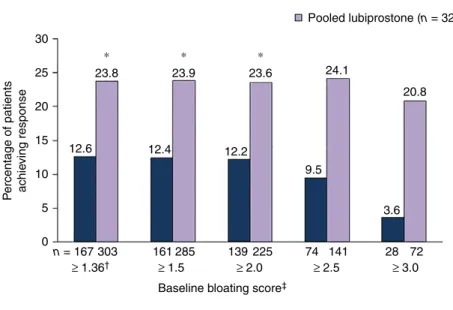
Bloating and stool frequency. Composite response rates in the pooled population with baseline bloating score
≥1.36 were significantly higher for patients who received
lubiprostone vs. placebo [23.8% (72/303) vs. 12.6% (21/
167); P =0.012; Figure 5]. Response rates with
lubipros-tone remained higher vs. placebo for patients in baseline
bloating score subgroups ≥1.5 and ≥2.0, but not in the
≥2.5 and ≥3.0 subgroups, where a numerical difference
was observed. Composite response rates for patients with
a baseline bloating score ≥1.36 were not significantly
dif-ferent between patients who received lubiprostone vs. pla-cebo in Study 1 [23.2% (38/164) vs. 13.8% (11/80) respectively] or Study 2 [24.5% (34/139) vs. 11.5% (10/87) respectively (Table S4)].
Pooled safety evaluation
At least one treatment-emergent AE was reported by 49.4% of patients who received lubiprostone and 45.3% Total enrollment
n = 505
Lubiprostone Placebo
n = 170
Lubiprostone n = 155
n = 170
n = 92
n = 92 Placebo
n = 88
n = 88 ITT
Discontinuation n = 25 (27.2%) Adverse events – 8.7% Lack of efficacy – 6.5% Lost to follow-up – 5.4% Non-compliance – 2.2% Other – 0.0%
Voluntary withdrawal – 4.3% Protocol violation – 0.0%
Discontinuation n = 29 (18.7%) Adverse events – 3.2% Lack of efficacy – 3.9% Lost to follow-up – 1.9% Non-compliance – 2.6% Other – 0.6%
Voluntary withdrawal – 5.8% Protocol violation – 0.6% Discontinuation
n = 42 (24.7%) Adverse events – 5.3% Lack of efficacy – 0.6% Lost to follow-up – 2.9% Non-compliance – 4.1% Other – 1.8%
Voluntary
withdrawal – 10.0% Protocol violation – 0.0% Discontinuation
n = 26 (29.5%) Adverse events – 2.3% Lack of efficacy – 4.5% Lost to follow-up – 3.4% Non-compliance – 3.4% Other – 1.1%
Voluntary
Protocol violation – 1.1%
Completion rate – 70.5% Completion rate – 75.3% Completion rate – 72.8% Completion rate – 81.3%
ITT ITT
n = 155 ITT n = 258
Study 1 Study 2
n = 247
withdrawal – 13.6%
who received placebo. The most frequently reported treatment-emergent AEs in the overall pooled population were gastrointestinal in nature and included nausea (7.9%), diarrhoea (4.4%) and abdominal pain (4.4%).
The frequency of these AEs in patients receiving lubipro-stone treatment vs. placebo, respectively, were nausea, 9.3% vs. 5.5%; diarrhoea, 4.9% vs. 3.3%; and abdominal pain, 3.7% vs. 5.5%. Of note, one patient in the pooled
Table 1 | Baseline demographic and clinical characteristics in two randomised, controlled studies of lubiprostone in patients with baseline SBM frequency<3/week (intent-to-treat populations)
Study 1 Study 2 Pooled Studies
Placebo (n=88)
Lubiprostone (n=170)
Placebo (n=92)
Lubiprostone (n=155)
Placebo (n=180)
Lubiprostone (n=325)
Sex,n(%)
Female 85 (96.6) 161 (94.7) 89 (96.7) 143 (92.3) 174 (96.7) 304 (93.5)
Male 3 (3.4) 9 (5.3) 3 (3.3) 12 (7.7) 6 (3.3) 21 (6.5)
Mean (s.d.) age, years 47.6 (12.4) 45.8 (12.9) 45.3 (12.0) 44.8 (11.8) 46.4 (12.2) 45.4 (12.4) Race/ethnicity,n(%)
White 64 (72.7) 117 (68.8) 68 (73.9) 112 (72.3) 132 (73.3) 229 (70.5)
Black/African American 16 (18.2) 28 (16.5) 17 (18.5) 33 (21.3) 33 (18.3) 61 (18.8)
Hispanic/Latino 7 (8.0) 25 (14.7) 7 (7.6) 10 (6.5) 14 (7.8) 35 (10.8)
Other 1 (1.1) 0 0 0 1 (0.6) 0
Mean (s.d.) abdominal discomfort/pain*
2.18 (0.69) 2.27 (0.67) 2.25 (0.63) 2.14 (0.70) 2.21 (0.66) 2.21 (0.69)
Mean (s.d.) bloating* 2.37 (0.69) 2.48 (0.69) 2.40 (0.62) 2.30 (0.74) 2.39 (0.65) 2.39 (0.72) Mean (s.d.) SBM
frequency/week
1.49 (0.85) 1.56 (0.91) 1.32 (0.94) 1.55 (0.87)† 1.40 (0.90) 1.56 (0.89)
SBM, spontaneous bowel movement.
Pvalues were calculated using a 2-samplet-test for continuous variables and a chi-square test for categorical variables. * Scale from 0 (absent) to 4 (very severe).
†P<0.05 vs. placebo.
25.2 36.7
24.5 36.5
18.5
36.2 36.0 37.2
Pooled placebo (n = 180)
Percentage of patients achieving response
Pooled lubiprostone (n = 325)
15.8
8.3 40
35
30
25
20
15
10
5
0
†
∗ ∗ ∗
n = 163 151 271 119 199 57 111 24 43
≥ 1.36‡ ≥ 1.5 ≥ 2.0 ≥ 2.5 ≥ 3.0 Baseline abdominal pain score§
289
population, a patient who received lubiprostone, experi-enced an AE of severe diarrhoea. Study discontinuation due to diarrhoea occurred in two patients overall, one who received placebo and one who was treated with lubiprostone.
DISCUSSION
In this analysis, treatment with lubiprostone significantly
improved abdominal pain compared with placebo in patients with a baseline abdominal pain level corre-sponding to the current FDA-recommended trial entry 35
30
25
20
15
10
5
0 20.4
32.0 32.6 32.0
29.8 29.2
10.7 14.9
19.4 19.9
n = 167 303 161
≥ 1.36‡ ≥ 1.5 ≥ 2.0 ≥ 2.5 ≥ 3.0 285 139 225 74 141 28 72
Baseline bloating score§
Pooled placebo (n = 180)
P
ercentage of patients achie
ving response
Pooled lubiprostone (n = 325)
† ∗ †
Figure 3 |Treatment response rates in patients with baseline bloating scores≥1.36. Treatment response defined as ≥30% improvement in bloating vs. baseline for≥6 of 12 treatment weeks by baseline bloating score (pooled data). *P <0.05.†P< 0.01.‡Equivalent to 3 on a scale of 0–10.§Scale from 0 (absent) to 4 (very severe).Pvalues compare placebo vs. lubiprostone, based on the Cochran–Mantel–Haenszel test stratified by pooled site.
30
25
20
15
10
5
0 15.3
26.3
15.2 25.8
10.1 24.6
10.5 24.3
4.2 23.3
n = 163 289 151 271 119 199 57 111 24 43
≥ 1.36‡ ≥ 1.5 ≥ 2.0 ≥ 2.5 ≥ 3.0 Baseline abdominal pain score§
∗
∗
†
Pooled placebo (n = 180)
Pooled lubiprostone (n = 325)
P
e
rcentage of patients achie
ving response
criteria for baseline abdominal pain. Furthermore,
lubiprostone significantly improved bloating vs. placebo
in patients with a baseline bloating score of ≥1.36 on a
5-point scale, a baseline bloating level that corresponds to that recommended by the FDA for baseline abdomi-nal pain. Response rates for the composite endpoint
rec-ommended by current guidance, improvement in
abdominal pain and stool frequency, were significantly
higher in patients who received lubiprostone compared with those who received placebo. Response rates for the composite endpoint of bloating and stool frequency also were higher with lubiprostone treatment vs. placebo.
The effects of lubiprostone vs. placebo were explored in subgroups of patients with higher intensity pain or
bloating scores at baseline (≥1.5, ≥2.0, ≥2.5 and ≥3.0 on
a 5-point scale) than those corresponding to the FDA
entry criteria (≥1.36 on a 5-point scale). In the pooled
analyses, significant differences favouring lubiprostone
treatment vs. placebo were seen in patient subgroups with higher baseline pain or bloating scores (e.g. those
with scores ≥2.0 at baseline), and absolute differences in
response rates with lubiprostone vs. placebo were larger in subgroups with higher baseline pain or bloating
scores. Lack of statistical significance in subgroups with
baseline scores of ≥2.5 or ≥3.0 may be related to small
sample sizes (the number of patients in each subgroup decreased with increased baseline score) as the difference
in effect size between the study arms was preserved in these subgroups.
Safety findings from the two pivotal studies have been
described elsewhere.7 In this pooled analysis, as has been
reported, the most common AEs were gastrointestinal, and lubiprostone was generally well-tolerated. Severe diarrhoea and study discontinuation due to diarrhoea were seldom seen; each occurred in one patient who had received lubiprostone. In a randomised, 26-week study of linaclotide, diarrhoea was the most common
treatment-emergent AE, occurring significantly more often with
linaclotide (19.7%; 79/402) compared with placebo (2.5%; 10/403). A total of eight patients (2%) experienced severe diarrhoea with linaclotide vs. none with placebo, and linaclotide was associated with study drug discontin-uation in 18 patients (4.5%) who received linaclotide and
one patient (0.2%) who received placebo.10 Lubiprostone
and linaclotide have not been compared directly in the same population; however, the available evidence sug-gests that diarrhoea is not a concern with lubiprostone treatment.
We faced a number of challenges in retrospectively applying current FDA guidance to our lubiprostone data set. Among the most important was that SBMs, not CSBMs (current guidance), were collected as an endpoint in lubiprostone studies. In studies which evaluated lina-clotide in patients with IBS-C, the relative difference 30
25
20
15
10
5
P
e
rcentage of patients achie
ving response
0
n = 167 303 161 285 139 225 74 141 28 72
≥ 1.36† ≥ 1.5 ≥ 2.0 ≥ 2.5 ≥ 3.0 Baseline bloating score‡
∗ ∗ ∗
Pooled placebo (n = 180)
Pooled lubiprostone (n = 325)
12.6 23.8
12.4 23.9
12.2 23.6
9.5 24.1
3.6 20.8
between SBM vs. CSBM frequency at baseline was
approximately 1:9.10, 11 Regarding change in SBM
com-pared with CSBM frequency with treatment, however,
the percentage of patients who experienced ≥1 increase
in SBMs per week with linaclotide was approximately
1.5–2 times higher than the percentage who experienced
≥1 increase in CSBM.10, 11 These results suggest that a
composite measure using SBMs would lead to a higher responder rate than if CSBMs were used. However, it should be noted that entry criteria for the lubiprostone studies compared with more recent studies were quite different even in the selected population analysed here
(patients had to have an SBM frequency <3/week at
baseline), and the baseline weekly SBM frequency was 1.5, which is lower than in patients who participated in
studies of linaclotide (1.8).11 Therefore, a≥1 increase in
SBMs per week in lubiprostone studies could be a
clinically relevantfinding.
Finally, the dose of lubiprostone (8 lg b.d.) used in
pivotal phase 3 studies and approved for the treatment of
IBS-C is lower than the 24lg b.d. dose of lubiprostone
that is approved for the treatment of patients with chronic
idiopathic constipation or opioid-induced constipation.6
The lower dose of lubiprostone used in these IBS-C stud-ies compared with the dose approved for patients with chronic idiopathic constipation or opioid-induced
consti-pation may play a role in the 10–14% lower response rate
observed using the composite endpoint compared with
using the abdominal pain only responder definition. In a
phase 2 dose-ranging trial evaluating the efficacy of
lubiprostone in IBS-C, the 24lg, but not 8 lg, b.d.
dosage was associated with significantly greater
improve-ment in abdominal pain/discomfort scores vs. placebo at month 1, although both doses showed similar
improve-ment in months 2–3.12 However, the higher dose of
lubiprostone was also associated with a higher incidence
of adverse events and as such the 8lg b.d. dose is
consid-ered optimal for providing the benefit of efficacy with
limited (low incidence and intensity) adverse events in IBS-C. It should be noted that the lubiprostone IBS-C studies were designed in accordance with Rome II criteria,
which defined the hallmark symptom of IBS as abdominal
pain, with reduced stool frequency as one of a number of criteria that a patient may report in order to qualify for
an IBS diagnosis.13
In conclusion, lubiprostone was significantly more
effective than placebo in improving abdominal pain based on baseline abdominal pain scores, and bloating based on baseline bloating scores. Despite the challenges involved in applying new criteria to historical data,
treatment with lubiprostone significantly improved the
composite endpoint of improvements in abdominal pain (by baseline pain scores) and stool frequency in patients with IBS-C. A composite endpoint evaluating improve-ment in bloating (by baseline bloating score) and stool
frequency also found lubiprostone to be significantly
more effective than placebo. These results were achieved despite the trials having been designed to apply a dose
(8lg b.d.) more suitable for treatment of pain; this dose
was lower than one that would have been administered with the intention of showing a more profound effect on bowel movement frequency.
SUPPORTING INFORMATION
Additional Supporting Information may be found in the online version of this article:
Table S1. Treatment response rate (percentage of
patients with ≥30% improvement in abdominal pain vs.
baseline for ≥6 of 12 treatment weeks by baseline
abdominal pain score) in Studies 1 and 2 in patients
with baseline abdominal pain scores≥1.36.
Table S2. Treatment response rate (percentage of
patients with≥30% improvement in bloating vs. baseline
for≥6 of 12 treatment weeks by baseline bloating score)
in Studies 1 and 2 in patients with baseline bloating
scores≥1.36.
Table S3. Treatment response rate in Studies 1 and 2
in patients with baseline abdominal pain scores ≥1.36
using a composite endpoint defined as ≥30%
improve-ment in abdominal pain and ≥1 increase in spontaneous
bowel movements per week vs. baseline for ≥6 of 12
treatment weeks by baseline abdominal pain score.
Table S4. Treatment response rate in patients with
baseline bloating scores ≥1.36, using a composite
end-point in Studies 1 and 2 defined as ≥30% improvement
in bloating and≥1 increase in spontaneous bowel
move-ments per week vs. baseline for≥6 of 12 treatment weeks
by baseline abdominal pain score.
AUTHORSHIP
Guarantor of the article: Lin Chang.
approved thefinal submitted version. Peter Lichtlen contributed to the analysis and interpretation of the data, provided critical review of the manuscript and approved the final submitted manuscript. Shadreck Mareya participated in the planning of the manuscript, analysis and interpretation of data, review of manuscript drafts, and approval of thefinal submitted manuscript.
ACKNOWLEDGEMENTS
This study and the additional analyses were sponsored by Sucampo Pharma Americas, LLC, Bethesda, MD, and Takeda Pharmaceuticals International, Deerfield, IL. Writing and editorial support was pro-vided by Patrick Little, PhD, and Mariana Ovnic, PhD, of Complete Publication Solutions, LLC (North Wales, PA, USA) and was funded by Takeda Pharmaceuticals International, Inc.
Declaration of personal interests: LC was an advisory board member for Allergan, Ardelyx, AstraZeneca, Commonwealth
Laboratories, Ironwood Pharmaceuticals, QOL Medical, Salix, Syn-ergy and Takeda Pharmaceuticals. WDC has served as a consul-tant to Allergen, Ardelyx, AstraZeneca, Forest Laboratories, Inc., Ironwood Pharmaceuticals, Inc., Nestle, Prometheus Laboratories, Inc., SK biopharmaceuticals, Sucampo and Takeda Pharmaceuti-cals, and has received research grant support from Ironwood Pharmaceuticals, Inc., Nestle, Prometheus, and Perrigo. DD has served on advisory boards for AstraZeneca, QOL Medical LLC, Salix Pharmaceuticals and Takeda Pharmaceuticals. TLB, MW, SM and PL are employees and stock option holders of Sucampo Pharmaceuticals, Inc.
Declaration of funding interests: This study and the additional analyses were sponsored by Sucampo Pharma Americas, LLC, Bethesda, MD, and Takeda Pharmaceuticals International, Deer-field, IL.
REFERENCES
1. Lovell RM, Ford AC. Global prevalence of and risk factors for irritable bowel syndrome: a meta-analysis.Clin
Gastroenterol Hepatol2012;10: 712–21; e4. 2. Longstreth GF, Thompson WG, Chey
WD, Houghton LA, Mearin F, Spiller RC. Functional bowel disorders.
Gastroenterology2006;130: 1480–91. 3. Chey WD, Drossman DA, Johanson JF,
Scott C, Panas RM, Ueno R. Safety and patient outcomes with lubiprostone for up to 52 weeks in patients with irritable bowel syndrome with constipation.
Aliment Pharmacol Ther2012;35: 587–99.
4. Jadallah KA, Kullab SM, Sanders DS. Constipation-predominant irritable bowel syndrome: a review of current and emerging drug therapies.
World J Gastroenterol2014;20: 8898–909.
5. Bielefeldt K, Levinthal DJ, Nusrat S. Effective constipation treatment changes more than bowel frequency: a
systematic review and meta-analysis.
J Neurogastroenterol Motil2016;22: 31–45.
6. Amitiza(Lubiprostone). Full Prescribing Information, Sucampo Pharma Americas, LLC and Takeda Pharmaceuticals America, Inc., Bethesda, MD, and Deerfield, IL, 2013. 7. Drossman DA, Chey WD, Johanson JF,
et al.Clinical trial: lubiprostone in patients with constipation-associated irritable bowel syndrome–results of two randomized, placebo-controlled studies.
Aliment Pharmacol Ther2009;29: 329–41. 8. US Food and Drug Administration.
Guidance for Industry Irritable Bowel Syndrome-Clinical Evaluation of Drugs for Treatment. Rockville, MD: US Department of Health and Human Services; 2012.
9. Trentacosti AM, He R, Burke LB, Griebel D, Kennedy DL. Evolution of clinical trials for irritable bowel syndrome: issues in end points and study design.Am J Gastroenterol2010; 105: 731–5.
10. Chey WD, Lembo AJ, Lavins BJ,et al.
Linaclotide for irritable bowel syndrome with constipation: a 26-week,
randomized, double-blind, placebo-controlled trial to evaluate efficacy and safety.Am J Gastroenterol2012;107: 1702–12.
11. Lacy BE, Lembo AJ, Macdougall JE,et al.
Responders vs clinical response: a critical analysis of data from linaclotide phase 3 clinical trials in IBS-C.Neurogastroenterol Motil2014;26: 326–33.
12. Johanson JF, Drossman DA, Panas R, Wahle A, Ueno R. Clinical trial: phase 2 study of lubiprostone for irritable bowel syndrome with constipation.Aliment Pharmacol Ther2008;27: 685–96. 13. The Rome Foundation. Appendix B: