Christina Cortland. Crowdfunding in Libraries: An Analysis of Library Crowdfunding Project Data. A Master's paper for the M.S. in I.S. degree. April, 2019. 61 pages. Advisor: Jaime Arguello
Crowdfunding is one of the newest strategies libraries are using to connect with donors. While the past several years have produced a consistent trickle of reports about libraries using crowdfunding to extend traditional fundraising activities, research thus far has largely been constrained to case studies and surveys. By studying 174 library and archive projects on Kickstarter and Indiegogo, this research determined that library and archive crowdfunding campaigns raise more money on average and are more likely to
successfully meet their funding goals than typical Kickstarter campaigns. Additional findings regarding types of projects crowdfunded, types of libraries crowdfunding, and amount of campaigns launched over time are discussed. This study hopes to support library practitioners in judging the feasibility of crowdfunding as a practical fundraising strategy and determining the contexts in which crowdfunding is most likely to be successful.
Headings:
CROWDFUNDING IN LIBRARIES:
AN ANALYSIS OF LIBRARY CROWDFUNDING PROJECT DATA
by
Christina Cortland
A Master's paper submitted to the faculty of the School of Information and Library Science of the University of North Carolina at Chapel Hill
in partial fulfillment of the requirements for the degree of Master of Science in
Information Science.
Chapel Hill, North Carolina April, 2019
Approved by:
Table of Contents
Introduction... 2
Background... 3
Crowdfunding Basics... 3
Crowdfunding Principles... 4
Crowdfunding in Libraries... 7
Ethics of Crowdfunding Libraries... 9
Research Design... 11
Platform Selection... 11
Stage 1: Filter by Search and Tags... 13
Stage 2: Filter by Manual Review... 14
Results... 19
How many crowdfunding fundraisers have been run by or in partner with a library or archival institution? ... 19
What types of projects do library or archival institutions crowdfund? ... 24
How do crowdfunding fundraiser characteristics correlate to fundraiser success?... 29
Discussion... 38
Impact of Platform Selection... 38
Comparison with General Crowdfunding Trends... 40
Limitations... 41
Future Directions... 43
Conclusion... 45
References... 46
Appendices... 57
Appendix A. Benchmark Library Crowdfunding Campaigns on Kickstarter and Indiegogo... 57
Introduction
Fundraising from private donors is a familiar strategy for libraries to raise financial support, attention, and enthusiasm. For many libraries, individual donations do not just supplement government funding, corporate and university funding, or grants; they may be the primary source of a library's operating budget (Unisphere Media, 2013; "Survey of public library fundraising practices," 2014). Crowdfunding, the practice of raising small amounts of money online from groups of Internet users to fund a particular project (Butticè, Franzoni, Rossi-Lamastra, & Rovelli, 2018), is one of the newest strategies libraries are using to connect with donors.
While the past several years have produced a consistent trickle of reports about libraries using crowdfunding to extend traditional fundraising activities (Bowley, 2012; Cottrell, 2014; Cruz, 2014; James, 2017; Kalish, 2011; Mies, 2015; Peet, 2015; Ravipati, 2017; Schwartz, Klose, Lewis, Oder, & Warburton, 2013; Wilson, 2017), research thus far has largely been constrained to case studies and surveys (Bushong, Cleveland, & Cox, 2018; Riley-Huff, Herrera, Ivey, and Harry, 2016). Little research has yet been conducted to understand the true size and financial impact of library crowdfunding in the United States. By studying the shape of the library crowdfunding landscape, we can support library administrators and practitioners to:
Background Crowdfunding Basics
Crowdfunding is a relatively new term for what is merely the latest evolution of the much older and more familiar concept of community fundraising. In 1885, Joseph Pulitzer launched a successful campaign in the New York World newspaper to raise $100,000, or about $2.6 million today ("Inflation calculator," 2018), from more than 160,000 donors to pay for the pedestal for the Statue of Liberty (Davies, 2014). In 2014, LeVar Burton and Reading Rainbow used the online crowdfunding platform, Kickstarter, to raise $5.4 million from 106,000 backers to bring the Reading Rainbow's digital
collection to more platforms (Burton & Reading Rainbow, 2014). While the methods for fundraising changed between 1885 and 2014, both Joseph Pulitzer and LeVar Burton employed the same fundamental concept of raising funds from a large population of individuals.
Today, crowdfunding comes in four basic types: equity-based, lending-based, reward-based, and donation-based crowdfunding (Butticè et al., 2018):
1. In equity crowdfunding, sometimes referred to as "crowdinvesting," crowds on platforms like Wefunder and SeedInvest can invest in a company in exchange for a small share of the business.
3. Reward-based crowdfunding has been popularized by platforms such as Kickstarter and Indiegogo. Funders contribute to reward-based crowdfunding campaigns in exchange for a product or gift.
4. In donation-based crowdfunding on platforms like GoFundMe, donors contribute to support a cause with no expected remuneration.
The term "crowdfunding" in the literature has typically focused on reward- and donation-based crowdfunding, with separate research covering peer-to-peer lending or equity crowdfunding. This paper will continue with that focus.
In 2015, reward- and donation-based crowdfunding was a $5.5 billion global industry ("Crowdfunding Industry Statistics 2015 2016," 2016). Reward-based
crowdfunding campaigns are typified by technology and artistic projects, such as those seeking to develop a product, film, or game. Many donation-based crowdfunding campaigns seek to cover medical expenses or disaster relief. Civic crowdfunding, in which funds are raised for projects that provide services to communities (Davies, 2014), and nonprofit crowdfunding projects, have found success in both arenas.
Crowdfunding is not synonymous with general online fundraising. According to Davies (2014), crowdfunding is inherently public. Amount raised, number of donors, and campaign timeline are typically public details of a crowdfunding campaign. A mutual awareness of shared participation in online crowdfunding can harness more of a social movement than the more isolated act of online fundraising.
Crowdfunding Principles
category can determine what crowdfunding platform is used. For example, Kickstarter does not allow any projects to raise funds for charity ("Our rules — Kickstarter," n.d.), while DonorsChoose allows only public school classroom projects. Some platforms like ScaleFunder also provide branded campaign pages on custom domains while others like GoFundMe require their organizers to create pages under the platform's top-level domain and branding.
Typical crowdfunding campaigns have a limited duration and funding goal to focus marketing efforts and create a sense of urgency in the target funder base. However, some platforms allow campaigns to run past their deadline or to have no deadline. Goals are also self-selected, though many platforms may have minimum or maximum goals that can affect how the campaign organizers receive their money. Kickstarter projects can only receive funds raised if their goal is met (known as "all-or-nothing" funding), while many projects on Indiegogo can keep all funds raised regardless of goal ("flexible" funding). All-or-nothing campaigns that cannot meet their goal by their deadline typically refund all donations.
Because so many of these factors can differ between projects, crowdfunding literature has focused its attention on identifying the determinants of a successful crowdfunding campaign (Butticè et al., 2018; Kaartemo, 2017). Campaigns that seek to develop radical innovations are less successful than those creating incremental
contribute to a lower likelihood of success in the U.S., but higher in China. The amount and quality of information given about the project on campaign pages and in project updates are also positively correlated with success (Butticè et al., 2018). However, information overload can begin to degrade the likelihood of success past a certain point (Moy, Chan, & Torgler, 2018). The presence of short videos, images, and external links also improve the probability of success (Butticè et al., 2018).
It's important to note that "success" in the overwhelming majority of this research is defined by meeting the target funding goal. However, the literature recognizes that the amount of money raised is not the only value of crowdfunding; other benefits of
crowdfunding include market validation, direct user feedback, and building social capital and awareness (Liu & Wang, 2018; Mollick, 2016). Project success may also differ from campaign success: crowdfunding organizers that did not meet their campaign's funding goal might still successfully achieve their project's goal on a smaller budget. For example, organizers attempted to raise $20,000 in a flexible funding campaign on
Indiegogo to establish the Antelope Lending Library in Iowa City. They ultimately raised $13,000 that went towards a bookmobile instead (Schwartz et al., 2013). Similarly, the Pikes Peak Library District Foundation ended up meeting their funding goal with offline donations received after their online campaign launch (Cruz, 2014). These types of success are not considered in studies that look only at whether a campaign has reached its funding goal.
but their ultimate failure to deliver promised products to their 12,075 backers was highly public (Trew, 2018). Closer to home, Riley-Huff et al. (2016) shares a similar story that befell a different project on Kickstarter to create a gamified reading app called the Game of Books (Stanton, 2012). The campaign successfully raised almost $110,000 but
ultimately had to refund its 1,327 backers after failing to deliver promised rewards. Crowdfunding in Libraries
In one of the earliest published articles prophesying the benefits Internet
technologies can have for library fundraising efforts, Corson-Finnerty (2000) proposes a "science fiction" idea of "micropayments":
One way or another, we will soon be able to spend small amounts of money online—perhaps 15 cents for a transaction. Whether this payment is made through digital cash or through micro-debit is immaterial. Think about how an institution might be able to raise hundreds of thousands of dollars through micropayments— even millions! (p. 620)
Corson-Finnerty predicted the value that libraries would find in online fundraising several years before libraries actually found it (Holt & Horn, 2005; Price, 2014).
In 2013, Leman identified the potential value of crowdfunding for libraries as a call to action for the library field: "The age of crowdfunding is upon us, and opportunities abound for savvy librarians and information scientists" (p. 31). Since that time, scattered press releases and case studies have highlighted individual library crowdfunding
campaigns.
Cottrell (2014) highlights a 2013 campaign launched on Indiegogo by the Northlake (Ill.) Public Library District to raise $30,000 to buy a statue of the Incredible Hulk, a stack of new graphic novels, and new technology, including a 3D printer and an iMac with a drawing pad. Although they ultimately raised $4,262, a generous individual in California saw the campaign online and donated his own Hulk statue.
Bushong et al. (2018) examine three academic library crowdfunding projects, including University of Northern Iowa's Rod Library successful 2015 campaign to purchase a Microsoft Surface Hub. Using UNI's branded crowdfunding platform by ScaleFunder, they raised $8,622 from 99 donors, exceeding their goal of $7,500.
Raising money from individual donors to support GLAM projects has not been the only use of crowdfunding by libraries and archives. While the focus of this study is on community-based crowdfunding, Reveal Digital presents an alternative model in which libraries back projects to digitize collections ("How it works – Reveal Digital," n.d.; Rathemacher, 2015; Reinsfelder & Pike, 2018). Collections that meet their funding goals are made open access after digitization is complete.
Ethics of Crowdfunding Libraries
When crowdfunding is used for the benefit of communities in response to
tightening budgets, important questions need to be raised around the impact of harnessing community dollars (Davies, 2014; Minton, 2017; Pautz, 2014; Pelley, 2017; Sullivan, 2016). According to Pautz (2014):
Questions need to be asked about whether sponsorships, donation campaigns and government grants not only make it possible to provide some services to the public but also inhibit the provision of other services that would be of more relevance to less privileged and less visible groups of library (non-)users. This could be the case when staff and time resources have to be invested into funding campaigns to raise money for “flagship projects” financed by the great and the good, so that these resources are not available for the existing fundamental commitments of the public library. (p. 569)
This is especially true for public libraries, which strive to support diverse communities. By seeking dollars from the community, those with cash are given the power to
Research Design
This study took a non-experimental approach to gather quantitative data about crowdfunding campaigns organized by libraries and archives. Data was analyzed in bulk from online crowdfunding pages. This research seeks to answer the following questions: 1. How many crowdfunding fundraisers on Kickstarter and Indiegogo have been run
by or in partner with a library or archival institution?
2. What types of projects do library or archival institutions crowdfund?
3. How do crowdfunding fundraiser characteristics (e.g. project category, library type, platform) correlate to fundraiser success as measured by percentage of funding goal raised and amount raised?
Platform Selection
Data from library and archival crowdfunding pages on the crowdfunding
platforms Kickstarter and Indiegogo were collected for analysis. The two platforms were selected based on the following criteria:
1. frequently mentioned by press articles highlighting past library fundraisers; 2. hosts a significant number of U.S.-based fundraisers;
3. focuses on reward- or donation-based crowdfunding for general or cause fundraising;
4. receives significant site traffic;
6. allows research in its platform Terms of Use.
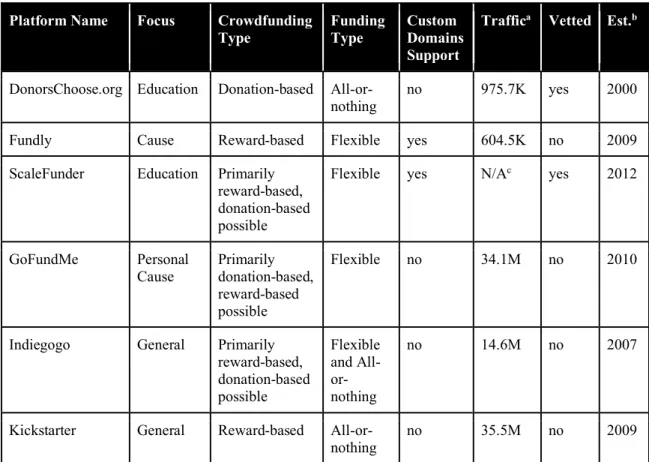
GoFundMe, Fundly, DonorsChoose.org, and ScaleFunder were additional platforms that met the first two criteria, but missed at least one of the final four. See Table 1 for a comparison of platforms.
Table 1. Comparison of crowdfunding platforms
Platform Name Focus Crowdfunding Type Funding Type Custom Domains Support
Traffica Vetted Est.b
DonorsChoose.org Education Donation-based All-or-
nothing no 975.7K yes 2000
Fundly Cause Reward-based Flexible yes 604.5K no 2009
ScaleFunder Education Primarily reward-based, donation-based possible
Flexible yes N/Ac yes 2012
GoFundMe Personal
Cause Primarily donation-based, reward-based possible
Flexible no 34.1M no 2010
Indiegogo General Primarily reward-based, donation-based possible Flexible and All-or- nothing
no 14.6M no 2007
Kickstarter General Reward-based All-or-
nothing no 35.5M no 2009
a Traffic data collected from SimilarWeb. Represents # of visits in February 2019. b Est. data collected from S&P Global Market Intelligence on bloomberg.com. c Not enough data for SimilarWeb to show complete estimates.
Stage 1: Filter by Search and Tags
Because its scope was narrower than the crowdfunding categories available on the selected platforms, this research was unable to rely on existing category or tag filters available on each platform. For example, Indiegogo has a Community category ("Support community projects at Indiegogo," 2019) that allows a broad range of fundraisers that includes sustainability and human rights projects. Kickstarter uses tags and curated collection pages that are closely aligned to library or archival fundraisers, e.g. their "bookish" and "conservation" tags and their staff-curated collection of "Archives" projects ("Archives on Kickstarter," n.d.). However, additional search strategies were necessary for generating a more comprehensive set of fundraisers.
This first set of crowdfunding page URLs were collected from the following: ● Related tag filters or curated collections (Kickstarter only)
● Keyword-based searches using platform search APIs
● Keyword-based Google site searches (e.g. "site:kickstarter.com/projects") ● Benchmark library fundraisers compiled from the same literature that informed
the chosen platforms. See Appendix A for the list of benchmarked fundraisers and their news sources.
Table 2. Keywords used in platform and Google searches
Stem Keywords
"librar*" "libraries," "library," "librarian," "librarians"
"archiv*" "archive," "archives," "archival," "archivist," "archivists"
Additional filters were applied when aggregating this first set of crowdfunding page URLs. Fundraisers located outside of the United States were excluded based on the geographic locations self-selected by project organizers. Fundraisers that raised less than $10 were also excluded to remove inactive or test pages from the final selection.
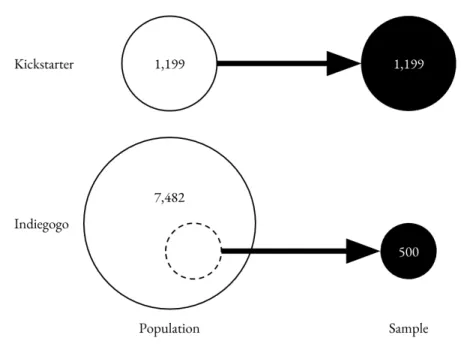
Suspended and canceled fundraisers were also excluded. The final aggregated set of crowdfunding page URLs from Stage 1 was then stripped of parameters and de-duplicated. In this first stage of data collection, 1,199 crowdfunding page URLs were collected from Kickstarter and 7,482 crowdfunding page URLs were collected from Indiegogo. These page URLs represented both successful and unsuccessful crowdfunding campaigns. This data was collected in January and February 2019.
Stage 2: Filter by Manual Review
The subset of crowdfunding page URLs generated in Stage 1 needed to be
reviewed manually to generate a final set of fundraisers that fit this study's narrow scope. Because of the large size of the dataset, the decision was made to review the entire population of Kickstarter projects within the Stage 1 dataset, but only review a sample population of the larger number of Indiegogo projects. In addition to the 1,199
and researched to determine if it was run by or in partner with a library or archival institution.
Figure 1. Kickstarter and Indiegogo Samples Selected for Analysis from Study Population
Operationalizing "library or archival institution."
specific" (Stewart, 2015). This "less specific" use of the word "library" proved to be common in the Stage 1 crowdfunding pages.
For the purpose of this research, Stage 2 of data collection employed a stricter definition of "library." Fundraisers from the Stage 1 dataset were categorized according to criteria matching Eberhart's definition of a "library" (2010):
A library is a collection of resources in a variety of formats that is (01) organized by information professionals or other experts who (02) provide convenient physical, digital, bibliographic, or intellectual access and (03) offer targeted services and programs (04) with the mission of educating, informing, or entertaining a variety of audiences (05) and the goal of stimulating individual learning and advancing society as a whole. (p. 1)
This excluded projects raising funds to create a "digital library" of educational videos, icon or sound effects libraries intended for graphic design or media usage, or personal libraries. This also excluded over 90 projects from Kickstarter's Stage 1 dataset that were raising funds to install a Little Free Library, a mailbox-sized neighborhood book
exchange ("Little Free Library FAQs," n.d.), in their neighborhood.
The decision was made to include fundraisers for archival institutions as a result of the overlap between archives and libraries. According to the Society of American Archivists (SAA), archives share many of the same characteristics as libraries, "but differ from libraries in both the types of materials they hold, and the way materials are
Common project patterns emerged in the initial dataset, and inclusion criteria was generated based on these patterns. In general, the following fundraisers were included in the final dataset:
● fundraisers organized by specific library or archival institutions;
● fundraisers organized by library or archival partners, such as Friends of the Library groups or professional networks for librarians and archivists;
● fundraisers seeking to benefit the library or archival field through professional development opportunities or new tools; and
● fundraisers seeking to build new library or archival institutions in the United States.
The following fundraisers were not included in the final dataset: ● fundraisers organized by museums;
● fundraisers organized by individual librarians, archivists, or information professionals for personal projects;
● fundraisers organized by individuals or organizations unaffiliated with library or archival institutions raising funds to process individual archival collections; and ● fundraisers to create a database or catalog of content.
See Appendix B for a more complete set of inclusion criteria. Data Collection.
institutions were given the "partner" organizer type (see Appendix B). For example, LA Makerspace raised $17,531 in partner with the Los Angeles Public Library System to provide STEAM and maker training to LA public librarians (LA Makerspace, 2014). Fundraisers to create a new library or archival institution were given an "other" organizer type. The type of library associated with the fundraising organizer was also identified as one of the following: "public," "special," "academic," "lending," "school," or "archive." If the organizer was a partner of libraries or archives, and the primary type of library or archive of its partner could not be determined, its library type was left blank. The primary purpose for each crowdfunding campaign was selected from a finite set of project
categories generated inductively during Stage 2 review (e.g. "process materials," "[library] programming"). For campaigns that were fundraising for multiple purposes (e.g. for cataloging photographs AND producing a photobook), a best attempt was made to identify the primary purpose from the project descriptions. Each of these values was determined by reviewing the crowdfunding page and organizer profile page content.
Finally, using data provided by Kickstarter and Indiegogo campaign and search APIs, the following fundraiser attributes were collected for each crowdfunding page in the final dataset:
● amount raised ● funding goal ● starting year
Results
How many crowdfunding fundraisers have been run by or in partner with a library or archival institution?
In total, data from 174 crowdfunding projects across Kickstarter and the
Figure 2. Estimated count of library and archival campaigns on Kickstarter (KS) and Indiegogo (IGG)
* Gray bar indicates estimated count of library and archive campaigns in Indiegogo study population of 7,482 campaigns based on a 500-campaign sample at a 95% confidence level and 1.6% margin of error. Black bars indicate actual count of library
and archive campaigns in Kickstarter and Indiegogo samples.
Organizer Type.
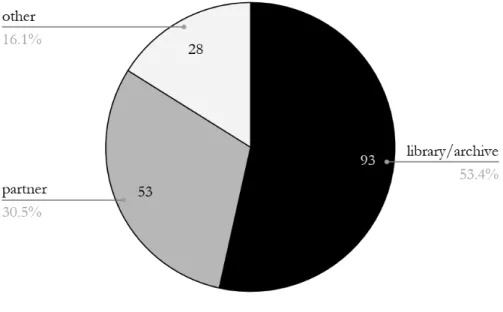
53.4% (n=93 [KS: n=82; IGG: n=11]) of projects were organized by an actual library or archival institution while 30.5% (n=53 [KS: n=48; IGG: n=5]) were managed in partner with or by a partner of library and/or archival institutions. 16.1% (n=28 [KS:
n=25; IGG: n=3]) were managed by an individual or organization that wanted to build a
Figure 3. Campaign count by organizer type
Library Type.
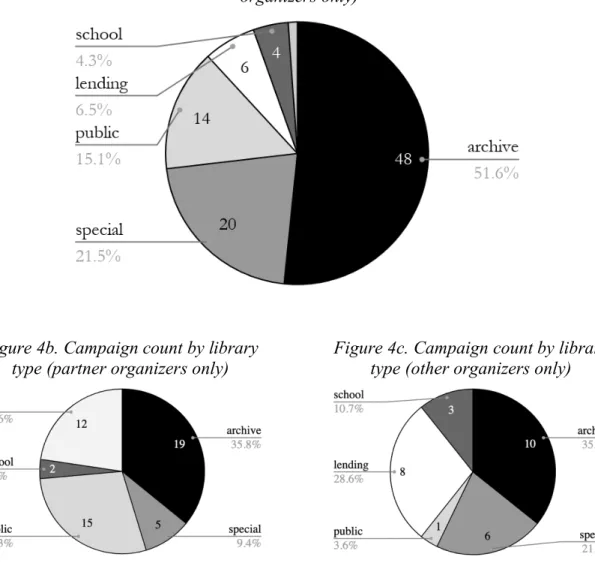
Of the 93 campaigns organized by a library or archival institution (organizer type="library/archive"), the majority were organized by archives (51.6%, n=48), special libraries (21.5%, n=20), or public libraries (15.1%, n=14) (see Figure 4a). Of the 53 campaigns organized by a partner of library or archival institutions (organizer
type="partner"), the majority of projects were organized by partners of archives (35.8%, n=19) and partners of public libraries (28.3%, n=15) (see Figure 4b). Of the 28
Figure 4a. Campaign count by library type (library/archive organizers only)
Figure 4b. Campaign count by library type (partner organizers only)
Table 3. Campaign count by library type, organizer type, and platform
library/archive partner other ALL
ORGANIZERS
library
type KS IGG KS+IGG KS IGG KS+IGG KS IGG KS+IGG KS IGG KS+IGG
archive 41 7 48 18 1 19 10 0 10 69 8 77
special 19 1 20 4 1 5 5 1 6 28 3 31
public 12 2 14 15 0 15 1 0 1 28 2 30
school 3 1 4 2 0 2 2 1 3 7 2 9
academic 1 0 1 0 0 0 0 0 0 1 0 1
lending 6 0 6 0 0 0 7 1 8 13 1 14
-a 0 0 0 9 3 12 0 0 0 9 3 12
TOTAL 82 11 93 48 5 53 25 3 28 155 19 174
a If the organizer was a partner of libraries or archives, and the primary type of library or archive of its partner could not be determined, its library type was left blank.
Launch Year.
Figure 5. Campaign count by starting year
What types of projects do library or archival institutions crowdfund?
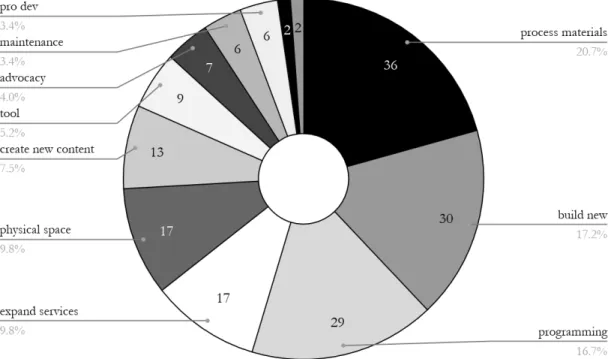
The crowdfunding campaigns in this dataset raised funds for the following project categories (Figure 6):
● Process Materials: For 20.7% of projects (n=36), the primary purpose of raising funds was to process materials in the institution's holdings. This included fundraising for staff time or equipment to digitize or catalog materials.
● Build New: 17.2% of projects (n=30) were fundraising to build a new library or archival institution.
● Programming: 16.7% of projects (n=29) fundraised to develop or continue library programming or archival exhibits.
● Expand Services: Another 9.8% (n=17) fundraised to expand services, such as develop a new mobile app, create a new video tutorial series, or set up additional pop-up locations.
● Create New Content: 7.5% (n=13) sought funds to create and sell derivative content from the institution's own library or archival holdings. For example, the Henry Miller Memorial Library in Big Sur, California successfully raised over $8,500 on Kickstarter to create a film about Henry Miller's Paris (Henry Miller Library, 2014).
● Tool: 5.2% of projects (n=9) raised funds to develop and/or distribute a new tool for librarians and archivists, such as a new digitization scanner or digital file distribution tool.
● Advocacy: 4.0% (n=7) raised funds for library or archival advocacy projects. For example, SLRI Productions successfully raised over $8,500 on Kickstarter to make a documentary highlighting the impact of school librarians (SLRI Productions, 2017).
● Professional Development: 3.4% (n=6) raised funds to bring professional development opportunities to librarians and archivists, including developing podcasts to spotlight and share innovative projects.
● Maintenance: 3.4% (n=6) raised funds for general maintenance purposes. For example, one public library used Indiegogo to supplement general operation costs after recent county budget cuts.
● Collection Development: Two projects (1.1% of projects) raised funds for acquisition or collection development purposes.
Figure 6. Campaign count by primary project category
Platform.
Because of the small number of Indiegogo campaigns in the dataset, differences between platforms in campaign count per project category were difficult to determine (see Table 4). The largest difference in percentage of campaigns per project category between platforms was for maintenance projects. Only 1.3% (n=2) of Kickstarter
Table 4. Campaign count by project category and platform
project category % KS % IGG
process materials 21.2% (n=33) 15.8% (n=3) build new 16.8% (n=26) 21.1% (n=4) programming 17.4% (n=27) 10.5% (n=2) expand services 9.7% (n=15) 10.5% (n=2) physical space 10.3% (n=16) 5.3% (n=1) create new content 7.7% (n=12) 5.3% (n=1)
tool 4.5% (n=7) 10.5% (n=2)
advocacy 4.5% (n=7) 0%
maintenance 1.3% (n=2) 21.1% (n=4) professional development 3.9% (n=6) 0%
expand content 1.3% (n=2) 0% collection development 1.3% (n=2) 0%
TOTAL 155 19
Organizer Type.
Using a nominal logistic regression test, we can reject the null hypothesis that the project category (where n>10) and organizer type are statistically independent (p<0.05). However, because of the small number of campaigns per project category (Table 5), significant differences between organizer types for each category could not be
Campaigns to build a new library or archive were more likely to be created by individuals or organizations outside of the library field.
Table 5. Campaign count by project category and organizer type
project category % library/archive % partner % other
process materials 28.0% (n=26) 18.9% (n=10) 0%
build new 1.1% (n=1) 1.9% (n=1) 100% (n=28) programming 17.2% (n=16) 24.5% (n=13) 0%
expand services 16.1% (n=15) 3.8% (n=2) 0% physical space 16.1% (n=15) 3.8% (n=2) 0% create new content 10.8% (n=10) 5.7% (n=3) 0%
tool 0% 17.0% (n=9) 0%
advocacy 0% 13.2% (n=7) 0%
maintenance 6.5% (n=6) 0% 0%
professional development 0% 11.3% (n=6) 0%
expand content 2.2% (n=2) 0% 0%
collection development 2.2% (n=2) 0% 0%
TOTAL 93 53 28
Library Type.
while projects to process existing materials or create creative content for sale were more likely to be organized by archives than libraries (Table 6).
Table 6. Campaign count by project category and library type
project category librarya archive - b
process materials 4.7% (n=4) 41.6 % (n=32) 0% build new 23.5% (n=20) 13.0% (n=10) 0%
programming 22.4% (n=19) 9.1% (n=7) 25.0% (n=3) expand services 16.5% (n=14) 3.9% (n=3) 0%
physical space 16.5% (n=14) 3.9% (n=3) 0% create new content 2.4% (n=2) 14.3% (n=11) 0%
tool 2.4% (n=2) 5.2% (n=4) 25.0% (n=3)
advocacy 5.9% (n=5) 1.3% (n=1) 8.3% (n=1) maintenance 3.5% (n=3) 3.9% (n=3) 0%
professional development 1.2% (n=1) 0% 41.7% (n=5)
expand content 0% 2.6% (n=2) 0%
collection development 1.2% (n=1) 1.3% (n=1) 0%
TOTAL 85 77 12
a "Libraries" includes special, public, academic, school, and lending libraries.
b If the organizer was a partner of libraries or archives, and the primary type of library or archive of its partner could not be determined, its library type was left blank.
How do crowdfunding fundraiser characteristics correlate to fundraiser success? Platform.
projects successfully met their goal while 29.0% (n=45) did not meet their goal. Because Kickstarter projects use an all-or-nothing model, this means that 29.0% of Kickstarter projects received no money. This 71.0% success rate for library and archival projects was considerably higher than the 42.2% success rate across all projects on Kickstarter that raised at least 1% of their goal ("Kickstarter stats," 2019). In contrast, only 26.3% (n=5) of the Indiegogo projects successfully met their goal while 73.7% (n=14) did not meet their goal. Because all of the Indiegogo projects in this dataset used a flexible funding model, however, every Indiegogo fundraiser received the money they raised (minus fees). Unfortunately, Indiegogo does not publish success stats for their projects, so this could not be compared to overall platform success rates. Using a two-tailed Fisher's exact test, we can determine that this difference in success rates per platform is statistically
significant (p<0.05).
Figure 7. Campaign success rates by platform
words, Kickstarter projects typically either successfully met their goals or came short by a large margin. 78.7% (n=122) of the Kickstarter projects that raised at least 20% of their goal were successfully funded, matching the pattern found across all Kickstarter projects ("Kickstarter Stats," 2019). Perhaps because flexible funding projects experience less urgency around meeting their funding goals (flexible funding projects receive the amount they raise regardless of whether or not they meet their goal), Indiegogo reflected a more even distribution of goal met percentage (Figure 8b). 63.2% (n=12) of the Indiegogo projects that raised at least 20% of their goal were successfully funded. Using a nonparametric Wilcoxon test, we can determine that the distributions illustrated in Figure 8a (KS) and 8b (IGG) are significantly different (p<0.05).
Figure 8a. Percent of goal raised for
Kickstarter projects Figure 8b. Percent of goal raised for Indiegogo projects
The distribution of amount raised (in USD) across both platforms had a high positive skew due to scattered outlier projects that overfunded their project goals (Figure 9). Across both platforms, the median was $4,930, the mean was $23,481, and the 5% trimmed mean (excluding outliers) was $11,334. The interquartile range was $13,394 with 75% of projects raising between $1,634 and $15,028.
published average across all projects ($9,532) ("Kickstarter stats," 2019). For a more fair comparison, taking into account differences in methodology, the non-trimmed mean for projects that successfully met their goal ($34,932) can also be similarly compared to Kickstarter's average across all successful projects ($23,221) ("Kickstarter Stats," 2019).
Indiegogo's numbers shifted left of average with a median of $3,551, a mean of $8,326, and a 5% trimmed mean of $5,635. However, a nonparametric Wilcoxon test did not find this difference between platforms significant. The maximum amount of funds raised for a library or archival project in the dataset was $1,126,036 for a Kickstarter project. The maximum amount raised on an Indiegogo project in the dataset was $62,241.
Figure 9. Distribution of amount raised (logarithmic scale)
Organizer Type.
most likely to meet their goals while projects by others are least likely to meet their goals (p<0.05).
Figure 10. Campaign success rates by organizer type
Comparing percent of goal raised and amount raised to organizer type showed similar trends. A Kruskal-Wallis test identified a significant difference between organizer type means (p<0.05). Using a Dunn's test to compare groups, projects organized by either library or archival institutions or their partners were found to raise more in both amount raised and percent of goal than "other" organizer types (see Table 7).
Table 7. Average percent of goal raised and amount raised by organizer type
percent of goal raised amount raised (in USD)
organizer type mean 5% trimmed
mean mean
5% trimmed mean library/archive (n=93) 97.8% 92.0% $17,276 $11,177
partner (n=53) 126.1% 103.5% $40,423 $13,969
Library Type.
Figure 11 shows success rates per library type. However, there was no statistical difference found between success rates or average percent of goal raised for each library type. When comparing amount raised to library type, a Kruskal-Wallis test revealed a statistically significant relationship between amount raised and library type (p<0.05). Using a Dunn's test to compare groups, projects organized by archives were found to raise 3 times more on average than public libraries (see Table 8).
Table 8. Average percent of goal raised and amount raised by library type
percent of goal raised amount raised (in USD)
library type mean 5% trimmed mean mean 5% trimmed mean
archive (n=77) 108.6% 102.7% $36,580a $16,169
special (n=31) 85.3% 82.1% $40,423 $13,969
public (n=30) 66.1% 65.1% $7,167a $4,528
school (n=9) 73.9% 78.5% $11,575 $3,615
academic (n=1) 140.4% - $351 -
lending (n=14) 94.5% 81.5% $7,043 $3,375
- (n=12) 211.5% 143.4% $23,169 $16,560
a Comparison of means between amount raised for archives versus public libraries revealed a significant difference.
Project Category.
Figure 12. Campaign success rates by project category
Because of the wide range of number of projects per project category, further analysis of individual differences between project categories was conducted only on project categories with n>10 (Table 9). A nominal logistic regression test revealed that for this subset of project categories, projects raising funds for library or archival
Table 9. Average percent of goal raised and amount raised by project category
percent of goal raised amount raised (in USD)
project category mean 5% trimmed mean mean 5% trimmed mean
process materials (n=36) 120.3% 116.0%a $13,398 $11,018b
build new (n=30) 62.7% 46.8%a $11,235 $3,994b
programming (n=29) 98.4% 95.1% $8,471 $5,597
expand services (n=17) 102.6% 104.1%a $18,737 $12,516
physical space (n=17) 82.3% 81.4% $22,740 $16,417 create new content (n=13) 113.7% 102.9% $144,096 $67,919b
a Comparison of means between percent of goal raised for "process materials" and "expand services" versus "build new" project
categories revealed a significant difference.
b Comparison of means between amount raised for "create new content" and "process materials" versus "build new" project
categories revealed a significant difference.
Launch Year.
Discussion
The data from this study shows that crowdfunding can be a successful strategy for libraries and archives to raise funds. In fact, projects run by or in partner with library or archive institutions were found to be more often successful and to raise more money on average than a typical project on Kickstarter. However, the number of crowdfunding projects for libraries and archives is still small, and the number of projects launched each year appears to be declining. There are a number of possible reasons for this, some of which may be specific to libraries and archives, and others may be indicative of crowdfunding trends in general.
Impact of Platform Selection
Crowdfunding platforms are often tailored for particular categories of projects and may have restrictions on the types of projects allowed. For example, Kickstarter aims its services toward the support of "artists, musicians, filmmakers, designers, and other creators" ("About — Kickstarter," n.d.). According to its rules, projects "must create something to share with others" and can’t fundraise for charity ("Our rules —
success rates found in this study's results may be representative of the particular platforms studied rather than library crowdfunding as a whole.
Projects organized by archives, special libraries, and public libraries were more represented in the data than projects by academic or school libraries. However, this data predominantly represents projects on Kickstarter only. Kickstarter actually made a dedicated marketing push in 2015 to specially highlight archive-related projects (Pollari, 2015; Schmalz, 2015a; Schmalz, 2015b; Schmalz, 2015c; Schmalz, 2015d; Schmalz, 2016), perhaps responding to or attracting additional traffic from archival organizations. Archives raising money for particular collections or to preserve a particular community's history exactly fits the modus operandi of crowdfunding on Kickstarter by speaking to a niche community's interests via a tangible product. Other more specialized crowdfunding platforms may be competitors for libraries underrepresented in the data. For example, Bushong et al. (2018) studies an academic library that used their university's branded crowdfunding platform powered by ScaleFunder. Wilson (2017) reports on several K-12 and classroom libraries that used the education-focused DonorsChoose.org to crowdfund. A number of public library projects have also been reported on the cause-oriented
GoFundMe platform (Ravipati, 2017; Wilson, 2017).
potentially notable that Kickstarter's population of 155 projects only included 2 projects (1.3%) raising funds for maintenance purposes, while Indiegogo's sample of 19 projects included 4 such projects (21.1%).
Comparison with General Crowdfunding Trends
It is interesting to note how trends for library and archive projects compare to available data for all crowdfunding projects. For example, the bimodal distribution of percent of goal met for Kickstarter projects (Figure 8a) is striking, but not unique to this particular subpopulation ("Kickstarter stats," 2019). Similarly, the peak in project count on both Kickstarter and Indiegogo in 2014 and 2015 could be representative of the popularity of crowdfunding in general, as suggested by Google search trends
("Crowdfunding - Explore - Google Trends," 2019). While the number of library and archive projects have been decreasing since 2014, the amount of funds raised per project has been slightly increasing. This slightly upward growth in amount of funds raised per project also appeared to match Statista's projected growth in average funding per crowdfunding campaign worldwide over the next few years (Statista, 2019).
The characteristics that appeared to be unique to this subpopulation of projects were project success rates and average amount of funds raised per project. Library and archive projects on Kickstarter more often met their goal than Kickstarter projects overall. While this can certainly be heartening for librarians and archivists, this may not be entirely unsurprising considering that this study focused specifically at projects run by established institutions. Projects organized by institutions are likely to have more
high success rates for library and archive projects in this study suggest that the
institutional organizers of the projects were able to leverage those resources successfully. Limitations
While the results of this study have practical implications for library
administrators and practitioners, several limitations should be noted or reiterated. Due to limited time and resources, the process of identifying projects for the final dataset was highly manual and relied on a subjective operationalization of "library and archive projects." This data also excluded projects on both Kickstarter and Indiegogo that raised less than $10, an acknowledgment of the fact that public project pages don't necessarily indicate active crowdfunding campaigns; however, this exclusion may have skewed presented averages and obscured direct comparisons of library and archival project trends with overall crowdfunding trends.
Projects on both Kickstarter and Indiegogo were also primarily sourced from Google site searches and the respective platform's search. The combined searches for each platform resulted in significantly different measures of precision during Stage 1 of data collection (12.9% for Kickstarter projects versus 3.8% for Indiegogo projects). Relying on these divergent and proprietary search algorithms meant that Stage 1 results were potentially biased at the outset.
Because this study was limited to available campaign page characteristics, success in this study was measured by percent of goal met and amount of money raised.
However, as previously noted, these measurements don't necessarily correspond to successful project completion.
Conscious attempts were made to avoid identifying specific projects that did not meet their funding goals. To avoid any negative attention for organizers from spotlighting these projects, only successfully funded projects or projects that were highlighted in previously published literature were included in this paper as specific crowdfunding examples.
Future Directions
Libraries' use of crowdfunding remains an underexplored branch of fundraising research relative to the amount of available public data. By looking only at library projects on Kickstarter and Indiegogo, this study took advantage of clustered library fundraiser data to describe the state of library crowdfunding. However, there are many related areas that suggest future research directions.
Understanding the relationship between successful project completion and
crowdfunding campaign success emerged as a topic of particular interest during the initial research for this study. A number of project organizers noted the use of multiple
fundraising strategies ("Bookmobile continues," 2015; Cruz, 2014; Kalish, 2011), and an evaluation of how and when crowdfunding is more effective than other strategies would be of considerable practical value for library practitioners.
Another important area for future research is to better understand the cost of crowdfunding for libraries. As previously noted, there is a potential danger in
crowdfunding community services (Davies, 2014; Minton, 2017; Pelley, 2017; Sullivan, 2016). The cost to libraries comes not just to the library in the form of staff time and marketing budgets, but also to library users who may not benefit from having the crowd determine what services they can receive.
was defined in this study due to time constraints. However, a number of innovative projects by museums were filtered out during the data collection stages that warrant further investigation. Similarly, an examination of alternative white-label, nonprofit, or cause-focused crowdfunding platforms, like branded ScaleFunder platforms, GoFundMe, DonorsChoose.org, or Reveal Digital, may provide additional data points about the frequency of library crowdfunding, types of projects, and types of libraries who crowdfund.
In the course of this research, one project on Indiegogo was excluded from the sample population based on updates provided by the organizer. According to the organizer, the project was suspended because their institution's accounting department could not process the donations. Further research into the processes libraries use to accept donations received through externally hosted crowdfunding projects may prove valuable.
Conclusion
Crowdfunding is a fundraising strategy highlighted in the professional library science literature as either merely "another opportunity to raise monies for a specific program or service" (Joiner & Swanzy, 2016), or "the most current and potentially best method for fund-raising" (Rossman III, 2016), having "revolutionized digital
philanthropy" in just a few years (Price, 2014). Opinions on the value of crowdfunding for libraries may be varied, and it is not within the scope of this research to argue the benefits of this particular strategy over another. However, this study definitively shows that crowdfunding has indeed been wielded effectively by a number of libraries and archives over the past several years.
References
About — Kickstarter. (n.d.). Kickstarter. Retrieved 24 March 2019, from https://www.kickstarter.com/about
About Us | Indiegogo. (2014). Wayback Machine. Retrieved 24 March 2019, from http://web.archive.org/web/20140625081441/https://www.indiegogo.com/about/o ur-story
Archives on Kickstarter (n.d.). Kickstarter. Retrieved 8 February 2019, from https://www.kickstarter.com/pages/archive-projects
Biggs, J. (2015). When crowdfunding fails the backers are left with no way out.
TechCrunch. Retrieved 25 March 2019, from
https://techcrunch.com/2015/11/19/when-crowdfunding-fails-the-backers-are-left-with-no-way-out/
Bookmobile continues. (2015). The Citizen. Retrieved 24 March 2019, from http://thecitizen.us/article/bookmobile-continues
Brabham, D. C. (2016). How crowdfunding discourse threatens public arts. New Media &
Society, 19(7), 983–999. doi: 10.1177/1461444815625946
Burton, L. & Reading Rainbow. (2014). Bring Reading Rainbow back for every child, Everywhere! Kickstarter. Retrieved 10 December 2018, from
https://www.kickstarter.com/projects/readingrainbow/bring-reading-rainbow-back-for-every-child-everywh/
Bushong, S., Cleveland, S., & Cox, C. (2018). Crowdfunding for academic libraries: Indiana Jones meets polka. The Journal of Academic Librarianship, 44(2), 313-318. doi: 10.1016/j.acalib.2018.02.006
Butticè, V., Franzoni, C., Rossi-Lamastra, C., & Rovelli, P. (2018). The road to
crowdfunding success: A review of the extant literature. In C. L. Tucci, A. Afuah, & G. Viscusi (Eds.), Creating and Capturing Value through Crowdsourcing (pp. 98-124). doi: 10.1093/oso/9780198816225.003.0005
Corson-Finnerty, A. (2000). Cybergifts. Library Trends, 48(3), 619-633.
Cottrell, M. (2014). Libraries find success in crowdfunding. American Libraries
Magazine. Retrieved 9 October 2018, from
https://americanlibrariesmagazine.org/2014/05/12/libraries-find-success-in-crowdfunding
Crowdfunding industry statistics 2015 2016. (2016). CrowdExpert.com. Retrieved 11 December 2018, from http://crowdexpert.com/crowdfunding-industry-statistics/
Cruz, R. (2014). Crowdfunding: A new fundraising option for libraries. Public Libraries
Online. Retrieved 9 October 2018, from http://publiclibrariesonline.org/2014/06/
crowdfunding-a-new-fundraising-option-for-libraries/
Davies, R. (2014). Civic crowdfunding: Participatory communities, entrepreneurs and the political economy of place. doi: 10.2139/ssrn.2434615
Dilworth, K., & Henzl, L. S. (2017). Successful fundraising for the academic library :
philanthropy in higher education. Cambridge, MA: Chandos Publishing.
Eberhart, G. M. (2010). The librarian's book of lists : A librarian's guide to helping job
seekers. American Library Association.
Enis, M. (2013). Technology: LibraryBox 2.0 Project Gets Kickstarted. Library Journal,
138(13), 18.
Garczynski, J. (2016). #Donate: the role of social media in academic library fundraising.
The Bottom Line, 29(2), 60-66. doi: 10.1108/bl-02-2016-0013
Henry Miller Library. (2014). Henry Miller's Paris: a film. Kickstarter. Retrieved 22 March 2019, from https://www.kickstarter.com/projects/henrymillerlibrary/henry-millers-paris-a-film
How it works – Reveal Digital. (2019). REVEAL DIGITAL. Retrieved 25 March 2019, from http://revealdigital.com/how-it-works/
Inflation calculator. (2018). U.S. Official Inflation Data, Alioth Finance. Retrieved 10 December 2018, from
https://www.officialdata.org/1885-dollars-in-2018?amount=100000
James, A. (2017). Crowdfunding for theological libraries is not as difficult as it seems.
Bulletin of the Association of British Theological & Philosophical Libraries,
24(3), 17-21.
Johnston, C. (2014). The ugly afterlife of crowdfunding projects that never ship and never end. Ars Technica. Retrieved 25 March 2019, from
https://arstechnica.com/information-technology/2014/10/the-ugly-afterlife-of-crowdfunding-projects-that-never-ship-and-never-end/
Joiner, S. K., & Swanzy, G. (2016). Teen services today : a practical guide for librarians. Lanham: Rowman & Littlefield.
Kaartemo, V. (2017). The elements of a successful crowdfunding campaign: A
systematic literature review of crowdfunding performance. International Review
of Entrepreneurship, 15(3), 291–318.
Kalish, J. (2011). Libraries make room for high-tech 'hackerspaces'. NPR. Retrieved 9 October 2018, from https://www.npr.org/2011/12/10/143401182/
Kickstarter stats. (2019). Kickstarter. Retrieved 18 March 2019, from https://www.kickstarter.com/help/stats
Koerber, J., & Sauers, M. P. (2015). Emerging technologies : a primer for librarians. Lanham ; Boulder ; New York ; London: Rowman & Littlefield.
LA Makerspace. (2014). LA Makerspace: Let's teach LA science & tech at the library!
Kickstarter. Retrieved 25 March 2019, from
https://www.kickstarter.com/projects/lamakerspace/la-makerspace-lets-teach-la-to-make-at-the-library
Learn about Indiegogo. (2019). Indiegogo. Retrieved 24 March 2019, from https://www.indiegogo.com/about/our-story
Leman, H. (2013). Crowd-funding: What's in it for us as librarians? Computers in libraries, 33(10).
Little Free Library FAQs. (n.d.) Little Free Library. Retrieved 17 March 2019, from https://littlefreelibrary.org/faqs/
Liu, H., & Wang, Y. (2018). The value of crowdfunding: An explanation based on demand uncertainty and comparison with venture capital. Emerging Markets
Finance & Trade, 54(4), 783–791. doi: 10.1080/1540496X.2018.1434619
http://www.techsoupforlibraries.org/blog/crowdfunding-tips-from-two-small-libraries
Minton, A. (2017). Civic crowdfunding is privatisation masquerading as democracy. The
Guardian. Retrieved 24 March 2019 from
https://www.theguardian.com/cities/2017/oct/24/civic-crowdfunding-erode-democracy-local-authority
Mollick, E. (2016). The unique value of crowdfunding is not money — it’s community.
Harvard Business Review. Retrieved 25 March 2019, from
https://hbr.org/2016/04/the-unique-value-of-crowdfunding-is-not-money-its-community
Moy, N., Chan, H. F., & Torgler, B. (2018). How much is too much? The effects of information quantity on crowdfunding performance. PloS one, 13(3), e0192012. doi:10.1371/journal.pone.0192012
Our rules — Kickstarter. (n.d.). Kickstarter. Retrieved 10 December 2018, from https://www.kickstarter.com/rules
Pautz, H. (2014). Income generation in public libraries: potentials and pitfalls. Library
Review, 63(8/9), 560-573. doi: 10.1108/lr-03-2014-0023
Peet, L. (2018). Holding Pattern | Budgets & Funding. The Library Journal. Retrieved 24 March 2019, from https://www.libraryjournal.com/?detailStory=holding-pattern-budgets-funding
Pelley, V. (2017). City Governments Are Crowdfunding, Too. Should They? CityLab. Retrieved 24 March 2019, from https://www.citylab.com/life/2017/09/the-rise-of-public-sector-crowdfunding/539244/
Petronzio, M. (2015). Ironically, offline Internet could help bridge the digital divide.
Mashable. Retrieved 29 March 2019, from
https://mashable.com/2015/03/25/widernet-pocket-library/
Pollari, N. (2015). Rescuing movies from annihilation. Kickstarter. Retrieved 26 March 2019, from https://www.kickstarter.com/blog/rescuing-movies-from-annihilation
Price, L. (2014). Digital philanthropy and libraries. In M. S. Wood (Ed.), Successful
Library Fundraising : Best Practices (pp. 144-160). Rowman & Littlefield
Publishers.
Rathemacher, A. J. (2015). Crowdfunding access to archives. Library Journal, 140(2), 43.
Ravipati, S. (2017). Crowdfunding snapshot: 5 campaigns to 'transform' libraries. THE
Journal. Retrieved 9 October 2018, from
Reinsfelder, T. L. & Pike, C. A. (2018). Using library funds to support open access publishing through crowdfunding: going beyond article processing charges.
Collection Management, 43(2), 138-149. doi: 10.1080/01462679.2017.1415826
Riley-Huff, D. A., Herrera, K., Ivey, S., & Harry, T. (2016). Crowdfunding in libraries, archives and museums. The bottom line, 29(2), 67-85. doi: 10.1108/BL-03-2016-0014
Rossman, E. A., III. (2016). 40+ new revenue sources for libraries & nonprofits. Chicago: ALA Editions, an imprint of the American Library Association.
Schmalz, G. (2015a). New from the Archives: July 2015. Kickstarter. Retrieved 26 March 2019, from https://www.kickstarter.com/blog/new-from-the-archives-july-2015
Schmalz, G. (2015b). New from the archives: September 2015. (2015). Kickstarter. Retrieved 26 March 2019, from https://www.kickstarter.com/blog/new-from-the-archives-september-2015
Schmalz, G. (2015c). New from the archives: October 2015. Kickstarter. Retrieved 26 March 2019, from https://www.kickstarter.com/blog/new-from-the-archives-october-2015
Schmalz, G. (2016). New from the archives: February 2016. Kickstarter. Retrieved 26 March 2019, from https://www.kickstarter.com/blog/new-from-the-archives-february-2016
Schwartz, M., Klose, S., Lewis, C., Oder, N. & Warburton, B. (2013). Crowdfunding the library. Library Journal, 138(9), 14-14.
Similarweb.com - Digital World Market Intelligence Platform. (2019). SimilarWeb.com. Retrieved 8 February 2019, from https://www.similarweb.com/
SLRI Productions. (2017). It's on us: The stories of public school librarians. Kickstarter. Retrieved 22 March 2019, from
https://www.kickstarter.com/projects/1027437456/its-on-us-the-stories-of-public-school-librarians
Stanton, A. (2012). The Game of Books: reward your imagination. Kickstarter. Retrieved 24 March 2019, from https://www.kickstarter.com/projects/aaronstanton/the-game-of-books-a-discovery-game-for-libraries-a
Statista. (2019). Crowdfunding - worldwide | Statista Market Forecast. Statista. Retrieved 24 March 2019, from
https://www-statista-com.libproxy.lib.unc.edu/outlook/335/100/crowdfunding/worldwide
Sullivan, V. (2016). Raising money for civic projects raises questions about democracy.
The Washington Post. Retrieved 24 March 2019, from
https://www.washingtonpost.com/local/raising-money-for-civic-projects-raises-
questions-about-democracy/2016/04/24/9dd7cb0c-058e-11e6-b283-e79d81c63c1b_story.html
Support community projects at Indiegogo. (2019). Indiegogo. Retrieved 8 February 2019, from https://www.indiegogo.com/explore/community-projects
The survey of public library fundraising practices. (2014). New York, NY: Primary Research Group, Inc.
Torquing Group Ltd. (2015). ZANO - Autonomous. Intelligent. Swarming. Nano Drone.
Kickstarter. Retrieved 25 March 2019, from
https://www.kickstarter.com/projects/torquing/zano-autonomous-intelligent-swarming-nano-drone
Trew, J. (2018). Zano drone returns after multi-million dollar crowdfunding failure.
Engadget. Retrieved 25 March 2019, from
https://www.engadget.com/2018/01/08/zano-drone-returns/
What are archives and how do they differ from libraries? (n.d.). Society of American
Archivists. Retrieved 17 March 2019, from
https://www2.archivists.org/usingarchives/whatarearchives
Appendices
Appendix A. Benchmark Library Crowdfunding Campaigns on Kickstarter and Indiegogo
Source(s) Campaign Title Campaign Organizer Launch Year Campaign Page URL
Campaigns on Kickstarter:
Schwartz et al.,
2013 Santa Cruz Public Library Inside Out Roberts, M. 2012
https://www.kickstarter.com/projects/1425 370793/santa-cruz-public-library-inside-out Cottrell, 2014 Library Sponsored Public Hotspots
for Paonia, CO Gavan, J. 2013
https://www.kickstarter.com/projects/1360 234848/library-sponsored-public-hotsots-for-paonia-co
Leman, 2013 Literary Lots Razvi, K. 2013
https://www.kickstarter.com/projects/litera rylots/literary-lots Bowley, 2012; Enis, 2013; Koerber & Sauers, 2015; Riley-Huff,
2016 LibraryBox 2.0 Griffey, J. 2013 https://www.kickstarter.com/projects/griffey/librarybox-20
Leman, 2013
Circulating Ideas: the Librarian
Interview Podcast Thomas, S. 2013
https://www.kickstarter.com/projects/steve thomas/circulating-ideas-the-librarian-interview-podcast
Rossman, 2016
Free For All: Inside the Public
Library Logsdon, D. & Faulknor, L. 2014 https://www.kickstarter.com/projects/669475837/free-for-all-inside-the-public-library
Campaigns on Indiegogo:
Kalish, 2011; Koerber &
Sauers, 2015 FFL Fab Lab Smedley, L. B. 2011 https://www.indiegogo.com/projects/ffl-fab-lab
Rossman, 2016 Dr. Seuss Wants You! Willow Creek Foundation 2014 https://www.indiegogo.com/projects/dr-seuss-wants-you
Rossman, 2016 Early Literacy Storytime Nook Keenan, J. 2014 https://www.indiegogo.com/projects/early-literacy-storytime-nook
Rossman, 2016
Help Rebuild the
Weed Library Christmas, E. 2014
https://www.indiegogo.com/projects/help-rebuild-the-weed-library--2
Cottrell, 2014; Mies, 2015
Bring the Hulk to the Northlake
Cruz, 2014
MakerBot 3D Printer - PPLD Library 21c
Pikes Peak Library District
Foundation 2014 https://www.indiegogo.com/projects/makerbot-3d-printer-ppld-library-21c Schwartz et al.,
2013
Antelope Lending
Library Elton, C. 2012
https://www.indiegogo.com/projects/antelo pe-lending-library
Petronzio,
2015 eGranary Pocket Library Missen, C. 2015 https://www.indiegogo.com/projects/egranary-pocket-library
Rossman, 2016 MPL bookbike Dodd, C. 2015 https://www.indiegogo.com/projects/mpl-bookbike
Appendix B. Library and Archive Project Inclusion Criteria
Criteria Include? organizer type category project
Is the fundraiser organized by...
a library/archival institution? yes library/archive ANY
an organization that is partnering with a
library/archive to complete the project? yes partner ANY
a Friends of the Library group? yes library/archive ANY
a partner of libraries/archives (e.g. professional library/archival networks, film conservationists)?
yes partner ANY
an individual librarian/archivist/information professional for a personal project?
no - -
a museum that self-identifies as part-library or
archive in its name (e.g. "X Museum and Library")? yes library/archive ANY
a museum (that doesn't meet the above criteria)? no - -
a historical or genealogical society that hosts its own archives AND raising funds to support its archives?
yes library/archive ANY
a historical or genealogical society (that doesn't
meet the above criteria)? no - -
a lending library organization? yes library/archive ANY
an unaffiliated individual or organization? SEE BELOW - -
Is the fundraiser organized by an unaffiliated individual or organization AND seeking to...
create a new U.S. library/archival institution hosting
create professional development opportunities for librarians/archivists?
yes partner professional development
build a tool for libraries/archives? yes partner tool
promote library advocacy with the explicit support
of librarians/archivists? yes partner advocacy
support a project or event that is sponsored by a
library/archive? no - -
create a database or catalog of content (e.g. for
purchase)? no - -
process individual archival collections? no - -
process an institutional repository? no - -
donate materials to a specific library? no - -
create archival content (e.g. oral history project)? no - -
create educational content (e.g. video tutorials)? no - -
create a new non-U.S. library/archival institution? no - -