& December 18, 2015
Steepening of the 820
µ
m continuum surface-brightness profile
signals dust evolution in TW Hya’s disk
Michiel R. Hogerheijde
1, David Bekkers
1, Paola Pinilla
1, Vachail N. Salinas
1, Mihkel Kama
1, Sean M. Andrews
2,
Chunhua Qi
2, and David J. Wilner
21 Leiden Observatory, Leiden University, PO Box 9513, 2300 RA, Leiden, The Netherlands
e-mail:[email protected]
2 Harvard-Smithsonian Center for Astrophysics, 60 Garden Street MS42, Cambridge, MA 02138, USA
Received; accepted
ABSTRACT
Context. Grain growth in planet-forming disks is the first step toward the formation of planets. The growth of grains and their inward drift leaves a distinct imprint on the dust surface-density distribution and the resulting surface-brightness profile of the thermal continuum emission.
Aims.We determine the surface-brightness profile of the continuum emission using resolved observations at millimeter wavelengths of the disk around TW Hya, and infer the signature of dust evolution on the surface density and dust opacity.
Methods.Archival ALMA observations at 820µm on baselines up to 410 kλare compared to parametrized disk models to determine the surface-brightness profile.
Results.Under the assumption of a constant dust opacity, a broken radial power law best describes the dust surface density, with a slope of−0.53±0.01 from the 4.1 au radius of the (already known) inner hole to a turn-over radius of 47.1±0.2 au, steepening to
−8.0±0.1 at larger radii. The emission drops below the detection limit beyond∼60 au.
Conclusions.The shape of the dust surface density is consistent with theoretical expectations for grain growth, fragmentation, and drift, but its total dust content and its turn-over radius are too large for TW Hya’s age of 8–10 Myr even when taking into account a radially varying dust opacity. Higher resolution imaging with ALMA of TW Hya and other disks is required to establish if unseen gaps associated with, e.g., embedded planets trap grains at large radii or if locally enhanced grain growth associated with the CO snow line explains the extent of the millimeter-continuum surface brightness profile. In the latter case, population studies should reveal a correlation between the location of the CO snow line and the extent of the millimeter continuum. In the former case, and if CO freeze out promotes planet formation, this correlation should extend to the location of gaps as well.
Key words. accretion disks – protoplanetary disks – stars: circumstellar matter – dust – submillimeter: planetary systems
1. Introduction
Within the core-accretion scenario, formation of planets starts inside disks around newly formed stars with the coagulation of (sub)micron-sized dust grains into larger objects (see, e.g., Lissauer & Stevenson 2007, for a review). Evidence for grain growth follows from the spectral slope at submillimeter-to-centimeter wavelengths (e.g., Draine 2006) and has been found toward many disks (Beckwith et al. 1990; Andrews & Williams 2005; Rodmann et al. 2006; Lommen et al. 2009; Ricci et al. 2010a,b, 2011; Mann & Williams 2010; Guilloteau et al. 2011; Ubach et al. 2012). As grains grow to millimeter sizes, they start to decouple dynamically from the gas and, no longer sup-ported by gas pressure, begin to feel the ‘head-wind’ of the gas and drift inward (Whipple 1972; Weidenschilling 1977). This results in radially more compact millimeter continuum emission (roughly probing millimeter-sized dust) as compared to near-infrared scattered light (probing submicron-sized dust) and CO (probing the cold gas), as detected to an increasing number of disks (Pani´c et al. 2009; Andrews et al. 2012; de Gregorio-Monsalvo et al. 2013; Walsh et al. 2014). The high sen-sitivity of the Atacama Large Millimeter/submillimeter Array (ALMA) allows detailed investigation of the radial distribution
of millimeter-sized grains and critical comparison to theoretical expectations of their growth and dynamics.
One of the first disks for which radial migration of millimeter-sized dust was inferred, is found around the nearby T Tauri star TW Hya (Andrews et al. 2012). At a distance of 53.7±6.2 pc (Hipparcos; van Leeuwen 2007), TW Hya is the closest gas- and dust-rich planet-forming disk; it is observed close to face-on with an inclination of 7◦±1◦(Qi et al. 2004;
Hughes et al. 2011; Rosenfeld et al. 2012). TW Hya has a mass of 0.55±0.15 Mand, although some uncertainty exists (Vacca
& Sandell 2011), an estimated age of 8–10 Myr (Hoffet al. 1998; Webb et al. 1999; de la Reza et al. 2006; Debes et al. 2013). Its disk has a gas mass of at least 0.05 M as inferred from the
emission of HD (Bergin et al. 2013), consistent with a gas-to-dust ratio of 100 and the derived gas-to-dust mass of 2–6×10⁻⁴ M
(Calvet et al. 2002; Thi et al. 2010). The outer radius of the disk as seen at near-infrared wavelengths and in the emission of CO is∼200–280 au (Weinberger et al. 2002; Qi et al. 2004; Andrews et al. 2012; Debes et al. 2013). From the spectral energy distribu-tion (SED) an inner hole in the disk of∼4 au was found (Calvet et al. 2002; Hughes et al. 2007; Menu et al. 2014). Andrews et al. (2012) show that millimeter-sized grains, as traced by 870µm SMA observations, extend out only to∼60 au, indicating signif-icant radial inward drift. Menu et al. (2014) found a population
of even larger grains at smaller radii from 7 mm JVLA obser-vations. At near-infrared wavelengths, Debes et al. (2013) show a depression of emission around 80 au, while Akiyama et al. (2015) detected structure in polarized scattered light at radii of 10–20 au possibly indicating a gap, or changes in the scale height or opacity of micron-sized grains.
In this paper we re-analyse archival ALMA Cycle 0 data of the 820µm (365.5 GHz) continuum emission of TW Hya with an angular resolution of∼000.4. This observing wavelength is near
870µm, the wavelength used by Andrews et al. (2012) to infer the 60 au outer radius for millimeter-sized grains. We do not con-sider available ALMA continuum data at 106 GHz and 663 GHz, because we aim to make a direct comparison to the 870µm SMA data without the added degeneracy between dust surface density and dust emissivity as function of wavelength. The sensitivity of the archival ALMA data allows detailed comparison of the continuum visibilities as function of deprojected baseline length with parametrized models of the disk. Section 2 presents the data and describes how the visibilities vary with deprojected baseline length. Section 3 describes our disk model and the fitting meth-ods, yielding the radial surface-brightness profile of millimeter-sized grains as well as the underlying dust surface density and opacity. Section 4 discusses our results in the light of theoretical models of dust grain growth, fragmentation, and transport, and Section 5 summarizes our findings.
2. Observations and data reduction
The ALMA archive contains two Cycle 0 data sets with contin-uum observations of TW Hya near 870µm. These data sets are 2011.0.00340.S (340.S, for short), covering wavelengths of 804– 837µm (frequencies of 348–373 GHz), a total bandwidth of 0.94 GHz, baselines up to 370 m (460 kλ), and a total on-source in-tegration time of 5449 s; and 2011.0.00399.S (399.S, for short), covering 867–898µm (334–346 GHz), a total bandwidth of 0.24 GHz, baselines up to 345 m (430 kλ), and a total on-source inte-gration time of 4615 s. For both data sets, 3C279 and J0522−364 served as bandpass calibrators; Ceres, and for some of data set 399.S, Titan, as flux calibrators; and J1037−295 as gain calibra-tor. Median system temperatures were 230–260 K for S.340 and 110–130 K for S.399. The 340.S data were previously presented by Qi et al. (2013), who do not analyse the continuum emission in detail.
After verifying the calibration of these data sets, to im-prove the complex gain calibration we iteratively performed self-calibration on the continuum down to solution intervals of 60 s. We use CASA 4.2.1 for the calibration. We reach noise levels of 0.50 mJy beam−1(340.S) and 0.59 mJy beam−1(399.S). Uni-formly weighted synthesized beams are 000.45×000.37 (340.S) and
000.45×000.40 (399.S). Integrated fluxes of 1.7 Jy (340.S) and 1.3
Jy (399.S) are found.
In the remainder of this paper, we focus on data set 340.S which has slightly higher resolution and lower noise. Although we can combine both data sets into a single set at an effective observing wavelength, with a∼30% lower resulting noise, we instead prefer to use data set 399.S to independently confirm our results (as is indeed the case). Other than that, we do not further discuss this data set in this paper. Figure 1 shows the continuum image obtained from data set 340.S.
Adopting a position angle for the (projected) disk’s major axis of 155◦(east of north) and an inclination of+6◦(Qi et al. 2013; Rosenfeld et al. 2012), we derive average continuum vis-ibilities (real and imaginary part) in 41 10-kλwide radial bins of deprojected baseline length. We use the equations of Berger
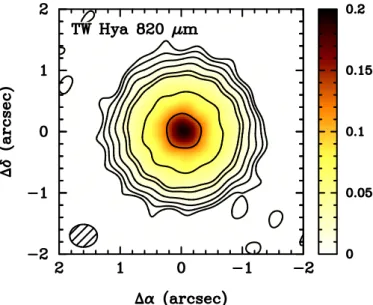
Fig. 1.Image of the 820µm (365.5 GHz) continuum of TW Hya based on data set 2011.0.00340.S. We imaged these data, and obtain a re-sult indistinguishable from (Qi et al. 2013). The image construction em-ployed self-calibration and uniform weighting. The resulting beam size, indicated in the lower left, is 000.45×000.37 at a position angle of−56◦
. The color scale is in units of Jy beam−1and contours are drawn at 1.5,
6.0, 12.0, 24.0, 48.0, 64.0, and 128. mJy beam−1. The peak intensity is
195.8 mJy beam−1and the rms noise level is 0.50 mJy beam−1.
& Segransan (2007) (as referenced in Walsh et al. 2014) to carry out the deprojection. Given the near face-on orientation of TW Hya’s disk, the deprojection corrections are small.
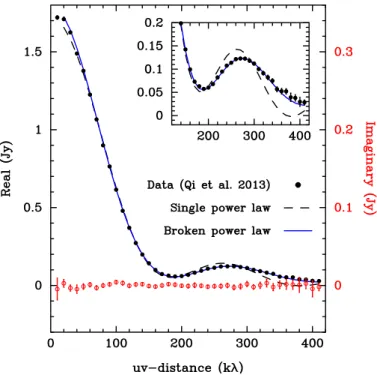
Figure 2 plots the real and imaginary parts of the continuum visibilities against the deprojected baseline length. The imagi-nary parts are all zero to within the accuracy, indicating that the emission is symmetric around the source center at the resolution of our observations. Apart from the much higher signal-to-noise, the real part of the visibilities show a behavior similar to that shown by Andrews et al. (2012), with a drop offfrom 1.72 Jy at the shortest baselines to a minimum of 0.057 Jy near 190 kλ, followed by a second maximum of 0.123 Jy around 275 kλand a subsequent decrease to 0.028 Jy at our longest baseline of 410 kλ. The data of Andrews et al. (2012) continue to longer base-lines of 600 kλwith fluxes approaching 0 Jy.
We overplot the data with the model presented by Andrews et al. (2012) (their model pC) which they find to best fit the con-tinuum data. We recalculate the model at the exact observing wavelengths of the ALMA data. Our model is geometrically thin and uses only the midplane temperatures as calculated by An-drews et al. (2012) (see Section 3). Our model curve therefore differs in detail from the one shown by Andrews et al. (2012), but qualitatively shows the same behavior. In particular, it fits the data well out to baselines of 290 kλbut severely under-predicts the emission on baselines of 300 and 400 kλ, corresponding to angular scales of 000.5–000.7 (27–37 au). In the next section we
attempt to find a model description that provides a better fit.
3. Model fitting
emis-Fig. 2.Real (black points) and imaginary (red points) parts of the visi-bilities of project 340.S (previously presented in Qi et al. 2013) in Jy vs deprojected baseline length in kλ. The inset shows the region of 120–420 kλin greater detail. The dashed black curve shows the recal-culated single power-law model of Andrews et al. (2012) (their model pC), which fails to reproduce the data on baselines>290 kλ. A much better fit is found for a broken power-law model described in Section 3 (solid blue curve). Because both models are symmetric, the imaginary parts of their visibilities are all 0 (not shown).
sion is symmetric (imaginary visibilities are all 0) and the 41 data points in Fig. 2 fully sample the curve and do not average out any detected asymmetric structure, this simplification is al-lowed. As a consequence of using only the binned visibilities, our fitting places relatively little weight on the shortest-baselines which represent the total flux. Because we are primarily inter-ested in the spatial distribution of the emission, rather than the total amount, our results are not affected. However, even a small discrepancy in total flux would be accentuated if we would cal-cuate a residual image. For this reason, we refrain from imaging the residuals and exclusively work with the visibilities.
The real part of the visibilities,V, are related to the intensity distribution of the source by
V(ruv)=2π
Z ∞
0
Iν(R)J0(2πRruv)RdR, (1)
whereruv is the baseline length,Iν(R) is the intensity as func-tion of radiusR, andJ0the zeroth-order Bessel function of the first kind (see, e.g., Hughes et al. 2007). We solve the integral in equation (1) by summation using a step size of 0.1 au, which was found to be sufficiently small.
The intensityIν(R) follows from the expression
Iν(R)=BνT(R)1−exp−τ(R)), (2)
whereBν T(R)is the Planck function,
T(R) is the dust temper-ature, and τ(R) is the dust optical depth which is given by the product of the dust surface density Σ, the dust opacityκ at the observing wavelength, and cosi, whereiis the inclination. The factor cos iis very close to unity for TW Hya.
We follow the midplane temperature as calculated by An-drews et al. (2012), which reproduces the observed SED. Here, T(R) is characterized by a very steep drop offin the inner few au, withT(R)∝R−q0 withq
0=2.6, followed by a very shallow decrease across the remainder of the disk, withT(R)∝R−q1and
q1 = 0.26. Physically, this corresponds to the stellar radiation being stopped by the high opacity in the inner few au of the disk just outisde the inner hole, and the remainder of the disk being heated indirectly by stellar radiation absorbed in the disk surface and reradiated vertically (e.g., Chiang & Goldreich 1997). In our model, the temperature at the turnover radius,R0(7 au),T0, is a free parameter. In all cases, we find best-fit values forT0 close to the values found by Andrews et al. (2012). Furthermore,R0 is much smaller than the resolution of our data, andT0is degen-erate with the optical depthτ(R). Therefore their exact values do not change our results. The steep rise of the temperature in the inner few au adds an unresolved component to the contin-uum emission. This provides a vertical offset to the real part of the visibilities. Indeed, the observed real part of the visibilities never become negative (Fig.2), showing that the sharp increase in temperature at small radii is essential in our model even if we do not resolve these scales.
We choose to describe the optical depth τ(R) as the prod-uct of a constant dust opacityκ365.5 and a radially varying dust surface density distributionΣ(R). For the dust opacity at the (av-erage) observing wavelength of 365.5 GHzκ365.5, we adopt the same value as employed by Andrews et al. (2012),κ365.5 =3.4 cm2 g−1 (dust). We describe the dust surface densityΣ(R) as a (set of) radial power law(s) between an inner radiusRinand an outer radiusRout. In Section 4.1 we further discuss what happens if alsoκvaries radially, as would be naturally expected.
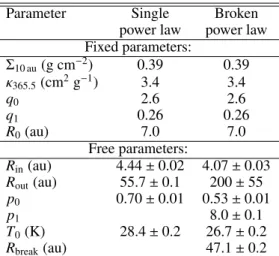
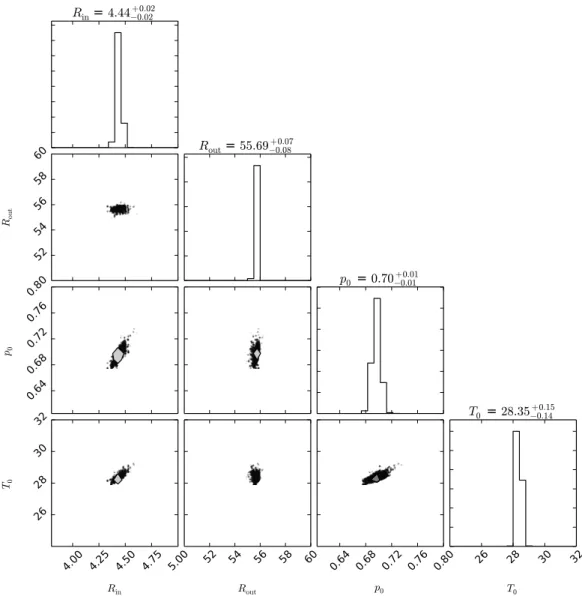
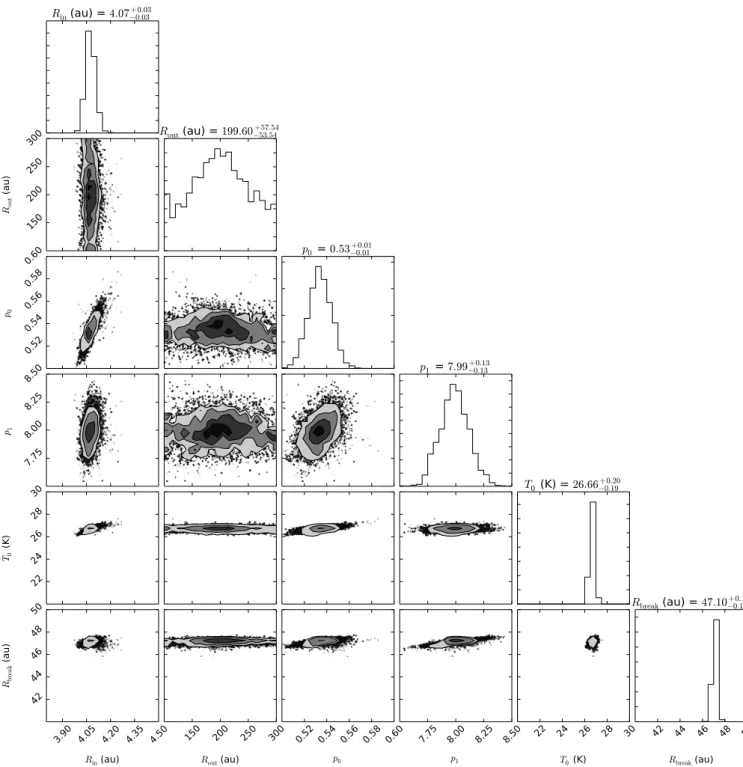
Table 1 lists the fixed and 4 or 6 (depending on the model) free parameters of our model. Estimates of the parameters follow from a Markov chain Monte Carlo (MCMC) exploration of the parameter space, minimizingΣ(xi−yi)2/2σ2i, wherexiandyiare the 41 observed and modeled binned real visibilities, andσithe observed dispersion in each of the bins. Theseσicorrespond to the error on the averaged real visibilities and follow from the dis-persion of the data points in the bin divided by the square root of the number of data points. Any undetected asymmetric structures also contribute toσi, which ranges from 2.0 to 12.0 mJy, with a median value of 3.0 mJy. We use theemcee1implementation of the (MCMC) method, which uses affine invariant ensemble sam-pling (Goodman & Weare 2010; Foreman-Mackey et al. 2013). Figure A.1 in Appendix A plots the results.
Assuming a single radial power law for the surface density, the relevant free parameters in our model are the surface-density distributionΣ(R), the inner hole radiusRin, and the outer radius
Rout. In all cases we find inner radii of the order of a few au, con-sistent with SED estimates of the inner hole. The best-fit model of Andrews et al. (2012) (their model pC) hasΣ(R)∝R−0.75and a surface density ofΣ0of 0.39 g cm−2at 10 au. Keeping thisΣ0 fixed and using a single power power-law for the radial depen-dence (Σ∝R−p0), we find very similar values as Andrews et al.
(2012) for the slope (p0 =0.70±0.01 vs 0.75) and outer radius (Rout=55.7±0.1 au vs 60 au; see Table 1). The quoted errors on the parameters are formal fitting errors, only meaningful within the model assumptions. The emission in Fig. 1 is convolved with the synthesized beam and therefore appears to extend beyond the value forRout found from the visibilities (57 au, corresponding to 100.1). Figure 2 shows the model curve corresponding to the
single-power fit. This curve is similar (but not identical) to the
Table 1.Model Parameters
Parameter Single Broken
power law power law
Fixed parameters:
Σ10 au(g cm−2) 0.39 0.39 κ365.5(cm2g−1) 3.4 3.4
q0 2.6 2.6
q1 0.26 0.26
R0(au) 7.0 7.0
Free parameters:
Rin(au) 4.44±0.02 4.07±0.03
Rout(au) 55.7±0.1 200±55
p0 0.70±0.01 0.53±0.01
p1 8.0±0.1
T0(K) 28.4±0.2 26.7±0.2
Rbreak(au) 47.1±0.2
Notes. Quoted uncertainties are formal fitting errors only, and do not include the effect of the model assumptions or the distance to TW Hya.
curve for model pC in Andrews et al. (2012). Although the pa-rameters are nearly identical, our model is vertically isothermal, unlike model pC, resulting in a slightly different curve. Regard-less, both models have equal problems in reproducing the visi-bilities on baselines of 300–400 kλ.
After this single radial power law as a description for the sur-face density, the next simplest model consists of a broken power law, withΣ(R) ∝ R−p0 inside a radius R
break andΣ(R) ∝ R−p1 outside this radius. This adds two free parameters to the model p1andRbreak. A very good fit to the data is found (Fig. 2, Table 1 and Fig. A.2). In this best-fit model, the radial drop offof the surface density is initially modest (p0 = 0.53±0.01) out to a radius of 47.1±0.2 au, followed by a very sharp drop at larger radii (p1=8.0±0.1). Given the fast drop of the surface density, no useful constraint on the outer radius is found (200±55 au), as the emission drops below the detection limit. This fit is sig-nificantly better than the single power law fit, with respectiveχ2 values of 1437 and 283. A likelihood-ratio test indicates that the broken power law model describes the data better than the single power law model with a probability lager than 0.999.
The broken power law solution found above should not be confused with the exponentially tapered models that are often used (see, for example, Hughes et al. 2008). Such models are described by a surface densityΣ = Σc(R/Rc)−γexp[−(R/Rc)2−γ]. Andrews et al. (2012) already show that exponentially tapered models do not fit the millimeter continuum visibilities of TW Hya: there are no values ofγthat give a sufficiently shallow drop offofΣat smallRand a sufficiently steep fall offat largeR. Only our broken power law can combine these slopes.
In this analysis, we have parameterized the emission with a constant dust opacity κ and a radially varying surface density Σ(R). We stress that our real constraints are on the dust opti-cal depth τ(R) = κΣ. This optical depth follows the same ra-dial broken power law found above. The functional description of the surface-brightness profile is more complex, since follow-ing equation (2) it also includes the slope of the temperature via the Planck function and the slope of the optical depth via the factor (1−exp(−τ)). The optical depth drops from 2.1 at 4.1 au to 0.57 at 47 au, making the emission moderately opti-cally thick and preventing us from taking the limit for smallτ, limτ→0(1−exp(−τ))=τ.
4. Discussion
4.1. Dust drift
The broken power-law distribution obtained for the dust surface density resembles predictions from Birnstiel & Andrews (2014) who consider the effects of radial drift and gas drag on the grow-ing grains. At ‘late’ time (∼ 0.5–1 Myr in their models), the dust surface density follows a slope of approximately−1 out to
∼50 au, after which it steepens to approximately−10. Our in-ferred surface density profile, although different in detail, shows a similar steeping, further strengthening the suggestion of An-drews et al. (2012) that the grains in TW Hya’s disk have under-gone significant growth and drift. However, Birnstiel & Andrews (2014) consider the total dust surface density while our fit is es-sentially to the 820µm contiunuum optical-depth profile. This is dominated by grains of roughly 0.1–10 mm (Draine 2006) but grains of all sizes contribute. As noted by Birnstiel & Andrews (2014), the total dust surface density consist of a radially vary-ing population of dust at different sizes, with larger grains having more compact distributions than smaller grains. This is certainly the case for TW Hya, given that grains small enough to scatter near-infrared light extend out to 200–280 au (Debes et al. 2013) while 7 mm observations by Menu et al. (2014) show emission concentrated toward only the inner several au. From observa-tions at a single wavelength, we cannot infer both the dust sur-face density and the dust opacity as function of radius.
Various authors describe simulations of grain evolution in-cluding growth, fragmentation, and drift (e.g., see Testi et al. 2014, for a review). Pinilla et al. (2015) follow the description of Birnstiel et al. (2010) to describe the advection-diffusion diff er-ential equation for the dust surface density, simultaneously with the growth, fragmentation, and erosion of dust grains via grain-grain collisions. We do not perform a detailed simulation of the TW Hya disk here, since this would require knowledge of the gas surface denisty distribution and comparison to multi-wavelength continuum observations. Instead, we note that any simulation of realistic disks using the prescriptions of Pinilla et al. (2015) re-sults in a very low 820µm continuum surface brightness and in radial profiles that have turnover radiiRbreak .20 au at ages>5 Myr, and therefore cannot explain the observations for the 8–10 Myr of TW Hya. This age vs surface brightness (extent) problem was already noted before (e.g., Pinilla et al. 2012, 2015; Testi et al. 2014). The conundrum of TW Hya’s surface-brightness profile is that it resemblesin shapethe signatures of grain evolu-tion and drift while inin flux and sizeit is too bright and extended for these same mechanisms to have operated over the 8–10 Myr lifetime of the disk.
One possible explanation is that TW Hya’s disk was origi-nally much more massive and larger than the 200–280 au now seen. However, to have a turn-over radius of∼50 au, after 10 Myr, requires an initial disk size of 800–1000 au and a mecha-nism to remove all CO and small dust outside 200 au over the past 10 Myr to match current observations of CO line emission and near-infrared scattered light. We do not consider this a likely scenario.
4.2. The presence of unseen gaps
emis-sion of HL Tau (ALMA Partnership et al. 2015). HL Tau is a very young disk (<1 Myr), but its millimeter continuum im-age shows a remarkable set of bright and dark rings. The pres-ence of these rings have been variously interpreted as the re-sult of gap clearing by embedded planets (Dipierro et al. 2015; Dong 2015; Pinte et al. 2015), secular gravitational instabili-ties (Youdin 2011; Takahashi & Inutsuka 2014), or emissivity-depressions due to accelerated grain growth to decimeter-sizes at the location of the frost lines of dominant ices and clathrates (Zhang et al. 2015; Okuzumi et al. 2015).
Millimeter-sized grains are known to become ‘trapped’ out-side gaps in so-called transitional disks because of the reversed pressure gradient (e.g., van der Marel et al. 2013; Casassus et al. 2013). Therefore, one or more embedded planets inside the TW Hya disk could have ‘trapped’ millimeter-sized grains and pre-vented further inward migration. This mechanism has been in-voked by Pinilla et al. (2012), who show that even small pres-sure maxima are sufficient to slow down the inward migration of millimeter-sized dust.
We investigated if the currently available ALMA data place constraints on the presence of gaps inside the TW Hya disk (other than the known gap inside∼4 au). Starting with the two-slope model, we include a gap centered on 20 au characterized by a Gaussian width and a depth. We choose the value of 20 au to be near the center of the extent of the millimeter-sized grains. We then repeat the procedure of the previous section to find the best-fit parameters for a series of gap widths and depths. By optimiz-ing the other free model parameters we allow these to maximally ‘compensate’ for the effect of the presence of the gap on the vis-ibilities. We find that we can exclude, as defined by an increase of the χ2 value by a factor of two or more, models with gaps that are entirely empty with FWHM widths of more than 6.6 au and models with gaps that have only a depth of 80% to widths of 16.6 au. Assuming a gap width of 5 Hill radii, such gaps cor-respond to planet masses of 0.7–10 MJup(Dodson-Robinson & Salyk 2011). For comparison, the widths and depths of the gaps in HL Tau are well within the allowed range. We conclude that TW Hya’s disk may very well contain planet-induced gaps as detected toward HL Tau, which are capable of halting further inward migration of grains and explain the observed millimeter-continuum surface-brightness profile.
4.3. Dust temperature and the CO snow line
The discussion above attributes the characteristics of the distri-bution of the millimeter-wave continuum to the surface density distribution and opacity of the grains. According to equation (2) the explanation could equally well lie with the dust temperature. At radii inside the turn-over of the emission, up to 47 au, the disk is known to be cold,<20K, as witnessed by the CO freeze out probed by N2H+ emission (Qi et al. 2013). A shallow surface-density distribution combined with a steep temperature drop off outside 47 au cannot explain the observations, since this requires unrealistically low temperatures (10 K). A steeper density dis-tribution combined with a temperature rise around 30–40 au fol-lowed by a return to nominal temperatures can fit the observa-tions, but requires temperatures as high as 70 K, clearly inconsis-tent with the detection of N2H+that would be rapidly destroyed by gas-phase CO at such temperatures.
The N2H+data from Qi et al. (2013) place the CO snow line at 30 au. Just outside this snow line, grain growth may receive a boost by the accumulation of frost resulting from mixing of material across the snow line. This cold-finger effect was ear-lier described by Meijerink et al. (2009) and invoked by Zhang
et al. (2015) to explain the dark rings in the HL Tau millimeter-continuum image as locations of growth to decimeter-sized par-ticles at the location of frost lines. Similarly in TW Hya, the location of the turn-over radius in the millimeter emission may be determined, not by the inward migration of millimeter-sized grains, but by a local enhancement of growth of (sub) micron-sized grains to millimeter micron-sized grains in the 30–47 au region outside the CO snow line. If the efficiency of grain growth is locally sufficiently enhanced, this may increase the dust opacity at 820µm and explain the observed surface-brightness profile. Zhang et al. (in prep.) present an analysis of four protoplanetary disks with high resolution continuum observations, and find that regions just beyond CO snowlines show locally enhanced con-tinuum emission. Detailed modeling of grain growth and drift in the presence of ices and the resulting dust opacity is required to further explore this mechanism. If this mechanism is indeed effective, population studies of disks should reveal a correlation between the location of the CO snow lines2and the sizes of the millimeter continuum emission disk.
5. Summary
We analyzed archival ALMA Cycle 0 365.5 GHz continuum data with baselines up to 410 kλand conclude the following.
1. The interferometric visibilities are described by a disk with a broken power law radial surface-desnity distribution and contstant dust opacity, with slopes of−0.53±0.01 and−8.0±
0.2 and a turn-over radius of 47.1±0.2 au. The outer radius is unconstrained, as the emission drops below the detection limit beyond∼57 au.
2. Under the assumption of a constant dust opacityκ, the corre-sponding surface-density distribution resembles in shape the one expected in the presence of grain growth and radial mi-gration for ‘late times’ as calculated by Birnstiel & Andrews (2014).
3. The total surface brightness and the turn-over radius of 47 au are too large for a source age of 8–10 Myr. This implies that either the disk formed with a much larger size and mass, that one or more unseen embedded planets have opened gaps and halted inward drift of millimeter-sized grains, or that the region outside the CO snow line at radii of 30–47 au has a significantly locally enhanced production rate of millimeter-sized grains boosting the dust opacity at 820µm.
Higher resolution observations with ALMA are essential to explore the reason for the location of the turnover at 47 au (see, e.g., Zhang et al. in prep.). Such observations can easily show the presence of one or more gaps, as shown by the HL Tau image. Near-infrared observations (Debes et al. 2013; Akiyama et al. 2015; Rapson et al. 2015) suggest the presence of structures at, respectively, 80 au, 10–20 au, and ∼ 23 au that are consistent with (partially filled) gaps. Whether these correspond to unre-solved structures of millimeter-wave emitting grains is unknown but likely. If, in spite of this, no gaps in the millimeter emis-sion are found, high resolution multi-wavelength observations of the brightness distribution can be contrasted to models of grain growth and migration in the presence of the CO snow line, to ex-plore if an increase in grain growth in the 30–47 au region can be sufficiently efficient to create the observed millimeter-continuum
2 In the case of a disk with a temperature structure that varies with
brightness profile. There is even the possibility that both scenar-ios operate: increased grain growth outside the CO snow line has led to the formation of a planet that subsequently has halted fur-ther migration of millimeter-sized grains. If so, the correlation mentioned above between CO snow-line locations and the sizes of the millimeter continuum emission disks, should extend to the locations of gaps as well.
Acknowledgements. This paper makes use of the following ALMA data: ADS/JAO.ALMA#2011.0.00340.S and ADS/JAO.ALMA#2011.0.00399.S. ALMA is a partnership of ESO (representing its member states), NSF (USA) and NINS (Japan), together with NRC (Canada), NSC and ASIAA (Taiwan), and KASI (Republic of Korea), in cooperation with the Republic of Chile. The Joint ALMA Observatory is operated by ESO, AUI/NRAO and NAOJ. The research of MRH and VNS is supported by grants from the Netherlands Organization for Scientific Research (NWO) and the Netherlands Research School for Astronomy (NOVA). This work made use of PyAstronomy.
References
Akiyama, E., Muto, T., Kusakabe, N., et al. 2015, ApJ, 802, L17 ALMA Partnership, Brogan, C. L., Pérez, L. M., et al. 2015, ApJ, 808, L3 Andrews, S. M. & Williams, J. P. 2005, ApJ, 631, 1134
Andrews, S. M., Wilner, D. J., Hughes, A. M., et al. 2012, ApJ, 744, 162 Beckwith, S. V. W., Sargent, A. I., Chini, R. S., & Guesten, R. 1990, AJ, 99, 924 Berger, J. P. & Segransan, D. 2007, New A Rev., 51, 576
Bergin, E. A., Cleeves, L. I., Gorti, U., et al. 2013, Nature, 493, 644 Birnstiel, T. & Andrews, S. M. 2014, ApJ, 780, 153
Birnstiel, T., Dullemond, C. P., & Brauer, F. 2010, A&A, 513, A79 Calvet, N., D’Alessio, P., Hartmann, L., et al. 2002, ApJ, 568, 1008 Casassus, S., van der Plas, G., M, S. P., et al. 2013, Nature, 493, 191 Chiang, E. I. & Goldreich, P. 1997, ApJ, 490, 368
de Gregorio-Monsalvo, I., Ménard, F., Dent, W., et al. 2013, A&A, 557, A133 de la Reza, R., Jilinski, E., & Ortega, V. G. 2006, AJ, 131, 2609
Debes, J. H., Jang-Condell, H., Weinberger, A. J., Roberge, A., & Schneider, G. 2013, ApJ, 771, 45
Dipierro, G., Price, D., Laibe, G., et al. 2015, MNRAS, 453, L73 Dodson-Robinson, S. E. & Salyk, C. 2011, ApJ, 738, 131 Dong, R. 2015, ApJ, 810, 6
Draine, B. T. 2006, ApJ, 636, 1114
Foreman-Mackey, D., Hogg, D. W., Lang, D., & Goodman, J. 2013, PASP, 125, 306
Goodman, J. & Weare, J. 2010, Commun. Appl. Math. Comput. Sci., 5, 65 Guilloteau, S., Dutrey, A., Piétu, V., & Boehler, Y. 2011, A&A, 529, A105 Hoff, W., Henning, T., & Pfau, W. 1998, A&A, 336, 242
Hughes, A. M., Wilner, D. J., Andrews, S. M., Qi, C., & Hogerheijde, M. R. 2011, ApJ, 727, 85
Hughes, A. M., Wilner, D. J., Calvet, N., et al. 2007, ApJ, 664, 536
Hughes, A. M., Wilner, D. J., Qi, C., & Hogerheijde, M. R. 2008, ApJ, 678, 1119 Lissauer, J. J. & Stevenson, D. J. 2007, Protostars and Planets V, 591
Lommen, D., Maddison, S. T., Wright, C. M., et al. 2009, A&A, 495, 869 Mann, R. K. & Williams, J. P. 2010, ApJ, 725, 430
Meijerink, R., Pontoppidan, K. M., Blake, G. A., Poelman, D. R., & Dullemond, C. P. 2009, ApJ, 704, 1471
Menu, J., van Boekel, R., Henning, T., et al. 2014, A&A, 564, A93
Okuzumi, S., Momose, M., Sirono, S.-i., Kobayashi, H., & Tanaka, H. 2015, ArXiv e-prints [arXiv:1510.03556]
Pani´c, O., Hogerheijde, M. R., Wilner, D., & Qi, C. 2009, A&A, 501, 269 Pinilla, P., Birnstiel, T., Ricci, L., et al. 2012, A&A, 538, A114
Pinilla, P., Birnstiel, T., & Walsh, C. 2015, A&A, 580, A105
Pinte, C., Dent, W. R. F., Menard, F., et al. 2015, ArXiv e-prints
[arXiv:1508.00584]
Qi, C., Ho, P. T. P., Wilner, D. J., et al. 2004, ApJ, 616, L11 Qi, C., Öberg, K. I., Wilner, D. J., et al. 2013, Science, 341, 630
Rapson, V. A., Kastner, J. H., Millar-Blanchaer, M. A., & Dong, R. 2015, ArXiv e-prints [arXiv:1512.01865]
Ricci, L., Testi, L., Natta, A., & Brooks, K. J. 2010a, A&A, 521, A66 Ricci, L., Testi, L., Natta, A., et al. 2010b, A&A, 512, A15
Ricci, L., Testi, L., Williams, J. P., Mann, R. K., & Birnstiel, T. 2011, ApJ, 739, L8
Rodmann, J., Henning, T., Chandler, C. J., Mundy, L. G., & Wilner, D. J. 2006, A&A, 446, 211
Rosenfeld, K. A., Andrews, S. M., Wilner, D. J., & Stempels, H. C. 2012, ApJ, 759, 119
Takahashi, S. Z. & Inutsuka, S.-i. 2014, ApJ, 794, 55
Testi, L., Birnstiel, T., Ricci, L., et al. 2014, Protostars and Planets VI, 339 Thi, W.-F., Mathews, G., Ménard, F., et al. 2010, A&A, 518, L125
Ubach, C., Maddison, S. T., Wright, C. M., et al. 2012, MNRAS, 425, 3137 Vacca, W. D. & Sandell, G. 2011, ApJ, 732, 8
van der Marel, N., van Dishoeck, E. F., Bruderer, S., et al. 2013, Science, 340, 1199
van Leeuwen, F. 2007, A&A, 474, 653
Walsh, C., Juhász, A., Pinilla, P., et al. 2014, ApJ, 791, L6 Webb, R. A., Zuckerman, B., Platais, I., et al. 1999, ApJ, 512, L63 Weidenschilling, S. J. 1977, MNRAS, 180, 57
Weinberger, A. J., Becklin, E. E., Schneider, G., et al. 2002, ApJ, 566, 409 Whipple, F. L. 1972, in From Plasma to Planet, ed. A. Elvius, 211 Youdin, A. N. 2011, ApJ, 731, 99
Zhang, K., Blake, G. A., & Bergin, E. A. 2015, ApJ, 806, L7
R
in=
4
.
44
−+00..020252
54
56
58
60
Rou
t
R
out=
55
.
69
−+00..08070.64
0.68
0.72
0.76
0.80
p0
p
0=
0
.
70
−+00..01014.00 4.25 4.50 4.75 5.00
Rin26
28
30
32
T0
52 54 56 58 60
Rout
0.64 0.68 0.72 0.76 0.80
p026
28
30
32
T0
T
0=
28
.
35
−+00..1415R
in(au) =
4.
07−+00..0303150 200 250 300
Rou
t
(a
u)
R
out(au) =
199.
60−+5753..54540.52 0.54 0.56 0.58 0.60
p0
p
0=
0.
53−+00..01017.75 8.00 8.25 8.50
p1
p
1=
7.
99−+00..131322 24 26 28 30
T0
(K
)
T
0(K) =
26.
66−+00..19203.90 4.05 4.20 4.35 4.50 Rin (au) 42
44 46 48 50
Rbr
ea
k
(a
u)
150 200 250 300 Rout (au)
0.52 0.54 0.56 0.58 0.60 p0
7.75 8.00 8.25 8.50 p1
22 24 26 28 30
T0 (K)
42 44 46 48 50
Rbreak (au)