44
BEHAVIOUR OF SOME APPLE VARIETIES, GRAFTED ON VEGETATIVE
ROOTSTOCK IN THE ORCHARDS OF SOUTHERN ROMANIA
CICHI M1., CICHIDANIELA1*
1University of Craiova, Faculty of Agronomy, Agricultural Technology & Forestry,
Street Libertății 19, Craiova, Romania; [email protected] *Corresponding author:[email protected]
Keywords: variety, quality, rootstock, apple
ABSTRACT
The increase of fruit production per hectare and the improvement of its quality can be achieved by the correct selection of the two partners x rootstocks, in accordance with the vegetative factors in the area. In order to choose and promote the most valuable rootstocks in the culture, it is necessary to differentiate the best rootstocks for each area of culture and variety, taking into account that rootstocks influence the entry of trees into bearing fruit stage, the vigor, the quantity and the quality of production.
The study aimed at evaluating the behaviour of Florina and Red delicious varieties grafted on MM 104, MM 106 and MM 109 rootstocks in the specific pedoclimatic conditions in the south of Romania between 2016 and 2018 period.
The MM 109 rootstock determines the higest increase in thickness during the first eight years after planting. The Red delicious variety grafted on MM104 and MM106 achieves a ratio between cuttings and rootstocks closer to 1 (per unit), compared to grafting on MM 109 rootstock.
The root system of grafted trees on MM 109 shows a much greater development compared to the other two rootstocks, ensuring the trees a better anchorage in the soil.
The higest number of active roots for the studied rootstocks within a radius of 1 m
from the trunk, is at a depth of 20-40 cm, and the number of roots decreases with the depth. High quality fruits with a higher weight and size index were obtained on MM 104 and MM 106 rootstocks.
INTRODUCTION
The increase of fruit production per hectare and the improvement of its quality can be achieved by the correct choice of the two partners variety x rootstocks in symbiosis with the vegetation factors in the area. It is necessary to differentiate the best rootstocks for each variety, taking into account that the rootstocks influence the entry into production of the tree, the force, the quantity and the quality of the production.
Due to the different behavior of the varieties compared to the rootstocks, it is
necessary to study the types of
vegetative rootstocks in our country, to establish their behavior and to choose the most valuable ones and to promote them.
The study of rootstocks is an important research topic, so Crassweler R.M. et al, (2001), mentioned that they studied the behavior of Golden delicious and Red delicious varieties on certain rootstocks such as: P 2, P 22, B 146, B 491, M 9, and the rootstocks Lancep and Cepiland induced a greater growth of the respective varieties than the rootstock M 9. The study of soil type, pedological and chemical characteristics in correlation with environmental factors is an important objective for the normal growth and development of plants in a region (Grecu Florina et al., 2016).
45 106, where the roots of the rootstock MM 106 penetrated deeper into the soil than the rootstock M 7, (Sharma D. et al, 2005).
The growth and development of the Auksis apple variety was also studied on several rootstocks such as P 22, P 59, P61, P 66, P 62, P 67, B 9, M 9 and others, in different regions of Latvia, Estonia and Lithuania, (Lepsis J. et al., 2014).
The growth and selection of new rootstocks for apple continues at East Malling, where different rootstocks have been selected, namely AR 680-2 similar to M 9, rootstock that induces an increase in fruit. Also, the selections AR 801-11 AR 835-11 produce the same force to the trees as the rootstock M 26 but also a good productivity, (Johnson D. et al., 2007). The effect of different rootstocks
on fruit quality parameters has been observed, but some parameters such as fruit weight, acidity and firmness of the fruit do not show significant differences from year to year, (Gjamovski V. et al., 2013).
Some authors have studied the behavior of trees in some apple varieties, namely the vigor and branching out of the
sprouts, the phenological phases
(burgeoning, flowering, ripening of fruits), the morphological characteristics of the fruits studied at harvest (weight, shape, color of fruits), (Eccher T. et al., 2002).
The growth and development of the Starkrimson apple variety has been studied on different rootstocks of different vigor, in the southern area of the country, highlighting small rootstocks (Cichi M. et al,2009).
MATERIAL AND METHOD
Three vegetative rootstocks from the MM series were studied, namely: MM 104, MM 106 and MM 109, on which two varieties of apple of different vigor are grafted: Florina and Red delicious. The placement of the experience is in blocks randomized with three repetitions, and in each repetition 4 trees were planted.
The planting distance was 4 m between rows and 3 m between trees in a row. The surface on which the trees were
planted was 5,000 m2 and the number of
trees was 416 trees on the respective surface. The form of the implemented crown was thin spindle.
In order to achieve the proposed purpose, the following objectives have been set:
- verification of varieties in the
growing process;
- verification of varieties in the
fruiting process;
- affinity between grape and
rootstocks;
- the study of the root system;
- fruit production and quality.
During the period 2016-2018, the
following observations and
determinations were made to achieve the set objectives:
- Phenological observations were made during the respective period every 2 days by noting from 1 - 3 of each phenophase.
- The height and diameter of the tree crown was recorded at the end of each vegetation period, by measuring with the meter.
- The increase in the thickness of the tree trunk element that gives us information on the vigor of the trees was done with the electronic calipers at 10 cm below the first branch inserted.
- The graft - rootstock ratio was
determined with the calipers by
measuring above and below the grafting point.
- We carried out the study of the root system using the profile method.
- The main physical properties determined by the fruits were: the size index expressed in mm by sizing 50 fruits for each variant with the calipers, the weight index of the fruits by measuring 50 fruits for each variant.
46 determined were: the content in soluble dry matter, total sugar. The soluble dry matter was determined with the Zeiss
hand-held refractometer, the sugar
content was determined by the Schoorll method.
- Calculation of all the data
respectively of the vegetative growths, the height of the trees, the diameter of the crown, the thickness of the trunk, the productions per year of experimentation were carried out by analyzing the variance.
RESULTS AND DISCUSSIONS
The apple begins its vegetation by swelling the buds at the Jonagold variety between March 29 - April 4, and the Red delicious variety during March 30 - April 7. The phenophase of bud swelling is different depending on the rootstocks, so it is observed that the swelling of the vegetative buds occurs earlier on the rootstocks MM 104 and MM 106 and with late start in vegetation the rootstock MM 109.
Regarding the beginning of the growth of the sprouts, this phenophase took place between 4 - 10 April in the variety Florina and between 7 - 15 April in the variety Red delicious.
The duration in days of the vegetation period varies between 224 and 234 days. The longest vegetation is Red delicious/MM 109 and the shortest Florina variety is MM 104 and MM 106.
Comparatively analyzing the onset and the carrying out of the phenophases of the fruit organs, it is found that the swelling of the small buds took place between March 26 and 31 in the variety Florina and between March 27 and 31 in the variety Red delicious. The rootstocks that influenced the early vegetation start of the small buds are MM 104 and MM 109, and with a later start the rootstock MM 106.
With early flowering we can specify the variety Florina grafted on MM 109 - April 20, the variety Florina grafted on MM 104 - April 21 and a day or two Florina on MM 106 - April 22.
The Red delicious variety starts later with 5-6 days on all three rootstocks, so Red delicious on MM 104 and MM 109 started flowering on April 26 and Red
delicious on MM 106 on April 27. The mass flowering takes place earlier in the period 23 - 27 April at the Florina variety on the three rootstocks, and at the Red delicious variety it takes place between 1 and 4 May.
The ripening of the fruit of the studied varieties is carried out earlier at the Florina variety on the rootstock MM 106 - 4 September and on MM 104 - 5 September and later on MM 109 - 10 September. Red delicious variety matures in apples later on September 13-17.
The maturation of ripened fruits of the varieties indicates that the rootstock MM 106 and MM 104 influence the maturation faster than the same varieties on the rootstock MM 109.
Within these varieties we found that there is a correlation between the later beginning of the production and the vigor of the rootstocks.
On vigorous rootstocks the
beginning of the fructification is delayed, as is the case of rootstock MM 109 within both Florina and Red delicious varieties.
From the obtained results we can see that the two varieties had a more vigorous growth of sprouts on the high force rootstock MM 109 and lower on MM
106 and MM 104. During the
experimentation, large annual growths had Florina varieties on rootstock MM 109 - 86.0 cm/tree and Red delicious variety on MM 109 - 85.0 cm/tree. Florina
variety recorded lower values on
47
Figure 1 – Average annual growth of the shoots of trees
Within the varieties researched regarding the height of the trees, we can see that there is an average of the height of 4.55 m/tree.
The apple varieties with the highest growth were registered on the rootstock MM 109, thus the variety Florina/MM 109 with 4.65 m/tree and the Red delicious variety on MM 109 had a height of 4.70 m/tree. Lower increases in height showed the rootstocks MM 104 and MM 106. The variety Florina/MM 106 had a height of 4.40 m/tree and on the rootstock MM 104 was 4.45 m/tree.
Another criterion that must be taken into account in intensive apple crops is the width of the crown of trees between rows as well as row of trees.
This aspect helps the mechanical
execution of the works among the rows of fruit trees.
In the case of apple varieties on the vegetative rootstocks studied with a larger size of the crown, the varieties Florina/MM 109 with a diameter of 2.00
m/tree and the variety Red delicious/MM 109 with 2.10 m/tree diameter are highlighted. The same varieties on rootstocks MM 104 and MM 106 have smaller crown sizes below the average of 2.00 m/tree.
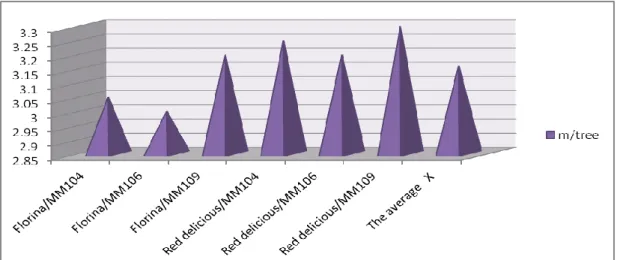
To observe if the 3.0 m distance between trees in a row is sufficient for a good growth and development of the trees, the increase in the length of the branches of the trees, that is, of branches of the first order was measured. According to data, the length of the branches of first order is average of 3.16 m/tree. In conclusion, the distance of 3.0 m/tree between trees in a row is not sufficient for the development of trees.
The smallest increases in the length of the branches below the average of experience is the variety of apple
Florina grafted on the vegetative
rootstocks MM 104 and MM 106, (figure 2).
48 In order to know the mutual influence between graft and rootstocks on the increase in thickness, measurements were made with the calipers above the grafting point and below this point after which the report was made. According to the data, there are differences between the partners, so in the studied varieties the diameter of the tree trunk is larger at the rootstocks and smaller at graft at a distance of 2.0 cm from the grafting point. The data shows a favorable growth ratio for apple varieties studied on the respective rootstocks, so the most favorable report is made by the variety Florina/MM106 where the ratio was 0.85, which represents a growth difference of 19.0 mm.
Also, a favorable ratio makes the variety Red delicious on rootstock MM 104 where the ratio was 0.92, the difference being 10.0 mm and the same variety on MM 106 where the ratio was 0.91 and the difference of 11.0 mm.
The biggest difference between graft and rootstocks is observed in the case of the Red delicious variety on the rootstock MM 109 this being 17.0 mm and in the variety Florina on the rootstock MM 109 the difference being 41.0 mm.
In conclusion, the smaller the differences between the graft and the rootstocks, the closer the ratio between the two partners is to the unit, i.e. 1.00, respectively, has a better affinity, (figure 3).
Figure 3 - Report scion / rootstock
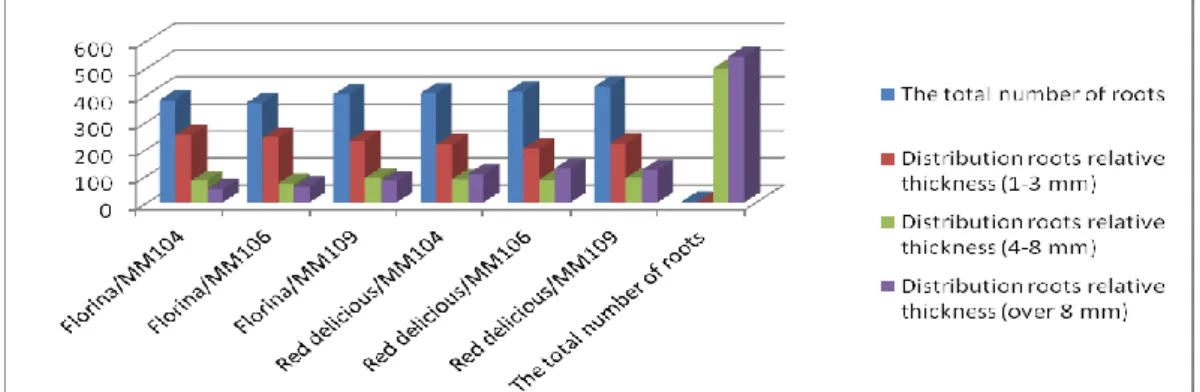
The distribution of the roots in the soil at 1.0 m from the trunk differs from one rootstock to another, thus to the Florina variant /MM109 the most roots are found in number 400 and in the variant Red delicious/MM 109 the number of roots is 430. The largest number of roots is found at a depth of 20-40 cm at both
varieties on all rootstocks. The smallest number of roots has the variety Florina on the rootstocks MM 104 and MM 106 this being 370-380 roots, and in the case of the Red delicious variety also on the same rootstocks MM 106 and MM 104 - respectively a number of roots of 405 and 410, (figure 4).
49
In conclusion, the vigorous
rootstocks have a root system richer in roots and have a higher percentage of thick roots over 1 mm.
From the determinations carried out in the years 2016 - 2018 it is found that the productions carry an average of 43.1 kg/tree, respectively 35.7 t/ha. The most productive variety proved to be the Red delicious variety, which obtained an average yield of 52.3 kg/tree, and the Florina variety obtained an average production of 34.0 kg/tree. Red delicious
has registered very good productions on the rootstock MM 106 respectively 57.0 kg/tree and 53.0 kg/tree on rootstock MM 104. Lower values of production we meet at the same variety Florina on rootstocks MM 104 and MM 109 these being 27.0 and 28.0 kg/tree.
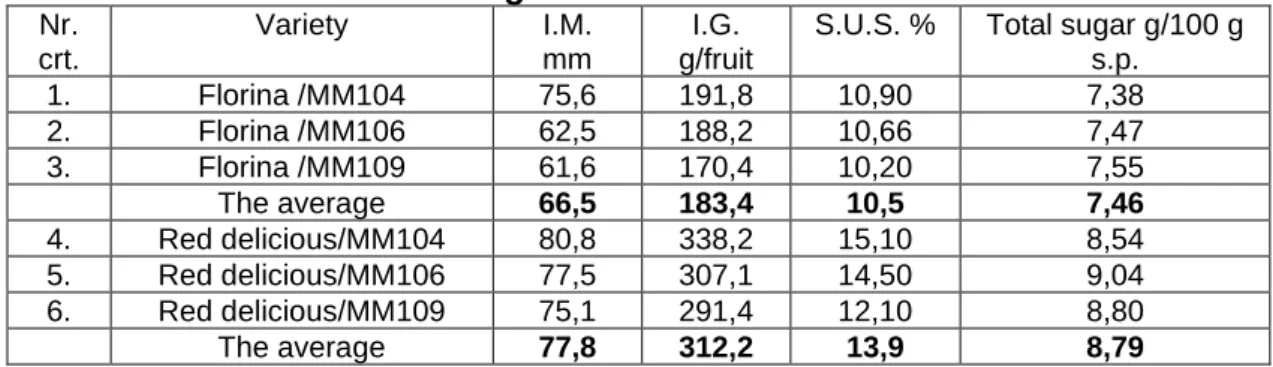
The quality of the fruits was assessed according to the influence of the vegetative rootstocks on the size, weight of the fruits, the content in dry matter and sugar (table 1).
Table 1
The main physical and chemical properties a few apple varieties grafted onto vegetative rootstock
Nr. crt.
Variety I.M.
mm
I.G. g/fruit
S.U.S. % Total sugar g/100 g s.p.
1. Florina /MM104 75,6 191,8 10,90 7,38
2. Florina /MM106 62,5 188,2 10,66 7,47
3. Florina /MM109 61,6 170,4 10,20 7,55
The average 66,5 183,4 10,5 7,46
4. Red delicious/MM104 80,8 338,2 15,10 8,54
5. Red delicious/MM106 77,5 307,1 14,50 9,04
6. Red delicious/MM109 75,1 291,4 12,10 8,80
The average 77,8 312,2 13,9 8,79
As for the size of the fruits, it differs in relation to the characteristics of the variety and due to the influence of the rootstock.
From the table we notice that the fruits of the Florina variety recorded an average of the size of the fruits of 66.5 mm and Red delicious variety 77.8 mm.
These values of fruit size specify the category of medium or large fruits, and their weight was Florina variety of 183.4 g and Red delicious variety 312.2 g, classifying the fruits of these varieties into the category of large fruits. It should be noted that the size of fruit in all varieties is higher on rootstocks MM 106 and MM 104 and smaller on rootstocks MM 109.
The weight of the fruits is conditioned by the environmental factors and their number on the same tree, because it is known that there is a negative correlation between the quantity of fruit on the tree and their weight.
The weight of the fruits varied with the variety Florina between 170.4 and 191.8 g/fruit, the fruits on rootstocks MM 104 and MM 106 being heavier (188.2-191.8 g/fruit). In the Red delicious variety the weight of the fruit had values between 338.2 and 291.4 g/fruit, being lower on the rootstock MM 109.
The fruits of the Red delicious variety have the highest content in dry matter, this being of 13.9%, and the variety Florina obtained an average of the dry matter of 10.5%. Regarding the rootstock, it is observed that the apple varieties grafted on the rootstocks MM 104 and M 106 obtained the highest content in dry matter, this being 10.90-10.66% in the variety Florina and 15.10-14, 50% in Red delicious variety.
50 100 g s.p., Florina /MM109 - 7.55 g at 100 g s.p.
The production efficiency index results from the production ratio (kg/tree)
with the trunk section surface (cm2 /tree).
This index is in Florina variety between 0.29 and 0.56 and in Red delicious is between 0.51 and 0.65.
The highest productive index was the variety Florina on MM 106, this being 0.56 and the variety Red delicious on the rootstock MM 106 of 0.65.
The smallest production index had
the varieties Florina on the MM 109, this being 0.29 and the variety Red delicious on the rootstock MM 109 of 0.51. The rootstock MM 104 recorded an average yield index of 0.32 and 0.60 in both varieties.
The index of economic efficiency close to the unit corresponds to a balance between growth and the fruit of the trees. Of the two varieties of apple, a higher efficiency index had the variety Red
delicious indicating its precocity.
CONCLUSIONS
1. The rootstocks that influenced the beginning of the vegetation earlier were MM 104 and MM 106, and with a slightly later start was the rootstock MM 109.
2. The variety Red delicious on rootstocks MM104 and MM106 makes a ratio between graft and rootstock closer to 1 (per unit) than rootstock MM 109.
3. The root system of the grafted trees on MM 109 shows a much greater
development than the other two
rootstocks, ensuring the trees a better anchoring in the soil.
4. Varieties Florina and Red
delicious grafted on rootstocks MM 106 and MM 104 produce high and medium (productive) economic efficiency indices.
5. From the presented conclusions, we find that the rootstocks with the best behavior in the plantation were MM 106 and MM 104 and with an average behavior MM 109.
6. It is necessary to strictly respect the maintenance works, the green and dry cuts, and the climatic conditions in the southern part of the country correspond to the growth, fruition and development of the apple species.
BIBLIOGRAPHY
1. Cichi, M., Ileana Popescu, Larisa
Păun, Ciobanu, A., 2009. The study of the reaction of Starkrimson apple variety on different rootstocks in the south area of Oltenia. Editura Universitaria Craiova.
Annals of the University of Craiova –
Agriculture, Montanology, Cadastre, Vol XXXIX/A, 66-69. ISSN 1841-8317.
2. Crassweler, R.M., Smith, D.,
Tukey, L., 2001. Performance of Golden Delicious and Delicous apples on dwarfing rootstocks. ISHS Acta
Horticulturae 557 – VII International
Symposium on Orchard and Plantation Systems, 47 – 54.
3. Bonciu Elena, 2017. Food
processing, a necessity for the modern
world in the context of food safety: a
Review. Annals of the University of Crai
ova – Agriculture, Montanology,
Cadastre Series, Vol. 47(1), 391-398.
4. Eccher, T., Folini, L., Tonesi, R.,
2002. Field performance and fruit quality of scab resistant apple cultivars in the Lombardia (Italy ) region. ISHS Acta
Horticulturae 595: International
Symposium on apple breeding for scab resistance, 149 – 154.
5. Gjamovski, V., Kiprijanovski, M.,
Arsov, T., 2013. Fruit quality parameters of apple cultivar Granny Smith produced on nine different dwarfing rootstocks. ISHS Acta Horticulturae 981: II Balkan Symposium on Fruit Growing, 581-586. 6. Grecu Florina, Pavel, Ștefan, 2016.
51 characterization of a brown-stagnic
vertosoil in order to establish the
fertilization plan. Annals of the
University of Craiova - Agriculture, Montanology, Cadastre Series, Vol XLVI, 322-325. ISSN 1841-8317.
7. Johnson, D., Spencer, J.E.,
Tobutt, K., Webster, A. D., 2007. New apple rootstock selections from the East Malling breeding programme. ISHS Acta Horticulturae 732: VIII International Symposium on Canopy,
Rootstocks and Environmental
Physiology in Orchard Systems, 43-50.
8. Lepsis, J., Bite, A., Kviklys, D.,
Univer, N., 2014. Evaluation of Auksis
apple trees on dwarfing rootstocks in
the Baltic region. ISHS Acta
Horticulturae 1058: X International Symposium on Integrating Canopy,
Rootstock and Environmental
Physiology in Orchard Systems. Vol. I, 601 – 606.
9. Sharma, D., Chauhan, J., 2005.
Effect of different rootstocks on root
distribution of apple. ISHS Acta