Address for correspondence Dr. Tayyaba Iqbal
Department of Dermatology, Abbasi Shaheed Hospital, Karachi Email: [email protected]
Original Article
Frequency of xerosis leading to asteatotic eczema in
geriatrics presenting to Abbasi Shaheed Hospital,
Karachi
Introduction
Skin aging is a complex process involving both genetics and environmental factors that result in functional and aesthetic changes in the skin, soft tissue and skeletal support structure.1 The
continuous and inevitable process of aging has a variable spectrum of manifestations of all organ systems including the skin.2 Smith et al.3
reported fungal infection 61.6%, xerosis 58.3%,
pruritic dermatosis 7.3% and scabies 3.3% in Taiwan. Tay et al.4 reported both acute and
chronic eczema with asteatotic eczema being the commonest at 9.1%, at a multidisciplinary tertiary hospital in Singapore.
Two types of skin aging exist: intrinsic aging, which includes changes due to normal maturity and occurs almost in all individuals; and extrinsic aging, caused by the extrinsic factors such as ultraviolet light, smoking and other environmental pollutant(s).5 Clinical features of
intrinsic aging include skin dryness, wrinkling, laxity, decreased elasticity, lentigines, seborrheic keratoses, skin fragility and thinning,
Tayyaba Iqbal, Naseema Kapadia, Saher Athar, Sadia Iqbal, Syeda Shahmoona, Maria Mansoor
Department of Dermatology, Abbasi Shaheed Hospital, Karachi
Abstract Objective To determine the frequency of xerosis and asteatotic eczema in the elderly.
Methods This cross-sectional study included 248 geriatric patients, at the Department of Dermatology, Abbasi Shaheed Hospital, Karachi, in out-patient department. Their ages, gender and dermatological diagnosis of xerosis and asteatotic eczema were recorded and analyzed using SPSS Version 11.
Results Of 248 patients, 143 (57.7%) patients were males and 105 (42.3%) patients were females.
The age range was from 65 to 90 years, with the mean age being 72.36±7.48 years. Out of 143 male patients, 20 (14%) were suffering from asteatotic eczema and out 105 female patient only 4 (3.8%) patient were suffering from asteatotic eczema. Total 24 (10%) patients developed asteatotic eczema. The longer the duration of disease the more were the chances of developing asteatotic eczema.
Conclusion Xerosis is a common condition in older adults. Intrinsic aging of the skin may predispose the patient to xerosis, but it is not a foregone conclusion that all older adults will develop this troublesome condition. Identifying and addressing xerosis may be viewed as an integral part of maintaining skin integrity. This is especially important in seniors, since aging skin experiences anatomic changes resulting in altered physiologic behavior and susceptibility to disease.6
ecchymosis, depigmented hair, fine hair/vellus hair, diffuse hair loss and thin, brittle nails.6 The
clinical features of extrinsic aging include skin dryness, wrinkling, laxity, decreased elasticity with elastosis, skin fragility and thinning, stellate pseudoscars, freckling, lentigines and seborrheic keratosis.6
The structure and the function of the skin change with age. In an aging skin, the epidermis becomes thinner and loses its undulating rete pattern, the stratum corneum loses its ability to retain water, and cell replacement, barrier function, and wound healing decreases, the dermis becomes thinner and loses its elasticity.7
Immune dysfunction in the elderly encourages the development of several autoimmune disorders: bullous and benign mucous membrane pemphigoid, paraneoplastic pemphigus, and the potentially fatal pemphigus vulgaris.8
Xerosis, or dry skin is a common skin condition in older adults, but it is not a part of aging. Xerosis in aging is multifactorial: intrinsic changes in keratinization and lipid content, use of diuretics and other medications, and overuse of heaters or air conditioners. Xerosis causes pruritus, which then leads to excoriations and risk of skin infections.9 Alteration in the
structure of the skin like decreased amounts of skin surface lipids and amino acids which impairs the water holding capacity of the stratum corneum and leads to dryness.10,11 Due to various
senile changes in the skin, geriatrics are predisposed to certain dermatological disorders including inflammatory dermatoses, cutaneous infections, vascular disorders and neoplasms. Management of these cutaneous diseases in the elderly population requires particular attention to their inherent physical and physiological weakness and associated problems.12 The
rationale of this study was to estimate the burden of asteatotic eczema, thereby strategies could be developed to screen geriatrics with xerosis.
Methods
This cross-sectional study was conducted at the Department of Dermatology, Abbasi Shaheed Hospital, Karachi, in out-patient department. The duration of the study was 6 months, from January 17th 2012 to June 16th 2012.
The study included 248 patients. On the basis of previous study prevalence of asteatotic eczema 9.1% at the 95% confidence interval and absolute precision 5% with design effect 2, using computer program “OpenEpi Version 2’, the sample size was calculated. Patients between the age of 65 years to 90 years, of either gender with the presence of xerosis with or without other skin diseases such as scabies, eczemas and onychomycosis were included in the study, while patients under the age of 65 years or over the age of 90 years were excluded from the study. Patients with xerosis of skin secondary to renal disease, liver disease or any other systemic disease were also excluded. A non-probability purposive sampling method was chosen.
Patients meeting the inclusion criteria were included after taking an informed consent by the researcher. A detailed history regarding the duration of illness, and cutaneous lesion and sites involved was taken and entered into the prescribed proforma. Asteatotic eczema secondary to xerosis was diagnosed as per operational definition.
gender and duration of diseases to see the effect of there on outcome through Chi-square test, P
value ≤0.05 as taken significant.
Results
Out of 248 patients, 143 (57.7%) were male and 105 (42.3%) were female. The age range was 65 years to 90 years; and the mean age was 72.36 ± 7.48 years. The male-to-female ratio was 1.36. A total of 24 (10%) patients developed asteatotic eczema, 20 (8%) of which were male, while only 4 (1.6%) were female (p=0.931), (Table 1).
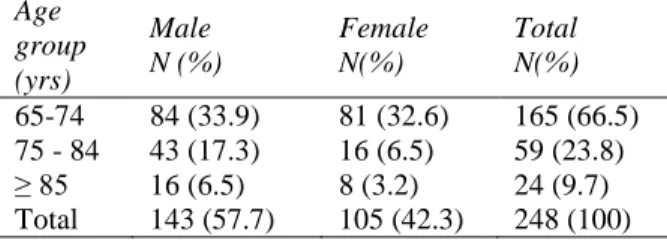
Based on the age groups, 165 (66.5%) patients were in the 65-74 year age group, 59 (23.7%) patients were in the 75-84 year age group, and 24 (9.6%) patients were in 85 year or over age group. Ages and gender distributions were also noted (Table 2). The duration of xerosis after which asteatotic eczema developed was also noted. 5 (20.8%) patients developed asteatotic eczema within 2 months of xerosis, 10 (41.7%) patients developed asteatotic eczema after 6 months of xerosis and 9 (37.5%) patients had asteatotic eczema after having xerosis for more than 1 year (p=0.768).
Discussion
The geriatric population comprises of persons aged 60 years and above. Statistical projections indicate that the elderly people (over 60 years of age) will constitute more than one quarter to one third of the population in the Western countries by the year 2025.13,14 According to Pakistan
Demographic Survey, 6.3% of the population in our country is ≥ 60 years.15 The provision of
specialized services for persons aged 60 years and above is still lacking in our country.
Aging of the skin involves the intrinsic process of senescence and extrinsic damage induced by chronic exposure to UV radiation. A recent
Table 1 Age distribution of patients enrolled Age
group (yrs)
Male N (%)
Female N(%)
Total N(%) 65-74 84 (33.9) 81 (32.6) 165 (66.5) 75 - 84 43 (17.3) 16 (6.5) 59 (23.8)
≥ 85 16 (6.5) 8 (3.2) 24 (9.7)
Total 143 (57.7) 105 (42.3) 248 (100)
Table 2 Gender-wise frequency of asteatotic eczema (p=0.931).
Gender
Asteatotic Eczema
Total (%) Present (%) Not present
(%)
Female 4 (1.6) 101 (40.7) 105 (42.3) Male 20 (8.1) 123 (49.6) 143 (57.7) Total 24 (9.7) 224 (90.3) 248 (100)
consensus forum of the American Academy of Dermatology concluded that the majority of undesirable clinical features associated with ‘skin ageing’ are the result of damage to skin due to UV radiation (photoageing).16
The aging of skin presents a growing problem for dermatologists. When considering ageing it is important to distinguish between the effects of true biological aging and environmental factors, such as exposure to sun.
In Pakistan no study has been conducted to determine the frequency of xerosis leading to asteatotic eczema. In our study 248 patients were enrolled. Out of who mean age was 72.36 ± 7.48 years.
In this study xerosis and asteatotic eczema was more common in male population (p=0.931) this is consistent with Durai et al.17 study conducted
in India that male are commonly affected probably due to outdoor occupation, smoking and other life style factors. However, the study conducted in France by Paul et al.18 is not
with 56% of patients experiencing at least some degree of xerosis and about 9% of the elderly population experiencing moderate and severe xerosis. The most significant risk factors associated with xerosis in the elderly were older age, female sex, dry skin or atopic dermatitis during childhood or adolescence, atopic dermatitis (current or previous), itching during sweating and concomitant treatment that may be associated with xerosis.18 The xerotic skin of
elderly individuals facilitates the development of cracking and fissuring of the skin surface in dry and cold winter. Such damage in the SC is sometimes aggravated by inadvertent scratching due to pruritus, allowing skin permeation of various environmental allergens. They may induce eczematous changes in those with preserved adequate delayed hypersensitivity despite their advanced age.19
Xerosis and chronic pruritus have also been labeled as the most common problems seen in the elderly in India, by Verma.20In this study, it
was found that there is a relationship between the duration of xerosis and asteatotic eczema, the more the duration of xerosis the more the asteatotic eczema was observed.
As the average human lifespan continues to increase, the dermatological needs of the aging skin become more important. Utilizing the increasing knowledge of the molecular and cellular components of skin aging will facilitate more effective treatments of skin in old age.
Conclusion
The present study provides information regarding the high prevalence of xerosis in the elderly, and also hints at the comorbidity i.e. asteatotic eczema. With extrinsic factors such as exposure to UV rays and lifestyle factors such as smoking, is well established as a cause of xerosis, and further substantiates a higher
frequency of xerosis in males in our part or in other parts of the world. An early diagnosis, avoidance of risk factors can help in the prevention of asteatotic eczema in the elderly.
References
1. Sadick NS, Karcher C, Palmisano L. Cosmetic dermatology of the aging face. Clin Dermatol. 2009;27:S3-S1.
2. Yalcin B, Tamer E, Toy GG, Oztas P, Hayram M, Alli N et al. The prevalence of skin diseases in the elderly: analysis of 4099 geriatric patients. Int J Dermatol. 2006;45:672-6.
3. Smith DR, Sheu HM, Hsieh FS, Lee YL, Ghang SJ, Guo YL. Prevalence of skin disease among nursing home patients in Southern Taiwan. Int J Dermatol. 2002;41:754-9.
4. Tay LK, Lee HY, Thirumoorthy T, Pang SM. Dermatology referrals in an East Asian tertiary hospital. Clin Exp Dermatol. 2011;36:129-34.
5. Gandhi A, Gandhi M, Kalra S. Dermatology in Geriatrics - ISPUB. [serial on the Internet]. 2010 [cited 2011 Aug 29].
Available from:
http://www.ispub.com/journal/the-internet-
journal-of-geriatrics-and- gerontology/volume-5-number-2/dermatology-in-geriatics-4.html
6. Sheng CW. Traditional Chinese medicine in dermatology. Dermatol Bull. 2008; 3-6. 7. Tomecki KJ, Lifshitz OH. Disease
Management Project Chapters. [homepage on the Internet]. 2010 [cited 2011 Aug 29].
Available from:
http://www.clevelandclinicmeded.com/med icalpubs/diseaseman
agement/dermatology/the-aging-skin/ 8. Farage MA, Miller KW, Berardesca E,
Maibach HI. Clinical implication of aging skin. Am J Clin Dermatol. 2009;10:78-80. 9. Afaq F, Ahmad N, Mukhtar H. Suppression
of UVB-induced phosphorylation of mitogen-activated protein kinases and nuclear factor kappa B by green tea polyphenol in SKH-1 hairless mice. Oncogene. 2003;22:9254-64.
11. Cork MJ, Danby SG, Vasilopoulos Y, Hadgraft J, Lane ME, Moustafa M et al. Epidermal barrier dysfunction in atopic dermatitis. J Invest Dermatol. 2009;129:1892-1908.
12. Wey S-J, Chen D-Y. Common cutaneous disorders in the elderly. J Clin Gernotol Geriatr. 2010;1(2):36-41.
13. Oratonne JP. Pigmentary changes of the ageing skin. Br J Dermatol. 1990;122 (Suppl 35):21-8.
14. Eurostate. Regional population aging of the EU at different speeds up to 2025 in statistics in focus. Luxembourg: Eurostat; 1999. p. 1-8.
15. Federal Bureau of Statistics. Pakistan demographic survey. Islamabad: Ministry of Economic Affairs; 2005.
16. Leyden JJ. Clinical features of ageing skin. Br J Dermatol. 1990;122 (Suppl 35):1-3.
17. Durai PC, Thappa DM, Kumari R, Malathi M. Aging in elderly: chronological versus photoaging. Indian J Dermatol. 2012;57:343-52.
18. Paul C, Maumus-Robert S, Mazereeuw-Hautie J, Guyen CN, Saudez X, Schmitt AM. Prevalence and risk factors for xerosis in the elderly: A cross-sectional epidemiological study in primary care. Dermatology. 2011;223:260-5.
19. Aoyama H, Tanaka M, Hara M, Tabata N, Tagami H. Nummular eczema: An addition of senile xerosis and unique cutaneous reactivities to environmental aeroallergens. Dermatology. 1999;199:135-9.