Corresponding Author: Eyad S.M. Abu-Nameh, Department of Chemistry, Faculty of Science, Al-Balqa Applied University, Al-Salt, Jordan
730
A Validated Stability Indicating HPLC Method for Determination of Diltiazem
Hydrochloride in Tablet Dosage Form
Eyad S.M. Abu-Nameh
Department of Chemistry, Faculty of Science, Al-Balqa Applied University, Al-Salt, Jordan
Abstract: A simple, specific, accurate and precise HPLC stability indicating method for assay testing method of Diltiazem hydrochloride in tablet dosage form is described. The method was performed in a manner consistent with general validation protocol according to the ICH guidelines. The method proved to be specific and linear for Diltiazem hydrochloride in the range of 70% to 130%, relative to prescribed concentration of 1200 µg/ml for Diltiazem hydrochloride. Limit of detection and limit of quantitation was found to be 0.0408 and 0.2668 µg/ml, respectively. The accuracy of the method for the assay of Diltiazem hydrochloride was satisfactory. For the 70%, 100%, and 130% concentration levels, the mean of recovery of Diltiazem hydrochloride was within the acceptance criteria from 98% to 102%. The precision of the method was within the acceptable criteria. The precision expressed in terms of RSD was found to be 0.37%.
Key words: Diltiazem hydrochloride, stability indicating, ICH guidelines, HPLC.
INTRODUCTION
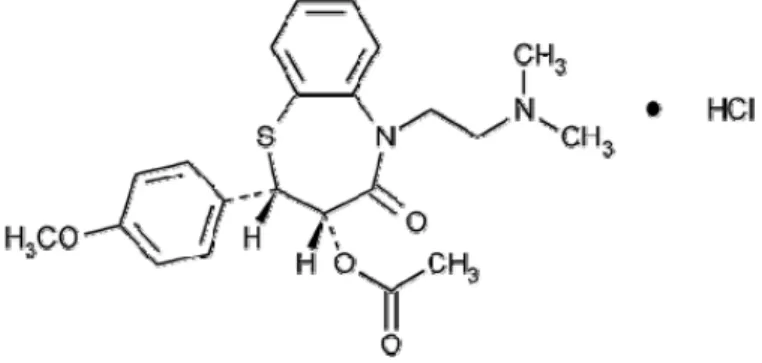
Diltiazem hydrochloride (figure 1) is a nondihydropyridine (non-DHP) member of the class of drugs known as calcium channel blockers, used in the treatment of hypertension, angina pectoris and some types of arrhythmia (Amer and Maher,2005; Kaymaz et al., 1995). It is also an effective preventive medication for migraine (Scott et al., 1997). Moreover, Diltiazem is metabolized by and acts as an inhibitor of the CYP3A4 enzyme. Diltiazem is a potent vasodilator (Shinjo et al., 1978), increasing blood flow and variably decreasing the heart rate via strong depression of A-V node conduction (Katsumata et al., 2000; Ellenbogen et al., 1991).
Fig. 1: The chemical structure of Diltiazem hydrochloride.
A literature survey reveals few analytical methods for the analysis of Diltiazem in solution and biological systems. Several spectrophotometric methods for determination of Diltiazem hydrochloride have been reported (Kamath et al, 1991; Zivanov-Stakic et al, 1992; Agrawal et al, 1992; Rahman and Azmi, 2000).
Diltiazem was identified by TLC method on silica gel by ascending technique, in presence of five other antiarrhythmic drugs (Witek and Przyborowski, 1996). For several years, high performance liquid chromatography has been the method of choice for analysis, separation and identification of chemicals, medicines and medicinal plants (Abbas and Ateya, 2011; Abdel Azeiz et al, 2009; Torkey et al, 2009; El-Sayed et al, 2012). HPLC method has been used for the analysis of diltiazem in pharmaceutical formulations and biological fluids (Clozel et al, 1984; Dube et al, 1988; Sultana et al, 2007; Shah et al, 1990).
731
The present study is favored over the previous published work because the pH value of the mobile phase is acceptable (pH=6.2). This may increase the lifetime of the column. Moreover, the run time in the present study is somewhat longer than the previous work. This is an advantage to follow all the degradants that may appear separated in chromatograms. In some previous studies the run time is extremely short (less than 3 minutes) at which, degradants that may appear in the work are not visible in the chromatogram.
2. Experimental: Buffer Preparation:
1.16 g of d-10-camphorsulfonic acid dissolved in one liter of 0.1 M sodium acetate. The pH was adjusted to 6.2 ± 0.05 by 0.1N NaOH.
Mobile Phase:
500 ml Buffer, 250 ml acetonitrile, and 250 ml methanol were mixed and the resulting solution was filtered through a regenerated cellulose filter paper having a pore size 0.2 m and degassed.
Chromatographic Conditions:
An HPLC system connected to an ultraviolet detector set at a wavelength of 240 nm was used. Inertsil ODS-3, 5μm (4.6 x 250mm) column was used at a flow rate of 1.6 ml/min.
Standard Preparation:
An amount of Diltiazem hydrochloride equivalent to 60 mg transferred to 50 ml volumetric flask; 40 ml diluent (methanol) was added, sonicated for 5 minutes to dissolve and then diluted to volume with diluent.
Sample Preparation:
Ten tablets were finely powdered. An accurately weighed portion of the powder, equivalent to 60 mg of Diltiazem hydrochloride transferred to a 50 ml volumetric flask; 40 ml of methanol was added, sonicated for one hour, cooled, diluted with methanol to volume and mixed. The sample was then filtered using 0.7μm glass filter.
Linearity:
The linearity of Diltiazem hydrochloride was determined in the range of 70% to 130%, relative to the prescribed standard concentration of Diltiazem hydrochloride. This corresponds to 840 to 1560 µg/ml.
Stability Indicating and Stress Tests:
The stress conditions that have been applied in this study were: heat, hydrolysis, acidic, basic and oxidation.
The HPLC method will be used for stability investigations. Therefore, the method must be a stability indicating method. The method is considered to be stability indicating if the number or amount of impurities or degradation products has changed or showed any loss in potency. An accelerated stability investigation was performed to demonstrate that the method is sufficiently specific for the determination of degradation products.
Heat for Diltiazem Hydrochloride Standard:
59.52 mg Diltiazem hydrochloride, working standard were placed in an open 50 ml volumetric flask, and heated directly at 200°C over hot plate till color changed, allowed to cool, then treated as in method of analysis.
Hydrolysis Stress for Diltiazem Hydrochloride Standard:
61.17 mg Diltiazem hydrochloride, working standard were placed in an open 50 ml volumetric flask, 2.5 ml distilled water were added, heated for 2 hours over water bath, and cooled to room temperature, then treated as in method of analysis to get nominal concentration.
Acidic Stress for Diltiazem Hydrochloride Standard:
61.42 mg Diltiazem hydrochloride working standard were placed in an open 50 ml volumetric flask, 2.5 ml 0.1 M HCl were added and heated for 2 hours over water bath, and cooled to room temperature, 2.5 ml 0.1 M NaOH were added, then treated as in method of analysis to get nominal concentration.
732
60.68 mg Diltiazem hydrochloride, working standard were placed in an open 50 ml volumetric flask, 2.5 ml of 0.1 M NaOH were added, and heated for 2 hours over water bath, and cooled to room temperature, 2.5 ml 0.1 M HCL were added, then treated as in method of analysis to get nominal concentration.
Oxidation Stress for Diltiazem Hydrochloride Standard:
62.38 mg Diltiazem hydrochloride, working standard were placed in an open 50 ml volumetric flask, 2.5 ml 2% H2O2 were added and heated for 2 hours over water bath, cooled to room temperature, then treated as in
method of analysis to get nominal concentration.
Heat For Diltiazem Sample:
62.08 mg Diltiazem hydrochloride working standard and 73.3 mg placebo were placed in an open 50 ml volumetric flask, and heated directly over 200°C over hot plate till color changed then treated as in method of analysis to get nominal concentration.
Hydrolysis Stress for Diltiazem Sample:
57.96 mg Diltiazem hydrochloride, working standard and 73.3 mg placebo were placed in an open 50 ml volumetric flask, 2.5 ml distilled water were added, heated for 2 hours over water bath, and cooled to room temperature, then treated as in method of analysis to get nominal concentration.
Acidic Stress Diltiazem Sample:
58.03 mg Diltiazem hydrochloride, working standard and 73.3 mg placebo were placed in an open 50 ml volumetric flask, 2.5 ml 0.1 M HCl were added and heated for 2 hours over water bath, and cooled to room temperature, 2.5 ml 0.1 M NaOH were added, then treated as in method of analysis to get nominal concentration.
Basic Stress for Diltiazem Sample:
61.75 mg Diltiazem hydrochloride, working standard and 73.3 mg placebo were placed in an open 50 ml volumetric flask, 2.5 ml of 0.1 M NaOH were added, and heated for 2 hours over water bath,, and cooled to room temperature, 2.5 ml 0.1 M HCL were added, then treated as in method of analysis to get nominal concentration.
Oxidative Stress for Diltiazem Sample:
63.28 mg Diltiazem hydrochloride working standard, and 73.3 mg placebo were placed in an open 50 ml volumetric flask, 2.5 ml of 0.1 M NaOH were added, and heated for 2 hours over water bath,, and cooled to room temperature, 2.5 ml 0.1 M HCL were added, then treated as in method of analysis to get nominal concentration.
RESULTS AND DISCUSSION
Linearity:
The Linearity of the method is the ability to obtain a detector signal that is directly proportional to the concentration of the analyte in the sample. The linearity of Diltiazem hydrochloride was determined in the range of 70% to 130%, relative to the prescribed standard concentration of Diltiazem hydrochloride this corresponds to 840-1560 µg/ml for Diltiazem hydrochloride.
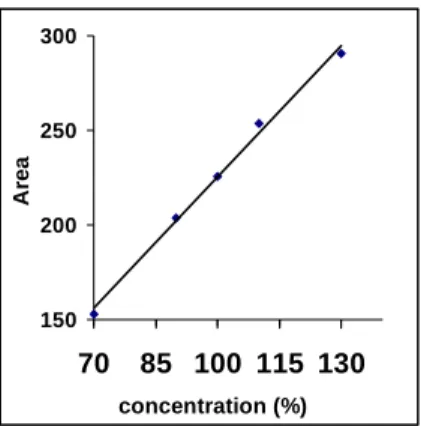
Graphs were plotted between the theoretical concentrations and corrected peak areas of these solutions. Slope, y-intercept, and correlation coefficients (R) of linearity were calculated. Results for the assay of Diltiazem hydrochloride are shown in table 1, and the calibration curves are illustrated in figure 2.
The obtained equation for the standard curve of Diltiazem hydrochloride standard unspiked was: Equation: Y= 18499.8X + 80222.9 (correlation coefficient R =0.9999).
Test results observed are in conformity to acceptance criteria. Therefore, the method is linear for Diltiazem hydrochloride between 70 % and 130 % concentration range.
Table 1: Standard curve forDiltiazem hydrochloride unspiked (Nominal concentration= 1200 μg/ml). Percentage
from Nominal
Conc. From Nominal
Actual Conc. Average AUC RSD
70 840 820 15303112 0.65
90 1080 1102 20372279 0.75
100 1200 1216 22565790 0.53
110 1320 1361 25353360 0.12
733 150
200 250 300
70 85 100 115 130
concentration (%)
Ar
e
a
Fig. 2: Regression for concentrations vs. area for Diltiazem hydrochloride standard.
Stability Indicating at Stress Conditions:
The stressed samples were analyzed and the chromatograms of the samples stressed under the conditions of heat, hydrolysis, oxidation, acidic, and basic were compared with the chromatograms of standard that shown in figures 3-5. Results of the stressed samples and standards are summarized in table 2.
Table 2: Stress testing and stability investigation studies for Diltiazem hydrochloride.
Stress test Name Retention Time Area
standard Diltiazem HCl 25.41 2236924
hydrolysis Diltiazem HCl 25.12 2238611
oxidation Diltiazem HCl 25.16 2090627
acidic Diltiazem HCl 25.13 1973673
heat Diltiazem HCl 25.12 1846551
basic Diltiazem HCl 25.14 1030798
Fig. 3: Chromatogram for A) diluent (methanol) and B) placebo.
734
Fig. 5: Chromatogram for A) Diltiazem hydrochloride standard hydrolysis stress, B) Diltiazem hydrochloride standard acidic stress, C) Diltiazem Hydrochloride standard oxidative stress, D) Diltiazem Hydrochloride standard basic stress
Accuracy:
The accuracy of the method expresses the closeness of the results obtained with the true value. For this test, the recovery of Diltiazem hydrochloride conducted on placebo sample solution was determined for the tablets, at a level of 70% -130%, relative to the prescribed sample concentration of Diltiazem hydrochloride.
Test concentrations, percentage recovery, and RSD were calculated, and the results are shown in table 3.
Table 3: Recovery test for Diltiazem hydrochloride. Percentage
from nominal
Theoretical concentration
(g/ml)
Experimental concentration (g/ml)
% Recovery
Average of recovery
%
831.3 845.9 101.75
70% 831.1 839.4 100.99 100.9
867.2 866.6 99.93
1173 1180 100.64
100 % 1214 1221 100.58 100.5
1242 1244 100.20
1547 1552 100.30
130% 1625 1627 100.09 99.97
1657 1650 99.52
Average recovery % 100.4%
SD 0.46 RSD 0.46%
The mean recovery of Diltiazem hydrochloride at the prescribed levels is between 98 and 102 %; therefore, it meets the acceptance criteria.
Limit of Detection and Limit of Quantification:
Limit of detection (LOD) is the lowest concentration of analyte in a sample, which can be detected, but not necessary quantified, under the stated experiment conditions. The limit of quantitation (LOQ) is the lowest concentration of analyte in a sample, which can be determined with an acceptable accuracy and precision detected.
Limit of detection and Limit of quantitation for Diltiazem hydrochloride was found to be 0.0408 and 0.2668 μg/ml, respectively.
Precision:
735 Table 4: System precision for Diltiazem hydrochloride standard.
Repeated injections for standard of Diltiazem hydrochloride Area under the curve for 10 replicate injections of Diltiazem hydrochloride
Injection 1 2335862
Injection 2 2330650
Injection 3 2329122
Injection 4 2326674
Injection 5 2330566
Injection 6 2326794
Injection 7 2323985
Injection 8 2308826
Injection 9 2311098
Injection 10 2328127
Average 2325170
RSD% 0.37%
4. Conclusion:
In this study, the following parameters were investigated: specificity, linearity, accuracy, precision, range, limit of detection, and limit of quantitation, for the assay of Diltiazem hydrochloride in tablet dosage. All the above-mentioned parameters for the assay testing method of Diltiazem hydrochloride met the acceptance criteria. Therefore, the method is proved to be valid, stability indicating and may be used for routine and stability sample analysis.
REFERENCES
Abbas, F.A., A. Ateya, 2011. Estradiol, Esteriol, Estrone and Novel Flavonoids from Date Palm Pollen. Aust. J. Basic & Appl. Sci., 5(8): 606-614.
Abdel Azeiz, A.Z., A.I. Shadi, A.R. Nassar, S.A. El-Saeyd, 2009. Separation and Identification of a New Glycolipoprotein Produced by Bacillus Psychrosaccharolyticus Against Sclerotium Rolfsii. Aust. J. Basic & Appl. Sci., 3(3): 2262-2269.
Agrawal, Y.K., K. Shivramchanda, B.E. Rao, 1992. Spectrophotometric methods for the determination of dilitiazem in pharmaceutical preparations. Indian J. Pharm. Sci., 54: 218-221.
Amer, A., T.J. Maher, 2005. Nasal administration of the calcium channel blocker diltiazem decreases food intake and attenuates weight gain in rats. Pharmaco. Biochem. Behav., 82(2): 379-387.
Clozel, J.P., G. Caille, Y. Toeymans, P. Theroux, P. Biron, F. Trudel, 1984. High-performance liquid chromatographic determination of diltiazem and six of its metabolites in human urine. J. Pharm. Sci., 73: 771-773.
Dube, L.M., N. Mousseau, I.J. McGilveray, 1988. High-performance liquid chromatographic determination of diltiazem and four of its metabolites in plasma: evaluation of their stability. J. Chromatogr., 430: 103-111.
Ellenbogen, K.A., V.C. Dias, V.J. Plumb, J.T. Heywood, D.M. Mirvis, 1991. A placebo-controlled trial of continuous intravenous diltiazem infusion for 24-hour heart rate control during atrial fibrillation and atrial flutter: a multicenter study. J. Am. Coll. Cardiol., 18(4): 891-897.
El-Sayed, S.T., E.M. El-Sayed, W.G. Shousha, A.N. Shehata, N.I. Omar, 2012. Production of Novel Antitumor Chitooligosaccharides by using Purified Chitosanases from Capsicum annuum Leaves. Aust. J. Basic & Appl. Sci., 6(4): 1-15.
Kamath, B.V., K. Shivram, 1991. Extractive spectrophotometric method for the determination of diltiazem hydrochroide in its dosge forms. Indian Drugs, 29: 50-52.
Katsumatal, N., X. Ma, H. Higuchi, 2000. Protective effect of diltiazem against ischemia-induced decreases in regional myocardial flow in rat heart. Eur. J. Pharmacol., 398(1): 83-91.
Kaymaz, A.A., H. Tan, T. Altuğ, A.S. Büyükdevrim, 1995. The effects of calcium channel blockers, verapamil, nifedipine and diltiazem, on metabolic control in diabetic rats. Diabetes. Res. Clin. Pract., 28(3): 201-205.
Rahman, N., S.N.H. Azmi, 2000. Spectrophotometric determination of diltiazem hydrochloride with sodium metavanadate. Microchem. J., 65: 39-43.
Scott, W.J. Jr., E. Resnick, H. Hummler, J.P. Clozel, H. Bürgin, 1997. Cardiovascular alterations in rat fetuses exposed to calcium channel blockers. Reprod. Toxicol., 11(2-3): 207-214.
Shah, Y., S. Khanna, V.S. Dighe, K.C. Jindal, 1990. High-performance liquid chromatographic determination of diltiazem hydrochloride in tablets. Indian Drugs, 27: 363-364.
Shinjo, A., Y. Sasaki, M. Inamasu, T. Morita, 1978. In vitro effect of the coronary vasodilator diltiazem on human and rabbit platelets. Thromb. Res., 13(6): 941-955.
736
Torkey, H.M., H.M. Abou-Yousef, A.Z. Abdel Azeiz, E.A. Hoda, 2009. Insecticidal Effect of Cucurbitacin E Glycoside Isolated from Citrullus colocynthis Against Aphis craccivora. Aust. J. Basic & Appl. Sci., 3(4): 4060-4066.
Witek, A., L. Przyborowski, 1996. Chromatographic (TLC) analysis of diltiazem in pharmaceutical form in presence of other antiarrhythmics. Acta. Pol. Pharm., 53(1): 9-12.