PROMOTION OF GEOPOLITICAL INTERESTS THROUGH MILITARY INTERVENTION IN REGIONAL CONFLICTS:
US/NATO INTERVENTION IN FORMER YUGOSLAVIA IN 1999 AND RUSSIAN INCURSION INTO GEORGIA IN 2008
Zumrat K. Salmorbekova
A thesis submitted to the faculty of the University of North Carolina at Chapel Hill in partial fulfillment of the requirements for the degree of Masters of Arts in the Curriculum in Russian
and East European Studies.
Chapel Hill 2009
Approved by:
Dr. Robert Jenkins
Dr. Graeme Robertson
ABSTRACT
ZUMRAT K. SALMORBEKOVA: PROMOTION OF GEOPOLITICAL INTERESTS THROUGH MILITARY INTERVENTION IN REGIONAL CONFLICTS: US/NATO INTERVENTION IN FORMER YUGOSLAVIA IN 1999 AND RUSSIAN INCURSION
INTO GEORGIA IN 2008
(Under the direction of Dr. Robert Jenkins)
The August 2008 Russian use of force against sovereign Georgia shocked the international community. The intervention triggered comparisons with the US-led NATO military intervention into the former Yugoslavia in 1999. This paper explores key foreign policy interests of the US and Russia and examines how these interests were expressed in these military interventions. The analysis revealed similarities in goals and differences in approaches. Both the US and Russia promoted their national geopolitical interests through military intervention. Nevertheless, there are considerable differences in their peace-mediation approaches with the involvement of international institutions preceding military intervention. The author believes that Russia’s incursion into Georgia sends a strong
message to newly independent states, in particular Ukraine, about the possible consequences of seeking close relations with the West. Indeed, the building of mutual trust and
ACKNOWLEDGEMENTS
TABLE OF CONTENTS
LIST OF TABLES ... vi
Chapter I. INTRODUCTION ...1
Research Question and Argument ...3
Methodology ...8
Organization of the thesis ...9
II. FOREIGN POLICY AND NATIONAL INTERESTS OF THE UNITED STATES AND THE RUSSIAN FEDERATION...12
National Interests and Foreign Policy of the United States ...13
US interests in Kosovo...15
US interests in Georgia ...18
United States Participation in Multilateral Organizations ...21
National Interests and Foreign Policy of the Russian Federation ...26
Russian interests in Kosovo ...33
Russian interests in Georgia...36
III. “OPERATION ALLIED FORCE”: DIPLOMATIC EFFORTS AND MILITARY
INTERVENTION INTO KOSOVO IN 1999...51
US motives for military intervention into the former Yugoslavia ...51
History of conflict ...55
Peace mediation process and use of force ...58
Reaction of the Russian Federation ...66
IV. “COERCION OF GEORGIA TO PEACE”: DIPLOMATIC EFFORTS AND MILITARY INTERVENTION INTO GEORGIA IN 2008 ...70
Russia’s motives for military intervention in Georgia ...71
History of conflict and peacekeeping operation ...74
Use of force ...81
V. CONCLUSION ...86
Similarities in goals ...86
Differences in approaches ...91
Confrontation of interests ...93
Implications for US and Western policies toward Russia and its ‘zone of influence’ ...95
APPENDICES ...98
LIST OF TABLES
Table
ABBREVIATIONS
CIS Commonwealth of Independent States CSTO Collective Security Treaty Organization
EU European Union
FRY Federal Republic of Yugoslavia JPKF Joint Peacekeeping Force MAP Membership Action Plan
NATO North Atlantic Treaty Organization
OSCE Organization for Security and Co-operation in Europe
UN United Nations
UNOMIG United Nations United Nations Observer Mission in Georgia UNSC United Nations Security Council
US United States
CHAPTER 1
INTRODUCTION
The five day war in the South Caucasus between Russia and Georgia in August 2008 shocked the international community and raised many questions regarding the ability of international institutions to prevent unlawful military interventions into the territory of sovereign states, as well as their ability to respond to such regional conflicts. The Russian military intervention into the territory of Georgia provoked widespread discussion about the legitimacy of the use of force against a sovereign state and, as a consequence, raised
questions about its impact on stability in Europe, threats to the energy corridor, which goes through Georgian territory, and the real role of Russia as an equal partner to democratic countries in ensuring peace and security in the region.1
In academic circles and the mass media, this event triggered discussions that the US-led NATO war over Kosovo created precedents for opportunistic adaptations. George Friedman argues that “the war in 1999 was the framework that created the war of 2008” and points out that without understanding Kosovo it is impossible to understand the war between Russia and Georgia. 2 On the contrary, Charles King argues that South Ossetia and Kosovo
1 “Russia vs. Georgia: The Fallout.” International Crisis Group. Europe Report no 195, Tbilisi/Brussels. 22
Aug. 2008. 15 Oct. 2008.
<http://www.crisisgroup.org/library/documents/europe/caucasus/195_russia_vs_georgia___the_fallout.pdf>.
2 Friedman, George. “Georgia and Kosovo: A Single intertwined Crisis.” Stratfor.com, 25 Aug. 2008. 17 Oct.
2008 <http://www.stratfor.com/weekly/georgia_and_kosovo_single_intertwined_crisis>.
are not the same; he indicates that there are differences in the circumstances of the military interventions, as well as in the involvement of multilateral institutions before and during the operation, which in Kosovo was undertaken by a Western coalition and afterwards followed by a UN peacekeeping mission.3
Ironically, the Russian leadership used the same terminology as did the US and NATO during the Kosovo crisis in 1999 in justifying its use of force against Georgia, such as “genocide,” “peacekeeping,” “humanitarian intervention,” “coercion to peace,”
“pre-emptive-strike,” and others. In addition, the Kremlin used the Kosovo case to legitimize its own actions, pointing out that Kosovo is a ‘precedent,’ arguing that the people of Abkhazia and South Ossetia equally have the right to decide their own future. Russia staunchly
opposed NATO’s military intervention, calling it a violation of the sovereignty and territorial integrity of Serbia and accusing the US of using double standards in international affairs. In August 2008, Russia itself was highly criticized and condemned for undermining Georgian sovereignty and territorial integrity. A sequence of events in the post-Soviet space, such as the gas scandal with Ukraine, the strengthening of the Collective Security Treaty
Organization in the CIS, and the decision of the government of Kyrgyzstan to close the US air base, has demonstrated the need for a deeper understanding of Russian foreign policy and US national interests in the post-Soviet space. Russia’s assertive behavior in the ‘near abroad’ and its self-perception as a ‘big brother’ have limited the interaction of newly independent states with western countries, impeding processes for democratic development and supporting ill-governments in post-Soviet states.
3
Research Question and Argument
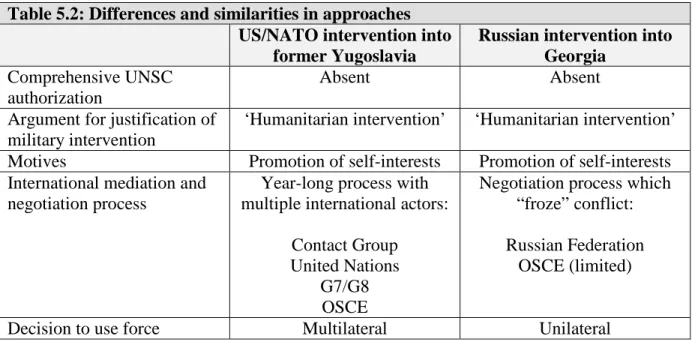
Taking into consideration discussions about Kosovo as a precedent for the use of force by Russia against Georgia over South Ossetia, as well as about Russia’s real intentions in preserving peace and stability in post-Soviet space, I attempt to explore the key foreign policy interests of the US and Russia, and how these interests were expressed during the US-led NATO military interventions into the former Yugoslavia in 1999 and Russia’s incursion into Georgia in 2008. The paper compares and reveals similar and different approaches undertaken in diplomatic efforts with the level of involvement of multilateral organizations during the peace-mediation process and in the decisions to use force. This study will attempt to provide an understanding of what drives major powers, without a comprehensive UN Security Council resolution authorizing the use of force, to undertake such large-scale, risky, and expensive military interventions in sovereign countries.
The study endeavors to uncover any other motivations hidden behind the argument of ‘protecting ethnic groups from ethnic cleansing,’ which was used in both cases as
justification. Additionally, the analysis reveals the role of the US in the Russo-Georgian conflict, as well as role of Russia during the Kosovo crisis, because the US and Russia were engaged in both conflicts, even though their roles were opposite to each other.
Europe that the post-Soviet space is Russia’s ‘zone of influence,’ and that without its
permission no other country has the right to build partnerships and friendly relations with its ‘protectorates.’
At first glance it seems that the NATO intervention into Serbia in 1999 and the Russian intervention into Georgia in 2008 are similar. Such an argument might be based on the fact that the former Yugoslavia, like Georgia, was experiencing interethnic conflict. Both countries’ conflicts were rooted in aggressive national policies against ethnic minorities, which led to social, political, and economic inequality and resulted in the creation of
vehement separatist movements. Structural violence, including institutionalized poverty and discrimination against ethnic minorities, widened divisions. Both military interventions could be said to be illegitimate due to the absence of the comprehensive endorsement of a United Nations Security Council resolution. In both cases “protection of ethnic groups from cleansing” was considered the official reason for military intervention. However, this study exposes the fact that the humanitarian reason took a backseat to other key motives and was mainly used to gain public support and as international justification. The analysis discloses that the US’s and Russia’s involvement in the conflicts were largely motivated by the promotion of strategic and geopolitical interests, the securing of leadership positions, and domination in Europe and the post-Soviet space.
US involvement in the Kosovo crisis was motivated by two main factors. The first factor relates to preserving regional security in the Balkans and Europe. Being committed to NATO and its allies in Europe, Washington was concerned by refugee flow and war
atrocities in Kosovo, which meant the possibility of the spreading of conflict into
factor was to secure NATO’s credibility and determine its new role in the post-cold war world. Defining a new role for NATO was a strategic issue for the US because through NATO it could secure a leadership position in Europe, which would allow for the promotion of the US’s economic and political interests in the region and elsewhere. The Kosovo crisis was an opportunity for the US to demonstrate NATO’s credibility and capability to secure peace and stability in the region. The effective military intervention into Kosovo made it clear to Western European countries that without the US’s technological capabilities and resources the protection of national security would be challenging. NATO’s failure to act decisively in the crisis could have provoked discussions and undermined its future role in Europe. In that case Washington risked losing a tool for maintaining its leadership position in Europe and elsewhere, and for pursuing its own national interests.
Russia’s incursion into Georgia has been motivated by mainly geostrategic reasons that combine local, regional, and geopolitical interests.4 These interests include maintaining protectorates such as South Ossetia and Abkhazia, exercising a predominant position in the region through political and economic influence, and sending a message to the West about Russia’s growing status as a great power and as a counterweight to the presence of the US and NATO in the post-Soviet space. The preservation of South Ossetia and Abkhazia as protectorates was needed for securing Russia’s strategic economic and politico-military interests, which would allow Russia to secure its presence in Georgia. Moscow’s presence in Georgia is of strategic importance for exercising Russia’s political influence and opposing the possible location of US or NATO military forces in the region. For Russia, presence in
4
the region is also beneficial for keeping economic influence by controlling energy
transportation, thus undermining European attempts to build an alternative energy pipeline. Nevertheless, my research reveals differences between NATO’s military intervention into the former Yugoslavia and the incursion of Russia into Georgia. The distinctive
differences are seen in the respective peace-mediation processes with the involvement of multilateral institutions, as well as in the peacekeeping operations. Prior to military intervention into Kosovo, the US and NATO member states undertook lengthy multistage mediation and negotiation processes with the wide involvement of international institutions such as the UN, the Contact Group, and the OSCE. UNSC Resolution 1199 recognized that the crisis in Kosovo presented a threat to stability and security in the region.5 Another UNSC Resolution 1203 endorsed and supported signed agreements between the Federal Republic of Yugoslavia (FRY) and the OSCE and between the FRY and NATO on establishing an OSCE monitoring verification mission and NATO air verification mission over Kosovo.6 The decision to use force was made multilaterally based on a consensus among NATO member states; however, the comprehensive authorization of the United Nations Security Council was lacking. The main cause of the lack of authorization was Russia’s veto power at the UNSC. Even though Russia played an insider role in assisting in the negotiation process with the Serbian leadership, the Kremlin actively opposed the possibility of the use of force by NATO against the Former Republic of Yugoslavia. The main reason for such opposition was the affirmation that Kosovo was an internal matter of, and therefore the problem should be solved by, the FRY government. The Kremlin’s position might be explained by the fact that
5 UNSC Resolution 1199. UNSC S/RES/1199. 23September 1998. 17 Feb. 2009
<http://www.un.org/peace/kosovo/98sc1199.htm>
6
Russia had a separatist problem in Chechnya at that time. Moscow’s stance was closely linked with aspirations to preserve its great power status. Accordingly Russia, along with China, warned the US and the EU that it would use its veto power and prevent them from obtaining permission from the UNSC to conduct military intervention into the territory of the Former Republic of Yugoslavia. In light of this warning, NATO did not appeal to the UNSC in order to get comprehensive Security Council authorization to conduct military
intervention. This case serves as evidence of Russia’s use of UNSC veto power as a tool for maintaining its national interests.
In 1991-1992, the first armed conflict between Georgia and South Ossetia took place. On 24 June 1992, Russia played the role of mediator and brokered a ceasefire agreement in Sochi between warring parties that led to the deployment of the tripartite Joint Peacekeeping Force (JPKF) with Georgian, Russian, and North Ossetian units, and a limited observation mandate of the OSCE. 7 Deployment of joint Russian, Georgian, and North Ossetian peacekeeping forces to the conflict zone successfully restricted international involvement. Only bilateral pace-negotiation was conducted by Moscow, before deployment of the tripartite peace keeping forces (Russia, Georgia and Ossetia).
After the Georgian-Abkhazian conflict in May 1994, the UN and Russia signed the Moscow Agreement which established the CIS Peacekeeping Forces (CISPKF). However, the peacekeeping force of 2,000 peacekeepers and military observers were composed exclusively of Russian forces, unlike the JPKF in Ossetia. The Moscow Agreement also provided the conditions for the deployment of a United Nations Observer Mission in Georgia (UNOMIG) with the task of observing the implementation of the agreement. Thus, in
7
Georgia peace-mediation and peacekeeping operations were under the obvious domination of Russia with limited involvement of international organizations and therefore cannot be seen as equivalent to United Nations peacekeepers in Bosnia or Kosovo. The role of the
Commonwealth of Independent States (CIS) in the peace-mediation process is under doubt due to a vague initial structure and the apparent domination by Russia in the decision making process. Thus, Russian leadership decided to use force against Georgia unilaterally, without any consultations with the CIS or support from multilateral institutions.
Lastly, the Kosovo crisis was not generated by the NATO alliance or the US. Third-party involvement came later and the airstrike against Serbia was provoked by the
deterioration of the situation and escalation of ethnic cleansing. In addition, the US and the NATO alliance did not support Albanians in Kosovo, unlike Russia, who supported
breakaway regions by backing separatist movements and distributing Russian citizenship to South Ossetians.8 Thereby Russia took a dominant role in the conflict between Georgia, South Ossetia, and Abkhazia, and was mainly focused on pursuing its own geopolitical interest rather than on helping Georgia solve the problem with its breakaway region.
Methodology
This research explores three categories: (1) the strategic interests and motives for the US’s and Russia’s military interventions, (2) the level of international institutions’
involvement in the peace-mediation process, and (3) the decisions to use force.
8
The broad foreign policy interests of the United States and the Russian Federation were divided into two periods: the 1990s and the beginning of the 2000s. Also each country’s national interests and motives to intervene were examined in the respective regions: Kosovo and Georgia.
The US’s and Russia’s participation in multilateral organizations and level of
engagement of these institutions in diplomatic efforts were studied. The role of regional and international institutions in the promotion of the US’s and Russia’s national interests in regional conflict management were studied as well.
Taking into account that both military interventions were conducted without
comprehensive UNSC authorization, the study explores how the decisions to use force were made and on what basis. This study reveals a considerable difference between the two cases. In the Kosovo case the decision was multilateral based on a consensus between NATO member states. On the other hand, in the Georgia case the decision was made unilaterally by Russia without consultation with CIS member states.
Organization of the thesis
Chapter 3 will discuss the possible strategic motives that drove Washington into the Kosovo crisis. The process of interest realization through negotiation and mediation
processes with the involvement of regional and international institutions will be discussed as well. Also, the chapter will illustrate the role of Russia in the peace-mediation process and its position on the Kosovo issue. In addition, the wide engagement of the international community and the presence of a previous UNSC resolution allowing for the establishment of a NATO verification air mission over Kosovo and OSCE’s monitoring mission, which led to the conclusion that the decision on “Operation Allied Force in Kosovo” was based on multilateral consensus, will be discussed. This, incidentally, is the main difference between NATO’s military intervention into Kosovo and Russia’s intervention into Georgia.
Chapter 4 will discuss the motives of the Russian counter-offensive attack on Georgia in August 2008, as well as the role of Russia in Caucasian conflicts, in particular the
Georgia-Ossetia conflict. Russia’s dominant position in negotiations and peacekeeping processes created limitations on international involvement in the conflict, which played a negative role in solving the root causes of the conflict and resulted in Russia’s active
tensions between Russian and Georgia, which led to a situation in which US and Russian interests conflicted and caused a dramatic shift in Russian-Western relations.
Finally, in the conclusion I summarize the vital and strategic interests of the US and Russia in both regions, and review differences and similarities in the engagement of
multilateral institutions in peace-mediation processes and decisions to use force. The Russia- monopolized “mediator” role in interethnic conflicts in the post-Soviet space indicates that Russia will use ‘soft’ and ‘hard’ methods to influence and promote its national interests in the near abroad in order to counterbalance the US’s interests.
Now we turn to chapter 2 where will be discussed foreign policy interests of the United States and Russia in a broad and regions oriented context. The foreign policy
CHAPTER 2
FOREIGN POLICY AND NATIONAL INTERESTS OF THE UNITED STATES AND THE RUSSIAN FEDERATION
In order to understand the motives behind military intervention it is important to examine the foreign policy interests of the US and Russia in the 1990s and into this century. National interest refers to the self-interest of a nation-state, defined as a state’s goal or vision for the defense and projection of its power beyond its borders in order to pursue economic growth and power.9 Foreign policy is a strategy or set of goals designed to interact with other countries on economic, political, cultural, social, and military issues, as well as with non-state actors. As a rule, these interactions attempt to take a full advantage of the benefits of multilateral international cooperation. Foreign policy is closely linked with national interest because it is developed in order to protect a country’s national interest, security, ideology, and economic prosperity.
The paper divides national interests into two groups: vital and strategic interests. Vital interests concern survival issues and could affect the security and economic future of a country. Vital interests require total military mobilization and readiness to conduct war in order to protect and defend a country’s welfare, as well as the regions that directly affect its security interests. Strategic interests include concerns that do not affect issues of survival or present a threat to the nation, but have the potential to become vital over an extended period
9
of time. In addition, pursuing strategic interests facilitates obtaining political, economic, and military advantages to keep a hegemonic position, either regionally or globally.
National Interests and Foreign Policy of the United States
Sarkesian, Williams, and Cimbala define the national interests of the United States as “… expressions of US values projected into the international and domestic arena. The purpose of interests includes the creation and perpetuation of an international environment that is most favorable to the peaceful pursuit of US values. It follows that interest’s nurture and expand democracy and open systems.”10 This definition emphasizes the vital role of American values in the formulation of the principles of the US political-social system upon which national interests are based. Promotion of American values and national security interests requires projection of power into different parts of the globe.
US foreign policy is not defined only by the ruling leadership. American foreign policy is developed through the close interaction of societal forces and the institutional branches that were established by the US Constitution. The societal force concept embraces the broad viewpoints and orientations of the American people that consist of “… shared ideas, ideals, concepts, stories and myths that orient citizens within their political systems.”11 At the institutional level foreign policy materializes as a result of interaction between two parts of the institutional establishment—the President of the United States within the executive branch and the US Congress. Each of these institutions influences foreign policy
10 Sarkesian, Sam, and Williams, John Allen, and Cimbala, Stephen J. US National Security: Policymakers,
Processes and Politics. Boulder London: Lynne Rienner, 2008. pp. 8-9.
11
formation and its implementation. Public opinion and its consent in implementing certain policies plays a crucial role in the policies launched by the government. After the end of World War II and up until end of the Cold War, the US’s key foreign policy interests included containment of the Soviet Union, prevention of the spread of communist ideology, and promotion of a global economy under US leadership. At that time, defining national interest was clear-cut and every foreign policy decision was seen through this ideological prism. For most of the twentieth century and today, US foreign policy has been driven by geopolitics and the prevention of domination by any strategic power in the world.
With the dissolution of the USSR, serious challenges of territorial domination ended and the principal goal of American policy was achieved. Once the Cold War ended it became more difficult to define national interests and to translate them into coherent foreign policy objectives. Such difficulties occurred due to the unpredictable, uncertain, and
unstable situation in the world. The new era demanded new ways of thinking and new approaches in the formulation of strategies, policies, and concepts. In the 1990s, US foreign policy had very broad multiple political, economic, strategic, and humanitarian interests. Convinced that the major war threat was reduced, US policy was directed to solving domestic problems and in 1991 was engaged in the Gulf War to protect Kuwait from Iraq.
Sarkesian, Williams, and Cimbala describe the Clinton’s administration grand strategy as that of “engagement and enlargement.” 12 One of the vital interests for
Washington in the 1990s was defining a new role for the North Atlantic Treaty Organization (NATO) in European affairs and continuing to build strong partnerships with European allies, thus securing US hegemony and leadership.
12 Sarkesian, Sam, and Williams, John Allen, and Cimbala, Stephen J. US National Security: Policymakers,
Building a strong partnership between itself and Europe is another vital interest for the US. For America, Europe is considered a key region for maintaining a strong US economy, and for obtaining the support of allies that gives the US leverage in advancing its political and economic interest around the globe. The US and its European allies have cultivated strong economic ties which increase employment opportunities, as well as provide trade and profitable investment opportunities for Americans. The US engagement in
Europe’s security issues and in expanding stable zones decreases the threat to stability and creates a secure environment that fosters economic benefits and results in reducing defense costs and increases the possibility of promoting its vital economic interests. For example, according to Institute for National Strategic Studies about 50percent of the US’s direct investment abroad is in Europe, and over 60 percent of foreign direct investment in the US is from Europe.13 A strong US economy became a unified objective that intertwined economics and politics.
Among strategic interests, these include issues of the protection of the homeland from nuclear, biological, chemical (NBC), or conventional military attack, as well as the
prevention of any hostile power from dominating Europe, the Middles East, Asia, or the high seas.
US interests in Kosovo
The United States was engaged in the Yugoslav crisis in 1994 as a member of both NATO and the United Nations Security Council. Despite efforts of European countries in Bosnia-Herzegovina, the situation deteriorated in Bosnia and the US was a high profile
13 Department of Defense Office of International Security Affairs. “United States Security Strategy for Europe
participant in the negotiation process and played a decisive role in stopping the war in Bosnia by assisting in signing the Dayton agreement in 1995. NATO was used as a peacemaking tool during the war and replaced the UN peacekeeping personnel afterwards.
On 24 March 1999, NATO, backed by the US, launched a 78 day air campaign against the Federal Republic of Yugoslavia (FRY). In that military intervention, NATO used sustained force for the first time in the history of the alliance. It involved the large-scale use of air force operations against the Yugoslav state’s army and resulted in policy changes by the Yugoslav government. NATO and its allies justified the military campaign with overwhelming humanitarian reasons, notably stopping the killing and expulsion of the Albanian population in Kosovo by Serbian paramilitary and law-enforcement forces.
US involvement in the Kosovo crisis was motivated by two interests. First, the issue of NATO’s credibility in its new role in European affairs was vital to American politics in the 1990s. Having engaged in international diplomacy over the Kosovo crisis and having made military threats to Belgrade over the continuation of atrocities, NATO member states could have lost confidence in the credibility and capability of NATO to guarantee peace and security in the region if Milošević refused to agree to a diplomatic solution.14 In addition, as a founder of NATO, the US was interested in the expression of NATO’s new mission in Euro-Atlantic political relations. It was a vital interest to preserve US leadership in NATO in order to secure a continued leadership position in Europe, influence European security issues, and promote the US economy in Europe and beyond.15
14 Roberts, Adam. “NATO’s ‘Humanitarian War’ over Kosovo.” Survival, 41.3 (Autumn 1999): 102-23. 15
Accordingly, President Clinton stated during his address to the nation prior to intervention into the Former Republic of Yugoslavia on 24 March 1999 that “Kosovo is about the US’s relation with Western Europe.”16 The US commitment to multilateralism in NATO resulted in the transformation of the institution from a regional defense-alliance to a peacemaking mechanism and ensured a leadership role for the US, allowing it to promote its national interests within a multilateral framework in regional conflict. Preserving NATO as an instrument for maintaining a leadership position in Europe and beyond was a key interest for the US rather than saving Kosovo per se. With Kosovo’s declaration of independence in February 2008, it is a matter of honor for the US and EU to provide sustained support for the promotion of democratic principles and establishment of the rule of law in Kosovo, in order to ensure sustainable development in the Balkan region.
The second interest was preserving regional security in the Balkans. The situation in Kosovo threatened international peace and security due to the intensification of war atrocities and ethnic cleansing that generated refugee flows. Large refugee flows from Kosovo into neighboring countries were considered a destabilizing factor for Europe and a potential source for the conflict to spill over into neighboring countries.17 Indeed, according to UNHCR (March 1, 1998-March 24, 1999) about 100,000 Kosovo Albanians left the region before NATO’s campaign.18
16 Gowan Peter. “The Euro-Atlantic Origins of NATO’s Attack on Yugoslavia.” Masters of the Universe?
NATO’s Balkan Crusade. Ed. Tariq Ali. Verso: London-New York, 2000. 3-45.
17 Roberts, Adam. “NATO’s ‘Humanitarian War’ over Kosovo.” Survival, 41.3 (Autumn 1999):102-23. 18
US interests in Georgia
The region of the Southern Caucasus, with its three sovereign countries Georgia, Azerbaijan, and Armenia, takes one of the central places in the promotion of US foreign policy. US strategic interests are focused on several issues, such as the promotion of freedom and democracy, energy security, counterterrorism, and the peaceful resolution of “frozen conflicts.” Georgia plays a significant role in US strategic geopolitical and economic interests in terms of energy security, counterterrorism, averting great power domination and NATO enlargement.
The strategic economic interest is concerned with the security of the Baku-Tbilisi-Ceyhan (BTC) oil pipeline that goes through Georgian territory from the Caspian Sea and Central Asia to Turkey and ultimately to Europe and the US. BTC is the only regional transit route that avoids Russia and Iran. The 1,100-mile long pipeline started service in 2006 and pumps up to 1 million barrels of oil per day from Baku, Azerbaijan, to Yumurtalik, Turkey. In Georgian territory the BTC stretches 154.7 miles.19 There is also the Baku-Tbilisi-Erzurum (BTE) pipeline that transports natural gas from the Shah Deniz gas field in
Azerbaijan to Turkey. The BTE pipeline started its first deliveries on December 15, 2006.20 Bernard Gelb refers to the estimates of BP and the Energy Information
Administration of the US Department of Energy and points out that the Caspian Sea is a significant but not major source of crude oil to the world market.21 To put things in
19 Pagnamenta, Robin. “Analysis: Energy Pipeline that Supplies the West Threatened by War Georgia Conflict.”
Times Online. 28 Dec. 2008. 29 Dec. 2008
<http://www.timesonline.co.uk/tol/news/world/europe/article4484849.ece>.
20
During the Russo-Georgian war the pipeline was closed for a couple of days and resumed operation on August 14, 2008.
21 Gelb, Bernard A. “Caspian Oil and Gas: Production and Prospects.” CRS Report for Congress received
perspective, in 2005 the Caspian Sea’s energy production was 1.9 million barrels per day (only 2percent of total world output), while each country within the Organization of
Petroleum Exporting Countries produces more than 1.9 million barrels per day.22 However, by BP’s estimates the Caspian basin has on reserve about 48 billion barrels of oil, which is about 4percent of world reserves, compared to the US’s estimated 29 billion barrels of reserves.23 Gelb points out that gas reserves in the Caspian region are higher, proportionally, than those of oil; thus, BP estimates confirm that the Caspian region has 4percent of the world’s total in gas reserves.24 Thereby the Caspian Sea contains more energy resources than it produces and as a consequence, it is of long-term importance.
The region is attractive for other energy-thirsty countries such as Turkey and China. Considering that the Caspian basin is a landlocked region, Russia has monopolized energy transit, controlling the majority of energy routes from the Caspian reserves. In addition, with the difficulties of post-war Iraq and the deterioration of relations with Iran, the importance of the Caspian region and Central Asia has increased. In this regard the BTC pipeline became an additional, however not main, source for energy supply that reduces heavy reliance for oil on the Middle East and Russia. Georgia as a transit country plays an important role for Euro-Atlantic society because its geographic location serves as an option for a non-Russian export route and provides an important access point to the northern borders of Middle East and Central Asian energy resources.25 Therefore, the preservation of stability in the region will
22 Gelb, Bernard A. “Caspian Oil and Gas: Production and Prospects.” CRS Report for Congress received
through the CRS Web. 8 Sep. 2006.
23 Ibid. 24 Ibid.
25 Tsereteli, Mamuka. “Beyond Georgia: Russia’s Strategic Interests in Eurasia.” CACI analyst, 11 June 2008.
make access of Caspian energy resources to the global market easier, thereby diversifying energy resources and releasing monopolistic pressure.
Another strategic interest of the US is to prevent great power domination in the region. The US is concerned about Russian aspirations to influence and dominate in the region. In this regard, Washington tries to counterbalance the Kremlin’s ambitions by providing considerable support in the implementation of reforms and promotion of
democracy in Georgia, and encouraging Georgia in finding peaceful ways to solve separatist conflicts. The US considers the promotion of democracy in countries in transition to be indispensable to America’s own national security, since the United States does not feel fully secure when undemocratic countries dominate in the world.
Within the framework of support for democratic reforms in Georgia, the United States provided assistance in the modification and restructuring of the Georgian defense system and trained the Georgian military within the framework of the Georgian Train and Equip Program (GTEP).26 This training program was in line with the US’s vital interest in the “war on terror” as well as in enhancing Georgian counter-terrorism capabilities and addressing the situation in the Pankisi Gorge. According to numerous intelligence data, terrorists supported by international terrorist organizations including Al-Qaeda, remain there.27 In turn, Georgia has provided military forces that support the peacekeeping missions in Iraq under Operation ‘Iraqi Freedom’ and in Kosovo, KFOR.
26 Gularidze, Tea. “U.S. Boosts Successful Military Cooperation with Georgia.” Civil Georgia. 5 Aug. 2004. 24
Feb. 2009 <http://www.civil.ge/eng/article.php?id=7556>.
27
US support of Georgia in obtaining NATO membership is directly linked with the strategic interest of averting of great power domination and in line with the US policy on NATO enlargement in Europe. The US considers the NATO enlargement process to be a contribution to security and stability in the Euro-Atlantic region. For America it is
strategically important to maintain NATO as a capable and successful alliance with a strong adherence to its principles.
United States Participation in Multilateral Organizations
For Washington unilateralism is a preferred form of action due to its technological and material capacity. According to Clement, the United States is inclined to use a multilateral framework when it needs political support for legitimizing its actions. 28 Generally the United States tends to include its allies and partners who share its ideas and interests, and are able to contribute to common efforts. For the US, the NATO alliance is a great example of a permanent, multilateral framework with a group of credible, reliable, and loyal states that allows the US to promote its national political and economic interests.
Membership in the UN
The United States is a member of the United Nations (UN) with a permanent seat on the United Nations Security Council (UNSC) since its establishment after World War II. Washington played a great role in designing the United Nations system. The US views the UNSC rather than the General Assembly as the main decision making platform on key security issues. The UNSC is the only UN body that has the primary authority to deal with
28
issues concerning international peace and security that are reflected in the United Nations Charter. With the end of the Cold War the US emerged as the only superpower due to its financial, technological, and military capabilities, which resulted in distortion of the structural balance in the UN scheme.
The United States is considered the most dominant actor in the Security Council due to its technological, financial, and military capacities. As a consequence of the end of the Cold War, the balance shifted from interstate conflicts to internal warfare, which demanded new approaches in UN peacekeeping operations. The majority of those internal armed conflicts have been based on the issue of self-determination. The success of the UN peacekeeping operations in internal conflicts is unlikely to succeed without strong US backing, due to the US’s dominant position in the UN. Before engaging in one of the new types of conflict, Washington’s decision-makers first of all question whether it is in the US’s security and political interests to respond to these distant conflicts and what approach should be taken in order to respond to the conflict unilaterally, through a UN peace operation, or not at all. In addition, US leadership considers the consequences of this choice on the authority and capacity of the UN to keep peace, and whether the choice would have any rebound effects on the US itself.29
A permanent seat with veto power at the UNSC gives the United States, along with the other four SC permanent members, tremendous power to exercise. In this manner the US has actively used veto power in order to protect itself against decisions that have opposed its interests. Washington has exercised veto power in the Security Council largely on issues
29
related to the Arab-Israeli conflicts and to impose targeted and comprehensive sanctions against, for instance, such countries as Yugoslavia at the time of the Kosovo crisis. Very often due to veto power the UNSC becomes paralyzed and is unable to respond rapidly and decisively to the world’s challenges.
Membership in the North Atlantic Treaty Organization (NATO)
The US took active part in establishing the North Atlantic Treaty Organization on 4 April 1949 as a military alliance between North America and Europe. The primary role of the organization during the Cold War was to defend Europe and North America from possible attacks by any nation or group of nations (Soviet threat), promote peace and
security, and maintain the military balance in the region.30 Today NATO is an alliance of 26 countries from North America and Europe with the fundamental role of safeguarding the freedom and security of its member countries by political and military means. The principal decision-making body is the North Atlantic Council; NATO decisions are based on a
consensus between all member states. Such a decision making process compels the US to undertake bilateral and multilateral consultations with all member states in order to develop a consensus on a particular decision. 31 NATO has the military, material, and political
leadership capacity that allows it to fulfill its main mission in Europe and beyond. However, the technological capability of the US and its ability to conduct military operations ensures its leadership role in NATO and allows it to pursue national interests within a multilateral
30 Clement, Sophia. “The United States and NATO: A Selective Approach to Multilateralism.” Unilateralism
and U.S. Foreign Policy: International Perspective. Ed. Malone, David M. and Yuen Foong Khong. Lynne Rienner Publishers: Boulder-London, 2003. 399-417.
31
framework. Thus, the United States uses NATO as a tool in maintaining its leadership role in Europe; in turn, its presence ensures NATO’s credibility as a central European security institution. In addition, Washington sees in NATO a prime multilateral framework for legitimizing its activities, which allows for the promotion of its political and economic interests. In turn, for NATO member states it is beneficial to use the US’s capacities in ensuring peace and stability in Europe. Thus, during the Kosovo crisis, NATO became the prime multilateral institution able to obtain legitimacy for military action because the UN Security Council was paralyzed by the threat of Russia’s and China’s veto powers. Russia and China strongly considered the Kosovo crisis to be a purely internal problem of the Former Republic of Yugoslavia and therefore that use of force against a sovereign state would violate its territorial integrity.
In the 1990s NATO was significantly reoriented through organizational changes in four areas: ‘internal adaptation’, ‘external adaptation’, ‘peace support’, and ‘crisis
management and response’.32 Internal adaptation was mainly concerned with rebalancing relations with member states; specifically, the issue of NATO enlargement raised questions about establishing new decision-making procedures, because consensus-based decisions would become difficult with an increased number of members. Another issue of internal adaptation was the creation of a mechanism which allows the undertaking of military operations without the direct participation of US forces. This discussion resulted in the establishment in 1994 of the Combined Joint Task Forces (CJTF), with the idea of deploying flexible military forces by a ‘coalition of the willing.’
The ‘external adaptation’ process was related to the establishment of relations between NATO and non-member states. In 1994, NATO adopted the Partnership for Peace
(PfP) process, which was in line with the external adaptation framework, notably with Russia. NATO’s third unplanned peace support role took place with the arising of violent conflicts on the territory of the former Yugoslavia. In this way NATO’s troops and
command resources were deployed in Bosnia during the violence. In addition, after signing the Dayton agreement in 1995, NATO played a central peacekeeping role in Bosnia along with the OSCE and the UN. The fourth role of NATO in response to a crisis came with the use of military force, without a UNSC resolution, in 1999 under Operation Allied Force, which was aimed at coercing the Serbian leadership to peace in Kosovo, similar to the 1995 air strikes in Bosnia against Bosnian Serb positions near Sarajevo. This new role of the alliance was called ‘crisis management and response’ at a NATO summit in Washington in April 1999.33
Membership in the Organization for Security and Cooperation in Europe
The US has a seat in the Organization for Security and Co-operation in Europe (OSCE), which is the largest regional security organization in the world. The OSCE is a platform for political negotiations and decision-making in the field of early warning, conflict prevention, crisis management, and post-conflict rehabilitation in the region. The OSCE has a network of field missions around Europe and Central Asia that enables participating states to put their political will into practice.34
The OSCE is an organization that positions the US, Russia, and European countries on a level surface and bring together states from the west and east. It is a forum where all 56 member states have an opportunity to work closely on issues of common interests and make
33
Smith, Martin. From Cold War through cold peace to partnership? Routledge: London and New York, 2006.
decisions by consensus. The OSCE as a multilateral organization has a specific set of capacities such as mediation power in a conflict situation, institution-building in a post-conflict environment, and information dissemination in democratic processes, like elections. Thus the organization took a special position with regards to the Balkan wars in post-conflict rehabilitation, resettlement of refugees, establishment of electoral systems, and reforming the local police. In addition, the OSCE was present in Kosovo as an international monitoring organization before NATO’s military intervention into the former Yugoslavia. In contrast to NATO, the US uses the OSCE as an instrument for the promotion of security and peace in the region by non-military means.
National Interests and Foreign Policy of the Russian Federation
Foreign policy formation and implementation in contemporary Russia is affected by an imperial and totalitarian past. Andrei Tsygankov argues that Russian interaction with the world depends upon its own unique patterns of thinking and behavior, because throughout history the Russian response to national security threats was similar and resulted in the development of three main groups of interests: neighboring countries, external threat of invasion, and preservation of state integrity.35
Tsygankov states that such historical developments resulted in the emergence of three schools of foreign policy making: westernizers, statists, and civilizationists, or so-called
eurasianists. Westernizers affiliate themselves with the West and share Western values such
as democracy, human rights, freedom, and free market. 36 Statists strongly believe that only
35 Tsygankov, Andrei. Russia’s Foreign Policy: Change and Continuity in National Identity. Lanham: Rowman
& Littlefield Publishers, Inc. 2006. p. 4.
36
the state, without external assistance, is able to preserve the political, economic, and social order. Statists value strong state power, independence, and stability, and they sturdily believe that Russia’s national security is under the threat. Such a perception moves Russia toward great power ambitions and enables it to respond to challenges and threats from the inside and out. In foreign policy, the vital interest is associated with promotion of Russia’s greatness and demonstration of its strength. 37 Civilizationists are characterized as hard-line politicians and intellectuals who recognize widespread expansion as an approach to
guarantee national security. To Civilizationists, the dissemination of Russian values is important in challenging the Western system of values. Civilizationists believe that the expansion of territory and dissemination of their values is competition for power against the West, in particular the US.38
To Tsygankov, Russian foreign policy formulation and its implementation depends upon the political establishment following a particular school of thought.39 With the dissolution of the USSR in the early 1990s, Russia lost its superpower position in the world and was engaged in political, economic, and social transformation. The new Russian
leadership under Yeltsin was devoted to developing a pro-Western vision of national identity and motivated by initiating democratic reforms with the aim to integrate with the West. At that time national interest consisted of three main components. The first component was related to the conducting of radical economic and political reforms by investing resources in the creation of a modern economy without fear of military threat or geopolitical interests.
37 Tsygankov, Andrei. Russia’s Foreign Policy: Change and Continuity in National Identity. Lanham: Rowman
& Littlefield Publishers, Inc. 2006.
38 Ibid. 39
The second component was joining international organizations and becoming a full member of the transatlantic economic and security community (such organizations as the OSCE, NATO, the G-7, and others). Finally, the last component was related to the economic, political, and cultural separation of Russia from the former Soviet republics. The Russian leadership considered the former republics to be a heavy burden to the economy. In this regard Moscow aimed to gradually withdraw the army and military equipment from the territories of the former republics and relied on assistance from international organizations in solving the local conflicts that occurred in the Southern Caucasus and Central Asia. With the intention to “divorce” the former Soviet republics in a civilized way, Russia played a great role in establishing the Commonwealth of Independent States (CIS) in 1991. The CIS was also meant to be a platform for economic and cultural integration among the former Soviet republics.40
Thus, in 1992 the Ministry of Foreign Affairs of the Russian Federation prepared a new concept of foreign policy that denied imperial ambitions and placed its trust in the Western concept and support.41 However, due to weak economic capabilities the new strategy did not work. People’s growing dissatisfaction with the declining economy, the worsening standard of living, and skepticism toward the new reforms resulted in the intensification of the opposition. Such developments led toward the strengthening of the state’s role and the revitalization of the ‘great Russia’ status. External and internal threats to Russian security considerably affected the revival of great power status ambitions. The war in Chechnya undermined the country’s stability from the inside. Ethnic conflicts that
40
Tsygankov, Andrei. Russia’s Foreign Policy: Change and Continuity in National Identity. Lanham: Rowman & Littlefield Publishers, Inc. 2006.
occurred in the “near abroad” threatened Russia’s security from the outside, such as brutal fights between Georgians and South Ossetians, Georgians and Abkhazians, and disputes between Armenia and Azerbaijan over the Nagorno Karabakh region. In addition, despite Russia’s protests, NATO’s expansion toward the east became a factor reinforcing the power of the statist school and the cooling of relations with the West.
An even more assertive and solid stance emerged with the appointment of Yevgeny Primakov as Foreign Minister in 1996. A fundamental part the definition of national interest at the end of 1990s was related to securing great power status, counterbalancing the United States, and promoting the concept of a multipolar international system.42 The concept of multipolarity became central to Russia’s foreign policy and promoted the conditions needed to be a counterweight to US hegemonic aspirations.43 However, the great power balance policy did not create favorable conditions for economic development and did not improve the well-being of Russians. The policy turned out to be purely geopolitical, which resulted in a worsening economic situation, increased foreign debt, and a decline in foreign investments.44 During Yeltsin’s rule, foreign policy decision-making was chaotic and inconsistent due to in-fighting among different groups and the promotion of interests through the President’s favorites.45
42 Karlsson, H. “The United States and Russia: A clash of strategic visions.” Changing Transatlantic Security
Relations: Do the US, the EU and Russia form a new strategic triangle? Eds. Hallenberg, Jan and Karlsson, Hakan. Routledge: London and New York, 2006. 184-204.
43 Ambrosio, T. “Russia’s Quest for Multipolarity: A Response to US Foreign Policy in the Post-Cold War
Era.” European Security 10.1 (Spring 2001): 45-67.
44 Tsygankov, Andrei. Russia’s Foreign Policy: Change and Continuity in National Identity. Lanham: Rowman
& Littlefield Publishers, Inc. 2006. 25.
45
Putin inherited Russia at a difficult time, with the consequences of the 1998 economic crisis that paralyzed the economy and an external debt of $133 billion to Western banks and governments.46 Payment of the foreign debt and pursuing economic priorities was essential for Putin in order to restore Russia’s great power status. Dependence on loans from Western banks and governments inevitably meant that Russia lost independence in the formulation of its own political course and sovereignty. During his first years of rule Putin launched two main economic programs that resulted in paying off all Russian debt to the International Monetary Fund in the beginning of 2005, three and a half years ahead of schedule.47 The world price of oil also played an important part in increasing Russia’s wealth; the price rose from under $10 a barrel in 1998 to over $140 in 2008.48 Putin saw Russia’s gas and oil as a powerful foreign policy instrument and primary geopolitical asset. Such an understanding led to the creation of conditions where the state took greater control over these resources.
Putin’s consolidation of power and resources resulted in a consensus among the political elite about Russia’s identity and interests based on their perception of Putin. Like any other country in the world, Russia’s first vital interest is to ensure the security of the country while preserving its sovereignty and territorial integrity. The strategic interest of Putin’s Russia is attaining the status of major world power alongside the United States and China. It is clearly stated in an official document on foreign policy formation, adopted in 2000, that “… the Russian Federation is a great power and influential center in the modern
46 Gaddy, Clifford G. and Ickes, Barry W. “Putin’s Third Way.” National Interest online, 21 Jan. 2009. 7 Feb.
2009 <http://www.nationalinterest.org/Article.aspx?id=20496>.
47 Ibid. 48
world.”49 Great power ambition is also emphasized in Putin’s article devoted to the consolidation of Russian society when he says that “Russia has been and will be a great power”.50 Great power status was directly linked to the cultivation of a Russian sphere of influence in the post-Soviet space, a region identified as a ‘zone of special responsibility and influence.’
The next central interest is a continuation of the 1997 policy on the promotion of a multipolar world in order to balance “… a growing trend towards the establishment of a unipolar world order, with economic and power domination of the United States.”51 Moscow presents NATO enlargement, US missile defense deployment in Poland and the Czech Republic, and the official US policy on democracy promotion as a serious threat to Russia’s national security. These issues were clearly stated by Putin during his speech at a Munich conference in 2007.52 In addition, the presence of NATO forces in Central Asia, US military training in Georgia, and the desire of Georgia and Ukraine to obtain NATO’s Membership Action Plan are clearly irritating Russia and increasing its insecure feelings in regards to its geopolitical and national interests. In order to keep multipolarity Russia aims to influence global processes through generally recognized international law (UN Charter) and
institutions as the UN Security Council, where Russia has permanent member status.
49 “Foreign Policy Conception of the Russian Federation (2000).” Russian Foreign Policy in Transition:
Concepts and Realities. Ed. Melville, Andrei and Shakleina, Tatiana. Central European University Press: Budapest New York, 2005. 89-104.
50 Putin, Vladimir. “Rossia na rubezhe tysiacheletii.” Russian Foreign Policy in Transition: Concepts and
realities. Ed. Melville, Andrei and Shakleina, Tatiana. Central European University Press: Budapest New York, 2005, 221-234.
51
“Foreign Policy Conception of the Russian Federation (2000).” In Russian Foreign Policy in Transition: Concepts and realities. Ed. Melville, Andrei and Shakleina, Tatiana. Central European University Press: Budapest New York, 2005. 89-104.
52 Putin, Vladimir. “Speech at the 43rd Munich Conference on Security Policy.” Munich Security Conference,
The election of Dmitri Medvedev as President of the Russian Federation in 2008 offers little chance to anticipate that Russia will change its foreign policy and behavior. On 12 July 2008 Medvedev adopted a new foreign policy for the Russian Federation, which is not too far from Putin’s concepts of great power, multipolarity, and a new world order.53 After the Russo-Georgian conflict the President of Russia underlined five main principles that will guide foreign policy and defend Russia’s national interests. The first principle is the primacy of international law in developing and defining relations with other states (this principle seems to be elusive, due to Russia’s military action against sovereign Georgia). The second principle is a multipolar world, which means unacceptability by Russia of the primacy of one country (i.e. the US) in the determination of world policy. The third principle of ‘no isolation’ might be interpreted as that Russia does not seek confrontations with the US and Europe and other countries; however, it requires that its interests should be met first. The next principle is the protection of the lives and dignity of Russian citizens ‘wherever they are’54 and the business community abroad. Moscow warns that any aggressiveness toward its citizens will result in a quick protective response (as “it did in Georgia”). Finally, the last principle demands a “sphere of influence,” especially over states on its border, where Russia has privileged interests. Failure by other states to respect Russia’s interests in ‘zones of influence’ might be potential for further conflicts.55
53
Ministerstvo Inostrannyh Del Rosii. “Koncepciya vneshnei politiki Rossiskoi Federacii.” 12 July 2008. 2 March 2009 <
http://www.mid.ru/ns-osndoc.nsf/0e9272befa34209743256c630042d1aa/d48737161a0bc944c32574870048d8f7?OpenDocument>.
54 There is a significant Russian diaspora in Georgia and in general throughout the post-Soviet space. 55
Realignment in Russian foreign policy and security policy is enduring and radical since 2000s. Putin’s understanding of world order profoundly reappraised Russia’s national interests, reverted to old statist’s ambitions, and revived Russian nationalism. Putin’s Russia has been concerned about more pragmatic relations with the West, i.e. aligning with most powerful states in international affairs, and motivated by protecting national security and national interests through mutually gainful cooperation.56
Russia’s interests in Kosovo
During Tsarist times, Russia had strategic, economic, and cultural interests in the Balkans. Strategically, the empire’s leaders saw the Balkans as a security zone for Russian borders, which also allowed control of the Bosporus and Dardanelle Straits for the promotion of commercial and economic development. A second interest was related to pan-Slavism, the idea of the cultural and religious unity of all Slavic peoples. However, Larrabee points out that pan-Slavic and Orthodox Christian interests never drove Russian policy in the Balkans as much as strategic and economic interests.57
Great power status aspiration was a reason for Russia’s involvement in the Yugoslav crisis, which resulted in the return of assertiveness in Russian foreign policy in 1993. The Yugoslav wars did not pose a threat to Russian security interests per se; it supported its Serbian ally based on great power ambition and vague Slavic ties. Russia’s engagement in the Kosovo crisis was mainly to preserve its great power status in European affairs and constrain NATO’s influence.
56 Smith, Martin. From Cold War through cold peace to partnership? Routledge: London and New York, 2006. 57
NATO’s eastward expansion at the end of the 1990s was alarming to the Russian political establishment and created a feeling of threat to Russian interests and security. In addition, in the mid 1990s, the Russian leadership clearly understood that NATO was becoming a foundation for European security. Moscow perceived NATO expansion as a rejection of Russian integration into the western security organization and a refusal to keep a promise not to expand the alliance. Putin stresses that during the dissolution of the Warsaw Pact, Western partners assured Soviet leaders that a NATO army would not be placed outside of German territory, and quotes the speech of NATO General Secretary Mr. Woerner in Brussels on May 17, 1990: “The fact that we are ready not to place a NATO army outside German territory gives the Soviet Union a firm security guarantee.”58
Yuri Romanchenko interprets NATO’s action in the Balkans as a possible case-scenario for the disintegration of Russia itself due to the growing separatist mood and
movements in the Northern Caucasus and Tatarstan.59 He deeply believes that ethnic conflict in Yugoslavia was used by the US and NATO to strengthen their influence in the Balkans. Romanchenko states that the US’s refusal to participate in the beginning of Yugoslav wars and its ‘support for one of the warring parties’ resulted in constant destabilization of the region and intimidation of the other party by using force.60
However, there might be strategic, economic, and geopolitical motives for Russia as well. James Headley points out that Russia has economic interests in the Balkans. Russia’s expansion to the territories of Eastern Europe, the Caucasus, and Central Asia might have
58 Putin, Vladimir. “Speech at the 43rd Munich Conference on Security Policy.” Munich Security Conference,
10 Feb. 2007. 2 March 2009 <http://www.securityconference.de/konferenzen/rede.php?sprache=en&id=179>.
59 Romanchenko, Yuri. Ohota na Rossiu: Nashi vragi i “druz’ya” v XXI veke. Moskva: Veche, 2005. 411. 60
strategic importance. A corridor from the Black Sea and further to the Mediterranean would allow diversification of energy pipelines and provide other political and economic
opportunities for Russia.61 Thus, natural gas supply was one of the tools that allowed Russia to be a player in European security affairs during the Yugoslav crisis.
For the Kremlin, neither Kosovo itself, the Kosovo Serbs, nor the Kosovo Albanians mattered greatly. The most vital interest for Russia in the Kosovo crisis was the issue of European security and relations with the West. It seems that Russia sought recognition of its power status, which meant Russia’s involvement in the peace-mediation process and
participation in multilateral organizations allowing the use of its veto power to oppose the plans of the West. Russia was keen to preserve the territorial integrity of FRY, to prevent unwanted military intervention by western powers into the territory of a sovereign state, and to avert NATO’s presence inside the former Yugoslavia. Such a stance was dictated by Russia’s internal problems, namely in Chechnya due to growing separatist movements. Moscow was not interested in creating a precedent for third party intervention.
NATO’s intervention into Kosovo reinforced Russia’s perceptions about the alliance as a major threat to its security, in the form of the creation of Kosovo as a model for future actions, as well as increased feelings of isolation. Such an understanding resulted in the redefining of military doctrine, an increase in budget spending on defense, maintaining the strength of the UNSC, and tightening the defense space in the territory of the former Soviet
61
Union. In addition, NATO’s intervention into Kosovo triggered a stronger partnership with China and India against western powers.62
Russian interests in Georgia
Historically, Russia always had special interests in the Caucasus. Since 1801, Georgia was under Russia’s control, with a brief period of independence after the Socialist revolution, before its reluctant incorporation into the Soviet Union in 1921. Despite being part of the Russian, then Soviet, empire for almost 200 years, Georgia’s inhabitants preserved a strong sense of national identity.
Geographically, Georgia is linked to Armenia, Azerbaijan, and the Northern Caucasus within the Russian Federation. Its geographic proximity to Russia positions Georgia as a special country with particular interests. Russia has four distinct interests in Georgia, which can be summarized as regional stability, politico-military influence, “protection” of the Russian diaspora, and development of economic ties.
Regional stability
With the gaining of independence from the Soviet Union in 1991, Georgia has faced political turnover, social instability, economic difficulties, and interethnic and territorial conflicts. However, the tension between South Ossetians and Abkhazians began as early as 1989, when Georgia was still part of the Soviet Union. Russia has an ambivalent attitude towards Georgia. The unstable situation gives Russia the opportunity to maintain its
influence in the country. At the same time, however, instability in Georgia threatens security
62
in the Northern Caucasus and Chechnya, where Russia has problems with separatism and threats of radical religious extremism. Instability on Russia’s frontier could have spill-over effects and endanger the unity of the Russian Federation.
Until 1993 Moscow policy toward the region was passive and became reactive only in ad hoc situations. In the early 1990s, when conflicts erupted between Georgia and South Ossetia and Georgia and Abkhazia, Russia was involved directly as a peace mediator and peacekeeper. Moscow began to support separatist forces in South Ossetia and Abkhazia when the Georgian leadership started to build a close relationship with the US. Russia’s support of separatist regions inside Georgia aggravated the situation and created
preconditions for the outbreak of open war between Georgia and Russia in August 2008. It seems that the Kremlin wanted to weaken Georgia and gain more geopolitical and
geoeconomic control over Transcaucasia.63 Georgia’s destabilization is in Russia’s strategic interest because Russia would achieve a much better tactical position, with closed access for the West in the use of ports and the energy transportation system that connects the Caspian Sea with the world market. In addition, destabilization would impede the air corridor that serves NATO as a supply link to Afghanistan. Under such conditions the West would seek support and make better deals with Russia in order to secure alternative supply roads.64
63 Russia has also long-standing desires in other post-soviet countries as Azerbaijan and Moldova by supporting
separatists in Karabakh and Trans-Dniester.
64
Politico-military interest
Russia has a critical strategic interest in Georgia, since historically Georgian territory served as a “buffer zone” to protect the southern frontier of Russia and the Black Sea coast. During Soviet times the Transcaucasian military district was located across Georgia,
Armenia, and Azerbaijan. After the Soviet dissolution, the Russian army inherited about 1600 bases and facilities with ground troops and military bases of the Black Sea Fleet and border guards.65
Initially Georgia did not demand immediate Russian military withdrawal from the country. Negotiations about the withdrawal of military bases from Georgia started after Georgia’s defeat in the civil war with Abkhaz separatists in 1992. The conflict between Georgia and Abkhazia resulted in the departure of about 250,000 Georgians from Abkhazia and left up to 10,000 dead.66 Georgians suspected Russian military assistance to the
separatists and perceived Russia as an aggressor and a danger to Georgia’s territorial
integrity. In 1993 Russia restored its influence in Georgia and persuaded it to unite with the CIS, thus guaranteeing that Russian military bases would stay on Georgian territory.
Nevertheless, in 1995 Tbilisi and Moscow signed an agreement about the withdrawal of military bases, which was never ratified by the Russian Duma. Despite the lack of
ratification, most of the bases were closed between 1997 and 1999. The process of
withdrawal was not easy due to strong criticism of the Kremlin by nationalist and communist leaders in Russia. In turn Russia demanded that Georgia would not allow military bases from
65 Sokov, Nikolai. “The Withdrawal of Russian Military Bases from Georgia: Not Solving Anything.”
PONARS Policy Memo 363. Monterey Institute of International Studies, June 2005.
66
International Crisis Group webpage. “Conflict history: Georgia.” 20 Mar. 2009