TENEMENT TALES: THE FASHIONING OF 97 ORCHARD STREET
Elissa J. Sampson
A dissertation submitted to the faculty at the University of North Carolina at Chapel Hill in partial fulfillment of the requirements for the degree of Doctor of Philosophy in the
Department of Geography.
Chapel Hill 2015
ABSTRACT
Elissa J. Sampson: Tenement Tales: The Fashioning of 97 Orchard Street
(Under the direction of Nina Martin and John Pickles)New York’s Lower East Side Tenement Museum reflects its famed immigrant
neighborhood’s history in tours of 97 Orchard Street’s reconstructed ethnic household
apartments. The Museum interprets its landmarked building to let visitors experience a past
multi-ethnic Lower East Side, oscillating among different scales of representation to harness
Jewish collective memory pointing to an American immigrant place of origin. One message is
that for today’s newcomers as well as those of the past, hardship precedes multi-generational
success.
I examine the Museum’s discursive and material practices in its acquisition and
interpretation of 97 Orchard Street to tell a history of American immigration through the
personal stories of past building residents. More broadly, this thesis uses 97 Orchard Street to
trace how history is produced, displayed, received and interpreted spatially through a Lower
East Side building where narratives stick to place, eventually coming to seem inevitable.
Interpretive layers expose how stories accrete and get reused, making them harder to dislodge
in a building whose commodified tours re-inscribe collective memories today. I trace how a
poor tenement building was transformed into an American national landmark (touching on the
time when gentrification permits the tenement to be newly presented as precious and
authentic.
The Museum’s use of history involves interdisciplinary debates about migration,
memory, representation, historicity and heritage, and urban immigrant acculturation in space
and time. One claim I make in conclusion is that its initial interpretive schemes for its building–
including its earliest residential stories–simultaneously failed to give full voice to a fuller range
of the Lower East Side’s groups (historic and post-1935) and undercut its Jewish specificity of
place. An activist museum subsequently found it hard to cordon off a local immigrant present
from a historic past re-created in place expressly for visitors. I also claim that the question of
whose story gets told in 97 Orchard’s privileged spaces has again shifted as a post-9/11 Lower
East Side further hollows out into a place of memory, with hyper-gentrification accompanying
To my UNC Professors and Committee whose commitment to critical thinking and intellectual engagement is nothing short of extraordinary;
To a different generation of professors whose classes I still treasure: Jay Winter, Geoffrey Barraclough, and Louise Tilley
To Justin Ferate—New York’s urban and architectural historian par excellence—officially and truly known as "New York's Most Engaging Tour Guide”
ACKNOWLEDGEMENTS
A profound acknowledgement of gratitude goes to the Lower East Side Tenement Museum whose larger than life 97 Orchard Street building now defines a neighborhood for its many visitors. The Museum graciously provided access to its archives on its building.
Another debt is to Professor Naomi Seidman who ran the 2011 two week workshop for The Posen Summer Seminar: The Literatures of Jewish Secularism and Secularization. Similarly, Professor Sarah Chinn usefully convened the 2011 New York Metro Studies Association Summer Institute on the Lower East Side held at Hunter College. Both created congenial, productive settings to learn from colleagues and workshop current research.
TABLE OF CONTENTS
LIST OF FIGURES ...ii
LIST OF ABBREVIATIONS ... iii
Prologue ... vi
Want to See the Building? ... vi
A Short Tour ... xi
Introduction: The Tenement Museum ... 1
Welcome to New York’s Lower East Side ... 1
Representing History Now ... 3
A Building for a Nation of Immigrants ... 5
The Tenement as American Immigrant Experience ... 7
Questions: The Fashioning of 97 Orchard Street ... 9
Representing Immigrant Ethnicity ... 11
A Past for the Present ... 14
A Universal Great Ghetto ... 16
Searching for the Lower East Side ... 20
Community Space ... 24
Literature Review ... 26
Audience ... 30
Methodology ... 31
Definitions and Usage ... 33
Thesis Organization ... 34
Chapter 1: Presenting an “Immigrant Neighborhood” ... 42
Faith’s House ... 42
The Past is Present ... 46
Building Presentism ... 50
Noblesse Oblige: Reformers as Social Activists ... 55
“Introduce LES as Immigrant Neighborhood Past and Present” ... 60
A Timeless Lower East Side ... 64
Sharing Hardship and Assistance ... 67
Affectively Packaged ... 69
Good and Bad Immigrants: Imperfect Descendants ... 70
Modeling a Migrant Future? ... 72
“To Use the Past to Build a Better Future” ... 75
Commensurable Neighborhood Framings ... 76
Spatializing New Stories ... 77
Chapter Two: Building Ethnicity ... 81
Navigating a Past Lower East Side ... 84
Ethnic as Past Perfect ... 85
Contestation and Contingency... 94
Composite Heritage ... 97
This Group Goes Where? ... 100
Diverse Heritage ... 106
Common Ground ... 109
Building a Symbol — What’s a Tenement? ... 109
The Tenement as a Common Place ... 110
A Jewish Pitch ... 117
When “Jews Predominate” ... 118
Tapping Heritage ... 120 Real Lives ... 122 Meeting a Vickie ... 124
Chapter Three: Building Stories ... 127
Practicing Stories ... 127
Building Neighbors ... 130
Contingency’s Handmaidens ... 131
“Africa is not a Country” ... 133
Josephine’s Moving Day: Out and Back Again ... 134
“Authentic Recreations” ... 136
Nathalie’s Gesundheit ... 139
Language Has its Place ... 143
Dating Place ... 148
A Periodic Table ... 149
Early Framings ... 151
Housing Variations ... 153
Six Heritage Tours of the Lower East Side ... 154
A Back [Tenement] Story ... 156
Trailing Heritage ... 158
Storytelling Comes “First” ... 159
Chapter Four: Building Americans ... 162
An American Tenement... 162
A Perfectly Situated Building ... 166
The Pre-Law Tenement as Precious ... 168
Restoring History ... 170
A Gateway to America ... 175
Preserving National Affiliation ... 176
An Urban Log Cabin for a Nation’s Urban Pioneers ... 178
Pioneering On ... 180
A Dangerous Urban Frontier ... 181
An Aura of Inevitability ... 182
Shifting Missions ... 186
Flirting with Other Tenements ... 187
Touring in a Time Machine ... 193
A Nation of Personalized Immigrants... 197
Building Reminders ... 198
Chapter Five: Growing Pains in a Moral Economy of Tourism ... 201
Welcome Again to the Lower East Side ... 201
Building Heritage Tourism ... 203
Coveting Thy Neighbor: 99 Orchard ... 204
Showcasing Past Life ... 205
The 99 ‘Story’ ... 206
Moral Lessons from a Storied Past ... 208
A Pragmatic Morality ... 211
Gazing Through a Past Prism ... 213
Heritage as Real Estate ... 214
Good Neighbors ... 217
Pragmatic Moral Benefits ... 218
103’s Representations ... 220
Updating a Formula for a New Tenement ... 223
In Conclusion ... 228
Appendix A: 99 Orchard Street, 2002 ... 233
Next Door Neighbors ... 233
Backyards: 97 and 99 Orchard Street, facing Allen Street ... 234
Museum Docent Encyclopedia Index (2002, 2005) ... 235
Museum Gift Shop; NYC & Ethnically Themed Gifts (2011) ... 236
Museum Tours with Ethnicity Spelled Out (2010) ... 236
Appendix C: Tour “Script” ... 237
Appendix D: Interpreting Ethnicity ... 238
Heritage: Tenement Composite Households and Tours ... 238
25 Nations ... 239
Presumed Religion and Empire of Origin ... 241
Default Assumptions ... 241
Appendix E: Mapping the Lower East Side ... 244
Google 2015 Map Lower East Side (current area in red; historic in black) ... 244
Neil Smith’s (1996a) Lower East Side Map (uses historic boundaries) ... 245
Moses Rischin’s (1977) map of historic Jewish Lower East Side boundaries ... 246
Ronald Sander’s (1994) map of historic Jewish Lower East Side boundaries ... 247
Lower Manhattan Ward boundaries (red numbers) ... 248
Appendix F: A Commercial Orchard Street ... 249
97 Orchard as a Commercial Building ... 249
ENDNOTES ... 250
LIST OF FIGURES
Figure 1 – 97 Orchard, 1970s ... 7
Figure 2 – The Ghetto, Postcard ... 16
Figure 3 – Ghetto Postcard, Hester and Orchard ... 17
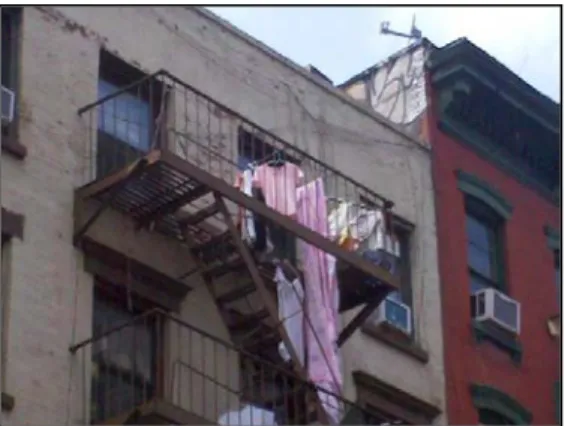
Figure 4 – Laundry on Fire Escape ... 67
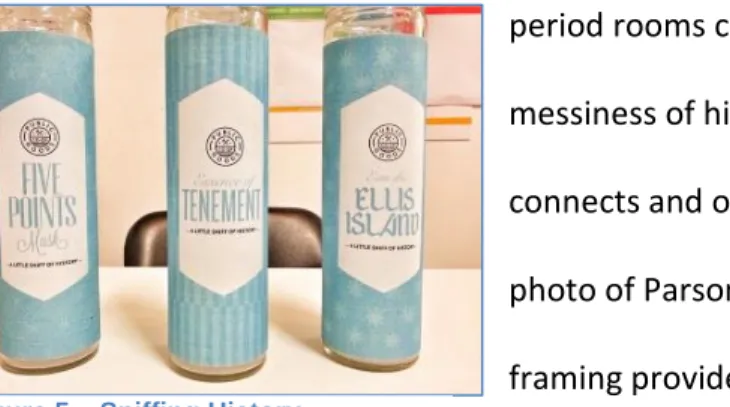
Figure 5 – Sniffing History ... 149
Figure 6 – Perris Insurance Map, 1853-56 ... 167
Figure 7 – Urban Log Cabin ... 180
Figure 8 – Time Capsule ... 190
Figure 9 – 99 Orchard Street, April 28, 2002 ... 233
Figure 10 – Museum Clothesline, July 21, 2010 ... 234
Figure 11 – Tenement Museum Snapshot Photo Tour, July 21, 2010 ... 234
Figure 12 – Docent Encyclopedia with Familial Apartments & Ethnic Groups Topics ... 235
Figure 13 – "Of Jewish Interest, Of Irish Interest, Of Italian Interest" ... 236
Figure 14 – Indoor and Outdoor Ethnic Tours ... 236
Figure 15 – A Shrunken Lower East Side Starts at E. Houston Street ... 244
Figure 16 – Neil Smith: Historic Boundaries using 1900 borders up to 14th Street ... 245
Figure 17 – Moses Rischin (1962) Lower East Map with Jewish sub-ethnic districts ... 246
Figure 18 – Ronald Sanders 1979 Expansive Boundaries (west to Broadway) ... 247
Figure 19 – 1871 Hardy Ward & Precinct Map with 10th Ward ... 248
LIST OF ABBREVIATIONS
AHW American History Workshop (headed by Richard Rabinowitz) ATSS Association of Teachers of Social Studies (part of the UFT) BID Business Improvement District
CB3 Community Board 3
CSWA Chinese Staff and Workers Association
COS Charity Organization Society of New York (Tenement House Committee) ESOL English for Speakers of Other Languages
ESDC Empire State Development Corporation ESL English as a Second Language
HPD New York City’s Department of Housing Preservation and Development HUD Housing and Urban Development (federal)
IDA New York City Industrial Development Agency ILGWU International Ladies Garment Makers Union
IMS Institute of Museum Services (predecessor to IMLS) (federal) IMLS Institute for Museum and Library Services (federal)
JGSGB The Jewish Genealogical Society of Great Britain
Landmark Filing Department of Interior filing to apply to be a National Historic Site. New York City Landmarks has its own process. Both require first being listed on the National Register which requires serious vetting as to a building’s historical and social significance
LESTM The Lower East Side Tenement Museum
Museum The Lower East Side Tenement Museum The Museum The Lower East Side Tenement Museum Tenement Museum The Lower East Side Tenement Museum NEA National Endowment for the Arts
NEH National Endowment for the Humanities Neocon Neo-conservative
NLRB National Labor Relations Board NPS National Park Service
NYANA New York Association for New Americans
NYC New York City
NYCHA New York City Housing Authority NYSCA New York State Council for the Arts
National Trust The National Trust for Historic Preservation
PBS Public Broadcasting System (U.S. government and listener-sponsored network of affiliated public TV stations)
PR Public Relations
PSA Public Service Announcements (done pro bono by mainstream and other media)
TB Tuberculosis
The Times The New York Times
UJA/Federation The UJA is the United Jewish Appeal. The Federation is the Jewish Federation, also a consolidated Jewish charitable organization. In New York City, they eventually merged as part of a broader consolidation of Jewish philanthropic appeals.
VOA Voice of America
WNET NYC’s public PBS station, a.k.a, Channel 13 WTUL Women’s Trade Union League
Prologue
People who think the past lives on in Sturbridge Village or Mystic Seaport haven't seen Fredericksburg [Texas]. Things live on here in the only way the past ever lives--by not dying. –William Least-Heat Moon (1982), 144
...living history museums do not merely represent the past; they make historical "truth" for the visitor. –Scott Magelssen (2007), xii
Want to See the Building?
The Tenement Museum tells the story of its humble building, its immigrant residents and their historic Lower East Side. “We tell the stories of 97 Orchard Street,” the Museum announces in its “About Us” website page (2010c). These stories in turn define the Museum, allowing it to draw on popular associations with Lower East Side immigrant life. Thematic guided tours are an essential commodity to be purchased by visitors, since they provide the only way to enter the Museum’s historic building. Interpretive constructions of past
immigration are re-inscribed daily as guides uncover the building’s physical layers and changes while presenting the personal stories of selected prior building residents. The Tenement Museum is a national landmark open almost every day of the year, and its standardized tours are repeated sometimes up to seven times daily. Yet 97 Orchard’s resurrected residents are real not just to visitors; their larger-than-life stories are kept alive in the Museum’s culture. The use of costumed interpreters for some tours further abets this sense of “reality,” as does having employees other than guides sometimes giving, and taking, tours.
Rogarshevskys stop sitting shiva [mourning] and start observing the Sabbath?” The Museum’s archivist answered “two months ago” without missing a beat. In this exchange, we both were speaking of the residents in what anthropologist Johannes Fabian (2002) refers to as the “ethnographic present—” as though they somehow actually lived in this diorama, unaffected by the passage of time except insofar as the Museum makes it so. Today, the personal stories of families such as the
Rogarshevskys are recounted to the Museum’s over 200,000 annual visitors. Inevitably questions arise as to how these particular 97 Orchard residents were picked to represent an immigrant past. The Museum’s internal training document 97FAQ conveniently explains:
The Museum selects particular family stories that are substantially documented by historical records, to demonstrate the building’s ethnic and religious diversity …
chronological span of its habitation and, most importantly, their ability to raise pressing and sometimes controversial contemporary issues (2005, 2010) (8). Hence residents’ familial stories depict social issues relevant to current immigration, explicitly framed by ethnicity, religion, era, and the building’s official dates of residence (1863-1935).
Table 1 - 97 Orchard Street Original Residential Apartments by Family
Family Gumpertz Baldizzi Rogarshevsky Levine Confino Moore Ethnicity/ Religion German Jewish1 Southern Italian Catholic E. European Jewish E. European Jewish Greek Jewish2 Irish Catholic3
Opens 1994 1994 1998 2002 1998 2008
Setting 1879
(dressmaking) Depression 1935 (eviction) Depression 1918 (mourning shiva and TB)
1897 (birth) sweatshop 1913 (chores) 1869 (mourning a baby)
are interwoven with those of the tenement itself so as to continually mark how tenants were affected by code changes requiring hall toilets, lighting and cold water sinks. Apartments are referred to by the name of the family whose tenancy is now represented there, with each apartment staged to support a familial story told by a guide, educator or costumed interpreter. The Confino apartment is where a “Vickie” gets to interpret a teenage Victoria who dispenses advice. Family days also produce “Bridgets” and other past residents. Although a chosen few past tenants have been reanimated in some fashion, the stories of its numerous unnamed residents reside obliquely in set aside apartments referred to simply as “Ruins.” The overall result is a building and Museum so identified with the telling of these stories that its narrative connections seem inevitable, as if they have always been in place and actively define it.
Visitors see apartments re-created by historians and interior designers who chose furnishings to align interiors with an envisioned familial scenario as well as era. There is a very short list in the Museum (2005, 2010) of “actual” family objects; a few replicas are on display but most furnishings were bought as period pieces.4 Despite differences that denote religion, era or changes ensuing from building code, anecdotal evidence suggests that, to visitors, the tiny familial apartments—although not the stories—appear somewhat similar.
The stories of 97 Orchard Street’s selected past residents are told inside the tiny apartments re-created to once again house them. These affective narratives of immigrant hardship and collective memory get constructed to stick in place, even if their use and
were most likely to be heritage tourists who intersect with a contemporary neighborhood in looking for their own past (Kirshenblatt-Gimblett 1998c). The Museum’s use of tours to impart its various historic lessons spatially highlights the narrative joints ostensibly holding its
building’s and residents’ stories in place. One historian’s academic review of its 1997 exhibits provides a useful account of how its stories were then being told and received:
New York City's Lower East Side remains today much as it was during the era of its greatest fame: an ethnically diverse, economically depressed area in which new immigrants get their start in the United States..., the Lower East Side Tenement Museum is the brainchild of Ruth Abram…, [who] decided to promote greater social tolerance from a historical perspective. Built in 1867 [sic], 97 Orchard Street is a six-story, Italianate brick building that originally contained twenty-two three-room
apartments and two stores. During its close to seventy years of operation, it was home to as many as ten thousand people.
To date only the first and second floors have been opened to the public, and for
insurance reasons all visitors must be accompanied by guides. A visit begins, then, down the block at 90 Orchard Street, a former corner store that houses a scale model of the tenement, small exhibits, and orientation video and slide-tape programs. The tour of the actual tenement starts in the dark first-floor hallway, remodeled in 1905 to impress prospective tenants with a pressed tin ceiling, tile floor, Lincrusta wall treatments, and hand-painted murals….
Restored to how it might have looked in 1878 when Natalie Gumpertz was working as a dressmaker to support her children, the front room has been set up as a workroom…. Fifty years later, the Baldizzis lived in the apartment next door… and helped their neighbors, the Rauchenbergs, by turning on the lights on the Jewish sabbath (Charles Hardy III 1997) (1019-1011)
Rogarshevskys, and Museum guides are supposed to be there to make for an intimate touring experience. The Museum’s former “ten thousand people,” is now less than 7,000 occupants.
Hardy apparently doesn’t realize that the Gumpertzes were placed in the “wrong” apartment since the Museum’s Director wanted to start with a German [Lutheran] family and the second floor was most convenient. Nor would the casual visitor at the 1998 Rogarshevsky apartment opening—displaying a sweatshop story of TB [tuberculosis] and of a family’s mourning—guess at Hardy’s 1997 description of “A third-floor apartment will tell the story of the Rogarshevsky family, devastated by the great influenza epidemic of 1918” (1012).6
Some later changes in the Museum’s stories are seen as acceptable by Museum management since they still get the familial “history” right, as when the observant Rogarshevskys eventually start celebrating the Sabbath. Tours get tweaked to emphasize certain themes and for logistical reasons. But their broad outlines and many of their older affective elements just stick: the story of a Baldizzi child helping a Jewish [Rogarshevsky] family observe the Sabbath is broadcast and distributed twenty years later on a Voice of America English language lesson.
A Short Tour
An old tenement entry is tiny and there is only one narrow central staircase. So squeeze in, since here, two of the Museum’s earliest public apartment tours are on display. Tenements are technically a type of multiple dwelling for three or more unrelated families but they were used to house large families in tiny rooms. Telling stories in such intimate apartments amplifies an empathy induced by stories of immigrant hardship. Designed to interpret larger themes relevant to past and present immigration, two key building tours were given names like Getting By: Immigrants Weathering Hard Times, or Piecing It Together. 7
In Getting By, visitors are prompted by guides to discuss the German Jewish Gumpertz family’s problems ensuing from the Panic of 1873. Visitors are asked, “What happened to Nathalie?” so as to bring attention to the economic fragility of life for someone who is now a female head of household since her husband’s disappearance (2005e) (8). An informal intimacy ensues from guides cultivating their audiences’ use of residents’ first names. Visitors then movingly hear the recorded voice of an aged Josephine Baldizzi describing her childhood. In a rapidly evolving museum destination and entertainment culture, Museum tours were shaped so as to encourage sensory engagement as a needed experiential aspect in promoting a personal connection. Visitor interaction is encouraged but carefully time managed since scripted tour narratives are reiterated on a strict schedule: guides need to constantly move groups along to make room for the next group.
questions …to promote discussion.” The Group Management section offers tips: “If you turn out the [hallway] light in order to demonstrate the darkness of the space … Pause, allowing visitors a moment of silence to react, and then ask one of the visitors to turn the light back on.” A little later, the guide is prompted to “Lead visitors up the stairs to the 3rd Floor Ruin
Apartment parlor (5 minutes)and then ask “How does this building or apartment make you feel?” (2005e) (1-2)
These tightly structured tours encouraged a carefully induced empathetic identification not only with named past residents but with anonymous current immigrants.8 In the Getting By tour (now called Hard Times), visitors compare the choices poor immigrant families needed to make in ways that resonate with contemporary issues. The “Tour Objectives” section prompts the guide to: “Help visitors compare the Gumpertz and Baldizzis with the experiences of immigrants today” (2005e) (2). Tours doubly encourage personal connections: first, to the historical families portrayed, and second, to “the experiences of immigrants today.”
Piecing it Together interpreted the Levine and Rogarshevsky families in 2002 for a garment trade tour. While shopping and clothing manufacture declined precipitously in Lower
Manhattan in 9/11’s aftermath, Museum
attendance rose when this tour added the Levine apartment (see photo) as an attraction in a downtown museum, which remained open as a public site. These apartments of two East
interpreted to show the intimate familial and work adaptations required in 325 square feet or less. Portrayed almost twenty years later, the Rogarshevskys are in mourning for a father who died from the tailor’s disease (TB). Differences are seen in how they lived since by 1918
garment work had mainly moved to factories. The guide’s tour outline (2002, 2005b) points out past and current continuities in immigrant work and housing seen through the neighborhood:
The Lower East Side … has been home to immigrants, the garment industry, and tenements for years. Lower East Side streets, like Orchard and Broome, have provided homes, workspaces, and community connections for immigrants from around the world. In 2000, the City’s population was 37% immigrant. (2)
In memorializing the immigrant role in the garment trade, the tour stresses affinities in New York as an immigrant city, now and then.
Museum tour scripts (officially outlines) from its first two decades provide a window onto how a historical agenda is conveyed experientially, spatially, and emotively. The Museum’s paid guides (most of whom are part-time) are given training, literature, timing cues, and most importantly, an old building to deploy as a cherished centerpiece prop to aid in making these connections compelling. Even so, Ruth Abram (2007)—the Museum’s founder and Director— apparently did not think its earlier tours sufficiently emphasized contemporary connections.
I thought that once connected to the depth and breadth of the courage of their immigrant ancestors, contemporary Americans would draw connections between the forebears they admired and the newest arrivals….
It became clear that in order to be able to draw connections, for instance, between assistance offered nineteenth- and twentieth-century immigrants and that available today, visitors had to know something about that assistance then and now. To compare and contrast the conditions in the garment industry past and present, visitors needed information on the conditions in both periods.9
Together” tour … begins with a recording of people in all sectors of the industry discussing present conditions from their various vantage points. (67)
Introduction: The Tenement Museum
The tenement building represented the common ground of immigrants from everywhere. Through a tenement museum, the general public … could be invited to consider this question: How will we be one nation and at the same time enjoy, appreciate and certainly not be afraid of the profound differences we bring to the table based on background?—Ruth Abram, 199110 “We tell the stories of 97 Orchard Street.”—Tenement Museum website, 2011
Welcome to New York’s Lower East Side
In the late 1980s, I noticed the Tenement Museum when it first opened for business in a relatively classy part of a fading Orchard Street. Located at 97 Orchard Street, it was just down the block from Klein’s of Monticello, a store whose unquestioned taste in clothing still attracted upscale bargain shoppers to a once thriving Jewish thoroughfare. Its Lower East Side block, which bordered historic Chinatown, was beginning to shift residentially from Latino to Chinese, but that was not possible at number 97. While 97 Orchard’s ground level and first floor stores had remained part of the street’s commercial and ethnic fabric, its upstairs apartments had been officially closed to residents since 1935.
As a long-time neighborhood resident, I was aware that the small and largely Orthodox local Jewish community was ambivalent about a museum solely displaying a Lower East Side that “once was.” Indeed it’s hard to live in the shadow of an area called “the Great New York Ghetto” that in 1911 was simultaneously seen as the world’s largest Jewish city and as possessing the world’s densest urban population.12 As an urban dweller, I only became seriously interested in the Museum when, in 2001, I first saw protest signs and began to think about the Museum’s relationship to other groups in the community. By early 2002 a slippage of past and present seemed particularly visible in its real-estate dealings: the Museum’s attempt to expand into its neighboring next-door tenement had evoked protests from local immigrants.
I walked by on a Sunday to see Museum visitors watching Fujianese migrants holding Mandarin and English signs on 99 Orchard’s stoop, demanding an end to “Eminent Domain Abuse.” A photo later showed a sign that said “Don’t ERASE real history with artificial history.” To accommodate doubling its visitors, the Tenement Museum had invoked eminent domain to acquire an inhabited next-door tenement that also had a restaurant employing Fujianese workers. Ruth Abram (2002)—the Museum’s founder and Director—claimed that “The preservation of the Museum's landmark tenement at 97 Orchard Street is crucial for the
Nation.” The Museum’s expansion was “part of a plan to secure a partnership with the National Parks Service-administered- Statue of Liberty and Ellis Island, bringing thousands more people to the museum… 200,000 to 250,000 more visitors annually” (Keys 2002).
immigrant history whose mission was devoted to “promoting tolerance.” Here, a museum had chosen to make its case for tolerance and diversity through showcasing past immigrant lives. Yet, the tangible benefits of its advocacy for new immigrants seemed unclear even as the Museum’s public visibility expanded in Lower Manhattan’s post- 9/11 landscape. After six months of protests, Abram (2002) suddenly offered to put a Chinese apartment into the new building if the expansion went through. I will revisit this purposely unfinished Tenement Tale in my last chapter by highlighting its intersections with a moral economy of expected local norms, expressly articulated in the course of dealing with a Lower East Side museum officially
dedicated to representing multi-ethnic stories of immigration.
Representing History Now
This story offers but one of many entry points into the framing and historicity13 of immigration by a Museum deeply interested in history’s experiential, transformative pull. My project documents how a museum of past ethnic immigrant life tells stories in a present that shapes and is shaped by that past history. While researching the Museum’s archives in 2010, I saw this controversy presaged in early documents that discussed what sort of museum it should be, and how best to interpret its building and neighborhood when connecting past and
contemporary migration. Ideally, visitors to 97 Orchard Street could see a past ethnic immigrant history that would “speak” to them in a personal, experiential fashion, while at the same time engage them in thinking about a new immigrant present.
than anywhere else in the United States, important Museum figures such as architectural historian Andrew Dolkart14 saw the neighborhood as “the most appropriate and meaningful setting” to show the story of past immigration and demonstrate its contemporary
continuities.15 Yet as Dr. Richard Rabinowitz (1986), founder and president since 1980 of American History Workshop, had earlier noted in starting this project: “The challenge of doing so in the midst of the Lower East Side itself poses powerful questions about the integration of history into our daily lives and contemporary environments.” The quote shows that Rabinowitz was aware of challenges inherent in situating a “living history” site within a living
neighborhood. His caveat seems prescient not least because of an uncertain coupling of that particular history to the area’s then contemporary communities. Indeed, an activist museum found it hard to safely cordon off the present as it worked to recreate a historic past in place expressly for visitors.
The Museum’s reconstructions of immigrant spaces are cultural geographies of a neighborhood, interpreted by liberal historians as an intimate domestic reflection of the Lower East Side’s past ethnic enclaves. Its apartments, each of which purports to show how it might have looked when occupied by an immigrant family known to have actually lived in the building, provide a window onto how the past is actively used to create new geographies of migration, memory and heritage. The Museum’s overt uses of history pertain to larger interdisciplinary debates about migration, the urban-built environment, and immigrant acculturation in space as well as time.
happened under the Museum’s first Director and founder, Ruth Abram, who started in 1986 and resigned in 2008. That is likewise the period mainly considered here, during which only four public tours were developed as six apartments opened for view. I analyze these building tours here as a spatial, affective performance of history, scripted by the Museum.
Today the Tenement Museum sits at the center of an area that has rapidly gentrified as the Museum has come into its own. Once considered a troubled “inner city” neighborhood, the Lower East Side is now viewed as conveniently located between the central business districts of Midtown and Wall Street. As a growing destination in an “iconic neighborhood,” the Museum has come to encompass far more buildings and visitors. Even so, touring 97 Orchard Street remains at the heart of the Museum’s visitor experience and its raison d’être.
A Building for a Nation of Immigrants
The Tenement Museum is an affiliated, but lesser-known part of a National Park Service trio that also includes Ellis Island (its associated late-nineteenth-century immigrant portal) and the Statue of Liberty. 97 Orchard Street is an unusually old tenement retroactively ennobled as a landmark by the Museum’s depiction of it as a humble survivor bearing witness to the
neighborhood’s past and the ethnic groups that once lodged in its building.16 Thus the Tenement Museum navigates its local situation at the gentrifying intersection of a formerly Jewish Lower East Side and contemporary Chinatown, even as it presents itself as an U.S. National Landmark and National Park Service affiliated site.
Johnson-Reed legislation also included the Asian Exclusion Act).18 These national sites are important for many immigrant descendants, a group that includes four fifths of America’s Jews. Historically the Museum has seen its role as depicting a Lower East Side that is a shared place, as part of a universalized story of diverse American multi-ethnic immigration and of hardship, both then and now. As the Museum’s footprint and public voice become larger, and as an increasingly gentrifying environment makes it harder to find other stories its representation of that immigrant life grows more salient in shaping views of the Lower East Side.19
Rabinowitz (1990b) had proposed a Conceptual Plan to Abram that stated: “One would have difficulty identifying a building more suitable than 97 Orchard Street to represent the ethnic diversity which has always characterized the Lower East Side." (5) The Museum’s (1990n) earlier interpretive schemes had included Black and Chinese historic composite families (Abram 1987c). In an interview, Abram confirmed that Black New Yorkers were to be part of its story:
…living next door, we found a freed slave [Mr. Douglass]. So we've decided to use the building to tell the story of the Settlement of the Lower East Side by the major groups that settled here and not to confine our interpretive work only to the people who actually lived here….The truth is that as early as 1820 the area is over twenty-percent freed slaves ...we’re determined to tell this story…blacks are very much associated with the tenement experience (Kugelmass 2000), (190-191)
As late as 1992, Abram seemed sure that the Museum would use its earlier “heritage” scheme to interpret the history of “the major groups that settled here.” By 1994, the Museum’s mission called for interpreting “the variety of immigrant and migrant experiences on
in its upstairs apartments became those of “real” European immigrants from a past “Age of Mass Migration.” Mr. Douglas’ story was shunted aside. The Museum’s institutional knowledge of and interest in prior residents shifted in the course of acquiring and interpreting a Lower East Side building.
The Tenement as American Immigrant Experience
My research traces such discursive and material interpretive shifts in 97 Orchard’s re-emplacement in a
neighborhood that kept on living long after that building’s official residential closure in 1935 (see Sanders, 1979 photo of 97
Orchard). Tenements are deeply associated with a densely habited past for an immigrant neighborhood whose population peaked circa 1910. The Museum’s eventual choice to interpret its building through the lives of past residents also marks what is deemed historic for the Lower East Side by setting an end date that coincides with its building residential closure in 1935. When the Museum’s transformed upstairs apartments opened to visitors in 1994, number 97 with its brisk ticket sales was reinserted into Orchard Street’s commercial environment. The first floor, which the Museum had taken over when initially renting in 1988, had first become commercial space in 1905; until then the building only had two basement storefronts and its top five floors were solely residential.
space was largely used for performances, meetings and classrooms. The rapidly growing
Museum expanded to nearby buildings for its Museum Shop and administrative needs. By 2008, it had attracted over 130,000 paying visitors annually, including 44,000 school children, already making 97 Orchard the Lower East Side’s largest visitor destination (Pogrebin 2008). Its 2012 expansion almost doubled its visitor numbers.20
The Museum works to harness an American “immigrant experience” in defining that history, yet it also negotiates the Lower East Side’s legacy as a topos of specifically Jewish diaspora. While the Museum particularly attracts visitors interested in the Lower East Side’s impact on American Jewish life, its overall founding narratives portray a somewhat static historic Lower East Side in which immigrant acculturation processes across time similarly foster American identity and mobility for an ongoing series of groups who pass through the
neighborhood as they begin to overcome hardship. Hence, it is not a Jewish museum but a museum of American immigrant life that relies on and recruits Jewish collective memory within a context of heritage tourism.
Ironically, the universalizing impulses expressed in the Museum’s building tour
narratives can be seen as representative of a specifically Jewish political legacy associated with late twentieth-century liberal politics. In a further twist, the museumification process
demonstrates how being in place becomes harder as place hollows out. It is precisely within 97 Orchard, its poor immigrant tenement expressly reconstructed for upscale, heritage tourism, that the ironies and virtues of the Museum’s presence and stories are most sharply felt.
“tenement chic” ethos relies on the authenticity of its tenement buildings. As Lower Manhattan goes upscale (Mele 2000), its endangered ethnic communities are also part of its appeal. While the Museum’s blog protests gentrification’s ravages, arguably gentrification attracts tourism particularly where busy “revitalized” and relatively intact streetscapes allow accreted collective memories to be invoked as buildings are “restored.” The Museum’s relationship to its
neighborhood is shaped by a larger downtown economic restructuring, in which rezoning in a changing built environment not only attracts but relies on tourism and gentrification.
Questions: The Fashioning of 97 Orchard Street
Geography concerns itself with experienced and represented spaces: 97 Orchard Street serves as a useful lens for tracing—during the Museum’s first two decades—how past ethnic immigrants are represented, produced and reproduced in its tenement, and to what historic ends. This research shows how narratives of place—and their discursive and material
practices—are implicated in the collective memory of immigrant pasts and presents in ways that affect newer migration. The appearance of inevitability surrounding the Museum’s overall narratives of place reinforces 97 Orchard Street’s current identity as a building whose one-time residents tell stories of Jewish, Italian, German, and Irish migration. These inquiries can be described as addressing the following broad concerns:
2) Narrative and Place: How do the Museum’s discursive and material practices change and persist in the course of acquiring and interpreting a tenement building to tell a history of American immigration? How do its various incommensurable narratives stick to place?
3) Spatial Politics of Memory: How and where do the Museum’s stories of local
“historic” ethnic and living communities get told? How do its multi-directional narratives point to the stakes involved in its politics of collective memory and ethnic representation at different scales?
As these questions imply, authenticity, a much sought after commodity (Zukin 2010), is quite endangered on the Lower East Side. The Museum’s setting is as “authentic” as anything is, due to its deep association with a densely habited immigrant past. As Michel de Certeau (1980) reminds us, “the places people live in are like the presences of diverse absences” (108). If place evokes an absent reality in drawing on memory, nostalgia is also invoked in the neighborhood’s continuing production as a destination and place of memory. The trope of Lower East Side nostalgia concerns its intensity and uniqueness of place as disappearing or gone.
The notion of “nostalgia” originally referred to the pain associated with a journey of homecoming or the desire for home, making its transformation into a longing for that lost past especially relevant for geographies of Lower East Side memory. Nostalgia for the Lower East Side, in various formulations by those who know the neighborhood as well as by those who have never been there, belongs to a landscape of longing for reconnection to a place and identity shaped from a perceived common past (Diner 2000).21 History is the glue that binds the storytelling needed for heritage and destination tourism at its historic sites, channeling a
As a growing visitor destination in a rapidly gentrifying area, the Museum’s success arguably comes from providing visitors with a sense of briefly touching that disappearing past. Thus the next sections offer a brief overview of the Museum and of the Lower East Side, followed by a short literature review, and a recap of the thesis’ organization and chapters.
Representing Immigrant Ethnicity
In a neighborhood with Fujianese, Cantonese, Dominican, Puerto Rican, and Black communities, fateful repercussions for representation are made when only some groups are represented as “historic” and displayed (Kirshenblatt-Gimblett 1998c). Being chosen as historic also speaks to a choice of intended audience. Contemporary communities may well be
ambivalent about being relegated to the past, or on the contrary, view such representation as an honor.22 Or they may see it as irrelevant given more pressing concerns.
By 1993—at a point when Museum leadership had chosen to only directly interpret past building residents—commemorative and other agendas were already visible in the capital campaign to purchase 97 Orchard Street. Given its commemorative focus, it is far too facile to propose that the Museum’s (2004) representations of the past solely serve the future as advocacy for immigration, or “use the past to build a better future.” Issues of representation and reception are also important in approaching how historic immigrant ethnic groups now considered to be “white” are exhibited to contemporary publics, presenting a flip side to how contemporary neighborhood communities are exhibited to heritage tourists.
to Rabinowitz how she envisioned a “Lower East Side Heritage Trail” designed to interpret the living yet historic “heritage” communities outside of its building.
I had a grand time dreaming up the trails. We meet a pigtailed Chinese chef in a chop suey house in 1900. That tour starts over noodles. The Italian tour starts in a pasta shop. The Jewish one starts in a sweat shop. And so it goes. I think we could get various
managers to let us use their restaurants, shops ... this way. (1)
Abram’s concept seems almost startling in its eagerness to use living places and people in ways that knowingly speak to the past exoticization of ethnic enclaves (ghettos) already viewed voyeuristically in Jacob Riis’ (1890) time.23 There is something more than a little
audacious in marrying living history in this fashion to a museum situated in the Lower East Side. The neighborhood at large becomes a living set for ethno-tourism. What seems playful to a Museum director or entertaining to a visitor could offend community merchants and residents precisely because contemporary lives are exoticized and tied to past stereotypes.
Although clearly excited by the Museum’s potential, Rabinowitz seems far more cautious about living history’s projected intersections with local residents than Abram was. A report on local gentrification pointedly noted in 2008: “Chinatown … is more than just a tourist destination, it is also a home. Its people, tenements, and shops are not merely eccentricities to be enjoyed” (CAAAV Organizing Asian Communities 2008) (12). If heritage tourism intimates traveling to a place to temporarily travel back in time, it can imply that people who stay in place remain in an exoticized or timeless past, and are fair game to represent, display, and view.
only was Chinese and Black representation in residential apartments set aside, but the Jewish “nature” of its building was initially obscured even though the site functions as a place of Jewish heritage tourism. I argue through using archival documents and tour scripts that the initial display of Jewish residents was in tension with a critical Museum goal: telling a multicultural story of shared place and hardship by successive immigrant waves as leading eventually toward successful Americanization. Interviews also bore out how this affected the Museum’s efforts to instill its messages, fund apartments and create narratives of futurity.
The Museum’s agenda ties a project of shaping the Lower East Side’s history to a type of multi-ethnicity seen as a necessary part of American immigrant acculturation. Archival
materials also bear out that, as historians, the Museum’s founding figures sought to generalize what were seen as shared lessons culled from earlier Jewish and ethnic European immigrant tenement life. Despite its inherent hardship, the Lower East Side experience was perceived by the Museum as a foundation for a successful (albeit improvable) model for American citizenship and mobility. The Museum’s approach has been to endorse rhetorics of tolerance and
democracy in ways that emphasize American commonality and mutuality, allowing for sufficient but not overwhelming ethnic difference.
Abram had studied public history in graduate school. By the mid-1980s, she had already brought in Rabinowitz—who had interpreted Old Sturbridge Village, a leading Living History site—to guide the Museum’s interpretations, designs and tours.24 Rabinowitz brought in
interlocutor in interpreting the building’s older “fabric” before and during renovation by discerning its changes over time.25 This allowed the Museum to draw the lesson from its building that its residents were helped by others; Dolkart had paid particular attention to how Reformers had inscribed their own social history upon the building’s doors, windows, sinks and toilets through their advocacy for building codes (Dolkart 2001, 2006).
A Past for the Present
The ability to induce a rapid intimacy with the past relies on recognition. Immigrant narratives associated with ethnic apartments straddle the fine line of remaining recognizable in collective memory even as they invite comparison with experiences from other eras. Families residing in the building from 1863 to 1935, the years in which it was officially residentially occupied, were placed in reconstructed ethnic period apartments.26 During the Museum’s working hours, its residents from the 1870s live down the hall from newer arrivals from the 1920s, in a spatial and narrative juxtaposition that renders all contemporary.27 Some of the families represented are thus separated by large gaps in their respective periods of migration. Hence, at 97 Orchard Street new virtual next-door neighbors have been created, a social term once so meaningful to Yiddish speaking immigrants that the neologism “neksdorike” (“the lady next door”) became part of the neighborhood’s lexicon.
mobile transience for visitors who are immigrant descendants. The Museum’s juxtapositions offer for consideration the question of just how different and separate any group’s temporary, associated experiences really was/is, including the implied space of current immigrants living in surrounding tenements.
That implied visible space has broadened to encompass immigration generally. For many years, the “About Us” page in the Museum’s blog explained that it is a museum where “visitors view restored apartments and learn about the struggles of past generations in the hope of providing historical perspective on the experiences of today's newcomers” (2009a). The museum’s current slogan of “Revealing the Past, Challenging the Future,” implies a purposeful engagement with the unveiling of history to change contemporary understandings of future immigration. That “activist” perception of the Museum’s purpose is widely shared:
The Lower East Side Tenement Museum of New York City, which opened in 1994, has restored the apartments of dwellers of a historic tenement on Manhattan’s Lower East Side, but uses the heritage of these people to connect visitors and New York City
residents to contemporary concerns of affordable housing, single parenthood and living conditions in present-day tenements. (Wali 2005)
This quote, from the anthropology curator of Chicago’s Field Museum, asserts that pressing contemporary concerns are successfully addressed by the Tenement Museum’s use of the past. I argue that it is important to look both ways here: “[T]he heritage of these people” can be used for many goals, even unintended ones. Nor should the narrative weight and success of the historic interpretations on view in its apartments be underestimated, not least because most visitors come to hear, expect and experience those stories.
the successful acculturation of future generations (often in suburbia) are relevant to views of how (inner city) ethnic enclaves function as a step on Abram’s journey of “up and out.” I suggest that it is productive to also probe the tensions concerning past representation serving as commodity, commemoration, and fodder for future advocacy in looking at 97 Orchard Street. Given the Museum’s founders, location and visitors, it is unsurprising that a discernible undercurrent taps into Jewish collective memory.
A Universal Great Ghetto
The Lower East Side is particularly associated with Jewish migration. History and literature typically acknowledge the neighborhood as a place where most residents were Jews when the neighborhood reached its population height.28 By 1910 the area described as the densest place on the planet had
approximately 500,000 residents. That legacy has left its own spatial concentration of “collective memory” and identification (Diner 2000) (131).29
No other ethnic group in America, with the exception of the African-American
construction of Harlem, has so thoroughly understood, imagined, and represented itself through a particular chunk of space. The phrases 'Lower East Side' and 'Harlem' do not need ethnic adjectives to precede them and identify the group that occupied that space (Diner 2000) (50).
Historian Hasia Diner conveys the Lower East Side’s magnetism as a space of memory even as she pulls in Harlem as a similarly marked space. Historian Ronald Sanders (1994) also pursues that analogy: “Similarly, for a long time to speak of the ‘Lower East Side’ was to speak of Jews (although the area was never exclusively Jewish, even when the Jewish community there was at its height)” (1). An East Side story was seen as quintessentially but not uniquely
Figure 2 – The Ghetto, Postcard
Jewish. As Diner (2000) points out, this spatial concentration adds to the image of the Lower East Side as a particularly Jewish place: "In addition to the simple numbers and percentages of Jews in lower Manhattan and in New York as a whole, the memory of the Lower East Side derived much of its power from the physical concentration of Jews on those streets" (132).
Although the mass immigration of “new immigrants” and Asians had fully stopped by 1924 by an act of Congress, New York City was a quarter Jewish on the eve of World War II.30 A third of East Europe’s Jews had “voted with their feet” to rapidly migrate from 1880-1914, bringing approximately 2.5 million people almost exclusively to urban areas, especially New York’s Lower East Side. While by World War I the area no longer remained the preferred first-stop destination, it retained enough of a Jewish presence even after World War II to remain an ethnic hub with commercial, residential and institutional components.
The tension in interpreting the Great Ghetto (see postcard) is palpable at the Museum, in part because the “Old East Side” was in fact “home” to a number of groups. The area’s past is marked, among others, by Jewish, Irish, German,
Slavic, Hungarian, Bohemian, Italian, Chinese and Black settlement.31 Its building’s story is marked by, but hardly limited to, the Jewishness of past tenants and current tourists. It is marked by the presence of German and Italian prior residents and of a more diffuse New York tourism, not necessarily tied to ethnicity. And it is marked by an overlapping but distinctive
diversity in regard to its commercial life. In 97 Orchard, the Tenement Museum chose a symbol that speaks deeply to a particular past yet is open to broader readings.32
Anthropologist Karen Brodkin (1998) views rubrics such as Irish, Jewish, Slavic and Mediterranean as racialized designations prior to a post-World War II shift into white ethnicity. "European races were visible, seemingly a natural phenomenon, when one looked at where Americans worked. Immigrants were visible not least because they were concentrated in urban industrial centers" (56). The Lower East Side was exactly such a place where immigrants worked at home, or locally in garment factories, light manufacturing, retail venues, peddling or at nearby docks. Immigrants not only worked in such urban centers but lived in differentiated enclaves in them. The area’s past has been unevenly interpreted in relation to ethnicity, race, labor, immigrant acculturation, social mobility, and Americanization. As a site of U.S.
immigration, the Museum’s representations reflect larger academic, ideological and
generational divides as to the putatively voluntary nature of immigrant “first” destinations, Jewishness, Americanization and future social mobility.
necessity of broadening and universalizing—that is Americanizing—its narratives. The problem was the building’s residential history. In responding to Abram’s initial plan to render its first residents’ apartments as German (Lutheran) and Italian (Catholic), Dolkart (1992) wrote:
I realize that the Tenement Museum is making a concerted effort to be seen as an organization that does not deal exclusively with Jewish issues. I think this is correct since the immigrant tenement experience is much more universal. However, for the longest period of occupation in this building it was largely inhabited by Eastern European Jews. In addition, as far as I know, funding and visitation have largely come from people of Jewish descent. lt seems odd, even perhaps perverse, that the Eastern European Jewish experience (so closely connected with the lore of the Lower East Side and the history of 97 Orchard Street) is being overlooked (2).
Although Dolkart agrees that a prior understanding to universalize the “immigrant tenement experience” is correct, he argues it is “perverse” to leave out the building’s most important historical narrative. Dolkart’s complaint implies a distortion of the building’s history by a Museum unwilling to acknowledge how Jewish its own story was. His memo is written just when the Museum’s interpretive schemes were shifting, as personal information was becoming available about the Baldizzi and Gumpertz families. The Museum would eventually claim that it was showing “the stories of 97 Orchard Street” (2011), but here Dolkart cited the building’s actual history as a corrective against the direction the Museum’s evolving narrative was taking.
argue that further narrative complexity ensued in this regard once the Museum finally settled on its decision to highlight the personal stories of ethnic past building residents.
Searching for the Lower East Side
The rapid changes in the local built environment and economy, changes in which the Museum participates, affect its evolving narratives of place, as well as interactions with and depictions of current immigrants and migrants. The Museum’s uneasy relation to heritage tourism is framed in that context for a number of reasons, not least due to its importance in shaping 97 Orchard Street’s interpretations and impact. The Museum’s intimate connection to a shifting local economy in a gentrifying area is connected to how tourism and real estate intersect in a valorization and commodification of past history. At the same time, community relations are seen as critical for public museums. Foundations and governmental entities expect museums to do community outreach, and redefine themselves through connections to living communities and by modeling engaged citizenship (Hanchett 2013). These vectors come together in Museum grant-writing and programming.
away from urban centers and second generation urban enclaves.34 For the Museum, such socially mobile Jews are hovering in the background, with Lower East Side antecedents serving as an assumed but unmarked default and baseline for generalization.
The Lower East Side of the 1930s on was marked by tear-the-slum-down urban renewal. Governmental agencies, insurance companies and banks had also redlined the neighborhood to the point that its next decades were equally marked by increasing disinvestment, arson and further depopulation (Brodkin 1998, Mele 2000, Abu-Lughod 1994, Hackworth 2001). That early post-war period also saw a brief inbound population shift into tenements and new tower block public housing “projects.” Some European immigrant populations such as Jews, Italians and Slavs stayed, or moved to local projects or eventually to Mitchell-Lama middle class co-op housing. The projects built by Robert Moses on the neighborhood’s periphery primarily became home to Latino/a (Puerto Rican and then Dominican) and Black residents. Tenement housing abandonment marked the 1960s and 1970s. Even so, largely commercial Orchard Street remained largely Jewish through the 1980s, retaining customers from the metropolitan area even as local residents, clientele and proprietors changed.
The relationship of each group to the living neighborhood and to its past differs in terms of documented citizenship, numbers and remembered presence. When the Museum was founded, its local “ethnic enclaves” were primarily Latino and Chinese, referred to respectively as Loisaida and Chinatown – Lower East Side, with a notable Black, Jewish and Slavic
gentrification that has put increased pressure on these poorer communities.36 That housing pressure is now blamed for Chinatown’s net population loss in the last decade, as newer Fujianese and other Chinese migrants go directly to less expensive parts of Brooklyn.
The Museum’s website specifies that 97 Orchard Street is uniquely located in the Lower East Side, “near other great neighborhoods. By foot, it's 5 minutes to Chinatown, 10 minutes to Little Italy” (2010g). Although the Museum positions itself more generally as a Lower East Side and New York historic resource, its Museum Shop and website until recently overtly invited visitors to browse and shop an area labeled as “Of Jewish Interest.”37 While it describes its choice of past residents as diverse, its gradual inclusion of the Confino, Levine and
Rogarshevsky families into 97 Orchard Street—in addition to the Gumpertz family—has effectively reinforced its identification as a Jewish site.
The Museum anticipates and negotiates its elided identification as a Jewish institution, one that is largely responsible for the Museum’s initial popularity. Its universalized but still recognizable ethnic narratives attract heritage tourists who may not share its liberal agenda even as they look to “reconnect” with a past Jewish neighborhood. The Museum’s insistence about the neighborhood’s multi-ethnic past adds to its official sense that it provides a historical corrective to heritage tourist expectations of a Jewish Lower East Side by attempting to
However, Diner has protested "But the Jewishness of the building and its residents emerges despite the efforts of the staff to present the historically more accurate take of what happened within its walls" (118). Diner’s statement is intriguing since the Museum has not resurrected 97 Orchard’s residents as a mere reflection of prior occupancy. If it had, the building’s stories would be even more predominantly Jewish. Here, Diner seems invested in using “accurate” as a reflection of the Museum’s stress on not just telling a Jewish story.40
That the Tenement Museum is seen as a Jewish destination may be borne out in a number of ways. Anthropologist Jack Kugelmass (2000) identified the Museum’s visitors as mainly suburban Jews (199). New York Magazine’s “A Jewish Tour of the Lower East Side” includes the Museum along with sites such as synagogues and eateries. It starts its description of the Museum by asking: “So, wondering what those teeming tenements actually looked like?” (Appelton 2004). This rhetorically assumed ignorance on the part of the magazine’s reader and potential Museum visitor doubtless extended to then contemporary Lower East Side tenements teeming with “real” residents. Unusually, the article alerts readers that the Museum’s
“apartments have been furnished to mimic the lives of former residents.” That same (2004) article emphasizes that walking around was important since “beneath the L.E.S.'s everchanging identity, remnants of a gritty, tumultuous, and Jewish past remain.”
Community Space
As I will discuss in more detail later, 97 Orchard Street’s story has long been positioned in relation to nearby tenements occupied by Fujianese and other migrant residents. In Museum apartment tours the implied presence of non-represented groups is acutely felt as guides point out connections to contemporary immigration. As groups enter from the outside to tour the building, nearby poorer tenements are pointed out. For the Piecing It Together Tour, guides were prompted to say: "Even though the immigrant groups have changed, the experience of tenements and the garment industry are much the same” (2002, 2005b) (3). A Lower East Side story of a shared experience in a shared place—cutting across groups and time—became available for a type of tourism in which living communities flesh out historic ones.41 The neighborhood’s teeming tenements framed a newer migration as obliquely illustrating a past historical imagery.
The ethnic mix of the neighborhood remains diverse. Community outreach is further complicated for the Museum given its various interpretive categories. The Museum’s narrative construction, with its hardwiring of stories and place, constrains the histories told in 97
Orchard’s upstairs apartments in relation to its neighborhood. That this affects community interactions with the Museum is seen in its difficulty of directly interpreting “newer,” that is mainly but not only post 1935 groups.
Thus the neighborhood’s more contemporary migrant groups have so far been only directly interpreted outside of 97 Orchard Street’s apartments: in window displays, multi-media presentations, theater spaces, Shop Life exhibit, or outside, in streets, websites, gift shops, or, most recently in newer Museum buildings. Community groups are most directly featured in the Museum’s outdoors tours, whether in discussing waves of immigration, gentrification’s impact on the built environment, or through eating tours featuring local “food ways.” For a time the Museum displayed art work about “new” immigrants in its street-level Windows of 97 Orchard (Tenement Windows) program (2010h) as an adjunct extraneous to apartment tours.
Once its residential scheme was locked into place in 1993, the Museum implicitly used its building’s official 1935 residential closure as the basis for drawing a line between the “historic” past and the present. The Museum cannot easily take back its stories now that they’ve been fixed in place. Its current management has had to work backwards from this state of affairs to introduce new and old groups into 97 Orchard’s previously un-interpreted
is introducing broader stories of immigration into newer buildings. Even so, this perception cannot be entirely decoupled from the question of how local communities are served by its historicization and representations. If distance brings nostalgia and paying heritage tourists who feel drawn to the Lower East Side as a place of origin, proximity breeds its own knowledge of tenement life for residents. In a neighborhood still primarily composed of tenements, there can be a marked lack of interest (and ability) to pay over twenty dollars a person to go to a museum that shows, in Jacob Riis’ (1890) formulation, “how the other half lives” (or, as it may be, lived). In advocating for newer immigrants through showing difficulties faced by previous immigrants, the Museum interpreted 97 Orchard into a place whose defining stories are largely, but incompletely, protected from a post-1935 changing Lower East Side.
Literature Review
De Certeau’s work speaks to the importance of contingency, commemoration and reception in an accounting of how a building’s stories are told as history. His broader sense of stories as spatial practice also points to how stories of place attract extraneous elements.
Stories about places are makeshift things. They are composed with the world’s debris…. heterogeneous and even contrary elements fill the homogeneous form of the story. Things extra and other… insert themselves into the accepted framework, the imposed order. One thus has the very relationship between spatial practices and the constructed order. [Emphasis in original] (Michel de Certeau 1980) (107).
Stories of place, though ostensibly fixed, static or dead, are rendered here into somewhat fragile collages through the accretion of things other and extraneous into a given framework. Spatial practices actively render the constructed order permeable; in de Certeau’s analogy, stories of place become leaking sieves. Such narratives of place are necessarily implicated in historical retellings and their varied elements also adhere to place.
De Certeau’s work points as well to the uncontrollable nature of “consumer” reception of prepared narratives of place intended to offer up known collective tropes. More generally, de Certeau’s critical analysis serves as a corrective to master narratives, through an insistence on contingency in human agency, multi-vocality and variability in local conditions. Memory and heritage share history’s narrative tensions; they don’t stand outside of history.
(56). Kirshenblatt-Gimblett’s work on representation—especially in exhibits of Jewish and other “ethnic” life—explicitly draws attention to how museums function as visitor attractions in a type of destination tourism that provides heritage for consumption. Her analysis of the
museum as an evolving global travel destination that encompasses entertainment and heritage, neatly ties back to an emphasis on visitor revenue.
I also draw on Walter Benjamin’s approach to place, and of course, urban space. His work illuminates how the rhetorics of authenticity and nostalgia are invoked in the continuing production of the Lower East Side. My interrogation of the Museum’s narratives here draws on Benjamin’s insights (Benjamin 1955a, b, 2002) on the politics of memory, modern urban
identity, and history. Benjamin uses material objects such as buildings to read against the grain of historicism, noting how such objects become increasingly imbued with the meaning they accrue in their past provenance, including reception. The ultimate “snag” is to see an object just before it is destroyed, recuperated or restored as a re-used commodity with a narrative; that is before it falls out of its time to be captured as historic and recuperated into heritage or
relegated to a ruin. Benjamin warns also of efforts to perfectly recreate and sense the past through an attempt to immerse or lose oneself in it. That compelling illusion can also be read as a prescient call about the problematic character of embodied “living history” that has been echoed not only by historians but in performance studies (Magelssen 2007, Schneider 2011).