Case Study:
Electronics, mining
and urban mining
A case study for the Dutch Fair Bank and
Insurance Guide
Case Study:
Electronics, mining
and urban mining
A case study for the Dutch Fair Bank and
Insurance Guide
Research:
In cooperation with:
Anniek Herder Jan Willem van Gelder
Hassel Kroes Evert Hassink (Milieudefensie)
January 15, 2015, embargoed until 15 January 2015, 00:01
Naritaweg 10
1043 BX Amsterdam
The Netherlands
Tel: +31-20-8208320
E-mail: [email protected]
Website: www.profundo.nl
Contents
Chapter 1
Background ... 2
1.1 The need to use metals wisely and the impact of mining ... 2
1.1.1 The role of metals in our societies ... 2
1.1.2 The impact of mining around the world ... 2
1.2 Future metal needs and the implications ... 4
1.2.1 Depletion of crucial metals and minerals ... 4
1.2.2 Scarcity, a risk and a chance for investors ... 5
1.2.3 Metals and the electronics sector ... 5
1.3 Urban mining and resource efficiency ... 6
1.3.1 Factor 4 ... 6
1.3.2 Cradle to Cradle ... 7
1.3.3 Ellen McArthur foundation on the Circular Economy ... 7
1.3.4 UNEP’s International Resource Panel ... 8
1.3.5 European Union policies ... 9
1.3.6 Dutch government policy ... 10
1.4 The transition to urban mining and the role of financial institutions .. 10
1.4.1 Efficient production... 11
1.4.2 Efficient consumption ... 11
1.4.3 Recycling: focus of this study ... 11
1.5 Electronics recycling industry ... 11
1.5.1 Statistics ... 11
1.5.2 Problems in the recycling industry: 4 trends ... 12
1.6 Financing recycling companies, opportunities and examples ... 12
1.6.1 Scrap metal collection and separation ... 13
1.6.2 Metallurgical recycling ... 13
1.6.3 EIB ... 13
1.6.4 Social and environmental issues connected to the recycling industry ... 13
Chapter 2
Methodology ... 14
2.1 Approach ... 14
2.2 Research group ... 14
2.3 Selection of companies ... 15
2.3.1 Selection of electronics metals mining companies... 15
2.3.2 Selection of electronics recycling companies ... 16
2.4 Financial analysis ... 17
2.5 Analysis of activities to encourage (electronics) recycling ... 18
2.5.1 Company engagement ... 18
2.5.2 Sector engagement ... 19
2.5.3 Commitment... 20
2.5.4 Calculating the score ... 20
2.6 Limitations of this research ... 20
3.1 ABN Amro ... 22
3.1.1 Company profile ... 22
3.1.2 Investments... 22
3.1.3 Other activities ... 23
3.1.4 ABN Amro’s response ... 24
3.2 Achmea ... 25 3.2.1 Company profile ... 25 3.2.2 Investments... 25 3.2.3 Other activities ... 26 3.2.4 Achmea’s response ... 27 3.3 Aegon ... 28 3.3.1 Company profile ... 28 3.3.2 Investments... 28 3.3.3 Other activities ... 29 3.3.4 Aegon’s response ... 30 3.4 Allianz ... 31 3.4.1 Company profile ... 31 3.4.2 Investments... 31 3.4.3 Other activities ... 32 3.4.4 Allianz’ response ... 33 3.5 APG ... 34 3.5.1 Company profile ... 34 3.5.2 Investments... 34 3.5.3 Other activities ... 35 3.5.4 APG’s response ... 35 3.6 ASN Bank ... 35 3.6.1 Company profile ... 35 3.6.2 Investments... 35 3.6.3 Other activities ... 35
3.6.4 ASN Bank’s response ... 37
3.7 ASR ... 38 3.7.1 Company profile ... 38 3.7.2 Investments... 39 3.7.3 Other activities ... 39 3.7.4 ASR’s response ... 41 3.8 Delta Lloyd... 41 3.8.1 Company profile ... 41 3.8.2 Investments... 42 3.8.3 Other activities ... 43
3.8.4 Delta Lloyd’s response ... 44
3.9 Generali ... 44 3.9.1 Company profile ... 44 3.9.2 Investments... 44 3.9.3 Other activities ... 45 3.9.4 Generali’s response ... 45 3.10 ING Group ... 45
3.10.1Company profile ... 45
3.10.2Investments... 46
3.10.3Other activities ... 47
3.10.4ING Group’s response ... 48
3.11 Legal & General ... 48
3.11.1Company profile ... 48
3.11.2Investments... 49
3.11.3Other activities ... 50
3.11.4Legal & General’s response ... 50
3.12 NIBC ... 50 3.12.1Company profile ... 50 3.12.2Investments... 50 3.12.3Other activities ... 51 3.12.4NIBC’s response ... 52 3.13 Rabobank ... 52 3.13.1Company profile ... 52 3.13.2Investments... 53 3.13.3Other activities ... 53 3.13.4Rabobank’s response ... 55
3.14 SNS Reaal (Vivat Verzekeringen) ... 55
3.14.1Company profile ... 55 3.14.2Investments... 56 3.14.3Other activities ... 56 3.14.4SNS Reaal’s response ... 58 3.15 Triodos Bank ... 58 3.15.1Company profile ... 58 3.15.2Investments... 59 3.15.3Other activities ... 59
3.15.4Triodos Bank’s response ... 61
3.16 Van Lanschot ... 61
3.16.1Company profile ... 61
3.16.2Investments... 62
3.16.3Other activities ... 62
3.16.4Van Lanschot’s response ... 63
Chapter 4
Analysis and conclusions ... 65
4.1 Introduction ... 65
4.2 Investments ... 65
4.2.1 Shareholdings and bond holdings ... 65
4.2.2 Loans ... 67 4.3 Other activities ... 69 4.3.1 Company engagement ... 69 4.3.2 Sector engagement ... 70 4.3.3 Commitments ... 71 4.4 Conclusions ... 71 4.5 Recommendations ... 73
Appendix 1
List of electronics metals mining companies ... 75
Appendix 2
List of electronics recycling companies ... 81
Appendix 3
References ... 86
Summary
Recycling of metals is crucial in the transition to a sustainable circular economy. Many raw materials are becoming scarce, shifting mining to increasingly vulnerable areas, escalating both environmental and human rights problems. Land grabbing, forced relocation, water usage and water pollution are some of the main problems caused by mining and refining of metals. Mining requires more energy than reuse and recycling, and the current lack of recycling of metals in electronics also leads to waste problems. Furthermore, resource scarcity might increase metal prices. It is therefore also crucial for the economy to make sure we do not waste resources any longer.
Research framework
This case study assesses whether sixteen financial institutions, selected within the framework of the Fair Bank Guide and the Fair Insurance Guide, invest in recycling companies and/or in mining companies. The case study selected 60 mining companies that extract metals that are often used for electronics production and 65 companies involved in the recycling of electronics. The central question to this research was to which degree financial institutions finance both groups of companies and whether these financial institutions use strategies such as
engagement and voting to promote a circular economy.
By investing in and promoting recycling of metals, also called urban mining, banks and insurance groups can support a closed metals loop. The recycling sector is an important player in ensuring a society in which metals are used and reused efficiently. Besides the investments, this study analysed company and sector engagement by the financial institutions to influence the conduct of companies in which they invest.
Results
This study shows that the main Dutch banks and insurance groups have different approaches to support the development of the (electronics) recycling sector. The major banks in the Netherlands take part in events or communicate about the concept of the circular economy on their website. Except for NIBC, their efforts are not reflected in their investments as they often invest in or finance companies in the mining sector more than in the recycling sector. ABN Amro, ING and especially Rabobank put a lot of effort in promoting the concept of circular economy but are not transparent about their investments in the recycling of electronics-related metals. This makes it difficult to state how much these financial institutions invest in such companies. NIBC on the other hand, considers recycling companies as an interesting and profitable investment opportunity.
The banks ASN Bank and Triodos Bank hardly invest in metals recycling because, according to them, many companies in the metals sector are linked to sustainability issues, such as pollution or have links to weapons producers. However, ASN Bank and Triodos Bank promote recycling when contacting clients and engage companies active in sectors where metals’ recycling is relevant on the issue.
In the insurance sector, Achmea, ASR and Delta Lloyd stand out. Although they invest broadly to spread risks, they invest relatively more in recycling than others do. In absolute numbers APG, parent company of Loyalis, is the top investor in the recycling companies, while it has also huge investments in mining. ASR and SNS Reaal also actively engage with companies on, or communicate about recycling.
Major insurance companies Aegon, Allianz, Generali, ING (NN Group) and Legal & General hardly undertake efforts to promote recycling, neither through their investments, nor by engagement with companies in this sector or communicating about the issue. These five large insurers invest severely in mining companies and seem to ignore recycling companies. The following table presents an overview of the results.
Overview research results Table 1
Financial institution
Value shareholdings and bond holdings in selected companies (in mln €)
Value loans in selected
companies (in mln €) Score other activities Mining Recycling Mining Recycling
ABN Amro 4.1 0.4 108.1 0.0 3
Achmea 2.5 0.6 n.a. n.a. 5
Aegon 211.0 1.3 0.0 0.0 1
Allianz 844.0 9.0 n.a. n.a. 1
APG 459.9 10.7 n.a. n.a. 1
ASN Bank 0.0 0.0 0.0 0.0 6
ASR 0.1 0.9 n.a. n.a. 6
Delta Lloyd 50.7 5.4 0.0 0.0 1
Generali 63.0 2.2 n.a. n.a. 1
ING 654.5 2.2 700.0 11.0 2
Legal & General 749.9 1.0 n.a. n.a. 1
NIBC 0.0 0.0 0.0 13.8 5 Rabobank 2.5 0.0 144.0 0.0 4 SNS Reaal 10.2 0.6 0.0 0.0 5 Triodos Bank 0.0 0.0 0.0 0.0 8 Van Lanschot 14.4 0.0 0.0 0.7 1 Commitments
As a result of this research, seven financial institutions have committed themselves to improve their investments in companies that enhance recycling and resource efficiency and/or to develop specific plans to contribute to (electronics) recycling in other ways. Aegon anticipates that recycling will play a bigger role in selecting companies for investment, while Allianz plans to develop an engagement framework, including the topic of recycling. Also SNS Reaal will study the feasibility of taking circular economy criteria in its investment decision process.
ASN Bank, ASR, NIBC and Triodos Bank committed themselves to improve their investments in companies that increasingly use recycling and promote the concept of circular economy. NIBC further commits to train senior management by organising a meeting about circular economy, Triodos Bank will study the relevancy of joining the platform Circle Economy for its financial products and sustainability criteria, and ASR has planned an evaluation of its sustainability criteria. Finally, Achmea intends to join the platform Circle Economy and to enhance cooperation with a number of other organisations to transition business models integrating the circular economy concept.
Recommendations
Based on the results of this case study on investments by Dutch bank and insurance groups in mining and recycling companies and their activities to stimulate the transition to urban mining, and more specifically electronics recycling, the Dutch Fair Bank and Insurance Guide makes the following recommendations to the financial institutions that were examined:
1. Include the concept of circular economy and the transition to urban mining in the
environmental, social and governance (ESG) screening policy of the insurance groups and the credit risk assessments of banks. This will enable investors and financiers to select those companies leading the way in efficient recycling and introducing new and innovative technologies, also in the design of products, to improve the output of the recycling process.
2. Address the concept of circular economy systematically in engagement with mining and recycling companies, as well as with other companies within the supply chain of
electronics.
3. Address the debate on circular economy and resource efficiency, and more specifically, the transition to urban mining, when exercising their voting rights.
4. Promote the transition to a circular economy amongst clients and other entrepreneurs, by communicating about, organizing of, or participating in events regarding recycling and resource efficiency. If banks and investors can also show they invest in these sectors themselves, their arguments in support of the circular economy would gain strength.
5. Be a lot more transparent about investments and about engagement and voting processes, without disrespecting the duty of care they have towards clients. Report for example the number of companies with which there has been engagement and in which sectors and regions they operate. Disclose the percentage of investments that does not comply with the financial institution’s policy and which steps will be taken to change this.
6. The Dutch Fair Bank and Insurance Guide calls on the bank and insurance groups who did not cooperate to the fullest extent possible with this research project, to take their clients and other stakeholders, such as many Dutch citizens, seriously. Clients and other stakeholders deserve to know what their money is used for and whether financial institutions pay sufficient attention to mining and recycling issues with regard to their investments.
Samenvatting
Het recyclen van metalen speelt een cruciale rol in de transitie naar een circulaire en
duurzame economie. Veel grondstoffen worden schaars, waardoor mijnbouwwerkzaamheden zich in toenemende mate verplaatsten naar onstabiele regio’s met vaak een verhoogd risico op milieuproblemen en mensenrechtenschendingen tot gevolg. Landroof, gedwongen verhuizing en het gebruik en de vervuiling van water, behoren tot de meest voorkomende problemen veroorzaakt door mijnbouw en metaalverwerking. Bovendien verbruikt mijnbouw meer energie dan recycling en hergebruik. Ook leidt het huidige gebrek aan metaalrecycling van elektronica tot afvalproblemen. Daarnaast zou grondstoffenschaarste in de toekomst kunnen leiden tot hogere prijzen voor metalen. Het is daarom ook voor de economie van groot belang om een halt toe roepen aan het verspillen van grondstoffen.
Onderzoeksopzet
In dit praktijkonderzoek wordt beoordeeld of zestien financiële instellingen, geselecteerd binnen het kader van de Eerlijke Bank- en Verzekeringswijzer, investeren in recyclingbedrijven en/of mijnbouwbedrijven. In het praktijkonderzoek zijn 60 mijnbouwbedrijven geselecteerd, waarvan de gedolven metalen worden gebruikt voor de productie van elektronica en 65 bedrijven die zich bezig houden met het recyclen van elektronica. De onderzoeksvraag van dit praktijkonderzoek is: in hoeverre investeren financiële instellingen in beide groepen bedrijven en maken deze financiële instellingen gebruik van strategieën zoals engagement en stemrecht om de circulaire economie te bevorderen.
Door middel van investeren in en het promoten van metaalrecyclingbedrijven kunnen banken en verzekeraars de zogenaamde ‘gesloten metaalcirkel’ ondersteunen. De recyclingsector is een belangrijke speler in het waarborgen van een samenleving waarin metalen op een efficiënte manier worden gebruikt en hergebruikt. Naast een analyse van de investeringen, wordt er in het onderzoek ook gekeken naar bedrijfs- en sectorengagement van de financiële instellingen, door middel waarvan zij invloed uit kunnen oefenen op het gedrag van bedrijven waarin zij investeren.
Resultaten
Dit rapport toont aan dat de belangrijkste Nederlandse banken en verzekeraars een
verschillende aanpak hanteren als het gaat om het ondersteunen van de ontwikkelingen in de (elektronica) recycling sector. De grootste Nederlandse banken nemen deel aan evenementen of vermelden het concept circulaire economie op hun website. Echter, op de NIBC na, wordt dit streven niet weerspiegeld in de investeringen van de banken, aangezien ze meer investeren in of kredietverlening verstrekken aan de mijnbouwsector dan aan de recyclingsector. Hoewel ABN Amro, ING en vooral Rabobank erg actief zijn in het promoten van de circulaire
economie, geven zij geen openheid over investeringen in de recycling van aan elektronica gerelateerde metalen. Hierdoor is het moeilijk om aan te geven hoeveel financiële instellingen investeren in dergelijke bedrijven. NIBC echter, beschouwt recyclingbedrijven als een
interessante en winstgevende investeringsmogelijkheid.
De ASN Bank en de Triodos Bank investeren nauwelijks in metaalrecycling, omdat, volgens hen, veel bedrijven in de metaalsector kampen met duurzaamheidsvraagstukken, zoals vervuiling of links met de wapenindustrie. Echter, ASN Bank en Triodos Bank promoten recycling in hun klantcontact en werken samen met bedrijven die actief zijn in sectoren waar metaalrecycling een relevant onderwerp is.
In de verzekeringssector vallen vooral Achmea, ASR en Delta Lloyd op. Hoewel zij breed investeren om risico’s te spreiden, investeren zij relatief gezien meer in recycling dan anderen. In absolute zin is APG, moederbedrijf van Loyalis, de grootste investeerder in recycling bedrijven, terwijl het ook enorme bedragen investeert in de mijnbouw sector. Ook ASR en SNS Reaal hebben een engagementprogramma of communiceren met bedrijven over recycling.
Grote verzekeraars Aegon, Allianz, Generali, ING (NN Groep) en Legal & General ondernemen nauwelijks actie om recycling te promoten, niet door middel van hun investeringen, noch door middel van engagement met bedrijven in deze sector of communicatie over dit thema. Deze vijf grote verzekeraars investeren in grote mate in mijnbouwbedrijven en lijken recycling bedrijven te negeren. De volgende tabel laat een overzicht van de resultaten zien.
Overzicht onderzoeksresultaten Table 2 Financiële instellingen Waarde aandelen en obligaties in geselecteerde bedrijven (in mln €) Waarde leningen in geselecteerde bedrijven (in mln €) Score andere activiteiten Mijnbouw Recycling Mijnbouw Recycling
ABN Amro 4,1 0,4 108,1 0,0 3
Achmea 2,5 0,6 n.a. n.a. 5
Aegon 211,0 1,3 0,0 0,0 1
Allianz 844,0 9,0 n.a. n.a. 1
APG 459,9 10,7 n.a. n.a. 1
ASN Bank 0,0 0,0 0,0 0,0 6
ASR 0,1 0,9 n.a. n.a. 6
Delta Lloyd 50,7 5,4 0,0 0,0 1
Generali 63,0 2,2 n.a. n.a. 1
ING 654,5 2,2 700,0 11,0 2
Legal & General 749,9 1,0 n.a. n.a. 1
NIBC 0,0 0,0 0,0 13,8 5 Rabobank 2,5 0,0 144,0 0,0 4 SNS Reaal 10,2 0,6 0,0 0,0 5 Triodos Bank 0,0 0,0 0,0 0,0 8 Van Lanschot 14,4 0,0 0,0 0,7 1 Toezeggingen
Als gevolg van dit onderzoek hebben zeven financiële instellingen toegezegd om
investeringen te verhogen in bedrijven die recycling en efficiënt gebruik van grondstoffen bevorderen en/of om specifieke plannen te ontwikkelen die bijdragen aan (elektronica) recycling op een andere manier. Aegon verwacht dat recycling een grotere rol gaat spelen in het selecteren van bedrijven voor haar investeringen, terwijl Allianz het plan heeft opgevat om een engagementbeleid op te zetten waarbinnen het thema recycling wordt opgenomen. SNS Reaal gaat onderzoeken of het haalbaar is om circulaire economie criteria te implementeren in het proces dat ten grondslag ligt aan haar investeringsbeslissingen.
ASN Bank, ASR, NIBC en Triodos Bank hebben zichzelf gecommitteerd aan het verbeteren van investeringen in bedrijven die in toenemende mate gebruik maken van recycling en het concept ‘circulaire economie’ promoten. Daarnaast committeert NIBC zich om haar senior management trainingen te geven over de circulaire economie. Triodos Bank onderzoekt de relevantie van een eventuele toetreding tot het platform Circle Economy voor haar financiële producten en duurzaamheidscriteria. ASR heeft een evaluatie van haar duurzaamheidscriteria ingepland. Tot slot heeft Achmea aangegeven zich aan te willen sluiten bij het platform Circular Economy en de samenwerking met een aantal andere organisaties te willen verbeteren om het concept ‘circulaire economie’ in bedrijfsmodellen te integreren. Aanbevelingen
Op basis van de resultaten van dit praktijkonderzoek over de investeringen van Nederlandse banken en verzekeraars in mijnbouw- en recyclingbedrijven en hun activiteiten om de transitie naar ‘urban mining’, en in het bijzonder electronicarecycling, komt de Eerlijke Bank- en Verzekeringswijzer met de volgende aanbevelingen voor de onderzochte financiële instellingen:
1. Verwerk het concept ‘circulaire economie’ en de omschakeling naar urban mining in
het environmental, social and governance (ESG) screening beleid van de verzekeraars en in de credit risk assesment van banken. Dit zorgt ervoor dat investeerders en financiers de bedrijven kunnen selecteren die voorop lopen in efficiënte recycling en die nieuwe en innovatieve technologieën introduceren, ook met betrekking tot het ontwerpen van producten, om zo het recycling proces te blijven verbeteren.
2. Bespreek systematisch het concept ‘circulaire economie’ in het contact met mijnbouw
en recycling bedrijven, evenals met andere bedrijven in de elektronica toeleveranciersketen.
3. Bespreek het onderwerp circulaire economie en efficiënt grondstofgebruik , en meer in het bijzonder de transitie naar urban mining, wanneer stemrecht uitgeoefend kan worden.
4. Promoot de transitie naar een circulaire economie onder klanten en andere
ondernemers door er over te communiceren, of door het organiseren/bijwonen van evenementen aangaande recycling en efficiënt grondstofgebruik. Als banken en investeerders laten zien dat zij zelf in deze sectoren investeren, draagt dit bij aan de ondersteunende argumenten voor de circulaire economie.
5. Meer openheid over investeringen, engagement en stemmingsprocedures, zonder daarbij de disrespectvol om te gaan met klantenbelangen. Denk bijvoorbeeld aan het rapporteren van het aantal bedrijven waarmee engagement heeft plaatsgevonden en in welke sectoren/regio’s zij actief zijn. Rapporteer ook het percentage van
investeringen dat niet overeenkomt met het beleid van de financiële instelling en welke stappen worden ondernomen om dit te veranderen.
6. De Eerlijke Bank- en Verzekeringswijzer vraagt banken en verzekeraars die niet volledig hebben meegewerkt aan dit onderzoeksproject, om hun klanten en andere belanghebbenden, zoals vele Nederlandse burgers, serieus te nemen. Klanten en andere belanghebbenden behoren te weten waar hun geld voor wordt gebruikt en of financiële instellingen genoeg aandacht schenken aan het thema mijnbouw en recycling bij het maken van hun investeringsbeslissingen.
Preface
The world is confronted with the task of fundamentally reorganising the economy to make the transition from current linear production methods to production methods based on circular economy principles. Circular production processes make far more efficient use of natural resources possible. Only in this way can the world remain within tenable ecological limits with world population and prosperity continuing to grow.
Large investments are needed to make the transition to a more sustainable, circular economy. In 2011, ING calculated that in order to meet European environmental targets, the Netherlands would have to invest €10 billion annually in green energy, while at that time investments were about € 2 billion per year. This research asks attention for all the other raw materials, metals and minerals upon which we have built our society. Because current infrastructure is becoming increasingly outdated, it must be radically 'rebuilt' in the coming years in order to realise a sustainable economy. As such, investment in the circular use of metals and minerals is crucial and urgent. Some examples include the metals used in electric cars, solar panels and ICT infrastructure.
Creating a circular economy involves major and collective effort and while there has been movement in the right direction, considerable acceleration is necessary. In order to make do so, both the financial sector as well as the government must place this theme considerably higher on the agenda. This study for the Dutch Fair Bank and Fair Insurance Guide finds that while financial institutions are taking steps, these have not been very promising when looking at the bigger picture of what is needed.
There are many more opportunities for investors to stimulate a circular economy. Generally, the ways for approving funding applications are still based on conventional practice and models. Partly because of this, available bank funds are insufficiently used for productive investments which will become profitable over the long term and could bring raw material productivity to a much higher level.
Furthermore, it is of the utmost importance that appropriate knowledge and funding models are developed. Of course, this is primarily the responsibility of the financial institutions themselves. At the same time, it would also be of great support for financiers if government and politicians would endorse the transition to a circular economy as a developmental direction and stimulate appropriate policy measures. Finely attuned cooperation would prove very helpful to make the type of fundamental economic change that is now presenting itself. A nationwide project could be made of this, in which the role of the financial sector could also be directly addressed.
I therefore hope that the study at hand will contribute to the work of financial institutions and the government to redevelop our economy with renewed energy and consistency.
Introduction
In September 2013 the Dutch Fair Insurance Guide (Eerlijke Verzekeringswijzer) was launched. This Guide informs consumers about the financing and investment policies and practices of Dutch insurance companies. The Fair Insurance Guide builds on the methodology of the Fair Bank Guide (Eerlijke Bankwijzer), a project which was started in 2009. The
foundation is a joint initiative of Amnesty International, FNV (Dutch Trade Union), Milieudefensie (Friends of the Earth Netherlands) and Oxfam Novib, with the
Dierenbescherming (Dutch Society for the Protection of Animals) and PAX joining later. The Fair Bank Guide informs consumers about the financing and investment policies and practices of Dutch banking groups.
The Fair Bank Guide advocates the recycling of metals because many raw materials are becoming scarce, and this means that mining is shifting to increasingly vulnerable areas, which escalate both environmental and human rights problems. Furthermore, mining requires more energy than reuse and recycling, and the current lack of recycling of metals in
electronics is leads to waste problems. To close the metals loop in the circular economy, recycling infrastructure is a key link.
Therefore, Milieudefensie, (Friends of the Earth Netherlands) commissioned a case study for the Fair Bank and Insurance Guide, investigating to which degree financial institutions stimulate recycling of metals or 'urban mining', compared to how much they invest in mining virgin metals. Given the large scope of such a study , our research focused on the recycling of electronics and the mining of the metals that are often used in these devices. In addition, the research includes other actions by banks and insurance companies to promote recycling, such as communication and advice to clients. For these activities we used a wider scope as it was not possible to separate promotion of metals recycling from promotion of the 'circular economy' in general.
Banking groups and insurers are involved in this issue because they supply capital to both types of companies – electronics metals mining companies and companies involved in recycling electronics. As such, financial institutions can, to a certain extent, influence these companies’ behaviour and promote their further growth. Banks and insurers also have influence on companies via their communication, advice and engagement activities.
Therefore, these activities are also taken into consideration in this research. This case study aims to determine to which degree the financial institutions investigated by the Fair Bank and Insurance Guide finance both groups and promote recycling in general. This will give financial institutions insight in the approaches their peers take. The primary goal for the Fair Bank and Insurance Guide is to use this study to stimulate investment in 'urban mining'. More generally, the study aims to give an indication of the pace at which our society is moving towards 'closing the metals loop’.
Chapter 1
Background
Written by Evert Hassink, Milieudefensie (Friends of the Earth Netherlands)
1.1
The need to use metals wisely and the impact of mining
1.1.1 The role of metals in our societiesWith almost 3 tonnes per person per year, Europe is the continent with the highest net imports of resources. In Europe, consumption is around 45 kg per day. This is substantial compared to the situation in Africa, where people use only around 10 kg per day. Most of the resources we use remain invisible. A car of 1.6 tonnes represents a resource use of 70 tonnes, as a huge amount of ore has to be dug up and processed to obtain a much smaller amount of metals. A CD requires around 1.6 kg of resources. And even a computer download uses resources, because of the huge material and energy consumption of both the computer and the internet infrastructure we use.1
1.1.2 The impact of mining around the world
Our resource use is linked to increasing water, climate and land footprints. Due to depletion of mineral deposits, miners have to dig deeper, dig more and process more ore, leading to increased energy use in the mining sector. Miners also take more risks, relating to social and environmental impacts. The rate of expansion has a major impact on the very conditions of life of local communities and societies at large: it impacts critical ecosystems, watershed areas and populated and food growing areas. Therefore, recycling of resources would not only save resources including water and land, but also energy. Other social and environmental reasons to focus on proper recycling of these materials are prevention of forced evictions and social unrest, availability of resources for developing societies and for the development of renewable energy and the social impacts which informal electronic waste handling 'recycling' has in slums in Africa and China.2
Some metals are becoming scarce. But for most metals the more urgent issue is the increasing social and environmental impact that is caused by their mining and refining, such as:3
An increase in land grabbing as a result of the rapid expansion of mining and extraction, which impacts the land and people’s lives and livelihoods;
The forced relocation of communities and agricultural activities surrounding mine sites, which endangers economies and food security;
Large amounts of water used by the mining industry in often water-scarce regions, which undermines watershed areas vital for agriculture, local economies and community livelihoods;
The toxification of water and soil through dumping of chemicals, tailings leakages, acid mine drainage and (radioactive) heavy metal leaching; with devastating impacts on large areas of ecosystems over centuries, far beyond the mining site, as water travels.
The following examples illustrate the above mentioned impacts.
The Bangka Belitung islands: from paradise to a tin mining craters landscape
The rapid spread of tin mining – on land and at sea – is turning parts of an Indonesian tropical island into a barren, cratered landscape. It is spoiling fresh water supplies, killing coral and wrecking the lives of local communities. A major reason for this is tin, which has become a vital ingredient in modern-day essentials such as the smart phone.
Mining ruins the landscape, leaving grey, sandy and acidic subsoil peppered with craters where once there was a lush forest. Despite some efforts there has been little effective restoration by the mining companies. Efforts at replanting often fail as even the toughest trees, such as acacia, may struggle to grow on what’s left after mining. Mining companies also say that their efforts are frustrated by individuals or small groups of miners reopening old mines after they have left.
In some places, clean drinking water has become much harder to find and the soil has not just lost its fertility, but has been dug away, making it hard for families to grow their own vegetables. Meanwhile, doctors suspect that many reported malaria cases in recent years might be linked to the hundreds of abandoned mines that fill with stagnant water, allowing mosquitoes that carry the malaria parasite to thrive. 4
Philippine mountain region and local tribe sacrificed for copper and gold
The proposed Tampakan project is a copper and gold mine in the south-east of the
southern Island of Mindanao in the Philippines. The Swiss company Glencore Xstrata is the main company behind the project. Its local subsidiary Sagittarius Mining International (SMI) has ploughed USD350 million into the USD5.9 billion project, which it describes as one of the world's largest undeveloped copper-gold deposits. The Tampakan project area contains 15 million tonnes of copper and nearly 18 million ounces of gold according to SMI/Xstrata. From the mining site in Tampakan, SMI will build a 100 km underground pipeline to ferry the minerals towards Maasim for loading to the ships. Alongside the pipeline will be the
transmission lines to a dedicated 500MW power plant.
The project will destroy the way of life of the B'laan tribe, an indigenous people that once lived on large parts of Mindanao but has only managed to survive as a community up in the Tampakan mountains. Resistance by the B'laan against their forced eviction and
subsequent army intervention has led to several deaths on both sides. The project also causes conflict in villages surrounding the hills where local farmers fear pollution while others hope for jobs in the mine.5
The mine produces overburden and tailings with a high arsenic content and potential for acid drainage on a tributary of Mal River, the region's biggest river system. The mine could also pollute five other rivers: the Altayan, Dalal, Manit, Manteo and Taplan. These rivers irrigate the rice fields of Mindanao, the rice belt of the Philippines.
The associated port, coal mine and coal-fired power plant, planned to provide the mine with cheap energy, will cause additional negative impacts.6
Mountain regions suffering from Lithium mining in the Andes and Tibet
The Salar de Atacama in Chile is a salty wetland within the driest desert in the world. Surface water is limited. The present major concern is over groundwater usage and the extent to which the exploitation is sustainable. The Salar de Atacama holds over 40% of world lithium reserves; mining provides 12% of local employment and two-thirds of the regional GDP. It also consumes 65% of the water used in the region. Tourism is the second largest source of employment and income, and tourist facilities need fresh water. Local communities rely on water for subsistence agriculture and livestock farming. Most subsistence farmers do not have enough resources to buy water rights when bidding against the mining companies. Hence, the shortage of water is generating major conflicts over access and ownership rights among competing users. 7
There are reports that lithium extraction poses human health risks, due to heavy-duty chemicals, such as isobuthanol and chloroform, used to separate the minerals in the brine. A journalist described the Salar de Atacama as: “a landscape scarred by mountains of discarded salt and huge canals filled with blue chemically contaminated water. The scarce remaining water in the region has been contaminated by mines, and once-agricultural communities are deserted due to migration.” 8
1.2
Future metal needs and the implications
As populations in emerging economies adopt similar technologies and lifestyles as currently used in OECD countries, global metal needs will be three to nine times larger than all the metals currently used in the world. This poses a significant call for increased secondary production of metals.9
Historically, the EU has been an important destination and major consumer of raw materials. In response to the rising demand for raw materials from developing countries, the EU started the 'Raw Materials Initiative' to ensure continued availability of raw materials for the European economy10.
Western economies have collected large stocks of metals in their infrastructure and products. Still more metals, especially specialty metals will be needed, for example for the construction of renewable energy systems and IT infrastructure.11 Our economies will thus be further contributing to the rapid growth and scale of mining and extractive industries across the planet. Due to depletion of minerals deposits, miners have to dig deeper, dig more and take more risks. Nowadays, the rate of expansion has a major impact on the very conditions of life. As a matter of urgency, critical ecosystems, watershed areas, and populated and food growing areas must be protected from mining. Simultaneously we should shrink our materials footprint to slow down the extraction boom.12 Due to the large stocks of metals in our Western societies, urban mining can provide most of the metals we need to replace old products and
infrastructure with new and more efficient products and infrastructure.
People today extract and use around 50% more natural resources than only 30 years ago, at about 60 billion tonnes of raw materials a year. This is equivalent to the weight of around 41,000 Empire State Buildings. Increasing resource extraction does not just lead to environmental problems, but is often also linked to social problems such as human rights violations and poor working conditions. These negative environmental and social impacts are most strongly felt in countries with low environmental and social standards. Given current trends of growth, our extraction of natural resources could increase to 100 billion tonnes by 2030.13
1.2.1 Depletion of crucial metals and minerals
Depletion of metals and minerals is not only an important environmental issue in resource rich countries. Scarcity of metals and rare earth minerals also leads to rising prices. It could even hamper the roll out of essential technologies such as wind power and electric vehicles.14 See for example this list: 15
Tellurium: brittle, silvery-white metallic element used in solar panels;
Germanium: hard, greyish-white element with metallic lustre; used in solar panels; Platinum: silvery-white, lustrous, ductile and malleable; used in pollution control
devices for cars, and in fuel cells;
Neodymium: bright, silvery rare-earth metal element; used in wind turbines and hybrid cars;
Lithium: a soft, silver-white metallic element; used in wind turbines and lithium-ion batteries in hybrid cars.
1.2.2 Scarcity, a risk and a chance for investors
Especially for global investors, such as life insurance companies, long term economic growth is crucial to be able to fulfil future commitments. Energy crises are a threat to economic stability, but so is resource scarcity. Without the availability of crucial metals at fair prices, key products such as cars, electronics and (sustainable) energy production will become too expensive to be able to support economic activity. This scarcity problem, called Peak Everything, could be an opportunity for smart entrepreneurs, but for society at large it might become a major hurdle, causing an economic downturn. An investment policy that focuses on companies that are preparing for 'peak everything' might therefore make more sense than a diversified strategy that ignores global scarcity issues.16
This has also been recognized by the World Economic Forum: “Global markets in a
sustainable world should transit into a circular economy to mitigate anticipated trends, such as a growing middle class (an additional 2 billion middle-class consumers by 2030), commodity price volatility, growing waste volumes and environmental regulations. The circular economy refers to a move from linear business models, in which products are manufactured from raw materials and then discarded, to circular business models where products or parts are repaired, reused, returned and recycled. The opportunity is immense – it is estimated that a subset of the European Union’s manufacturing sector will have realized a net material cost savings of up to US$ 630 billion annually through 2025, stimulating economic activity in product development, re-manufacturing and refurbishment.” 17
1.2.3 Metals and the electronics sector
This case study focuses on electronics recycling as there is much to gain in this sector. Note that in the report, the analyses of investments by financial institutions have a narrow scope and are limited to a group of metals typical for the electronics sector. The remainder of this report, which looks into other activities to stimulate recycling, has a broader focus on metals in the (circular) economy.
Case studies for the Fair Bank Guide and the Fair Insurance Guide are limited in scope because of budgetary and data availability restraints. Therefore, it was not possible to investigate all links between Dutch banks and insurance companies and the broader topic of circular production and consumption. The Fair Bank Guide and the Fair Insurance Guide instead opted for a focus on the crucial metals that are used in electronics, as they are becoming scarce and have substantial environmental and social impacts.18
The UN estimates that 20 to 50 million tonnes of electronic waste (e-waste)19 is created every single year. To grasp the scope, consider that in 1990, 19.5 million tonnes of electric and electronic equipment (EEE) were produced and sold globally. In 2000, this number rose to 34 million tonnes, in 2010 to 57.4 million tonnes and by 2015 it is estimated to reach 76.1 million tonnes.20
The mobile phone currently is the iconic electronic device. The stock of actively used mobile phones in Europe is growing quickly: from 503 million in 2012 to 625 million in 2020. Mobile phones sold in Europe every year, will grow from 256 million in 2012 to 318 million by 2020. The number of phones reaching end-of-life treatment after active use amounted to 17.3 million in 2012, growing to 34 million in 2020. The stock of unused and not yet discarded phones grows from 1.6 billion in 2012 to 3.2 billion in 2020. This is more than three phones per capita in 2012 and 6 phones per capita in 2020.21
In the EU, a total of between 15 and 20 kg of electrical and electronic equipment (EEE) per inhabitant per year is marketed. 22 In economic terms, this concerns the combination of end consumption of households and businesses (ca. € 7.5 billion in 2010, or 1.7% of the total end consumption in the Netherlands) 23 and investment in fixed capital or capital goods (ca. € 9 billion in 2010 or 8.6% of total investments in fixed capital in the Netherlands).
An average of 10 to 15 kg EEE is discarded by households in the Netherlands every year. A third of this, 3 to 5 kg, consists of electronic equipment. In the professional world (business, government and other institutions) 7 to 8 kg is discarded per year in the Netherlands; a good deal of this is likely to be ICT equipment. 24 TNO, a Dutch independent research organisation, has estimated the value of the current circular economy around the metal-electrical sector to be approximately € 3.3 billion. 25
The quantities of materials discussed above are relatively small compared to the total amount of materials (such as food crops) that flows through our societies. But as explained above, a small amount of metals requires a huge amount of rock to be mined and processed.
Apart from the extraction impacts of the metals, electronic products represent a great deal of energy. More than 60% of the energy that is used for a mobile phone during production and consumption is the result of extraction of resources needed for its production. TNO calculated that more circularity in the electronics sector would have large positive effects. The prevented CO2 emissions in the Netherlands in the EEE sector alone is estimated at 747 kilotonnes. This
is 9.7% of the current emissions produced in the EEE sector. Emissions prevented by the use of raw materials (Raw Material Equivalent, RME) still have to be added; these are emissions released abroad. The prevented RME contains 5.2 million kilotonnes of raw materials, 6.3% of the current RME in the metals-electrical sector in the Netherlands. The reduction was
calculated in detail through consideration of specific product groups. Land-use and mining impacts were not quantified.26
1.3
Urban mining and resource efficiency
Urban mining is the key to closing the metals loop in a circular economy. But urban mining or metals recycling is only a part of the broad path towards sustainable society. Thinking about a resource efficient society has a long tradition and encompasses many approaches.
The ‘Sustainable Netherlands’ ('Nederland Duurzaam') report that Milieudefensie published in 1992 on its 20th anniversary, clearly describes that we in Western societies use
proportionately far more raw materials than would be entitled to us on the basis of a fair distribution of environmental space. 27 Governments and business organisations aim to improve resource efficiency. Environmental NGOs stress that efficiency is nice, but often leads to cheaper production, higher production levels and therefore an increase in resource use. NGOs therefore also stress the need for absolute resource use reductions.28 In the past decades several approaches have been championed to reduce the impact of consumption and production on the environment. In this chapter we describe the wider context of urban mining.
1.3.1 Factor 4
Factor 4 is a formula which expresses the challenging concept that we need to move to an economy that not only brings about prosperity but also places less pressure on the
environment. It has to do with an absolute de-coupling of economic growth and environmental pressure: the objective is to achieve economic growth while the pressure on the environment decreases, in an absolute sense. Factor 4 points the way to reduced energy and raw materials use, a major component of environmental pressure.
An illustration: if economic growth leads in time to a doubling of economic activity, energy and raw materials efficiency must increase by a factor of 4 in order to achieve a 50% reduction in the use of non-sustainable energy and raw materials in an absolute sense. This is how the Dutch Minister for the Environment, Margreet de Boer, explained the use of this concept as a guiding principle in 1997. She derived the Factor 4 concept from the book Factor Vier,
Doppelter Wohlstand – halbierter Naturverbrauch, that was published as a report for the Club of Rome in 1995 and received a great deal of publicity.29
1.3.2 Cradle to Cradle
Although the EU and other OECD countries developed and implemented waste policies, it was clear that this remained an end of pipe solution, that missed the chance to transition to a real recycling economy. The Cradle-to-Cradle (C2C) approach is a move in the opposite direction, promoting perfect recyclability either technically (for metals and plastics) or through nature (compostable materials), with the aim of zero-impact products.30
This approach has gained support from some major companies, but appears to be a bridge too far for most companies, as the approach prohibits the use of any substance that could have toxic effects. Environmental NGOs object to the suggestion in the C2C-approach that growth is no problem as long as products are C2C and therefore completely recyclable or compostable. They point to the fact that the production growth promoted by the C2C approach needs energy, which is seldom renewable energy in our societies, materials, if we gather more products, and in the case of agro-based materials, land and water. These are resources that are inherently scarce. Infinite growth on a planet that imposes limits on our economies is not possible.
1.3.3 Ellen McArthur foundation on the Circular Economy
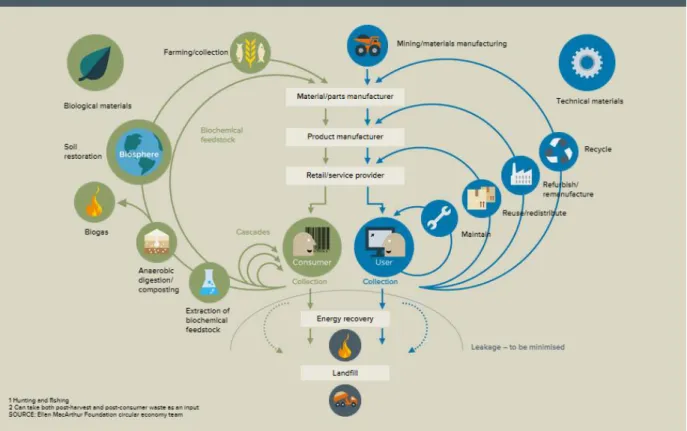
The Ellen McArthur foundation, supported by companies such as Philips, Unilever and Ikea, promotes a circular economy in which products are designed and marketed in a way that optimises re-use of products and the materials they are composed of. 31 Most companies support this approach and Dutch banks such as De Lage Landen Leasing / Rabobank and ABN Amro are working with the foundation. The Ellen MacArthur Foundation provides a very relevant and inspiring website, is the leading think-tank on circular economy and produces reports that are highly relevant for businesses and politicians.
Figure 1 Circular Economy System Diagram
Source: Ellen MacArthur Foundation (n.d.) “Interactive system diagram”, online: http://www.ellenmacarthurfoundation.org/, last viewed in November 2014.
“The evolution of our economy from an increasingly resource-constrained ‘take-make-dispose’ model towards one that is circular and re-generative by intention poses a huge opportunity for business innovation. This report highlights the significant economic opportunities, both
immediate and long-term, that are available across the EU. I believe the report offers the catalyst for a sector-wide re-design revolution”, said Ellen Mac Arthur on the report Towards the Circular Economy: Economic and business rationale for an accelerated transition.32
1.3.4 UNEP’s International Resource Panel
In 2013 the United Nations Environment Programme (UNEP)’s International Resource Panel (IRP) published a report on metal recycling concluding that a product-centric approach is essential.33 This approach is considered to be an essential enabler of resource efficiency by increasing recycling rates. The IRP report provides a techno-economic, product design and physics basis to address the challenges of recycling increasingly complex products in the 21st century.
The IRP considers that our contributions need to be systemic, for example through the
promotion of resource efficiency, improved materials recycling and life-cycle thinking. Its report shows that sustainable metals management requires more than improving recycling rates of selected materials. We need to change the whole mind-set on recycling metals, moving away from a material-centric approach to a product-centric approach. Recycling has become increasingly difficult today and much value is lost due to the growing complexity of products and complex interactions within recycling systems. While common commodity metals like steel, magnesium and copper can be recovered relatively easily, as these are often used in relatively simple applications, the small amounts of metals in, for example, electrical and electronic waste can be harder to recover because they are often just one among up to 50 elements. As an example, a mobile phone can contain more than 40 elements including base metals such as copper and tin, special metals such as cobalt, indium and antimony, and precious and platinum-group metals including silver, gold, palladium, tungsten and yttrium. 34
IRP concludes that: “in order to boost historically low recycling rates, a global move from a material-centric to a product-centric approach, in which recycling targets specific components of a product and their complexity at its End of Life (EoL) and devises ways to separate and recover them, is essential. Optimising the recycling of EoL products can avoid losses in efficiency throughout the chain of recycling. The global mainstreaming of such a
product-centric view will be a remarkable step towards efficient recycling systems, resource efficiency and a Green Economy.”
1.3.5 European Union policies
The European Commission supports resource efficiency and has established a high level European Resource Efficiency Panel. The Platform's members include European
Commissioners, members of the European Parliament (MEPs), ministers, business CEOs, academia and representatives of NGOs. The Platform calls on Europe to double its resource productivity by 2030 – at least – in order to boost the competitiveness of our industry and maintain a high quality of life for citizens. One of their recommendations addresses: “moving towards a circular economy and promoting high-quality recycling.”35
On financing, the platform advises the EU and Member States to encourage investment in resource-efficiency research and development, green innovation and their implementation. “We call on companies and large investors to take advantage of the forthcoming European reporting framework which improves transparency by including key performance indicators, to harmonise disclosure of non-financial information and provide information on resource
efficiency to shareholders, investors and the wider public. The EU should also examine the responsibility of investors through fiduciary duty in order to see if it truly reflects the impact of resource use on the financial results and risk exposure of companies. In order to enable institutional investors to invest more broadly into resource efficiency, the potential of the bonds market should be explored, including for small projects and SMEs.”36
The most recent report on the circular economy by the European Commission Directorate General for the Environment also acknowledges the crucial, but problematic role of the financial sector in creating a circular economy within the EU. The report identifies “insufficient investment in recycling and recovery infrastructure, innovation and technologies (related to this is the lock-in of existing technologies and infrastructure) and challenges in obtaining suitable finance for such investments as important barriers to the circular economy.”37
Since the first EU Waste Framework Directive was adopted in 1975, legislation has expanded dramatically to cover many specific waste streams and various areas of waste management. Although the average recycling rate in 2006 was around 79%, this was not the case for waste electronic and electrical equipment (WEEE). Only 23% of WEEE placed on the market was reported as collected. This raises concerns as to the continuing impact of WEEE in the environment. Currently, the EU is working on the Circular Economy Package which includes a reinforcement of EU waste policies. This contains, amongst others, an increase recycling / re-use of municipal waste to 70% in 2030. Ambitions to promote recycling are unfortunately minimal. 38
1.3.6 Dutch government policy
The Dutch government attaches great importance to stimulating the circular economy. In a recent letter to the House of Representatives, the state secretary stated:39 ‘Opportunities for the Netherlands offered by the circular economy are becoming increasingly clear. A recent TNO study showed that at least € 7 billion per year could be earned, well over 50,000 jobs could be created and the impact on the environment could be sharply reduced’. Front runners within industry and government have shown that circular business models lead to better performance.40
Therefore, the Dutch government has agreed ‘Green Deal Circular Purchasing’. And the government is working toward an ‘accelerator’ as a significant component in its effort to transition to a circular economy. In the Green Deal, about 20 public and private parties have agreed to boost the circular economy through means of their purchasing policy. The Dutch government also views the scarcity of raw materials as a clear opportunity. The Cabinet wants to stimulate innovation, re-use and substitution, so that the Netherlands can play a leading role in Europe in this field. This could strengthen the economy and the Dutch trading position. 41
Many interesting initiatives are taken, but the economic system and tax system that encourage the existing (linear) resource consumption patterns, remain untouched.
1.4
The transition to urban mining and the role of financial institutions
It clearly is crucial for our economy to make sure we do not waste resources and use fewer resources overall. To make this shift, the economic system needs to place a higher value on materials. Proposals for taxes on 'extracted value' instead of on labour have been developed by the Ex'Tax project.42 The EU and governments should also consider economic incentives such as taxation on resource imports or restrictions on scrap exports. Through such changes in the tax system and other incentives, companies would be stimulated to construct products in a way that makes repair, re-use and recycling easy and therefore economically attractive.The goals of all stakeholders should go far beyond stimulating resource efficiency, as we need an absolute reduction of metals and minerals consumption. As a major transition is needed, the financial sector should play its role amongst other actors such as industries, governments, consumers and NGOs. There are several steps in the circular production and consumption process where financial institutions could play a role. These are described in the next sections.
1.4.1 Efficient production
The step in the circular production and consumption process on which industries have been focusing most is applying efficient production processes within companies. Banks also encourage efficient production as it raises profits and makes companies less vulnerable to price hikes for the resources they use. Recently major Dutch banks started to promote the circular economy and industrial ecology, two approaches in which efficiency is promoted beyond companies, through the supply chain or in cooperation with neighbouring companies that can use the waste streams of other companies. In some cases banks have played a role in raising awareness or in bringing parties together. But this role is generally difficult to
substantiate and therefore difficult to capture in a Fair Bank Guide report.
1.4.2 Efficient consumption
In our society, purchasing products still remains the dominant type of consumption. However, in many cases sharing or leasing products fits better into a circular system. If products can be shared, fewer products are needed. Leasing products is a way to ensure that producers keep an eye on their products and can ensure the responsible processing of the next stage of their lifecycle, after they are no longer needed by the user. Financing the sharing economy, investing in leasing concepts or providing insurance for products that are shared by different users are ways in which banks and insurers can support more efficient consumption. Because a precise interpretation is essential for determining the environmental benefit of sharing and leasing constructions, and that is difficult to determine, this study does not focus on these activities.
1.4.3 Recycling: focus of this study
A circular approach to electronics ranges from expanding lifetimes, via refurbishment, modular design and reparability, to ultimately, recycling of electronic appliances into scrap metals. In our financial analyses, we focus on the collection and recycling phase because this is a step in the lifecycle of electronics that can be identified and because, like most products, electronic appliances become obsolete in a matter of years, with recycling into scrap metals as the only remaining option. This moment can be postponed, by repairing or refurbishing appliances, and will save energy as we need new products less often. But materials will still become available as scrap metal sooner or later. This should not be a problem as most metals can be recycled, in theory. Recycling metals is therefore not an end-of-pipe technology but a key link in the circular economy of electronics.
The Fair Bank and Insurance Guide therefore encourages financial institutions (private and public), recyclers and electronics companies to invest more in the European recycling
infrastructure, a key element in a circular use of metals. The next paragraphs further focus on the recycling industry and its trends, initiatives and positive examples. Better recycling of metals in the electronics sector in Europe is beneficial for many reasons, as we explained above, but unfortunately there are some hurdles to be overcome.
1.5
Electronics recycling industry
1.5.1 StatisticsThe European Electronics Recycling Association (EERA) consists of 38 recycling companies which are positioned in 17 countries. EU employment related to the recycling of
materials increased by 45 % between 2000 and 2007 — the second largest increase of all eco-industry sub-sectors.43 The total turnover of recycling of the group 'precious and other metals' in Europe, which includes most metals used in electronics except for copper, was in 2009 approximately € 5 billion.44
1.5.2 Problems in the recycling industry: 4 trends
The European Electronics Recycling Association identifies four trends that are making recycling increasingly difficult from a technical and economic viewpoint:45
Miniaturisation: as products get smaller they contain less material and materials are packed so tightly that it is hard to separate them. The result is less materials to be recovered by recyclers;
Shorter lifespans: technologies such as LCD-screens have ever shorter lifespans. Recyclers that invest in recycling infrastructure therefore have a shorter timespan to make money with their equipment. Investments have a shorter economic lifespan and costs go up;
Complex materials: smaller and more sophisticated products use more
sophisticated materials, alloys and components. These complex materials are often impossible to process by recyclers. Electronics brands are not transparent about the chemical composition of the components they use. In many cases they do not know which materials their suppliers have used in their products;
Price reduction: low prices of electronics products make it difficult for electronics brands to invest in recyclability. In many sectors price is the overriding design argument.
Taking products and the materials inside them apart is often impossible, and never
economical. Recyclers therefore use shredders and chemical refining to separate different materials. Total recycling through chemical processes is unfortunately not possible. Recyclers optimise recycling for certain metals and accept that other metals will disappear as waste or as impurities in the main products from the recycling process. Design for recycling and better technologies can improve the output of the recycling process. 46
But even when only existing technologies are used, more circularity could bring the Dutch economy huge benefits. The total added value in the metal-electrical sector is € 9,983 million. The total increase in the market value of the circular economy for metal-electrical products is substantial, amounting to € 573 million on an annual basis. This value has been corrected to reflect the decrease in the sales of new products. This amounts to 10,583 jobs in the
metal-electrical sector.47
At EU-level the huge opportunities are clear as well. Less than 10% of the materials in our new electronic equipment currently can be sourced from recycled WEEE material. Collected WEEE is recycled but the amount collected is relatively low. This is due to the significant exports of second-hand electronic and electrical equipment from the EU, increasing EU stocks of electronic and electrical equipment, and the lack of adequate collection infrastructure. In the case of rare metals in WEEE, dissipative use can reduce recycling rates, which may also contribute to low coverage of demand. 48
1.6
Financing recycling companies, opportunities and examples
A recent report for the European commission mentions as one of the constraints to the transition towards a circular economy, “the insufficient investment in recycling and recovery infrastructure, innovation and technologies (related to this is the lock-in of existingFor entrepreneurs, the financing of electronics recycling companies can be difficult because recyclers currently face costs that are going up faster than the prices for the resources they recover and prices are volatile. Another issue is that recyclers, especially the collectors of discarded products tend to be small companies, which are not very interesting for all banks. Advice on business development is important for these companies. On the other hand, resource prices are expected to rise, supporting longer term business cases.
1.6.1 Scrap metal collection and separation
Scrap metal collection is a sector that is crucial for efficient recycling. Effective and efficient collection and separation of metals is crucial to supply metallurgical industries. Quantity and quality are important. High quality means that different types of metals and alloys are separated before smelting.
In the Netherlands the electronics industry (NVMP) manages the Wecycle network of e-waste collection and scrapping installations. 50 In other European countries similar professionalised networks are still lacking, although European legislation calls for such systems
1.6.2 Metallurgical recycling
Construction of an integrated plant for recycling many metals is a very large investment, and will only be undertaken where it has ‘bankable feasibility’, for example where the desired return on investment is reliable and not subject to strong risk. The predictable availability of reliable scrap-input streams is a key determinant for how plants are set up. For example, over the past 14 years the Umicore facility in Belgium has invested around € 1400 million in a brown-field upgrade of their long-established metallurgical operation, setting up a world-class recycling facility that produces many metals on the basis of lead and copper metallurgy.51
Boliden has recently started up its new Kaldo e-waste expansion (from 45,000 to 120,000 tpa e-waste) with a total investment of SEK 1.3 billion (ca. € 1.145 million) in Skellefteå, Sweden.52
Where bankable feasibility is shown, financing is often available, especially for proven
technology. However, finding money for introducing new and innovative technologies, not yet commercially proven, can be difficult due to the perceived financial risk and the
multi-million-dollar nature of such projects. This holds back technological development.53
1.6.3 EIB
The European Investment Bank offers support to small and medium-sized Enterprises (SMEs) through the ‘Joint European Resources for Micro to Medium Enterprises’. Investors pool funds and knowledge in investment vehicles that are able to invest in relatively small or innovative SMEs.54 This approach is needed in the recycling industry, especially to support new business initiatives.
1.6.4 Social and environmental issues connected to the recycling industry
Investing in and support of recycling companies is important as has been explained in this chapter. These companies, however, may be polluting or may be linked to labour rights issues. Several banks interviewed for this study indicated that they were reluctant to invest in recycling companies because of these kinds of issues. Like in other industries, banks and insurance companies should assess whether they can pursue an engagement strategy and convince these companies to improve their behaviour or should divest (or refrain from investing) from companies that cannot comply with environmental or other standards.
Chapter 2
Methodology
2.1
Approach
This case study assesses whether 16 financial institutions selected within the framework of the Fair Bank Guide and the Fair Insurance Guide invest in electronics recycling companies and compare these to how much they invest in electronics metals mining companies. Furthermore, this case study assesses how the 16 financial institutions contribute to electronics recycling and recycling in other ways.
The research approach consisted of several steps:
selecting mining and recycling companies (for details, see section 2.3);
designing methodology for scoring the financial institutions with regard to their investments in mining and recycling and for other steps taken to stimulate recycling;
analysing the relationship between the financial institutions and the selected companies (for details, see section 2.4);
analysing other steps taken by financial institutions to stimulate recycling, via interviews and/or a survey (for details, see section 2.5);
writing the background and results chapter;
asking feedback on the profiles and scores of the researched financial institutions; and writing final conclusions.
During this process the researched banking and insurance groups were repeatedly asked for feedback. Whenever possible and reasonable, and in consultation with the Fair Bank and Insurance Guide, the methodology has been adjusted.
2.2
Research group
Table 3 gives an overview of the ten banking groups that are included in the Fair Bank Guide, including the brand names they use in the Netherlands for banking services.i
Banking groups included in the Fair Bank Guide
Table 3
Banking group Brand names for banking services in the Netherlands
ABN Amro ABN Amro Bank, MoneYou
Aegon Aegon, Knab
ASN Bankii ASN Bank
Delta Lloyd Delta Lloyd Bank
ING ING Bank, Nationale-Nederlanden Bank, WestlandUtrecht Bank
NIBC NIBC Bank
Rabobank Rabobank, Friesland Bank
SNS Reaal SNS Bank, Region.Bank
i
Nine banking groups have been selected by the Fair Bank Guide based on their market share of the Dutch market for current and savings accounts. Triodos Bank has been selected as the tenth banking group because the bank has a special position in the Dutch banking market. For background information, please see:
http://www.eerlijkebankwijzer.nl/media/35819/eerlijke_bankwijzer_14e_update_140422_rapport.pdf
ii
ASN Bank is a wholly owned subsidiary of SNS REAAL, but is treated separately because the bank carries its own formal policy and is part of the ten largest banks in the Dutch savings market on its own account.