SOFTWARE-ORIENTED DISTRIBUTED SHARED
CACHE MANAGEMENT FOR CHIP
MULTIPROCESSORS
by
Lei Jin
B.S. in Computer Science,
Zhejiang University, China, 2004
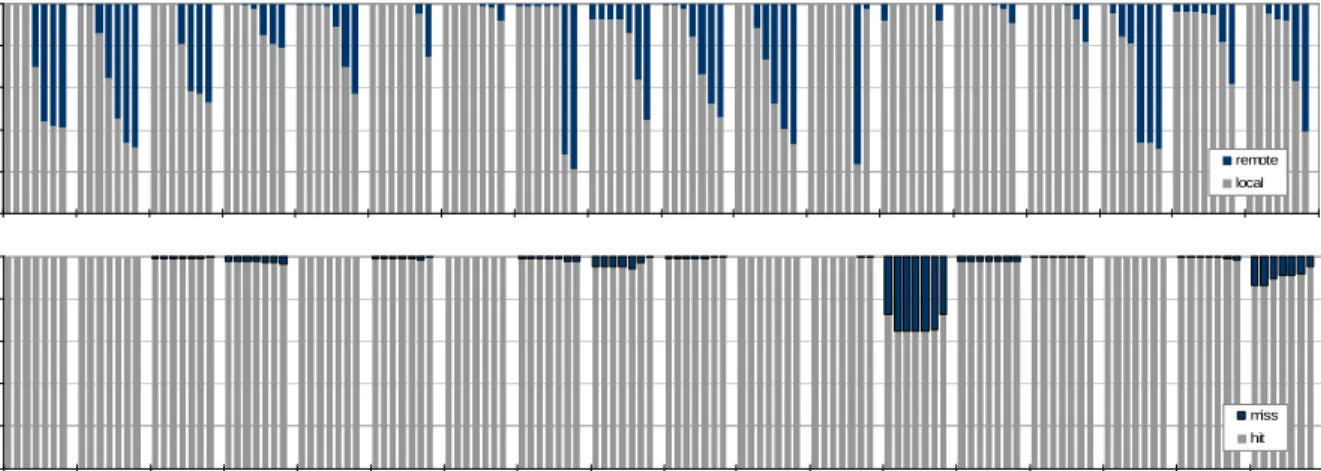
Submitted to the Graduate Faculty of
the Department of Computer Science in partial fulfillment
of the requirements for the degree of
Doctor of Philosophy
University of Pittsburgh
2010
UNIVERSITY OF PITTSBURGH
DEPARTMENT OF COMPUTER SCIENCE
This dissertation was presented
by
Lei Jin
It was defended on
Jan 20th 2009
and approved by
Sangyeun Cho, Ph.D., Assistant Professor at Department of Computer Science
Rami Melhem, Ph.D., Professor at Department of Computer Science
Bruce R. Childers, Ph.D., Associate Professor at Department of Computer Science
Onur Mutlu, Ph.D., Assistant Professor at Electrical and Computer Engineering, Carnegie
Mellon University
Dissertation Director: Sangyeun Cho, Ph.D., Assistant Professor at Department of
ABSTRACT
SOFTWARE-ORIENTED DISTRIBUTED SHARED CACHE MANAGEMENT FOR CHIP MULTIPROCESSORS
Lei Jin, Ph.D.
University of Pittsburgh, 2010
This thesis proposes a software-oriented distributed shared cache management approach for chip multiprocessors (CMPs). Unlike hardware-based schemes, our approach offloads the cache management task to trace analysis phase, allowing flexible management strategies. For single-threaded programs, a static 2D page coloring scheme is proposed to utilize oracle trace information to derive an optimal data placement schema for a program. In addition, a dynamic 2D page coloring scheme is proposed as a practical solution, which tries to ap-proach the performance of the static scheme. The evaluation results show that the static scheme achieves 44.7% performance improvement over the conventional shared cache scheme on average while the dynamic scheme performs 32.3% better than the shared cache scheme. For latency-oriented multithreaded programs, a pattern recognition algorithm based on the K-means clustering method is introduced. The algorithm tries to identify data access pat-terns that can be utilized to guide the placement of private data and the replication of shared data. The experimental results show that data placement and replication based on these access patterns lead to 19% performance improvement over the shared cache scheme. The reduced remote cache accesses and aggregated cache miss rate result in much lower bandwidth requirements for the on-chip network and the off-chip main memory bus. Lastly, for throughput-oriented multithreaded programs, we propose a hint-guided data replication scheme to identify memory instructions of a target program that access data with a high reuse property. The derived hints are then used to guide data replication at run time. By
balancing the amount of data replication and local cache pressure, the proposed scheme has the potential to help achieve comparable performance to best existing hardware-based schemes.
Our proposed software-oriented shared cache management approach is an effective way to manage program performance on CMPs. This approach provides an alternative direction to the research of the distributed cache management problem. Given the known difficulties (e.g., scalability and design complexity) we face with hardware-based schemes, this software-oriented approach may receive a serious consideration from researchers in the future. In this perspective, the thesis provides valuable contributions to the computer architecture research society.
TABLE OF CONTENTS
1.0 INTRODUCTION . . . 1
1.1 Recent Development of Microprocessor Technology . . . 1
1.2 Cache Architectures and Workload Classification . . . 3
1.2.1 Cache Architectures in CMPs . . . 3
1.2.2 Workload Classification . . . 6
1.3 Limitations of Existing Schemes. . . 8
1.4 Research Overview and Contributions . . . 9
1.4.1 Problem Overview . . . 9
1.4.2 Research Contributions . . . 14
1.5 Dissertation Organization . . . 15
2.0 BACKGROUND AND RELATED WORK . . . 16
2.1 Hardware-Based Cache Management Schemes . . . 16
2.1.1 Shared Cache Scheme . . . 16
2.1.2 Private Cache Scheme . . . 17
2.1.3 Hybrid Cache Schemes . . . 18
2.2 Page-Based Cache Management . . . 23
2.3 Schemes for Non-Uniform Memory Architecture . . . 26
3.0 MACHINE MODEL AND EXPERIMENTAL SETUP . . . 30
3.1 Machine Model . . . 30
3.2 Experimental Setup . . . 33
4.0 DATA PLACEMENT FOR SINGLE-THREADED PROGRAMS . . . 38
4.1.1 Basic Approach . . . 39
4.1.2 Discussions . . . 43
4.2 Dynamic 2D Page Coloring . . . 43
4.2.1 Basic Approach . . . 43
4.2.2 Page Migration . . . 45
4.2.3 Architectural Support . . . 46
4.3 Evaluation Results . . . 48
4.3.1 Static 2D Page Coloring. . . 48
4.3.2 Dynamic 2D Page Coloring . . . 53
4.3.3 Multiprogrammed Workload . . . 56
4.4 Summary . . . 59
5.0 DATA AFFINITY ANALYSIS FOR MULTITHREADED PROGRAMS 60 5.1 Properties of Multithreaded Programs . . . 61
5.1.1 Parallel Programming Models . . . 61
5.1.2 Data Structure Types . . . 61
5.1.3 Memory Allocation Types. . . 62
5.2 Basic Approach . . . 63
5.2.1 Access Pattern Classification . . . 64
5.2.2 Access Pattern Recognition Algorithm . . . 68
5.2.2.1 Pattern Recognition for Dynamic Data . . . 69
5.2.2.2 Affinity Hint for Static Data . . . 72
5.2.3 Hint-Guided Data Placement . . . 73
5.3 Evaluation Results . . . 77
5.3.1 Hint Accuracy . . . 77
5.3.2 Performance Improvement . . . 80
5.3.3 Cache Miss Rate Comparison . . . 82
5.3.4 Network Traffic . . . 83
5.4 Summary . . . 84
6.0 PROFILE-GUIDED DATA REPLICATION FOR MULTITHREADED PROGRAMS . . . 86
6.1 Program Behavior Analysis . . . 86
6.1.1 Overview . . . 87
6.1.2 Distribution of Cache Blocks . . . 88
6.1.3 Distribution of Cache Accesses . . . 89
6.1.4 Distribution of Cache Reads and Writes . . . 91
6.1.5 Property of Memory Instructions . . . 92
6.2 Profile-Guided Data Replication Scheme . . . 93
6.2.1 Trace Analysis Algorithm . . . 93
6.2.2 Profile-Guided Data Replication . . . 96
6.2.3 Implementation Issues . . . 98
6.3 Evaluation Results . . . 99
6.3.1 Profiling Analysis Threshold . . . 99
6.3.2 Reuse Comparison . . . 101
6.3.3 Performance . . . 103
6.4 Summary . . . 105
7.0 CONCLUSIONS AND FUTURE WORK . . . 107
7.1 Summary . . . 107
7.2 Conclusions . . . 110
7.3 Contributions . . . 112
7.4 Future Work . . . 113
LIST OF TABLES
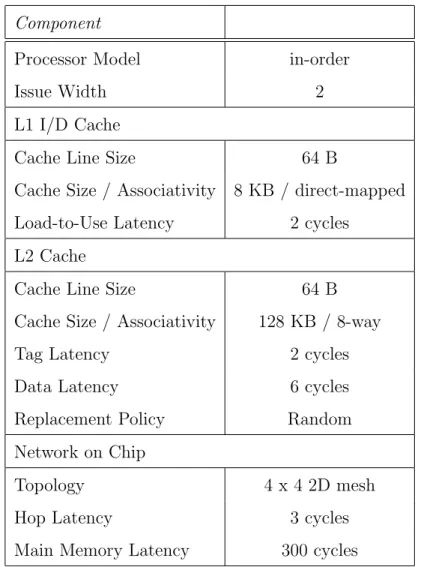
1 Baseline architecture configuration . . . 34
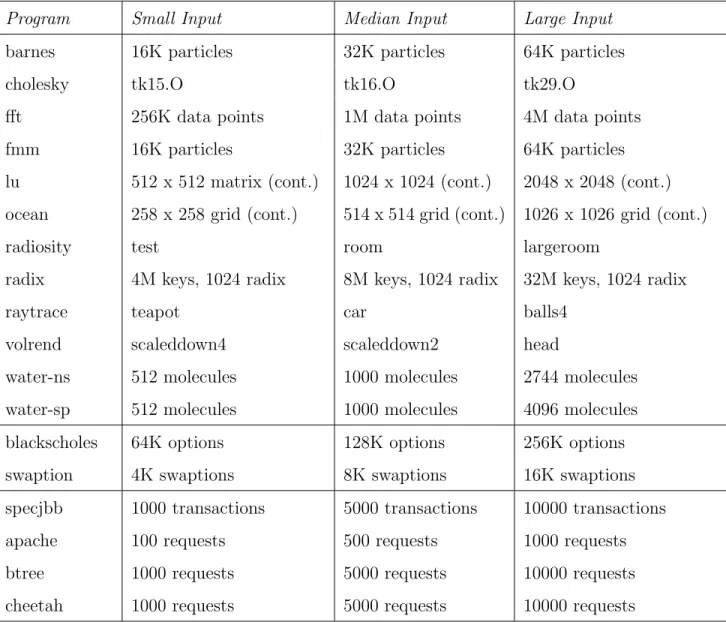
2 Multithreaded benchmarks with inputs . . . 36
3 Pattern recognition accuracy and coverage. . . 79
4 Number of static memory instructions captured by different threshold values. 100
5 The optimal threshold value derived from test executions is given for each pro-gram. A high threshold value filters out more memory instructions, resulting in less data replication. A threshold value of 0 represents the victim replication scheme. . . 101
LIST OF FIGURES
1 Data sharing behavior of cholesky at page granularity . . . 12
2 Machine model for experiments . . . 31
3 TLB modification for supporting L2 cache page placement . . . 32
4 The algorithm to extract conflict information . . . 40
5 An example demonstrates how the algorithm extracts conflict information from an access trace.. . . 41
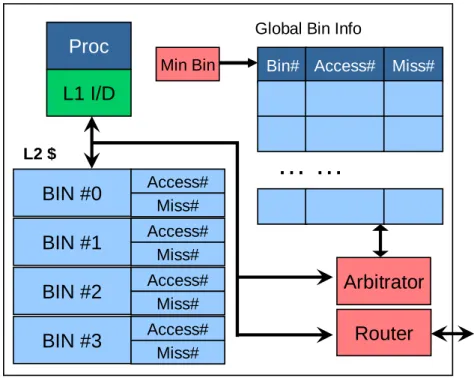
6 Microarchitectural support for dynamic 2D page coloring . . . 47
7 L2 cache access decomposition . . . 49
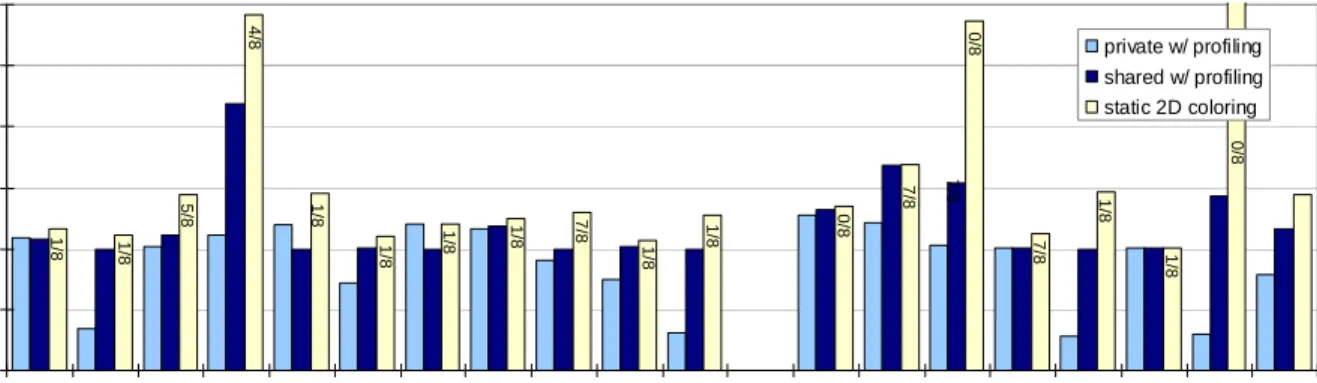
8 Static 2D page coloring performance . . . 50
9 Performance scaling of static 2D page coloring . . . 51
10 Page placement and cache access distribution example . . . 52
11 Dynamic 2D page coloring performance . . . 53
12 Cache access distribution of mgrid under different schemes . . . 55
13 Program performance of the dynamic 2D page coloring scheme with and with-out page migration enabled . . . 56
14 Multiprogrammed workload performance of dynamic 2D page coloring scheme 58 15 The one-time profiling and data access pattern analysis flow (upper box) and the hint exploitation flow (lower box) of the proposed hint-guided data place-ment scheme. . . 63
16 An example of a dynamically allocated memory area . . . 66
17 An example of K-means clustering for even partition pattern . . . 71
19 Breakdown of L2 cache accesses based on the classified pattern types . . . 78
20 Execution time of benchmarks with different input size. . . 81
21 Aggregated L2 cache miss rate of benchmarks . . . 82
22 Number of remote L2 data requests . . . 83
23 On-chip network traffic . . . 84
24 Instruction and data blocks distribution of specjbb 2005 based on the number of sharers of the blocks . . . 89
25 Instruction and data access distribution of specjbb 2005 based on the number of sharers of the blocks . . . 90
26 Read/write access distribution of specjbb 2005 based on the number of sharers of the blocks . . . 91
27 Block diagram for the proposed profile-guided data replication scheme . . . . 94
28 Impact of threshold value on program execution time. . . 100
29 A comparison of the ratios of the total number of L2 cache accesses that find data replicated in local cache slices for L2VR and L2HR. . . 102
30 Number of data replication instances in L2HR relative to L2VR. . . 102
31 A comparison of the aggregated L2 cache miss ratio for L2VR and L2HR. . 103
32 Normalized execution time of L2S, L2P,L2VR, and L2HR schemes. . . 104
1.0 INTRODUCTION
1.1 RECENT DEVELOPMENT OF MICROPROCESSOR TECHNOLOGY
Since the debut of the world’s first microprocessor in the early 70’s, microprocessor tech-nology has experienced an astonishing evolution. The introduction of the commercial su-perscalar processors [68] in the late 80’s resulted in significant performance improvement. Since then, mechanisms to extract instruction-level parallelism (ILP) have been greatly em-phasized in the computer architecture community. Taking the transistor budget for granted, computer architects employed many microarchitecture innovations such as aggressive branch prediction mechanisms, intelligent memory data prefetching, multiple instruction issue, dy-namic scheduling, speculative execution, and simultaneous multithreading to keep improving the processor performance [41, 93, 49, 90, 77, 61, 67, 32, 62, 110, 47, 50, 83, 10, 51, 21, 35,
107, 105,30,3,100,57,29]. Some of these mechanisms have developed to a level of extreme sophistication and complexity. Luckily, Moore’s law [69], which successfully predicted that the number of transistors that can be placed inexpensively on an integrated circuit doubles approximately every two years, has been valid for more than three decades. The complexity and inefficiency of these hardware structures have been largely hidden by the fast increase of transistor count on a chip. As a consequence, the microprocessor industry had much success during the last two decades since the release of the first superscalar processor [68].
More recently, the advancement of microprocessor technology has faced some difficulties. Moore’s law is challenged by physical constraints and is believed to be impossible to sustain in the foreseeable future [54]. For instance, feature size is being pushed to near physical limitations. Without care, power consumption can grow exponentially. Researchers even predict if the power density is increasing at the current page, the core temperature of the
microprocessor is going to trigger nuclear reaction [2]! Another challenge is reliability. With decreased feature size, products become vulnerable to hard and soft faults. The degraded product yield can also increase the cost significantly. Moreover, the margin of performance improvement by using more aggressive speculation is decreasing, even though the hardware design complexity and area budget are increasing exponentially. The fundamental obstacle is the lack of ILP in current single-threaded programs and efficient mechanisms to uncover them. With these issues, superscalar uniprocessor design can apparently no longer sustain the historical performance growth rate. On the other hand, symmetric multiprocessor (SMP) design tries to speed up program execution by running threads on multiple cooperating pro-cessors, which are physically separated but wired together through interconnection. However the performance of these workloads suffers from the slow interconnection. As a result, the chip multiprocessor (CMP) architecture [73,18,37,12,11,38] is proposed as an alternative solution.
The CMP architecture is like the traditional SMP design. But instead of wiring together physically separated processors, a CMP integrates multiple processor cores on a single die with an on-chip network. In comparison to the SMP design, the on-chip network in the CMP architecture naturally has much lower latency. In addition, the on-chip cache partially replaces the role of main memory and takes the responsibility for synchronizing cooperating cores. Unlike the superscalar uniprocessor architecture that depends on complex pipeline design to extract ILP [91, 75], the CMP architecture is designed to exploit thread-level parallelism (TLP). The individual core design is made simpler in compromise for larger core count. Thus, the design principle here is that the CMP architecture sacrifices performance of individual cores for higher overall throughput. Some studies [98, 99, 70] even propose to use an asymmetric CMP (ACMP) design. In such a design, there is a high performance superscalar core, which provides fast execution of a single-threaded program, while other small parallel cores can run multiple threads simultaneously. By scheduling the workload properly, ACMP is expected to achieve a good balance between performance for single-threaded programs and throughput for multisingle-threaded programs. Based on this discussion, it is clear that the CMP architecture has advantages over the uniprocessor architecture in terms of design complexity, performance scalability and power efficiency.
CMPs with 4 or more processor cores [45, 88, 5, 6] are available now. Some special purpose processors such as Tilera [103] even integrate 64 processor cores or more in a single chip. It is believed that the CMP architecture will become the mainstream architecture. CMPs with hundreds of cores are certainly anticipated.
1.2 CACHE ARCHITECTURES AND WORKLOAD CLASSIFICATION
In company with the shift from uniprocessor architecture to CMP architecture, the memory hierarchy evolves accordingly, mainly adopting ideas from SMP design. To facilitate commu-nication among processing cores, the memory subsystem (off-chip main memory) is shared by all cores within a CMP in one form or another. As a result, the integration of more and more processing cores on a single chip dramatically increases pressure on the memory subsystem [43]. The last-level cache acts as a last defense before letting the request go off-chip. A well-designed last-level cache can relieve pressure on the memory subsystem and off-chip bandwidth. Comparing to the last-level cache design in uniprocessor design, it plays a much more important role in the CMP architecture. Thus designing an effective on-chip cache hierarchy becomes an imminent task for computer architects in the CMP era. In this section, we will first introduce existing last-level cache designs briefly. Then we will discuss common workload types, to which we should pay special attention when designing new cache architectures.
1.2.1 Cache Architectures in CMPs
The research community has paid considerable attention to the last-level on-chip cache. To exploit temporal locality not captured by higher level caches, the last-level cache tends to employ large capacity. The large aggregated footprint size of programs running on CMPs also favors caches with large capacity. However, the amount of die area required is proportional to the cache capacity. The cross-chip diameter increases as the on-chip cache capacity grows, leading to a longer signal propagation delay. The decreased feature size makes the wire delay
even worse [13]. In such a case, adopting a traditional monolithic cache structure commonly found in uniprocessors can result in very slow cache accesses.
To improve cache performance, the whole cache space is broken into banks or slices. These banks are connected through wires or on-chip networks [31] to form a logically unified view to the processing cores. The benefits of this approach come in two folds. First, com-pared with the monolithic cache structure, smaller cache banks have lower access latency. Furthermore, only the accessed cache banks are enabled at a time, providing much better power efficiency. Second, the wire delay can now vary based on the target bank distance. Nearby banks can be accessed much faster due to reduced wire delay even though accesses to farthest cache banks still take the same latency as before. This distance-based latency results in a much lower average access latency than that of the uniform latency design found in traditional cache structure. This improved cache design is called Non-Uniform Cache Architecture (NUCA) [13, 25, 53]. It has a simple design and achieves effective latency re-duction. Without significant improvement of on-chip wire delay, NUCA seems an inevitable solution for organizing the last-level on-chip caches with large capacity in CMPs. Moreover, a new CMP design approach [111, 103] becomes very popular recently. The new approach first designs a tile containing processing core, caches, and necessary logic to communicate with others through the network. Then the tile is simply duplicated to meet the core count requirement. This approach can dramatically reduce design effort for large-scale CMPs. The resulting tile-based CMP architecture intrinsically uses a sliced last-level cache design. Thus, NUCA is a natural fit in such a design.
Unfortunately, the speed gap between the processor and the main memory still exists. Effective management of the on-chip cache capacity to minimize the number of expensive off-chip accesses is critical to overall system performance. The introduction of NUCA brings new opportunities for further optimizing cache performance. Since nearby cache banks can be accessed faster than others, placing data close to where they are needed can provide better cache access latency. However, excessive aggregation increases contention in the cache banks, leading to performance loss of off-chip main memory accesses. An intelligent last-level cache management scheme that balances these two conflicting factors to achieve optimal performance is desirable.
The popular last-level cache organizations in CMPs are borrowed from traditional SMPs since they share similarities. These two most widely used designs are the shared cache scheme [45, 6, 46, 56, 71, 84] and the private cache scheme [5, 101, 40]. The shared cache scheme interleaves consecutive cache blocks among all available cache banks based on their block addresses. It provides a logically shared cache view out of physically distributed cache banks. The shared use of all cache banks maximizes cache capacity utilization, thus minimizing the number of cache misses. However, it distributes data purely based on block address, without considering bank distance. A heavily accessed data block coincidentally placed in a nearby cache bank could gain much more benefit than otherwise. For this reason, program performance is sensitive to its cache access pattern and is not predictable to some extent. As CMP core count increases, the performance degradation due to the increased access latency to remote cache banks can become significant. It will eventually out-weigh the benefit of reduced cache misses with large effective cache capacity. Without a significant reduction in wire delay, the shared cache scheme seems not a proper choice for very large-scale CMPs.
The second design is the private cache scheme. Its design philosophy lies on the other extreme of the shared cache scheme. The private cache scheme avoids remote accesses by always keeping a copy of an accessed data block in the processing core’s local cache bank. Cache banks are independent of each other and exclusively accessed by their owners. A cache miss in the local cache bank results in a main memory request directly. A directory or snooping mechanism is responsible for maintaining coherence among cache banks. Each processor becomes an autonomous unit, making a CMP easy to scale. Since data lookup is always performed in the local cache bank, wire delay has limited impact on cache per-formance. However, the strict capacity partitioning often becomes a fatal limitation. In a CMP with N processing cores, the private cache scheme only allows each processor accessing its own cache bank even though the total on-chip cache capacity is N times larger. When a program’s working set exceeds the local cache bank’s capacity, performance is lost due to conflicting misses, which can be saved with larger cache capacity. If a workload is not distributed evenly, some cache banks can face severe contention while others are barely used. Without caution, the increased number of cache misses can easily offset the benefit brought
by the elimination of remote accesses.
Motivated by the limitations of these two basic cache management schemes, many recent proposals try to combine the advantages of both [72, 43, 111, 14, 27, 26, 23, 39]. They can be broadly classified into two basic approaches. One approach starts from a shared cache organization and manages to reduce cache access latency by allowing some degree of replica-tion [111, 14, 26]. The principle is to replicate frequently reused data in a local cache bank so that a later access can be served locally. Replication effectively reduces average access latency. For instance, the victim replication scheme [111] replicates remote cache blocks that are replaced from L1 caches. Instead of replicating all blocks unconditionally as the private cache scheme, the victim replication scheme gives preference to blocks with potential reuse in the future. The other approach is based on a private cache scheme and tries to in-crease the effective cache capacity by limiting the amount of replication [23]. The suppressed replication of some rarely used data improves cache capacity utilization. For example, the cooperating caching scheme [23] proposes to improve the private cache scheme by assigning high replacement priority to replicated data and globally inactive data. Both approaches seem promising, but challenges remain. First, it is difficult to track program behavior pre-cisely. Without precise run-time information regarding the program’s data access pattern, it is difficult to decide the best replication level. Unfortunately, the tracking mechanism often requires complex hardware logic. Second, it lacks a mechanism to inexpensively trace data movement around the cache. In order to maintain cache coherence, any data placement or replication has to be recorded. At cache block granularity, the hardware cost for bookkeeping the related information seems overly expensive.
1.2.2 Workload Classification
Neither the shared cache scheme nor the private cache scheme can perform consistently better than the other because the access pattern varies a lot from one program to another. It is important to have a good understanding of workload behavior before trying to come up with any new scheme that can adapt to different situations. At the fundamental level, all workloads can be broadly classified into three categories: single-threaded workload,
latency-oriented multithreaded workload, and throughput-latency-oriented multithreaded workload. These three types of workloads have very distinct behavior. Some of them even have distinctively different goals. For instance, a Fast Fourier Transformation program employs multithreading to speedup the computation. On the other side, a web server application uses multithreading to improve the number of HTTP requests serviced per second rather than the service time of each individual request. In the following, we will examine these three workload categories in detail.
For single-threaded programs, only one thread is active at any time. All data are exclu-sively accessed by this thread. So no data sharing exists. The workloads in this category are very popular in uniprocessors and still play an important role in CMPs. The access pattern is the simplest among all types, since there is only one data owner all the time. It is always attractive to place data close to where the program is running. But care has to be taken to avoid excessive cache misses incurred by data aggregation. One variation to the single-threaded workload is the multiprogrammed workload. It is composed of multiple instances of single-threaded programs running concurrently. All instances are independent of each other and use separate virtual address spaces. Data sharing among programs rarely happens. Except the interference created by peering programs, the data access pattern is largely unchanged as running alone.
The second category includes multithreaded programs that optimize the execution time. This is the most commonly seen type of multithreaded programs. To improve execution time, the original algorithm in a single-threaded form is rewritten to take advantage of mul-tiple processing elements (e.g., cores in a CMP). A computation task is split into mulmul-tiple parallel threads. By running threads on spare hardware resources simultaneously, speedup is achieved. A perfect workload partition can lead to an execution speedup proportional to the number of processing cores available in a CMP. However, an ideal speedup is difficult to achieve in real-world applications. Performance scaling is partly hindered by the inter-thread communication, which essentially serializes the execution of participating threads. Further-more, arbitrary data placement can increase the number of remote accesses, degrading cache performance. If a parallel algorithm is not designed carefully, the benefit of parallelization can be offset by the increased communication cost.
The last group of workloads are throughput-oriented applications. A typical example is a server daemon. In this type of workload, the execution time of an individual thread is still as important as that in a latency-oriented multithreaded program. But the focus becomes how to complete as many transactions as possible in a given time period. Unlike latency-oriented multithreaded programs, some programs in this category can run continuously until terminated explicitly. As a result, the OS virtual memory management policy can have a profound impact on their performance. Moreover, threads in a throughput-oriented multi-threaded program are often independent. They communicate and share data among each other, but not in a cooperative way as the latency-oriented multithreaded programs.
Given the various characteristics of these workloads, it is not at all surprising that none of these static cache schemes can serve all of them equally well. Some workloads favor a shared cache scheme, while others may perform better on a private cache scheme. In practical cases, a program can even exhibit different memory access patterns within different execution phases. As a result, a fixed static cache scheme cannot even satisfy the requirement of a single program. A flexible and intelligent cache management scheme that can adapt to different program behaviors is desired in CMPs.
1.3 LIMITATIONS OF EXISTING SCHEMES
Apparently, neither the shared cache scheme nor the private cache scheme alone can suit the memory access patterns of all workloads. Many proposals try to improve the performance of the baseline shared and private cache schemes by adapting to program behavior. They are motivated by different observations and provide distinct solutions. But the basic principles of these proposals are the same: combining the advantages of both shared and private cache schemes to form a new hybrid scheme. Naturally, these architectural innovations are implemented in hardware. Admittedly, a hardware-based solution provides many benefits. First, it hides the underlying detail completely from the OS and the applications. The program behavior tracking and management decisions are performed in parallel with other operations in background. Thus, these designs introduce limited interference to the program
execution. Furthermore, the worst case latency of an operation is guarded by the hardware design. The delay is predictable.
However, these hardware-based designs have some limitations: (1) Maintaining up to date information for the executing program is critical to a dynamically adaptive cache scheme. It is not trivial to track program behavior in hardware. The data storage for bookkeeping the event history can become substantial and potentially unmanageable, not to mention the complexity of the control logic. An over-simplified design can generate inaccurate estimation of the current execution status. It can lead to incorrect run-time decisions and impact the program performance adversely. Some statistical sampling method [78] is proposed to reduce the monitoring cost. However, most of these tasks can be easily accomplished by software using off-line analysis; (2) More importantly, these proposed hardware schemes often require a central arbitrator to keep distributed caches coherent. Such a centralized design violates the original purpose of using a distributed cache organization, creating a potential performance bottleneck for large-scale CMP architectures.
1.4 RESEARCH OVERVIEW AND CONTRIBUTIONS
Motivated by these issues in existing hardware-based schemes,this thesis studies the dis-tributed shared cache management problem using a software-oriented approach. The proposed solutions are expected to perform at least comparable to available hardware-based cache management schemes, but with much less hardware cost and better scalability.
1.4.1 Problem Overview
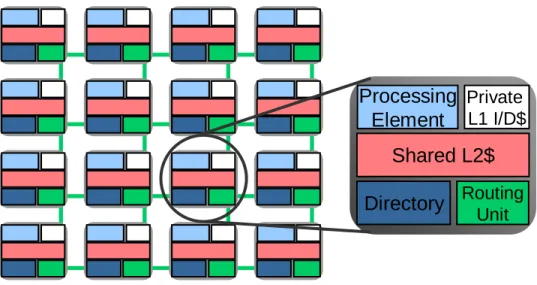
In this thesis, we propose a software-oriented last-level cache management approach for optimizing program performance on CMPs. We assume the L2 cache is the last-level cache in a CMP and L2 cache slices are distributed and shared by all cores, similar to recent multicore processors [80, 103, 97]. To remove the constraints exposed in hardware-based schemes, it is important to have a flexible mechanism to locate data in the L2 cache. The
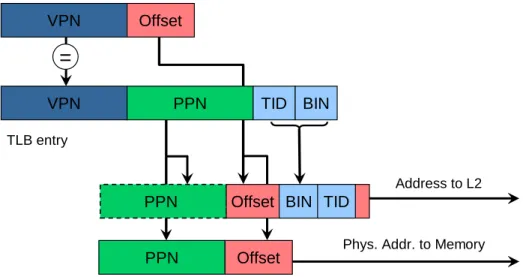
underlying mechanism used to control data placement in this work is similar to the page coloring technique [27]. When a page fault is triggered, a free physical page frame has to be mapped to the virtual page generating the fault. During this process, the OS also chooses a target cache slice index and a cache bin number as augmented fields to the page table entry.1 Whenever a cache block belonging to that page is accessed, the corresponding cache slice index and the cache bin number are fetched to locate it among L2 cache slices. The challenge is to determine a proper cache slice index and a cache bin number for a given virtual page. The proposed software-oriented cache management approach employs a profile analysis method to generate data mapping hints for a program. The hints are then used to guide data placement at run time. The off-line analysis is not limited by hardware resources and can perform a very sophisticated analysis task. By off-loading the cache management task onto software, the proposed approach can exploit a program’s cache access patterns that are hard to capture by hardware mechanisms. More importantly, the flexibility of the off-line analysis even allows us to adopt different strategies to tackle programs with various characteristics. In this thesis, a unique strategy is designed for three different types of workloads separately.
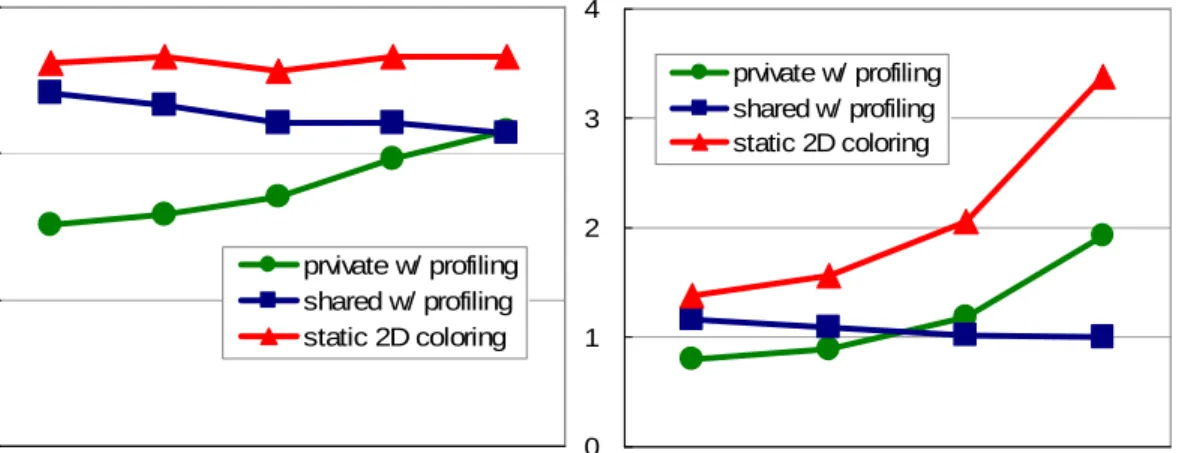
For single-threaded programs, it is obvious that distributing data blindly across all L2 cache slices is not an efficient method. If the working set is not large, the remote access delay from the on-chip network can degrade performance. Without causing excessive cache misses, aggregating program working set data as close as possible to where the program runs can provide a considerable performance boost. In this study, the cache access latency (including the network delay) and the cache contention information are considered in combination to compute the cost of a cache access. The derived “optimal” data distribution is the one with minimum total cost for all L2 cache accesses. The evaluation results show that hints are provide up to 3 times speedup with the oracle static 2D page coloring scheme. The average improvement is 44.7%. The dynamic 2D page coloring scheme, which is the online version of the static 2D page coloring scheme, achieves up to 191% better performance than the shared cache scheme with an average of 32% improvement. In addition to the encouraging results,
1A cache bin is a collection of consecutive cache sets. The number of sets in a cache bin equals to the
page size divided by a cache block size. For example, if a page is 8KB, then a 512KB 4-way associative cache with 64-byte cache block size contains 16 cache bins. Each cache bin has 128 cache sets.
this study also leads to several interesting insights: (1) When NUCA L2 cache is used, cautious data placement is beneficial to single-threaded program performance; (2) In a CMP architecture design, the on-chip network delay becomes a nontrivial performance-limiting factor, which, if not handled properly, will lead to significantly degraded performance; and (3) As the number of cores increases, a flexible L2 cache management framework can be highly beneficial and of growing importance.
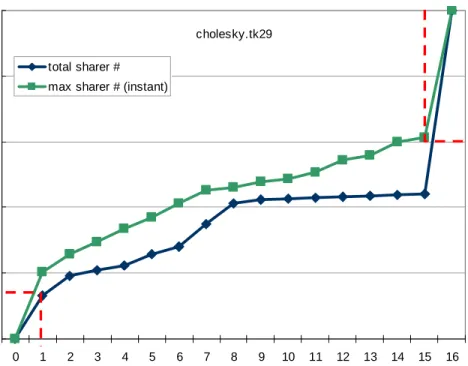
Multithreaded programs have much more complex access patterns. Since several threads are active at the same time, data can be requested from multiple sources simultaneously. It is not obvious immediately which is the optimal location for the data. However, it is observed that the data access behavior of a program is closely related to its intrinsic char-acteristics. For instance, an array is accessed by an index. In a sophisticated program, the index is usually computed from other variables, such as thread ID and loop iterators. Even though the values of these dependent variables can change, the way the index is calculated is determined by the algorithm itself. As a consequence, its access pattern persists. To gain basic understanding of the cache access behavior of multithreaded workloads, profile analysis is carried out. Some observations from the study are very motivating and worth mentioning. Figure 1 shows the data sharing behavior of cholesky from the SPLASH-2 benchmark suite [86]. Cholesky is a representative latency-oriented multithreaded programs. In the fig-ure, both curves represent the cumulative percentage of accesses to data pages that are shared by different number of threads. But the number of sharing threads is counted differently for these two curves. For the dark blue curve (diamond), the number of sharers for a page is counted over the entire program execution. For the light green curve (square), the number of sharers for a page is determined by the maximum number of simultaneous sharers at any instant during the program execution. As the figure shows, nearly 17% of the all accesses are shown to go to pages predominantly accessed by a single thread. At the top right of the plot, it shows around 40% of all accesses touch pages that are shared by all threads. This type of curve shape is common in SPLASH-2 programs, suggesting that many data pages are either private or highly shared. Indeed, this is intuitive as scientific workloads often involve partitioned data processing (private data) and global synchronization and data ex-change (highly shared data). For private data, it is desirable to place them in the requester’s
cholesky.tk29 0% 20% 40% 60% 80% 100% 0 1 2 3 4 5 6 7 8 9 10 11 12 13 14 15 16 total sharer #
max sharer # (instant)
C u m u la ti ve P e rce n ta g e o f T o ta l A cce sse s Number of Sharers
Figure 1: Data sharing behavior of cholesky at page granularity. The two curves capture the number of memory references to a page shared by a different number of threads. For the dark curve (“total sharer #”), the number of sharers is determined by counting the total number of threads accessing the page over the entire program run. For the light curve (“max sharer #”), the number of sharers is determined by recording the maximum number of simultaneous shares for that page at any instant during the program run.
local cache slice at the earliest to avoid remote accesses. On the other hand, it is benefi-cial to replicate highly shared data or fetch them from neighbors nearby. This observation uncovers an excellent data locality optimization opportunity by using the software-oriented shared cache management approach. In more detail, the compiler can employ a K-means clustering based algorithm to classify data access patterns for latency-oriented multithreaded workloads. The generated hints, which are independent of program inputs and cache con-figurations, are opportunistically used by the system to improve program performance. The experimental results show that the proposed scheme improves the evaluated multithreaded
scientific program performance by 10% over the shared cache scheme and achieves similar performance to the victim replication technique [111]. When data replication is enabled and guided by the hints, the proposed scheme brings additional 9% performance gain, performing 19% and 9% better than the shared cache and the private cache respectively.
The throughput-oriented multithreaded programs have very different nature in compar-ison to the latency-oriented multithreaded programs. Thus a new strategy has to be taken. However, it is difficult to extract access patterns of a throughput-oriented multithreaded program through off-line trace analysis. Due to the randomness of the incoming requests and the impact of thread scheduling by the OS, this type of program may even have no trackable patterns at all. We have not found any related work from the literature in this as-pect. In this study, we take an indirect approach to characterize the data access behavior of a program. Instead of analyzing accessed data directly, we examine the memory instructions which access those data. The profile study shows that the reuse property of a memory in-struction is quit persistent. That is, a data block accessed by a memory inin-struction exhibits frequent reuse during its residence in the cache, then other data blocks accessed by the same memory instruction tend to have similar reuse pattern. As a result, the reuse statistics of memory instructions from a profile analysis can be used to predict data reuse patterns. The data reuse information is a good hint for controlling data replication in NUCA caches. For example, if the data touched by a load instruction exhibit good temporal locality during a profile study, it is beneficial to always allow replication of the data touched by this instruc-tion based on our observainstruc-tion. Thus, this load instrucinstruc-tion itself becomes a hint for data replication. Here, there is no need to track data addresses as hints for online execution. In addition, this scheme is not limited to throughput-oriented programs. The idea is general and can be applied to other types of workloads as well. The evaluation results show that the proposed hint-guided data replication control scheme is effective in locating the optimal data replication level, achieving performance that is comparable to the best of other compared cache schemes.
1.4.2 Research Contributions
This thesis studies a software-oriented shared cache management approach, which is con-sidered as deviating from conventional hardware-based cache management schemes substan-tially. It opens up a new research direction for the last-level cache management. To the best of our knowledge, this is the first study for software-oriented NUCA cache manage-ment strategies. Moreover, the proposed software-oriented approach is orthogonal to other hardware-based schemes and can be used in combination.
Through the study of the proposed software-oriented schemes, this thesis makes the following contributions:
• A page-granularity data mapping mechanism is proposed. By transferring the data placement control to virtual memory management, the proposed mechanism offers a novel way to manage traditional shared caches through software.
• Based on the page placement mechanism, three different optimization strategies are proposed for single-threaded programs, latency-oriented multithreaded programs, and throughput-oriented multithreaded programs respectively. They are evaluated and com-pared to the shared cache scheme, the private cache scheme, and their variants. The experimental results show that the proposed schemes are effective for boosting the per-formance of the baseline shared cache schemes, achieving better perper-formance than other compared schemes.
• For single-threaded programs, static and dynamic 2D page coloring schemes are proposed. They improve a previous cache optimization scheme [82], which focuses on cache conflicts removal. To adapt to the CMP architecture, the proposed schemes try to balance both cache access latency and cache miss rate on a NUCA.
• For latency-oriented multithreaded programs, a novel cache access pattern recognition algorithm is proposed. By utilizing machine learning techniques, the recognized patterns are effective across different program inputs and cache configurations. The derived data affinity hints can guide data placement at run-time for improved data locality.
• For throughput-oriented multithreaded programs, a novel profile-guided data replication control scheme is proposed. Through off-line analysis, a set of memory instructions
that contribute to most of the data reuse are identified. This information is then used to guide online data replication. It is worth mentioning that there are only few profile-based studies for this type of workloads.
1.5 DISSERTATION ORGANIZATION
In the remaining chapters of this thesis, previous work and related background are first pre-sented in Chapter 2. In Chapter 3, the machine model on which the proposed schemes are based and the detailed experimental setup are provided. Then the static 2D page coloring technique and its dynamic counterpart are introduced in Chapter4, along with the evaluation results. Chapter 5first analyzes common memory access patterns found in latency-oriented multithreaded programs. Based on the analysis, a novel pattern recognition algorithm for generating data affinity hints is introduced. Then the evaluation results are given. Chapter6
analyzes the obstacles to perform profile-assisted optimizations for throughput-oriented pro-grams and common characteristics of these propro-grams. Then it introduces the profile-guided data replication control scheme, followed by evaluation results. Finally, the summary of this thesis work and the future research plan are described in Chapter 7.
2.0 BACKGROUND AND RELATED WORK
In this chapter, we review related background and previous work in detail. First, we delve into the basic shared cache scheme and the private cache scheme, as well as point out the pros and cons of both. Then, previously proposed hybrid cache management schemes that try to combine the advantages of the shared cache scheme and the private cache scheme are discussed. This thesis work also bears some similarity to the memory management schemes in Cache-Coherent Non-Uniform Memory Architecture (CC-NUMA) or Cache-Only Memory Architecture (COMA) machines [41]. The related literature is introduced at the end.
2.1 HARDWARE-BASED CACHE MANAGEMENT SCHEMES
Almost all cache schemes proposed in recent literature or adopted by products in industry are purely hardware-based schemes. In these schemes, the cache controller manages where and how a block of data should be placed using predetermined rules. At the time of a data access, the cache controller seeks data by following the same rules and supplies the data to the processor pipeline. Some of them may require auxiliary hardware components, but all hardware-based schemes introduced in the following sections essentially differ only in these rules about data placement and replacement.
2.1.1 Shared Cache Scheme
There are two baseline L2 cache management schemes in the current-generation of CMPs: the shared cache scheme and the private cache scheme [5, 6, 45, 40, 46, 56, 71, 84, 101].
The shared cache scheme is a natural evolution from the cache structure of uniprocessors. However, a monolithic shared cache structure is not suitable for CMPs. It is often split into banks or slices to reduce cache access latency. All banks or slices are connected together through wires or networks to form a logically unified cache space. The whole cache space is shared and accessible by all cores in a CMP. If a shared cache is composed of multiple cache slices, the common approach is to interleave consecutive memory blocks across available cache slices based on their block address [6,46, 56,71,84]. Spreading data in this way helps balance cache accesses among all slices, mitigating hot-spots and contention. By aggregating all cache slices, the shared cache scheme can utilize the cache capacity effectively. As a result, it leads to a low cache miss rate, which is often the most important feature when designing a cache for a uniprocessor. However, the biggest disadvantage of the shared cache scheme for a CMP is that accesses to remote cache banks or slices may incur considerable delay on the wires or interconnection network. In certain situations, data are blindly distributed to remote slices even though the nearby cache slices are underutilized. This causes an unnecessary latency penalty and negatively impacts the cache performance.
2.1.2 Private Cache Scheme
The private cache scheme adopts a different philosophy as compared to the shared cache scheme. It divides the whole cache space into private cache partitions (slices), each of which is owned by one core in a CMP [5, 40, 101]. A core has exclusive access to its own private cache slice. The cache is often arranged in a way such that a core has the shortest distance to its corresponding cache slice. On a cache access, only the local cache slice is searched. A cache miss in the local slice results in a memory request. The cache coherence mechanism then determines if the requested data should be fed from the off-chip main memory or a neighboring cache slice. A returned data block is always replicated in the local cache slice in the hope that the next access to the same data block can be resolved locally. If this is the case, a slow remote cache access in the shared cache scheme is turned into a faster local access in the private cache scheme. The latency saving can lead to better cache performance than the shared cache scheme if a cache request sequence exhibits sufficient reuse patterns.
Given the diversity of workloads characteristics, however, this does not always happen. Since the whole cache capacity is split into N partitions for a N-core CMP, the effective capacity seen by each core in the private cache scheme is much smaller than the shared cache scheme. As a result, the cache miss rate becomes more sensitive to the program working set size. So the private cache scheme often causes higher cache miss rate than the shared cache scheme. When the cache miss rate increases, the benefit of local cache accesses starts to shrink and is finally offset by cache miss penalties (the more expensive off-chip main memory accesses). For this reason, the private cache scheme is not the best design for all workloads.
2.1.3 Hybrid Cache Schemes
It is apparent that neither the shared cache scheme nor the private cache scheme can perform consistently better than the other for all workloads [72,43,111,27]. For example, streaming programs with little temporal locality or programs with their working sets entirely fit into a cache slice can perform better with the private cache scheme, while programs with large working sets or a high degree of read-write data sharing may perform better with the shared cache scheme. Researchers have thus examined many possible solutions. The basic principle of those proposals is to combine the advantages of both the shared cache scheme and the private cache scheme, while avoiding their shortcomings. This goal is achieved by balancing between latency (by improving data locality) and cache miss rate (by utilizing cache capacity more efficiently).
Speightet al.[85] presented an eight-core CMP architecture design where each two cores form a cluster and share a private L2 cache. Within an L2 cache cluster, four cache banks are shared, providing fast access to shared data among the two cores. But each L2 cache cluster is a private cache from the viewpoint of the CMP chip. So coherence should be maintained among the four clusters. When a cache line is evicted from an L2 cache cluster, hints are consulted to decide if the victim should be written to the off-chip main memory or kept in a peer L2 cache cluster. If the victim is kept in a peer L2 cache cluster, an L2-to-L2 transfer is much faster than an off-chip main memory access when it is reused. Hints are constructed dynamically in tables within each L2 cache cluster during a program execution.
The performance of this scheme depends on the design-time parameters such as the cache size and the number of cores in a cluster. Grouping threads with sharing data into a cache cluster would provide much benefit. However it may be hard to predict the performance of an application developed without any knowledge of the parameters unless the OS makes informed process scheduling decisions.
Similarly, Huh et al.[44] proposed an L2 cache organization with a configurable sharing degree. To be more specific, it clusters L2 cache banks based on a configuration set by the OS. Cores assigned to an L2 cache bank cluster have exclusive access to it. By varying the degree of clustering, this scheme essentially trades off between purely shared cache scheme and purely private cache scheme. They also studied a static cache mapping policy and a dynamic cache mapping policy. The dynamic cache mapping policy allows a cache block to go to multiple candidate banks. With proper placement of a cache block, its access latency can be improved. Furthermore, with the dynamic mapping policy, a generational promotion algorithm can be used to guide cache block migration, which can further improve the access latency depending on the cache block usage. The more cache banks it allows to go to, the more aggressive the optimization becomes. However, an L1 cache miss can trigger a search in multiple cache banks in parallel. Even though partial tags are added to help reduce the pressure of full tags, this can still consume substantial cache bandwidth. Thus the search cost largely determines the freedom of the dynamic mapping policy. This scheme is not considered to be scalable for large-scale CMPs.
Zhang and Asanovi´c [111] proposed the victim replication scheme based on a shared L2 cache organization. In the proposed scheme, each L2 cache slice can replicate a data block from a remote cache slice when it is replaced from the L1 cache. The replication saves accesses to remote L2 cache slices or directories when the replicated data blocks get reused in the future. This scheme can boost shared cache performance significantly when the program’s working set fits well into its local L2 cache slice, bringing the performance close to that of the private cache scheme. Essentially, the local L2 cache slice provides a large victim cache space for the cache blocks whose home are remote so that data locality can be improved. However, a coherence request or an L1 cache miss calls for more actions than before, because locating a cache block is no more deterministic. Both L1 and L2 caches (in parallel or in
sequence) should be checked upon an invalidation request because it is not readily known if a remote cache block has been replicated in the local L2 cache slice. The local cache slice must be always searched on an L1 cache miss regardless of the missed address. As a result, cache pressure is increased substantially. Further, the replicated victims can kick out unowned cache lines in the L2 cache. This unwanted consequence can increase the number of cache misses considerably, incurring expensive off-chip main memory accesses. Under certain circumstance, victim replication becomes too aggressive and degrades program performance. Beckmann et al.[14] proposed a controlled victim replication scheme calledASR, which tries to reduce cache pollution caused by excessive replication in the original victim repli-cation scheme. ASR employs a technique called selective probabilistic replication to achieve controlled replication of frequently reused data. To measure the best replication level, their design introduces a set of tables along with each core to keep track of the performance gain and loss with regard to increasing or decreasing replication level. By adjusting the repli-cation level adaptively during a program execution, their scheme is shown to achieve the near-optimal balance between the miss rate and access latency. However, these tables take considerable effort to maintain. The control logic can also be very complex. These hardware structures can consume a lot of chip area. If such a complex scheme is suitable for a practical design is unclear. Furthermore, the selective probabilistic replication technique relies on a ring network to merge a victim with a copy in a remote cache slice. This limits it from scaling up to a large number of cores.
Chishtiet al.[26] proposed a cache scheme calledCMP-NuRAPIDhaving a hybrid of pri-vate per-core tag arrays with forward pointers and a shared data array with reverse pointers. By utilizing those pointers, cache blocks can virtually reside in any L2 cache slices. Based on this hardware mechanism, they studied a series of optimizations, such as controlled repli-cation, in-situ communirepli-cation, and capacity stealing. The controlled replication duplicates reused data blocks in L2 slices nearby to avoid remote cache accesses. The in-situ commu-nication optimizes the access latency of read-write shared data by placing data blocks closer to readers and updating the data blocks on every write actively. This allows direct data block reads without incurring coherence misses. The capacity stealing technique allows a core with large capacity demand to demote its less-frequently-used data to neighboring L2
slices. By using this technique, a core can attract as many data blocks as necessary to im-prove data affinity without suffering from the limited cache capacity as in the private cache scheme. However, the flexibility of data movement among L2 cache slices does not come as free. First, CMP-NuRAPID doubles the size of the tag array, incurring storage overhead. Second, the modification to the coherence protocol increases the complexity of the control logic substantially. Lastly, the use of bus and broadcast policy for making private tag arrays consistent limits its capability to be adopted in large-scale CMPs.
Chang and Sohi [23] proposed a cooperative caching framework based on the private cache scheme via cooperative actions among cache slices. They studied optimizations such as cache-to-cache transfer of clean data, replication-aware data replacement, and global replacement of inactive data. The cache-to-cache transfer of clean data is a natural extension to the traditional cache coherence design in a multiprocessor system as the network latency becomes much lower in CMPs. The replication-aware data replacement overrides the LRU policy and gives the eviction priority to replicas in a private cache. This technique intends to overcome the problem of excessive replications in the private cache scheme. The global replacement of inactive data breaks the rigorous partitioning of a private cache space by allowing local L2 cache victims to replace inactive cache blocks in peer L2 cache slices. However, all those cooperations among multiple private L2 cache slices are implemented assuming there is a facilitating data structure called Central Coherence Engine (CCE). The CCE maintains information regarding replication status of all cache blocks. It has to consult the CCE on every optimization decision and status update. As admitted in the paper, this centralized structure becomes performance bottleneck when the number of cores is beyond 8.
Michael and Mark [65] proposed a two-level cache coherence based on the conventional shared cache scheme for CMPs. In their scheme, each program is assigned a home node table, which maps lower bits of a data block address to a target home node. By carefully designing the mapping, all accessed cache blocks of a program can be grouped in cache slices nearby where the program runs. The first-level cache coherence is responsible for maintaining consistency among these L1 caches and the corresponding home nodes. By grouping related threads together and binding home nodes tightly, the average access latency to these home
nodes through the first-level cache coherence becomes lower than the shared cache scheme, which distributes data to all available cache slices blindly. On an L1 cache miss, a lookup is performed in the home node. A miss in the first-level cache coherence can involve extra directory access in the second-level cache coherence. If the data is not found in the home node, a request is sent to the directory like the conventional cache coherence. The directory then either broadcasts or directly notifies the owner to forward the data. This scheme essentially clusters data closely to the threads of a program by using a flexible mapping mechanism. The focus of this paper is to optimize the cache performance of large-scale CMPs for multiple co-scheduled server programs. No effort is made to improve data locality within a cluster. As a result, it only benefits when the number of threads is smaller than the number of available cores within a CMP.
Dybdahl and Stenstrom [33] proposed a hybrid scheme which divides each core’s local cache slice into shared and private partitions, assisted by a modified replacement policy. The shared partitions from all cores form a unified shared space. The Sharing Engine estimates the best partition size for private partitions based on the augmented per-set shadow tags and the LRU information. An accessed data block is first allocated in the local private partition, which is always accessed first on a data request. An eviction from a private partition replaces a cache block in the shared partition. The candidate for replacement is determined based on the partition estimation and the LRU information. A miss in the private partition leads to parallel search on the local and neighboring shared partitions. Their scheme provides the benefit of fast access of the private cache scheme while loosens the cache capacity constraint to include neighboring cache slices. The evaluation results show that this smart partitioning scheme performs better than both the private cache scheme and the shared cache scheme as expected. It also outperforms the cooperative caching scheme proposed by Chang and Sohi [23]. However, the centralized Sharing Engine for estimating cache partition size, controlling shared partitions, and enforcing the modified replacement policy is not scalable. As a result, the proposed scheme suffers the same limitations of the other related hardware-based schemes.
2.2 PAGE-BASED CACHE MANAGEMENT
The page coloring technique was first proposed by Kessler and Hill [52] to reduce cache con-flict misses. They derived a simple model that shows a naive page placement policy can lead to up to 30% more unnecessary cache conflicts. Based on this observation, they developed several page placement algorithms that reduce cache misses by 10-20%. The proposed page coloring policies are relatively simple. They color pages based on static heuristic rules. So it still leaves a lot of space for further improvement. Romeret al.[87] studied several dynamic page mapping policies for reduced cache conflicts. They proposed two types of mapping policies. The active policies closely monitor the TLB contents and proactively remap a page that has potential to cause conflicts to a different color. The other group, called periodic policy, is more passive and only periodically checks the TLB for selecting any pages that violate the rules as recoloring candidates. Similarly, Bershad et al. [15] used cache miss lookaside buffer to detect cache conflicts by recording and summarizing a history of cache misses. Based on these hints, the OS virtual memory management module plays the role for remapping a page that suffers from a large number of conflict misses.
Alternatively, Bugnion et al. [20] proposed a compiler-directed page coloring technique. Their technique utilizes the compiler’s knowledge of the access patterns of a parallelized application to reorder and group the pages that are accessed by the same processor together. Then these pages are colored cyclically to avoid conflicts based on the principle that pages accessed by the same processor should be spread to different colors as even as possible. Also arrays accessed by the same processor should be assigned with different starting addresses. The derived coloring plan guides memory page mapping in the OS at run time.
Sherwood et al.[82] proposed a profile-based method to guide page coloring for reduced conflict misses. Their static approach uses a heuristic algorithm to analyze an L2 cache access trace and estimates the number of potential conflicts between any pair of pages. Given the inter-page conflict statistics, an optimal page placement is arranged to achieve minimum number of conflict misses prior to a program execution. The derived hints then guide page placement at run time for the same program and input set. They also propose a dynamic scheme, which tries to recognize the pages that are responsible for the high conflict misses
in a cache bin and migrate them to a different one. The evaluation results show that the dynamic scheme is very effective in reducing the number of expensive main memory accesses for a unified L2 cache. However, these early works all target for the cache architecture of uniprocessors. The problem caused by non-uniform cache access latency in CMPs is not considered.
There are several other works inspired by the page coloring based cache management framework. Instead of using a simulation-based evaluation approach, Linet al. [63] modified memory management module in the OS to support different page coloring policies. Then they evaluated in a real machine several previously proposed cache partitioning policies, which target for different goals, such as performance, fairness, and quality of service (QoS). Through the study, they confirmed several important conclusions from the prior work and obtained new insights that are unlikely to get from a simulation. However, only single-threaded programs and multiprogrammed workloads are studied in this work. Multisingle-threaded scientific programs and server programs can exhibit distinct cache behavior and require a different cache policy. Besides that, the cache partitioning scheme only improves the cache miss rate by isolating the impact from other co-running programs, it does not improve the data affinity for the non-uniform latency cache at all.
Chaudhuri [24] proposed a hardware-based page migration scheme. His proposal is mo-tivated by the observation that a majority of pages are only accessed by a single core during consecutive sampling periods. These “solo pages” often exhibit good locality. If a page is accessed by a core within a sampling period, it is very likely that most of the accesses to that page would come from the same core in that epoch. His scheme adopted a simple threshold-triggered page migration policy. The migration destination is determined based on the principle of minimizing the average access latency for all sharing cores. The evaluation results show significant improvement over the conventional shared cache scheme. However, the tracking of a page usage and its location by hardware poses a big challenge. The solu-tion given in this work employs a set-associative page access counter table to measure the usage. It also uses a mapping table in both L1 cache and L2 cache to track the page move-ment. Even though the author claims that the storage overhead of these tables is only 4.8%, the logic required to maintain these tables becomes intractable, let alone the complexity of
the migration protocol. Furthermore, it requires special care to maintain table consistency and to avoid deadlock. The complexity also makes the job of logic design and verification overwhelming.
Awasthi et al. [9] proposed a more practical page migration scheme. By modifying the TLB and utilizing unused bits in the original page address, it allows a main memory ac-cess with the original physical address and an L2 cache acac-cess with a manipulated address. Decoupling the cache access address and the main memory access address makes page migra-tion scheme very flexible. The scheme enables the OS to manage cache capacity allocamigra-tion to all cores within a CMP by dynamically migrating pages at the end of each epoch. The goal of capacity allocation is to minimize the cache miss rate. They also studied a policy to control the migration of shared pages. Based on the usage, a page is migrated to a location where the total access latency of all sharers is minimized. Their evaluation results show 10% to 20% performance improvement compared to the shared cache scheme. However, it is not very clear from the paper how the page migration process is done and how the cache coherence is maintained during the migration. Another concern is that the page migration scheme can suffer the “ping-pong” problem as discovered in the previous data block migra-tion schemes. Many evenly shared pages may end up residing in these central cache banks, creating hot-spots.
Finally, Hardavellaset al.[39] analyzed L2 access traces of scientific and server workloads. They observed that the L2 cache accesses can form three categories: (1) Highly shared read-only instruction accesses; (2) Mostly read-write shared data accesses; and (3) Private data accesses. They introduced a new address interleaving mechanism so that data can be clustered around the accessor in a controlled manner while still retaining quick lookup within the cluster. Besides, they proposed to optimize access categories differently at page granularity. First, instruction pages are replicated and spreaded nearby the requesting core. Then data pages are initially classified as private and loaded into a local L2 cache slice. If a data page is detected as actively shared, the corresponding TLB and related cache contents are invalidated. The page is then distributed cross all cache slices using the traditional address interleaving method. By differentiating read-write shared data from private data and read-only shared data, it enables data replication without incurring cache coherence
problem. As a result, their scheme avoids the hardware complexity introduced by previously proposed data replication and migration mechanisms. However, one obvious shortcoming of this scheme is that the classification conversion cannot be reversed. Once a page is deemed as shared, it is distributed like the conventional shared cache scheme until the end of the program execution. For long-run programs, especially server workloads, this undesirable feature can gradually degrade their scheme to the traditional shared cache scheme.
2.3 SCHEMES FOR NON-UNIFORM MEMORY ARCHITECTURE
The problem of tackling non-uniformity of the L2 cache access latencies (i.e., NUCA) bears similarity to the problem of attacking disparate memory access latencies of the distributed shared memory in a SMP, such as the Non-Uniform Memory Architecture (NUMA) or the Cache-Only Memory Architecture (COMA) machines [41]. Because the ratio between local memory accesses and remote memory accesses largely determines program performance in such a machine, it is of utmost importance to improve the data affinity at the level of distributed main memory by carefully placing, migrating, and replicating pages [42, 17, 28,
59, 22, 106, 94, 108]. Indeed, NUMA is similar to the shared cache scheme while COMA behaves like the private cache scheme. Previous studies of these schemes provide valuable insights.
Holliday [42] studied the paged main memory management in a local/remote architecture for shared memory multiprocessors. He addressed issues regarding the architectural support for recording page reference history, the impact of a page size, and the operating system support for page migration.
Bolosky et al. [17] proposed a very simple page placement policy, which initially places a page in the local memory and migrates it to other processor’s local memory as requested. A page is put into global memory after the page movement passes a threshold. They defined three statuses for a page: read-only, local-writable, and global writable. The policy decision combined with a page status decide the action to perform for a memory request. They found the simple page placement policy performs well and achieves near optimal performance.
Vergheseet al.[106] classified all memory pages to three categories, which are very similar to the Hardavellas’ classification [39]. Based on these page categories, they devised a decision tree to control page migration and replication in the operating system through monitoring some event counters. The evaluation results show that it achieves up to 30% improvement over the ordinary NUMA scheme. Wilson and Aglietti [108] extended Verghese’s work and further studied a dynamic page placement policy for a TPC-C workload.
Soundararajan et al. [94] studied the data locality property and performance of the baseline NUMA scheme, the NUMA with remote access cache (RAC), the COMA, and the NUMA with page migration and replication. Through experiments, they found RAC can effectively capture short-term temporal locality of fine-grain data. Also the page migration controlled by the OS can adapt to program memory usage (long-term data sharing at page-granularity) and move a page’s home to the local memory. As a result, they proposed to combine these two techniques so that they can work in a synergistic way. The evaluation shows that the new scheme performs well and is robust.
Chandra et al. [22] studied the OS process scheduling policy for improving data locality of a CC-NUMA machine. To increase the affinity of data that already reside in memory, the modified OS scheduling manager tries to resume the execution of a sleeping process on a processor or a processor cluster where it has been running before switched out. On the other hand, they also employed a page migration policy, which uses a TLB miss as the signal. This scheme is simple and effective.
Marathe and Mueller [64] proposed a hardware profile-guided page placement scheme for reducing memory contention. In their work, a truncated version of code is profiled each time before a program is about to execute. The sampled memory access trace is then used to determine the optimal placement for each touched page. Then the derived affinity hints are used to direct page placement in the full program execution. This method is effective in improving data locality but has several limitations. First, it requires to profile the memory access trace every time before a program’s execution. The quality of the truncated code is crucial to the derived affinity hints. Generating representative code for the whole program is difficult. Furthermore, they assume that a dynamic memory allocation returns the same address for both the profile execution and the full program run. This is not always true and