Lattice-based Cryptography
Oded Regev?Tel Aviv University, Israel
Abstract. We describe some of the recent progress on lattice-based cryptography, starting from the seminal work of Ajtai, and ending with some recent constructions of very efficient cryptographic schemes.
1
Introduction
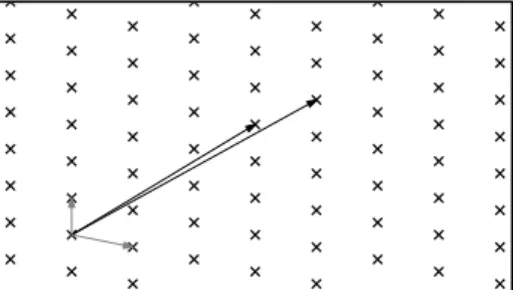
In this survey, we describe some of the recent progress on lattice-based cryp-tography. What is a lattice? It is a set of points in n-dimensional space with a periodic structure, such as the one illustrated in Figure 1. More formally, given n-linearly independent vectorsv1, . . . , vn∈Rn, the lattice generated by them is
the set of vectors
L(v1, . . . , vn) := ( n X i=1 αivi αi∈Z ) . The vectorsv1, . . . , vn are known as abasis of the lattice.
Fig. 1.A lattice inR2
and two of its bases
Historically, lattices were investigated since the late 18th century by mathe-maticians such as Lagrange, Gauss, and later Minkowski. More recently, lattices have become an active topic of research in computer science. They are used as an algorithmic tool to solve a wide variety of problems (e.g., [1–3]); they have
?Supported by an Alon Fellowship, by the Binational Science Foundation, by the
II
found many applications in cryptanalysis (e.g., [4, 5]); and they have some unique properties from a computational complexity point of view (e.g., [6–8]). In this survey we will focus on their positive applications in cryptography, i.e., on the construction of cryptographic primitives whose security relies on the hardness of certain lattice problems.
Our starting point is Ajtai’s seminal result from 1996 [9]. His surprising discovery was that lattices, which up to that point were used only as tools in cryptanalysis, can actually be used to construct cryptographic primitives. His work sparked a great interest in understanding the complexity of lattice problems and their relation to cryptography.
Ajtai’s discovery was surprising for another reason: the security of his crypto-graphic primitive is based on theworst-case hardnessof lattice problems. What this means is that if one succeeds in breaking the primitive, even with some small probability, then one can also solveanyinstance of a certain lattice problem. This remarkable property is what makes lattice-based cryptographic constructions so attractive. In contrast, virtually all other cryptographic constructions are based on someaverage-case assumption. For example, in cryptographic constructions based on factoring, the assumption is that it is hard to factor numbers chosen from a certain distribution. But how should we choose this distribution? Obvi-ously, we should not use numbers with small factors (such as even numbers), but perhaps there are other numbers that we should avoid? In cryptographic constructions based on worst-case hardness, such questions do not even arise.
There are several other reasons for our interest in lattice-based cryptogra-phy. One is that the computations involved are very simple and often require only modular addition. This can be advantageous in certain practical scenarios when encryption is performed by a low-cost device. Another reason is that we currently do not have too many alternatives to traditional number-theoretic-based cryptography such as RSA. Such alternatives will be needed in case an efficient algorithm for factoring integers is ever found. In fact, efficientquantum algorithms for factoring integers and computing discrete logarithms already ex-ist [10]. Although large-scale quantum computers are not expected to exex-ist for at least a decade, this fact should already be regarded as a warning. There are currently no known quantum algorithms for lattice problems.
Our choice of topics for this survey is clearly biased by the author’s personal taste and familiarity. One notable topic that we will not discuss here are crypto-graphic constructions following the design of Goldreich, Goldwasser, and Halevi [11]. In particular, this includes the highly efficient constructions developed by the company NTRU [12, 13].
For other surveys on the topic, see, e.g., [14, 15] and also the lecture notes [16, 17]. Another useful resource is the book by Micciancio and Goldwasser [18], which also contains a wealth of information on the computational complexity aspects of lattice problems.
The rest of this survey is organized as follows. In Section 2 we define the shortest vector problem and state some known results. In Section 3 we describe the known constructions of hash functions, starting from Ajtai’s work [9]. Then,
III in Section 4 we describe the known constructions of public key cryptosystems. The only technical part of this survey is Section 5, where we outline the construc-tion of a lattice-based collision resistant hash funcconstruc-tion together with its security proof. We end with some open questions in Section 6.
2
Lattice Problems
The main computational problem associated with lattices is the shortest vector problem (SVP). In SVP, given a lattice basis, we are supposed to output a shortest nonzero vector in the lattice. In fact, we will be mostly interested in the approximation variant of this problem, where our goal is to output a nonzero lattice vector whose norm is greater than that of the shortest nonzero lattice vector by at most some approximation factor γ. There are other interesting lattice problems (such asSIVP), and roughly speaking, the goal in most of them is to find short vectors under some appropriate definition of ‘short’. We will encounter one such problem in Section 5. The behavior of these problems is often very similar to that of SVP, so for simplicity we do not discuss them in detail here (see [18] for more details).
Part of the difficulty ofSVPcomes from the fact that a lattice has many dif-ferent bases and that typically, the given lattice basis contains very long vectors, much longer than the shortest nonzero vector. In fact, the well-known polynomial time algorithm of Lenstra, Lenstra, and Lov´asz (LLL) [1] from 1982 achieves an approximation factor of 2O(n)wherenis the dimension of the lattice. As bad as
this might seem, this algorithm is surprisingly useful, with applications ranging from factoring polynomials over the rational numbers, integer programming, and many applications in cryptanalysis (such as attacks on knapsack based crypto-graphic systems and special cases of RSA). In 1987, Schnorr presented an im-proved algorithm obtaining an approximation factor that is slightly subexponen-tial, namely 2O(n(log logn)2/logn). This was recently improved to 2O(nlog logn/logn) [19]. We should also mention that if one insists on an exact solution toSVP(or even just an approximation to within poly(n) factors), the best algorithm has a running time of 2O(n)[19].
Given the above results, one might expectSVPto beNP-hard to approximate to within very large factors. However, the best known result only shows that approximatingSVP to within factors 2(logn)12−ε
isNP-hard (under randomized quasi-polynomial time reductions) [8]. Moreover,SVPis not believed to beNP -hard to approximate to within factors above pn/logn [20, 6, 7], since for such approximation factors it lies in classes such asNP∩coNP.
On the practical side, it is difficult to say what is the dimensionn beyond which solvingSVPbecomes infeasible with today’s computing power. A reason-able guess would be that taking n to be several hundreds makes the problem extremely difficult.
To conclude, the problem of approximatingSVPto within polynomial factors ncforc≥ 1
2 seems to be very difficult (best algorithm runs in exponential time),
IV
3
Hash Functions
As mentioned above, the first lattice-based cryptographic construction with worst-case security guarantees was presented in the seminal work of Ajtai [9]. More precisely, Ajtai presented a family of one-way functions whose security is based on the worst-case hardness ofnc-approximateSVPfor some constantc >0. In other words, he showed that being able to invert a function chosen from this family with non-negligible probability implies the ability to solveany instance ofnc-approximateSVP. Shortly after, Goldreich et al. [21] improved on Ajtai’s result by constructing a stronger cryptographic primitive known as a family of collision resistant hash functions. Much of the subsequent work concentrated on decreasing the constantc (thereby improving the security assumption) [22–24]. In the most recent work, the constant is essentiallyc= 1 [24]. The hash function in all these constructions is essentially the modular subset sum function. We will see an example of such a construction in Section 5 below.
We remark that all these constructions are based on the worst-case hardness of a problem not believed to be NP-hard. Although it seems unlikely, it is not entirely impossible that further improvements in these constructions would lead us to approximation factors of the form nc for c strictly below 1
2. That would
mean that we managed to base the security on the worst-case hardness of a problem that might beNP-hard.
The constructions described above are not too efficient. For instance, ˜O(n2)
bits are necessary in order to specify a function in the family, where n is the dimension of the lattice underlying the security and the ˜Ohides poly-logarithmic factors (in other words, the key size is ˜O(n2) bits). So if, for instance, we choose
nto be several hundreds, we might need roughly a megabyte just to specify the hash function. Recently, an improved construction was presented by Micciancio [25]. He gives a family of one-way functions where only ˜O(n) bits are needed to specify a function in the family. Its security is based on the worst-case hardness of lattice problems on a restricted set of lattices known as cyclic lattices. Since no better algorithms are known for this family, it is reasonable to assume that solving lattice problems on these lattices is as hard as the general case. Finally, in more recent work [26, 27], the hash function of [25] was modified, preserving the efficiency and achieving the stronger security property of collision resistance.
4
Public-key Cryptography
Following Ajtai’s discovery of lattice-based hash functions, Ajtai and Dwork [28] constructed apublic-key cryptosystemwhose security is based on the worst-case hardness of a lattice problem. Several improvements were given in subsequent works [29, 30]. Unlike the case of hash functions, the security of these cryp-tosystems is based on the worst-case hardness of a special case of SVP known as unique-SVP. Here, we are given a lattice whose shortest nonzero vector is shorter by some factorγthan all other nonparallel lattice vectors, and our goal is to find a shortest nonzero lattice vector. The hardness of this problem is not
V understood as well as that of SVP, and it is a very interesting open question whether one can base public-key cryptosystems on the (worst-case) hardness of SVP.
As is often the case in lattice-based cryptography, the cryptosystems them-selves have a remarkably simple description (most of the work is in establishing their security). For example, let us describe the cryptosystem from [30]. LetN be some large integer. The private key is simply an integer hchosen randomly in the range [√N,2√N). The public key consists of m = O(logN) numbers a1, . . . , amin {0,1, . . . , N−1}that are ‘close’ to integer multiples ofN/h
(no-tice that hdoesn’t necessarily divideN). We also include in the public key an index i0 ∈ [m] such that ai0 is close to an odd multiple of N/h. We encrypt one bit at a time. An encryption of the bit 0 is the sum of a random subset of {a1, . . . , am} reduced modulo N. An encryption of the bit 1 is done in the
same way except we add bai0/2cto the result before reducing modulo N. On receiving an encrypted wordw, we consider its remainder on division byN/h. If it is small, we decrypt 0 and otherwise we decrypt 1. To establish the correctness of the decryption procedure, notice that sincea1, . . . , amare all close to integer
multiples ofN/h, any sum of a subset of them is also close to a multiple ofN/h and hence encryptions of 0 are decrypted correctly. Similarly, sincebai0/2cis far from a multiple ofN/h, encryptions of 1 are also far from multiples ofN/hand hence we again decrypt correctly. The proof of security is more difficult and we omit it here (but see Section 5 for a related proof).
The aforementioned lattice-based cryptosystems are unfortunately quite in-efficient. It turns out that when we base the security on lattices of dimension n, the size of the public key is ˜O(n4) and each encrypted bit gets blown up to
˜
O(n2) bits. So if, for instance, we choosento be several hundreds, the public key
size is on the order of several gigabytes, which clearly makes the cryptosystem impractical.
Two recent works by Ajtai [31] and by the author [32] have tried to remedy this. Both works present cryptosystems whose public key scales like ˜O(n2) (or even ˜O(n) if one can set up a pre-agreed random string of length ˜O(n2)) and each encrypted bit gets blown up to ˜O(n) bits. Combined with a very simple encryption process (involving only modular additions), this makes these two cryptosystems a good competitor for certain applications.
However, the security of these two cryptosystems is not as strong as that of other lattice-based cryptosystems. The security of Ajtai’s cryptosystem [31] is based on a problem by Dirichlet, which is not directly related to any standard lattice problem. Moreover, his system has no worst-case hardness as the ones previously mentioned. However, his system, as well as many details in its proof of security, have the flavor of a lattice-based cryptosystem, and it might be that one day its security will be established based on the worst-case hardness of lattice problems.
The second cryptosystem [32] is based on the worst-casequantumhardness of theSVP. What this means is that breaking the cryptosystem implies an efficient quantum algorithm for approximatingSVP. This security guarantee is
incompa-VI
rable to the one by Ajtai and Dwork: On one hand, it is stronger as it is based on the generalSVPand not the special case of unique-SVP. On the other hand, it is weaker as it only implies a quantumalgorithm for a lattice problem. Since no quantum algorithm is known to outperform classical algorithms for lattice problems, it is not unreasonable to conjecture that lattice problems are hard even quantumly. Moreover, it is possible that a more clever proof of security could establish the same worst-case hardness under a classical assumption. Fi-nally, let us emphasize that the cryptosystem itself is entirely classical, and is in fact somewhat similar to the one of [30] described above.
5
An Outline of a Construction
In this section, we outline a construction of a lattice-based family of collision re-sistant hash functions. We will follow a simplified description of the construction in [24], without worrying too much about the exact security guarantee achieved.1
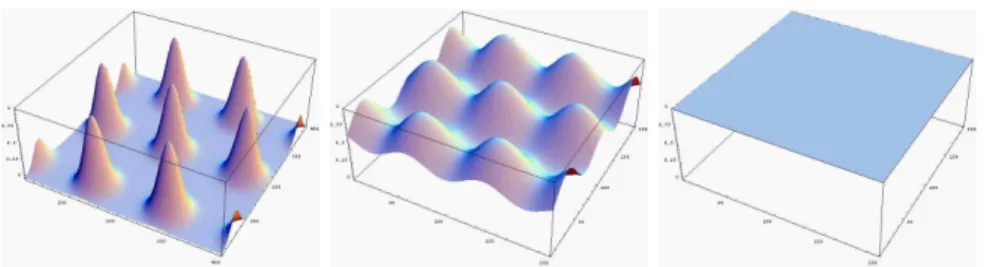
At the heart of the proof is the realization that by adding a sufficient amount of Gaussian noise to a lattice, one arrives at a distribution that is extremely close to uniform. An example of this effect is shown in Figure 2. This technique first appeared in [30], and is based on the work of Banaszczyk [33]. Let us denote by η = η(L) the least amount of Gaussian noise required in order to obtain a distribution whose statistical distance to uniform is negligible (where by ‘amount’ we mean the standard deviation in each coordinate). This lattice parameter was analyzed in [24] where it was shown that it is ‘relatively short’ in the sense that finding nonzero lattice vectors of length at most poly(n)η is a ‘hard’ lattice problem as it automatically implies a solution to other, more standard, lattice problems such as an approximation toSVPto within polynomial factors.2
Before going on, we need to explain what exactly we mean by ‘adding Gaus-sian noise to a lattice’. One way to rigorously define this is to consider the uniform distribution on all lattice points inside some large cube and then add Gaussian noise to this distribution. While this approach works just fine, it leads to some unnecessary technical complications due to the need to deal with the edges of the cube. Instead, we choose to take a mathematically cleaner approach (although it might be confusing at first): we work with the quotientRn/L. More explicitly, we define a functionh: Rn →[0,1)n as follows. Given any x∈Rn, write it as a linear combination of the lattice basis vectorsx=Pni=1βivi, and defineh(x) = (β1, . . . , βn) mod 1. So for instance, all points inLare mapped to
(0, . . . ,0). Then the statement about the Gaussian noise above can be formally
1
A more careful analysis of the construction described below shows that its security can be based on the worst-case hardness of ˜O(n1.5
)-approximateSIVP, which implies a security based on ˜O(n2.5
)-approximate SVP using standard reductions. In order to obtain the best known factor of ˜O(n), one needs to use an iterative procedure.
2
To be precise, we need slightly more than just finding vectors of length at most poly(n)η; we need to be able to findn linearly independent vectors of this length. As it turns out, by repeatedly calling the procedure described below, one can obtain such vectors.
VII
Fig. 2.A lattice with different amounts of Gaussian noise
stated as follows: if we sample a pointxfrom a Gaussian distribution inRn cen-tered around 0 of standard deviationη in each coordinate, then the statistical distance between the distribution ofh(x) and the uniform distribution on [0,1)n is negligible.
We now turn to the construction. Our family of hash functions is the modular subset-sum function overZnq, as defined next. Fix q = 22n and m = 4n2. For each a1, . . . , am ∈ Znq, the family contains the function fa1,...,am : {0,1}
m → {0,1}nlogq given by fa1,...,am(b1, . . . , bm) = m X i=1 biai modq.
Notice that with our choice of parameters,m > nlogqso collisions are guaran-teed to exist. Clearly, these functions are easy to compute. Our goal is there-fore to show that they are collision resistant. We establish this by proving that if there exists a polynomial-time algorithm CollisionFind that given
a1, . . . , amchosen uniformly fromZnq, finds with some non-negligible probability b1, . . . , bm ∈ {−1,0,1}, not all zero, such that Pmi=1biai = (0, . . . ,0) (mod q),
then there is a polynomial-time algorithm that finds vectors of length at most poly(n)η in any given lattice L(which, as mentioned before, implies a solution to approximateSVP).
Our first observation is that fromCollisionFind we can easily construct
another algorithm, call it CollisionFind0, that performs the following task:
given elementsa1, . . . , amchosen uniformly from [0,1)n, it finds with some
non-negligible probabilityb1, . . . , bm∈ {−1,0,1}, not all zero, such thatPmi=1biai∈
[−mq, m
q]n(mod 1). In other words, it finds a{−1,0,1}combination ofa1, . . . , am that is extremely close to (0, . . . ,0) modulo 1. To see this, observe that Colli-sionFind0 can simply applyCollisionFindtobqa1c, . . . ,bqamc.
Our goal now is to show that usingCollisionFind0 we can find vectors of
length at most poly(n)ηin any given latticeL. So letLbe some lattice given by its basis v1, . . . , vn. Our first step is to apply the LLL algorithm tov1, . . . , vn.
This makes sure that v1, . . . , vn are not ‘unreasonably’ long: namely, none of
these vectors is longer than 2nη.
We now arrive at the main part of the procedure. We first choosemvectors x1, . . . , xmindependently from the Gaussian distribution inRncentered around
VIII
0 of standard deviationη in each coordinate. (To be precise, we don’t know η, but we can obtain a good enough estimate by trying a polynomial number of values.) Next, we computeai=h(xi) fori= 1, . . . , m. By the discussion above, we know that each ai is distributed essentially uniformly on [0,1)n. We can therefore apply CollisionFind0 to a
1, . . . , am and obtain with non-negligible
probability b1, . . . , bm ∈ {−1,0,1} such that Pmi=1biai ∈ [−mq, m
q]
n (mod 1). Now consider the vectory =Pmi=1bixi. On one hand, this is a short vector, as it is the sum of at most m vectors of length roughly √nη each. On the other hand, by the linearity ofh, we have thath(y)∈[−mq,
m
q]n (mod 1). What this means is thaty is extremely close to a lattice vector. Indeed, write y =P
βivi for some realsβ1, . . . , βm. Then we have that eachβiis within±mq of an integer.
Consider now thelattice vector y0 =P
bβievi obtained by rounding eachβi to the nearest integer. Then the distance betweenyand y0 is
ky−y0k ≤ n X i=1 m qkvik ≤ mn q 2 nη η
and in particular we found a lattice vectory0 of length at most poly(n)η. The
procedure can now outputy0, which is a short lattice vector.
So are we done? Well, not completely: we still have to show thaty0isnonzero
(with some non-negligible probability). The proof of this requires some effort, so we just give the main idea. Recall that we define y0 as a (rounding of a)
{−1,0,1} combination ofx1, . . . , xm obtained by callingCollisionFind0 with
a1, . . . , am. The difficulty in proving thaty06= 0 is that we have no control over
CollisionFind0, and in particular it might act in some ‘malicious’ way, trying
to set theb1, . . . , bmso thaty0 ends up being the zero vector. To solve this issue,
one can prove that the ai do not contain enough information about the xi. In other words, conditioned on any fixed values to the ai, thexi still have enough uncertainty in them to guarantee that no matter whatCollisionFind0outputs,
y0 is nonzero with very high probability.
To conclude, we have seen that by a single call to the collision finder, one can find inanygiven lattice, a nonzero vector of length at most (m√n+ 1)η= O(n2.5η) with some non-negligible probability. Obviously, by repeating this a
polynomial number of times, we can obtain such a vector with very high proba-bility. The essence of the proof, and what makes possible the connection between the average-case collision finding problem and the worst-case lattice problem, is the realization that all lattices look the same after adding a small amount of noise — they turn into a uniform distribution.
6
Open Questions
– Cryptanalysis:Attacks on lattice-based cryptosystems, such as the one by Nguyen and Stern [34], seem to be limited to low dimensions (a few tens). Due to the greatly improved efficiency of the new cryptosystems in [31, 32], using much higher dimensions has now become possible. It would be very interesting to see attempts to attack these new cryptographic constructions.
IX
– Improved cryptosystems: As we have seen in Section 4, the situation with lattice-based cryptosystems is not entirely satisfactory: The original construction of Ajtai and Dwork, as well as some of the follow-up work, are based on the hardness of the unique-SVPand are moreover quite inefficient. Two recent attempts [31, 32] give much more efficient constructions, but with less-than-optimal security guarantees. Other constructions, such as the one by NTRU [12], are extremely efficient but have no provable security. A very interesting open question is to obtain efficient lattice-based cryptosystems based on the worst-case hardness of unique-SVP(or preferably SVP). An-other interesting direction is whether specific families of lattices, such as cyclic lattices, can be used to obtain more efficient constructions.
– Comparison with number theoretic cryptography: Can one factor integers or compute discrete logarithms using an oracle that solves, say, √
n-approximate SVP? Such a result would prove that lattice-based cryp-tosystems are superior to traditional number-theoretic-based ones (see [35, 36] for related work).
– Reverse reductions: Is the security of lattice-based cryptographic con-structions equivalent to the hardness of lattice-problems? More concretely, assuming we have an oracle that solves (say)√n-approximateSVP, can we break lattice-based cryptography? A result along these lines is known for the Ajtai-Dwork cryptosystem [34], but it is still open if the same can be shown for newer cryptosystems such as the ones in [31, 32].
– Signature schemes: Lattices have been successfully used in constructing hash functions and public key cryptosystems. Can one also construct signa-ture schemes with worst-case hardness guarantees and similar efficiency? See [37] for some related work.
– Security against chosen-ciphertext attacks: The Ajtai-Dwork cryp-tosystem, as well as all subsequent work, are not secure against chosen-ciphertext attacks. Indeed, it is not too difficult to see that one can extract the private key given access to the decryption oracle. In practice, there are known methods to deal with this issue. It would be interesting to find an (efficient) solution with a rigorous proof of security in the standard model (for related work, see, e.g., [38]).
– Applications in Learning Theory: The cryptosystems of [30, 32] were recently used by Klivans and Sherstov to obtain cryptographic hardness results for problems in learning theory [39]. It would be interesting to extend this line of research.
Acknowledgements I am grateful to Ishay Haviv, Julia Kempe, Daniele Mic-ciancio, and Phong Nguyen for many helpful comments.
References
1. Lenstra, A.K., Lenstra, Jr., H.W., Lov´asz, L.: Factoring polynomials with rational coefficients. Math. Ann.261(4) (1982) 515–534
X
2. Lenstra, Jr., H.W.: Integer programming with a fixed number of variables. Math. Oper. Res.8(4) (1983) 538–548
3. Babai, L.: On Lovasz’ lattice reduction and the nearest lattice point problem. Combinatorica 6(1) (1986) 1–13 Preliminary version in STACS 1985.
4. Lagarias, J.C., Odlyzko, A.M.: Solving low-density subset sum problems. J. Assoc. Comput. Mach.32(1) (1985) 229–246
5. Coppersmith, D.: Finding small solutions to small degree polynomials. Lecture Notes in Computer Science2146(2001) 20–31
6. Goldreich, O., Goldwasser, S.: On the limits of nonapproximability of lattice prob-lems. Journal of Computer and System Sciences60(3) (2000) 540–563 Preliminary version in STOC 1998.
7. Aharonov, D., Regev, O.: Lattice problems in NP intersect coNP. Journal of the ACM52(5) (2005) 749–765 Preliminary version in FOCS 2004.
8. Khot, S.: Hardness of approximating the shortest vector problem in lattices. In: Proc. 45th Annual IEEE Symp. on Foundations of Computer Science (FOCS). (2004) 126–135
9. Ajtai, M.: Generating hard instances of lattice problems. In: Proc. 28th ACM Symp. on Theory of Computing. (1996) 99–108 Available from ECCC at http://www.uni-trier.de/eccc/.
10. Shor, P.W.: Polynomial-time algorithms for prime factorization and discrete loga-rithms on a quantum computer. SIAM J. on Computing 26(5) (1997) 1484–1509 11. Goldreich, O., Goldwasser, S., Halevi, S.: Public-key cryptosystems from lattice
reduction problems. In: Advances in cryptology. Volume 1294 of Lecture Notes in Comput. Sci. Springer (1997) 112–131
12. Hoffstein, J., Pipher, J., Silverman, J.H.: NTRU: a ring-based public key cryp-tosystem. In: Algorithmic number theory (ANTS). Volume 1423 of Lecture Notes in Comput. Sci. Springer (1998) 267–288
13. Hoffstein, J., Graham, N.A.H., Pipher, J., Silverman, J.H., Whyte, W.: NTRUSIGN: Digital signatures using the NTRU lattice. In: Proc. of CT-RSA. Volume 2612 of Lecture Notes in Comput. Sci., Springer-Verlag (2003) 122–140 14. Nguyen, P.Q., Stern, J.: The two faces of lattices in cryptology. In Silverman, J.H.,
ed.: Cryptography and Lattices, International Conference (CaLC 2001). Number 2146 in Lecture Notes in Computer Science (2001) 146–180
15. Kumar, R., Sivakumar, D.: Complexity of SVP – a reader’s digest. SIGACT News 32(3) (2001) 40–52
16. Micciancio, D.: Lattices in cryptography and cryptanalysis (2002) Lecture notes of a course given in UC San Diego.
17. Regev, O.: Lattices in computer science (2004) Lecture notes of a course given in Tel Aviv University.
18. Micciancio, D., Goldwasser, S.: Complexity of Lattice Problems: A Cryptographic Perspective. Volume 671 of The Kluwer International Series in Engineering and Computer Science. Kluwer Academic Publishers, Boston, Massachusetts (2002) 19. Ajtai, M., Kumar, R., Sivakumar, D.: A sieve algorithm for the shortest lattice
vector problem. In: Proc. 33rd ACM Symp. on Theory of Computing. (2001) 601–610
20. Lagarias, J.C., Lenstra, Jr., H.W., Schnorr, C.P.: Korkin-Zolotarev bases and successive minima of a lattice and its reciprocal lattice. Combinatorica 10(4) (1990) 333–348
21. Goldreich, O., Goldwasser, S., Halevi, S.: Collision-free hashing from lattice prob-lems. Technical Report TR96-056, Electronic Colloquium on Computational Com-plexity (ECCC) (1996)
XI 22. Cai, J.Y., Nerurkar, A.: An improved worst-case to average-case connection for lattice problems. In: Proc. 38th IEEE Symp. on Found. of Comp. Science. (1997) 468–477
23. Micciancio, D.: Improved cryptographic hash functions with worst-case/average-case connection. In: Proc. 34th ACM Symp. on Theory of Computing (STOC). (2002) 609–618
24. Micciancio, D., Regev, O.: Worst-case to average-case reductions based on Gaus-sian measures. In: Proc. 45th Annual IEEE Symp. on Foundations of Computer Science (FOCS). (2004) 372–381
25. Micciancio, D.: Generalized compact knapsacks, cyclic lattices, and efficient one-way functions from worst-case complexity assumptions. Computational Complex-ity (2006) To appear. Preliminary version in ECCC report TR04-095.
26. Lyubashevsky, V., Micciancio, D.: Generalized compact knapsacks are collision resistant. In: 33rd International Colloquium on Automata, Languages and Pro-gramming (ICALP). (2006)
27. Peikert, C., Rosen, A.: Efficient collision-resistant hashing from worst-case assump-tions on cyclic lattices. In: 3rd Theory of Cryptography Conference (TCC). (2006) 145–166
28. Ajtai, M., Dwork, C.: A public-key cryptosystem with worst-case/average-case equivalence. In: Proc. 29th Annual IEEE Symp. on Foundations of Computer Science (FOCS). (1997) 284–293
29. Goldreich, O., Goldwasser, S., Halevi, S.: Eliminating decryption errors in the Ajtai-Dwork cryptosystem. In: Advances in cryptology. Volume 1294 of Lecture Notes in Comput. Sci. Springer (1997) 105–111
30. Regev, O.: New lattice-based cryptographic constructions. Journal of the ACM 51(6) (2004) 899–942 Preliminary version in STOC’03.
31. Ajtai, M.: Representing hard lattices withO(nlogn) bits. In: Proc. 37th Annual ACM Symp. on Theory of Computing (STOC). (2005)
32. Regev, O.: On lattices, learning with errors, random linear codes, and cryptogra-phy. In: Proc. 37th ACM Symp. on Theory of Computing (STOC). (2005) 84–93 33. Banaszczyk, W.: New bounds in some transference theorems in the geometry of
numbers. Mathematische Annalen296(4) (1993) 625–635
34. Nguyen, P., Stern, J.: Cryptanalysis of the Ajtai-Dwork cryptosystem. In: Ad-vances in cryptology (CRYPTO). Volume 1462 of Lecture Notes in Comput. Sci. Springer (1998) 223–242
35. Schnorr, C.P.: Factoring integers and computing discrete logarithms via Diophan-tine approximation. In Cai, J.Y., ed.: Advances in computational complexity. Volume 13 of DIMACS Series in Discrete Mathematics and Theoretical Computer Science. AMS (1993) 171–182 Preliminary version in Eurocrypt ’91.
36. Adleman, L.M.: Factoring and lattice reduction (1995) Unpublished manuscript. 37. Micciancio, D., Vadhan, S.: Statistical zero-knowledge proofs with efficient provers:
lattice problems and more. In: Advances in cryptology (CRYPTO). Volume 2729 of Lecture Notes in Computer Science., Springer-Verlag (2003) 282–298
38. Dwork, C., Naor, M., Reingold, O.: Immunizing encryption schemes from decryp-tion errors. In: Advances in cryptology (EUROCRYPT). Volume 3027 of Lecture Notes in Comput. Sci. Springer (2004) 342–360
39. Klivans, A., Sherstov, A.: Cryptographic hardness results for learning intersections of halfspaces (2006) Available as ECCC report TR06-057.