Anna van Saksenlaan 51 2593 HW Den Haag Postbus 95366 2509 CJ Den Haag T 070 342 1542 F 070 363 3488 E [email protected] I www.rathenau.nl
Societal Impact Analysis
Next Generation Infrastructures
Final Report
Science System Assessment
Who was Rathenau?
The Rathenau Instituut is named after Professor G.W. Rathenau (1911-1989), who was successively professor of experimental physics at the University of Amsterdam, director of the Philips Physics Laboratory in Eindhoven, and a member of the Scientific Advisory Council on Government Policy. He achieved national fame as chairman of the commission formed in 1978 to investigate the societal implications of micro-electronics. One of the commission’s
recommendations was that there should be ongoing and systematic monitoring of the societal significance of all technological advances. Rathenau’s activities led to the foundation of the Netherlands Organization for Technology Assessment (NOTA) in 1986. On 2 June 1994, this organization was renamed ‘the Rathenau Instituut’.
Infrastructures
Final Report
Board of the Rathenau Instituut
Drs. S. Dekker (chairman)
Prof. dr. E.H.L. Aarts
Prof. dr. ir. W.E. Bijker
Prof. dr. C.D. Dijkstra
Drs. E.J.F.B. van Huis
Prof. dr. H.W. Lintsen
Prof. dr. H. Maassen van den Brink
Prof. mr. J.E.J. Prins
Prof. dr. A. Zuurmond
Rathenau Instituut Anna van Saksenlaan 51 P.O. Box 95366 2509 CJ The Hague The Netherlands Telephone: +31 (0)70 342 15 42 Telefax +31 (0)70 363 34 88 E-mail: [email protected] Website: www.rathenau.nl
Publisher: Rathenau Instituut Cover photo: iStock
Graphics: Boven de Bank, Amsterdam Print: Sil’s drukwerk, Amsterdam First edition: december 2011
Preferred citation:
De Jong, S.P.L., L.K. Hessels & B.J.R. van der Meulen, Societal Impact Analysis Next Generation Infrastructures. Rathenau Instituut, The Hague. SciSA report 1121
© Rathenau Instituut, The Hague, 2011
Permission to make digital or hard copies of portions of this work for creative, personal or classroom use is granted without fee provided that copies are not made or distributed for profit or commercial advantage and that copies bear this notice and the full preferred citation mentioned above. In all other situations, no part of this book may be reproduced in any form, by print, photoprint, microfilm or any other means without prior written permission of the holder of the copyright.
Content
Preface 9
Summary 11
1 Introduction 15
1.1 Impact 16
1.2 Aim of the study and limitations 18
1.4 Report outline 21
2 Programme Logics of Next Generation Infrastructures 23
2.1 Organisation of the programme 23
2.2 Logic chart 26
2.3 Conclusions 28
3 Stakeholders and Impact 31
3.1 Sample description researcher survey 31
3.2 Stakeholder Involvement 33
3.3 Programme output relevant to stakeholders 40 3.4 Use and impact of programme output by stakeholders 45
3.5 Conclusions 48
4 Case Studies 51
4.1 HARS 51
4.2 Unbundling energy companies 53
4.3 Asset Management Platform 57
5 Conclusions and Discussion 65
5.1 Organisation of NG Infra for realising impact 65 5.2 Involvement of stakeholders NG Infra and its projects 66 5.3 Impact of NG Infra and its projects on stakeholders 67 5.4 Organisation of NG Infra and impact 68 5.5 NG Infra as a learning organisation 69
Bibliography 73
Appendices 77
Appendix I Interviewees 79
Interviewed researchers 79
Interviewed stakeholders 79
Appendix II Interview protocols 80
Interview protocol researchers 80
Interview protocol stakeholders 83
Appendix III Surveys 85
Researcher Survey 85
Preface
Next Generation Infrastructures is pleased to present this Social Impact Analysis Report. Since 2004, when we started our scientific mission to acquire a better understanding of the behavior of infrastructures system, we have seen a vibrant international community emerge in the new discipline of infrastructure systems engineering. More recently we have shifted our focus towards the intended users of our knowledge and actively pursued our societal mission: to help improving infrastructures. To support us in finding and using the mechanisms at work in making impacts on society, we commissioned the Rathenau Institute to perform a detailed impact study. This report shows that it is difficult to measure the societal impact of research that is largely conceptual, and rarely results in tangible devices or practices that are ready to be implemented. Furthermore, the capital intensity of infrastructure systems and their deep embeddedness in society and the economy imply that they cannot be changed quickly. Change in the world of infrastructures takes a long time, and patience is needed to see the societal impact of our work unfold.
From this report we draw encouragement to further nourish the dialogue between researchers and practitioners so that our theories, insights, simulation games and models continue to find their way to the users.
In time, this dialogue will yield increasing societal impact of Next Generation Infrastructures. We are proud to learn that we are well underway to really make a difference in society.
On behalf of the management team Next Generation Infrastructures,
Summary
In this report we present a systematic analysis of the societal impact of the research programme Next Generation Infrastructures. This is a ~50% government funded research programme that runs from 2004-2014.
The aim of our study is twofold. The first aim of this study is to identify the contributions of the research programme to practitioners of infrastructures in the Netherlands. The second aim is to get an insight into the mechanisms through which the research programme has had impact. Based on these insights, NG Infra programme management can enhance the programme activities concerning stakeholder involvement and societal impact.
Approach
Societal impact of scientific research refers to measurable effects of the research funded by the programme in the domain of infrastructures. ‘Measurable’ in this definition is understood both in terms of quantifiable indicators and qualitative measures (‘indications’). With ‘effects’, we refer to changes in use or behaviour of organisations or people (for example using new instruments, introducing new protocols, and so on).
The study has been structured by four research questions:
1. How is the research programme organised in terms of activities, output and outcomes - especially in terms of realising impact among its stakeholders?
2. To what extent and in what ways are societal stakeholders involved in NG Infra and its projects?
3. What impact does NG Infra and its projects have on the activities of stakeholders?
4. How does the organisation of NG Infra and stakeholder involvement relate to the impact it has?
For the analysis we interviewed programme management and theme leaders; we analysed programme documents; we surveyed researchers for all projects funded by NG Infra; we interviewed stakeholders; and we did three case studies on impacts on specific infrastructural developments.
There are some limitations that need to be taken into account in the interpretation of the results. The programme is still running and some of the projects are even still in their start-up phase. While research projects can have an impact already in an early phase, their full impact can only be expected after they have been finished. The programme has an international component, especially through collaborations with partners in India, Germany, Switzerland, Italy, China, Norway and Canada. For pragmatic reasons the impact of these international activities are not analysed in this report.
Results
NG Infra started off as a scientific research programme with little organisation of stakeholder interactions and impact. Since 2008, it has put more effort in stakeholder involvement and impact. NG Infra developed several practices to do so, of which the two dissemination themes,
12
the Academy, HubHolland Magazine and a programme-wide conference stand out. Furthermore, industry involvement became a project selection criterion. Stakeholder involvement and impact is organised similarly to scientific research; there is a high level of freedom for individual
researchers and projects. This is reflected by the different perceptions that theme leaders have of their roles. Some themes organize theme-wide publications or conferences, while others don’t. Some theme leaders steer on social relevance; others leave this up to project leaders. An indication of this high level of the self-government of themes and projects is the scattered output pattern of the projects. Many types of outputs are produced, but most of them only in small numbers.
Research projects of NG Infra are relevant to the full range of infrastructural sectors and to different kinds of stakeholders. From the survey we also learn that stakeholders that used the research results are rather heterogeneous and come from a range of different infrastructural sectors. Stakeholders are mainly involved at the programme level and in individual research projects.
Most projects are organised as scientific projects. Very few projects are set up as collaborative projects with stakeholders for the co-creation of knowledge in order to integrate scientific knowledge and practitioners experiences into innovative technologies. In making its research projects more user oriented or get stakeholders more involved, NG Infra might learn from the experiences of others. We know other national research programmes and the Technology Foundation (STW) have successfully tried this before.
The impacts we found are predominantly immediate impacts. Some are intermediate impacts. The most dominant immediate impacts of NG Infra can be summarised as network creation and the changed insights of societal actors. The perception of researchers on the intermediate and ultimate impacts and the results of stakeholder interviews and case studies diverge. Rather high numbers of researchers agreed with statements on the intermediate and ultimate impacts. In the stakeholder views, the importance of NG Infra was acknowledged, but few long-term impacts on organisational practices were reported. These interview results are supported by the case studies.
Most significant is the success of the impact organised at the level of the two dissemination themes, Serious Gaming and the Asset Management Platform. Within the sector and within the knowledge portfolio of NG Infra, likely there are more topics for such dissemination themes. The advantage of organising interactions and impact at the theme level is that knowledge from different projects can be integrated and the efforts get critical mass, both in terms of research results and stakeholders.
At programme level, NG Infra has organised activities like the Academy and programme conferences and network meetings which are highly valued by the stakeholder community and facilitate unplanned knowledge exchange. Dedicated publications like HubHolland Magazine also contribute to the appreciation of stakeholders for NG Infra.
Results of NG Infra can have more impact if results of the projects and expertise of NG Infra researchers are better communicated at programme level. Contributions of NG Infra to important political, societal and organisational issues such as the unbundling of energy companies were invisible in the first phase of the program. In the current phase, the programme might more
openly consider supporting public debate and decision making. Such a public communication strategy requires both facilitation at programme level and the dedication of individual
researchers.
In our study, we have tried to take into account the impact NG Infra has had through education at PhD level and the involvement of master’s students in projects. The training of new professionals is often perceived by stakeholders as the best impact that university research programmes can have. Probably for organisational reasons, the full performance of the research programme in terms of education is not visible, as PhD graduates and current affiliations are monitored, while this is not being done for Master graduates. It would contribute to NG Infra’s profile within the stakeholder community if the impact through education would be mapped more systematically.
Recommendations
The results reflect an increased focus on dissemination, but not yet in an unambiguous way. For the programme these results raise the question of how to move forwards and how to further improve the programme’s impact on infrastructural policies and practices in the Netherlands and abroad. Based on our analyses we have formulated six options to consider for the programme board.
1. Formulate more clearly a specific strategy for realising impact, taking into account the academic character of the programme.
2. Map impact performances that relate to the impact strategy more systematically.
3. Build a database of stakeholders involved or interested in the programmes, which can serve as a means to improve regular stakeholder interactions.
4. Involve theme leaders and the programme’s other core researchers more directly into the management of impact.
5. Create new dissemination themes on issues that reflect the knowledge needs of stakeholders or critical issues in current infrastructural developments around related projects.
6. Improve stakeholder interactions by creating proper mechanisms that assure that interested stakeholders are kept informed during projects. Have graduate students involved in these interactions.
7. Develop stakeholder relations at different levels and with different expertise in the case of large organisations.
1 Introduction
In the last two decades, throughout Europe there have been enormous developments in what once were stable foundations of modern societies: public infrastructures for water, electricity, gas, communication, transportation, and so on. After decades of use, many became outdated and faced huge maintenance and renewal projects requiring equally huge investments. One by one, country by country and sector by sector, infrastructure companies and governments have been confronted with new technological developments that require and allow new forms of infrastructural management, new services and new consumer relationships. Monopolists are confronted with competition and many of the state companies are privatised. Competition increasingly becomes an international matter; from regional and national to European and global. Companies face the liberalisation and vertical disintegration of generators and distributors of, e.g., energy and telecommunication.
Against the backdrop of these substantive and ongoing changes in infrastructures, the research programme Next Generation Infrastructures (NG Infra1) started off in 2004 with support from the
Dutch BSIK programme2. The main objective of the NG Infra programme is ‘to understand how infrastructures work and to develop practical solutions that will steer infrastructural
developments’ (NG Infra, 2011). In more practical terms, it wants to prepare infrastructures for the future. To this end, the programme NG Infra aims to gain insight into the functioning of infrastructures, to generate practical solutions, and to educate ‘a new generation of researchers that is familiar with both technical and institutional aspects of infrastructures.’ As a result of these activities, dissatisfaction about the functioning of infrastructures should decrease, allowing infrastructure companies to maintain good relations with both the government and customers. Clearly, NG Infra does not only aspire to develop scientific knowledge, but also to have a practical impact on Dutch infrastructures.
In the midterm evaluation of NG Infra, it was concluded that the programme had developed strong relations with societal partners and a number of projects had resulted in outcomes that are of direct importance to the actors involved. However, to date a systematic overview of societal impact at the programme level is not available. Given the practical aspects of its
mission, it is difficult to evaluate NG Infra’s success without such an overview. Moreover, there is a lack of knowledge regarding the factors or conditions that facilitate the generation of societal impact in a research programme like NG Infra.
The board of the programme has commissioned a societal impact analysis to the Rathenau Instituut. In this report we present a systematic analysis of the societal impact of the NG Infra research programme up to know. The programme itself will run until 2014.
The study is one in a series of studies of the Rathenau Instituut on impact of research. Some of these studies have aimed at developing an approach to evaluate societal contributions in the
1 We noticed researchers frequently use the abbreviation ‘NG Infra’, while societal actors opt for ‘NGI’. Within Dutch science studies NGI often refers to the Dutch Genomics Initiative, a task force linked to the research council NWO. To avoid misunderstandings, in this report we will use the abbreviation NG Infra.
2 BSIK programmes (37 in total) are funded by the Dutch government with an overall budget of €802 million. They typically run four to six years and conduct basic research in multiple projects. Research results are translated into new products, processes or societal concepts. The research consortia are responsible for external knowledge transfer and dissemination (Agentschap NL, 2011).
16 Societal Impact Analysis Next Generation Infrastructures – Final Report
context of the Dutch audit system for academic research. Others aim at understanding the dynamics of societal impact and analyse how research programme activities have induced interactions between researchers and their social stakeholders. Behind these studies is a perspective on the societal impact of research which focuses on the immediate impacts from the interactions with stakeholders. The advantage is that impact can be empirically researched and results can be related to ongoing research programmes.
1.1 Impact
Often societal impact of research is associated with large effects of scientific research to society in terms of sustainability, health, economic welfare, and so on. Without questioning the value of science for society, usually these effects are not attributable to specific research projects or research programmes. In our study, societal impact of scientific research refers to measurable effects of the research funded by the programme in the domain of infrastructures. ‘Measurable’ in this definition is understood both in terms of quantifiable indicators and of qualitative measures (‘indications’). With ‘effects’, we refer to changes in use or behaviour of organisations or people (for example using new instruments, introducing new protocols, and so on). We identify such changes both in terms of realised changes and intended changes.
There are different ways to measure the effects. Literature on societal impact of research is dominated by literature on economic impact. Part of this literature studies impacts
econometrically, at a high aggregation level. Results seem to depend very much on
assumptions, are not related to specific research activities, and, in general, are not considered to be very reliable (Salter & Martin, 2001). In a bibliometric study on ‘knowledge utilisation’
Estabrooks, Derksen et al. (2008) found that most of this literature is (still) based on models of innovation diffusion and technology transfer.
Literature on non-economic impact is limited, apart from a body of knowledge on the use of research in policy processes (e.g. Weiss, 1979; 1980). More recently this research has taken up insights from science studies and looks at the boundary work that structures the relation
between research and policy (e.g. Halffman, 2003; Hoppe, 2005). These studies look at impact in terms of modes of use and transformation of knowledge in the policy process (Maassen & Weingart, 2005). While policy impact is an important contribution of scientific research, it is far from the only one. Moreover, once part of the policy process, the specific contributions of research programmes get subjected to other forces and the actual outcome can hardly be ascribed to the programme itself.
There is a third, emerging stream of literature which focuses on the knowledge exchange and interactions between researchers and other societal actors (firms, NGOs or governmental bodies). Examples are studies on Knowledge Value Mapping (Rogers & Bozeman, 2001; Bozeman & Rogers, 2002), the Compass Card / Laboratory Activity Profiles (Laredo et al.), the Payback model (Hanney et al., 2000; 2003) and the ERiC methodology (Spaapen et al.). Most of these studies map interactions and knowledge streams inductively. Often they aim at more quantitative data, and are made to support research management or evaluation studies.
between researchers and other social actors. It assumes such interactions are a necessary condition for any societal impact to occur. Interactions can be directly between people, but also through intermediate products such as texts, software tools and models. Furthermore, we distinguish between interactions that have occurred occasionally and those that result in an ongoing interaction up to a level of networks. Often, the latter are conceived to be more productive in terms of dedicated knowledge production as well as knowledge transfer and use. One of the advantages of this approach is that we can look at impacts during the entire research process. In many accounts of impacts of research, the impact is still conceptualised as a result of completed research and delivered knowledge. In reality, researchers have interactions with stakeholders already before and during the research process and impact already occurs while the research is still being done. Such impacts may already occur when research agendas are set and stakeholders get inspired by the way a researcher defines a problem. Some programmes organise such interactions systematically up to a level where the knowledge relation between researcher and stakeholders is better conceptualised as one of a co-creation of knowledge rather than a task division of knowledge producer and knowledge user.
In our methodology we make use of logic models to reconstruct the relationships between the objectives of the programme and the activities as well as the intended outputs and different forms of impacts (McLaughlin & Jordan, 1999). Logic models or programme logics distinguish between immediate impacts, intermediate impacts and long-term impacts. Our focus on
interactions between researchers and stakeholders implies a focus on the immediate impacts of these interactions. Intermediate impacts occur either when relationships between researchers and stakeholders continue within networks or when research results get embedded within stakeholder practices. While further downstream long-term impacts might be anticipated, we would claim that both in terms of time and in terms of causality these long-term impacts, even if they are measurable, cannot be attributed to the specific programme.
A final word on our notion of stakeholder. The notion of stakeholder has emerged in
management studies as a concept that focuses the attention of managers on the actors in the environment of the firm. In its first, general definition, stakeholders are those actors that can affect an organisation or can be affected by the achievements of an organisation (Freeman, 1984). Traditionally, management studies tend to focus on shareholders and stockholders as the owners of the firm. Stakeholder theory puts other actors like governments, neighbourhoods of firm locations, labour unions, consumer groups and the likes to the foreground: these are social actors that affect or are affected indirectly by the firm and need to be taken into account to understand the performances of the firm more broadly.
We use the notion of stakeholder in a similar way. In their activities and outputs, researchers and research management usually focus on their peers and other scientific (funding) bodies that emphasise the scientific quality of research. In this study, stakeholders are those social actors that do not belong to the academic community related to the NG Infra research programme but are part of professional infrastructure communities, the business world, the policy world, and so on. So while some of these social actors are formally part of the NG Infra programme, through membership of user boards, advisory committees and sometimes project teams, in this study they are considered to be stakeholders of the programme. The early results on the programme logic, reported in the next chapter, legitimise this choice.
Societal Impact Analysis Next Generation Infrastructures – Final Report
18
1.2 Aim of the study and limitations
The aim of our study is twofold. The first aim of this study is to identify the contributions of the research programme to practitioners of infrastructures in the Netherlands. Therefore, the impact of the programme on the scientific community is not part of this analysis. The programme has an international component. Collaborations with and contributions by the programme to research capacity on infrastructures in India, Germany, Switzerland, Italy, China, Norway and Canada are a significant part of the activities. For pragmatic reasons the impact that these international activities have are not analysed in this report.
The second aim is to get an insight into the mechanisms through which the research programme has had impact. We focus on the interactions between researchers and their stakeholders, and some of these interactions will be more effective than others. Based on these insights, NG Infra programme management can enhance the programme activities concerning stakeholder involvement and societal impact.
The report is commissioned by NG Infra itself in order to broaden the accountability towards the programme’s funders, in addition to an evaluation of scientific quality and productivity. The study, however, is set up more as a learning evaluation than as a summative evaluation, and our conclusions and recommendations aim at supporting the programme management to improve. In this respect it is important to note that the programme is still running and some of the projects are even still in their start-up phase. When analysing impact, time is an important dimension to consider and although research projects can have impact already at an early phase, their full impact can be expected only after they are completed.
Moreover, it should be mentioned that our analysis of the societal impact of NG Infra relies to a significant extent on the perceptions of the researchers involved. Their affiliation to NG Infra may create a positive bias in their observations. Unfortunately, monitoring impact has not been an issue for all researchers involved in the programme, and as a result available data on impact was limited. In particular we have tried to make an inventory of NG Infra’s stakeholders through a survey among researchers, but we were not really successful. The limited list of stakeholders compiled in this way was insufficient for a reliable survey. Instead, perceptions of the impact of stakeholders have been collected through interviews and case studies.
1.3
Research questions and methods
In order to meet the two aims we will answer four research questions:
1. How is the research programme organised in terms of activities, output and outcomes - especially in terms of realising impact among its stakeholders?
2. To what extent and in what ways are societal stakeholders involved in NG Infra and its projects?
3. What impact do NG Infra and its projects have on the activities of stakeholders?
4. How does the organisation of NG Infra and stakeholder involvement relate to the impact the programme has?
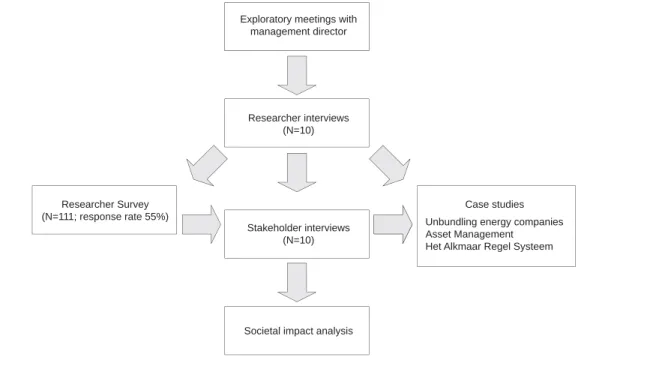
Figure 1 Summary of Research Design
Box 1 List of studied documents of NG Infra
Exploratory meetings with management director
Researcher interviews (N=10)
Stakeholder interviews (N=10)
Societal impact analysis
Unbundling energy companies Asset Management Het Alkmaar Regel Systeem
Case studies Researcher Survey
(N=111; response rate 55%)
Studied documents
BSIK programme proposal
Programme website Next Generation Infrastructures Programme database
Programme financial overviews Programme brochures
Annual report 2008 Self-Assessment 2010
QANU Research review Technology, Management, Policy and Industrial Engineering 2010 Advice of the ‘Commissie van Wijzen’ in reaction to the midterm evaluation of BSIK projects In order to answer these questions we have used a mixed-method approach. We have
investigated the societal impacts of the programme through the analysis of relevant documents (see box 1), interviews with (sub)programme leaders, a researcher survey, stakeholder
We have interviewed two of three scientific programme directors. The programme is divided into seven themes. Of five themes we have interviewed theme leaders and of two themes we have interviewed senior researchers. In total we have interviewed ten researchers. Appendix I shows an overview of interviewees. During one hour semi-structured interviews, they were asked questions about the organisational structure of the programme and their tasks within that structure; research methods; users and user interaction (communication channels); and societal impact. Appendix II contains the interview protocol. During the study we had regular contact with the managing director of the programme. Next to that, we organised two feedback meetings with programme management and researchers to reflect on intermediate results.
Based on these interviews and NG Infra’s programme documentation, we have reconstructed the programme logic. The programme logic is a representation of the relations between the programme activities, its goals, output and impact as perceived by actors closely involved in the programme management. Moreover, programme logics delineate the domain of the impact analysis and help to structure data collection in subsequent steps (McLaughlin & Jordan, 1999; Williams et al., 2009). Chapter 2 reports on the programme logic of NG Infra.
We designed a web-based survey ground on the programme logics to validate the programme logics and to get a deeper understanding of it. For all known projects (111), the survey was sent to one of the researchers involved. In most cases, the survey was sent to the project leader. Researchers who led multiple projects were sent surveys for no more than two projects. Surveys for the other projects were sent to another involved researcher in that project. For non-Dutch speaking researchers, the survey was translated in English and personally distributed. The response rate was 58%, which is high. The survey included items on objectives of the research project within the overall programme; involvement of societal actors; project activities and outputs; dissemination of results; perceived use of results by societal actors; and overall aims and goals of NG Infra. The complete survey, in Dutch, is added in appendix III.
After consultation with NG Infra managing directors and based on survey results, we interviewed ten stakeholders. These stakeholders differ in their level of involvement (programme, theme and project), and in their organisational type and sector. Some of them make use of NG Infra’s knowledge more strategically, others more operationally. Appendix I shows an overview of the interviewed stakeholders. Interviews included items on the role of the stakeholder in the programme; involvement in research and other NG Infra activities; use of research output and results; impact on their organisation; and overall appreciation of the programme and projects. The full item list for the interviews is in appendix II.
Finally, we analysed three cases of impact reported in programme documentation and interviews in considerable detail. We have selected a case from the early days of the programme, a case half way during the programme and a recent case, to analyse differences over time. These case studies are:
1. The traffic management system ‘Het Alkmaar Regel Systeem (HARS);
2. The unbundling of energy companies, a major infrastructural change which related to series of research projects and research themes within the programme;
3. The practice of asset management, for which the programme had developed the Asset Management Platform.
Societal Impact Analysis Next Generation Infrastructures – Final Report
Cases were selected because of the difference in sector they aimed at (energy, infrastructure wide, and roadways) and the type of result (advice, network creation, and implementation of a product). The case-studies are based on interviews, a survey and document analysis. In each case, the main stakeholders involved were interviewed, and relevant reports, websites, news features and other documents were analysed to identify the contribution of NG Infra research to this practice. More details about the precise methods used in each case will be given in Chapter 4.
1.4 Report outline
Chapter 2 reports on the mission of the NG Infra research programme and the organisational structure of the programme. Based on the interviews, we describe how programme management and theme leaders are organised for societal impact. The chapter end with a logic chart of the programme. This chart visualises how the activities of the programme support the mission, and it serves as an important heuristic in the subsequent chapters.
Chapter 3 discusses societal stakeholders of the programme and the impact of the programme on their activities. We report the main results of the survey and juxtapose these with results from interviews with stakeholders. The involvement of stakeholders is studied both at programme level and at project level. What is the role of stakeholders in conducting research? What programme output do they use and how do they value that output? What impact does NG Infra have on their activities?
In Chapter 4 we present the results of the three case-studies. For each of the case study we describe both the steps we took for data collection and the results of each step. As expected, the impact of each case is rather different, and we use different data collections for each case study. In the last chapter we bring the results together to answer the four main questions and present some recommendations.
2
Programme Logics of
Next Generation Infrastructures
Research programmes can have multiple functions and goals. The core of most programmes is the organisation of funding and the performance of scientific research to develop knowledge in a particular area. Increasingly, however, research programmes also serve wider goals such as evidence-based policy or contributions to economic growth or sustainability. As part of the BSIK regulation, NG Infra is an example of a research programme that has a wider goal than only developing scientific knowledge. The programme also aims to develop technical and governance solutions that will be applied by infrastructure companies and government bodies. The
programme funds and coordinates research and organises additional activities that reach out to societal stakeholders that may benefit from the research results.
The first step in our societal impact analysis is to investigate the relation between activities and the societal impact aimed for. This step results in a presentation of the so-called ‘programme logics’ (W.K. Kellog Foundation, 2001). The programme logics provide an overview of the relations between the societal goals, programme goals, activities, (expected) output, (expected) outcomes and (expected) societal impact of the programme.
This chapter describes the programme and presents the programme logics based on interviews with programme leaders and theme leaders, and programme documents.
2.1 Organisation of the programme
The NG Infra research programme builds upon a preceding Interfaculty Research Centre of Delft University of Technology (TU Delft), in which many researchers were involved and one of the scientific directors was programme leader. The programme itself runs from 2004 to 2014 with a total budget of 40 million euros, of which 20 million euros is government funding (BSIK funding) and 20 million euros is co-funded by the participants in the programme. NG Infra combines sociological and technical approaches to cover all relevant aspects of infrastructures – technical, social and organisational – and their mutual relations. The mission of the programme is ‘to understand how infrastructures work and to develop practical solutions that will steer
infrastructural development’ (NG Infra, 2011), which reflects both scientific and societal goals. Research results are shared with governments, private companies, public organisations and knowledge institutes.
In its first phase, up to 2008, emphasis has been mainly on knowledge development and building the research capacity and competence for research on infrastructures. In the second phase, from 2008 onwards, knowledge dissemination has been receiving more specific attention and specific themes and activities have been initiated to this end.
Organisationally, the centre of the programme is the Faculty of Technology, Policy and Management of TU Delft. Figure 2 is a self-visualisation of the organisational structure of NG Infra. The board is end responsible, but it has delegated daily responsibility to the scientific and
24 Societal Impact Analysis Next Generation Infrastructures – Final Report
managing directors. This management team aims to stimulate programme-wide activities, such as the NG Infra Academy and HubHolland Magazine. The programme management aims to increase societal impact at project level with targeted calls and industry involvement as a requirement for projects. Intervention on the project level is delegated to theme leaders. The programme office (located in the centre) supports both the programme direction as well as research and dissemination activities (located in the outer rings). These activities are organised in five research themes and two dissemination themes. The design of the programme aims to stimulate knowledge exchange among the themes. Joint project calls and jointly organised workshops are a means to serve this goal. Theme leaders are responsible for the content and administration of the themes. They monitor the scientific direction and coherence of the theme and select projects. While programme management set industry involvement as a project selection criterion after 2008, some theme leaders use it as a strict criterion and others don’t use it at all. Theme leaders don’t feel they have a strict steering function, as ‘what is blossoming bottom up, should not be steered hierarchically.’ Furthermore, they gather annual project reports and organise dissemination to societal actors.
The Scientific Advisory Board is composed of international peers. It reflects on the scientific progress and direction of the programme and has an advisory role in project selection. Each project proposal is independently reviewed by two members of the Scientific Advisory Board. Their assessment is taken into account, but it is not necessarily decisive. Moreover, once per year this board provides advice concerning the scientific direction of the programme.
The programme’s User Council consists of six high profile members, like presidents of energy network companies and railway companies, the president of the Social and Economic Council of the Netherlands and top level civil servants of the Ministry of Infrastructure. The council meets Figure 2 Organisational chart NG Infra (source: NG Infra)
Table 1 Budget of NG Infra and theme objectives
Theme Objective Budget
(M€)
Understanding Complex Systems (23 projects)
To obtain a fundamental understanding of the complexity of the next generation of infrastructures 8
Flexible Infrastructures (21 projects)
To ensure long-term flexibility for the next generation of infrastructures, while maintaining their stability and reliability
5
Intelligent Infrastructures (19 projects)
To develop advanced methods and tools for the operation and control of existing infrastructures 5.5
Reliable Infrastructures (14 projects)
To develop design approaches, technological innovations and new inter-organisational arrange-ments to be better prepared for failures and their damaging effects
4
Public Values (28 projects)
To assess and redefine public and private values in the light of European liberalisation and to develop new governance models for safeguarding these values
5 Knowledge
Dissemination (36 projects)
To translate NG Infra body of knowledge into practice, other domains and other countries 4
Reservation Umbrella Contracts
To establish a long-term cooperation with Alliander and Haven Bedrijf Rotterdam 5
Programme Office To monitor projects; synthesise; facilitation exchange 3.5
Total - 40
Table 1 lists the budgets for and objectives of the activities of NG Infra. The five research themes make up two third of the budget. The more fundamental research theme, Understanding
Complex Systems, aims to support the more applied research themes with basic knowledge concerning infrastructures. The applied themes are Flexible Infrastructures, Intelligent Infrastructures and Reliable Infrastructures; the research theme Public Values is a generic applied theme of relevance for all three other applied themes. Within the research themes, most projects are organised as PhD projects.
Beside these five research themes, since 2008 NG Infra has included two dissemination themes: Serious Gaming and Strategic Asset Management. These have evolved over time in response to stakeholder needs and are funded through the budget on knowledge dissemination. They built upon knowledge developed in one or more of the research themes. Within Serious Gaming, games on real world complex infrastructural problems are built and used to develop possible solutions together with societal partners. The second theme is a platform for infrastructure asset managers (NG Infra, 2011b). The NG Infra Academy, organised in 2009 and 2010, is also part of the knowledge dissemination budget.
twice a year and is regularly renewed to keep focus and to maintain value. The council has an advisory role and reflects on the societal relevance of the programme. Unlike the Scientific Advisory Board, it does not have a role in project selection. Projects can have their own user councils for monitoring and advisory purposes. On top of that, some themes have organised their own user councils, which don’t have a formal role in the programme. An example is Public values, which involved practitioners when composing a vision document.
2.2 Logic chart
Programme logics show the pathways from activities, via output and outcomes to societal impact of the programme. Programme logics do not only reveal official activities, output and outcomes, but also more informal or unintended ones, to give insight into what is actually going on in a research programme. Based upon a round of interviews with one or two leaders from each theme and two of the scientific directors of NG Infra, as well as on programme documentation, the programme logics of NG Infra have been reconstructed. Results have been discussed with the programme management at a presentation of mid-term results of this study. Figure 4 presents the resulting logic chart.
Activities are the acts that the programme organises to produce output. For NG Infra, activities are research projects, advisory and reflection roles, writing publications, organising meetings and providing education. Outputs are the products resulting from the activities. For NG Infra, outputs are scientific publications, concepts and theories, answers to questions from
stakeholders, contacts between practitioners and researchers, advice and reflective
conversations, professional publications, media appearances and meetings, master’s degrees3
and PhD degrees, participants in postgraduate education, bilateral contacts between practitioners, networks around themes, participants in practice oriented meetings, and new research questions.
Outcomes are the use of output and the benefits that result from using the programme’s output. In the case of NG Infra, outcomes include use in scientific, policy and management discussions, knowledge transfer, co-creation of knowledge, use of advice and reflections, relevant jobs, dissemination of concepts, theories and tacit knowledge, and bilateral sharing of knowledge among practitioners.
The ultimate impacts of the programme are difficult to link to outcomes directly. Therefore, impacts are divided into immediate impacts, intermediate impacts and ultimate impacts.
Immediate impacts are the adoption of knowledge or change of insights. An example is the case of societal actors realising the value of a specific tool or concept for their organisation.
Intermediate impacts are a change of acting by stakeholders, resulting from the immediate impact. This could be the implementation of a tool in the organisations. Ultimate impacts are the
3 Though not a formal part of the programme, master’s degrees are an indicator of knowledge dissemination. Master’s students who base their master‘s thesis on involvement in a NG Infra project can be expected to have embodied part of the programme’s knowledge.
Societal Impact Analysis Next Generation Infrastructures – Final Report
26
Table 1 gives an indication of the budgets for themes. The dissemination themes Serious Gaming and Strategic Asset Management do not have their own budgets and are part of the dissemination budget. Out of this budget the programme also funds the NG Infra Academy, organised in 2009 and 2010. The Academy is a summer school for young researchers and young professionals. It allows them to explore latest infrastructure developments and to create a network in the field of infrastructures (NG Infra, 2011c). The reservation for umbrella contracts is meant for co-funding long-term collaborations between multiple projects with a power grid company and the Rotterdam Harbour. Finally, the programme office is financed out of the programme budget. An important share of the budget of the office also is used for dissemination activities.
results of the change of acting. Examples of ultimate impacts that NG Infra aims at are preparing infrastructures for the future and improving relations between the organisations responsible for infrastructures and their customers and governments.
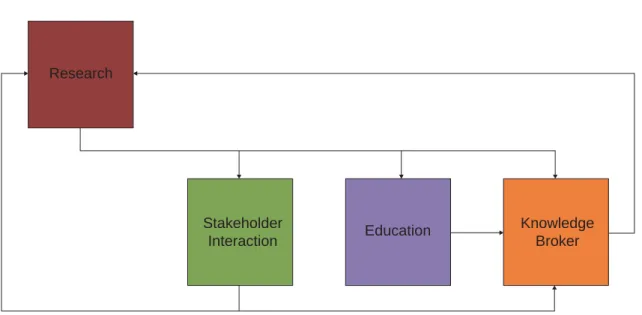
In the logic chart of NG Infra, we can distinguish four main pathways from projects towards outcomes and impacts.
1. The first pathway is that of scientific research being scientifically published and contributing to the development of scientific knowledge. Though one can think of further impacts of this scientific knowledge by uptake in new research and by stakeholders not involved directly in the NG Infra programme, we have only looked at this pathway to the extent by which the research outputs have been taken up by stakeholders. Examples are: the use of scientific knowledge in scientific and policy discussions and answers to stakeholder questions. 2. The second pathway is built upon stakeholder interactions. Researchers interact with
stakeholders within the programme, for example through user councils at the programme level, theme level and project level, but also externally through advisory roles to the government, for instance. Stakeholder interaction may lead to co-creation of knowledge, knowledge transfer and interest and reactions from practice on research.
3. The third pathway is education. This includes both the education of master’s students and PhD students and postgraduate education of professionals. The NG Infra Academy and simulation games are also part of this pathway. Potential outcomes are the adoption of NG Infra concepts and tools through educated people.
4. In the fourth pathway, NG Infra functions as a knowledge broker. As such, NG Infra organises networks around infrastructure developments and provides these networks with knowledge from NG Infra itself, and brings in knowledge from other networks. The Asset Management Platform is part of it. The pathway leads to the sharing of information and the dissemination of concepts, tools and tacit knowledge.
Note that the logic chart is an aggregation of the results of a series of interviews and several programme documents. At the programme level, the logic chart is recognised as a fair
representation of how the programme works. In the interviews with theme leaders we found that none of the team leaders had the full programme as a reference for managing its theme. Research is perceived as the core of the programme, and involvement in other activities seems to be more a result of either the interest of individual researchers or of initiatives at the level of the programme management.
Figure 3 shows the relations between the four pathways of the logic chart of NG Infra. Figure 4 shows the complete overview of the logic chart, including all the activities, outputs and
28 Societal Impact Analysis Next Generation Infrastructures – Final Report
2.3 Conclusions
NG Infra has a dual mission: to generate both knowledge and practical applications in the context of infrastructures. In this chapter we have looked at the organisation of the programme. We have analysed relationships between various themes. Through interviews and programme documentation, we have also analysed how programme management perceives the
relationships between the programme activities and the impacts.
The programme has several themes and is designed to stimulate knowledge exchange between the research themes. Over time, especially since 2008, it has developed a number of clear pathways for improving its impact. Not only scientific researchers have a role in the programme, but also societal actors such as firms and governments. These actors have a formal role in the user council of the programme: namely, to reflect on the societal relevance of the research, in the editorial board of HubHolland Magazine to put discussion topics on the agenda through HubHolland Magazine, and to participate in research projects. Less formally they are involved in thematic networks.
The programme has three main pathways to support interaction with societal stakeholders and induce the impact of its research results. We identified stakeholder interaction, education and the function of knowledge broker. These pathways are all connected to scientific research. Within the pathways, activities are organised and output and outcomes are realised that could potentially have societal impact. Two knowledge dissemination themes, Serious Gaming and Strategic Asset Management, have been officially introduced as themes in 2008 in reaction to knowledge needs from societal actors.
Although knowledge dissemination is of growing importance, management is still organised according to academic standards. As a result, each theme is managed in a different way to fit Figure 3 Logic chart basic pathways of NG Infra
Research Education Stakeholder Interaction Knowledge Broker
management to specific needs. Some theme leaders regard their role as merely administrative; allocating funding and collecting annual reports. Others also aspire to enhance the coherence of their theme or aim to stimulate the societal relevance of the research conducted in their theme. To this end, theme leaders use various means, including practice-oriented project selection and stimulating researchers to organise workshops and conferences for stakeholders.
The relations among the pathways and activities, output, outcomes and impact have been represented as the logic chart of the programme. Taking the logic chart as a starting point, the next two chapters analyse to what extent the pathways are used and result in interaction with societal actors, and to what extent these interactions result in societal impact.
3 Stakeholders and Impact
Transferring knowledge and achieving societal impact requires interactions between scientific researchers and societal actors. These interactions can take place before doing research, while formulating research questions and determining the research design; during the actual research; and afterwards when results are disseminated and implemented.
In this chapter, interactions between researchers in the NG Infra programme and stakeholders will be discussed. The results are based on interviews with ten NG Infra researchers, a survey among NG Infra researchers (N=64) and ten stakeholder interviews. Stakeholders can be societal actors that are formally involved in the programme, but also societal actors that are potential beneficiaries of NG Infra’s activities. In this chapter, first the involvement of
stakeholders in the programme will be discussed. Then, we will take a look at the programme output relevant to stakeholders. Next, the usage of programme output by stakeholders and the impact it had on them will be discussed.
The programme is characterised by a phase of building a body of knowledge up to 2008, and a phase in which that body of knowledge was extended and actively disseminated from 2008 onwards. To study the effect of the focus on knowledge dissemination, results concerning the managerial design of the projects are also presented per phase. The official start date of a project is used to assign it to the first phase (before 1/1/2008) or the second phase (on or after 1/1/2008). Results concerning output, outcomes and impact are not presented per phase, since the majority of the projects that were started in the second phase have not been completed yet. Therefore, a distinction on these levels would only give a skewed image.
3.1 Sample description researcher survey
The survey was distributed to one of the project members of each of the 111 projects of NG Infra, mostly project leaders. For non-Dutch speaking researchers, the survey was translated into English and personally distributed. In most cases, the survey was sent to academic researchers. In three projects only employees of societal actors were involved, so in these cases they were requested to fill in the survey. We have sent two reminders. In total, 64 respondents filled in the survey, which is a response rate of 58%.
The large majority of respondents (92%) is employed by universities (78% TU Delft, 8% other Dutch universities and 6% international universities), 6% is employed by societal actors (3% knowledge institutes, 1.5% private companies and 1.5% government) and the remaining 2% did not answer the question. The vast majority of TU Delft researchers (77%) are employed by the Faculty of Technology, Policy and Management.
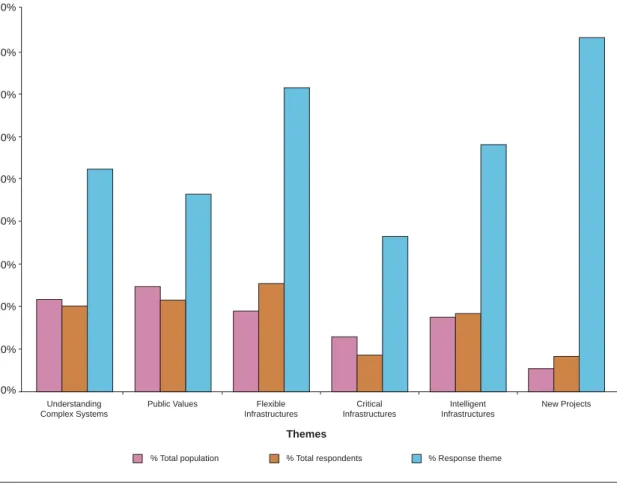
Figure 5 shows the composition of the population and the respondents per theme. Leaving new projects out of consideration, response rates per theme differ between 36% and 71%. As the average response rate is 58%, this means some themes are underrepresented while others are overrepresented.
32
Figure 5 Composition population and respondents
Understanding Complex Systems
Public Values Flexible Infrastructures Themes Critical Infrastructures Intelligent Infrastructures New Projects 80% 90% 70% 60% 50% 40% 30% 20% 10% 0%
% Total population % Total respondents % Response theme
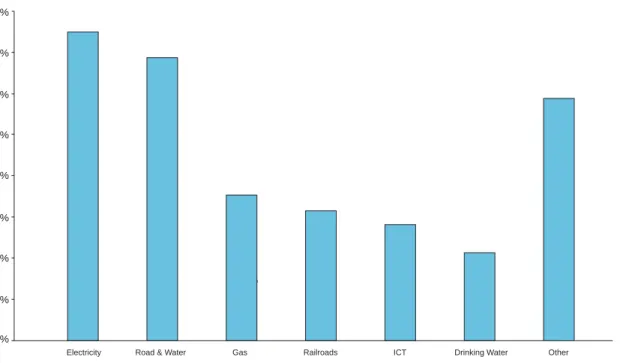
To put output, outcomes and impact of projects into a realistic perspective, it is important to note that 44% of the projects are completed and 56% are not completed yet. Furthermore, it is of significance to take into account the distribution of the sectoral focus of the projects when analysing the involvement of stakeholders and output and impact of the programme. Figure 6 visualises the distribution. Each sector is represented by at least 10% of the projects. Electricity (35% of projects) and roads and water ways (35%) and are focused upon most. Each project could mention multiple sectors.
Figure 6 Research focus of projects (multiple answers accepted)
Electricity Road & Water Gas Railroads ICT Drinking Water Other
6% 40% 35% 30% 25% 20% 15% 10% 5% 0%
3.2. Stakeholder Involvement
3.2.1 Involvement of stakeholders in NG Infra activities
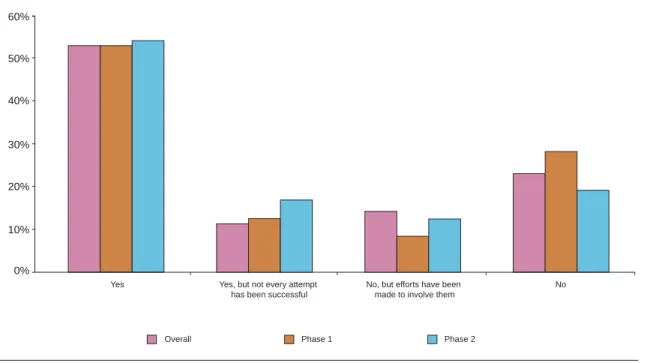
Our basic assumption is that to have any impact, research programmes need to have productive interactions with their stakeholders. One way to establish interactions with stakeholders is to involve them in research projects. Of all NG Infra projects, 63%4 have involved stakeholders in
their projects. An additional 14% has tried to involve stakeholders, but did not succeed (see figure 7). The reasons for this are discussed in paragraph 3.2.4. When comparing the two phases of the programme, we see that the share of projects that successfully involved stakeholders did not increase much. The share of projects that made efforts to involve stakeholders, however, did increase and the share of projects that did not try to involve stakeholders decreased.
Stakeholders of a number of different types of organisations have been involved in the projects. Infrastructure providers (28% of the projects), knowledge institutes (22%) and provinces or municipalities (17%) have been involved the most. Societal organisations (5%), banks (none) and international policy organisations (none) have been involved least. Figure 8 shows the distribution of financial contributions to the overall programme. ‘Public research institutes’ includes both universities and public research organisations like Deltares. Not all stakeholders have been involved financially; some have only signed so-called letters of interest. These
34
Figure 7 Involvement of stakeholders
Figure 8 Financial contributions to the programme
Yes Yes, but not every attempt has been successful
No, but efforts have been made to involve them
No 60% 50% 40% 30% 20% 10% 0%
Overall Phase 1 Phase 2
Public research institutes Public organisation Private organisation
71% 27%
2%
Societal Impact Analysis Next Generation Infrastructures – Final Report
stakeholders have not been included in the graph. Figure 9 provides a full overview of the types of organisations that are involved in NG Infra’s projects. Researchers could give multiple answers per project.
Figure 9 Involvement of societal actors (per organisation type – multiple answers accepted) 0% 5% 10% 15% 20% 25% 30% 35% Infrastructure provider Knowledge institute Consultancy firm Province or municipality Ministry
Rijkswaterstaat, Inspectie Verkeer en
Agentschap NL
T
e
chnology provider
Construction company Societal organisation
International policy
organisation
Bank None Other
3.2.2 Reasons to involve stakeholders
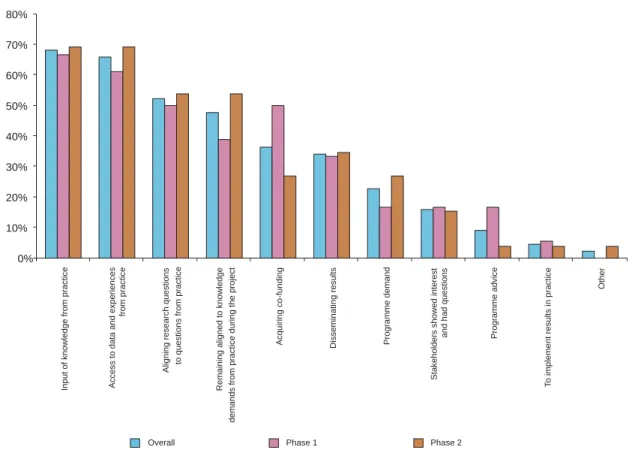
We asked all projects that involved or tried to involve stakeholders (N=44) what the reasons were to involve them. The main reasons are
1. input and knowledge from practice (67%),
2. access to data and experience from practice (65%),
3. aligning research questions to questions from practice (52%), and
4. remaining aligned to knowledge demands from practice during the project (48%).
All four reasons relate to the involvement of practice in the programme. Demands or advice at the programme level are reasons to involve stakeholders for respectively 23% and 9% of the projects. When comparing the two phases, the largest differences concern ‘remaining aligned to knowledge demands from practice during the project’ (39% versus 54%), ‘programme demand’
(17% versus 27%) and ‘access to data and experience from practice’ (61% versus 69%). Other reasons to involve stakeholders can be found in figure 10. Multiple answers were accepted. From interviews with stakeholders, we learn that the main reasons for them to engage in the programme are specific knowledge demands and image building. Stakeholders feel they should anticipate certain developments, such as the replacement of old infrastructures or including societal concerns in their activities, but they sometimes don’t know how to do that on their own. In these cases, NG Infra provides a way for them to study these questions, and concerning some questions, NG Infra is seen as the only knowledge provider available.
Image building by involvement in scientific research is important both for organisations and individuals. Firstly, a NG Infra stamp can help to scientifically validate knowledge from practice.
36
Figure 10 Reasons to involve stakeholders (multiple reasons accepted)
Overall Phase 1 Phase 2
0% 10% 20% 30% 40% 50% 60% 70% 80%
Input of knowledge from practice Access to data and experiences
from practice
Aligning research questions to questions from practice
Remaining aligned to knowledge
demands from practice during the project
Acquiring co-funding Disseminating results Programme demand
Stakeholders showed interest
and had questions Programme advice
T
o
implement results in practice
Other
3.2.3 Realisation of stakeholder involvement
Around 80 societal organisations involved in infrastructures supported NG Infra’s expression of interest in the process of applying for a grant. How have stakeholders been involved after the programme received the grant? Societal stakeholders engage in the programme at different levels and in various ways. Stakeholders are involved at the programme level, theme level and project level and can be involved in, for example, research, dissemination or providing advice. In this section we will report how stakeholders are involved in the programme.
Stakeholders are involved at the programme level in the user council, were five individuals represent societal actors involved in infrastructures. The user council reflects and advises on the societal relevance of NG Infra’s research. At the programme level, some stakeholders are also
Societal Impact Analysis Next Generation Infrastructures – Final Report
Moreover, involvement shows that an organisation or individual is at the forefront of new developments, which increases competitive advantage. Other reasons are quality control: NG Infra is a gatekeeper for the quality of new contacts and knowledge, as well as ‘philanthropy’, the perception of a social task to sponsor research and educational programmes. For most
stakeholders, recruitment of potential employees is not a main motive for involvement in NG Infra projects, although it is an interesting side effect for them.
5 Another 14% tried to involve stakeholders, but did not succeed.
actively involved in dissemination. NG Infra, the Ministry of Economic Affairs and Rijkswaterstaat jointly publish HubHolland Magazine. HubHolland Magazine is a platform for organisations in the infrastructure sector that highlights interesting research themes. After each edition there is a high-level meeting, organised by NG Infra, to decide on a follow-up in research and practice. More recently, NG Infra has umbrella contracts (‘raamcontracten’) with three organisations to organise long-term cooperations on multiple projects.
At the theme level, it has been tried to involve stakeholders in conferences and workshops, but in the end stakeholders are rarely present, according to two of the theme leaders. Some of the theme leaders actively stimulate the involvement of stakeholders in research projects, although there are no repercussions for not doing so.
Concerning the project level, the intensity of the interactions between researchers and stakeholders varies strongly, as explained by a number of stakeholders. On one end of the spectrum, in some cases NG Infra researchers work one day a week at the stakeholders office, or vice versa: a stakeholder employee works one day a week at the TU Delft. In other cases, researchers discuss their findings with stakeholders only about once a year or only after the projects are completed. In projects, stakeholders are involved in both research and
dissemination activities. Stakeholders are indeed involved in most projects (63%)5 and are
members of the project’s user council in 33% of the projects. In the first phase of the programme, 33% of the projects have stakeholders as members of the user council, and in the second phase this is the case for 42%. Of new projects, starting in 2010, this share is 80%.
In projects in which they are involved, stakeholders have a large or full contribution concerning the input of knowledge and expertise (63%) and concerning the provision of feedback on results (61%) (see figure 11). Other types of contributions occur less frequently: in 19% of the projects, stakeholders make a large or full contribution to the co-funding of research and, in 14% of the projects, to the execution of the research.
38 Societal Impact Analysis Next Generation Infrastructures – Final Report
In the majority of projects, researchers are in charge concerning the formulation of research questions (81%), designing the research approach (89%), conducting research (89%) and disseminating results (65%). In a minority of projects, stakeholders take the lead in formulating research questions (14%), designing the research approach (5%), conducting research (5%) and disseminating results (27%). See figure 12.
If we compare the involvement of the stakeholders in projects for the first and second phase of the programme, we see that this involvement decreases slightly. The financial and knowledge contributions of stakeholders decrease, though the latter finding might be a result of the fact that second phase projects are still running. In the second phase, researchers are more in charge of projects than in the first phase.
Most stakeholders we have interviewed perceive that there is sufficient room for them to give their input on the level of questions and research design. Some stakeholders want to have independent knowledge and believe that their steering would harm the independence of
researchers. These stakeholders do provide data, contacts and feedback, but they are reluctant to have intensive contacts with researchers concerning the content of the project. In other cases it was the other way around. NG Infra’s role was only to guard the scientific quality of the research, since the stakeholder was more knowledgeable on a subject and was therefore the principal investigator. There are also some stakeholders that would have liked to be more intensively involved in research to communicate their needs. They feel that they have been ‘used’ in the very beginning to show stakeholder interest in the funding application and in the end to provide feedback, but they were forgotten during the actual research phase.
Figure 11 Project contribution of stakeholders
Feedback on results Conducting research Input of knowledge and expertise (Co-)Funding Phase 1 Phase 2 0% 10% 20% 30% 40% 50% 60% 70% 80% 90% 100% 0% 10% 20% 30% 40% 50% 60% 70% 80% 90% 100%
Figure 12 Task division between researchers and stakeholders
Phase 1 Phase 2
0% 20% 40% 60% 80% 100% 120% 0% 20% 40% 60% 80% 100% 120%
Researchers in charge; stakeholders involved Researchers and stakeholders both in charge Stakeholders in charge; researchers involved
Disseminating results Conducting research Designing research approach Formulating research questions
3.2.4 Unsuccessful attempts to involve stakeholders
NG Infra researchers do not always succeed to involve stakeholders in their work, as we have seen in figure 7 in paragraph 3.1.1. Quite some projects have wanted to involve stakeholders, but did not succeed in one or more cases (N=27). The most important barriers reported by these projects are i) administrative burdens of the programme (22%), ii) a lack of time to get them interested (19%), and iii) a negative attitude of stakeholders towards participation in scientific research (19%). The first two reasons are related to the organisation of the programme.
Stakeholders who are involved in the programme also mention high administrative burdens that do not compare to the small amounts of financial support provided by the programme.
When comparing the two phases, we see that a larger share of projects in the second phase selected ‘their knowledge questions could be better addresses somewhere else’ (0% versus 20%), ‘they did not perceive participating in scientific research as their role’ (8% versus 27%), and ‘administrative burdens of the programme’ (17% versus 27%). ‘They believed the project would not result in relevant knowledge’ was selected by 8% of the projects in the first phase and 0% of projects in the second phase. A complete overview of the reasons that researchers provide for stakeholders not to be involved in the project can be found in figure 13. Multiple answers were accepted.
40 Societal Impact Analysis Next Generation Infrastructures – Final Report
Figure 13 Reasons for no stakeholder involvement (multiple answers accepted)
Overall Phase 1 Phase 2
Administrative burdens were
too high for them
There was a lack of time to
get them interested
They did not perceive participating in scientific research as their role
They could not agree with
co-funding conditions
Their knowledge questions could be better addressed somewhere else
They lacked financial means
for co-funding
They believed the project would not
result in relevant knowledge
Other 0% 5% 10% 15% 20% 25% 30%
3.3 Programme output relevant to stakeholders
Knowledge is disseminated to stakeholders in a number of ways, before and after final results are made available. The programme disseminates both tacit and codified knowledge. The first is disseminated through people, in meetings and via mobility of people. NG Infra researchers serve as sparring partners in policy discussions, for example. Codified knowledge is disseminated through texts and artefacts, such as reports with policy recommendations.
In the survey, 78% of all projects have reported dissemination of research results (n=50) and 100% of completed projects have done so. Figure 14 shows the share of projects that have resulted in at least one item of output per category. Only projects that produced output are included. Scientific publications rank first, with 70% projects resulting in one or more scientific publications. Second, 60% of the projects that produced output have given presentations for professionals. Nearly half of the projects (48%) have disseminated new theoretical concepts. Projects have resulted least in future scenarios (6%), guidelines, protocols and standards (6%), and publicly available databases (8%). Although all interviewed stakeholders know about at least a number of NG Infra outputs relevant to them, most would like to regularly receive an overall overview of relevant output.