Managing Shared Last-Level Cache in a
Heterogeneous Multicore Processor
Vineeth Mekkat, Anup Holey, Pen-Chung Yew, Antonia Zhai
Department of Computer Science & EngineeringUniversity of Minnesota Minneapolis, MN 55455, USA
{
mekkat, aholey, yew, zhai
}
@cs.umn.edu
Abstract—Heterogeneous multicore processors that integrateCPU cores and data-parallel accelerators such as GPU cores onto the same die raise several new issues for sharing various on-chip resources. The shared last-level cache (LLC) is one of the most important shared resources due to its impact on performance. Accesses to the shared LLC in heterogeneous multicore processors can be dominated by the GPU due to the significantly higher number of threads supported. Under current cache management policies, the CPU applications’ share of the LLC can be significantly reduced in the presence of competing GPU applications. For cache sensitive CPU appli-cations, a reduced share of the LLC could lead to significant performance degradation. On the contrary, GPU applications can often tolerate increased memory access latency in the presence of LLC misses when there is sufficient thread-level parallelism.
In this work, we propose Heterogeneous LLC Management (HeLM), a novel shared LLC management policy that takes advantage of the GPU’s tolerance for memory access latency. HeLM is able to throttle GPU LLC accesses and yield LLC space to cache sensitive CPU applications. GPU LLC access throttling is achieved by allowing GPU threads that can tolerate longer memory access latencies to bypass the LLC. The latency tolerance of a GPU application is determined by the availability of thread-level parallelism, which can be measured at runtime as the average number of threads that are available for issuing. Our heterogeneous LLC management scheme outperforms LRU policy by 12.5% and TAP-RRIP by 5.6% for a processor with 4 CPU and 4 GPU cores.
Index Terms—heterogeneous multicores, shared last-level cache, cache management policy.
I. INTRODUCTION
Advances in semiconductor technology and the urgent need for energy efficient computation has facilitated the integra-tion of computaintegra-tional cores that are heterogeneous in na-ture onto the same die. Data-parallel accelerators such as the Graphic Processor Units (GPU) are the most popular among the accelerator cores used in such designs. With easy to adopt programming models, such as Nvidia CUDA [17] and OpenCL [10], these data-parallel cores are now being employed to accelerate diverse workloads. The availability of heterogeneous multicore systems such as AMD Fusion [3], Intel Sandy Bridge [5], and Nvidia Denver [18] suggests that multicore designs with heterogeneous processing elements are becoming the mainstream. Diversity in the performance characteristics of these computational cores presents a unique set of challenges in designing these heterogeneous multicore processors.
One of the key challenges in designing heterogeneous multicore systems is the sharing of on-chip resources such as the last-level cache (LLC), since integrating CPU and GPU cores onto the same die leads to competition in the LLC that does not exist in homogeneous systems. First, the difference in cache sensitivity among diverse cores imply difference in performance benefits obtained from owning the same amount of cache space. Second, GPU cores with a large number of threads can potentially dominate accesses to the LLC, and consequently, skew existing cache sharing policies in favor of the GPU cores. As a result, GPU cores occupy an unfair share of the LLC with existing policies. Prior work have shown that judicious sharing of the LLC can improve the overall performance of diverse workloads in homogeneous multicore system [6, 11, 16, 19, 21, 24, 26, 27]. However, it is unclear whether these techniques can be adopted by heterogeneous multicore processors.
Dynamic Re-Reference Interval Prediction (DRRIP) [6] is a cache management policy developed primarily for homo-geneous multicore processors. DRRIP predicts re-reference (reuse) interval of cache lines to be either intermediate or distant, and inserts lines at non-MRU (Most Recently Used) position based on the reference prediction. If a line is re-used after insertion into the LLC, it is promoted by increasing its age to improve its lifetime in the cache. Non-MRU insertion of cache lines performs better than MRU insertion because most of the lines do not observe immediate re-reference.
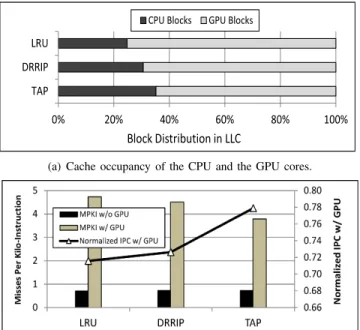
Figure 1 shows the performance of Least Recently Used (LRU) and DRRIP policies in a heterogeneous execution en-vironment where 401.bzip2 (from SPEC CPU2006 benchmark suite) executing on a single CPU core shares a 2MB LLC with a GPU benchmark (listed in Table IV) executing on four GPU cores. Details of the experiment are provided in Section IV. Figure 1(a) shows the average LLC occupancy and Figure 1(b) shows the average LLC misses per kilo-instruction (MPKI) as well as normalized IPC of the CPU application across all GPU benchmarks. Since 401.bzip2 is cache sensitive, while most of the GPU applications are not, it is desirable to allocate a larger share of the LLC to the CPU application. However, we observe that a major chunk of the LLC is occupied by the GPU application. This leads to significant performance degradation for the CPU application for the LRU policy. DRRIP provides little performance improvement as it is overwhelmed by an order of magnitude difference between the memory access rates of the CPU and the GPU cores.
(a) Cache occupancy of the CPU and the GPU cores.
(b) Misses per kilo-instruction (MPKI) and normalized IPC for 401.bzip2. IPC is normalized to the IPC of 401.bzip2 executing on the heterogeneous processor without interference from the GPU cores.
Fig. 1: The performance impact on a CPU core for sharing the LLC with four GPU cores. 401.bzip2 executes on the CPU core. The performance impact is measured across the
set of GPU benchmarks shown in Table IV.
We are aware of only one existing work, TLP-Aware Cache Management Policy (TAP) [13], that addresses the diversity of on-chip cores while designing the LLC sharing policy. TAP identifies the cache sensitivity of the GPU application, and the difference in LLC access rate between the CPU and GPU cores. This information is then used to influence the decisions made by the underlying cache management policy. When these metrics indicate a cache sensitive GPU application, both the cores are given equal priority. Whereas, when GPU application is found to be cache insensitive, GPU core is given lower priority in the underlying policy.
However, Figure 1(a) indicates that a large portion of the cache is still allocated to the cache-insensitive GPU application under TAP, and consequently, the performance degradation due to LLC sharing is still significant for the CPU application. Several reasons prohibit TAP from achieving the desired performance. First, the core sampling technique used in TAP to measure the cache sensitivity of the GPU application leaves a significant amount of GPU dead-blocks in the LLC. Second, TAP takes the same decision for all GPU memory accesses in a sampling period, and is slow to adapt to the runtime variations in the application’s behavior. A morefine-grained control over the GPU LLC share could potentially improve the utilization of the shared LLC. We discuss TAP in detail in Section V-B. The GPU core can support thousands of active threads simultaneously. Thus, the thread-level parallelism (TLP) avail-able with the GPU core is orders of magnitude higher than that with the CPU core. This higher level of TLP aids the GPU core in tolerating longer memory access latency by scheduling threads that are ready to execute. Our experiments show that majority of the GPU applications we study have a high level
of memory access latency tolerance. Taking into consideration the latency tolerance of the GPU, we propose Heterogeneous LLC Management (HeLM), a mechanism for managing shared LLC in heterogeneous multicore processors.
HeLM is a cache replacement policy that improves the effectiveness of the shared LLC in a heterogeneous envi-ronment by utilizing the available TLP in GPU applications. Under the HeLM policy, GPU LLC accesses are throttled by allowing memory accesses to selectively bypass the LLC; and consequently, the cache sensitive CPU application is able to utilize a larger portion of the cache.
Overall, the contributions in this work are as follows: • We analyze GPU application characteristics in Section II,
and identify available TLP and LLC bypassing as two significant factors in managing shared LLC in a hetero-geneous multicore processor.
• We propose a runtime mechanism, in Section III, that dynamically determines the cache sensitivity of both CPU and GPU applications, and adapts the cache management policy based on this information.
• We evaluate the proposed mechanism in Section V, and demonstrate performance improvement over previously proposed cache management policies.
II. CHALLENGES& OPPORTUNITIES
The heterogeneous multicore architecture we address in this work is depicted in Figure 2. This design is modelled after Intel Sandy Bridge [5]. The processor consists of several CPU and GPU cores each with its own private cache. These cores share the LLC and DRAM controllers, and the modules communicate through an on-chip interconnection network. Efficient sharing of on-chip resources is critical to the per-formance of a multicore processor. The last-level cache is one of the most important among these resources.
000 000 000 000 000 000 000 111 111 111 111 111 111 111 0000 0000 0000 0000 0000 0000 0000 1111 1111 1111 1111 1111 1111 1111 000 000 000 000 000 000 000 111 111 111 111 111 111 111 000 000 000 000 000 000 000 111 111 111 111 111 111 111 00 00 00 00 00 00 11 11 11 11 11 11 00 00 00 00 00 00 11 11 11 11 11 11 00 00 00 00 00 00 11 11 11 11 11 11 00 00 00 00 00 00 11 11 11 11 11 11 00000 00000 00000 00000 00000 11111 11111 11111 11111 11111 00000 00000 00000 00000 00000 11111 11111 11111 11111 11111 000000 000000 000000 000000 000000 111111 111111 111111 111111 111111 DRAM Ctrl. DRAMCtrl. DRAMCtrl.
$
CPU CPU
$
CPU$
CPU$
U P G
$
U P G$
U P G$
U P G$
Last− $ Level Last− $ Level Last− $ LevelOn−Chip Interconnection Network
Fig. 2: Architecture of a heterogeneous multicore processor with CPU and GPU cores sharing the LLC.
Existing cache management policies, developed for homo-geneous multicore processors, face difficulty in adapting to heterogeneous multicores. These mechanisms [6, 11, 16, 19, 21, 24, 26, 27] do not consider the diversity of core charac-teristics in their design. While many mechanisms [6, 19, 21, 26, 27] consider the cache sensitivity of the application, they do not consider the difference in LLC access rate between the diverse cores in a heterogeneous multicore. An order of magnitude higher access rate from the GPU core, compared to the CPU core, tends to skew their judgement in favor of the GPU.
A. Challenges in LLC sharing
Sharing of the LLC among cores in a heterogeneous mul-ticore processor introduces several challenges. This section presents the challenges in determining the cache sensitivity of various applications executing on individual cores; and devising cache management mechanisms that can cope with cores having widely divergent memory access patterns. (i) Cache Sensitivity: Cache sensitivity indicates how much the performance of an application can benefit from an increase in cache capacity. Cache management policies can utilize cache sensitivity as a metric to determine how to best share cache capacity between cores. In CPU-based homogeneous multicore systems, this issue has been extensively studied. Techniques, such as set dueling[19], have been demonstrated effective in improving cache utilization. It is worth pointing out that, in such CPU-based systems [6, 19, 21, 26, 27], cache sensitivity is often measured in terms of variations in cache miss rates across different cores as cache capacity allocation varies [21, 27] or as cache replacement policy changes [6, 19, 26]. While for CPU cores, change in cache miss rate is a direct indicator of cache sensitivity, in GPU cores, increase in cache miss rate does not necessarily lead to performance degradation. This is because GPU cores can tolerate memory access latency by context switching between a large number of concurrently active threads. Thus, cache miss rate is not a good indicator of the cache sensitivity of the GPU. GPU-specific techniques must be developed to determine the cache sensitivity of GPU workloads.
(ii) Cache Management Mechanisms: There are two classes of techniques for managing the shared caches: i) partitioning the cache ways among applications; and ii) prioritizing the insertion/eviction of blocks from different programs. When workloads with differing cache sensitivities share a cache, one of these techniques could be employed to enhance cache utilization and maximize the overall performance. However, when GPU workload is sharing the cache with CPU, previ-ously proposed mechanisms are often unable to make judicious decisions because GPU workloads often have memory access rates that are an order of magnitude higher than those of CPU workloads. In particular, when both CPU and GPU workloads are identified as cache sensitive, the memory accesses from the GPU will pollute the shared cache, and wipe out cache blocks needed by the CPU. In such cases, it is desirable to give cache sensitive CPU workloads higher priority over cache sensitive GPU workloads to improve the overall performance.
B. Improving LLC sharing
In this work, we propose to address the challenges faced by existing cache management techniques in a heterogeneous multicore environment. First, we propose to use TLP as a run-time metric to correctly identify the cache sensitivity of GPU applications. Second, we propose to use LLC bypassing to improve cache management in the heterogeneous environment. TLP as a Runtime Metric:The general cache insensitivity of GPU applications stems from two main reasons: i) streaming memory access behavior; and ii) high levels of available TLP. Even when the memory access behavior is not streaming,
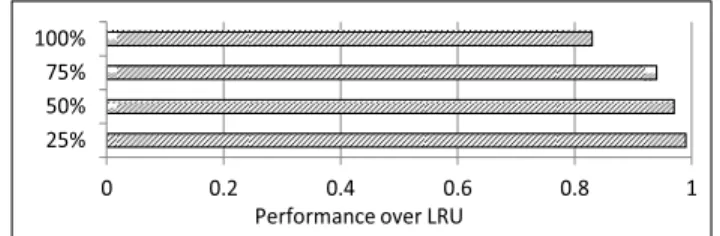
GPU applications are able to tolerate higher memory access latency using the available TLP. Figure 3 shows the impact of bypassing1 the shared LLC for 100%, 75%, 50%, and
25% of GPU memory access requests. We observe that, on an average, GPU applications can sustain up to 75% of LLC access bypassing without significant performance degradation. The GPU is able to do so by utilizing its high degree of TLP.
Fig. 3: Impact of random LLC bypassing on GPU benchmarks. Graph shows the IPC of each configuration
relative to the native run (without LLC bypassing). These characteristics point to the fact that the TLP available in a GPU application is a good indicator to its cache sensitivity, and hence could aid in promoting an effective sharing of LLC among cores. Moreover, TLP is a true runtime metric that adapts to dynamic behaviors of the GPU application. To the best of our knowledge, no other work has directly utilized TLP as a metric to manage shared LLC in heterogeneous multicore processors. We observe that while mechanisms such as set dueling are not able to identify the true cache sensitivity of GPU applications, TLP forms an accurate metric for the same. LLC Bypassing: To improve the flexibility of cache man-agement mechanisms in a heterogeneous multicore processor, we explore LLC bypassing techniques. LLC bypassing allows potentially different decisions for each incoming GPU access. When both CPU and GPU applications are identified as cache sensitive, the mechanism can consider various application characteristics while making the bypass decisions. Such char-acteristics include the difference in cache sensitivities of CPU and GPU applications, and the amount of TLP available in the GPU application. Such fine-grained throttling of each LLC access can bring significant performance improvement as a result of better LLC utilization.
Additionally, bypassing of unnecessary blocks improves the dynamic energy performance of the LLC. For cache insensitive applications, the blocks in LLC are mostlydead (zero reuse before eviction). Hence, they end up accessing off-chip DRAM for these blocks whether they are stored in LLC or not. Thus, bypassing technique can improve the LLC dynamic energy performance without significant increase in the off-chip DRAM access.
C. Workload Characteristics
A rethinking of the optimal sharing of on-chip resources in a heterogeneous multicore processor necessitates a reevaluation of the characteristics of the target workload. We analyze the 1For 75%, 50%, and 25% bypassing, we randomly choose the GPU accesses
for bypassing. The values shown are average for GPU benchmarks in Table IV, executing on 4 GPU cores with specifications as mentioned in Table II.
0 0.5 1 1.5 2 4096 2048 1024 512 256 128 64 32 16 8 70 80 90 100 110 120 130 140 150 IPC MPKI Performance Insensitive IPC MPKI 0 0.5 1 1.5 2 4096 2048 1024 512 256 128 64 32 16 8 0 0.005 0.01 0.015 0.02 IPC MPKI Compute Intensive IPC MPKI 0 0.5 1 1.5 2 4096 2048 1024 512 256 128 64 32 16 8 0 50 100 150 200 250 300 350 400 IPC MPKI Cache Sensitive IPC MPKI 0 0.5 1 1.5 2 4096 2048 1024 512 256 128 64 32 16 8 100 110 120 130 140 150 160 170 IPC MPKI Streaming IPC MPKI
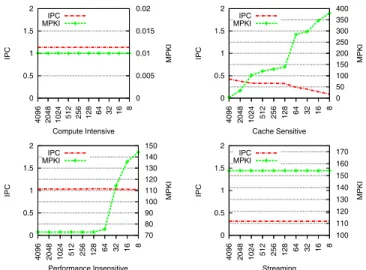
Fig. 4: LLC sensitivity of GPU benchmarks. Four different classes of GPU benchmarks are shown with their IPC and
MPKI for different LLC sizes (in KB).
performance characteristics of general purpose GPU applica-tions for varying LLC sizes. Based on instrucapplica-tions per cycle (IPC) and misses per kilo-instruction (MPKI) characteristics, we broadly classify these applications as either cache sensitive or cache insensitive. Cache insensitive applications can further be classified into three types: compute intensive, performance insensitive, or streaming. Thefirst type puts very little pressure on the shared LLC. The last two types have high LLC access rate, however, cache size has hardly any influence on their performance. This characteristic is either due to their streaming access behavior or their TLP availability.
Figure 4 shows the IPC and MPKI characteristics for these categories. This characterization can be used to evaluate the ef-fectiveness of LLC space on the application, and it shows that not all GPGPU applications have a uniform streaming access behavior. There are several cache sensitive applications that need special attention while managing the LLC. These charac-teristics assume increased importance when GPU applications share the LLC with CPU applications in a heterogeneous multicore processor. Benchmarks belonging to each class is shown in Table IV. We utilize this benchmark characterization to form the workload mix in Section IV-B. Section V-D evaluates HeLM based on these application classes.
III. HETEROGENEOUSLLC MANAGEMENT
In this section, we describe our heterogeneous LLC man-agement mechanism that mitigates the performance impact of LLC sharing by throttling LLC accesses initiated by the GPU cores. HeLM exploits the memory access latency tolerance capability of the GPU cores and allows the GPU cores to yield LLC space to the cache sensitive CPU cores without significantly degrading their own performance. In HeLM, we manage the LLC occupancy of the GPU cores by allowing the GPU memory traffic to selectively bypass the LLC when: i) the GPU cores exhibit sufficient TLP to tolerate memory access latency; or ii) when the GPU application is not sensitive to LLC performance.
For each GPU memory access, the decisions for bypassing the LLC is made at the shared LLC. On an L1 cache miss,
the TLP information of the GPU core is attached to the LLC access request. The available TLP at runtime is measured using hardware performance monitors that measure the number of wavefronts2 ready to be scheduled at any given time. Higher
number of ready wavefronts indicate higher TLP, which in turn suggests that GPU can tolerate higher memory access latency. Cache sensitivity of the CPU and GPU applications plays a critical role in making bypassing decisions. A cache insen-sitive CPU application does not benefit from increased LLC space available due to GPU LLC bypassing. Bypassing LLC for a cache sensitive GPU application executing along with such cache insensitive CPU applications could degrade GPU performance without improving the overall performance.
In the following subsections, we discuss in detail the techniques employed to identify: i) the cache sensitivities of the CPU and GPU applications; and ii) an effective TLP threshold to measure the memory access latency tolerance of the GPU application. We combine these metrics into a Threshold Selection Algorithm (TSA) that makes GPU LLC bypassing decisions.
A. Measuring the LLC Sensitivity
We employ a mechanism based on the set dueling [19] technique to measure the cache sensitivity of the CPU and GPU applications. Set dueling applies two opposing tech-niques to two distinct sets, and identifies the characteristic of the application from the performance difference among the sets. We apply set dueling in two different ways to the CPU core and the GPU core.
1) GPU LLC Sensitivity: To measure the GPU LLC sen-sitivity, we utilize two GPU sampling cores and two TLP thresholds: LowThr and HighThr. In every sampling period, one of the GPU cores (LowGPU) performs LLC bypassing at LowThr, while the other core (HighGPU) uses HighThr. LowThr is always smaller than HighThr and indicates a higher rate of bypassing. Hence, LowGPU bypasses more memory accesses than HighGPU. A significant performance (IPC) difference (ΔIPCGP U), greater than pThreshold3, between
these two cores indicates that LLC bypassing is having an adverse impact on the GPU performance and hence the GPU application is cache sensitive. If the performance difference is within the limit, the GPU application is considered cache insensitive.
2) CPU LLC Sensitivity: We evaluate the cache sensitivity of the CPU application by monitoring the impact of GPU LLC bypassing on the performance of the CPU application. Since CPU applications are more cache sensitive than GPU applications, change in cache misses directly affects the perfor-mance of CPU applications. We measure two CPU LLC misses MissLow and MissHigh corresponding to GPU bypassing at LowThr and HighThr respectively. Two set dueling monitors (SDM) are used at the LLC to obtain the MissLow and MissHigh numbers, each bypassing GPU accesses at LowThr 2Work is allocated to the GPU cores askernelsthat contain a large number
of threads. A kernel is further partitioned and mapped to different GPU cores asthread-blocks or workgroups. Scalar threads within each GPU core are scheduled simultaneously aswarps[17] orwavefronts [10] onto the SIMD computing engine.
and HighThr respectively. For these SDMs, the bypassing decision is made using its unique TLP threshold irrespective of which GPU core initiated the access.
Since GPU takes more LLC space with HighThr than with LowThr, MissHigh is always greater than MissLow. If the difference between MissHigh and MissLow (ΔMISSCP U)
is greater than mThreshold4, GPU bypassing is affecting the
CPU LLC behavior, and hence its performance. This criterion can identify compute intensive as well as streaming CPU workloads5. Dynamic Set Sampling (DSS) [20] has shown
that sampling a small number of sets in the LLC can indicate the cache access behavior with high accuracy. We use this technique by sampling 32 sets (out of 4096) to measure the cache sensitivity.
B. Determining Effective TLP Threshold
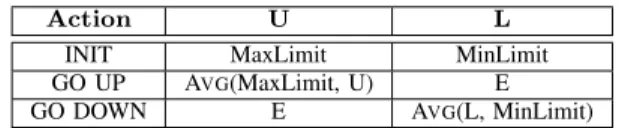
Determining the effective TLP threshold to initiate GPU LLC bypass is critical. To adapt to the diversity among GPU applications, and the runtime variations within an application itself, we propose an algorithm to dynamically determine LowThr and HighThr. Our heuristic is inspired by the binary chop algorithm that is commonly used for searching an ele-ment in a sorted list bound by limitsMaxLimitandMinLimit. The algorithm starts with two parameters U and L such that U≥L, and calculates a decision element E as the average of U and L (AVG(U, L)). At the beginning of the algorithm, U and
L are initialized to MaxLimit and MinLimit, respectively, and a prediction is made. If the prediction is lower than expected, the search window is moved up (GO UP) by updating U and L as shown in Table I. If the prediction is higher than expected, the search window is moved down (GO DOWN). At each step, E is recalculated, and the process is continued until E matches with the searched element.
Action U L
INIT MaxLimit MinLimit GO UP AVG(MaxLimit, U) E GO DOWN E AVG(L, MinLimit)
TABLE I: Binary chop algorithm for adapting sampling thresholds at runtime.
Our adaptation of the binary chop algorithm recomputes the higher and lower bypass thresholds at runtime depend-ing upon the application behavior. We start by initializdepend-ing HighThr = U = 3
4×MAXwavefronts, and LowThr = L = 1
4×MAXwavefronts. Here, MaxLimit = MAXwavefronts,
Min-Limit = MINwavefronts. After every sampling period, HighThr and LowThr values are updated with new values of U and L, respectively.
C. Putting It All Together
TSA monitors the workload characteristics continuously and re-evaluates the TLP threshold at the end of every sampling period (1M execution cycles in our study). Once the threshold is chosen, it is enforced on all the follower GPU cores.
4Based on empirical analysis, we set mThreshold to 10%.
5For compute intensive workloads, MissHigh≈MissLow≈0, while for
streaming workloads, MissHigh≈MissLow≈K (positive number).
Data:ΔIPCGP U,ΔMISSCP U Result: Bypass TLP Threshold ifΔMISSCP U ≥mThresholdthen
Set LowThr as TLP threshold; end
else ifΔIPCGP U >pThresholdthen Set HighThr as TLP threshold; end
else
if delta(ΔIPCGP U,pThreshold)≥ delta(ΔMISSCP U,mThreshold)then
Set LowThr as TLP threshold; end
else
Set HighThr as TLP threshold; end
end
Algorithm 1:Pseudocode for the Threshold Selection Algo-rithm (TSA).
The pseudocode for TSA is shown in Algorithm 1. If the CPU application is cache sensitive, LowThr is selected for bypassing LLC for GPU memory accesses. Otherwise, the choice of threshold depends on the characteristics of the GPU application. If GPU application is cache sensitive, HighThr is selected for bypassing LLC for GPU memory accesses. Although the threshold selected when both CPU and GPU applications are identified as cache insensitive does not impact performance significantly, it could have a significant impact on the off-chip DRAM access rate. In such a case, we take a conservative approach by evaluating which metric is nearer to the limit and select the TLP threshold accordingly.
Based on the threshold selected by TSA, HighThr and LowThr are re-calculated using the binary chop heuristic discussed in Section III-B. For cache sensitive GPU appli-cations, LLC bypassing aggressiveness is reduced by action GO UP; otherwise, the aggressiveness is increased by action GO DOWN. If the actions toggle between GO UP and GO DOWN for consecutive sampling periods, we maintain the existing HighThr and LowThr values for next five sampling periods.
CPU cache management policies have employed thread awareness to avoid the domination of one application on the sharing policy. Mechanisms such as thread-aware DRRIP [6] (referred to as DRRIP in this paper) utilize separate set of SDMs to isolate the influence of applications on each other. Similarly, HeLM is made thread aware by assigning individual MissLow and MissHigh counters to calculateΔMISSCP Ufor each thread. For thread awareness, TSA selects LowThr as the TLP threshold if any of theΔMISSCP U is≥mThreshold. D. Other Design Considerations
Impact on On-Chip Energy and Off-Chip Access:Allowing memory accesses that are unlikely to be reused in the cache to bypass the LLC can potentially improve cache utilization and reduce dynamic energy of LLC accesses. However, LLC bypassing could also increase the off-chip DRAM accesses. Due to the streaming nature of GPU applications, the blocks in the LLC are mostly dead, and the accesses go off-chip to fetch
data blocks from DRAM. Thus we observe that LLC bypassing does not increase off-chip DRAM accesses significantly. We evaluate the impact of bypassing on LLC energy consumption and off-chip accesses in Section V-E.
Handling Coherence:The contemporary GPU does not port coherent memory hierarchy. However, if coherence is sup-ported in future GPUs, bypassing can also be easily supsup-ported. The additional support for maintaining coherence with GPU bypassing may or may not be required depending upon the inclusion property of GPU cache hierarchy. Inclusion ensures that cache blocks present in high level caches are also present in the LLC, while non-inclusion or exclusion relaxes such a constraint. Bypassing essentially turns the inclusive LLC into a non-inclusive cache. Therefore, the support necessary for maintaining coherence in non-inclusive LLC can also be used to support bypassing in inclusive LLC. Coherence in non-inclusive caches is maintained by employing mechanisms such as snoop filter [22], which is essentially a replica of higher level cache tags at the LLC. Therefore, bypassing for non-inclusive LLC will not require any modifications for handling coherence, while support similar to snoopfilter will be necessary for inclusive LLC.
While this work evaluates workloads where the CPU and GPU applications have disjoint address spaces, we expect the proposed technique to be equally effective when these applications share the same address space. When data is shared between the CPU and the GPU, the underlying cache coherence mechanism will ensure correctness of data accesses, and the proposed bypass mechanism can be deployed with a snoop filter as discussed above. In this work, we model a GPU cache hierarchy that is write-through; however, it will work equally well with a write-back cache.
IV. EXPERIMENTALMETHODOLOGY
A. Simulator
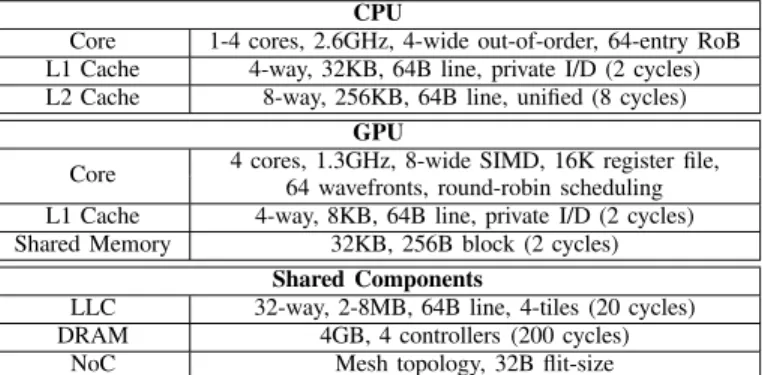
We evaluate HeLM on a cycle accurate simulator, Multi2Sim [25], that simulates both CPU and GPU cores as depicted in Figure 2. The CPU cores are modelled on a 4-wide out-of-order x86 processor, while the GPU cores are based on AMD Evergreen [2] architecture. We extended the memory subsystem in Multi2Sim to support shared LLC between CPU and GPU cores. Table II shows the parameters of the cores we simulate.
CPU
Core 1-4 cores, 2.6GHz, 4-wide out-of-order, 64-entry RoB L1 Cache 4-way, 32KB, 64B line, private I/D (2 cycles) L2 Cache 8-way, 256KB, 64B line, unified (8 cycles)
GPU
Core 4 cores, 1.3GHz, 8-wide SIMD, 16K register64 wavefronts, round-robin scheduling file, L1 Cache 4-way, 8KB, 64B line, private I/D (2 cycles) Shared Memory 32KB, 256B block (2 cycles)
Shared Components
LLC 32-way, 2-8MB, 64B line, 4-tiles (20 cycles) DRAM 4GB, 4 controllers (200 cycles)
NoC Mesh topology, 32Bflit-size
TABLE II: Configuration parameters for the heterogeneous evaluation infrastructure.
We evaluate 500 million instructions for each CPU bench-mark and 150 million instructions6 for each GPU
bench-mark. The 500 million representative interval for each CPU benchmark, with ref input, is obtained through SimPoint [4] analysis. As followed in previous works [6, 13, 21], early
finishing benchmarks continue to execute until all the bench-marks execute the specified number of instructions. We utilize McPAT [14] for studying on-chip LLC energy consumption. B. Benchmarks
The CPU benchmarks evaluated belong to the SPEC CPU2006 benchmark suite [23]. The GPU benchmarks eval-uated are OpenCL programs from AMD APP (Application Parallel Programming) v2.5 software development kit [1]. We classify these benchmarks into different categories, depending upon their cache performance, as shown in Tables III and IV.
Category Benchmarks
Cache sensitive bzip2, gcc, mcf, perlbench, dealII,omnetpp, astar, soplex, povray, h264 Cache insensitive
Streaming:libquantum, bwaves, milc, zeusmp, cactusadm, gemsfdtd, lbm, leslie3d
Compute intensive:gobmk, hmmer, gromacs, sjeng, gamess, calculix, tonto, namd
TABLE III: Classification of CPU benchmarks.
Category Benchmarks
Cache sensitive matrix-multiplication, matrix-transpose,gaussian, fast-walsh transform,floyd-warshal
Cache insensitive
Streaming:histogram, radix sort, blackscholes, reduction
Performance insensitive:sobel, dwthaar1D, scanarray, dct, boxfilter
Compute intensive:binomial option, eigen, bitonic sort
TABLE IV: Classification of GPU benchmarks.
Core Configuration Workloads 1CPU + 4GPU (1C4G) 100 2CPU + 4GPU (2C4G) 40 4CPU + 4GPU (4C4G) 30
TABLE V: Heterogeneous workloads evaluated. We evaluate multiprogrammed workloads on heterogeneous processors with core configuration as shown in Table V. We consider three types of processors: processors with one, two, and four CPU cores, respectively. All of them contain four GPU cores as well. Each of the CPU core executes a CPU benchmark while all the four GPU cores execute the same GPU benchmark. We refer to the workloads executing on these processors as 1C4G, 2C4G, and 4C4G, respectively, where C stands for CPU core and G stands for GPU core. Equal number of CPU and GPU benchmarks are selected from cache sensitive and insensitive categories. Workloads in Table V are formed by randomly selecting benchmarks from each category. Processor with one CPU core shares a 2MB LLC with the four GPU cores, while processor with two and four CPU cores share 4MB LLC and 8MB LLC respectively.
6An instruction executed by all threads in a wavefront is counted as one
C. Cache Management Policies
HeLM is decoupled from the underlying cache management policy, which brings flexibility to the mechanism as it can be adapted to work with any cache management policy. In this paper, we implement HeLM over DRRIP policy, however, it could well be implemented over other cache management poli-cies such as Utility-based Cache Partitioning (UCP) [21]. TAP was proposed with two variants: TAP-UCP and TAP-RRIP, built on top of UCP and DRRIP respectively. Since TAP-RRIP outperforms TAP-UCP in all evaluations, we choose to compare HeLM against TAP-RRIP. In DRRIP policy, in-coming cache blocks are inserted at non-MRU position and are promoted later on cache hits. Similar to TAP, we do not promote GPU blocks on LLC hits. Also, when both CPU and GPU blocks are available for replacement, we replace the GPU block first.
Reuse-based Cache Management. Reuse-based mecha-nisms [7–9, 12, 15] have been studied extensively in CPU domain to improve cache utilization. Also known as dead-block predictors, they predict whether a cache dead-block is dead or live and improve cache performance by replacing dead blocksfirst, by bypassing dead blocks, or by prefetching data into dead blocks. In this paper, we compare performance of HeLM with two reuse-based bypass mechanisms, MAT [7] and Sampling Dead-Block Predictor (SDBP) [8]. Other reuse-based mechanisms are discussed in Section VI-B.
MAT is an address-based reuse mechanism in which cache block reuse is determined using a Memory Address Table (MAT) at a macroblock granularity. MAT bypasses a cache block if the victim block has higher reuse than the one being inserted. SDBP, on the other hand, is a PC-based reuse mechanism in which the reuse pattern is learned from accesses to the cache blocks in a few sampled sets in the LLC. SDBP updates its prediction table using the PC of the last instruction that accesses a cache block in the sampled sets. On an access to the LLC, SDBP predicts the cache block as dead or live by referring to the prediction table, indexed by the PC of the instruction initiating the access. If the block being accessed is dead, it can be bypassed from the LLC.
V. EVALUATION
In this section, we evaluate the impact of HeLM on the performance of shared LLC in a heterogeneous multicore pro-cessor. We compare the performance of HeLM with DRRIP, MAT, SDBP, and TAP-RRIP, all normalized to LRU. MAT and SDBP were originally proposed for bypassing CPU memory accesses. However, to compare with HeLM, we employ these techniques to bypass only the GPU memory accesses. A. Performance
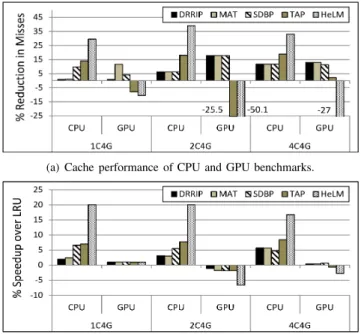
We start our evaluation with the impact of these policies on the cache performance for CPU and GPU cores. Figure 5(a) shows the reduction in CPU and GPU LLC misses for these policies (normalized to LRU) for 1C4G, 2C4G, and 4C4G workloads. In case of CPU, although all of them perform better than LRU, the improvement for DRRIP and the reuse-based mechanisms (MAT and SDBP) are lower than TAP and HeLM.
(a) Cache performance of CPU and GPU benchmarks.
(b) Speedup for CPU and GPU benchmarks.
Fig. 5: Impact of different cache management policies on cache performance and speedup of the CPU and GPU benchmarks. Graphs show results for workloads: 1C4G, 2C4G, and 4C4G. Results are relative to the LRU policy. Additionally, HeLM outperforms TAP. Overall, HeLM reduces CPU LLC misses by 29.5%, 39.1%, and 33% over LRU for 1C4G, 2C4G, and 4C4G workloads, while the corresponding reduction for TAP are 13.9%, 18.1%, and 18.8%. On the other hand, TAP and HeLM increase the GPU LLC misses as they give lower priority to GPU over CPU. While DRRIP does better than TAP and HeLM, MAT and SDBP are the most favorable towards GPU.
For the CPU, cache performance directly translates to speedup as shown in Figure 5(b). Here, HeLM outperforms all other policies convincingly. The lower priority given to the GPU is evident in the speedup of TAP and HeLM. However, the impact of increased cache misses do not translate linearly into performance degradation for the GPU. This is due to the difference in cache sensitivity among the CPU and GPU cores. This shows that since the CPU benchmarks are more cache sensitive than the GPU benchmarks, it is preferable to prioritize CPU benchmarks while managing the shared LLC space. In our experiments, the GPU benchmarks in 2C4G workloads show slightly higher performance degradation over-all when compared to 1C4G and 4C4G workloads. This is potentially due to the random selection of the workload mix which contains more cache sensitive GPU benchmarks than 1C4G and 4C4G.
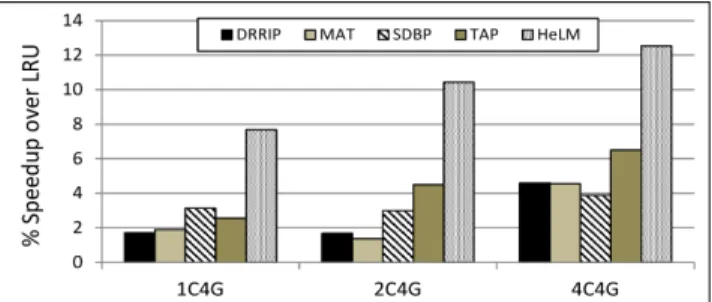
Combined speedup for CPU and GPU for all workloads is shown in Figure 6. Speedup is calculated as the geometric mean of individual benchmark speedups. The figure shows that HeLM outperforms all other replacement policies consis-tently in overall system performance. As the number of CPU benchmarks increases, speedup from HeLM also increases, indicating that HeLM is able to scale with the number of CPU cores in a heterogeneous multicore. Overall, HeLM performs 7.7%, 10.4%, and 12.5% better than LRU for 1C4G,
Fig. 6: Combined speedup for various workloads under different policies. Combined speedup is calculated as the geometric mean of individual benchmark speedups. Results
are relative to the LRU policy.
2C4G, and 4C4G workloads, respectively. The corresponding improvements in TAP over LRU are 2.6%, 4.4%, and 6.5%, respectively.
B. Comparison with Other Policies
Here we discuss the reasons for the performance improve-ment of HeLM over various cache manageimprove-ment policies we evaluate.
DRRIP: The effectiveness of DRRIP in multicore environ-ment is visible in Figures 5(a) and 5(b) as DRRIP outperforms LRU. However, DRRIP faces difficulty in adapting to the heterogeneous characteristics of the cores. DRRIP policy, similar to LRU, does not consider the diversity among the on-chip cores and gives equal priority to both. Therefore, the higher LLC access rate from the GPU cores tends to skew the cache management policy in their favor. Thus, the performance improvement for the CPU core is limited, while GPU cores do not benefit much from the additional LLC space. Hence, the overall speedup for DRRIP in Figure 6 is low.
MAT/SDBP: The performance of reuse analysis based poli-cies, MAT and SDBP, is very similar to DRRIP, however for different reasons. These mechanisms, although capable of LLC bypassing of memory accesses, are overly conservative in their approach towards the GPU applications. They detect reuse pattern in GPU memory access behavior and preserve the GPU blocks in LLC. This improves the cache performance of GPU as in Figure 5(a). However, GPU does not benefit significantly from the increased LLC space due to their TLP and the ability to tolerate higher memory access latency. This additional LLC space would have been better utilized had it been provided to the CPU application. Hence, these mechanisms also observe low overall speedup as in Figure 6.
TAP:TAP considers the diversity of on-chip cores in optimiz-ing the cache management policy, and improves performance over existing policies by prioritizing CPU over GPU. However, HeLM still outperforms TAP for two reasons:
(i) the core sampling technique used by TAP leaves a sig-nificant portion of the shared LLC to be occupied by the GPU cores. Majority of these blocks originate from the GPU core that inserts at the MRU position in the core sampling technique, and end up being dead blocks. In our experiments with 1C4G workloads, we observe that nearly 40% of the shared LLC space is occupied by the GPU dead blocks that were inserted at the MRU position. This leads to eviction of useful CPU blocks, leaving significant room for improvement.
Since HeLM does not suffer from this side effect, it performs better than TAP.
(ii) TAP takes a binary decision on whether the GPU appli-cation is cache sensitive or not. This decision is then used to override the underlying policy for all the accesses in the sampling period. However, such a binary decision is at a coarse granularity, while a more fine-grained ability to control the LLC share between CPU and GPU could potentially improve the performance of both the cores. HeLM is able to control the cache occupancy of the GPU core at a finer granularity, by taking bypass decision for each GPU access, which also helps in outperforming TAP.
C. Sensitivity to Cache Size
Figure 7 presents the sensitivity of HeLM to varying LLC sizes for 4C4G workloads. To configure different LLC sizes we vary the LLC associativity. As shown in the figure, HeLM outperforms other policies for all cache configurations. Although the performance benefits of HeLM is more evident with smaller LLC size, it is able to preserve its benefits with increasing LLC sizes. This shows that HeLM can adapt well to variations in cache configurations.
Fig. 7: Performance of 4C4G workloads with varying cache sizes. Result are relative to the LRU policy. D. Workload Types
Mixing of CPU and GPU applications in a heterogeneous multicore processor creates workloads with unique characteris-tics. To evaluate the potential opportunities in these workloads, we broadly classify them based on their cache sensitivity, resulting in four different categories:
• CPU cache Sensitive, GPU cache Insensitive (CSGI): CSGI is perhaps the most common category in which GPU occupies majority of the LLC space leading to poor performance of the CPU application in existing cache policies.
• CPU cache Sensitive, GPU cache Sensitive (CSGS): Although GPU is cache sensitive in this combination, it has the advantage of high TLP. Hence, any additional LLC space given to CPU could bring a larger overall performance improvement.
• CPU cache Insensitive, GPU cache Insensitive (CIGI): • CPU cache Insensitive, GPU cache Sensitive (CIGS):
These categories do not leave significant room for perfor-mance improvement as the CPU applications are cache insensitive.
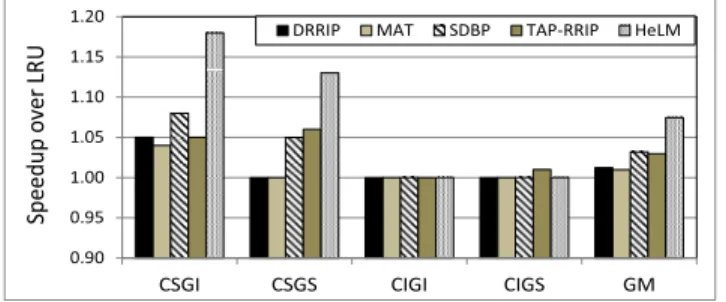
Figure 8 presents the speedup for the evaluated policies, over LRU, for the four categories. As expected, all the policies show performance improvement over LRU in the first two
Fig. 8: Speedup for 1C4G workloads category-wise. Result are relative to the LRU policy.
categories (CSGI, CSGS) where CPU is cache sensitive. Also, we can observe that HeLM outperforms all the other policies in these categories, particularly by a significant margin for CSGI which is the most common category. In the last two categories (CIGI, CIGS), there is hardly any performance improvement over LRU for any of the policies.
E. Energy Consumption & Off-Chip Bandwidth
In this section, we discuss the impact of HeLM on the energy consumption of the memory modules, both on-chip and off-chip. On one hand, HeLM reduces the on-chip dynamic energy consumption of the shared LLC by allowing GPU memory accesses to bypass the shared LLC. On the other hand, this could lead to an increase in off-chip main memory (DRAM) accesses, resulting in a potential increase in DRAM dynamic energy consumption and off-chip memory bandwidth. There are two scenarios contributing to LLC dynamic energy: (i) on an LLC hit, tag array and cache block data are accessed; and (ii) on an LLC miss, tag array is accessed, a cache block is written back to memory if it is dirty, and data for the missed access is written to the cache block. When an LLC access is bypassed on a miss, only the tag array is accessed, eliminating the energy consumption of data block accesses. We evaluate the LLC energy consumption using McPAT simulator (32nm technology). Overall, HeLM saves 65% of the LLC dynamic energy compared to LRU on average. Speedup combined with dynamic energy savings in HeLM result in total energy (static+dynamic) savings of 10.1% over LRU for the LLC.
Allowing certain memory accesses to bypass the LLC can potentially increase off-chip DRAM access. In general, GPU applications show streaming data access behavior and experience high LLC miss rate. Hence, LLC bypassing does not significantly increase the off-chip accesses as the accesses that miss LLC would anyway go off-chip to find the data in the DRAM. Overall, we observe a 5% increase in the off-chip DRAM accesses due to LLC bypassing in HeLM. However, this does not increase DRAM energy consumption significantly as increase in off-chip accesses affects only the dynamic energy consumption of the DRAM module.
We observe that the change in energy consumption with LLC bypassing is a characteristic of the workload category. For example, categories with cache sensitive CPU applications (CSGS) whose performance is improved by HeLM show significant reduction in their total energy consumption. On the other hand, categories with cache insensitive CPU applications (CIGS) that do not gain significant performance improvement
show slight increase in total energy consumption due to the increased off-chip DRAM access from GPU.
In systems which utilize significant amount of DRAM memory, such as data center systems, the increase in off-chip accesses due to bypassing could have a significant impact due to the increase in the DRAM energy consumption and off-chip memory bandwidth. In such situations, HeLM should consider DRAM energy consumption and bandwidth utilization while making bypassing decisions.
F. Hardware Overhead
Table VI presents the hardware overhead for various cache management policies, including HeLM. While MAT and SDBP require significant amount of storage to track the reuse of GPU LLC blocks, TAP and HeLM can be implemented using simple hardware counters. HeLM utilizes MissHigh, and MissLow counters to track GPU and CPU LLC access behavior. Also, instruction counters and core IDs are required to identify the cache sensitivity of the GPU application every sampling period. The TLP threshold register holds the TLP threshold selected by TSA. In summary, hardware overhead for HeLM is comparable to that for TAP, and both these mechanisms use significantly less additional hardware than MAT or SDBP.
Policy Hardware Overhead
MAT [7] (each entry: 20-bit tag, 8-bit counter,4K-entry memory address table 14.5 KB 1 valid bit)
SDBP [8] 4K-entry x 3 prediction tables (each entry:2-bit counter), sampler sets 13.7 KB TAP [13] Instruction counters (20-bit x 4 GPU cores),core IDs (10-bit x 4 LLC tiles) 120 bits HeLM MissHigh and MissLow counters (20-bit each),TLP threshold register (6-bit), 166 bits
instruction counters, core IDs
TABLE VI: Hardware Overhead. VI. RELATEDWORK
The importance of the cache subsystem to application per-formance has left a significantly large trove of research work in cache management techniques. Due to space limitations, we discuss only the works that are closely related to ours. A. Cache Management
Existing work on cache management for homogeneous mul-ticore processors can be divided into two general categories: (i) cache partitioning techniques; and (ii) cache replacement policies.
1) Partitioning Techniques: Dynamic cache partitioning mechanisms aim to achieve their performance goal by dividing the cache ways among the applications at runtime. Suh et al. [24] introduce dynamic cache partitioning among threads executing on the same chip by utilizing hardware performance counters to maximize cache hit among threads. Moreto et al. [16] propose a dynamic cache partitioning mechanism that considers the memory-level parallelism of an application and the impact of cache misses on its performance. Utility-based cache partitioning (UCP) [21] tries to find the optimal cache partitioning by prioritizing applications on the basis of benefit from cache over the demand for cache. Thrasher caging [27] re-evaluates cache partitioning mechanisms in the presence of one or more thrashing applications.
2) Replacement Policies: Cache replacement policies aim to identify the appropriate position to insert a new cache block, and to identify the right victim for replacement, to achieve their performance goal. Qureshi et al. propose the dynamic insertion policy (DIP) [19] that overcomes the impact of thrashing behavior of certain applications on other applications in the workload. Jaleel et al. [6], on the other hand, utilize re-reference interval prediction (RRIP) to develop replacement policies for multicore processors that is both thrashing and scan resistant. PIPP [26] is a cache management technique that combines insertion and promotion policies to utilize the benefits of cache partitioning and adaptive insertion.
However, these mechanisms face significant challenge in the presence of diverse cores sharing the LLC, and hence, they cannot be directly adopted to heterogeneous multicore processors. A recent work, TAP [13], adapts UCP and RRIP for heterogeneous multicore processors. However, HeLM out-performs these policies as discussed in Section V-B.
B. Dead Block Predictors
Reuse-based cache management, often referred to as dead-block predictors, have been proposed in prior work [7–9, 12, 15]. Lai et al. propose a dead-block predictor to prefetch data into L1 data cache [12]. While Kharbutli et al. propose counting-based dead-block predictors [9] that consider the number of accesses to a cache block, Cache Bursts [15] observes references to a cache block at MRU position to make dead block prediction. All prior work have only addressed the dead-block prediction issue for CPU workloads. These mechanisms cannot be directly adopted for heterogeneous workloads as they prove to be overly conservative for the GPU.
VII. CONCLUSIONS
The growing importance of data-parallel accelerator cores, such as GPU, has lead to their integration with CPU cores on the same die. Such architectures with heterogeneous process-ing cores present a significant challenge to optimal sharing of on-chip resources such as the LLC. Our heterogeneous LLC management mechanism, HeLM, monitors the TLP available in the GPU application, and uses this information to throttle the GPU LLC access when the application has enough TLP to sustain longer memory access latency. This in turn provides an increased share of the LLC to the CPU application, thus improving its performance. HeLM monitors the cache sensi-tivity of both CPU and GPU applications in heterogeneous workloads, and achieves LLC sharing that improves overall system performance.
We evaluate HeLM against: (i) existing shared LLC man-agement techniques (LRU, DRRIP); (ii) reuse-based bypassing mechanisms (MAT, SDBP); and (iii) the only technique pro-posed for heterogeneous multicore (TAP). HeLM outperforms all these mechanisms in overall system performance. HeLM improves over LRU policy by 7.7% and outperforms TAP by 4.9% for 1C4G workloads. HeLM scales well with increasing processor count and outperforms TAP by 5.7% and 5.6% for 2C4G and 4C4G workloads, respectively.
ACKNOWLEDGMENT
This work is supported in part by National Science Foun-dation grants CCF-0916583 and CPS-0931931. We would like to thank all anonymous reviewers for their constructive comments that helped to improve the quality of this paper. We would also like to thank Ragavendra Natarajan, Jieming Yin, and Carl Sturtivant for their suggestions to improve the paper.
REFERENCES
[1] AMD Accelerated Parallel Processing (APP) Software Development Kit (SDK) . http://developer.amd.com/sdks/amdappsdk/.
[2] ADVANCEDMICRODEVICES INCORPORATED. Evergreen Family Instruction Set Architecture . http://goo.gl/WQ5lE.
[3] BROOKWOOD, N. AMD Fusion Family of APUs: Enabling a Superior, Immersive PC Experience. AMD White Paper(2010).
[4] HAMERLY, G., PERELMAN, E., LAU, J.,ANDCALDER, B. Simpoint
3.0: Faster and moreflexible program analysis. InJournal of Instruction Level Parallelism(2005).
[5] INTEL CORPORATION. Intel Sandy Bridge Microarchitecture. http://www.intel.com.
[6] JALEEL, A., THEOBALD, K. B., STEELY, JR., S. C., AND EMER, J. High performance cache replacement using re-reference interval prediction (RRIP). InISCA(2010).
[7] JOHNSON, T., CONNORS, D., MERTEN, M.,ANDHWU, W.-M. Run-time cache bypassing. IEEE Transactions on Computers(1999). [8] KHAN, S. M., TIAN, Y.,ANDJIMENEZ, D. A. Sampling dead block
prediction for last-level caches. InMICRO(2010).
[9] KHARBUTLI, M.,ANDSOLIHIN, Y. Counter-based cache replacement and bypassing algorithms. IEEE Transactions on Computers(2008). [10] KHRONOSGROUP. OpenCL - The open standard for parallel
program-ming of heterogeneous systems. http://www.khronos.org/opencl/. [11] KIM, S., CHANDRA, D.,AND SOLIHIN, Y. Fair cache sharing and
partitioning in a chip multiprocessor architecture. InPACT(2004). [12] LAI, A.-C., FIDE, C.,ANDFALSAFI, B. Dead-block prediction &
dead-block correlating prefetchers. InISCA(2001).
[13] LEE, J.,ANDKIM, H. TAP: A TLP-aware cache management policy for a CPU-GPU heterogeneous architecture. InHPCA(2012). [14] LI, S., AHN, J. H., STRONG, R. D., BROCKMAN, J. B., TULLSEN,
D. M.,AND JOUPPI, N. P. Mcpat: an integrated power, area, and timing modeling framework for multicore and manycore architectures. InMICRO(2009).
[15] LIU, H., FERDMAN, M., HUH, J.,ANDBURGER, D. Cache bursts: A new approach for eliminating dead blocks and increasing cache efficiency. InMICRO(2008).
[16] MORETO, M., CAZORLA, F., RAMIREZ, A.,ANDVALERO, M. Mlp-aware dynamic cache partitioning. InHiPEAC. 2008.
[17] NVIDIA CORPORATION. NVIDIA CUDA C Programming Guide. http://www.nvidia.com.
[18] NVIDIACORPORATION. Nvidia Project Denver. http://goo.gl/Sbjbb.
[19] QURESHI, M. K., JALEEL, A., PATT, Y. N., STEELY, S. C.,ANDEMER, J. Adaptive insertion policies for high performance caching. InISCA (2007).
[20] QURESHI, M. K., LYNCH, D. N., MUTLU, O.,ANDPATT, Y. N. A case for mlp-aware cache replacement. InISCA(2006).
[21] QURESHI, M. K.,ANDPATT, Y. N. Utility-based cache partitioning: A
low-overhead, high-performance, runtime mechanism to partition shared caches. InMICRO(2006).
[22] SALAPURA, V., BLUMRICH, M.,ANDGARA, A. Design and imple-mentation of the Blue Gene/P snoopfilter. InHPCA(2008).
[23] SPRADLING, C. D. SPEC CPU2006 Benchmark Tools. SIGARCH
Computer Architecture News(2007).
[24] SUH, G., RUDOLPH, L.,ANDDEVADAS, S. Dynamic partitioning of shared cache memory. The Journal of Supercomputing(2004). [25] UBAL, R., JANG, B., MISTRY, P., SCHAA, D., AND KAELI, D.
Multi2Sim: A Simulation Framework for CPU-GPU Computing . In PACT(2012).
[26] XIE, Y.,ANDLOH, G. H. Pipp: promotion/insertion pseudo-partitioning of multi-core shared caches. InISCA(2009).
[27] XIE, Y.,AND LOH, G. H. Scalable shared-cache management by containing thrashing workloads. InHiPEAC(2010).