
OPEN JOURNAL OF BUSINESS MODEL INNOVATION
Acceptance Theories of Innovation and Modern
Methods in Construction Industry
Daniela Ma˘ckov ´a*, Tom ´a˘s Mandi˘c ´ak
Institute of Construction Technology and Management, Technical University of Ko˘sice Civil Engineering Faculty, Ko˘sice, Slovakia *Corresponding author: [email protected]
Abstract:
Every industry is forced at some point undergo the necessary changes. It is necessary to upgrade production routines, introduce new software or diversify offered products. Construction industry has to follow society, market and customers demands. Currently, one of the main building requirements is sustainability. This is related to the development of new building materials and construction technologies. Modern methods of construction (MMC) are one of the ways how to save costs for energy consumption and operations. They are environmentally friendly, able to save natural resources and they are comfortable and healthy for their users, but they have not been adopted as much as expected, yet. There are many acceptance theories, which imply the adoption of new technologies and can be applied in every sector. The aim of this paper is to suggest an overview of acceptance theories and to show their use potential in the construction industry, particularly in the acceptance of MMC.
Keywords:
Acceptance Theories; Construction Industry; Modern Methods of Construction
1. INTRODUCTION
Innovation in the enterprise is often the first stimulus to business performance. The need for innovation is indisputable. Innovation is the driving force behind each and every sector of the economy. Willingness to innovate in any form depends on several factors. The first factor is the economic situation in the market. In recent years the construction industry is in a difficult situation. The financial crisis in 2008 launched a number of problems that have arisen in the construction industry. Naturally occurring and positive things, but even today the main problem is the lack of construction of orders, reducing turnover. This automatically reduces expenses. This leads to a reduction in innovation. Of course, for implementation of new systems and innovations influenced several factors.
The role of innovation to improve the situation in the company. Success of construction projects depends on several factors. Furthermore, it is important to set the processes to be used effectively for available resources. For effective setting of processes is essential to use available information. According to Mes´aro˘s, work with information must be systematic and construction participants must seek to automate these processes [1]. Information constitutes an important factor in setting business processes and the use of available resources [2,3]. Set these processes means set up the system. This contribution provides system solutions for the implementation of innovations and new technologies in the field of construction. Literature provides many models and theories that address the issue of system implementation in all areas.
The issue of acceptance models is wide. Much of the literature gives us different perspectives and theories, as to look at the maturity models. Maturity models are often used for the evaluation of already implemented solutions. Every innovation and cost must be measured. This is the case for the implementation of IS in the construction business. The basic step, how to assess implemented information system is to know a wide range of these models for these purposes [3]. The next step is the selection of an appropriate model for the assessment. This affects the analysis of each IS.
2. ACCEPTANCE THEORIES AND MODELS
The first model, which addresses the issue of adoption of new technologies and solutions, is the Technology Acceptance Model (TAM). As will be shown below, many authors are devoted to this model. Often mentioned, there is the first model, which dealt with the matter in question. TAM has according to different sources many advantages, but also disadvantages that address other authors.
The TAMFigure 1was specifically developed for identifying the determinants involved in computer acceptance in general. It was its main aim. Secondly, to examine a variety of information technology usage behaviors (especially people skills) and last one, to provide a parsimonious theoretical explanatory model [4]. It is rooted in social psychology and draws on Fishbein’s and Ajzen’s reasoned action model (1975), which establishes that the intent to produce a behavior depends on two basic determinants: attitude toward behavior and subjective norms. Subjective norms refer to the reasons for producing a certain behavior or not and make the link between the latter and an expected result, whereas attitude toward behavior refers to the positive or negative value the individual associates to the fact of producing the behavior [5].
Figure 1. Technology Acceptance Model (TAM) [6].
Manon and Bouchard mention mainly the following factors:
• Intention to use
• Usefulness
• Perceived ease of use
• Self-efficacy • External control • Anxiety • Motivation • Attitude • Perceived cost 2
The DeLone and McLean IS Success Model has become a standard for the specification and justification of the measurement of the dependent variable in information systems research. The D&M IS Success Model, though published in 1992, was based on theoretical and empirical IS research conducted by a number of researchers in the 1970s and 1980s.
Figure 2. Information System Success Model (D&M IS) [7].
ISSM, also known as DeLone and McLean model, consists of a number of variables that recognize the effects. That includes these parts [7]:
• System quality – effect on the information system itself that produces the information,
• Information quality – accuracy, meaningfulness and timeliness of the information produced,
• System use – use of the information system,
• User satisfaction – interaction of the information system with its recipients: users and project owner,
• Individual impact – influence on management decisions,
• Project/organizational impact – effect on organizational performance,
• Process quality – effect on information management process quality.
Within the effective management of construction projects, it is necessary to set processes among the participants of construction. Given the extensive building projects there is a need for exchange of information, and arise between them information flows. When the exchange of data and information leads to the question of how to set up information flows so that the whole system has brought the greatest benefits to all stakeholders. In other words, set the rules and conditions for maximum utilization and efficient operation of the whole system, which incorporates new technologies in the form of hardware, relevant software solutions and applications, and not least its users, therefore participants construction. It is therefore necessary to deal with this problem and find an appropriate solution that is beneficial for all participants construction. Harnessing ICT to be the most effective. One possible approach how to set these flows and achieve efficient use of available ICT is a model Utau. This model highlights the factors that influence the successful use of ICT in all sectors, not excluding construction.
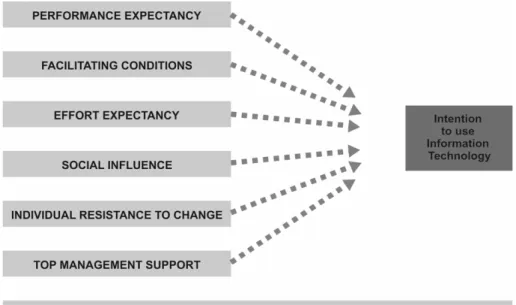
By Venkatesh [8], a single theory (model) the acceptance and use of technology (UTAUT) is a useful starting point for monitoring and adjustment process of adoption of the technology. UTAUT model, developed by Venkatesh, may primarily be used to identify factors that influence the intention to use information and communication technologies to be adopted by the organization. In addition, the model UTAUT trying to explain how they affect the individual differences between participants (users) technologies they use. What is important is the relationship between perceived usefulness, ease of use and intention to use. This can impact a number of factors such as the age, gender
and experience. Impact perception of ease of use is more important for women and older workers [9].
Figure 3. Model UTAUT by Venkatesh.
3. EARLIER STUDIES OF ACCEPTANCE THEORIES OF INNOVATION IN
CON-STRUCTION INDUSTRY
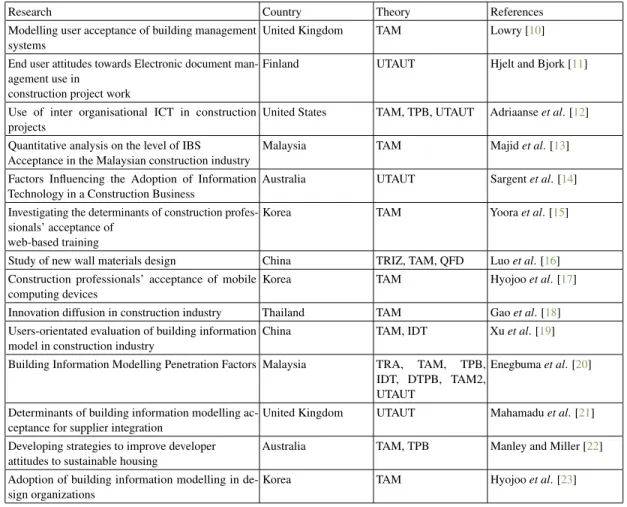
Literature provides many models and theories that address the issue of system or product implementation in all areas. In Table I. is a summary of previous acceptance theories usage in construction industry created on the basis of comprehensive literature review.
Lowry [10] in his study examines user acceptance of building management systems (crucial for optimising building performance) using a questionnaire survey. Established models of technology acceptance have been employed in his research, and the positive influence of user perceptions of ease of use and compatibility has been demonstrated. Hjelt and Bjork [11] proposed model that describes the key factors (performance expectancy, effort expectancy, social influence, facilitating conditions) affecting end user electronic document management adoption. Adriaanseet al. [12] in their research discussed the mechanisms that influence the way in which actors use inter organisational ICT in construction projects and directions for solutions for the potential barriers to the successful use of this ICT. Majidet al. [13] designed the quantitative survey in industrialized building systems (IBS) acceptance questionnaire based on the Technology Acceptance Model. The comparison between the groups of contractors was done and t-test analysis showed that all the class of contractors have a common agreement on the awareness of IBS and IBS actual use (the benefits of using IBS in construction) but have a significant difference in opinion on IBS actual use, perceived ease of IBS use and perceived IBS usefulness. Sargentet al. [14] examined individual and managerial factors which impact on intention to utilize a specific information technology in a project-based organization. The purpose of Yooraet al. [15] study was to investigate factors that influence the successful implementation of a Web-based training (WBT) system in the construction industry. It was found that user satisfaction is an adequate indicator of acceptance of WBT in the construction industry. Also it was found that construction professionals’ satisfaction with WBT was much more significantly affected by their belief about usefulness than by their belief about ease of use and finally, it was found that computer anxiety and organizational support are more important external variables than enjoyment, social
Table 1. Summary of previous researches in construction industry.
Research Country Theory References
Modelling user acceptance of building management systems
United Kingdom TAM Lowry [10]
End user attitudes towards Electronic document man-agement use in
construction project work
Finland UTAUT Hjelt and Bjork [11]
Use of inter organisational ICT in construction projects
United States TAM, TPB, UTAUT Adriaanseet al. [12]
Quantitative analysis on the level of IBS Acceptance in the Malaysian construction industry
Malaysia TAM Majidet al. [13]
Factors Influencing the Adoption of Information Technology in a Construction Business
Australia UTAUT Sargentet al. [14]
Investigating the determinants of construction profes-sionals’ acceptance of
web-based training
Korea TAM Yooraet al. [15]
Study of new wall materials design China TRIZ, TAM, QFD Luoet al. [16] Construction professionals’ acceptance of mobile
computing devices
Korea TAM Hyojooet al. [17]
Innovation diffusion in construction industry Thailand TAM Gaoet al. [18] Users-orientated evaluation of building information
model in construction industry
China TAM, IDT Xuet al. [19]
Building Information Modelling Penetration Factors Malaysia TRA, TAM, TPB, IDT, DTPB, TAM2, UTAUT
Enegbumaet al. [20]
Determinants of building information modelling ac-ceptance for supplier integration
United Kingdom UTAUT Mahamaduet al. [21]
Developing strategies to improve developer attitudes to sustainable housing
Australia TAM, TPB Manley and Miller [22]
Adoption of building information modelling in de-sign organizations
Korea TAM Hyojooet al. [23]
influence, information quality, and system quality in terms of their effects on the acceptance of WBT. In Luoet al. [16] study, design of new building wall materials was achieved through the integrated innovation method of Theory of Inventive Problem Solving (TRIZ), Technology Acceptance Model (TAM), and Quality Function Deployment (QFD). The goal of Hyojooet al. [17] research was to investigate the factors that influence successful implementation of mobile computing devices in the construction industry. This study extended the technology acceptance model (TAM) and founded that user satisfaction was an important indicator of adoption of the intent to adopt mobile computing devices in the construction industry. Gaoet al. [18] investigated the innovation diffusion situation in construction industry. They identified the main factors driving or hindering construction innovation diffusion - compatibility, performance justification, perceived risk, organizational variety and external influence. Xuet al. [19] proposed a research model to examine the factors that influence the adoption of BIM and the findings demonstrated that attitude, technological, and organizational dimensions indirectly affect the actual use of BIM. Furthermore, a striking finding was the positive influence of the attitude dimension on the actual use of BIM. Enegbumaet al. [20] study plots a path towards linking user perceptions of people, process and technology and how they react in strategic IT implementation and collaborative environment to fully support extensive BIM penetration in the industry. Mahamadu
et al. [21] defined model, by which it is demonstrated that user acceptance plays a major role in understanding BIM implementation within the supply chain context. The contribution of Manley and Miller [22] study was the presentation of novel theory and methods to address sustainability problems in the construction industry. Hyojoo
et al. [23] study introduced five external variables that may affect the adoption of BIM – top management support, subjective norm, compatibility, facilitating conditions, computer self-efficacy and result suggests that compatibility is
a major determinant of user perceptions of usefulness and ease of use in the context of BIM.
4. MODERN METHODS IN CONSTRUCTION INDUSTRY
The construction industry all over the world is under great pressure to improve its performance. Increasingly, new construction technologies are emerging and they are called modern methods of construction (MMC). Modern methods of construction are suggested to deal more effectively with uncertainties inherent in traditional construction regardinge.g.time, defects, safety, environmental impact [24], costs, profits and lifecycle performance [25].
The term of modern method of construction (MMC) was established in the UK as a common label for the construc-tion methods of construcconstruc-tion based on the off-site technologies (prefabricaconstruc-tion elements or parts of construcconstruc-tions are made off-site and then transported and assembled on site) and innovative on-site technologies (parts of construction elements are produced in the factory, but its functional location is completed on the site). According executive summary of Baker 33 Cross-Industry Group final report [26] modern methods of construction are about better products and processes. The aim is to improve business efficiency, quality, customer satisfaction, environmental performance, sustainability and the predictability of delivery timescales. MMC are, therefore, more broadly based than a particular focus on product. They engage people to seek improvement, through better processes, in the delivery and performance of construction. For MMC are characterized the following structural elements: wood or steel frame constructions, composite insulated non load-bearing or load-bearing sandwich panels, or still more popular volumetric modules [27]. Modern methods of construction have been proposed as a means of satisfying changes needed in building sector. Demands on the building sector have addressed effectiveness and efficiency issues, and they have been put forth by society, researchers and the sector itself.
Traditional buildings (TB) and buildings constructed by modern method are not as diametrically opposed as black versus white, and there are clear overlaps between them. In spite of that, it is possible to define the main distinctions between traditional buildings and buildings constructed by modern method [28] (seeTable 2).
Table 2. Distinctions between TB and building constructed by MMC [28].
Traditional buildings Buildings constructed by modern method High external clarity
Handling uncertainties/Agile production Flexibility (product)
Flexibility (process) Craftsmanship
Low external clarity
Aims to reduce uncertainties/standardise production Standardisation (product)
Standardisation (process) Industrialisation, factory-workers
Kozlovsk´a [29] says MMC has a great potential to improve the efficiency of construction production, quality, customer satisfaction, environmental impact, sustainability and predictability of construction design delivery in particular terms. Despite this, it has not been effectively implemented in Slovak republic, yet.
5. CONCLUSION
Each country has its own characteristics, which affect the adoption of new technologies in various fields. The acceptability of the use of models can help anticipate and resolve problems associated with innovation and adoption of amendments. Based on the evaluation of adoption of the model, based on innovation may also be rejected, since the risks that the change will not be accepted. The aim of the paper was to do an overview of the most commonly used acceptance models and theories for the innovation in general, and summarize their current use in the construction
industry. The adoption of new technologies and innovations in the building industry we can perceive from multiple perspectives. First view on this issue is the adoption of information and communication technologies to management support of construction projects., Suitable model for given area is the IS Success model, which takes into account a number of factors of adoption: system quality, information quality, system use, user satisfaction, individual impact project/organizational impact, process quality. Also UTAUT model is useful because of its highly versatile and it can be applied in construction. Another view of the adoption of innovations in the construction industry is adopting new methods of construction also known as the modern methods of construction. Modern methods of construction are suggested to deal more effectively with uncertainties inherent in traditional construction regardinge.g. time, defects, safety, environmental impact, costs, profits and lifecycle performance. For aacceptability assessment of these methods is, based on literature review, useful model TAM and UTAUT, which will be the subject of further research. It will be assessed the eligibility of several modern methods of construction, which are available in Slovakia, such as modular constructions and modern methods based on wood.
ACKNOWLEDGMENTS
”This publication is the result of the Project implementation: University Science Park TECHNICOM for Innovation Applications Supported by Knowledge Technology, ITMS: 26220220182, supported by the Research & Development Operational Programme funded by the ERDF.”
“The paper presented a partial research result of project VEGA - 1/0677/14 “Research of construction efficiency improvement through MMC technologies”.
References
[1] P. MES ´ARO ˇS, “Komunikaˇcn´e syst´emy,” p. 127, 2013.
[2] P. Mes´aroˇs and ˇS. ˇCarnick`y, “Business Intelligence and Knowledge Management : A Business Perspective,” p. 168, 2013.
[3] ˇS. ˇCarnick`y and P. Mes´aroˇs, “Informaˇcn´e syst´emy podnikov,” 2009.
[4] F. D. Davis, R. P. Bagozzi, and P. R. Warshaw, “User acceptance of computer technology: a comparison of two theoretical models,”Management Science, vol. 35, no. 8, pp. 982–1003, 1989.
[5] M. Bertrand and S. Bouchard, “Applying The Technology Acceptance Model To Vr With People Who Are Favorable To Its Use,”Journal of CyberTherapy & Rehabilitation, vol. 1, no. 2, pp. 200–207, 2008.
[6] F. D. Davis, “Perceived usefulness, perceived ease of use, and user acceptance of information technology,”MIS Quarterly, vol. 13, no. 3, pp. 319–340, 1989.
[7] C. Lindfors,Process oriented information management in construction. PhD thesis, Royal Institute of Technol-ogy, 2003.
[8] V. Venkatesh, M. G. Morris, G. B. Davis, and F. D. Davis, “User acceptance of information technology: Toward a unified view,”MIS Quarterly, vol. 27, no. 3, pp. 425–478, 2003.
[9] T. ˇSolt´es and M. Kozlovska, “Zniˇzovanie n´akladov stavebn´ych projektov prostredn´ıctvom n´avrhu,”Oceˇnovanie A Riadenie Stavebn´ych Projektov, 2012.
[10] G. Lowry, “Modelling user acceptance of building management systems,”Automation in Construction, vol. 11, no. 6, pp. 695–705, 2002.
[11] M. Hjelt and B.-C. Bjork, “End user attitudes towards EDM use in construction project work a case study,”
American Society for Civil Engineering Journal of Computing in Civil Engineering, vol. 21, no. 4, pp. 289–300, 2007.
[12] A. Adriaanse, H. Voordijk, and G. Dewulf, “The use of interorganisational ICT in United States construction projects,”Automation in Construction, vol. 19, no. 1, pp. 73–83, 2010.
[13] T. A. Majid, M. Azman, S. A. S. Zakaria, A. S. Yahya, S. S. Zaini, M. S. S. Ahamad, and M. H. Hanafi, “Quantitative analysis on the level of IBS acceptance in the malaysian construction industry,” Journal of
Engineering Science and Technology, vol. 6, no. 2, pp. 179–190, 2011.
[14] K. Sargent, P. Hyland, and S. Sawang, “Factors influencing the adoption of information technology in a construction business,”Australasian Journal of Construction Economics and Building, vol. 12, no. 2, pp. 72–86, 2012.
[15] Y. Park, H. Son, and C. Kim, “Investigating the determinants of construction professionals’ acceptance of web-based training: An extension of the technology acceptance model,”Automation in Construction, vol. 22, pp. 377–386, 2012.
[16] L. Yihong, S. Yunfei, and C. Ting, “Study of New Wall Materials Design Based on TRIZ Integrated Innovation Method,”Management Science and Engineering, vol. 6, no. 4, pp. 15–29, 2012.
[17] H. Son, Y. Park, C. Kim, and J.-S. Chou, “Toward an understanding of construction professionals’ acceptance of mobile computing devices in South Korea: An extension of the technology acceptance model,”Automation in Construction, vol. 28, pp. 82–90, 2012.
[18] J. Gao, M. Li, and C. Y. Tan, “A concept model for innovation diffusion in construction industry,”
[19] H. Xu, J. Feng, and S. Li, “Users-orientated evaluation of building information model in the Chinese construction industry,”Automation in Construction, vol. 39, pp. 32–46, 2014.
[20] W. Enegbuma, Y. Dodo, and K. Ali, “Building Information Modelling Penetration Factors in Malaysia,”
International Journal of Advances in Applied Sciences, vol. 3, no. 1, pp. 47–56, 2014.
[21] A.-M. Mahamadu, L. Mahdjoubi, and C. A. Booth, “Determinants of building information modelling (BIM) acceptance for supplier integration: a conceptual model,” inProcs 30th Annual ARCOM Conference, 1-3 September 2014, Portsmouth, UK, Association of Researchers in Construction Management, pp. 723–732, 2014. [22] K. Manley and W. Miller, “Innovative design: developing strategies to improve developer attitudes to sustainable
housing,”World Sustainable Building 2014, 2014.
[23] H. Son, S. Lee, and C. Kim, “What drives the adoption of building information modeling in design organiza-tions? An empirical investigation of the antecedents affecting architects’ behavioral intentions,”Automation in Construction, vol. 49, pp. 92–99, 2015.
[24] M. Kozlovsk´a and M. Spiˇs´akov´a, “Contruction waste generation across construction project life-cycle,” Orga-nization, Technology & Management in Construction: An International Journal, vol. 5, no. 1, pp. 687–695, 2013.
[25] L. Kyjakov´a and R. Baˇskov´a, “Genesis and potential of modern methods of construction,” in6th PhD. Student Conference of Civil Engineering and Architecture, pp. 1–8, 2014.
[26] “Baker 33 Cross-Industry Group final report,” http://www.hbf.co.uk/fileadmin/documents/ barker/MMC_Final_Draft.pdf.
[27] WRAP, “Current practices and future potential in modern methods of construction,”WAS003-001: Summary Final Report, 2007. http://www.wrap.org.uk/sites/files/wrap/Modern%20Methods% 20of%20Construction%20-%20Summmary.pdf.
[28] S. Engstr¨om, L. Stehn, and Y. Sard´en, “Competitive impact of industrialised building: in search for explanations to the current state,” inAnnual Conference, Association of Researchers in Construction Management ARCOM. ARJ Dainty. Nottingham, Storbritannien, Association of Researchers in Construction Management, vol. 25, pp. 413–424, 2009.
[29] M. Kozlovsk´a, “Research methodology of construction efficiency improvement through MMC technologies,” in
Improving the Efficiency of Construction Through MMC Technologies. Proceedings of Scientific Papers 2014, pp. 7–14, 2014.
![Figure 1. Technology Acceptance Model (TAM) [6].](https://thumb-us.123doks.com/thumbv2/123dok_us/9791441.2863737/2.918.177.689.588.740/figure-technology-acceptance-model-tam.webp)
![Figure 2. Information System Success Model (D&M IS) [7].](https://thumb-us.123doks.com/thumbv2/123dok_us/9791441.2863737/3.918.176.690.198.437/figure-information-system-success-model-d-amp-is.webp)
![Table 2. Distinctions between TB and building constructed by MMC [28].](https://thumb-us.123doks.com/thumbv2/123dok_us/9791441.2863737/6.918.196.671.701.798/table-distinctions-tb-building-constructed-mmc.webp)
