Available online on 15.09.2016 athttp://jddtonline.info
Journal of Drug Delivery and Therapeutics
An International Peer Reviewed Journal
Open access to Pharmaceutical and Medical research
© 2016, publisher and licensee JDDT, This is an Open Access article which permits unrestricted noncommercial use, provided the original work is properly cited
RESEARCH ARTICLE
ASSESSMENT OF KNOWLEDGE, ATTITUDE, AND PRACTICE OF SELF-MEDICATION
AMONG HARAR HEALTH SCIENCES COLLEGE STUDENTS, HARAR, EASTERN
ETHIOPIA
Weyni Hailemichael, Mekonnen Sisay*, Getnet Mengistu
School of Pharmacy, College of Health and Medical Sciences, Haramaya University, Harar, Ethiopia
Received 11 Aug 2016; Review Completed 30 Aug 2016; Accepted 30 Aug 2016, Available online 15 Sep 2016
ABSTRACT
Background: Self-medication is the selection and use of non-prescription medicines by individuals’ own initiatives to treat self-recognized illnesses or symptoms. It is practiced significantly worldwide even though its type, extent and reasons for its practice may vary. No data is available on the current status of self-medication practices among students of Harar Health Science College (HHSC). Therefore, this study aimed to assess basic information on self-medication practices among students of HHSC, Harar, Ethiopia.
Methods: Institutional based cross sectional study was conducted on students in HHSC from March 21 to March 25, 2016. Study participants were determined by two step stratified sampling followed by simple random sampling techniques. Data was collected using self administered questionnaire prepared in English. Data was entered and analyzed using SPSS version 16. Cross tabulation, Pearson Chi-square (χ2) test and logistic regression were applied to show the association between selected categorical variables with self medication. Data was then presented using tables, figures and charts.
Results: Out of the total 237 participants 112(36.50%) were males and 125(52.7%) were females. The prevalence of the practice of self-medication was high (70%) with most frequently reported problems being headache and mild pain (47.3) followed by GI problem (30.8%) and eye and ear symptoms (29.1%). Most of the respondents (55.7 %) read leaflet and 34.6 % of the respondents had some knowledge about the definition of self-medication. The two main reasons for self-medication were knowledge gain (37.6%) and time saving (28.7%). Antibiotic (47%) and pain killer (37%) were the two most frequently consumed medications. Previous prescriptions (33.9%) followed by Pharmacist/druggist (24.6%) were the two most frequently reported source of drug information for self-medication in this study. Besides, 70% of the respondents agreed with the practice of self-medication in the present study. There were statistically significant differences between respondents who reported practicing self-medication based on study year (p<0.05). Most respondents had positive attitude towards self-medication and antibiotics were the drugs most commonly used for self-medication without a prescription despite the fact that they were aware of the risk of development of antimicrobial resistance.
Conclusion: The practice of self-medication was common and, in most cases, inappropriate. Most students had a positive attitude towards medication. Hence, drug authorities and health professionals need to educate students about the pros and cons of self-medication.
Keywords: self medication, knowledge, attitude, practice
DOI:http://dx.doi.org/10.22270/jddt.v6i5.1329 URI: http://jddtonline.info/index.php/jddt/article/view/1329
INTRODUCTION
Self-medication can be defined as the use of drugs to treat self-diagnosed disorders or symptoms, or the intermittent or continued use of a prescribed drug for chronic or recurrent disease or symptoms.1 Self-care is what people do for their own selves to establish and maintain health, prevent and deal with illness.2Studies revealed that increase in self-medication was due to a number of factors. These include socioeconomic factors, lifestyle, ready access to drugs, the increased potential to manage certain illnesses through self-care, and greater availability of medicinal products.3
for the prevention or treatment of minor ailments or symptoms, which do not justify medical consultation. In some chronic or recurring illnesses, after initial diagnosis and prescription, self-medication is possible with the doctor retaining an advisory role. 4, 5
The main reasons for self-medication include health problem being not serious, the illness is minor, to get quick relief of the condition and to avoid long waiting at clinics. 6, 7
Inappropriate self-medication results in irrational use of drugs, wastage of resources, increased risk of adverse reactions and prolonged suffering.8 Irrational usage of antibiotics led to the emergence of resistance pathogens worldwide.9 Furthermore, The risk associated with self-medications also include a potential of delay in treating a serious medical conditions, masking of symptom of the serious condition through the use of non-prescription products, increase polypharmacy and interaction with other regularly used medication.10
METHODS
Study design and setting
Institution based prospective cross-sectional study was conducted to assess the knowledge, attitude and practice of self-medication in HHSC students, Harar which is located 526 km from the capital of Ethiopia, Addis Ababa. The study was conducted from March 21-25, 2016.
Study population
Students in the department of Pharmacy, Public Health, Compressive Nursing and Midwifery of both genders and of any age during the academic year 2016 G.C were included. However, students who have reading, hearing and/or psychiatric problem as well as those who are not willing to participate in the study were excluded.
Sample size determination and sampling techniques
The sample size was determined by taking the following assumptions; since there was no previous study in the area, the estimated prevalence rate of population who practice and have positive agreement towards self-medication to be 50%, with confidence level of 95%, marginal error of 5% and non-response rate of 5%.
ni =
=
= 384
The study population (N) was 546 students (<10,000) and hence estimating the final sample size was done as follows
nf=
where, nf=final sample size
ni=initial sample size
N=study population
nf =
= 226.
With 5% non-response rate, 226 +11=237 students were included in the study.
Two step stratified sampling (from college to departments and then to study years level) was employed based on appropriate proportion of the respective field of study. Finally, sample from each stratum (study year) was selected using simple random sampling.
Data collection tools and procedures
Structured questionnaire was prepared in English version. Data was collected using self administered questionnaire (filled by the respondent themselves).
Data quality control
The data was checked for completeness, accuracy, and those found missing in addressing important variables was discarded and no longer used as a predictor variable.
Data processing and analysis
Data was coded, given sequential numbers and entered into SPSS, version 16. Analysis was carried out using descriptive and inferential statistics. Cross tabulation, Pearson Chi-square test and logistic regression were applied for comparing the effects of selected categorical variables with self medication. P value less than 0.05 was considered to be statistically significant. The results were then presented in tables, figures and charts.
Ethical consideration
Approval and permission was sought from HHSC with letter written by School of Pharmacy, Haramaya University. To obtain the consent of college and students prior to data collection, a detailed explanation on the aim and objectives of the study was given.
RESULT
Out of the 237 participants, 112 (47.3%) were males and 125(52.7%) were females. Most of the responding students 110(46.6%) were aged less than 20 years, 103(43.6%) were aged 20-24 and >24 were 23(9.7%). Majority of the students were from Oromoia 107(45.1) followed by Amhara 67(28.1%) and Harari 36 (15.2%) regions. Most of the respondents were Orthodox 106(44.7%) followed by Muslims 83(35%). Besides, 151 (63.7%) respondents live with their family. Coming to self medication practices, with in age category, percentage of drug bought or utilized seems to be increased as the age increases. However, there is no statistically significant association between age and self medication in this study (Table 1).
There is no statistically significant difference between the students’ groups according to the use of self-medication by their department (Pearson χ2
Table 1: Socio- demographic characteristics of students in relation to self medication practices in HHSC, Harar, Ethiopia, March 2016 (n=237)
Socio demographic Variables Frequency (%) Drug utilized without prescription Pearson χ2 P value
Age <20 110 (46.6) 64 (58.2)
20-24 103 (43.6) 66 (64.1)
>24 23 (9.7) 17 (73.9) 2.25 0.324
Gender Male 112 (47.3) 66 (58.9)
Female 125 (52.7) 81(64.8) 0.07 0.791
Ethnicity Oromia 107 (45.1) 68 (63.6)
Amhara 67 (28.1) 39 (58.2)
Tigray 17 (7.2) 10 (58.8)
Harari 36 (15.2) 22 (61.1)
Others 10 (4.2) 8 (80.0) 1.98 0.74
Religion Orthodox 106 (44.7) 64 (60.4)
Catholic 22 (9.3) 12 (54.5)
Muslim 83 (35) 53 (63.9)
Others 26 (11) 18 (69.2) 1.37 0.71
Family structure
Live with family 151(63.7) 91 (60.3)
Live alone 86 (36.3) 56 (65.1) 0.55 0.45
Figure 1: Departments of respondents who bought drug without prescription in HHSC, March, 2016 (n=237)
There have been statistically significant differences between the students’ groups according to the use of self-medication by their study year (Pearson χ2=34.78, p<0.001). As study year is increased the prevalence of self-medication was increased. The study actually revealed the effects of knowledge gain on self medication practices as the year of enrollment increases. However, its positive effect might be overwhelmed by several negative factors such as emergence of drug resistance, adverse drug reactions (Table 2).
Fifty three (22.4%) of the respondents had very good knowledge regarding self medication; 82 (34.6%) had well; 77(32.5%) had poor and the rest 25(10.5%) had no knowledge about the definition of self-medication based on knowledge scaling. More than half 131(55.3%) of the respondents were aware of antimicrobial resistance (Table 3).
Table 2: Category of students who bought drugs without prescription by the study year in HHSC March, 2016 (n=237)
Study Year Drug used or bought without prescription Pearson χ2 P value
Yes No
First year 44 (29.93) 52(57.78)
Second year 49 (33.33) 34(37.78)
Third year 54(38.78) 4(4.44)
Total 147(100) 90(100) 34.78 0.00
27.21
38.89 36.73
21.11 18.37
21.11
17.69 18.89
0 10 20 30 40 50
Yes No
Per
ce
n
t
Drugs bought without prescription Pharmacy
Table 3: Respondents' knowledge regarding self-medication in HHSC, Harar, Ethiopia, 2016 (n=237)
Variables Grading Frequency %
Knowledge about definition of self-medication
Very good 53 22.4
Good 82 34.6
poor 77 32.5
Not at all 25 10.5
Awareness of antimicrobial resistance Aware 131 55.3
Nor aware 106 44.7
The majority 166(70%) of the respondents had a positive attitude towards self-medication and favored self-medication saying that they agreed, 51(21.5%) disagreed, while 20(8.4%) had no comment. Most of the respondents 114(48.1%) said that increase drug dose
can be dangerous. Amongst the socio-demographic factors, religion has shown relationship with views on various aspects of self medication (p=0.004). Being an orthodox Christian is more likely to associate with views on some aspects self medication (Table 4).
Table4: Respondents attitude regarding self-medication in HHSC, Harar, Ethiopia, 2016 (n=237)
Variables and scaling Frequency %
Attitude towards self-medication
Agreed 166 70
Disagreed 51 21.5
No comments 20 8.4
Students views on of self-medication
Increasing drug dose can be dangerous 114 48.1
All medications have adverse effect 44 18.6
No drug can be used during pregnancy 36 15.2
Self-medication can mask signs and symptoms 26 11
Decreasing drug dose can be dangerous 17 7.2
Of the 237 respondents, 147 (62%) bought drug without prescription. Majority of the students 80(33.9%) obtained information about self-medications from previous prescription, 24.6% followed by pharmacists/druggists, 21.6%. The most common health problems reported by respondents were headache and
mild pain 47%, GI problems 30.8%, eye and ear infections, 29.1% among others. Most of the respondents 158(66.7%) took the same medication when presenting with similar symptoms. High number of students 135(57%) gave prescription to someone when have similar manifestations (Table 5).
Table 5: Self-medication practices of HHSC students, Harar, Ethiopia, 2016 (n=237)
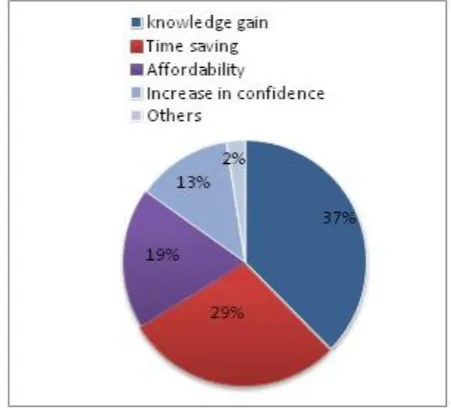
Self medication practices might be emanated from variety of reasons in this study, 37% of students’ reason to self-medicate was knowledge gain followed by 29% time saving (Figure 2).
Self-medication practice Variables Frequency (%)
Bought drug without prescription Yes 147 62
No 90 38
Source of self-medication information Previous prescription 80 33.9
Pharmacist 58 24.6
Study books /internet 51 21.6
Friends/ Family 40 16.9
Others 7 3
Common health problems Headache or mild pain 112 47.3
GI problems 73 30.8
Eye and ear symptoms 26 29.1
Vomiting 15 6.3
Others 11 4.6
Read the leaflets Yes 132 55.7
No 105 44.3
The same medication used when presenting the same symptoms
Yes 158 66.7
No 79 33.3
Gave prescription to someone who have similar symptoms
Yes 135 57.0
Figure 2: The reasons for self-medication given by respondents in HHSC, 2016 (n=237)
Besides, the most common types of self-medication used by participants include antibiotic (47%), pain killer (37%), vitamins and minerals (10%) among others (Figure 3).
Figure 3: Commonly used self-medications among HHSC students, Harar, Ethiopia, 2016 (n=237)
DISCUSSION
Self-medication is the practice whereby individuals treat their ailments and conditions with medicines which are approved and available without prescription, and which are safe and effective when used as directed. However, it will lead to unintended effect if inappropriately used. 10
Studies revealed that increase in self-medication was due to a number of factors. These include socioeconomic factors, lifestyle changes, ready access to drugs, the increased potential to manage certain illnesses through self-care, and greater availability of medicinal products.3
The issue of long waiting queues at clinics or hospitals was also raised by the respondents as one of the reasons for seeking self-care in order to meet up with their tight lecture schedule. Respondents used self-prescribed drugs to treat their self-diagnosed disorders or ailments based on their own initiative.11
Concerning the socio-demographic characteristics, most of the respondents were females (52.7%), less than 20 years old (46.6%), those came from Oromia region (45.1%), Follower of orthodox (44.7%), and live with their family (63.7%).
In this study, the prevalence of self-medication (62%) among the study subjects was higher than the study done in Mekelle University (43.24%) 12 and Gondar University 38.20%13. Most important reason for higher trend of self-medication might be the easy availability of medicines without prescription.
There had been statistically significant differences between the students’ groups according to the use of self-medication by their study year (p<0.05). As study year is increased the prevalence of self-medication was increased. This may partially attributable to knowledge gain to treat themselves despite the negative impacts of self medication such as emergence of adverse drug reactions, antimicrobial resistance and drug-drug interactions.
The prevalence of self-medication amongst university students in Palestine was found to be about 98%.14 regarding the knowledge on definition of self-medication, 34.6 % of the respondent had some knowledge on this study. This shows that most of the subjects had shortage of knowledge in the definition of self-medication and this can result to improper usage.
Concerning the source of information about self-medication, (33.9%) respondent in study use previous prescription the study done in Pakistan showed that (23.8%) respondent used previous history same medication. This is may be due to lack of awareness as using previous experience may be exposed to the dangers of misdiagnosis and consequently wrong treatment.
In this study the most common reason for self-medication reported by a large number (37.6%) of participants was due to increases the knowledge regarding drugs and their use which is similar reason with the study done in Mekelle university.12 However, affordability was a majorly reason reported in other study conducted in Jimma town (35.70%) 15 and in a study from Tamil Nadu most students practiced self-medication as it was time saving.1
The most common types of health problem faced for which the respondents reported were headache and mild pain (47%) which shows lower value compared to the study done in Mekelle university (51.56%).12
might be due to high access of these medication and poor usage of antimicrobials.
The majority (70%) of the respondents had a positive attitude towards medication and favored self-medication saying that they agreed. This was comparable with the study done in Jimma university10 but relatively high as compared to the report from Gonder University which is 55.5%13and study in Mekelle University (52.30%).12 This might be a means for drug interaction with regular medicine, drug resistance for antimicrobials, masking and complication of illnesses and increase irrational use of medicines.
CONCLUSION
The practice of self-medication was common and, in most cases, inappropriate. Most Students had a positive attitude towards self-medication and antibiotics were the drugs most commonly used for self-medication without a prescription despite the fact that majority of them were aware of the risk of emergence of antimicrobial resistance. Many diseases have similar symptoms, and a person using previous experience
may be exposed to the dangers of misdiagnosis and consequently wrong treatment.
Acknowledgements
We would like to thank Haramaya University for provision of material supports. We also extend our deep appreciation for Harar Health Sciences College staffs and students for their kindly support.
Competing interests:
The authors have declared that there is no competing interest
Authors' Contribution
WH and MS were involved in conception of the original idea, helped to draft the proposal, participated in all implementation stages of the project, and write up; all authors including GM reviewed it critically and involved preparation of the manuscript. All authors read and approved the final version of the manuscript.
Funding: None
REFERENCES
1. Badiger S. Kundapur R, Jain A, Kumar A, et al, Self-medication Patterns among medical students in South India,
Australasian Medical Journal 2012;5(4):217-20
2. World Health Organization (WHO): Role of pharmacists in self-care and self-medication. The Fourth consultative group meetings on the role of the pharmacist in the health care system organized by WHO in collaboration with the International Pharmaceutical Federation (FIP), Hague 1998,
pp. 2-11.
3. World Health Organization. The Role of pharmacist in Heath Care System; 1998. available from: http://www.apps.who.int /medicinedocs/en/d/Jwhozip32e last accessed on Nov 2015 4. Shankar PR, Partha P, Shenoy N: Self-medication and
non-doctor prescription practices in Pokhara valley, Western Nepal: a questionnaire-based study. BMC Family Practice
2002, 3:17.
5. Mohammed A and Ales K, Self-medication with antibiotics by the community of Abu Dhabi Emirate, United Arab Emirates. J. Infect. Dev. Ctrie 2009 3: 491-497
6. Olayemi, O.J., B.O. Olayinka and A.I. Musa, Evaluation of antibiotic self-medication pattern Amongst undergraduate students of Ahmadu Bello university (main campus), Zaria. Res. J. Applied Sci. Eng. Technol.2010, 2: 35-38.
7. Sontakke SD, Bajait CS, Pimpalkhute SA et al Comparative study of evaluation of self-medication practices in first and
third year medical students. Int. J. Biol. Med. Res.2011, 2: 561-564
8. Kiyingi KS, Lauwo JA; Drugs in the home: Danger and waste. World Health Forum, 1993; 14: 381-384.
9. Pagane D, Self-medication and health insurance coverage in Mexico. Health Policy 2007; 75(2): 170-177.
10. Angamo and Wabe, Evaluation of the Knowledge, Attitude and practice of self- Medication among undergraduate medical students IJPSR 2012, 3:1005-1010
11. Osemene KP and Lamikanra A, the Prevalence of Self-Medication Practice among University Students in Southwestern Nigeria Tropical Journal of Pharmaceutical
Research 2012; 11 ;683-689
12. Gutema A: Self-Medication Practices among Health Sciences Students: The Case of Mekelle University, Journal of Applied
Pharmaceutical Science 201, 01 : 183-189
13. Abay SN, Amelo W, Assessment of Self-Medication Practices Among Medical, Pharmacy, and Health Science Students in Gondar University, Ethiopia. Journal of young
and Pharmacy, 2010, 2: 306–310.
14. Sawalha AF; Assessment of self-medication practice among University students in Palestine: Therapeutic and Toxicity Implications. The Islamic University Journal (Series of
Natural Studies and Engineering)2007 15(2):67-82
15. G/Mariam A, Worku S: Practice of self-medication in Jimma town. Ethiop. J. Health Dev.2003; 17:111-11
*Corresponding Author: Mekonnen Sisay ([email protected]), Department of Pharmacology, School of Pharmacy, College of Health and Medical Sciences, Haramaya University, Harar, P.O. Box 125, Ethiopia, Cell phone, +251920-21-21-35
Cite this article as:
Hailemichael W, Sisay M, Mengistu G,Assessment of the knowledge, attitude, and practice of self-medication