© 2018 IJSRST | Volume 4 | Issue 2 | Print ISSN: 2395-6011 | Online ISSN: 2395-602X Themed Section: Science and Technology
Structured Teaching Program : An Effective Strategy for Mosquito Control
Practices among High School Children
Kasthuri S
Professor, Gitam Institute of Nursing, Gitam, Visakhapatnam, Andhra Pradesh, India
ABSTRACT
The present quasi-experimental study focused on identification of effectiveness of structured teaching program practices regarding control of mosquito control measures among high school children at selected high school at rural Vizianagaram district. The study identified that at pre-test, the practice levels are Poor practices 35.3% (12), and the fair practices 64.7% (22). It has been observed that the practices has improved to good practices 100% (34) during post-test. The study also showed that the structured teaching program was effective in improving the practices on mosquito control measures p < 0.00001 ( significant at 0.05 level). The study also identified that there is no significant association between the selected demographic variables and pre-test knowledge levels.
Keywords : Effectiveness, Structured Teaching Program, Mosquito Control Measures, Practices
I.
INTRODUCTION
In India, the common vector borne diseases are Malaria, Filaria, Dengue and Chikungunya. According to The National Health Mission (NHM), the total number of malaria cases reported in Andhra Pradesh is 3100. There is recurring outbreak of Dengue in Andhra Pradesh, with clinically reported 866 cases1. There is a strong need to improve the health of people in rural areas from mosquito borne diseases and improve the quality of life by providing preventive care. Structured teaching program can be used as a strategy to impart knowledge on prevention of mosquitoes and persuade school children to improve the mosquito control practices.
Need for the Study:
Maumita de et.al (2015) reported that vector borne disease occur due to interaction of biological, ecological, social and economic factor. Even if people are given information through mass communication and educational approaches, community participation is far below the expectation5.
Hanumath Raju et.al stated that Malaria prevalence is more especially P. falciparum which is due to lack of awareness and preventive measures in agency areas in Andhra Pradesh4.
Vala Mayur et.al (2013) stated that despite of so many efforts to control malaria, dengue and Chikungunya, these diseases are still having a huge impact on health, wellbeing and economy of the people. Key success for mosquito borne diseases control depends not only on services provided by Health Authority but also on knowledge on clinical manifestation, awareness and early care seeking behavior of the community8. There is a need to know existing knowledge and practice regarding mosquito borne diseases and its control in community.
practices and also persuade their parents to practice them.
Objectives:
To assess the pre-test and post-test practices of mosquito control measures among high school children.
To assess the effectiveness of structured teaching program on practices of mosquito control measures among high school children.
To find out the association between selected demographic variables and pre-test practices of mosquito control measures.
Limitations:
The study is limited to only high school children
The study is limited to only school.
Methodology:
Research design: A one group pre-test and post-test design is used to find out the effectiveness of structured teaching program on mosquito control measures.
Sample: A total of 34 samples were selected using simple random sampling technique.
Inclusion Criteria:
Students studying in high school.
Students of 6th and 7th standard are included in the study.
Students who can understand Telugu and English are included in the study.
Students who are willing to participate in the study.
Exclusion Criteria:
Students who are not willing to participate in the study
Students who are absent during data collection time.
Method of data Collection: Data was collected using self-reported questionnaire which was prepared by the researcher and content validity was obtained from the experts in community health nursing. Pre-test data is obtained. Then students are implemented with structured teaching program on mosquito control measures. Post-test data was collected with a gap of two weeks duration.
Description of Tool: It consists of 2 sections.
Section-1: The demographic information like age, sex, religion, class, type of the family, source of health information, type of house and method of disposal of refuse are included in this section.
Section-2: The items pertaining to practices of mosquito control measures are listed. The students are needed to answer the items according to the practices like “Always”, “sometimes” and “never”.
Data Collection procedure: Permission was obtained from the Principal of ZP high School, Maharajupeta at Vizianagaram district in Andhra Pradesh.
Data Analysis: Demographic data was analyzed using frequencies and percentages. T-test was used to find the effectiveness of structured teaching program on the practices of mosquito control measures. Chi-square was used to find the association between selected demographic variables and pre-test practices on mosquito control measures.
Score Interpretation for Practices
Each practice item is scored as following: Practice Score
Always 2 Marks Sometimes 1 Mark Never 0 Marks
II.
RESULTS
Table 1. The frequency and percentage distribution of high school children according to demographic variables (N= 34)
S.No Demographic variables Frequency Percentage
1. Age
<11 yrs 1 2.9
11-12 yrs 29 85.3
13-14 yrs 4 11.8
2. Sex
Female 20 58.8
Male 14 41.2
3. Religion
Hindus 100 100
Christians 0 0
Muslims 0 0
Others 0 0
4. Class
6th Class 20 58.8
7th Class 14 41.2
5. Type of family
Joint 10 29.4
Single 24 70.5
6. Source of information
T.V 31 91.2
Newspaper 2 5.9
Radio 0 0
Neighbours 1 3.0
Others 0 0
7. Type of House
Kutcha 5 14.7
Pucca 25 73.5
Slab 3 8.8
Others 1 3.0
8. Method of disposal of refuse
Dumping 9 26.4
Burning 15 44.1
Manure 5 14.7
Table 2. Comparison of pre-test and post-test Practices on mosquito control measures among high school children (N=34)
Practice levels
Poor Practice Fair Practice Good Practice Frequency Percentage Frequency Percentage Frequency Percentage
Pre-Test 12 35.3 22 64.7 0 0
Post-Test 0 0 0 0 34 100
Table 3. Effectiveness of structured teaching program on Practices on mosquito control measures among high school children (N=34)
Practice Mean SD Mean difference
df Paired T-test
p-value
Pre-Test 11.7 3.3
14.7 33 20.7 <0.00001* Post-Test 25.8 2.05
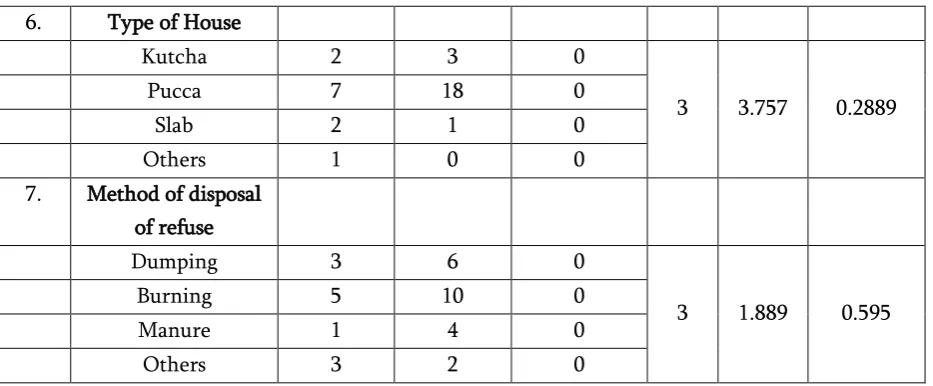
Table 4. Association between selected demographic variables and pre-test Practice levels of mosquito control measures among high school children (N=34)
S.No Demographic variables
Knowledge levels
df X2 p-value Poor
Practice
Fair Practice
Good Practice
1. Age
<11 yrs 1 0 0
2 2.027 0.362
11-12 yrs 10 19 0
13-14 yrs 1 3 0
2. Sex
Female 8 12 0
1 0.471 0.492
Male 4 10 0
3. Class
6th Class 8 12 0
1 0.471 0.492
7th Class 4 10 0
4. Type of family
Joint 3 7 0
1 0.174 0.6767
Single 9 15 0
5. Source of information
T.V 12 19 0
4 1.795 0.4076
Newspaper 0 2 0
Radio 0 0 0
Neighbors 0 1 0
6. Type of House
Kutcha 2 3 0
3 3.757 0.2889
Pucca 7 18 0
Slab 2 1 0
Others 1 0 0
7. Method of disposal of refuse
Dumping 3 6 0
3 1.889 0.595
Burning 5 10 0
Manure 1 4 0
Others 3 2 0
III.
DISCUSSION
Muninarayana et.al, reported that most organized vector control strategies require public support of one kind or another and the extent of people’s cooperation can determine the success or failure of the entire campaign6. Singh et.al (2006) stated that the Program implementers need to understand the disease-related knowledge, attitude, and practices of the community, because these are the important determinants of community participation7.
The present study proved that this structured teaching program helped in enhancing the practices of mosquito control measures among high school children. The high school children are provided information on diseases caused by mosquitoes, their signs and symptoms, mosquito breeding places and mosquito control measures that improved their mosquito control practices. Table-2 showed that at pre-test, the practice levels are Poor practices 35.3% (12), and the fair practices 64.7%(22). It has been observed that the practices have improved to good practices 100% (34) during post-test.
Table 3 shows that the structured teaching program was effective in improving the practices on mosquito control measures p < 0.00001 (significant at 0.05 level).
Gubler (1989) described that programmes should stress the importance of source reduction as a method
for control of indoor mosquito breeding for dengue and malaria prevention activities. The daytime biting nature of Aedes mosquitoes and the breeding of Anopheles and Aedes mosquitoes in relatively clean water stored in domestic water containers must be
conveyed to the community2.
Iloyd et.al (1994) stated that a sound knowledge-base about vector-borne diseases and methods of vector
control must be built among the community3.
Implications to Nursing:
Nursing Practice: Community health nurses can utilize similar strategies to provide knowledge on various preventive measures and improve preventive care among the high school children, as they are the future citizens of India, where the future health can be improved by providing knowledge to them.
Nursing Education: This strategy can be used as a reference material in order to provide health education and improve quality of life among high school children on mosquito control measures.
Nursing Research: Extensive research on child-to-parent approach can be done to transfer information from child to parent thereby preventive aspects of mosquito control measures can be imparted even to adults acting as a new strategy to impart health education.
Recommendation:
Similar study can be done with large sample. Comparative study can be done on practices
among rural and urban high school children. Similar study can be done on higher age groups.
IV.
REFERENCES
[1].Disease control Programs (NHM)-Annual Report 2016-17, chapter-5. Pg: 56-57.
[2].Gubler DJ. Aedes aegypti and Aedes aegypti-borne disease control in the 1990s: top down or bottom up. Am J Trop Med Hyg. 1989; 40(6): 571-578.
[3].Lloyd LS, Winch P, Ortega-Canto J and Kendall C.The design of a community-based health education intervention for the control of Aedes aegypti. Am J Trop Med Hyg. 1994; 50(4): 401-411.
[4].M. Hanumantha Raju, N. Ganesh, K. Kalyan Kumar, M. Sowjanya, P.V.V. Satish, K. Sunita. A study on prevalence of Malaria in different mandals of East Godavari District, Andhra Pradesh, India. International Journal of Latest Research in Science and Technology. Vol:3 (6), Pg:74-77.
[5].Maumita De, Diptanshu Mukherjee, Shubhadeep Paul, Romy Biswas, Anima Halder. A study on knowledge and Practices regarding Malaria among Adult urban population of Siliuri. IOSR Journal of Dental and Medical Sciences. Vol:14, Issue 9, Ver.VIII, PP: 33-36
[6].Muninarayana C, Hiremath SG, Krishna Iyengar, Anil NS, Ravishankar S. Awareness &
Perception Regarding Malaria in Devarayasamudra Primary Health Centre Area. Indian Journal for the Practicing Doctor 2008; 5(1).
[7].Singh P, Dandu C, Reddy S, Mishra RN, ShyamSundar. Knowledge, attitude, and practices related to kala-azar in a rural area of Bihar State, India. Am J Trop Med Hyg 2006; 75(3):505–8.