© 2018 IJSRST | Volume 4 | Issue 7 | Print ISSN: 2395-6011 | Online ISSN: 2395-602X Themed Section: Science and Technology
Improving Palmprint Identification Using Gabor Filter
P. Uma Sindhu*, S. Swarna Latha
Sri Venkateswara University College of Engineering, Tirupati, Andhra Pradesh, India
ABSTRACT
Multibiometrics can supply predominant arrangement exactness than specific biometrics, so it is further appropriate for an amount of genuine individual recognition applications that need exclusive expectation resistance. Among different biometrics advances, palm print distinguishing proof has accomplished much fixation in light of its great execution. Earlier practice depends on multi biometrics by joining the left and right palm print pictures. This structure fused three sorts of scores created from the left and right palm print pictures to perform coordinating score-level combination. The initial two sorts of scores were, separately, produced from the left and right palm print pictures and can be gotten by any palm print recognizable proof technique, while the third sort of score was acquired utilizing a devoted calculation arranged by application. Our future work depends on the gabor channel where the inclination and period of a palm print is computed. This is done in two stages .They are enlistment and check steps. In enlistment step, palm print procurement, palm print preprocessing and the surface and highlight extraction are finished. The database is discovered in light of the enlistment advance .Next a similar procedure is followed in check step. At that point coordinating of the inquiry picture with the database is confirmed .After coordinating the coordinated outcome is gotten. This strategy accomplishes better execution and acquired substantial and precise outcomes than the other condition of workmanship strategies.
Keywords : Palmprint recognition, biometrics, multibiometrics, Gabor filter
I.
INTRODUCTION
Palm print acknowledgment has developed as an exceptionally acknowledged biometric framework because of its simple procurement and unwavering quality. Palm is the inward surface of hand amongst wrist and fingers. The inward surface of palm contains three flexion wrinkles, auxiliary wrinkles, and edges for each finger. The flexion is additionally called as foremost lines and optional wrinkles are called wrinkles. Palm highlight additionally incorporates particular focuses, edges, wrinkles, and delta, datum and details focuses. Palm highlights are novel for each person and have rich data that can be utilized for include extraction.
whether there are a particular recurrence content in the picture in particular headings in a limited area around the point or locale of examination.
Recurrence and introduction portrayals of Gabor channels are like those of the human visual framework, and they have been observed to be especially fitting for surface portrayal and separation. In the spatial area, a 2D Gabor channel is a Gaussian piece functionmodulated by a sinusoidal wave. Straightforward cells in the visual cortex of mammalian brains can be demonstrated by Gabor capacities. In this manner, picture examination with Gabor channels is believed to be like observation in the human visual framework.
Gabor channels are straightforwardly identified with Gabor wavelets, since they can be intended for various expansions and turns. In any case, as a rule, extension isn't connected for Gabor wavelets, since this requires calculation of bi-orthogonal wavelets, which might be exceptionally tedious. In this manner, generally, a channel bank comprising of Gabor channels with different scales and revolutions is made. The channels are convolved with the flag, bringing about an alleged Gabor space. This procedure is firmly identified with forms in the essential visual cortex. Jones and Palmer demonstrated that the genuine piece of the perplexing Gabor work is a solid match to the open field weight capacities found in basic cells in a feline's striate cortex.
In report picture preparing, Gabor highlights are perfect for distinguishing the content of a word in a multilingual record. Gabor channels with various frequencies and with introductions in various ways have been utilized to limit and concentrate content just areas from complex report pictures (both dim and shading), since content is rich in high recurrence segments, while pictures are generally smooth in nature It has additionally been connected for outward appearance acknowledgment Gabor channels have
likewise been broadly utilized as a part of example investigation applications. For instance, it has been utilized to contemplate the directionality circulation inside the permeable elastic trabecular bone in the spine The Gabor space is extremely valuable in picture processingapplications, for example, optical character acknowledgment, iris acknowledgment and unique mark acknowledgment. Relations between actuations for a particular spatial area are exceptionally unmistakable between objects in a picture. Besides, vital actuations can be extricated from the Gabor space keeping in mind the end goal to make an inadequate protest portrayal.
II.EXISTING METHOD
Similarity between the Left and Right Palm prints In this subsection the outline of the relationship between's the left and right palm prints is exhibited. Palm print pictures of four subjects. Left palm print pictures of these four subjects. Pictures are the four switch Palm print picture. It can be seen that the left palm print picture and the switch right palm print picture of a similar subject are fairly comparative.
Procedure of the Proposed Framework
Matching Score Level Fusion
In the proposed system, a ultimate conclusion making depends on three sorts of data: the left palm print, the privilege palmprint and the relationship between's the left and right palm print. As we probably am aware, combination in multimodal biometric frameworks can be performed at four levels. In the picture (sensor)level combination, diverse sensors are generally required to catch the picture of the same biometric. Combination at choice level is excessively unbending since just dynamic character names chose by various matchers are accessible, which contain extremely restricted data about the information to be intertwined. Combination at highlight level includes these of the list of capabilities by linking a few component vectors to shape an extensive 1D vector. The mix of highlights at the prior stage can pass on substantially wealthier data than other combination techniques. So highlight level combination should give a superior ID exactness than combination at different levels. In any case, combination at the element level is very hard to execute due to the incongruence between different sorts of information. In addition, linking diverse component vectors additionally prompt a high computational cost.
Contrasting from the ordinary coordinating score level combination, the proposed technique presents the intersection coordinating scoreto the combination methodology. At the point when w3 = 0, the proposed technique is identical to the customary score level combination. Consequently, the execution of the proposed technique will in any event be on a par with or shockingly better than regular strategies by appropriately tuning the weight coefficients.
Palm print Databases
The PolyU palm print database contains7,752 palm print pictures caught from an aggregate of 386 palms of 193 people. The examples of every individual were gathered in two sessions, where the normal interim between the first and second sessions was around two months. In every session, every individual was gotten
some information about 10 pictures of each palm. We see that some individual give few pictures. For instance, just a single picture of the 150th individual was caught in the second session. To encourage the assessment of the execution of our structure, we set up a subset from the entire database by picking 3,740 pictures of187 person, where every individual give 10 right palm print pictures and 10 remaining palm print pictures, to complete the accompanying analyses.
Matching Results between the Left and Right Palm print
To acquire the relationship between's the left and right palm print in both the PolyU and the IITD databases, each left palm print is coordinated with each correct palm print of each subject and the primary line coordinating score is figured forthe left palm print and this subject. A match is considered a real coordinating if the left palm print is from the class; assuming something else, the match is considered a faker coordinating.
III.PROPOSED METHOD
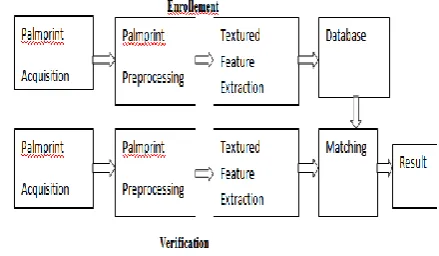
The method is done in two steps .They are 1.Enrollment step
2.Verification step
The block diagram of proposed methodology is as follows
Figure 1 : Block Diagram of Proposed Method Palm print acquisition
distinguishing proof. Diverse sorts of sensors like palm scanners, computerized cameras, high and low determination cameras are utilized for picture obtaining. Contingent upon the applications sensors are picked. For a non military personnel, business applications low determination pictures and for criminological, criminal location high determination pictures are utilized for handling.
Palm print pre-processing
Pre-handling Palm pictures gained are pre-prepared to separate its highlights. The foremost lines are critical and particulars and surfaces are utilized as remarkable data in criminological .The pre-preparing steps include changing over the picture to double, removing the district of intrigue and fragmenting, key point location and building up the organizing framework. The pre-preparing can be abridged as
Low pass Gaussian channel is connected to smoothen the palm picture.
Binarize the palm picture with an appropriate limit.
Apply morphological activities
Trace the limit of palm picture to recognize and settle the key focuses
Find the introduction of palm picture and locate the organize framework to trim the district of intrigue.
Extricating the district of intrigue is completed utilizing numerous techniques . Focus of palm is utilized as district of enthusiasm for some techniques as it covers a large portion of the palm includes and has novel surface for every individual. To extricate the focal point of palm picture first it must be adjusted and arranged to edit the inside part. Numerous techniques are utilized for introduction, as curved strategy where an oval that is fit the limit of palm is acquired and introduction of palm is gotten by real hub of oval. In key point extraction the valley focuses from center finger, ring finger, little finger and the
line joining these are taken as introduction and a middle bit of palm picture is found and a roundabout or a squared bit of characterized measure is trimmed. Filtering And Feature Extraction Using Gabor Filter By and large, foremost lines and wrinkles can be seen from our caught palm print pictures. A few calculations, for example, the stack channel can get the chief lines. Be that as it may, these lines don't contribute enough to high precision in light of their likeness among various palms. Six palm print pictures with comparable essential lines. Accordingly, wrinkles assume a vital part in palm print confirmation however precisely removing them is as yet a troublesome errand. This inspires us to apply surface investigation to palm print confirmation.
Textured and Feature Extraction
Matching and Decision Making
Coordinating and basic leadership Features removed are put away in the database as formats. Every format is one of a kind and has remarkable highlights of the picture under thought. At the point when the inquiry picture is prepared for check/confirmation, the highlights are contrasted and the put away format utilizing coordinating methods. Match scores are assessed utilizing a limit and ultimate conclusion is taken to acknowledge/dismiss the question picture. Classifiers are outlined in light of three diverse methodologies to be specific idea of closeness, probabilistic, or a geometric approach. Examples that are comparative are allocated with a class. In view of the comparability of highlight vector and the layout, each sub framework computes its own coordinating score esteem. These individual scores are at last consolidated to get an aggregate score which is then passed to the choice module.
IV.RESULTS
Figure 1 : Train Image
Figure 2 : Magnitude and Phase part of the Train Image
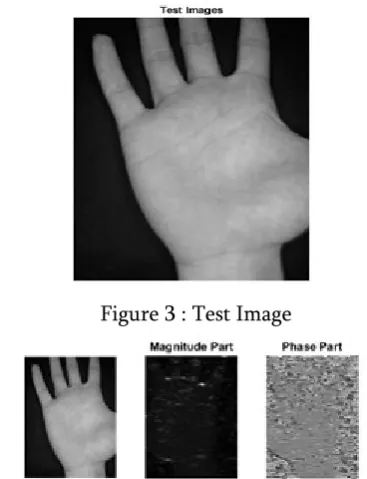
Figure 3 : Test Image
Figure 4 : Magnitude and Phase part of the test Image
Figure 5 : Train and Test Image
Figure 7 : Train Image
Figure 8 : Magnitude and Phase Part of the Train Image
Figure 9 : Test Image
Figure 10 : Magnitude and Phase Part of the palm
Figure 11 : Train and test Image
Figure 12 : Matched Dialog Box
V.CONCLUSION
II.
REFERENCES
[1]. Goldberg, D. E. and Deb K.A, Comparative
Analysis of Selection, Schemes Used in Genetic Algorithms, Foundations of Genetic Algorithms, Morgan Kaufmann, pp.69-93,1991.
[2]. Gupta, S., Chauhan, R.C., and Saxena, S.C, Locally
adaptive wavelet domain Bayesian Processor for denoising medical ultrasound imagesusing speckle
modeling based on Rayleigh distribution,
IEEEProceeding of Vision, Image and Signal Processing, 2005, 152(1): pp.129-135.
[3]. Gupta, S., Kaur, L., Chauhan, R.C, Saxena, S.C, A
wavelet based Statistical Approach for Speckle Reduction in Medical Ultrasound Images, IEEE Proceeding of Convergent Technologies for the Asia-Pacific Region, Tencon, 2003, 534-537.
[4]. Gupta, S., Kaur, L., Chauhan, R.C., Saxena, S.C, A
versatile techniquefor visual enhancement of
medical ultrasound images, Digital Signal
Processing, 2007, 17(3): pp.542-560.
[5]. Hashemi, S., Kiani, S., Noroozi, N., Moghaddam,
M.E, An Image Enhancement Method Based On Genetic Algorithm, IEEE Proceeding on Digital Image Processing, 2009, pp.167-171.
[6]. Kaur, P. and Kaur, R, A Novel Approach using
Image Enhancement based on Genetic Algorithm, in the proceeding of International Conference on Advances in Engineering and Technology, ICAET'14, IITRoorkee,2014, pp.584-589.
[7]. Kaur, K., Singh, G. and Singla, A. Research on
Spatial Filters andHomomorphic Filtering
Methods,Journal of Global Research inComputer Science.2012, 3(11):pp.1-4.
[8]. Kaur,L., Gupta, S. and Chauhan, R.C, Image
Denoising using WaveletThresholding, Indian Conference on Computer Vision, Graphics andImage Processing, Ahmedabad, 2002, pp 1-4.
[9]. Kaur, R. and Kaur, P, A Novel Approach For
Despeckling of Ultrasound Images, International Journal of Computer Science and Mobile Computing. 2014, 3(6): pp.618-622.
[10]. Kaur, R. and Kaur, P. Speckle Noise Reduction in
Ultrasound Images. International Journal of
Advanced Research in Computer Science and Software Engineering, 2014, 4(3):pp. 998-1001.
[11]. Kaur, S. and Kaur P, Review and Analysis of
Various Image Enhancement Techniques,
International Journal of Computer Applications Technology and Research, 2015, 4(5).
[12]. Krishna, K.S.R., Reddy, A.G., Prasad, M.N.G, Rao,
K.C., Madhavi, M.Genetic Algorithm Processor for Image Noise Filtering Using Evolvable Hardware, International Journal of Image Processing, 2010, 4(3):pp.240-250.
[13]. Liu Y, Image Denoising Method based on
Threshold, Wavelet Transform and Genetic
Algorithm., International Journal of
SignalProcessing, Image Processing and Pattern Recognition, 2015, 8(2): pp.29-40.
[14]. Ma, Q. M., Wang, X. Y., Du, S. P, Method and
application of wavelet shrinkage denoising based on genetic algorithm, Journal of Zhejiang University, 2006, 7(3):pp.361-367.
Authors :
S.Swarna Latha received B.Tech in Electronics and Communication Engineering from JNTU Ananthapur in the year 2000;M.Tech in Digital Electronics and Communication Systems from JNTU Ananthapur in the year 2004;and persuing Ph.D in Image Processing from Sri Venkateswara University,Tirupati. Currently,She is a Associate Professor in the Department of Electronics and Communication Engineering, SVUCE, Sri Venkateswara University, Tirupati, India.